


May 2026: Key Metallurgy Standards Released for Steel Testing and Quality
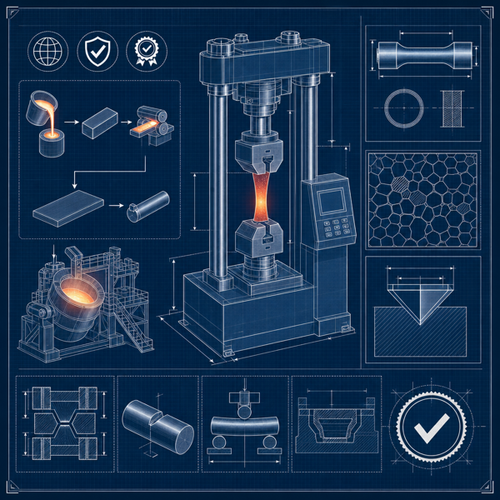
In May 2026, the metallurgy sector received a significant boost with the publication of five new international standards designed to address key challenges in steel testing, material integrity, and product specification. Developed by ISO and CEN, these standards cover non-metallic inclusion analysis, reference block calibration for hardness testing, brittle crack arrest temperature testing, and comprehensive requirements for hot-rolled steel bars. Industry professionals, including quality managers, production engineers, compliance officers, and researchers, need to be aware of these changes to maintain quality, ensure safety, and stay competitive.
Overview
The metallurgy industry underpins sectors such as construction, automotive, infrastructure, and manufacturing. Consistent, high-quality steel production relies on stringent standards to guide testing methods, product dimensions, and material properties. International standards ensure harmonization across global supply chains and offer clear guidelines for quality assurance, safety, and regulatory compliance.
This article provides a detailed breakdown of five new or revised standards published in May 2026. Readers will learn about the scope of each standard, their key requirements, and the real-world impact on steelmaking and downstream industries. Whether you are updating internal quality protocols, evaluating suppliers, or preparing for audits, understanding these updates is essential.
Detailed Standards Coverage
ISO 4967:2026 - Steel — Determination of Non-Metallic Inclusion Content — Micrographic Method
Steel — Determination of the non-metallic inclusion content — Micrographic method
ISO 4967:2026 provides a micrographic method to determine non-metallic inclusions in rolled or forged steel products with a reduction ratio of at least 3. The standard employs both traditional reference chart comparison and advanced image analysis to quantify inclusions—critical for assessing steel purity and predicting performance in demanding applications.
The document clarifies proximity conditions for stringers, redefines width measurements to reduce ambiguity, offers improved legacy rule accommodations, and addresses the rating and reporting of different inclusion types, especially oversized (DS) inclusions. It highlights the significance of precise image-based analysis, reducing reliance on subjective assessment, which enhances reproducibility.
Manufacturers and quality assurance labs producing or testing structural steels (excluding certain free cutting steels) must comply. The improved clarity benefits software developers integrating inclusion analysis algorithms into their systems.
Key highlights:
- Revised criteria for inclusion stringers and width definitions
- Mandatory averaging of cross sections in Method A
- Enhanced examples for computer-assisted rating and reporting
Access the full standard:View ISO 4967:2026 on iTeh Standards
EN ISO 14577-3:2026 - Metallic Materials - Instrumented Indentation Test for Hardness and Material Parameters - Part 3: Calibration of Reference Blocks (ISO 14577-3:2026)
Metallic materials - Instrumented indentation test for hardness and materials parameters - Part 3: Calibration of reference blocks (ISO 14577-3:2026)
This standard, published collaboratively by CEN and ISO, establishes the calibration methods for reference blocks used in indirect verification of instrumented indentation testing machines, in line with ISO 14577-2. It covers requirements for block manufacturing, thickness, surface finish, mounting, and resistance to magnetic forces. Calibration ensures testing equipment yields consistent and accurate hardness measurements, which are foundational to steel quality control.
Reference blocks serve as the benchmarks for indirect machine calibration in test labs and manufacturing QA settings. The standard details the minimum requirements on calibration force accuracy, indenter verification, surface roughness, and marking procedures to support international traceability and reproducibility.
Key highlights:
- Specifies strict thickness and surface roughness requirements for reference blocks
- Mandates regular verification/calibration cycles and robust marking
- Ensures uniformity and anti-magnetic properties in certified blocks
Access the full standard:View EN ISO 14577-3:2026 on iTeh Standards
ISO 14577-3:2026 - Metallic Materials — Instrumented Indentation Test for Hardness and Materials Parameters — Part 3: Calibration of Reference Blocks
Metallic materials — Instrumented indentation test for hardness and materials parameters — Part 3: Calibration of reference blocks
Closely aligned with its CEN equivalent, this ISO standard details the procedures for calibrating reference blocks used for indirect verification of instrumented indentation hardness testing machines. It defines production requirements to ensure block uniformity, mechanical stability, accurate hardness across a defined indentation size range, and precise dimensional tolerances. Guidelines for Vickers and Berkovich indenters, displacement measurement, and calibration cycles are clarified, along with new requirements for marking and traceability.
Materials and testing labs in metallurgy, mechanical testing, and R&D environments are the primary users. Accurate reference block calibration supports downstream certification and traceability for steel and metallic component testing.
Key highlights:
- Ensures uniform hardness and homogeneity in reference blocks
- Elaborates on indenter verification, including advanced microscopy methods
- Adds new requirements for block shape, traceability, and test cycle documentation
Access the full standard:View ISO 14577-3:2026 on iTeh Standards
ISO 20198:2026 - Metallic Materials — Steel — Method of Test for the Determination of Brittle Crack Arrest Temperature (CAT)
Metallic materials — Steel — Method of test for the determination of brittle crack arrest temperature (CAT)
ISO 20198:2026 specifies a method to determine the brittle crack arrest temperature (CAT) in rolled steel plates with a body-centred cubic (BCC) structure. CAT testing is essential for materials that undergo ductile-to-brittle transition, mainly used in heavy steel plate production for shipbuilding, bridges, and large structures where catastrophic fracture resistance is critical.
The standard outlines preparation of test specimens (typically 6–200 mm thick) and test equipment, specifies temperature controls (from −196 °C to +100 °C), crack initiation methods, and detailed procedures for measurement, fracture surface analysis, and CAT determination. This is crucial for manufacturers, designers, classification societies, and certifying bodies overseeing steel used in safety-critical structures.
Key highlights:
- Defines isothermal crack arrest method and validation procedures
- Covers a wide range of plate thickness and temperature conditions
- Provides standardized reporting and results validation steps
Access the full standard:View ISO 20198:2026 on iTeh Standards
ISO 1035:2026 - Hot-Rolled Steel Bars — Dimensions, Shape, Masses and Tolerances
Hot-rolled steel bars — Dimensions, shape, masses and tolerances
ISO 1035:2026 specifies the dimensional requirements, permissible tolerances, and mass per unit length for common bar shapes—round, square, flat, hexagonal, and octagonal—used across structural, machinery, and fabrication applications. The revised edition supersedes multiple previous documents, consolidating content and updating figures, permissible dimension ranges, and tolerance classes (normal, fine, superfine).
With this standard, steel producers, distributors, construction firms, and procurement specialists can confidently specify and verify the consistency and interchangeability of hot-rolled bars globally. The document covers special requirements for straightness, out-of-squareness, and custom dimension agreements between suppliers and buyers.
Key highlights:
- Provides preferred dimensions and tolerances for each bar type
- Consolidates and simplifies legacy requirements
- Adds figures and tables for practical reference during purchasing and inspection
Access the full standard:View ISO 1035:2026 on iTeh Standards
Industry Impact & Compliance
The adoption of these updated metallurgy standards directly impacts quality assurance, process control, and procurement in steel fabrication. Key compliance considerations include:
- Timelines: Organizations should review and incorporate these standards into internal specifications, supplier qualification, and contract documentation as soon as possible after publication.
- Benefits: Implementation supports consistent material quality, improved safety, audit readiness, and global supply chain optimization.
- Risks of Non-Compliance: Failure to adhere could result in increased rejects, claims, or even catastrophic failures—especially relevant for structural steels requiring high fracture resistance or strict inclusion parameters.
- Alignment with Market and Regulatory Expectations: Customers and regulatory bodies routinely require conformity to the latest standards for steel products and testing procedures.
Technical Insights
Several important technical advances run throughout these standards:
- Digital Analysis and Image Processing: ISO 4967:2026 emphasizes reproducible, objective methods for inclusion content via image analysis, minimizing subjective errors.
- Traceability and Calibration: Both EN ISO 14577-3:2026 and ISO 14577-3:2026 reinforce traceability by detailing rigorous calibration, marking, and verification cycles for reference blocks.
- Safety–Critical Testing: ISO 20198:2026 offers improved methods for brittle crack arrest, allowing for safer material selection and design.
- Dimensional Consistency: ISO 1035:2026 updates provide globally harmonized baseline tolerances, supporting interchangeability and modular construction practices.
Implementation Best Practices:
- Cross-train QA teams and lab staff on new requirements
- Update SOPs and control plans to align with revised methods
- Coordinate with software vendors to ensure updated algorithms where applicable (image analysis, data reporting)
- Conduct periodic internal or external audits for compliance with the new standards
- Incorporate updated standard references in procurement and contract documentation
Testing and Certification:
- Maintain up-to-date calibration cycles for all equipment involved in material testing (indentation testers, imaging systems)
- Use standardized reporting and validation steps for test results (e.g., CAT, inclusion ratings)
- Leverage third-party certified reference materials where feasible
Conclusion & Next Steps
With major updates to inclusion content analysis, hardness reference block calibration, brittle crack performance, and dimensional tolerancing, these May 2026 metallurgy standards position the industry for improved quality, reproducibility, and global interoperability. Organizations should review the new standards in detail, update their quality management systems, and engage with suppliers to ensure full compliance.
We recommend downloading the full standards directly via iTeh Standards, reviewing implementation guides, and integrating the latest specifications into your business processes. Stay ahead of the curve—monitor upcoming publications for Part 2 of this series for even more updates influencing the metallurgy sector.
Explore all newly released standards, actionable compliance tools, and expert guidance at iTeh Standards.
Categories
- Latest News
- New Arrivals
- Generalities
- Services and Management
- Natural Sciences
- Health Care
- Environment
- Metrology and Measurement
- Testing
- Mechanical Systems
- Fluid Systems
- Manufacturing
- Energy and Heat
- Electrical Engineering
- Electronics
- Telecommunications
- Information Technology
- Image Technology
- Precision Mechanics
- Road Vehicles
- Railway Engineering
- Shipbuilding
- Aircraft and Space
- Materials Handling
- Packaging
- Textile and Leather
- Clothing
- Agriculture
- Food technology
- Chemical Technology
- Mining and Minerals
- Petroleum
- Metallurgy
- Wood technology
- Glass and Ceramics
- Rubber and Plastics
- Paper Technology
- Paint Industries
- Construction
- Civil Engineering
- Military Engineering
- Entertainment