

ASTM A1124/A1124M-23
(Specification)Standard Specification for Textured Epoxy-Coated Steel Reinforcing Bars
General Information
- Abstract
SCOPE
1.1 This specification covers deformed steel reinforcing bars with protective epoxy coating applied by the electrostatic spray method followed by a texturing surface treatment material.
Note 1: The coating applicator is identified throughout this specification as the manufacturer.
1.2 Other organic coatings and texturing surface treatment materials may be used provided they meet the requirements of this specification.
1.3 Requirements for coatings are contained in Annex A1 of Specification A775/A775M.
1.4 Requirements for texturing surface treatment material are contained in Annex A1.
1.5 Requirements for patching material are contained in Annex A2 of Specification A775/A775M.
1.6 Guidelines for construction practices at the job-site are presented in Appendix X1.
1.7 This specification is applicable for orders in either inch-pound units (as Specification A1124) or SI units [as Specification A1124M].
1.8 The values stated in either inch-pound units or SI units are to be regarded separately as standard. The values stated in each system may not be exact equivalents; therefore, each system shall be used independently of the other. Combining values from the two systems may result in non-conformance with the standard.
1.9 This standard does not purport to address all of the safety concerns, if any, associated with its use. It is the responsibility of the user of this standard to establish appropriate safety, health, and environmental practices and determine the applicability of regulatory limitations prior to use.
1.10 This international standard was developed in accordance with internationally recognized principles on standardization established in the Decision on Principles for the Development of International Standards, Guides and Recommendations issued by the World Trade Organization Technical Barriers to Trade (TBT) Committee.
- Status
- Published
- Publication Date
- 31-Aug-2023
- Technical Committee
- A01 - Steel, Stainless Steel and Related Alloys
- Drafting Committee
- A01.05 - Steel Reinforcement
Overview
ASTM A1124/A1124M-23 is a standard specification developed by ASTM International for textured epoxy-coated steel reinforcing bars used in concrete construction. This standard specifies the requirements for deformed steel bars that receive a protective epoxy coating through an electrostatic spray method, followed by a texturing surface treatment. The intent is to enhance both the corrosion resistance and bond strength of steel reinforcement in concrete applications, supporting durability and structural integrity.
Key Topics
- Textured Epoxy Coating Process: The standard covers steel reinforcing bars treated with a fusion-bonded epoxy coating, followed by a surface texturing treatment. This process is designed to improve adhesion between the steel bar and concrete and provide long-term corrosion resistance.
- Material Requirements: Bars must meet quality standards for steel and be free of contaminants prior to coating. Both the epoxy and texturing materials must be certified, with batch traceability and written documentation required.
- Surface Preparation: Rigorous cleaning and surface profiling (to near-white metal) ensure maximum coating adhesion and performance. Use of abrasive blasting and air knives to remove contaminants is standard practice.
- Coating and Texturing Application: The coatings are applied under controlled conditions, with specific temperature and curing requirements to ensure consistent thickness and bonding.
- Inspection and Testing: Includes guidelines for coating thickness, texture measurement, flexibility, continuity (holiday detection), and the permissible amount of damaged coating. Detailed test methods and required documentation provide quality assurance.
- Ordering and Certification: Requirements for ordering, identification, and material traceability are included. Purchasers receive certification and test results for all delivered material.
Applications
- Concrete Reinforcement: Used widely in bridges, parking structures, highways, marine structures, and other concrete construction where enhanced durability is needed.
- Corrosion Resistance: The textured epoxy coating system significantly reduces the risk of corrosion, especially critical in environments exposed to chlorides, moisture, or deicing chemicals.
- Structural Longevity and Bond Strength: The textured surface treatment improves the mechanical bond between steel and concrete, reducing slippage and enhancing structural performance in reinforced concrete elements.
- Repair Applications: Where reinforcing bars are exposed during restoration work, textured epoxy-coated bars provide additional protection and performance compared to uncoated or conventionally coated alternatives.
- Compliance: Meeting ASTM A1124/A1124M-23 ensures that reinforcing bars comply with international quality and safety standards, supporting both project performance and regulatory acceptance.
Related Standards
- ASTM A775/A775M: Specification for Epoxy-Coated Steel Reinforcing Bars, referenced for coating material requirements.
- ASTM A615/A615M, A706/A706M, A996/A996M, A1035/A1035M: Standards for steel bars used as substrate materials suitable for coating.
- ASTM D4060, D7127: Methods for evaluating abrasion resistance and surface roughness.
- ACI 301: Specifications for Structural Concrete, providing additional guidance for construction practices.
- AMPP, SSPC Standards: Surface preparation, coating thickness, and inspection best practices.
Practical Value
Adhering to ASTM A1124/A1124M-23 in specifying and using textured epoxy-coated steel reinforcing bars ensures enhanced performance, regulatory compliance, and long-term durability for concrete structures. The clear and measurable testing, documentation, and inspection protocols provide confidence to designers, contractors, and owners that reinforcing steel will maintain strength, resist corrosion, and bond effectively with concrete for the lifespan of the structure.
Keywords: ASTM A1124/A1124M, textured epoxy-coated steel bars, concrete reinforcement, corrosion resistance, coating specification, surface treatment, structural durability.
Relations
- Effective Date
- 01-Feb-2024
- Effective Date
- 01-Nov-2023
- Effective Date
- 01-Oct-2023
- Refers
ASTM G62-23 - Standard Test Methods for Holiday Detection of Coatings used to Protect Pipelines - Effective Date
- 01-Oct-2023
- Effective Date
- 01-Oct-2019
- Effective Date
- 01-Sep-2019
- Effective Date
- 01-Jun-2017
- Effective Date
- 15-Oct-2016
- Effective Date
- 01-Mar-2016
- Effective Date
- 15-Jan-2016
- Effective Date
- 01-Jul-2015
- Effective Date
- 01-Jul-2015
- Effective Date
- 01-Apr-2015
- Effective Date
- 01-Oct-2014
- Effective Date
- 01-Apr-2014
Frequently Asked Questions
ASTM A1124/A1124M-23 is a technical specification published by ASTM International. Its full title is "Standard Specification for Textured Epoxy-Coated Steel Reinforcing Bars". This standard covers: SCOPE 1.1 This specification covers deformed steel reinforcing bars with protective epoxy coating applied by the electrostatic spray method followed by a texturing surface treatment material. Note 1: The coating applicator is identified throughout this specification as the manufacturer. 1.2 Other organic coatings and texturing surface treatment materials may be used provided they meet the requirements of this specification. 1.3 Requirements for coatings are contained in Annex A1 of Specification A775/A775M. 1.4 Requirements for texturing surface treatment material are contained in Annex A1. 1.5 Requirements for patching material are contained in Annex A2 of Specification A775/A775M. 1.6 Guidelines for construction practices at the job-site are presented in Appendix X1. 1.7 This specification is applicable for orders in either inch-pound units (as Specification A1124) or SI units [as Specification A1124M]. 1.8 The values stated in either inch-pound units or SI units are to be regarded separately as standard. The values stated in each system may not be exact equivalents; therefore, each system shall be used independently of the other. Combining values from the two systems may result in non-conformance with the standard. 1.9 This standard does not purport to address all of the safety concerns, if any, associated with its use. It is the responsibility of the user of this standard to establish appropriate safety, health, and environmental practices and determine the applicability of regulatory limitations prior to use. 1.10 This international standard was developed in accordance with internationally recognized principles on standardization established in the Decision on Principles for the Development of International Standards, Guides and Recommendations issued by the World Trade Organization Technical Barriers to Trade (TBT) Committee.
SCOPE 1.1 This specification covers deformed steel reinforcing bars with protective epoxy coating applied by the electrostatic spray method followed by a texturing surface treatment material. Note 1: The coating applicator is identified throughout this specification as the manufacturer. 1.2 Other organic coatings and texturing surface treatment materials may be used provided they meet the requirements of this specification. 1.3 Requirements for coatings are contained in Annex A1 of Specification A775/A775M. 1.4 Requirements for texturing surface treatment material are contained in Annex A1. 1.5 Requirements for patching material are contained in Annex A2 of Specification A775/A775M. 1.6 Guidelines for construction practices at the job-site are presented in Appendix X1. 1.7 This specification is applicable for orders in either inch-pound units (as Specification A1124) or SI units [as Specification A1124M]. 1.8 The values stated in either inch-pound units or SI units are to be regarded separately as standard. The values stated in each system may not be exact equivalents; therefore, each system shall be used independently of the other. Combining values from the two systems may result in non-conformance with the standard. 1.9 This standard does not purport to address all of the safety concerns, if any, associated with its use. It is the responsibility of the user of this standard to establish appropriate safety, health, and environmental practices and determine the applicability of regulatory limitations prior to use. 1.10 This international standard was developed in accordance with internationally recognized principles on standardization established in the Decision on Principles for the Development of International Standards, Guides and Recommendations issued by the World Trade Organization Technical Barriers to Trade (TBT) Committee.
ASTM A1124/A1124M-23 has the following relationships with other standards: It is inter standard links to ASTM G8-24, ASTM A1035/A1035M-23a, ASTM D374/D374M-23, ASTM G62-23, ASTM G20-10(2019), ASTM A1035/A1035M-19, ASTM D2967-07(2017), ASTM A1035/A1035M-16b, ASTM A1035/A1035M-16a, ASTM A1035/A1035M-16, ASTM A1035/A1035M-15, ASTM A996/A996M-15, ASTM A615/A615M-15, ASTM A996/A996M-14a, ASTM A615/A615M-14. Understanding these relationships helps ensure you are using the most current and applicable version of the standard.
ASTM A1124/A1124M-23 is available in PDF format for immediate download after purchase. The document can be added to your cart and obtained through the secure checkout process. Digital delivery ensures instant access to the complete standard document.
Standards Content (Sample)
This international standard was developed in accordance with internationally recognized principles on standardization established in the Decision on Principles for the
Development of International Standards, Guides and Recommendations issued by the World Trade Organization Technical Barriers to Trade (TBT) Committee.
Designation: A1124/A1124M − 23
Standard Specification for
Textured Epoxy-Coated Steel Reinforcing Bars
This standard is issued under the fixed designation A1124/A1124M; the number immediately following the designation indicates the
year of original adoption or, in the case of revision, the year of last revision. A number in parentheses indicates the year of last
reapproval. A superscript epsilon (´) indicates an editorial change since the last revision or reapproval.
1. Scope Development of International Standards, Guides and Recom-
mendations issued by the World Trade Organization Technical
1.1 This specification covers deformed steel reinforcing
Barriers to Trade (TBT) Committee.
bars with protective epoxy coating applied by the electrostatic
spray method followed by a texturing surface treatment mate-
2. Referenced Documents
rial.
2.1 ASTM Standards:
NOTE 1—The coating applicator is identified throughout this specifica-
A615/A615M Specification for Deformed and Plain Carbon-
tion as the manufacturer.
Steel Bars for Concrete Reinforcement
1.2 Other organic coatings and texturing surface treatment
A706/A706M Specification for Deformed and Plain Low-
materials may be used provided they meet the requirements of
Alloy Steel Bars for Concrete Reinforcement
this specification.
A775/A775M Specification for Epoxy-Coated Steel Rein-
1.3 Requirements for coatings are contained in Annex A1 of
forcing Bars
Specification A775/A775M.
A944 Test Method for Comparing Bond Strength of Steel
Reinforcing Bars to Concrete Using Beam-End Speci-
1.4 Requirements for texturing surface treatment material
mens
are contained in Annex A1.
A996/A996M Specification for Rail-Steel and Axle-Steel
1.5 Requirements for patching material are contained in
Deformed Bars for Concrete Reinforcement
Annex A2 of Specification A775/A775M.
A1035/A1035M Specification for Deformed and Plain,
1.6 Guidelines for construction practices at the job-site are Low-Carbon, Chromium, Steel Bars for Concrete Rein-
presented in Appendix X1. forcement
B117 Practice for Operating Salt Spray (Fog) Apparatus
1.7 This specification is applicable for orders in either
D374/D374M Test Methods for Thickness of Solid Electri-
inch-pound units (as Specification A1124) or SI units [as
cal Insulation
Specification A1124M].
D2967 Test Method for Corner Coverage of Powder Coat-
1.8 The values stated in either inch-pound units or SI units
ings
are to be regarded separately as standard. The values stated in
D3170 Test Method for Chipping Resistance of Coatings
each system may not be exact equivalents; therefore, each
D4060 Test Method for Abrasion Resistance of Organic
system shall be used independently of the other. Combining
Coatings by the Taber Abraser
values from the two systems may result in non-conformance
D7127 Test Method for Measurement of Surface Roughness
with the standard.
of Abrasive Blast Cleaned Metal Surfaces Using a Por-
1.9 This standard does not purport to address all of the
table Stylus Instrument (Withdrawn 2021)
safety concerns, if any, associated with its use. It is the
E2937 Guide for Using Infrared Spectroscopy in Forensic
responsibility of the user of this standard to establish appro-
Paint Examinations
priate safety, health, and environmental practices and deter-
G8 Test Methods for Cathodic Disbonding of Pipeline Coat-
mine the applicability of regulatory limitations prior to use.
ings
1.10 This international standard was developed in accor-
G14 Test Method for Impact Resistance of Pipeline Coatings
dance with internationally recognized principles on standard-
(Falling Weight Test)
ization established in the Decision on Principles for the
For referenced ASTM standards, visit the ASTM website, www.astm.org, or
This specification is under the jurisdiction of ASTM Committee A01 on Steel, contact ASTM Customer Service at service@astm.org. For Annual Book of ASTM
Stainless Steel and Related Alloys and is the direct responsibility of Subcommittee Standards volume information, refer to the standard’s Document Summary page on
A01.05 on Steel Reinforcement. the ASTM website.
Current edition approved Sept. 1, 2023. Published September 2023. DOI: The last approved version of this historical standard is referenced on
10.1520/A1124_A1124M-23. www.astm.org.
Copyright © ASTM International, 100 Barr Harbor Drive, PO Box C700, West Conshohocken, PA 19428-2959. United States
A1124/A1124M − 23
G20 Test Method for Chemical Resistance of Pipeline Coat- 4.1.3 Size and grade of bars, and
ings 4.1.4 ASTM designation A1124/A1124M and year of issue.
G62 Test Methods for Holiday Detection in Pipeline Coat-
4.2 The purchaser shall have the option to specify additional
ings
requirements, including but not limited to the following:
2.2 ACI Standards:
4.2.1 Requirements for review of test data to demonstrate
ACI 301 Specifications for Structural Concrete
that the powder coating meets Annex A1 (5.2),
2.3 AMPP Standards:
4.2.2 Representative sample of epoxy powder coating (5.3),
RP-287-87 Field Measurement of Surface Profile of Abra-
4.2.3 Requirements for review of test data to demonstrate
sive Blast-Cleaned Steel Surface Using a Replica Tape
that the textured coating meets Annex A1 (5.4),
SSPC-PA 2 Measurement of Dry Coating Thickness with
4.2.4 Representative sample of texturing surface treatment
Magnetic Gages
material (5.5),
SSPC-SP 10 Near-White Blast Cleaning
4.2.5 Quantity of patching material (5.6.2),
SSPC-VIS 1 Pictorial Surface Preparation Standards for
4.2.6 Specific requirements for test frequency (9.1),
Painting Steel Surfaces
4.2.7 A report of the results of the tests performed on the
coated steel reinforcing bars (14.1),
3. Terminology
4.2.8 Requirements for inspection (12.1),
3.1 Definitions of Terms Specific to This Standard:
4.2.9 Manufacturer qualification and certification require-
3.1.1 conversion coating, n—preparation of the blast-
ments (if any), and
cleaned steel surface prior to coating application that is
4.2.10 Other special requirements, if any.
designed to pretreat the metal to promote coating adhesion,
NOTE 2—It is recommended that the coating application procedures and
reduce metal-coating reactions, improve corrosion resistance,
processes be audited by an independent certification program for epoxy
and increase blister resistance.
coating applicator plants such as that provided by the Concrete Reinforc-
ing Steel Institute, or equivalent.
3.1.2 disbonding, n—loss of adhesion between the fusion-
NOTE 3—A typical ordering description is as follows: Deformed Grade
bonded epoxy coating and the steel reinforcing bar.
60 bars to ASTM A615 – _____; 20 000 ft, No. 6, 40 ft 0 in. long in
3.1.3 fusion-bonded epoxy coating, n—product containing
secured lifts with sufficient spacers or padding, or both; textured epoxy-
coated to ASTM A1124 – _____; including written certifications for the
pigments, thermosetting epoxy resins, crosslinking agents, and
powder coating and coated bars, and 1 qt of patching material.
other additives, which is applied in the form of a powder onto
Deformed Grade 420 bars to ASTM A615M – _____; 6000 m, No. 19, 12
a clean, heated metallic substrate and fuses to form a continu-
m long in secured lifts with sufficient spacers or padding, or both; textured
ous barrier coating.
epoxy-coated to ASTM A1124M – _____; including written certifications
for the powder coating and coated bars, and 1 L of patching material.
3.1.4 holiday, n—discontinuity in a coating that is not
discernible to a person with normal or corrected vision.
5. Materials
3.1.5 patching material, n—liquid two-part epoxy coating
5.1 Steel reinforcing bars to be coated shall meet the
used to repair damaged or uncoated areas.
requirements of one of the following specifications: A615/
3.1.6 R , n—the vertical distance between the highest peak
z A615M, A706/A706M, A996/A996M, or A1035/A1035M, as
and lowest valley in a sampling length averaged over the five
specified by the purchaser and shall be free of contaminants
sampling lengths comprising the evaluation length measured in
such as oil, grease, or paint.
accordance with Test Method D7127.
NOTE 4—Prior to coating, the steel reinforcing bars should be inspected
3.1.7 texturing surface treatment material, n—a product
for their suitability for coating. Bars with sharp edges on the deformations,
applied immediately following the application of a fusion- rolled-in slivers, or other surface imperfections are difficult to coat
properly and should not be coated. The coating will flow away from the
bonded epoxy coating to improve bond strength to concrete.
sharp edges and may result in inadequate coating thickness at these points.
3.1.8 wetting agent, n—material that lowers the surface
5.2 The powder coating shall meet the requirements of
tension of water allowing it to penetrate more effectively into
Annex A1 of Specification A775/A775M. Upon request, the
small discontinuities in the coating, giving a more accurate
purchaser shall be provided with the test report for review.
indication of the holiday count.
5.2.1 A written certification shall be furnished to the pur-
4. Ordering Information chaser that properly identifies the number of each lot of powder
coating used in the order, material quantity represented, date of
4.1 Orders for textured epoxy-coated steel reinforcing bars
manufacture, name and address of the powder coating
under this specification shall contain the following informa-
manufacturer, and a statement that the supplied powder coating
tion:
is the same composition as that qualified according to Annex
4.1.1 Specification and year of issue for the reinforcing bars
A1 of Specification A775/A775M.
to be coated (5.1),
5.2.2 The powder coating shall be stored in a temperature-
4.1.2 Quantity of bars,
controlled environment following the written recommenda-
tions of the powder coating manufacturer until ready for use.
Available from American Concrete Institute (ACI), 38800 Country Club Dr.,
Farmington Hills, MI 48331-3439, http://www.concrete.org.
5 6
Available from Association for Materials Protection and Performance (AMPP), CRSI Voluntary Certification Program for Fusion Bonded Epoxy Coating
15835 Park Ten Place, Houston, TX 77084, https://www.ampp.org. Applicator Plants.
A1124/A1124M − 23
At that point, if the storage temperature is below the plant 6.2 Multidirectional, high-pressure dry air knives shall be
ambient temperature, the powder coating shall be given suffi- used after blasting to remove dust, grit, and other foreign
cient time to reach approximate plant ambient temperature. matter from the blast-cleaned steel surface. The air knives shall
The powder coating shall be used within the powder coating not deposit oil on the steel reinforcing bars.
manufacturer’s written recommended shelf life.
NOTE 7—It is recommended that incoming steel reinforcing bars and
blast media be checked for salt contamination prior to use. Blast media
5.3 If specified in the order, a representative 8 oz [0.2 kg]
found to be salt-contaminated should be rejected. Steel reinforcing bars
sample of the powder coating shall be supplied to the purchaser
found to be salt-contaminated from exposure to deicing salts or salt spray
from each batch. The sample shall be packaged in an airtight
should be cleaned, by acid washing or other suitable methods, to remove
container and identified by batch number.
salt contaminants from the surface prior to blast cleaning.
6.3 It shall be permissible for the manufacturer to use a
5.4 The texturing surface treatment material shall meet the
requirements of Annex A1. Upon request, the purchaser shall chemical wash or conversion of the blast-cleaned steel rein-
forcing bar surface, or both, to enhance coating adhesion. This
be provided with the test report for review.
pretreatment shall be applied after abrasive cleaning and before
5.4.1 A written certification shall be furnished to the pur-
coating, in accordance with the written application instructions
chaser that properly identifies the number of each lot of
specified by the pretreatment manufacturer.
texturing surface treatment material used in the order, material
quantity represented, date of manufacture, name and address of
7. Coating and Texturing Surface Treatment Material
the powder coating manufacturer, and a statement that the
Application
supplied texturing surface treatment material is the same
composition as that qualified according to Annex A1 of this
7.1 If pretreatment is used in the preparation of the surface,
specification.
the powder coating shall be applied to the cleaned and
pretreated steel reinforcing bar surface as soon as possible after
5.5 If specified in the order, a representative 8 oz [0.2 kg]
surface treatments have been completed, and before visible
sample of the texturing surface treatment material shall be
oxidation of the surface occurs as discernible to a person with
supplied to the purchaser from each batch. The sample shall be
normal or corrected vision. In no case shall application of the
packaged in an airtight container and identified by batch
coating be delayed more than 3 h after cleaning.
number.
7.2 The fusion-bonded epoxy powder coating shall be
5.6 Patching material for repairing damaged coating shall be
applied in accordance with the written recommendations of the
compatible with the coating, inert in concrete, and feasible for
manufacturer of the powder coating for initial steel surface
repairs at the applicator plant or at the fabricating shop.
temperature range and post application curing requirements.
Patching material shall be approved in accordance with Annex
During continuous operations, the temperature of the surface
A2 of Specification A775/A775M prior to use.
immediately prior to coating shall be measured using infrared
5.6.1 The patching material manufacturer shall specify the
guns or temperature indicating crayons, or both, at least once
metal’s surface preparation, and the procedures for application
every 30 min.
of the patching material.
NOTE 8—The use of infrared and temperature-indicating crayon mea-
5.6.2 If specified in the order, patching material conforming
surement of the steel reinforcing bars is recommended.
to Annex A2 of Specification A775/A775M and recommended
by the powder coating manufacturer shall be supplied to the 7.3 The powder coating shall be applied by electrostatic
purchaser.
spray or other suitable method.
7.4 The texturing material shall be applied in accordance
6. Surface Preparation
with the written recommendations of the manufacturer of the
powder coating for initial steel surface temperature range and
6.1 The surface of the steel reinforcing bars to be coated
post application curing requirements. During continuous
shall be cleaned by abrasive blast cleaning to near-white metal
operations, the temperature of the surface immediately prior to
in accordance with SSPC-SP 10. Additional surface treatment,
as indicated in 6.3, shall be permitted. coating shall be measured using infrared guns or temperature
indicating crayons, or both, at least once every 30 min.
6.1.1 Use of SSPC-VIS 1 as a visual standard of comparison
to define the final surface condition shall be permitted.
7.5 The texturing material shall be applied by electrostatic
6.1.2 Average blast profile maximum roughness depth read-
spray or other suitable method.
ings of 1.5 mils to 4.0 mils [0.04 mm to 0.10 mm], as
determined by replica tape measurements using NACE RP-
8. Requirements for Textured Coated Steel Reinforcing
287-87, shall be considered suitable as an anchor pattern.
Bars
NOTE 5—The use of a “profilometer” type surface measurement
8.1 Coating Thickness:
instrument that measures the peak count as well as the maximum profile
8.1.1 Once per batch for each bar size and not less than once
depth is recommended.
per day, coating thickness after curing shall be measured on
NOTE 6—Abrasive blast cleaning of steel reinforcing bars with a high
production bars without the texturing surface treatment mate-
degree (>90 %) of grit in the cleaning media provides the most suitable
rial. To do so, the texturing surface treatment material shall be
anchor profile for coating adhesion. After grit has been recycled, a small
portion will take on the appearance of shot. omitted from a length of bar not less than 20 ft. The coating
A1124/A1124M − 23
thickness on the bar without the texturing surface treatment holiday detector or equivalent method with an automated
material shall be between 7 mils and 12 mils [175 μm and holiday counting system to determine the acceptability of the
300 μm]. epoxy-coated steel reinforcing bars prior to shipment.
8.1.2 Total coating and texturing material thickness mea-
8.3.2 If in-line detector or equivalent method is inoperable
surements after curing shall be 10 mils to 20 mils [250 μm to
or unavailable, an off-line holiday detector or handheld detec-
500 μm]. The upper thickness limit shall not apply to repaired
tor shall be permitted, provided that 100 % of the epoxy-coated
areas of damaged coating.
steel reinforcing bars are tested and all holiday counts are
8.1.3 A single recorded steel reinforcing bar coating thick-
recorded.
ness measurement is the average of three individual gauge
NOTE 9—Handheld holiday detector checks should be performed each
readings obtained between four consecutive deformations. A
production day to verify the accuracy of the in-line system. Handheld
minimum of five recorded measurements shall be taken ap-
holiday detectors offer a reliable way to correlate data obtained from the
proximately evenly spaced along each side of the test speci- in-line holiday detector and automated counting system.
mens (a minimum of ten recorded measurements per bar).
8.3.3 On average, there shall not be more than one holiday
8.1.4 For acceptance purposes, the average of all recorded
per foot [3 holidays per meter] on a coated steel reinforcing
coating thickness measurements shall not be less than the
bar. The average applies to the full production length of a bar.
specified minimum thickness or more than the specified
8.3.4 A wetting agent shall be used in accordance with Test
maximum thickness. No single recorded coating thickness
Methods G62 in the inspection for holidays on the coated steel
measurement shall be less than 80 % of the specified minimum
reinforcing bars.
thickness or more than 120 % of the specified maximum
8.4 Coating Flexibility:
thickness.
8.1.5 Measurements shall be made in accordance with 8.4.1 The coating flexibility shall be evaluated by bending
SSPC-PA 2, following the instructions for calibration and use production coated steel reinforcing bars at a uniform rate
recommended by the thickness gauge manufacturer. Pull-off or around a mandrel of specified size within a maximum specified
fixed probe gauges shall be used. “Pencil-type” pull-off gauges time period as prescribed in Table 1. The two longitudinal ribs
that require the operator to observe the reading at the instant shall be placed in a plane perpendicular to the mandrel radius.
the magnet is pulled from the surface shall not be used. The test specimens shall be between 68 °F and 86 °F [20 °C
8.1.6 The coating thickness shall be measured on the body and 30 °C].
of a straight length of steel reinforcing bar between the
8.4.2 Cracking or disbonding of the coating on the outside
deformations.
radius of the bent bar visible to a person with normal or
corrected vision shall be considered cause for rejection of the
8.2 Coating Texture:
coated steel reinforcing bars represented by the bend test
8.2.1 Texture measurements shall be made in accordance
sample.
with Test Method D7127 by using a portable stylus type
profilometer.
NOTE 10—The qualification requirements for coating flexibility (see
8.2.2 For each lot, a minimum of five texture measurements
A1.4.2.1) prescribe bending a No. 6 [No. 19] deformed bar around a 6 in.
shall be taken along the longitudinal deformation of the [150 mm] diameter mandrel. The bend test requirements in Table 1 for
evaluating the coating flexibility of production-coated steel reinforcing
reinforcement, each over a minimum length of 0.75 in.
bars, for bar sizes Nos. 3 to 8 [Nos. 10 to 25], are not compatible with
[19 mm].
fabrication bending practices. Finished bend diameters for bar sizes Nos.
8.2.3 The average of five measurements shall have an R
z 3 to 8 [Nos. 10 to 25] used in actual construction are smaller than the
value between 8 mils and 18 mils [200 μm and 460 μm].
mandrel diameters in Table 1. Thus, the finished bends of production-
coated bars, particularly the smaller bar sizes used for stirrups and ties,
8.3 Coating Continuity:
should be examined closely for hairline cracking on the outside radius of
8.3.1 The manufacturer’s plant shall have an operational
the bent bar. If hairline cracking is present, it should be repaired with
in-line 67.5 V, 80 000 Ω, wet-sponge type direct-current patching material.
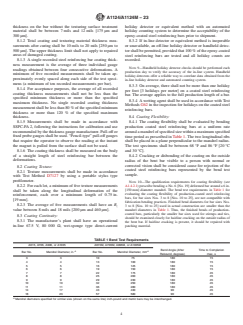
TABLE 1 Bend Test Requirements
A615, A706, A996, or A1035 A615M, A706M, A996M, or A1035M
Bend Angle (After Time to Completion
A A
Bar No. Mandrel Diameter, in. Bar No. Mandrel Diameter, mm
Rebound, degrees) max, s
3 3 10 75 180 15
4 4 13 100 180 15
5 5 16 125 180 15
6 6 19 150 180 15
7 7 22 175 180 45
8 8 25 200 180 45
9 9 29 230 180 45
10 10 32 250 180 45
11 11 36 280 180 45
14 17 43 430 90 45
18 23 57 580 90 45
A
Mandrel diameters specified for similar size (shown on the same line) inch-pound and metric bars may be interchanged.
A1124/A1124M − 23
8.4.3 A test in which fracture or partial failure of the steel 12. Inspection
reinforcing bar, or cracking or disbonding caused by imperfec-
12.1 Inspection of the textured epoxy-coated steel reinforc-
tions in th
...