

ASTM D4843-88(2016)
(Test Method)Standard Test Method for Wetting and Drying Test of Solid Wastes
General Information
- Abstract
SIGNIFICANCE AND USE
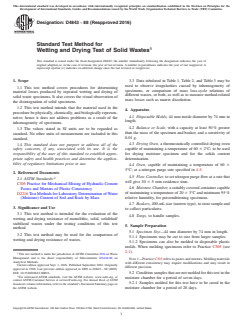
3.1 This test method is intended for the evaluation of the wetting and drying resistance of monolithic, solid, solidified/stabilized wastes under the testing conditions of this test method.
3.2 This test method may be used for the comparison of wetting and drying resistance of wastes.
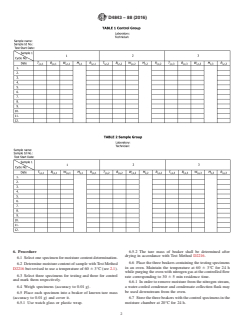
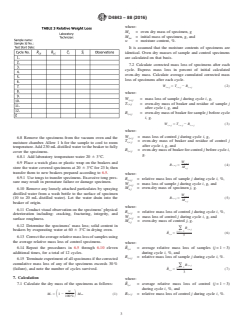
3.3 Data tabulated in Table 1, Table 2, and Table 3 may be used to observe irregularities caused by inhomogeneity of specimens, or comparison of mass loss-cycle relations of different wastes, or both, as well as to measure method-related mass losses such as matrix dissolution.
SCOPE
1.1 This test method covers procedures for determining material losses produced by repeated wetting and drying of solid waste specimens. It also covers the visual observation of the disintegration of solid specimens.
1.2 This test method intends that the material used in the procedure be physically, chemically, and biologically representative; hence it does not address problems as a result of the inhomogeneity of specimens.
1.3 The values stated in SI units are to be regarded as standard. No other units of measurement are included in this standard.
1.4 This standard does not purport to address all of the safety concerns, if any, associated with its use. It is the responsibility of the user of this standard to establish appropriate safety and health practices and determine the applicability of regulatory limitations prior to use.
- Status
- Published
- Publication Date
- 31-Aug-2016
- Technical Committee
- D34 - Waste Management
- Drafting Committee
- D34.01.06 - Analytical Methods

Overview
ASTM D4843-88(2016), "Standard Test Method for Wetting and Drying Test of Solid Wastes," establishes procedures to evaluate the wetting and drying resistance of monolithic, solid, and solidified/stabilized waste materials. Developed by ASTM International, this standard specifically addresses the evaluation of solid waste durability under cyclical wetting and drying, emphasizing both mass loss measurements and visual assessments of physical disintegration.
This test method is used to determine the susceptibility of solid wastes to decomposition or deterioration when repeatedly exposed to wetting and drying environments. It is an essential tool for waste management professionals, environmental engineers, and regulatory agencies to ensure the long-term stability and safety of solid waste disposal and containment strategies.
Key Topics
- Purpose: Assesses resistance to physical and chemical breakdown of solid waste specimens under repeated wetting and drying cycles.
- Scope: Applies to monolithic, solid, or stabilized solid wastes that are physically, chemically, and biologically representative (not addressing specimen inhomogeneity).
- Measurement: Involves quantitative determination of mass losses and qualitative visual observations (cracking, fracturing, integrity, and surface roughness).
- Test Conditions: Uses controlled moisture chambers, ovens, and specific temperature and humidity settings to simulate real-world exposure.
- Data Analysis: Facilitates comparison of waste materials and detection of inhomogeneity by documenting mass loss-cycle relations.
Applications
ASTM D4843-88(2016) is vital for:
- Waste Formulation and Stability Assessment
- Evaluation of new or improved waste forms intended for landfills or containment.
- Comparison of stabilization or solidification methods for hazardous or non-hazardous wastes.
- Regulatory Compliance
- Fulfilling regulatory requirements for landfill disposal and storage of solid wastes.
- Assisting in the approval process for new waste treatment or waste form technologies.
- Environmental Risk Mitigation
- Predicting potential for mass loss or structural breakdown in waste repositories due to environmental conditions.
- Supporting long-term monitoring and maintenance strategies for waste containment systems.
- Research and Development
- Benchmarking performance of different waste matrices and binding agents for durability.
- Providing data to refine waste treatment processes and materials.
Related Standards
Professionals employing ASTM D4843-88(2016) often refer to accompanying standards, which help ensure reliability and comparability:
- ASTM C305: Practice for Mechanical Mixing of Hydraulic Cement Pastes and Mortars - referenced for molding procedures.
- ASTM D2216: Test Methods for Laboratory Determination of Water (Moisture) Content of Soil and Rock by Mass - used for sample moisture content determination.
- Other ASTM waste management standards under Committee D34 on Waste Management.
Practical Value
By delivering a consistent, repeatable approach for the wetting and drying test of solid wastes, this ASTM standard:
- Supports decision-making in selecting waste forms with enhanced resistance to weathering and leaching.
- Enables material comparison by providing quantitative and qualitative data on waste durability.
- Improves environmental safety by reducing the risk of unexpected landfill or containment failures due to material breakdown.
- Facilitates regulatory approval of innovative waste management technologies.
Adherence to ASTM D4843-88(2016) ensures credible evaluation of solid waste materials, contributing to safer, more sustainable waste management practices globally.
For further details and the official document text, visit the ASTM International website.
Relations
- Effective Date
- 01-Sep-2016
- Effective Date
- 15-Jul-2020
- Effective Date
- 01-Mar-2019
- Effective Date
- 01-Jun-2013
- Effective Date
- 01-Jul-2012
- Effective Date
- 01-Apr-2011
- Effective Date
- 01-Jul-2010
- Effective Date
- 01-Aug-2006
- Effective Date
- 01-Mar-2005
- Effective Date
- 10-Jun-1999
- Effective Date
- 10-Jun-1999
- Effective Date
- 10-Feb-1998
- Effective Date
- 01-Sep-2016
Get Certified
Connect with accredited certification bodies for this standard

CIS Institut d.o.o.
Personal Protective Equipment (PPE) certification body. Notified Body NB-2890 for EU Regulation 2016/425 PPE.

Kiwa BDA Testing
Building and construction product certification.
Kmetijski inštitut Slovenije
Agricultural Institute of Slovenia. Soil testing, plant health, agricultural product analysis.
Sponsored listings
Frequently Asked Questions
ASTM D4843-88(2016) is a standard published by ASTM International. Its full title is "Standard Test Method for Wetting and Drying Test of Solid Wastes". This standard covers: SIGNIFICANCE AND USE 3.1 This test method is intended for the evaluation of the wetting and drying resistance of monolithic, solid, solidified/stabilized wastes under the testing conditions of this test method. 3.2 This test method may be used for the comparison of wetting and drying resistance of wastes. 3.3 Data tabulated in Table 1, Table 2, and Table 3 may be used to observe irregularities caused by inhomogeneity of specimens, or comparison of mass loss-cycle relations of different wastes, or both, as well as to measure method-related mass losses such as matrix dissolution. SCOPE 1.1 This test method covers procedures for determining material losses produced by repeated wetting and drying of solid waste specimens. It also covers the visual observation of the disintegration of solid specimens. 1.2 This test method intends that the material used in the procedure be physically, chemically, and biologically representative; hence it does not address problems as a result of the inhomogeneity of specimens. 1.3 The values stated in SI units are to be regarded as standard. No other units of measurement are included in this standard. 1.4 This standard does not purport to address all of the safety concerns, if any, associated with its use. It is the responsibility of the user of this standard to establish appropriate safety and health practices and determine the applicability of regulatory limitations prior to use.
SIGNIFICANCE AND USE 3.1 This test method is intended for the evaluation of the wetting and drying resistance of monolithic, solid, solidified/stabilized wastes under the testing conditions of this test method. 3.2 This test method may be used for the comparison of wetting and drying resistance of wastes. 3.3 Data tabulated in Table 1, Table 2, and Table 3 may be used to observe irregularities caused by inhomogeneity of specimens, or comparison of mass loss-cycle relations of different wastes, or both, as well as to measure method-related mass losses such as matrix dissolution. SCOPE 1.1 This test method covers procedures for determining material losses produced by repeated wetting and drying of solid waste specimens. It also covers the visual observation of the disintegration of solid specimens. 1.2 This test method intends that the material used in the procedure be physically, chemically, and biologically representative; hence it does not address problems as a result of the inhomogeneity of specimens. 1.3 The values stated in SI units are to be regarded as standard. No other units of measurement are included in this standard. 1.4 This standard does not purport to address all of the safety concerns, if any, associated with its use. It is the responsibility of the user of this standard to establish appropriate safety and health practices and determine the applicability of regulatory limitations prior to use.
ASTM D4843-88(2016) is classified under the following ICS (International Classification for Standards) categories: 13.030.10 - Solid wastes. The ICS classification helps identify the subject area and facilitates finding related standards.
ASTM D4843-88(2016) has the following relationships with other standards: It is inter standard links to ASTM D4843-88(2009), ASTM C305-20, ASTM D2216-19, ASTM C305-13, ASTM C305-12, ASTM C305-11, ASTM D2216-10, ASTM C305-06, ASTM D2216-05, ASTM C305-99, ASTM C305-99e1, ASTM D2216-98, ASTM E2060-22. Understanding these relationships helps ensure you are using the most current and applicable version of the standard.
ASTM D4843-88(2016) is available in PDF format for immediate download after purchase. The document can be added to your cart and obtained through the secure checkout process. Digital delivery ensures instant access to the complete standard document.
Standards Content (Sample)
This international standard was developed in accordance with internationally recognized principles on standardization established in the Decision on Principles for the
Development of International Standards, Guides and Recommendations issued by the World Trade Organization Technical Barriers to Trade (TBT) Committee.
Designation: D4843 − 88 (Reapproved 2016)
Standard Test Method for
Wetting and Drying Test of Solid Wastes
This standard is issued under the fixed designation D4843; the number immediately following the designation indicates the year of
original adoption or, in the case of revision, the year of last revision.Anumber in parentheses indicates the year of last reapproval.A
superscript epsilon (´) indicates an editorial change since the last revision or reapproval.
1. Scope 3.3 Data tabulated in Table1, Table2, and Table3 may be
used to observe irregularities caused by inhomogeneity of
1.1 This test method covers procedures for determining
specimens, or comparison of mass loss-cycle relations of
material losses produced by repeated wetting and drying of
different wastes, or both, as well as to measure method-related
solid waste specimens. It also covers the visual observation of
mass losses such as matrix dissolution.
the disintegration of solid specimens.
1.2 This test method intends that the material used in the
4. Apparatus
procedurebephysically,chemically,andbiologicallyrepresen-
4.1 Disposable Molds, 44 mm inside diameter by 74 mm in
tative; hence it does not address problems as a result of the
length.
inhomogeneity of specimens.
4.2 Balance or Scale, with a capacity at least 50% greater
1.3 The values stated in SI units are to be regarded as
than the mass of the specimen and beaker, and a sensitivity of
standard. No other units of measurement are included in this
0.01 g.
standard.
4.3 Drying Oven, a thermostatically controlled drying oven
1.4 This standard does not purport to address all of the
capable of maintaining a temperature of 60 6 2°C; to be used
safety concerns, if any, associated with its use. It is the
for drying moisture specimen and for the solids content
responsibility of the user of this standard to establish appro-
determination.
priate safety and health practices and determine the applica-
bility of regulatory limitations prior to use.
4.4 Oven, capable of maintaining a temperature of 60 6
3°C; at a nitrogen purge rate specified in 4.5.
2. Referenced Documents
4.5 Flow Controller, to set nitrogen purge flow at a rate that
2.1 ASTM Standards:
will give 30 6 5 min residence time.
C305Practice for Mechanical Mixing of Hydraulic Cement
4.6 Moisture Chamber,asuitablycoveredcontainercapable
Pastes and Mortars of Plastic Consistency
of maintaining a temperature of 20 6 3°C and minimum 95%
D2216Test Methods for Laboratory Determination ofWater
relative humidity, for preconditioning specimens.
(Moisture) Content of Soil and Rock by Mass
4.7 Beakers,400-mLsize(narrowtype),tostoresampleand
3. Significance and Use
to collect particulates.
3.1 This test method is intended for the evaluation of the
4.8 Tongs, to handle samples.
wetting and drying resistance of monolithic, solid, solidified/
stabilized wastes under the testing conditions of this test
5. Sample Preparation
method.
5.1 Specimen Size—44 mm diameter by 74 mm in length.
3.2 This test method may be used for the comparison of
5.1.1 Specimens may be cut to size from larger samples.
wetting and drying resistance of wastes.
5.1.2 Specimens can also be molded in disposable plastic
molds. When molding specimens refer to Practice C305 (see
2.1).
This test method is under the jurisdiction ofASTM Committee D34 on Waste
Management and is the direct responsibility of Subcommittee D34.01.06 on
NOTE1—PracticeC305referstopastesandmortars.Moldingmaterials
Analytical Methods.
with different consistency may require modifications and may result in
Current edition approved Sept. 1, 2016. Published September 2016. Originally
different precision.
approved in 1988. Last previous edition approved in 2009 as D4843–88 (2009).
DOI: 10.1520/D4843-88R16.
5.2 Conditionsamplesthatarenotmoldedforthistestinthe
For referenced ASTM standards, visit the ASTM website, www.astm.org, or
moisture chamber for a period of seven days.
contact ASTM Customer Service at service@astm.org. For Annual Book of ASTM
5.2.1 Samples molded for this test have to be cured in the
Standards volume information, refer to the standard’s Document Summary page on
the ASTM website. moisture chamber for a period of 28 days.
Copyright © ASTM International, 100 Barr Harbor Drive, PO Box C700, West Conshohocken, PA 19428-2959. United States
D4843 − 88 (2016)
6. Procedure 6.5.2 The tare mass of beaker shall be determined after
drying in accordance with Test Method D2216.
6.1 Selectonespecimenformoisturecontentdetermination.
6.6 Placethethreebeakerscontainingthetestingspecimens
6.2 DeterminemoisturecontentofsamplewithTestMethod
in an oven. Maintain the temperature at 60 6 3°C for 24 h
D2216 but revised to use a temperature of 60 6 3°C (see 2.1).
whilepurgingtheovenwithnitrogengasatthecontrolledflow
6.3 Select three specimens for testing and three for control
rate corresponding to 30 6 5 min residence time.
and mark them respectively.
6.6.1 In order to remove moisture from the nitrogen stream,
a water-cooled condenser and condensate collection flask may
6.4 Weigh specimens (accuracy to 0.01 g).
be used downstream from the oven.
6.5 Place each specimen into a beaker of known tare mass
(accuracy to 0.01 g) and cover it. 6.7 Storethethreebeakerswiththecontrolspecimensinthe
6.5.1 Use watch glass or plastic wrap. moisture chamber at 20°C for 24 h.
D4843 − 88 (2016)
where:
M = oven dry mass of specimen, g
s
M = initial mass of specimen, g, and
sw
w = moisture content, %.
It is assumed that the moisture contents of specimens are
identical. Oven dry masses of sample and control specimens
are calculated on that basis.
7.2 Calculate corrected mass loss of specimens after each
cycle. Express mass loss in pe
...