

ASTM D4648/D4648M-24
(Test Method)Standard Test Methods for Laboratory Miniature Vane Shear Test for Saturated Fine-Grained Soil
General Information
- Abstract
SIGNIFICANCE AND USE
5.1 The miniature vane shear test may be used to obtain estimates of the undrained shear strength of fine-grained soils. The test provides a rapid determination of the undrained shear strength on undisturbed, or remolded or reconstituted soils.
Note 2: Notwithstanding the statements on precision and bias contained in this test method: The precision of this test method is dependent on the competence of the personnel performing it and the suitability of the equipment and facilities used. Agencies that meet the criteria of Practice D3740 are generally considered capable of competent and objective testing. Users of this test method are cautioned that compliance with Practice D3740 does not in itself ensure reliable testing. Reliable testing depends on several factors; Practice D3740 provides a means for evaluating some of those factors.
SCOPE
1.1 These test methods cover the miniature vane test in saturated fine-grained, cohesive clay and silt soils for the estimation of undrained shear strength. Knowledge of the nature of the soil in which each vane test is to be made is necessary for assessment of the applicability and interpretation of the test results. These test methods are not applicable to sandy soils or non-plastic silts, which may allow drainage during the test. These test methods are intended for soils which have an undrained shear strength less than 1.0 tsf [100 kPa].
Note 1: Vane failure conditions in higher strength clay and predominately silty soils may deviate from the assumed cylindrical failure surface, thereby causing error in the measured strength.
1.2 These test methods include the use of both conventional calibrated torque spring units (Method A) and electrical torque transducer units (Method B) with a motorized miniature vane shear device.
1.3 Laboratory vane is an ideal tool to investigate strength anisotropy in the vertical and horizontal directions, if suitable samples (specimens) are available.
1.4 The values stated in either inch-pound units or SI units [presented in brackets] are to be regarded separately as standard. The values stated in each system may not be exact equivalents; therefore, each system shall be used independently of the other. Combining values from the two systems may result in non-conformance with the standard. Reporting of test results in units other than inch-pound shall not be regarded as nonconformance with this standard.
1.4.1 The gravitational system of inch-pound units is used when dealing with inch-pound units. In this system, the pound (lbf) represents a unit of force (weight), while the unit for mass is slugs. The rationalized slug unit is not given, unless dynamic (F = ma) calculations are involved.
1.5 All observed and calculated values shall conform to the guidelines for significant digits and rounding established in Practice D6026, unless superseded by this test method.
1.6 This standard does not purport to address all of the safety concerns, if any, associated with its use. It is the responsibility of the user of this standard to establish appropriate safety, health, and environmental practices and determine the applicability of regulatory limitations prior to use.
1.7 This international standard was developed in accordance with internationally recognized principles on standardization established in the Decision on Principles for the Development of International Standards, Guides and Recommendations issued by the World Trade Organization Technical Barriers to Trade (TBT) Committee.
- Status
- Published
- Publication Date
- 14-Jan-2024
- Technical Committee
- D18 - Soil and Rock
- Drafting Committee
- D18.05 - Strength and Compressibility of Soils
Buy Documents
ASTM D4648/D4648M-24 - Standard Test Methods for Laboratory Miniature Vane Shear Test for Saturated<brk/>Fine-Grained Soil
REDLINE ASTM D4648/D4648M-24 - Standard Test Methods for Laboratory Miniature Vane Shear Test for Saturated<brk/>Fine-Grained Soil
Overview
ASTM D4648/D4648M-24, “Standard Test Methods for Laboratory Miniature Vane Shear Test for Saturated Fine-Grained Soil,” is a key reference for the rapid estimation of undrained shear strength in saturated fine-grained, cohesive soils. Developed by ASTM International, this standard outlines laboratory procedures for assessing both intact and remolded samples, primarily clay and silt soils, using a miniature vane shear device. The standard applies to soils with undrained shear strengths below 1.0 tsf [100 kPa], and is not suitable for sandy soils or non-plastic silts that may allow drainage during testing.
Key Topics
Undrained Shear Strength Assessment
- Provides methods to determine the undrained shear strength of fine-grained soils, essential for geotechnical engineering.
- Can be applied to intact, remolded, or reconstituted soil specimens.
Miniature Vane Shear Test Procedures
- Utilizes a four-bladed vane inserted into the soil specimen, measuring torque required to shear the soil.
- Offers two approaches for torque measurement:
- Method A: Conventional calibrated torque spring units.
- Method B: Electrical torque transducer units with a motorized device.
Sample and Equipment Requirements
- Guidance on specimen size and preparation to ensure accurate results.
- Emphasis on regular calibration and maintenance of devices according to the standard.
- Careful handling to maintain sample integrity, particularly moisture content.
Significance of Soil Conditions
- Test is most effective for soft to stiff, saturated fine-grained soils (predominantly clays and silts).
- Highlights limitations due to sample anisotropy and provides considerations for anisotropic strength assessment.
Reporting and Accuracy
- Specifies reporting requirements for test data, including torque readings, sample details, vane geometry, and calculated shear strength.
- Addresses significance and rounding of measured and calculated values according to defined ASTM practices.
Applications
The ASTM D4648/D4648M-24 standard is widely used in laboratory geotechnical investigations where accurate measurement of undrained shear strength in fine-grained soils is needed. Common applications include:
- Site Characterization
- Determining soil strength properties for construction projects, foundation design, embankments, and slope stability analyses.
- Soil Sensitivity and Anisotropy Studies
- Investigating the differences in strength in vertical and horizontal directions, aiding in advanced geotechnical modeling.
- Quality Control and Soil Classification
- Comparing undisturbed and remolded strengths to assess soil sensitivity and stability.
- Remediation and Research
- Supporting research on soil behavior and the effectiveness of ground improvement techniques.
The rapid and relatively simple test procedures described in this standard make it a practical choice for routine laboratory testing, especially when sample volumes are limited or quick results are necessary.
Related Standards
Several ASTM and related standards support or complement ASTM D4648/D4648M-24:
- ASTM D653 - Terminology Relating to Soil, Rock, and Contained Fluids
- ASTM D2216 - Test Methods for Laboratory Determination of Water (Moisture) Content of Soil and Rock by Mass
- ASTM D2488 - Practice for Description and Identification of Soils (Visual-Manual Procedures)
- ASTM D2573/D2573M - Field Vane Shear Test in Saturated Fine-Grained Soils
- ASTM D3740 - Minimum Requirements for Agencies Engaged in Testing and/or Inspection of Soil and Rock
- ASTM D6519/D6519M - Sampling of Soil Using the Hydraulically Operated Stationary Piston Sampler
- ASTM D8121/D8121M - Approximating the Shear Strength of Cohesive Soils by the Handheld Vane Shear Device
- ASTM D6026 - Practice for Using Significant Digits and Data Records in Geotechnical Data
Practical Value
By establishing uniform methods for the miniature vane shear test, ASTM D4648/D4648M-24 enhances the reliability and reproducibility of soil strength measurements in the laboratory. This is vital for ensuring safe and effective geotechnical engineering solutions, contributing to the success of civil infrastructure projects worldwide. Compliance with this standard facilitates consistent data reporting, supports regulatory requirements, and aligns laboratory practice with internationally recognized testing protocols.
Relations
- Effective Date
- 15-Jan-2024
- Effective Date
- 15-Jan-2024
- Referred By
ASTM D3213-19 - Standard Practices for Handling, Storing, and Preparing Soft Intact Marine Soil - Effective Date
- 15-Jan-2024
Buy Documents
ASTM D4648/D4648M-24 - Standard Test Methods for Laboratory Miniature Vane Shear Test for Saturated<brk/>Fine-Grained Soil
REDLINE ASTM D4648/D4648M-24 - Standard Test Methods for Laboratory Miniature Vane Shear Test for Saturated<brk/>Fine-Grained Soil
Get Certified
Connect with accredited certification bodies for this standard

Zavod za gradbeništvo Slovenije (ZAG) - Inšpekcija
ZAG inspection body for construction products, structures, and materials.
Sponsored listings
Frequently Asked Questions
ASTM D4648/D4648M-24 is a standard published by ASTM International. Its full title is "Standard Test Methods for Laboratory Miniature Vane Shear Test for Saturated Fine-Grained Soil". This standard covers: SIGNIFICANCE AND USE 5.1 The miniature vane shear test may be used to obtain estimates of the undrained shear strength of fine-grained soils. The test provides a rapid determination of the undrained shear strength on undisturbed, or remolded or reconstituted soils. Note 2: Notwithstanding the statements on precision and bias contained in this test method: The precision of this test method is dependent on the competence of the personnel performing it and the suitability of the equipment and facilities used. Agencies that meet the criteria of Practice D3740 are generally considered capable of competent and objective testing. Users of this test method are cautioned that compliance with Practice D3740 does not in itself ensure reliable testing. Reliable testing depends on several factors; Practice D3740 provides a means for evaluating some of those factors. SCOPE 1.1 These test methods cover the miniature vane test in saturated fine-grained, cohesive clay and silt soils for the estimation of undrained shear strength. Knowledge of the nature of the soil in which each vane test is to be made is necessary for assessment of the applicability and interpretation of the test results. These test methods are not applicable to sandy soils or non-plastic silts, which may allow drainage during the test. These test methods are intended for soils which have an undrained shear strength less than 1.0 tsf [100 kPa]. Note 1: Vane failure conditions in higher strength clay and predominately silty soils may deviate from the assumed cylindrical failure surface, thereby causing error in the measured strength. 1.2 These test methods include the use of both conventional calibrated torque spring units (Method A) and electrical torque transducer units (Method B) with a motorized miniature vane shear device. 1.3 Laboratory vane is an ideal tool to investigate strength anisotropy in the vertical and horizontal directions, if suitable samples (specimens) are available. 1.4 The values stated in either inch-pound units or SI units [presented in brackets] are to be regarded separately as standard. The values stated in each system may not be exact equivalents; therefore, each system shall be used independently of the other. Combining values from the two systems may result in non-conformance with the standard. Reporting of test results in units other than inch-pound shall not be regarded as nonconformance with this standard. 1.4.1 The gravitational system of inch-pound units is used when dealing with inch-pound units. In this system, the pound (lbf) represents a unit of force (weight), while the unit for mass is slugs. The rationalized slug unit is not given, unless dynamic (F = ma) calculations are involved. 1.5 All observed and calculated values shall conform to the guidelines for significant digits and rounding established in Practice D6026, unless superseded by this test method. 1.6 This standard does not purport to address all of the safety concerns, if any, associated with its use. It is the responsibility of the user of this standard to establish appropriate safety, health, and environmental practices and determine the applicability of regulatory limitations prior to use. 1.7 This international standard was developed in accordance with internationally recognized principles on standardization established in the Decision on Principles for the Development of International Standards, Guides and Recommendations issued by the World Trade Organization Technical Barriers to Trade (TBT) Committee.
SIGNIFICANCE AND USE 5.1 The miniature vane shear test may be used to obtain estimates of the undrained shear strength of fine-grained soils. The test provides a rapid determination of the undrained shear strength on undisturbed, or remolded or reconstituted soils. Note 2: Notwithstanding the statements on precision and bias contained in this test method: The precision of this test method is dependent on the competence of the personnel performing it and the suitability of the equipment and facilities used. Agencies that meet the criteria of Practice D3740 are generally considered capable of competent and objective testing. Users of this test method are cautioned that compliance with Practice D3740 does not in itself ensure reliable testing. Reliable testing depends on several factors; Practice D3740 provides a means for evaluating some of those factors. SCOPE 1.1 These test methods cover the miniature vane test in saturated fine-grained, cohesive clay and silt soils for the estimation of undrained shear strength. Knowledge of the nature of the soil in which each vane test is to be made is necessary for assessment of the applicability and interpretation of the test results. These test methods are not applicable to sandy soils or non-plastic silts, which may allow drainage during the test. These test methods are intended for soils which have an undrained shear strength less than 1.0 tsf [100 kPa]. Note 1: Vane failure conditions in higher strength clay and predominately silty soils may deviate from the assumed cylindrical failure surface, thereby causing error in the measured strength. 1.2 These test methods include the use of both conventional calibrated torque spring units (Method A) and electrical torque transducer units (Method B) with a motorized miniature vane shear device. 1.3 Laboratory vane is an ideal tool to investigate strength anisotropy in the vertical and horizontal directions, if suitable samples (specimens) are available. 1.4 The values stated in either inch-pound units or SI units [presented in brackets] are to be regarded separately as standard. The values stated in each system may not be exact equivalents; therefore, each system shall be used independently of the other. Combining values from the two systems may result in non-conformance with the standard. Reporting of test results in units other than inch-pound shall not be regarded as nonconformance with this standard. 1.4.1 The gravitational system of inch-pound units is used when dealing with inch-pound units. In this system, the pound (lbf) represents a unit of force (weight), while the unit for mass is slugs. The rationalized slug unit is not given, unless dynamic (F = ma) calculations are involved. 1.5 All observed and calculated values shall conform to the guidelines for significant digits and rounding established in Practice D6026, unless superseded by this test method. 1.6 This standard does not purport to address all of the safety concerns, if any, associated with its use. It is the responsibility of the user of this standard to establish appropriate safety, health, and environmental practices and determine the applicability of regulatory limitations prior to use. 1.7 This international standard was developed in accordance with internationally recognized principles on standardization established in the Decision on Principles for the Development of International Standards, Guides and Recommendations issued by the World Trade Organization Technical Barriers to Trade (TBT) Committee.
ASTM D4648/D4648M-24 is classified under the following ICS (International Classification for Standards) categories: 93.020 - Earthworks. Excavations. Foundation construction. Underground works. The ICS classification helps identify the subject area and facilitates finding related standards.
ASTM D4648/D4648M-24 has the following relationships with other standards: It is inter standard links to ASTM D4648/D4648M-16, ASTM D2573/D2573M-18, ASTM D3213-19. Understanding these relationships helps ensure you are using the most current and applicable version of the standard.
ASTM D4648/D4648M-24 is available in PDF format for immediate download after purchase. The document can be added to your cart and obtained through the secure checkout process. Digital delivery ensures instant access to the complete standard document.
Standards Content (Sample)
This international standard was developed in accordance with internationally recognized principles on standardization established in the Decision on Principles for the
Development of International Standards, Guides and Recommendations issued by the World Trade Organization Technical Barriers to Trade (TBT) Committee.
Designation: D4648/D4648M − 24
Standard Test Methods for
Laboratory Miniature Vane Shear Test for Saturated
Fine-Grained Soil
This standard is issued under the fixed designation D4648/D4648M; the number immediately following the designation indicates the
year of original adoption or, in the case of revision, the year of last revision. A number in parentheses indicates the year of last
reapproval. A superscript epsilon (´) indicates an editorial change since the last revision or reapproval.
1. Scope* 1.5 All observed and calculated values shall conform to the
guidelines for significant digits and rounding established in
1.1 These test methods cover the miniature vane test in
Practice D6026, unless superseded by this test method.
saturated fine-grained, cohesive clay and silt soils for the
1.6 This standard does not purport to address all of the
estimation of undrained shear strength. Knowledge of the
safety concerns, if any, associated with its use. It is the
nature of the soil in which each vane test is to be made is
responsibility of the user of this standard to establish appro-
necessary for assessment of the applicability and interpretation
priate safety, health, and environmental practices and deter-
of the test results. These test methods are not applicable to
mine the applicability of regulatory limitations prior to use.
sandy soils or non-plastic silts, which may allow drainage
1.7 This international standard was developed in accor-
during the test. These test methods are intended for soils which
dance with internationally recognized principles on standard-
have an undrained shear strength less than 1.0 tsf [100 kPa].
ization established in the Decision on Principles for the
NOTE 1—Vane failure conditions in higher strength clay and predomi- Development of International Standards, Guides and Recom-
nately silty soils may deviate from the assumed cylindrical failure surface,
mendations issued by the World Trade Organization Technical
thereby causing error in the measured strength.
Barriers to Trade (TBT) Committee.
1.2 These test methods include the use of both conventional
calibrated torque spring units (Method A) and electrical torque 2. Referenced Documents
transducer units (Method B) with a motorized miniature vane
2.1 ASTM Standards:
shear device.
D653 Terminology Relating to Soil, Rock, and Contained
Fluids
1.3 Laboratory vane is an ideal tool to investigate strength
D1587/D1587M Practice for Thin-Walled Tube Sampling of
anisotropy in the vertical and horizontal directions, if suitable
Fine-Grained Soils for Geotechnical Purposes (Withdrawn
samples (specimens) are available.
2024)
1.4 The values stated in either inch-pound units or SI units
D2216 Test Methods for Laboratory Determination of Water
[presented in brackets] are to be regarded separately as
(Moisture) Content of Soil and Rock by Mass
standard. The values stated in each system may not be exact
D2488 Practice for Description and Identification of Soils
equivalents; therefore, each system shall be used independently
(Visual-Manual Procedures)
of the other. Combining values from the two systems may
D2573/D2573M Test Method for Field Vane Shear Test in
result in non-conformance with the standard. Reporting of test
Saturated Fine-Grained Soils
results in units other than inch-pound shall not be regarded as
D3740 Practice for Minimum Requirements for Agencies
nonconformance with this standard.
Engaged in Testing and/or Inspection of Soil and Rock as
1.4.1 The gravitational system of inch-pound units is used Used in Engineering Design and Construction
when dealing with inch-pound units. In this system, the pound D4220/D4220M Practices for Preserving and Transporting
(lbf) represents a unit of force (weight), while the unit for mass Soil Samples (Withdrawn 2023)
is slugs. The rationalized slug unit is not given, unless dynamic D6026 Practice for Using Significant Digits and Data Re-
(F = ma) calculations are involved.
cords in Geotechnical Data
1 2
This test method is under the jurisdiction of ASTM Committee D18 on Soil and For referenced ASTM standards, visit the ASTM website, www.astm.org, or
Rock and is the direct responsibility of Subcommittee D18.05 on Strength and contact ASTM Customer Service at service@astm.org. For Annual Book of ASTM
Compressibility of Soils. Standards volume information, refer to the standard’s Document Summary page on
Current edition approved Jan. 15, 2024. Published February 2024. Originally the ASTM website.
approved in 1987. Last previous edition approved in 2016 as D4648/D4648M – 16. The last approved version of this historical standard is referenced on
DOI: 10.1520/D4648_D4648M-24. www.astm.org.
*A Summary of Changes section appears at the end of this standard
Copyright © ASTM International, 100 Barr Harbor Drive, PO Box C700, West Conshohocken, PA 19428-2959. United States
D4648/D4648M − 24
D6519/D6519M Practice for Sampling of Soil Using the mended that the height of the vane be twice the diameter (2:1),
Hydraulically Operated Stationary Piston Sampler although vanes with a height equal to the diameter (1:1) also
D8121/D8121M Test Method for Approximating the Shear may be used (see Note 3). Vane blade diameter (D) may vary
Strength of Cohesive Soils by the Handheld Vane Shear from 0.50 to 1.0 in. [12.7 to 25.4 mm].
Device
7.2 Vane Device—The vane device should be motorized
and, in the case of a torque spring device, shall rotate the torque
3. Terminology
spring at a constant rate of 60 to 90°/min [1.0 to 1.6 rad/min].
3.1 Definitions:
A vane device which applies the torque directly through a stiff
3.1.1 For definitions of common technical terms used in this
shaft using an electrical transducer to measure torque shall
standard, refer to Terminology D653.
rotate the vane at a constant rate that ranges from 20 to 30°/min
3.2 Definitions of Terms Specific to This Standard:
[0.35 to 0.52 rad/min]. The vane/spring rotation device shall
3.2.1 torque spring, n—an elastic spring that can be cali-
have an indicator or recording system that displays/records
brated to provide a measure of torque that is proportional to the
deflection (torque) of the calibrated spring or electrical trans-
rotation (about a central longitudinal axis) of one end of the
ducer and, where possible, vane blade rotation.
spring relative to a fixed condition at the opposite end of the
7.3 Torque Measuring Device—The torque measuring de-
spring.
vice shall be a conventional torque spring, electrical torque
transducer, or any other measuring device capable of the
4. Summary of Test Method
accuracy prescribed herein and may be part of the vane device.
4.1 The miniature vane shear test consists of inserting a
The torque measuring device shall be capable of measuring the
four-bladed vane in the end of an intact specimen from a tube
torque to at least three significant digits. Undrained shear
sample or remolded specimen and rotating it at a constant rate
strength estimated by a hand-held vane (Test Methods D8121/
to determine the torque required to cause a cylindrical surface
D8121M) is often used to assist in selection of the appropriate
to be sheared by the vane. This torque is then converted to a
spring or torque transducer range and accuracy.
unit shearing resistance of the cylindrical surface area. The
NOTE 3—Since many clays are anisotropic with respect to strength, the
torque is measured by a calibrated torque spring or torque
relative importance of horizontal, as distinct from vertical, shearing
transducer that is attached directly to the vane.
surfaces can influence the test results. For this reason it is important that
the recommended ratio of height to diameter be respected unless the intent
5. Significance and Use
is to vary the ratio in order to determine the horizontal and vertical
5.1 The miniature vane shear test may be used to obtain
strengths separately. For more detailed discussion on effects of height to
diameter ratio as well as vane shape, refer to Refs. (1) and (2).
estimates of the undrained shear strength of fine-grained soils.
The test provides a rapid determination of the undrained shear
8. Preparation and Testing of Specimens
strength on undisturbed, or remolded or reconstituted soils.
8.1 Specimen Size—Specimens should have a diameter suf-
NOTE 2—Notwithstanding the statements on precision and bias con-
ficient to allow clearance of at least two blade diameters
tained in this test method: The precision of this test method is dependent
between all points on the circumference of the shearing surface
on the competence of the personnel performing it and the suitability of the
equipment and facilities used. Agencies that meet the criteria of Practice and the outer edge of the sample.
D3740 are generally considered capable of competent and objective
8.2 Intact Vane Strength—Prepare intact specimens from
testing. Users of this test method are cautioned that compliance with
intact samples secured in accordance with Practice D1587/
Practice D3740 does not in itself ensure reliable testing. Reliable testing
depends on several factors; Practice D3740 provides a means for
D1587M or D6519/D6519M, and handle and transport in
evaluating some of those factors.
accordance with the practices for Group C and D Samples in
Practices D4220/D4220M. Tests may be run in the sampling
6. Interferences
tube, eliminating the need for extrusion. Handle specimens
6.1 Vane Disturbance—The remolded zone around a vane
carefully to prevent disturbance or loss of water (moisture)
blade resulting from insertion is generally assumed to be small
content. Trim flat the end of the sample where the vane will be
and have little or no effect on the stress-strain properties of the
inserted. The specimen surface shall be perpendicular to the
sediment being tested. In reality, the volume of soil disturbed
wall of the tube and parallel to the leading, horizontal edge of
by the insertion of the vane blade into the assumed cylindrical
the vane.
volume of soil being tested may be significant. The vane shall
8.3 Remolded Vane Strength—Conduct remolded miniature
displace no more than 15% of the soil being tested as defined
vane strength tests on failed specimens similar to remolded
by the maximum vane area ratio presented in Fig. 1.
field vane tests (Test Method D2573/D2573M) by rotating the
7. Apparatus
7.1 Vane Blade—The vane assembly shall consist of four 4
The boldface numbers in parentheses refer to the list of references at the end of
rectangular bladed vanes, as illustrated in Fig. 2. It is recom- this standard.
D4648/D4648M − 24
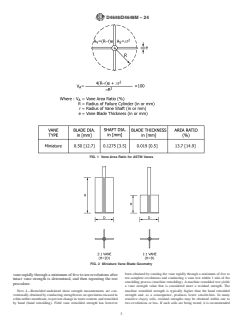
FIG. 1 Vane Area Ratio for ASTM Vanes
FIG. 2 Miniature Vane Blade Geometry
been obtained by rotating the vane rapidly through a minimum of five to
vane rapidly through a minimum of five to ten revolutions after
ten complete revolutions and conducting a vane test within 1 min of the
intact vane strength is determined, and then repeating the test
remolding process (machine remolding). A machine remolded test yields
procedure.
a vane strength value that is considered more a residual strength. The
machine remolded strength is typically higher than the hand remolded
NOTE 4—Remolded undrained shear strength measurements are con-
strength and, as a consequence, produces lower sensitivities. In many
ventionally obtained by conducting strength tests on specimens encased in
sensitive clayey soils, residual strengths may be obtained within one to
a thin rubber membrane, to prevent change in water content, and remolded
by hand (hand remolding). Field vane remolded strength has however two revolutions or less. If such soils are being tested, it is recommended
D4648/D4648M − 24
that several remolded strengths be obtained using the standard five to ten which shear occurs, it is recommended that torque be applied using a
revolutions for verification. If no major remolded strength differences are motorized vane device. A hand crank manual device may be utilized, but
noted, remolded strengths may be obtained at less than the recommended is not recommended due to the potential variation in rate of shear.
five to ten revolutions. NOTE 7—When the miniature vane test is conducted using a calibrated
NOTE 5—In cases where electrical torque transducers with wires for torque spring, the top of the spring unit is rotated at a constant rotation rate
signal transmission are utilized, the remolded miniature vane strength may while the bottom of the spring most often remains stationary or nearly
be obtained by rotating the vane one complete revolution in one direction stationary until enough energy (torque) is built up in the spring. Just prior
and then again in the opposite direction a number of times to produce the to or at failure, the bottom of the spring and vane begin to rotate (generally
desired five to ten complete revolutions. slowly) as failure begins. The torque applied by the spring soon over-
comes the shearing resistance of the soil and the vane blade rotates rapidly
9. Preparation of Apparatus to bring the soil to total failure. Thus, depending upon the stiffness of the
calibrated torque spring, soil strength, and consistency, the rate of shear
9.1 Vane Blade Damage—Carefully check each vane prior
and possibly the undrained shear strength may vary.
to each use for bent shafts and blades and imperfections that
NOTE 8—It should be recognized that there is a fundamental difference
in the failure modes between miniature vane tests made using a calibrated
could alter the vane failure surface from the assumed cylindri-
torque spring and an electrical transducer. An electrical torque transducer
cal surface.
will produce a strain-controlled failure of the soil, whereas a calibrated
torque spring will produce failure that varies somewhere between purely
10. Calibration
stress-controlled and strain-controlled conditions. Using an electrical
torque transducer, the constant rate of rotation applied to the top of the
10.1 Conduct periodic calibration of the spring units (or
to
...
This document is not an ASTM standard and is intended only to provide the user of an ASTM standard an indication of what changes have been made to the previous version. Because
it may not be technically possible to adequately depict all changes accurately, ASTM recommends that users consult prior editions as appropriate. In all cases only the current version
of the standard as published by ASTM is to be considered the official document.
Designation: D4648/D4648M − 16 D4648/D4648M − 24
Standard Test Methods for
Laboratory Miniature Vane Shear Test for Saturated
Fine-Grained Clayey Soil
This standard is issued under the fixed designation D4648/D4648M; the number immediately following the designation indicates the
year of original adoption or, in the case of revision, the year of last revision. A number in parentheses indicates the year of last
reapproval. A superscript epsilon (´) indicates an editorial change since the last revision or reapproval.
1. Scope*
1.1 These test methods cover the miniature vane test in very soft to stiff saturated fine-grained clayey soils (φ = 0). saturated
fine-grained, cohesive clay and silt soils for the estimation of undrained shear strength. Knowledge of the nature of the soil in
which each vane test is to be made is necessary for assessment of the applicability and interpretation of the test results.
NOTE 1—It is recommended that the miniature vane test be conducted in fine-grained, predominately clay soils with an undrained shear strength less than
1.0 tsf [100 kPa]. Vane failure conditions in higher strength clay and predominantly silty soils may deviate from the assumed cylindrical failure surface,
thereby causing error in the measured strength.These test methods are not applicable to sandy soils or non-plastic silts, which may allow
drainage during the test. These test methods are intended for soils which have an undrained shear strength less than 1.0 tsf [100
kPa].
NOTE 1—Vane failure conditions in higher strength clay and predominately silty soils may deviate from the assumed cylindrical failure surface, thereby
causing error in the measured strength.
1.2 These test methods include the use of both conventional calibrated torque spring units (Method A) and electrical torque
transducer units (Method B) with a motorized miniature vane shear device.
1.3 Laboratory vane is an ideal tool to investigate strength anisotropy in the vertical and horizontal directions, if suitable samples
(specimens) are available.
1.4 All measured and calculated values shall conform to the guidelines for significant digits and rounding established in Practice
D6026.
1.4 The values stated in either SIinch-pound units or inch-pound units SI units [presented in brackets] are to be regarded separately
as standard. The values stated in each system may not be exact equivalents; therefore, each system shall be used independently
of the other. Combining values from the two systems may result in non-conformance with the standard. Reporting of test results
in units other than inch-pound shall not be regarded as nonconformance with this standard.
1.4.1 The gravitational system of inch-pound units is used when dealing with inch-pound units. In this system, the pound (lbf)
represents a unit of force (weight), while the unit for mass is slugs. The rationalized slug unit is not given, unless dynamic (F =
ma) calculations are involved.
This test method is under the jurisdiction of ASTM Committee D18 on Soil and Rock and is the direct responsibility of Subcommittee D18.05 on Strength and
Compressibility of Soils.
Current edition approved Jan. 1, 2016Jan. 15, 2024. Published January 2016February 2024. Originally approved in 1987. Last previous edition approved in 20132016 as
D4648/D4648M – 13. DOI: 10.1520/D4648_D4648M-16.16. DOI: 10.1520/D4648_D4648M-24.
*A Summary of Changes section appears at the end of this standard
Copyright © ASTM International, 100 Barr Harbor Drive, PO Box C700, West Conshohocken, PA 19428-2959. United States
D4648/D4648M − 24
1.5 All observed and calculated values shall conform to the guidelines for significant digits and rounding established in Practice
D6026, unless superseded by this test method.
1.6 This standard does not purport to address all of the safety concerns, if any, associated with its use. It is the responsibility
of the user of this standard to establish appropriate safety and healthsafety, health, and environmental practices and determine
the applicability of regulatory limitations prior to use.
1.7 This international standard was developed in accordance with internationally recognized principles on standardization
established in the Decision on Principles for the Development of International Standards, Guides and Recommendations issued
by the World Trade Organization Technical Barriers to Trade (TBT) Committee.
2. Referenced Documents
2.1 ASTM Standards:
D653 Terminology Relating to Soil, Rock, and Contained Fluids
D1587D1587/D1587M Practice for Thin-Walled Tube Sampling of Fine-Grained Soils for Geotechnical Purposes (Withdrawn
2024)
D2216 Test Methods for Laboratory Determination of Water (Moisture) Content of Soil and Rock by Mass
D2488 Practice for Description and Identification of Soils (Visual-Manual Procedures)
D2573D2573/D2573M Test Method for Field Vane Shear Test in Saturated Fine-Grained Soils
D3740 Practice for Minimum Requirements for Agencies Engaged in Testing and/or Inspection of Soil and Rock as Used in
Engineering Design and Construction
D4220D4220/D4220M Practices for Preserving and Transporting Soil Samples (Withdrawn 2023)
D6026 Practice for Using Significant Digits and Data Records in Geotechnical Data
D6519/D6519M Practice for Sampling of Soil Using the Hydraulically Operated Stationary Piston Sampler
D8121/D8121M Test Method for Approximating the Shear Strength of Cohesive Soils by the Handheld Vane Shear Device
3. Terminology
3.1 Definitions:
3.1.1 For common definitions of common technical terms used in this standard, refer to Terminology D653.
3.2 Definitions of Terms Specific to This Standard:
3.2.1 torque—the product of the magnitude of a force and the perpendicular distance of the line of action of the force from a
specified axis of rotation.
3.2.1 torque spring—spring, n—an elastic spring that can be calibrated to provide a measure of torque that is proportional to the
rotation (about a central longitudinal axis) of one end of the spring relative to a fixed condition at the opposite end of the spring.
3.2.3 torque transducer—an electronic measuring device that can be calibrated to provide a measure of torque.
4. Summary of Test Method
4.1 The miniature vane shear test consists of inserting a four-bladed vane in the end of an intact specimen from a tube sample or
remolded samplespecimen and rotating it at a constant rate to determine the torque required to cause a cylindrical surface to be
sheared by the vane. This torque is then converted to a unit shearing resistance of the cylindrical surface area. The torque is
measured by a calibrated torque spring or torque transducer that is attached directly to the vane.
5. Significance and Use
5.1 The miniature vane shear test may be used to obtain estimates of the undrained shear strength of fine-grained soils. The test
provides a rapid determination of the undrained shear strength on undisturbed, or remolded or reconstituted soils.
For referenced ASTM standards, visit the ASTM website, www.astm.org, or contact ASTM Customer Service at service@astm.org. For Annual Book of ASTM Standards
volume information, refer to the standard’s Document Summary page on the ASTM website.
The last approved version of this historical standard is referenced on www.astm.org.
D4648/D4648M − 24
NOTE 2—Notwithstanding the statements on precision and bias contained in this test method: The precision of this test method is dependent on the
competence of the personnel performing it and the suitability of the equipment and facilities used. Agencies that meet the criteria of Practice D3740 are
generally considered capable of competent and objective testing. Users of this test method are cautioned that compliance with Practice D3740 does not
in itself ensure reliable testing. Reliable testing depends on several factors; Practice D3740 provides a means for evaluating some of those factors.
6. Interferences
6.1 Vane Disturbance—The remolded zone around a vane blade resulting from insertion is generally assumed to be small and have
little or no effect on the stress-strain properties of the sediment being tested. In reality, the volume of soil disturbed by the insertion
of the vane blade into the assumed cylindrical volume of soil being tested may be significant. It is recommended that the vane The
vane shall displace no more than 15% of the soil being tested as defined by the maximum vane area ratio presented in Fig. 1.
7. Apparatus
7.1 Vane Blade—The vane assembly shall consist of four rectangular bladed vanes, as illustrated in Fig. 2. It is recommended that
the height of the vane be twice the diameter (2:1), although vanes with a height equal to the diameter (1:1) also may be used (see
Note 3). Vane blade diameter (D) may vary from 0.50.50 to 1.0 in. [12.7 to 25.4 mm].
7.2 Vane Device—The vane device should be motorized and, in the case of a torque spring device, shall rotate the torque spring
at a constant rate of 60 to 90°/min [1.0 to 1.6 rad/min]. A vane device which applies the torque directly through a stiff shaft using
an electrical transducer to measure torque shall rotate the vane at a constant rate that ranges from 20 to 30°/min [0.35 to 0.52
rad/min]. The vane/spring rotation device shall have an indicator or recording system that displays/records deflection (torque) of
the calibrated spring or electrical transducer and, where possible, vane blade rotation.
7.3 Torque Measuring Device—The torque measuring device shall be a conventional torque spring, electrical torque transducer,
or any other measuring device capable of the accuracy prescribed herein and may be part of the vane device. The torque measuring
device shall be capable of measuring the torque to at least three significant digits. Undrained shear strength estimated by a
hand-held vane (Test Methods D8121/D8121M) is often used to assist in selection of the appropriate spring or torque transducer
range and accuracy.
FIG. 1 Vane Area Ratio for ASTM Vanes
D4648/D4648M − 24
FIG. 2 Miniature Vane Blade Geometry
NOTE 3—Since many clays are anisotropic with respect to strength, the relative importance of horizontal, as distinct from vertical, shearing surfaces can
influence the test results. For this reason it is important that the recommended ratio of height to diameter be respected unless the intent is to vary the ratio
in order to determine the horizontal and vertical strengths separately. For more detailed discussion on effects of height to diameter ratio as well as vane
shape, refer to Refs. (1) and (2).
8. Preparation and Testing of SamplesSpecimens
8.1 Specimen Size—Specimens should have a diameter sufficient to allow clearance of at least two blade diameters between all
points on the circumference of the shearing surface and the outer edge of the sample.
8.2 Intact Vane Strength—Prepare intact specimens from large intact samples secured in accordance with Practice D1587D1587/
D1587M or D6519/D6519M, and handle and transport in accordance with the practices for Group C and D Samples in Practices
D4220D4220/D4220M. Tests may be run in the sampling tube, eliminating the need for extrusion. Handle specimens carefully to
prevent disturbance or loss of water (moisture) content. Trim flat the end of the sample where the vane will be inserted. The sample
specimen surface shall be perpendicular to the wall of the tube.tube and parallel to the leading, horizontal edge of the vane.
8.3 Remolded Vane Strength—Conduct remolded miniature vane strength tests on failed specimens similar to remolded field vane
tests (Test Method D2573D2573/D2573M) by rotating the vane rapidly through a minimum of five to ten revolutions.revolutions
after intact vane strength is determined, and then repeating the test procedure.
NOTE 4—Remolded undrained shear strength measurements are conventionally obtained by conducting strength tests on specimens encased in a thin
rubber membrane, to prevent change in water content, and remolded by hand (hand remolding). Field vane remolded strength has however been obtained
by rotating the vane rapidly through a minimum of five to ten complete revolutions and conducting a vane test within 1 min of the remolding process
(machine remolding). A machine remolded test yields a vane strength value that is considered more a residual strength. The machine remolded strength
is typically higher than the hand remolded strength and, as a consequence, produces lower sensitivities. In many sensitive clayey soils, residual strengths
may be obtained within one to two revolutions or less. If such soils are being tested, it is recommended that several remolded strengths be obtained using
the standard five to ten revolutions for verification. If no major remolded strength differences are noted, remolded strengths may be obtained at less than
the recommended five to ten revolutions.
NOTE 5—In cases where electrical torque transducers with wires for signal transmission are utilized, the remolded miniature vane strength may be obtained
by rotating the vane one complete revolution in one direction and then again in the opposite direction a number of times to produce the desired five to
ten complete revolutions.
The boldface numbers in parentheses refer to the list of references at the end of this standard.
D4648/D4648M − 24
9. Preparation of Apparatus
9.1 Vane Blade Damage—Carefully check each vane prior to each use for bent shafts and blades and imperfections that could alter
the vane failure surface from the assumed cylindrical surface.
10. Calibration
10.1 Conduct periodicallyperiodic calibration of the spring units (or torque transducers) to ensure proper operation of the
miniature vane device and repeatability of the torque spring or transducers. Calibration is accomplished by the application of
calibrated weights onto a calibrated wheel to produce a known torque (lever arm X weight). Secure the vane shear unit in such
a way that the vane spring (torque unit) is in a horizontal position. Then insert the calibration wheel in place of the vane blade.
The calibration wheel, calibration string, and calibration weights all shall hang free of any obstructions. Dimensions of the
calibration wheel shall be noted; specifically the lever arm.
10.2 For each vane torque spring to be used, apply a series of calibration weights to the calibration wheel to develop a plot of
spring deflectionrotation (in degrees) versus torque (in lbf·in. or [N·m]). Carefully fasten each calibration weight to the calibration
string and allow to deflect the spring. Record the deflection of the spring (in degrees) and applied torque for each weight applied.
The calibration wheel configuration, lever arm, weights, and resulting torque shown in Fig. 3 is recommended for consideration
in the calibration procedure.
10.3 Conduct periodic measurements of the vane blade dimensions (height, diameter, and thickness) and vane shaft diameter with
a maximum interval between measurements of one year. Record measurements to the nearest 0.01 in. [0.1 mm] for blade height
and diameter, and to the nearest 0.001 in. [0.01 mm] for blade thickness and vane shaft diameter. At a minimum, record and average
four measurements of each blade dimension at unique locations on the vane. The height and thickness of each blade shall be
measured, and the diameter of the vane blades shall be measured using the two opposing blade pairs. Verify that the vane blade
measurements and shaft cross-sectional area result in a vane area ratio that meets the maximum a
...