

ASTM D1545-13(2023)
(Test Method)Standard Test Method for Viscosity of Transparent Liquids by Bubble Time Method
General Information
- Abstract
ABSTRACT
This test method covers the procedures for determining the viscosity of transparent liquids by bubble time method. The transparent liquids should be free from crystalline or gel particles. Test apparatus include a constant-temperature bath, standard viscosity tubes, a series of standard viscosity tubes as reference standards, timing device, tube racks, and viscosity tube corks.
SCOPE
1.1 This test method covers the determination of the viscosity in bubble seconds by timing. The bubble seconds are approximately equal to stokes for most liquids.
1.2 The test method is applicable to transparent liquids that are free from crystalline or gel particles.
1.3 The values stated in SI units are to be regarded as standard. No other units of measurement are included in this standard.
1.4 This standard does not purport to address all of the safety concerns, if any, associated with its use. It is the responsibility of the user of this standard to establish appropriate safety, health, and environmental practices and determine the applicability of regulatory limitations prior to use.
1.5 This international standard was developed in accordance with internationally recognized principles on standardization established in the Decision on Principles for the Development of International Standards, Guides and Recommendations issued by the World Trade Organization Technical Barriers to Trade (TBT) Committee.
- Status
- Published
- Publication Date
- 30-Jun-2023
- Technical Committee
- D01 - Paint and Related Coatings, Materials, and Applications
- Drafting Committee
- D01.24 - Physical Properties of Liquid Paints & Paint Materials


Overview
ASTM D1545-13(2023) - Standard Test Method for Viscosity of Transparent Liquids by Bubble Time Method - outlines a widely recognized procedure for measuring the viscosity of transparent liquids. This test method, developed by ASTM International, determines viscosity in "bubble seconds," a measure approximately equivalent to stokes, primarily for liquids free from crystalline or gel particles. The measurement process utilizes a bubble tube viscometer, reference standard tubes, a constant-temperature bath, and precise timing equipment.
This method is highly valued in industries where accurate viscosity evaluation of clear fluids, such as paints, varnishes, or lacquer solutions, impacts process consistency, quality control, and product performance. The standard strictly prescribes the use of SI units and supports internationally harmonized testing and reporting practices.
Key Topics
- Bubble Time Method: Measures how long it takes an air bubble to travel between two marked points in a transparent liquid, offering a practical approach to viscosity determination.
- Apparatus: Utilizes standard glass viscosity tubes, a calibrated water bath maintained at 25°C ± 0.1°C, reference standard tubes (Gardner-Holdt), tube racks, accurate timing devices, and specific corks for consistency.
- Sample Requirements: The test is valid only for transparent liquids that are completely free from crystalline or gel particles, ensuring reliable bubble motion and timing.
- Timing and Calculation: The bubble is timed as it travels a set distance within the viscosity tube. The result, reported as "bubble seconds," gives a practical estimate of the liquid's kinematic viscosity.
- Precision Requirements: Strict guidelines mandate tube positioning (vertical alignment), temperature stability, and repeatability for reliable data, supporting inter-laboratory and intra-laboratory consistency.
- Reporting: Results are expressed as both bubble seconds and approximate stokes, making it easier to compare with standard reference materials used in the paint and coatings industries.
Applications
The ASTM D1545 bubble time method is applied across several sectors for:
- Paints and Coatings: Ensures batch-to-batch consistency, optimal application properties, and compliance with quality standards.
- Varnishes and Lacquers: Essential for characterizing flow and film-forming properties during production and formulation adjustments.
- Chemical Manufacturing: Used for transparent, low to moderately viscous liquids to ensure proper mixing, processing, and transportation.
- Quality Control Laboratories: Provides a relatively simple, rapid, and cost-effective viscosity measurement tool for routine product release and research activities.
- Material Comparison and Specification: Enables standardized comparison of new formulations against reference standards and technical specifications.
The bubble time method is, however, not suitable for liquids exhibiting high non-Newtonian behaviors, water dispersions of gums, silicones, or samples containing suspended particulate matter.
Related Standards
For comprehensive viscosity measurement and quality assurance, the following ASTM standards and resources are referenced alongside ASTM D1545:
- ASTM D445 - Standard Test Method for Kinematic Viscosity of Transparent and Opaque Liquids (and Calculation of Dynamic Viscosity)
- ASTM D4212 - Standard Test Method for Viscosity by Dip-Type Viscosity Cups
- ASTM D2196 - Standard Test Methods for Rheological Properties of Non-Newtonian Materials by Rotational (Brookfield-type) Viscometer
- ISO 3104 - Petroleum products - Transparent and opaque liquids - Determination of kinematic viscosity and calculation of dynamic viscosity
These standards, along with ASTM D1545, support robust viscosity evaluation for a wide range of transparent liquid products, ensuring quality, safety, and international market acceptance.
Get Certified
Connect with accredited certification bodies for this standard

BSMI (Bureau of Standards, Metrology and Inspection)
Taiwan's standards and inspection authority.
Sponsored listings
Frequently Asked Questions
ASTM D1545-13(2023) is a standard published by ASTM International. Its full title is "Standard Test Method for Viscosity of Transparent Liquids by Bubble Time Method". This standard covers: ABSTRACT This test method covers the procedures for determining the viscosity of transparent liquids by bubble time method. The transparent liquids should be free from crystalline or gel particles. Test apparatus include a constant-temperature bath, standard viscosity tubes, a series of standard viscosity tubes as reference standards, timing device, tube racks, and viscosity tube corks. SCOPE 1.1 This test method covers the determination of the viscosity in bubble seconds by timing. The bubble seconds are approximately equal to stokes for most liquids. 1.2 The test method is applicable to transparent liquids that are free from crystalline or gel particles. 1.3 The values stated in SI units are to be regarded as standard. No other units of measurement are included in this standard. 1.4 This standard does not purport to address all of the safety concerns, if any, associated with its use. It is the responsibility of the user of this standard to establish appropriate safety, health, and environmental practices and determine the applicability of regulatory limitations prior to use. 1.5 This international standard was developed in accordance with internationally recognized principles on standardization established in the Decision on Principles for the Development of International Standards, Guides and Recommendations issued by the World Trade Organization Technical Barriers to Trade (TBT) Committee.
ABSTRACT This test method covers the procedures for determining the viscosity of transparent liquids by bubble time method. The transparent liquids should be free from crystalline or gel particles. Test apparatus include a constant-temperature bath, standard viscosity tubes, a series of standard viscosity tubes as reference standards, timing device, tube racks, and viscosity tube corks. SCOPE 1.1 This test method covers the determination of the viscosity in bubble seconds by timing. The bubble seconds are approximately equal to stokes for most liquids. 1.2 The test method is applicable to transparent liquids that are free from crystalline or gel particles. 1.3 The values stated in SI units are to be regarded as standard. No other units of measurement are included in this standard. 1.4 This standard does not purport to address all of the safety concerns, if any, associated with its use. It is the responsibility of the user of this standard to establish appropriate safety, health, and environmental practices and determine the applicability of regulatory limitations prior to use. 1.5 This international standard was developed in accordance with internationally recognized principles on standardization established in the Decision on Principles for the Development of International Standards, Guides and Recommendations issued by the World Trade Organization Technical Barriers to Trade (TBT) Committee.
ASTM D1545-13(2023) is classified under the following ICS (International Classification for Standards) categories: 17.060 - Measurement of volume, mass, density, viscosity. The ICS classification helps identify the subject area and facilitates finding related standards.
ASTM D1545-13(2023) is available in PDF format for immediate download after purchase. The document can be added to your cart and obtained through the secure checkout process. Digital delivery ensures instant access to the complete standard document.
Standards Content (Sample)
This international standard was developed in accordance with internationally recognized principles on standardization established in the Decision on Principles for the
Development of International Standards, Guides and Recommendations issued by the World Trade Organization Technical Barriers to Trade (TBT) Committee.
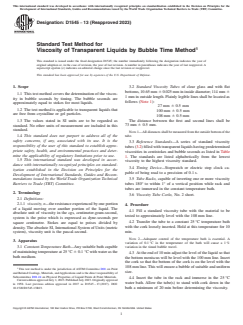
Designation: D1545 − 13 (Reapproved 2023)
Standard Test Method for
Viscosity of Transparent Liquids by Bubble Time Method
This standard is issued under the fixed designation D1545; the number immediately following the designation indicates the year of
original adoption or, in the case of revision, the year of last revision. A number in parentheses indicates the year of last reapproval. A
superscript epsilon (´) indicates an editorial change since the last revision or reapproval.
This standard has been approved for use by agencies of the U.S. Department of Defense.
1. Scope 3.2 Standard Viscosity Tubes of clear glass and with flat
bottoms, 10.65 mm 6 0.025 mm in inside diameter; 114 mm 6
1.1 This test method covers the determination of the viscos-
1 mm in outside length. Plainly legible lines shall be located as
ity in bubble seconds by timing. The bubble seconds are
follows (Note 1):
approximately equal to stokes for most liquids.
27 mm 6 0.5 mm
1.2 The test method is applicable to transparent liquids that
100 mm 6 0.5 mm
are free from crystalline or gel particles.
108 mm 6 0.5 mm
The distance between the first and second lines shall be
1.3 The values stated in SI units are to be regarded as
standard. No other units of measurement are included in this 73 mm 6 0.5 mm.
standard.
NOTE 1—All distances shall be measured from the outside bottom of the
1.4 This standard does not purport to address all of the tube.
safety concerns, if any, associated with its use. It is the
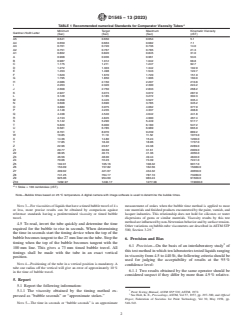
3.3 Reference Standards—A series of standard viscosity
responsibility of the user of this standard to establish appro-
tubes (3.2) filled with transparent liquids having predetermined
priate safety, health, and environmental practices and deter-
viscosities in centistokes and bubble seconds as listed in Table
mine the applicability of regulatory limitations prior to use.
1. The standards are listed alphabetically from the lowest
1.5 This international standard was developed in accor-
viscosity to the highest viscosity standard.
dance with internationally recognized principles on standard-
3.4 Timing Device—Stopwatch or electric stop clock ca-
ization established in the Decision on Principles for the
pable of being read to a precision of 0.1 s.
Development of International Standards, Guides and Recom-
3.5 Tube Racks, capable of inverting one or more viscosity
mendations issued by the World Trade Organization Technical
tubes 180° to within 1° of a vertical position while rack and
Barriers to Trade (TBT) Committee.
tubes are immersed in the constant temperature bath.
2. Terminology
3.6 Viscosity Tube Corks, No. 2 short.
2.1 Definitions:
2.1.1 viscosity, n—the resistance experienced by one portion
4. Procedure
of a liquid moving over another portion of the liquid. The
4.1 Fill a standard viscosity tube with the material to be
absolute unit of viscosity in the cgs, centimeter-gram-second,
tested to approximately level with the 108 mm line.
system is the poise which is expressed as dyne-seconds per
4.2 Transfer the tube to a constant 25 °C temperature bath
square centimetre. Stokes are equal to poises divided by
with the cork loosely inserted. Hold at this temperature for 10
density. The absolute SI, International System of Units (metric
min.
system), viscosity unit is the pascal-second.
NOTE 2—Adequate control of the temperature bath is essential. A
3. Apparatus
variation of 0.1 °C in the temperature of the bath will cause a 1 %
variation in the timed bubble travel.
3.1 Constant-Temperature Bath—Any suitable bath capable
of maintaining temperature at 25 °C 6 0.1 °C with water as the
4.3 At the end of 10 min adjust the level of the liquid so that
bath medium.
the bottom meniscus will be level with the 100 mm line. Insert
the cork so that the bottom of the cork is on the level with the
108 mm line. This will ensure a bubble of suitable and uniform
This test method is under the jurisdiction of ASTM Committee D01 on Paint
size.
and Related Coatings, Materials, and Applications and is the direct responsibility of
Subcommittee D01.24 on Physical Properties of Liquid Paints & Paint Materials.
4.4 Insert the tube in the rack and immerse in the 25 °C
Current edition approved July 1, 2023. Published July 2023. Originally approved
water bath. Allow the tube(s) to stand with cork down in the
in 1958. Last previous edition approved in 2017 as D1545 – 13 (2017). DOI:
10.1520/D1545-13R23. bath a minimum of 20 min before determining the viscosity.
Copyright © ASTM International, 100 Barr Harbor Drive, PO Box C700, West Conshohocken, PA 19428-2959. United States
D1545 − 13 (2023)
A
TABLE 1 Recommended numerical Standards for Comparator Viscosity Tubes
Minimum Target Maximum Kinematic Viscosity
Gardner-Hodlt Letter
(Sec) (Sec) (Sec) (cST)
A5 0.641 0.650 0.654 5.1
A4 0.659 0.663 0.682 7.1
A3 0.701 0.720 0.736 14.0
A2 0.751 0.767 0.785 21.3
A1 0.802 0.820 0.845 31.0
A 0.9
...