

ASTM F34-13(2023)
(Practice)Standard Practice for Construction of Test Cell for Liquid Extraction of Flexible Barrier Materials
General Information
- Abstract
SIGNIFICANCE AND USE
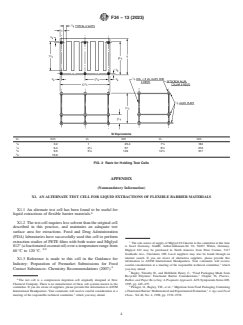
5.1 Knowledge of extractives from flexible barrier materials may serve many useful purposes. A test cell constructed as described in this practice may be used for obtaining such data. Another test cell has been found equivalent to the one described in this practice. See the appendix for the source of the alternate cell.
5.2 United States Federal Regulations 21CFR 176.170 (d)(3), 21CFR 177.1330 (e)(4), 21CFR 177.1360 (b), 21CFR 177.1670 (b), and 21CFR Appendix VI (b) cite this standard practice as the basis for determining the amount of extractables from the surface of a package or multilayer film or modified paper in contact with food. In some cases, it is the only practice defined for this purpose. No alternative detail is given in the regulations for conducting extractions.
5.3 Test Method D4754 is not an equivalent to this test method. It is for two-sided extraction of films having the same material on both of the exposed surfaces of the film.
SCOPE
1.1 This practice covers the construction of test cells which may be used for the extraction of components from flexible barrier materials by suitable extracting liquids, including foods and food simulating solvents.
1.2 The values stated in inch-pound units are to be regarded as standard. The values given in parentheses are mathematical conversions to SI units that are provided for information only and are not considered standard.
1.3 This standard does not purport to address all of the safety concerns, if any, associated with its use. It is the responsibility of the user of this standard to establish appropriate safety, health, and environmental practices and determine the applicability of regulatory limitations prior to use.
1.4 This international standard was developed in accordance with internationally recognized principles on standardization established in the Decision on Principles for the Development of International Standards, Guides and Recommendations issued by the World Trade Organization Technical Barriers to Trade (TBT) Committee.
- Status
- Published
- Publication Date
- 31-Mar-2023
- Technical Committee
- F02 - Primary Barrier Packaging
- Drafting Committee
- F02.15 - Chemical/Safety Properties
Overview
ASTM F34-13(2023): Standard Practice for Construction of Test Cell for Liquid Extraction of Flexible Barrier Materials establishes procedures for constructing test cells used to extract and analyze components from flexible barrier materials, such as those used in food packaging. This internationally recognized standard is vital in evaluating the potential for leachable or extractable substances from packaging surfaces that come into contact with food, ensuring compliance with United States Federal Regulations and food safety requirements.
The standard supports regulatory submissions and quality assurance in the packaging industry by defining a practice for building extraction test cells. It specifically addresses test methods aligned with FDA regulations for determining extractables in flexible packaging materials, particularly when in contact with foods or food-simulating solvents.
Key Topics
Test Cell Construction
Guidance is provided for assembling a test cell using durable, non-contributory materials (commonly stainless steel and fluorocarbon gaskets), ensuring that the test apparatus does not itself release extractables that could affect results.Significance of Extractables
Knowledge of extractives from flexible materials is critical for safety evaluation, especially in food contact applications. These data help determine the suitability of packaging materials for regulatory compliance and consumer safety.Regulatory Compliance
This standard is directly cited in several key US FDA regulations, including 21CFR 176.170, 21CFR 177.1330, 21CFR 177.1360, and 21CFR 177.1670. In many situations, ASTM F34-13(2023) is the only approved method for extractable testing, making it essential for industry compliance.Test Method and Application
The practice details the use of suitable extracting liquids-including foods and food simulating solvents-to obtain reliable data. The test cell allows a defined surface area of the flexible barrier material to be in contact with the extraction medium, facilitating gravimetric or other forms of analysis.
Applications
Food Packaging Safety Assessment
The primary application is in the food packaging industry, where materials such as multilayer films or coated papers must be tested for extractables when in contact with food. Ensuring minimal transfer of substances protects consumers and meets regulatory standards.Regulatory Submissions
This standard is frequently referenced in premarket submissions to regulatory authorities such as the US FDA for food contact substances. Data generated with F34-compliant test cells is often required to demonstrate material safety.Research and Development
Material scientists and packaging engineers use this standardized practice during R&D to compare the extractable profiles of various barrier materials under controlled conditions, supporting innovation in sustainable and safe packaging solutions.Alternate Test Cells
The appendix highlights an alternative test cell design recognized by regulatory bodies, offering flexibility and potentially greater efficiency in some laboratory settings.
Related Standards
ASTM D1193
Specification for Reagent Water, used in the cleaning and preparation of test cells.ASTM D4754
Test Method for Two-Sided Liquid Extraction of Plastic Materials Using FDA Migration Cell (note: not equivalent to F34 as it targets two-sided extraction for homogenous films).AOAC Official Method 964.15
Extraction protocol for flexible barrier materials, providing analytical methodology referenced within F34 procedures.FDA Guidance and Regulations
Directly referenced regulations include various sections of 21 CFR and FDA guidance on premarket submissions for food contact materials, reflecting the broad regulatory acceptance of this practice.
Keywords:
ASTM F34-13, liquid extraction, flexible barrier materials, test cell construction, food packaging safety, extractables, FDA food contact regulations, packaging compliance, gravimetric analysis, food simulating solvents
Relations
- Effective Date
- 01-May-2018
- Effective Date
- 01-Dec-2011
- Effective Date
- 01-Mar-2006
- Effective Date
- 10-Mar-2003
- Effective Date
- 10-Feb-1999
- Effective Date
- 10-Feb-1999
- Effective Date
- 10-Jul-1998
Get Certified
Connect with accredited certification bodies for this standard

BRCGS (Brand Reputation Compliance Global Standards)
Global food safety and quality standards owner.
Sponsored listings
Frequently Asked Questions
ASTM F34-13(2023) is a standard published by ASTM International. Its full title is "Standard Practice for Construction of Test Cell for Liquid Extraction of Flexible Barrier Materials". This standard covers: SIGNIFICANCE AND USE 5.1 Knowledge of extractives from flexible barrier materials may serve many useful purposes. A test cell constructed as described in this practice may be used for obtaining such data. Another test cell has been found equivalent to the one described in this practice. See the appendix for the source of the alternate cell. 5.2 United States Federal Regulations 21CFR 176.170 (d)(3), 21CFR 177.1330 (e)(4), 21CFR 177.1360 (b), 21CFR 177.1670 (b), and 21CFR Appendix VI (b) cite this standard practice as the basis for determining the amount of extractables from the surface of a package or multilayer film or modified paper in contact with food. In some cases, it is the only practice defined for this purpose. No alternative detail is given in the regulations for conducting extractions. 5.3 Test Method D4754 is not an equivalent to this test method. It is for two-sided extraction of films having the same material on both of the exposed surfaces of the film. SCOPE 1.1 This practice covers the construction of test cells which may be used for the extraction of components from flexible barrier materials by suitable extracting liquids, including foods and food simulating solvents. 1.2 The values stated in inch-pound units are to be regarded as standard. The values given in parentheses are mathematical conversions to SI units that are provided for information only and are not considered standard. 1.3 This standard does not purport to address all of the safety concerns, if any, associated with its use. It is the responsibility of the user of this standard to establish appropriate safety, health, and environmental practices and determine the applicability of regulatory limitations prior to use. 1.4 This international standard was developed in accordance with internationally recognized principles on standardization established in the Decision on Principles for the Development of International Standards, Guides and Recommendations issued by the World Trade Organization Technical Barriers to Trade (TBT) Committee.
SIGNIFICANCE AND USE 5.1 Knowledge of extractives from flexible barrier materials may serve many useful purposes. A test cell constructed as described in this practice may be used for obtaining such data. Another test cell has been found equivalent to the one described in this practice. See the appendix for the source of the alternate cell. 5.2 United States Federal Regulations 21CFR 176.170 (d)(3), 21CFR 177.1330 (e)(4), 21CFR 177.1360 (b), 21CFR 177.1670 (b), and 21CFR Appendix VI (b) cite this standard practice as the basis for determining the amount of extractables from the surface of a package or multilayer film or modified paper in contact with food. In some cases, it is the only practice defined for this purpose. No alternative detail is given in the regulations for conducting extractions. 5.3 Test Method D4754 is not an equivalent to this test method. It is for two-sided extraction of films having the same material on both of the exposed surfaces of the film. SCOPE 1.1 This practice covers the construction of test cells which may be used for the extraction of components from flexible barrier materials by suitable extracting liquids, including foods and food simulating solvents. 1.2 The values stated in inch-pound units are to be regarded as standard. The values given in parentheses are mathematical conversions to SI units that are provided for information only and are not considered standard. 1.3 This standard does not purport to address all of the safety concerns, if any, associated with its use. It is the responsibility of the user of this standard to establish appropriate safety, health, and environmental practices and determine the applicability of regulatory limitations prior to use. 1.4 This international standard was developed in accordance with internationally recognized principles on standardization established in the Decision on Principles for the Development of International Standards, Guides and Recommendations issued by the World Trade Organization Technical Barriers to Trade (TBT) Committee.
ASTM F34-13(2023) is classified under the following ICS (International Classification for Standards) categories: 55.040 - Packaging materials and accessories. The ICS classification helps identify the subject area and facilitates finding related standards.
ASTM F34-13(2023) has the following relationships with other standards: It is inter standard links to ASTM D4754-18, ASTM D4754-11, ASTM D1193-06, ASTM D4754-98(2003), ASTM D1193-99e1, ASTM D1193-99, ASTM D4754-98. Understanding these relationships helps ensure you are using the most current and applicable version of the standard.
ASTM F34-13(2023) is available in PDF format for immediate download after purchase. The document can be added to your cart and obtained through the secure checkout process. Digital delivery ensures instant access to the complete standard document.
Standards Content (Sample)
This international standard was developed in accordance with internationally recognized principles on standardization established in the Decision on Principles for the
Development of International Standards, Guides and Recommendations issued by the World Trade Organization Technical Barriers to Trade (TBT) Committee.
Designation: F34 − 13 (Reapproved 2023)
Standard Practice for
Construction of Test Cell for Liquid Extraction of Flexible
Barrier Materials
This standard is issued under the fixed designation F34; the number immediately following the designation indicates the year of original
adoption or, in the case of revision, the year of last revision. A number in parentheses indicates the year of last reapproval. A superscript
epsilon (´) indicates an editorial change since the last revision or reapproval.
1. Scope 2.3 Code of Federal Regulations, Title 21 —The following
regulations cite this standard:
1.1 This practice covers the construction of test cells which
21CFR 176.170 (d)(3)
may be used for the extraction of components from flexible
21CFR 177.1330 (e)(4)
barrier materials by suitable extracting liquids, including foods
21CFR 177.1360 (b)
and food simulating solvents.
21CFR 177.1670 (b)
1.2 The values stated in inch-pound units are to be regarded
Appendix VI (b) Cells for Migration Testing, Guidance for
as standard. The values given in parentheses are mathematical
Industry: Preparation of Premarket Submissions for Food
conversions to SI units that are provided for information only
Contact Substances: Chemistry Recommendations (2007)
and are not considered standard.
1.3 This standard does not purport to address all of the
3. Terminology
safety concerns, if any, associated with its use. It is the
3.1 Definitions of Terms Specific to This Standard:
responsibility of the user of this standard to establish appro-
3.1.1 flexible, adj— for purpose of this practice, a term
priate safety, health, and environmental practices and deter-
applying only to those flexible materials which can be inserted
mine the applicability of regulatory limitations prior to use.
in the test cell without affecting their barrier properties.
1.4 This international standard was developed in accor-
dance with internationally recognized principles on standard-
4. Summary of Preactice
ization established in the Decision on Principles for the
4.1 This test cell defines the surface area of a flexible barrier
Development of International Standards, Guides and Recom-
structure that may contribute extractable/leachable substances
mendations issued by the World Trade Organization Technical
to a packaged article. Although stainless steel and other
Barriers to Trade (TBT) Committee.
materials are cited in the body of the practice, the test cell may
2. Referenced Documents be constructed of any durable material that does not contribute
2 to the extractable content. The test cell should be evaluated for
2.1 ASTM Standards:
leaks after manufacture. It should be washed of manufacturing
D1193 Specification for Reagent Water
or milling fluids that may contribute to the extraction result.
D4754 Test Method for Two-Sided Liquid Extraction of
Plastic Materials Using FDA Migration Cell 4.2 Both pure chemicals as well as food simulants may be
used as extracting solvents. FDA regulations usually specify
2.2 AOAC International Methods of Analysis:
the extracting fluid of choice, but other solvents may be chosen
Official Method 964.15 Extraction from Flexible Barrier
based on known or expected effects on the exposed surface.
Materials
4.3 The extractable content is usually measured by gravi-
metric analysis after evaporation of the extracting fluid, but
This practice is under the jurisdiction of ASTM Committee F02 on Primary
other types of analysis may be performed if considered to be
Barrier Packaging and is the direct responsibility of Subcommittee F02.15 on
appropriate. Some methodologies are cited in the FDA regu-
Chemical/Safety Properties.
lations.
Current edition approved April 1, 2023. Published April 2023. Originally
approved in 1963. Last previous edition approved in 2018 as F34 – 13 (2018). DOI:
10.1520/F0034-13R23.
For referenced ASTM standards, visit the ASTM website, www.astm.org, or
contact ASTM Customer Service at service@astm.org. For Annual Book of ASTM Federal Regulations may be purchased from the U.S. Government Printing
Standards volume information, refer to the standard’s Document Summary page on Office Bookstore, 710 North Capitol Street, N.W., Washington, D. C. or may be
the ASTM website. downloaded from the internet. The website for the chemistry guidelines document
This method is available through the Association of Official Analytical may be found at:
Chemists, International, 481 North Frederick Ave., Suite 500, Gaithersburg, MD http://www.fda.gov/Food/GuidanceComplianceRegulatoryInformation/Guidance
20877 or from the AOAC website at www.aoac.org. Documents/FoodIngredientsandPackaging/ucm081818.htm
Copyright © ASTM International, 100 Barr Harbor Drive, PO Box C700, West Conshohocken, PA 19428-2959. United States
F34 − 13 (2023)
4.4 Unless otherwise specified, the test cell is designed to be 7. Procedure
used at room temperature and ambient environmental condi-
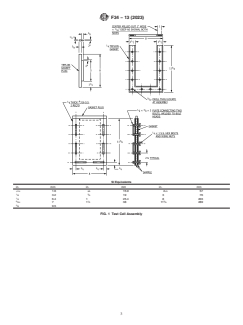
7.1 Construction of Test Cell (Fig. 1, Fig. 2)—Assemble as
tions.
follows:
3 1
7.1.1 Two 8 by 11 ⁄8 by ⁄8-in. (203 by 289 by 3.2-mm) No.
5. Significance and Use
316 stainless steel plates, degreased.
5.1 Knowledge of extractives from flexible barrier materials
1 1
7.1.2 One ⁄4 by 1 ⁄2-in. (6.4 by 38-mm) U-shaped virgin
may serve many useful purposes. A test cell constructed as
TFE-fluorocarbon gasket, grooved on both sides as shown.
described in this practice may be used for obtaining such data.
7.1.3 Twelve ⁄4 by 1-in. (6.4 by 25.4-mm) stainless steel
Another test cell has been found equivalent to the one
bolts with wing nuts.
described in this practice. See the appendix for the source of
7.1.4 One ⁄4 by 1 by 8-in. (6.4 by 25.4 by 203-mm)
the alternate cell.
TFE-fluorocarbon gasket plug tapered to provide a tight fit.
1 3
5.2 United States Federal Regulations 21CFR 176.170 7.1.5 Six ⁄8 by ⁄8 by 3-in. (6.4 by 9.5 by 76-mm) plates.
(d)(3), 21CFR 177.1330 (e)(4), 21CFR 177.1360 (b), 21CFR
NOTE 1—The use of stainless steel washers on the outside of each plate
177.1670 (b), and 21CFR Appendix VI (b) cite this standard
(7.1.1) may prevent the cells from leaking.
practice as the basis for determining the amount of extractables
7.2 Pre-Use Conditioning of Test Cell:
from the surface of a package or multilayer film or modified
7.2.1 Wash stainless steel plates and TFE-fluorocarbon gas-
paper in contact with food. In some cases, it is the only practice
kets in aqueous surfactant solution. Rinse with reagent water
defined for this purpose. No alternative detail is given in the
and dry at 122 °F (50 °C). Wash with n-heptane and redistilled
regulations for conducting extractions.
acetone.
5.3 Test Method D4754 is not an equivalent to this test
7.2.2 For new TFE-fluorocarbon gaskets, immerse in
method. It is for two-sided extraction of films having t
...