


ASTM F2590-06(2022)
(Specification)Standard Specification for Bearing, Roller, Thrust, Two Channeled Race Surface, Rigid or Flat Seat Type
Standard Specification for Bearing, Roller, Thrust, Two Channeled Race Surface, Rigid or Flat Seat Type
ABSTRACT
This specification covers requirements for rigid or flat seat type, two channeled race surface, thrust roller bearings intended for use in slow rotating or oscillating applications where pure thrust loads are applied. The thrust bearing shall be made of the specified high carbon chromium alloy steel. Requirements for (1) physical properties such as heat treatment, (2) dimensions and mass, and (3) surface finish are specified. Dimensions of retainer type, steering gear service and retainerless type, intermittent operation, are illustrated.
SCOPE
1.1 This specification covers requirements for rigid or flat seat type, two channeled race surface, thrust roller bearings.
1.2 Intended Use—The bearings covered in this specification are intended for use in slow rotating or oscillating applications where pure thrust loads are applied.
1.3 This specification contains many of the requirements of MS17169, which was originally developed by the Department of Defense and maintained by the Defense Supply Center in Richmond. The following government activity codes may be found in the Department of Defense, Standardization Directory SD-1.2
Preparing Activity
Custodians
Review Activities
DLA-GS4
Army-AT
Army-MI
Navy-MC
Air Force-84
Air Force-99
DLA-GS4
1.4 For design feature purposes, this specification takes precedence over procurement documents referenced herein.
1.5 The values stated in inch-pound units are to be regarded as standard. The values given in parentheses are mathematical conversions to SI units that are provided for information only and are not considered standard.
1.6 This standard does not purport to address all of the safety concerns, if any, associated with its use. It is the responsibility of the user of this standard to establish appropriate safety, health, and environmental practices and determine the applicability of regulatory limitations prior to use.
1.7 This international standard was developed in accordance with internationally recognized principles on standardization established in the Decision on Principles for the Development of International Standards, Guides and Recommendations issued by the World Trade Organization Technical Barriers to Trade (TBT) Committee.
General Information
- Status
- Published
- Publication Date
- 31-Dec-2021
- Technical Committee
- F34 - Rolling Element Bearings
- Drafting Committee
- F34.04 - Automotive/Industrial Bearing
Overview
ASTM F2590-06(2022) is the ASTM International standard that specifies requirements for bearing, roller, thrust, two channeled race surface, rigid or flat seat type. This standard is designed to ensure the performance and reliability of thrust roller bearings used in slow rotating or oscillating mechanical applications where pure thrust load is applied. These bearings are typically manufactured from high carbon chromium alloy steel and are suitable for use in industries such as heavy machinery, transportation, and defense systems.
Key Topics
Types Covered
- Rigid and flat seat, two channeled race surface, thrust roller bearings
Intended Use
- Bearings for use in slow rotating or oscillating applications subjected to pure thrust loads
Material Requirements
- High carbon chromium alloy steel as specified (e.g., AISI E52100 and equivalent grades)
Physical and Mechanical Properties
- Heat treatment and through hardening of races and rollers to specified hardness levels
- Strict dimensional tolerances and mass requirements
- Defined surface finish criteria for bearing components in accordance with ASME B46.1
Bearings Classification
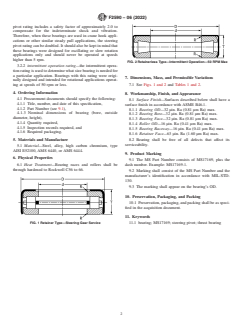
- Retainer type (primarily for steering gear service and intermittent operation)
- Retainerless type (for higher intermittent operation, up to 50 rpm max)
Marking and Packaging
- Part numbers based on MS17169 format and proper manufacturer identification
- Preservation, packaging, and packing must adhere to acquisition documentation
Applications
Bearings conforming to ASTM F2590-06(2022) are widely used in:
Automotive and Heavy Machinery
- King pins in front axles of large trucks
- Applications subject to oscillating or slow rotation Motion, with significant shock and vibration
Cranes and Lifting Equipment
- Crane hooks or mechanisms where steady pure thrust load occurs at low rotational speeds
Military and Defense Equipment
- Equipment originally designed under military specification MS17169
- Applications where reliable, repeatable function under defined load is critical
Industrial and Manufacturing Sectors
- Machinery requiring robust thrust bearings for intermittent operation (up to 50 rpm)
- Equipment where standardized, interchangeable bearing performance is needed
Related Standards
ASTM F2590-06(2022) aligns with and refers to the following related standards and documents:
- ABMA Std. 1: Terminology for Anti-Friction Ball and Roller Bearings and Parts
- ASME B46.1: Surface Texture (Surface Roughness, Waviness, and Lay)
- ISO 5593: Rolling Bearings - Vocabulary
- MIL-STD-102: Electronic and Electrical Component Parts
- MIL-STD-129: Military Marking for Shipment and Storage
- MIL-STD-130: Identification Marking of U.S. Military Property
- SAE AMS-STD-66: Steel Chemical Composition and Hardenability
Practical Value
Implementing ASTM F2590-06(2022) in product design, procurement, or quality assurance ensures:
- Consistent Quality and Performance: Clear criteria for material selection, heat treatment, dimensional control, and surface finish
- Interchangeability: Compatibility with military and industrial supply chains due to adherence to MS17169 requirements
- Reliable Service Life: Designed for applications with severe loading conditions, oscillation, and low speed operation
- Regulatory Compliance: Use of internationally recognized measurement systems and safety practices
By specifying bearings in accordance with ASTM F2590-06(2022), producers and end-users can benefit from internationally recognized guidance for thrust bearing selection, ensuring reliability in critical applications where performance is non-negotiable.

Frequently Asked Questions
ASTM F2590-06(2022) is a technical specification published by ASTM International. Its full title is "Standard Specification for Bearing, Roller, Thrust, Two Channeled Race Surface, Rigid or Flat Seat Type". This standard covers: ABSTRACT This specification covers requirements for rigid or flat seat type, two channeled race surface, thrust roller bearings intended for use in slow rotating or oscillating applications where pure thrust loads are applied. The thrust bearing shall be made of the specified high carbon chromium alloy steel. Requirements for (1) physical properties such as heat treatment, (2) dimensions and mass, and (3) surface finish are specified. Dimensions of retainer type, steering gear service and retainerless type, intermittent operation, are illustrated. SCOPE 1.1 This specification covers requirements for rigid or flat seat type, two channeled race surface, thrust roller bearings. 1.2 Intended Use—The bearings covered in this specification are intended for use in slow rotating or oscillating applications where pure thrust loads are applied. 1.3 This specification contains many of the requirements of MS17169, which was originally developed by the Department of Defense and maintained by the Defense Supply Center in Richmond. The following government activity codes may be found in the Department of Defense, Standardization Directory SD-1.2 Preparing Activity Custodians Review Activities DLA-GS4 Army-AT Army-MI Navy-MC Air Force-84 Air Force-99 DLA-GS4 1.4 For design feature purposes, this specification takes precedence over procurement documents referenced herein. 1.5 The values stated in inch-pound units are to be regarded as standard. The values given in parentheses are mathematical conversions to SI units that are provided for information only and are not considered standard. 1.6 This standard does not purport to address all of the safety concerns, if any, associated with its use. It is the responsibility of the user of this standard to establish appropriate safety, health, and environmental practices and determine the applicability of regulatory limitations prior to use. 1.7 This international standard was developed in accordance with internationally recognized principles on standardization established in the Decision on Principles for the Development of International Standards, Guides and Recommendations issued by the World Trade Organization Technical Barriers to Trade (TBT) Committee.
ABSTRACT This specification covers requirements for rigid or flat seat type, two channeled race surface, thrust roller bearings intended for use in slow rotating or oscillating applications where pure thrust loads are applied. The thrust bearing shall be made of the specified high carbon chromium alloy steel. Requirements for (1) physical properties such as heat treatment, (2) dimensions and mass, and (3) surface finish are specified. Dimensions of retainer type, steering gear service and retainerless type, intermittent operation, are illustrated. SCOPE 1.1 This specification covers requirements for rigid or flat seat type, two channeled race surface, thrust roller bearings. 1.2 Intended Use—The bearings covered in this specification are intended for use in slow rotating or oscillating applications where pure thrust loads are applied. 1.3 This specification contains many of the requirements of MS17169, which was originally developed by the Department of Defense and maintained by the Defense Supply Center in Richmond. The following government activity codes may be found in the Department of Defense, Standardization Directory SD-1.2 Preparing Activity Custodians Review Activities DLA-GS4 Army-AT Army-MI Navy-MC Air Force-84 Air Force-99 DLA-GS4 1.4 For design feature purposes, this specification takes precedence over procurement documents referenced herein. 1.5 The values stated in inch-pound units are to be regarded as standard. The values given in parentheses are mathematical conversions to SI units that are provided for information only and are not considered standard. 1.6 This standard does not purport to address all of the safety concerns, if any, associated with its use. It is the responsibility of the user of this standard to establish appropriate safety, health, and environmental practices and determine the applicability of regulatory limitations prior to use. 1.7 This international standard was developed in accordance with internationally recognized principles on standardization established in the Decision on Principles for the Development of International Standards, Guides and Recommendations issued by the World Trade Organization Technical Barriers to Trade (TBT) Committee.
ASTM F2590-06(2022) is classified under the following ICS (International Classification for Standards) categories: 21.100.20 - Rolling bearings. The ICS classification helps identify the subject area and facilitates finding related standards.
ASTM F2590-06(2022) is available in PDF format for immediate download after purchase. The document can be added to your cart and obtained through the secure checkout process. Digital delivery ensures instant access to the complete standard document.
Standards Content (Sample)
This international standard was developed in accordance with internationally recognized principles on standardization established in the Decision on Principles for the
Development of International Standards, Guides and Recommendations issued by the World Trade Organization Technical Barriers to Trade (TBT) Committee.
Designation:F2590 −06 (Reapproved 2022)
Standard Specification for
Bearing, Roller, Thrust, Two Channeled Race Surface, Rigid
or Flat Seat Type
This standard is issued under the fixed designation F2590; the number immediately following the designation indicates the year of
original adoption or, in the case of revision, the year of last revision. A number in parentheses indicates the year of last reapproval. A
superscript epsilon (´) indicates an editorial change since the last revision or reapproval.
This standard has been approved for use by agencies of the U.S. Department of Defense.
1. Scope mendations issued by the World Trade Organization Technical
Barriers to Trade (TBT) Committee.
1.1 This specification covers requirements for rigid or flat
seat type, two channeled race surface, thrust roller bearings.
2. Referenced Documents
1.2 Intended Use—The bearings covered in this specifica- 3
2.1 ABMA Standard:
tion are intended for use in slow rotating or oscillating
ABMAStd. 1 Terminology forAnti-Friction Ball and Roller
applications where pure thrust loads are applied.
Bearings and Parts
1.3 This specification contains many of the requirements of 2.2 ASME Standard:
MS17169, which was originally developed by the Department ASME B46.1 Surface Texture (Surface Roughness,
of Defense and maintained by the Defense Supply Center in Waviness, and Lay)
Richmond. The following government activity codes may be 2.3 ISO Standard:
found in the Department of Defense, Standardization Directory ISO 5593 Rolling Bearings—Vocabulary
2 6
SD-1. 2.4 Military Standards:
MIL-STD-102 Electronic and Electrical Component Parts
Preparing Activity Custodians Review Activities
DLA-GS4 Army-AT Army-MI
MIL-STD-129 Military Marking for Shipment and Storage
Navy-MC Air Force-84
MIL-STD-130 Identification Marking of U.S. Military Prop-
Air Force-99
erty
DLA-GS4
2.5 SAE Standard:
1.4 For design feature purposes, this specification takes
SAEAMS-STD-66 Steel: Chemical Composition and Hard-
precedence over procurement documents referenced herein.
enability
1.5 The values stated in inch-pound units are to be regarded
as standard. The values given in parentheses are mathematical 3. Terminology
conversions to SI units that are provided for information only
3.1 Definitions—For definitions of terms used in this
and are not considered standard.
specification, refer to ABMA Std. 1 and ISO 5593.
1.6 This standard does not purport to address all of the
3.2 Definitions of Terms Specific to This Standard:
safety concerns, if any, associated with its use. It is the
3.2.1 steering pivot rating—steering pivot rating is used to
responsibility of the user of this standard to establish appro-
determine what size bearing is needed for a particular appli-
priate safety, health, and environmental practices and deter-
cation. Bearings with this rating were originally designed and
mine the applicability of regulatory limitations prior to use.
intended for use in the king pins of front axles on large trucks.
1.7 This international standard was developed in accor-
In this application, the bearings are subject to only oscillation
dance with internationally recognized principles on standard-
motion, with a lot of shock and vibration loading. The steering
ization established in the Decision on Principles for the
Development of International Standards, Guides and Recom-
Available from Techstreet, 777 E. Eisenhower Parkway,AnnArbor, MI 48108.
Available from American Society of Mechanical Engineers (ASME), ASME
This specification is under the jurisdiction ofASTM Committee F34 on Rolling International Headquarters, Two Park Ave., New York, NY 10016-5990, http://
Element Bearings and is the direct responsibility of Subcommittee F34.04 on www.asme.org.
Automotive/Industrial Bearing. Available from American National Standards Institute (ANSI), 25 W. 43rd St.,
Current edition approved Jan. 1, 2022. Published January 2022. Originally 4th Floor, New York, NY 10036.
approved in 2006. Last previous edition approved in 2013 as F2590 – 06(2013). Available from the DOD’s Assist internet site located at: http://
DOI: 10.1520/F2590-06R22. assist.daps.dla.mil/online/start/. Available from DLA Document Services, Building
The Military codes that are listed in SD-1 give the address and phone numbers 4/D, 700 Robbins Ave., Philadelphia, PA 19111-5094, http://quicksearch.dla.mil.
of the DoD contacts. These are found in the DoD’s ASSIST website http:// Available from the Society of Automotive Engineers (SAE), 400 Common-
assist.daps.dla.mil/online/start/ wealth Dr. Warrendale, PA 15096-0001.
Copyright © ASTM International, 100 Barr Harbor Drive, PO Box C700, West Conshohocken, PA 19428-2959. United States
F2590−06 (2022)
pivot rating includes a safety factor of approximately 2.0 to
compensate for the indeterminate shock and vibration.
Therefore, when these bearings are used in crane hook appli-
cations or other similar steady pull applications, the steering
pivot rating can be doubled. It should also be kept in mind that
these bearings were designed for oscillating or slow rotation
applications only and should never be operated at speeds
higher than 5 rpm.
FIG. 2Retainerless Type—Intermittent Operation—50 RPM Max
3.2.2 intermittent operation rating—the intermittent opera-
tion rating is used to determine what size bearing is needed for
a particular application. Bearings with this rating were origi-
7. Dimensions, Mass, and Permissible Variations
nally designed and intended for rotational applications operat-
7.1 See Figs. 1 and 2 and Tables 1 and 2.
ing at speeds of 50 rpm or less.
4. Ordering Information
8. Workmanship, Finish, and Appearance
4.1 Procurement documents should specify the following:
8.1 Surface Finish—Surfaces described below shall have a
4.1.1 Title, number, and date of this specification,
surface fini
...
Questions, Comments and Discussion
Ask us and Technical Secretary will try to provide an answer. You can facilitate discussion about the standard in here.
Loading comments...