

ASTM D2997-21
(Specification)Standard Specification for Centrifugally Cast “Fiberglass” (Glass-Fiber-Reinforced Thermosetting-Resin) Pipe
General Information
- Abstract
ABSTRACT
This specification covers machine-made glass-fiber-reinforced thermosetting-resin pressure pipe manufactured by the centrifugal casting process. Pipe covered by this specification has been found suitable for conveying gases, petroleum products, or corrosive fluids. For the purposes of this standard, polymer does not include natural polymers. Pipe meeting this specification shall be categorized by the prescribed long-term static or cyclic hydrostatic design basis when tested. Additionally, the pipe shall meet the applicable cell limit requirements for short-term rupture strength, longitudinal tensile strength, tensile modulus, and pipe stiffness.
SCOPE
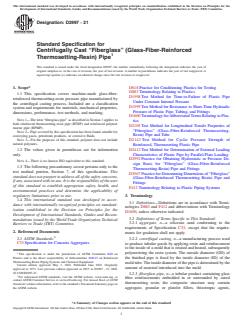
1.1 This specification covers machine-made glass-fiber-reinforced thermosetting-resin pressure pipe manufactured by the centrifugal casting process. Included are a classification system and requirements for materials, mechanical properties, dimensions, performance, test methods, and marking.
Note 1: The term “fiberglass pipe” as described in Section 3 applies to both reinforced thermosetting resin pipe (RTRP) and reinforced polymer mortar pipe (RPMP).
Note 2: Pipe covered by this specification has been found suitable for conveying gases, petroleum products, or corrosive fluids.
Note 3: For the purposes of this standard, polymer does not include natural polymers.
1.2 The values given in parentheses are for information only.
Note 4: There is no known ISO equivalent to this standard.
1.3 The following precautionary caveat pertains only to the test method portion, Section 7, of this specification: This standard does not purport to address all of the safety concerns, if any, associated with its use. It is the responsibility of the user of this standard to establish appropriate safety, health, and environmental practices and determine the applicability of regulatory limitations prior to use.
1.4 This international standard was developed in accordance with internationally recognized principles on standardization established in the Decision on Principles for the Development of International Standards, Guides and Recommendations issued by the World Trade Organization Technical Barriers to Trade (TBT) Committee.
- Status
- Published
- Publication Date
- 30-Apr-2021
- Technical Committee
- D20 - Plastics
Buy Documents
ASTM D2997-21 - Standard Specification for Centrifugally Cast “Fiberglass” (Glass-Fiber-Reinforced Thermosetting-Resin) Pipe
REDLINE ASTM D2997-21 - Standard Specification for Centrifugally Cast “Fiberglass” (Glass-Fiber-Reinforced Thermosetting-Resin) Pipe
Overview
ASTM D2997-21 is the Standard Specification for Centrifugally Cast “Fiberglass” (Glass-Fiber-Reinforced Thermosetting-Resin) Pipe. Developed by ASTM International, this specification covers machine-made, glass-fiber-reinforced thermosetting-resin pressure pipes manufactured by the centrifugal casting process. These fiberglass pipes are designed for use in applications requiring resistance to corrosion and pressure, making them ideal for transporting gases, petroleum products, and other corrosive fluids.
This standard provides a comprehensive framework covering the classification, materials, mechanical properties, dimensions, performance, testing, and marking requirements for centrifugally cast fiberglass (GFRP) pipe. It ensures consistency, reliability, and safety for both manufacturers and end-users.
Key Topics
- Product Scope: Applies to glass-fiber-reinforced, thermosetting-resin pipes manufactured by centrifugal casting, including both reinforced thermosetting resin pipe (RTRP) and reinforced polymer mortar pipe (RPMP).
- Applications: The pipe is suitable for conveying gases, petroleum products, and corrosive fluids in diverse industries due to its chemical resistance and high strength-to-weight ratio.
- Classification System: Categorizes pipes by type, grade, class, hydrostatic design basis (static or cyclic), and cell classification for mechanical properties, such as short-term rupture strength, tensile strength, tensile modulus, and pipe stiffness.
- Material Requirements: Specifies acceptable resins, reinforcements, fillers, and additives - natural polymers are excluded.
- Mechanical Properties: Outlines requirements for short-term rupture strength, longitudinal tensile strength, modulus, and stiffness to ensure reliable performance under long-term static or cyclic pressure.
- Dimensions and Tolerances: Provides strict tolerances for outside diameter, wall thickness, and liner thickness to ensure fit and performance.
- Workmanship: Mandates that the pipe must be free from visible defects such as bubbles, inclusions, or delamination.
- Testing and Certification: References test methods for physical properties, including hydrostatic pressure, tensile properties, and stiffness. Certification and marking protocols ensure traceability and conformance.
Applications
Fiberglass-reinforced thermosetting-resin pipes produced under ASTM D2997-21 are widely used in:
- Oil and Gas Industry: Safe transport of petroleum products due to superior chemical and pressure resistance.
- Chemical Processing: Conveyance of aggressive chemicals and corrosive fluids, leveraging the pipe’s non-reactive liner options.
- Water and Wastewater: Efficient handling of municipal and industrial fluids where corrosion resistance and durability are critical.
- Industrial Gases: Transport of gases under pressure, meeting demanding safety and performance requirements.
- General Industrial Use: Applications where lightweight, corrosion-resistant piping is essential, supporting long-term infrastructure reliability.
The specification’s detailed classification and performance requirements guide engineers and procurement teams in selecting piping systems that match their operational needs and compliance goals.
Related Standards
ASTM D2997-21 references and aligns with several related ASTM standards for terminology, testing, and materials, including:
- ASTM C33: Specification for Concrete Aggregates
- ASTM D618: Conditioning Plastics for Testing
- ASTM D883: Terminology Relating to Plastics
- ASTM D1598 and D1599: Test Methods for Pressure Resistance of Plastic Pipe
- ASTM D2105: Test Method for Longitudinal Tensile Properties
- ASTM D2143: Test Method for Cyclic Pressure Strength
- ASTM D2412: Method for Determining Pipe Stiffness
- ASTM D2992: Practice for Hydrostatic or Pressure Design Basis for Fiberglass Pipe
- ASTM D3567: Practice for Determining Pipe Dimensions
- ASTM F412: Terminology Relating to Plastic Piping Systems
There is currently no ISO equivalent for this standard, further establishing ASTM D2997-21 as a primary reference for fiberglass pipe manufactured by the centrifugal casting process.
By adhering to ASTM D2997-21, stakeholders ensure the selection of fiberglass pressure piping with documented performance, dimensional accuracy, and proven durability, making it a vital standard for industries prioritizing safety, longevity, and resistance to harsh environments.
Relations
- Effective Date
- 01-Feb-2024
- Effective Date
- 01-Nov-2023
- Effective Date
- 01-Apr-2020
- Effective Date
- 01-Jan-2020
- Effective Date
- 15-Nov-2019
- Effective Date
- 01-Aug-2019
- Effective Date
- 15-Apr-2019
- Effective Date
- 01-Feb-2019
- Effective Date
- 01-Jan-2019
- Effective Date
- 01-Dec-2018
- Effective Date
- 01-Nov-2018
- Effective Date
- 01-Sep-2018
- Refers
ASTM D1600-18 - Standard Terminology for Abbreviated Terms Relating to Plastics (Withdrawn 2024) - Effective Date
- 01-Jan-2018
- Effective Date
- 15-Aug-2017
- Effective Date
- 01-Aug-2017
Buy Documents
ASTM D2997-21 - Standard Specification for Centrifugally Cast “Fiberglass” (Glass-Fiber-Reinforced Thermosetting-Resin) Pipe
REDLINE ASTM D2997-21 - Standard Specification for Centrifugally Cast “Fiberglass” (Glass-Fiber-Reinforced Thermosetting-Resin) Pipe
Get Certified
Connect with accredited certification bodies for this standard

Institut za varilstvo d.o.o. (Welding Institute)
Slovenia's leading welding institute since 1952. ISO 3834, EN 1090, pressure equipment certification, NDT personnel, welder qualification. Only IIW Au
Sponsored listings
Frequently Asked Questions
ASTM D2997-21 is a technical specification published by ASTM International. Its full title is "Standard Specification for Centrifugally Cast “Fiberglass” (Glass-Fiber-Reinforced Thermosetting-Resin) Pipe". This standard covers: ABSTRACT This specification covers machine-made glass-fiber-reinforced thermosetting-resin pressure pipe manufactured by the centrifugal casting process. Pipe covered by this specification has been found suitable for conveying gases, petroleum products, or corrosive fluids. For the purposes of this standard, polymer does not include natural polymers. Pipe meeting this specification shall be categorized by the prescribed long-term static or cyclic hydrostatic design basis when tested. Additionally, the pipe shall meet the applicable cell limit requirements for short-term rupture strength, longitudinal tensile strength, tensile modulus, and pipe stiffness. SCOPE 1.1 This specification covers machine-made glass-fiber-reinforced thermosetting-resin pressure pipe manufactured by the centrifugal casting process. Included are a classification system and requirements for materials, mechanical properties, dimensions, performance, test methods, and marking. Note 1: The term “fiberglass pipe” as described in Section 3 applies to both reinforced thermosetting resin pipe (RTRP) and reinforced polymer mortar pipe (RPMP). Note 2: Pipe covered by this specification has been found suitable for conveying gases, petroleum products, or corrosive fluids. Note 3: For the purposes of this standard, polymer does not include natural polymers. 1.2 The values given in parentheses are for information only. Note 4: There is no known ISO equivalent to this standard. 1.3 The following precautionary caveat pertains only to the test method portion, Section 7, of this specification: This standard does not purport to address all of the safety concerns, if any, associated with its use. It is the responsibility of the user of this standard to establish appropriate safety, health, and environmental practices and determine the applicability of regulatory limitations prior to use. 1.4 This international standard was developed in accordance with internationally recognized principles on standardization established in the Decision on Principles for the Development of International Standards, Guides and Recommendations issued by the World Trade Organization Technical Barriers to Trade (TBT) Committee.
ABSTRACT This specification covers machine-made glass-fiber-reinforced thermosetting-resin pressure pipe manufactured by the centrifugal casting process. Pipe covered by this specification has been found suitable for conveying gases, petroleum products, or corrosive fluids. For the purposes of this standard, polymer does not include natural polymers. Pipe meeting this specification shall be categorized by the prescribed long-term static or cyclic hydrostatic design basis when tested. Additionally, the pipe shall meet the applicable cell limit requirements for short-term rupture strength, longitudinal tensile strength, tensile modulus, and pipe stiffness. SCOPE 1.1 This specification covers machine-made glass-fiber-reinforced thermosetting-resin pressure pipe manufactured by the centrifugal casting process. Included are a classification system and requirements for materials, mechanical properties, dimensions, performance, test methods, and marking. Note 1: The term “fiberglass pipe” as described in Section 3 applies to both reinforced thermosetting resin pipe (RTRP) and reinforced polymer mortar pipe (RPMP). Note 2: Pipe covered by this specification has been found suitable for conveying gases, petroleum products, or corrosive fluids. Note 3: For the purposes of this standard, polymer does not include natural polymers. 1.2 The values given in parentheses are for information only. Note 4: There is no known ISO equivalent to this standard. 1.3 The following precautionary caveat pertains only to the test method portion, Section 7, of this specification: This standard does not purport to address all of the safety concerns, if any, associated with its use. It is the responsibility of the user of this standard to establish appropriate safety, health, and environmental practices and determine the applicability of regulatory limitations prior to use. 1.4 This international standard was developed in accordance with internationally recognized principles on standardization established in the Decision on Principles for the Development of International Standards, Guides and Recommendations issued by the World Trade Organization Technical Barriers to Trade (TBT) Committee.
ASTM D2997-21 is classified under the following ICS (International Classification for Standards) categories: 23.040.20 - Plastics pipes. The ICS classification helps identify the subject area and facilitates finding related standards.
ASTM D2997-21 has the following relationships with other standards: It is inter standard links to ASTM D883-24, ASTM D883-23, ASTM F412-20, ASTM D883-20, ASTM D2105-01(2019), ASTM D883-19c, ASTM D883-19a, ASTM D883-19, ASTM F412-19, ASTM D883-18a, ASTM D883-18, ASTM D1599-18, ASTM D1600-18, ASTM D883-17, ASTM F412-17a. Understanding these relationships helps ensure you are using the most current and applicable version of the standard.
ASTM D2997-21 is available in PDF format for immediate download after purchase. The document can be added to your cart and obtained through the secure checkout process. Digital delivery ensures instant access to the complete standard document.
Standards Content (Sample)
This international standard was developed in accordance with internationally recognized principles on standardization established in the Decision on Principles for the
Development of International Standards, Guides and Recommendations issued by the World Trade Organization Technical Barriers to Trade (TBT) Committee.
Designation:D2997 −21
Standard Specification for
Centrifugally Cast “Fiberglass” (Glass-Fiber-Reinforced
Thermosetting-Resin) Pipe
This standard is issued under the fixed designation D2997; the number immediately following the designation indicates the year of
original adoption or, in the case of revision, the year of last revision.Anumber in parentheses indicates the year of last reapproval.A
superscript epsilon (´) indicates an editorial change since the last revision or reapproval.
1. Scope* D618Practice for Conditioning Plastics for Testing
D883Terminology Relating to Plastics
1.1 This specification covers machine-made glass-fiber-
D1598Test Method for Time-to-Failure of Plastic Pipe
reinforced thermosetting-resin pressure pipe manufactured by
Under Constant Internal Pressure
the centrifugal casting process. Included are a classification
D1599Test Method for Resistance to Short-Time Hydraulic
system and requirements for materials, mechanical properties,
Pressure of Plastic Pipe, Tubing, and Fittings
dimensions, performance, test methods, and marking.
D1600TerminologyforAbbreviatedTermsRelatingtoPlas-
NOTE1—Theterm“fiberglasspipe”asdescribedinSection3appliesto
tics
both reinforced thermosetting resin pipe (RTRP) and reinforced polymer
D2105Test Method for Longitudinal Tensile Properties of
mortar pipe (RPMP).
“Fiberglass” (Glass-Fiber-Reinforced Thermosetting-
NOTE 2—Pipe covered by this specification has been found suitable for
Resin) Pipe and Tube
conveying gases, petroleum products, or corrosive fluids.
NOTE 3—For the purposes of this standard, polymer does not include
D2143 Test Method for Cyclic Pressure Strength of
natural polymers.
Reinforced, Thermosetting Plastic Pipe
1.2 The values given in parentheses are for information D2412Test Method for Determination of External Loading
only. Characteristics of Plastic Pipe by Parallel-Plate Loading
D2992Practice for Obtaining Hydrostatic or Pressure De-
NOTE 4—There is no known ISO equivalent to this standard.
sign Basis for “Fiberglass” (Glass-Fiber-Reinforced
1.3 The following precautionary caveat pertains only to the
Thermosetting-Resin) Pipe and Fittings
test method portion, Section 7, of this specification: This
D3567PracticeforDeterminingDimensionsof“Fiberglass”
standard does not purport to address all of the safety concerns,
(Glass-Fiber-Reinforced Thermosetting Resin) Pipe and
if any, associated with its use. It is the responsibility of the user
Fittings
of this standard to establish appropriate safety, health, and
F412Terminology Relating to Plastic Piping Systems
environmental practices and determine the applicability of
regulatory limitations prior to use.
3. Terminology
1.4 This international standard was developed in accor-
3.1 Definitions—Definitions are in accordance with Termi-
dance with internationally recognized principles on standard-
nologies D883 and F412 and abbreviations with Terminology
ization established in the Decision on Principles for the
D1600, unless otherwise indicated.
Development of International Standards, Guides and Recom-
3.2 Definitions of Terms Specific to This Standard:
mendations issued by the World Trade Organization Technical
3.2.1 aggregate, n—a siliceous sand conforming to the
Barriers to Trade (TBT) Committee.
requirements of Specification C33, except that the require-
2. Referenced Documents
ments for gradation shall not apply.
2.1 ASTM Standards: 3.2.2 centrifugal casting, n—a manufacturing process used
C33Specification for Concrete Aggregates
to produce tubular goods by applying resin and reinforcement
to the inside of a mold that is rotated and heated, subsequently
1 polymerizing the resin system. The outside diameter (OD) of
This specification is under the jurisdiction of ASTM Committee D20 on
Plastics and is the direct responsibility of Subcommittee D20.23 on Reinforced the finished pipe is fixed by the inside diameter (ID) of the
Thermosetting Resin Piping Systems and Chemical Equipment.
moldtube.Theinsidediameterofthepipeisdeterminedbythe
Current edition approved May 1, 2021. Published June 2021. Originally
amount of material introduced into the mold.
approved in 1971. Last previous edition approved in 2015 as D2997–15. DOI:
10.1520/D2997-21.
3.2.3 fiberglass pipe, n—a tubular product containing glass
For referenced ASTM standards, visit the ASTM website, www.astm.org, or
fiber reinforcements embedded in or surrounded by cured
contact ASTM Customer Service at service@astm.org. For Annual Book of ASTM
thermosetting resin; the composite structure may contain
Standards volume information, refer to the standard’s Document Summary page on
the ASTM website. aggregate, granular or platelet fillers, thixotropic agents,
*A Summary of Changes section appears at the end of this standard
Copyright © ASTM International, 100 Barr Harbor Drive, PO Box C700, West Conshohocken, PA 19428-2959. United States
D2997−21
pigments, or dyes; thermoplastic or thermosetting liners or 4.1.5 Mechanical Properties—Table 2 presents a cell clas-
coatings may be included. sification system for identifying the mechanical properties of
pipe covered by this specification.
3.2.4 liner, n—theinnerportionofthewallatleast0.005in.
(0.13 mm) in thickness, as determined in 7.4 which does not
NOTE 6—All possible combinations covered by the preceding classifi-
contribute to the strength in the determination of the hydro-
cation system may not be commercially available.
static design basis.
4.1.6 Designation Code—The pipe designation code shall
3.2.5 reinforced polymer mortar pipe (RPMP), n—a fiber-
consist of the abbreviation RTRP or RPMP, followed by the
glass pipe with aggregate. typeandgradeinArabicnumerals,theclassandstaticorcyclic
hydrostaticdesignbasislevelincapitalletters,andfourArabic
3.2.6 reinforced thermosetting resin pipe (RTRP), n—afi-
numbers identifying, respectively, the cell classification desig-
berglass pipe without aggregate.
nations of the short-term rupture strength, longitudinal tensile
3.2.7 reinforced wall thickness, n—the total wall thickness
strength, tensile modulus, and pipe stiffness. Thus, a complete
minus the liner or exterior surface resin layer thickness, or
pipe designation code shall consist of four letters, two
both.
numerals, two letters, and four numerals.
4.1.6.1 Example—RTRP-21CA-1334. Such a designation
4. Classification
would describe a centrifugally cast, glass-fiber-reinforced,
4.1 General—Pipemeetingthisspecificationisclassifiedby
epoxy pipe having a nonreinforced epoxy liner; a long-term
type, grade, class, and hydrostatic design basis, and by a
cyclic pressure strength level exceeding 2500 psi (17.2 MPa);
secondary cell classification system that defines the basic
ashort-termrupturestrengthexceeding4000psi(27.6MPa);a
mechanicalpropertiesofthepipe.Thesetypes,grades,classes,
longitudinal tensile strength exceeding 16 000 psi (110 MPa);
hydrostatic design basis categories, and cell classification 6
a longitudinal tensile modulus exceeding 1.5 × 10 psi (10 300
designations are as follows:
MPa); and a pipe stiffness of 72 psi (496 kPa).
4.1.1 Types:—Type II
NOTE 7—Although the Form and Style for ASTM Standards manual
Centrifugally cast pipe.
requires that the type classification be roman numerals, it is recognized
4.1.2 Grades:—Grade 1
that few companies have stencil-cutting equipment for this style of type,
Glass-fiber-reinforced epoxy-resin pipe.
and it is therefore acceptable to mark the product type in arabic numbers.
Grade 2—Glass-fiber-reinforced polyester-resin pipe.
Grade 8—Glass-fiber-reinforced polyester-resin mortar
5. Materials
pipe.
5.1 General—The resins, reinforcements, colorants, fillers,
Grade 9—Glass fiber reinforced epoxy resin mortar pipe.
and other materials, when combined as a composite structure,
4.1.3 Classes:—Class A
shall produce a pipe that shall be classified in accordance to
No liner.
this specification based on performance.
Class B—Polyester-resin liner, nonreinforced.
Class C—Epoxy-resin liner, nonreinforced.
6. Requirements
NOTE5—Forthepurposesofthisclassification,polyesterresinincludes
6.1 Workmanship—The pipe shall be free from all defects,
vinylester resins, but the purchaser should consult with the manufacturer
to determine which resin is applicable for the specific conditions in which including indentations, delaminations, bubbles, pinholes, for-
the pipe will be used.
eign inclusions, and resin-starved areas which, as a result of
their nature, degree, or extent, detrimentally affect the strength
4.1.4 Hydrostatic Design Basis—Two methods of classify-
and serviceability of the pipe. The pipe shall be as uniform as
ing the hydrostatic design basis of the pipe are provided. Pipe
commercially practicable in color, opacity, density, and other
meeting this specification shall be classified using either the
physical properties. The pipe shall be round and straight, and
cyclic test method or the static test method, or both, and the
theboreofthepipeshallbesmoothanduniform.Allpipeends
designations are shown in Table 1. Appendix X1 explains how
shallbecutatrightanglestotheaxisofthepipe,andanysharp
to use the design basis categories shown in Table 1.
edges removed.
6.2 Dimensions and Tolerances:
TABLE 1 Hydrostatic Design Basis Categories
6.2.1 Outside Diameter—The outside diameter and toler-
Cyclic Test Method Static Test Method
ances of pipe meeting this specification shall conform to the
Hoop Stress, Hoop Stress,
requirements in Table 3, when determined in accordance with
Designation Designation
psi (MPa) psi (MPa)
7.4.
6.2.2 Wall Thickness—The minimum wall thickness of pipe
A 2500 (17.2) Q 5000 (34.5)
B 3150 (21.7) R 6300 (43.4) furnished under this specification shall not at any point be less
C 4000 (27.6) S 8000 (55.2)
than 87.5% of the nominal wall thickness published in the
D 5000 (34.5) T 10 000 (68.9)
manufacturer’sliterature,currentatthetimeofpurchase,when
E 6300 (43.4) U 12 500 (86.2)
measured in accordance with 7.4.
F 8000 (55.2) W 16 000 (110)
G 10 000 (68.9) X 20 000 (138)
6.2.3 LinerThickness—ExceptforClassAunlinedproducts,
H 12 500 (86.2) Y 25 000 (172)
all other cl
...
This document is not an ASTM standard and is intended only to provide the user of an ASTM standard an indication of what changes have been made to the previous version. Because
it may not be technically possible to adequately depict all changes accurately, ASTM recommends that users consult prior editions as appropriate. In all cases only the current version
of the standard as published by ASTM is to be considered the official document.
Designation: D2997 − 15 D2997 − 21
Standard Specification for
Centrifugally Cast “Fiberglass” (Glass-Fiber-Reinforced
Thermosetting-Resin) Pipe
This standard is issued under the fixed designation D2997; the number immediately following the designation indicates the year of
original adoption or, in the case of revision, the year of last revision. A number in parentheses indicates the year of last reapproval. A
superscript epsilon (´) indicates an editorial change since the last revision or reapproval.
1. Scope*
1.1 This specification covers machine-made glass-fiber-reinforced thermosetting-resin pressure pipe manufactured by the
centrifugal casting process. Included are a classification system and requirements for materials, mechanical properties, dimensions,
performance, test methods, and marking.
NOTE 1—The term “fiberglass pipe” as described in Section 3 applies to both reinforced thermosetting resin pipe (RTRP) and reinforced polymer mortar
pipe (RPMP).
NOTE 2—Pipe covered by this specification has been found suitable for conveying gases, petroleum products, or corrosive fluids.
NOTE 3—For the purposes of this standard, polymer does not include natural polymers.
1.2 The values given in parentheses are for information only.
NOTE 4—There is no known ISO equivalent to this standard.
1.3 The following precautionary caveat pertains only to the test method portion, Section 7, of this specification: This standard
does not purport to address all of the safety concerns, if any, associated with its use. It is the responsibility of the user of this
standard to establish appropriate safety, health, and environmental practices and determine the applicability of regulatory
limitations prior to use.
1.4 This international standard was developed in accordance with internationally recognized principles on standardization
established in the Decision on Principles for the Development of International Standards, Guides and Recommendations issued
by the World Trade Organization Technical Barriers to Trade (TBT) Committee.
2. Referenced Documents
2.1 ASTM Standards:
C33 Specification for Concrete Aggregates
D618 Practice for Conditioning Plastics for Testing
D883 Terminology Relating to Plastics
D1598 Test Method for Time-to-Failure of Plastic Pipe Under Constant Internal Pressure
D1599 Test Method for Resistance to Short-Time Hydraulic Pressure of Plastic Pipe, Tubing, and Fittings
This specification is under the jurisdiction of ASTM Committee D20 on Plastics and is the direct responsibility of Subcommittee D20.23 on Reinforced Plastic
Thermosetting Resin Piping Systems and Chemical Equipment.
Current edition approved May 1, 2015May 1, 2021. Published June 2015June 2021. Originally papprovedapproved in 1971. Last previous edition approved in 20072015
ε1
as D2997 – 01D2997 – 15.(2007) . DOI: 10.1520/D2997-15.10.1520/D2997-21.
For referenced ASTM standards, visit the ASTM website, www.astm.org, or contact ASTM Customer Service at service@astm.org. For Annual Book of ASTM Standards
volume information, refer to the standard’s Document Summary page on the ASTM website.
*A Summary of Changes section appears at the end of this standard
Copyright © ASTM International, 100 Barr Harbor Drive, PO Box C700, West Conshohocken, PA 19428-2959. United States
D2997 − 21
D1600 Terminology for Abbreviated Terms Relating to Plastics
D2105 Test Method for Longitudinal Tensile Properties of “Fiberglass” (Glass-Fiber-Reinforced Thermosetting-Resin) Pipe and
Tube
D2143 Test Method for Cyclic Pressure Strength of Reinforced, Thermosetting Plastic Pipe
D2412 Test Method for Determination of External Loading Characteristics of Plastic Pipe by Parallel-Plate Loading
D2992 Practice for Obtaining Hydrostatic or Pressure Design Basis for “Fiberglass” (Glass-Fiber-Reinforced Thermosetting-
Resin) Pipe and Fittings
D3567 Practice for Determining Dimensions of “Fiberglass” (Glass-Fiber-Reinforced Thermosetting Resin) Pipe and Fittings
F412 Terminology Relating to Plastic Piping Systems
3. Terminology
3.1 Definitions—Definitions are in accordance with Terminologies D883 and F412 and abbreviations with Terminology D1600,
unless otherwise indicated.
3.2 Definitions of Terms Specific to This Standard:
3.2.1 aggregate, n—a siliceous sand conforming to the requirements of Specification C33, except that the requirements for
gradation shall not apply.
3.2.2 centrifugal casting, n—a manufacturing process used to produce tubular goods by applying resin and reinforcement to the
inside of a mold that is rotated and heated, subsequently polymerizing the resin system. The outside diameter (OD) of the finished
pipe is fixed by the inside diameter (ID) of the mold tube. The inside diameter of the pipe is determined by the amount of material
introduced into the mold.
3.2.3 fiberglass pipe, n—a tubular product containing glassfiber glass fiber reinforcements embedded in or surrounded by cured
thermosetting resin; the composite structure may contain aggregate, granular or platelet fillers, thixotropic agents, pigments, or
dyes; thermoplastic or thermosetting liners or coatings may be included.
3.2.4 liner, n—the inner portion of the wall at least 0.005 in. (0.13 mm) in thickness, as determined in 7.4 which does not
contribute to the strength in the determination of the hydrostatic design basis.
3.2.5 reinforced polymer mortar pipe (RPMP), n—a fiberglass pipe with aggregate.
3.2.6 reinforced thermosetting resin pipe (RTRP), n—a fiberglass pipe without aggregate.
3.2.7 reinforced wall thickness, n—the total wall thickness minus the liner or exterior surface resin layer thickness, or both.
4. Classification
4.1 General—Pipe meeting this specification is classified by type, grade, class, and hydrostatic design basis, and by a secondary
cell classification system that defines the basic mechanical properties of the pipe. These types, grades, classes, hydrostatic design
basis categories, and cell classification designations are as follows:
4.1.1 Types:—Type II
Centrifugally cast pipe.
4.1.2 Grades:—Grade 1
Glass-fiber-reinforced epoxy-resin pipe.
Grade 2—Glass-fiber-reinforced polyester-resin pipe.
Grade 3—Glass-fiber reinforced polydicyclopentadiene-resin pipe.
Grade 8—Glass-fiber-reinforced polyester-resin mortar pipe.
Grade 9—Glass fiber reinforced epoxy resin mortar pipe.
4.1.3 Classes:—Class A
No liner.
Class B—Polyester-resin liner, nonreinforced.
Class C—Epoxy-resin liner, nonreinforced.
D2997 − 21
Class D—Polydicyclopentadiene-resin liner, nonreinforced.
NOTE 5—For the purposes of this classification, polyester resin includes vinylester resins, but the purchaser should consult with the manufacturer to
determine which resin is applicable for the specific conditions in which the pipe will be used.
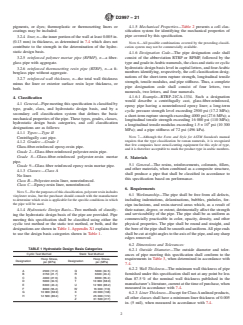
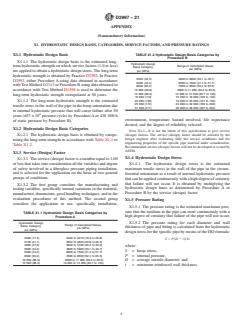
4.1.4 Hydrostatic Design Basis—Two methods of classifying the hydrostatic design basis of the pipe are provided. Pipe meeting
this specification shall be classified using either the cyclic test method or the static test method, or both, and the designations are
shown in Table 1. Appendix X1 explains how to use the design basis categories shown in Table 1.
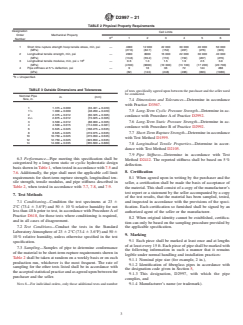
4.1.5 Mechanical Properties—Table 2 presents a cell classification system for identifying the mechanical properties of pipe
covered by this specification.
NOTE 6—All possible combinations covered by the preceding classification system may not be commercially available.
4.1.6 Designation Code—The pipe designation code shall consist of the abbreviation RTRP or RPMP, followed by the type and
grade in Arabic numerals, the class and static or cyclic hydrostatic design basis level in capital letters, and four Arabic numbers
identifying, respectively, the cell classification designations of the short-term rupture strength, longitudinal tensile strength, tensile
modulus, and pipe stiffness. Thus, a complete pipe designation code shall consist of four letters, two numerals, two letters, and four
numerals.
4.1.6.1 Example—RTRP-21CA-1334. Such a designation would describe a centrifugally cast, glass-fiber-reinforced, epoxy pipe
having a nonreinforced epoxy liner; a long-term cyclic pressure strength level exceeding 2500 psi (17.2 MPa); a short-term rupture
strength exceeding 4000 psi (27.6 MPa); a longitudinal tensile strength exceeding 16 000 psi (110 MPa); a longitudinal tensile
modulus exceeding 1.5 × 10 psi (10 300 MPa); and a pipe stiffness of 72 psi (496 kPa).
NOTE 7—Although the Form and Style for ASTM Standards manual requires that the type classification be roman numerals, it is recognized that few
companies have stencil-cutting equipment for this style of type, and it is therefore acceptable to mark the product type in arabic numbers.
5. Materials
5.1 General—The resins, reinforcements, colorants, fillers, and other materials, when combined as a composite structure, shall
produce a pipe that shall be classified in accordance to this specification based on performance.
6. Requirements
6.1 Workmanship—The pipe shall be free from all defects, including indentations, delaminations, bubbles, pinholes, foreign
inclusions, and resin-starved areas which, as a result of their nature, degree, or extent, detrimentally affect the strength and
serviceability of the pipe. The pipe shall be as uniform as commercially practicable in color, opacity, density, and other physical
properties. The pipe shall be round and straight, and the bore of the pipe shall be smooth and uniform. All pipe ends shall be cut
at right angles to the axis of the pipe, and any sharp edges removed.
6.2 Dimensions and Tolerances:
TABLE 1 Hydrostatic Design Basis Categories
Cyclic Test Method Static Test Method
Hoop Stress, Hoop Stress,
Designation Designation
psi (MPa) psi (MPa)
A 2500 (17.2) Q 5000 (34.5)
B 3150 (21.7) R 6300 (43.4)
C 4000 (27.6) S 8000 (55.2)
D 5000 (34.5) T 10 000 (68.9)
E 6300 (43.4) U 12 500 (86.2)
F 8000 (55.2) W 16 000 (110)
G 10 000 (68.9) X 20 000 (138)
H 12 500 (86.2) Y 25 000 (172)
X 31 500 (217)
Z 31 500 (217)
D2997 − 21
TABLE 2 Physical Property Requirements
Designation
Cell Limits
Order Mechanical Property
A
0 1 2 3 4 5 6
Number
1 Short time rupture strength hoop tensile stress, min, psi — 4000 12 000 22 000 30 000 40 000 50 000
(MPa) (27.6) (82.7) (152) (207) (276) (345)
2 Longitudinal tensile strength, min, psi — 2000 8000 16 000 22 000 30 000 40 000
(MPa) (13.8) (55.2) (110) (152) (207) (276)
3 Longitudinal tensile modulus, min, psi × 10 — 0.6 1.3 1.5
...