

ASTM D2281-10(2024)
(Test Method)Standard Test Method for Evaluation of Wetting Agents by the Skein Test
General Information
- Abstract
ABSTRACT
This test method covers the determination of the efficiency of ordinary commercial wetting agents using the skein test. It is applicable under limited and controlled conditions, but does not necessarily yield information correlating with specific end uses. The apparatus is comprised of a hook of standard weight depending on the concentration of the wetting agents and an anchor which shall be a flat, cylindrical, lead slug of specific dimensions. The reagents shall consist of water, acid and base test solutions, and wetting agent. The average of at least four determinations of the sinking time for each concentration of wetting agent shall be obtained and presented in plots with logarithmic coordinates. Standard deviation based on six replicate determinations shall also be calculated for precision.
SCOPE
1.1 This test method2,3 covers the determination of the efficiency of ordinary commercial wetting agents as defined in Terminology D459. This test method is applicable under limited and controlled conditions, but does not necessarily yield information correlating with specific end uses.
1.2 The values stated in inch-pound units are to be regarded as standard. The values given in parentheses are mathematical conversions to SI units that are provided for information only and are not considered standard.
1.3 This standard does not purport to address all of the safety concerns, if any, associated with its use. It is the responsibility of the user of this standard to establish appropriate safety, health, and environmental practices and determine the applicability of regulatory limitations prior to use.
1.4 This international standard was developed in accordance with internationally recognized principles on standardization established in the Decision on Principles for the Development of International Standards, Guides and Recommendations issued by the World Trade Organization Technical Barriers to Trade (TBT) Committee.
- Status
- Published
- Publication Date
- 31-Dec-2023
- Technical Committee
- D12 - Soaps and Other Detergents
- Drafting Committee
- D12.15 - Physical Testing


Overview
ASTM D2281-10(2024): Standard Test Method for Evaluation of Wetting Agents by the Skein Test establishes a consistent, reproducible procedure for assessing the efficiency of commercial wetting agents. This standard, maintained by ASTM International, is widely utilized in industries requiring reliable wetting performance, including textiles, detergents, and cleaning products. The skein test provides a direct method to compare different wetting agents under controlled laboratory conditions, focusing on the sinking time of a weighted cotton skein in a solution containing the agent being tested.
Key Topics
- Test Objective: The skein test measures the time a standardized cotton skein takes to fully sink in a solution with a specified concentration of a wetting agent, helping determine and compare the efficiency of various commercial wetting agents.
- Controlled Conditions: The method applies under defined and controlled laboratory conditions. Results may not always correlate directly with performance in specific end uses but are ideal for comparative evaluation.
- Required Apparatus:
- Hook (standardized weight, corrosion-resistant material)
- Anchor (flat, cylindrical lead slug of specified size and weight)
- Graduated cylinder and temperature control equipment
- Weighted cotton skeins
- Reagents & Solutions: Utilizes distilled or deionized water, acid/base solutions as needed, and commercial wetting agent solutions prepared in varying concentrations (commonly 0.05%–0.5%).
- Test Procedure Highlights:
- The skein is attached to the hook and anchor, twisted, and introduced into the wetting solution at controlled temperature.
- Sinking time is measured, indicating the speed and effectiveness of the wetting agent.
- Standardization of sample temperature (25°C to 90°C) ensures comparability.
- The test is repeated for statistical validity-averages and standard deviations are reported.
Applications
The ASTM D2281-10(2024) skein test is broadly applied in:
- Formulation and Quality Control: Used by manufacturers of wetting agents and detergents to benchmark products for wetting efficiency and optimize formulations.
- Comparative Performance Testing: Enables side-by-side comparisons of different surfactants or detergent additives under identical laboratory conditions.
- Textile and Cleaning Industries: Particularly relevant for textiles, where effective wetting is critical for processes such as dyeing, washing, or finishing.
- Research and Development: Supports the evaluation of novel wetting agents, particularly during product development or improvement phases.
- Educational and Laboratory Practice: Provides a standardized approach for training and academic studies related to surfactant behavior.
The method facilitates objective data presentation, including average sinking times, standard deviation, and essential test conditions, supporting transparent reporting and reproducible results.
Related Standards
ASTM D459 – Terminology Relating to Soaps and Other Detergents
Provides critical definitions and terminology referenced in the D2281 test method.American Association of Textile Chemists and Colorists (AATCC) TM 17
Similar physical test method for evaluating wetting agents used as a basis for ASTM D2281.ISO and Other National Standards:
While ASTM D2281 is internationally recognized, other regional standards may offer related or comparable test methods for surfactant and wetting agent evaluation.
Conclusion
ASTM D2281-10(2024) delivers a consistent framework for evaluating wetting agent efficiency via the skein test, ensuring comparability, repeatability, and objectivity in industrial and research contexts. Adherence to this standard helps manufacturers, quality control laboratories, and researchers assess product performance, optimize formulations, and demonstrate compliance with best-practice testing protocols. For further information or referenced documents, consult the ASTM website or relevant industry resources.
Relations
- Replaces
ASTM D2281-10(2016) - Standard Test Method for Evaluation of Wetting Agents by the Skein Test - Effective Date
- 01-Jan-2024
Get Certified
Connect with accredited certification bodies for this standard

ECOCERT
Organic and sustainability certification.

Eurofins Food Testing Global
Global leader in food, environment, and pharmaceutical product testing.

Intertek Bangladesh
Intertek certification and testing services in Bangladesh.
Sponsored listings
Frequently Asked Questions
ASTM D2281-10(2024) is a standard published by ASTM International. Its full title is "Standard Test Method for Evaluation of Wetting Agents by the Skein Test". This standard covers: ABSTRACT This test method covers the determination of the efficiency of ordinary commercial wetting agents using the skein test. It is applicable under limited and controlled conditions, but does not necessarily yield information correlating with specific end uses. The apparatus is comprised of a hook of standard weight depending on the concentration of the wetting agents and an anchor which shall be a flat, cylindrical, lead slug of specific dimensions. The reagents shall consist of water, acid and base test solutions, and wetting agent. The average of at least four determinations of the sinking time for each concentration of wetting agent shall be obtained and presented in plots with logarithmic coordinates. Standard deviation based on six replicate determinations shall also be calculated for precision. SCOPE 1.1 This test method2,3 covers the determination of the efficiency of ordinary commercial wetting agents as defined in Terminology D459. This test method is applicable under limited and controlled conditions, but does not necessarily yield information correlating with specific end uses. 1.2 The values stated in inch-pound units are to be regarded as standard. The values given in parentheses are mathematical conversions to SI units that are provided for information only and are not considered standard. 1.3 This standard does not purport to address all of the safety concerns, if any, associated with its use. It is the responsibility of the user of this standard to establish appropriate safety, health, and environmental practices and determine the applicability of regulatory limitations prior to use. 1.4 This international standard was developed in accordance with internationally recognized principles on standardization established in the Decision on Principles for the Development of International Standards, Guides and Recommendations issued by the World Trade Organization Technical Barriers to Trade (TBT) Committee.
ABSTRACT This test method covers the determination of the efficiency of ordinary commercial wetting agents using the skein test. It is applicable under limited and controlled conditions, but does not necessarily yield information correlating with specific end uses. The apparatus is comprised of a hook of standard weight depending on the concentration of the wetting agents and an anchor which shall be a flat, cylindrical, lead slug of specific dimensions. The reagents shall consist of water, acid and base test solutions, and wetting agent. The average of at least four determinations of the sinking time for each concentration of wetting agent shall be obtained and presented in plots with logarithmic coordinates. Standard deviation based on six replicate determinations shall also be calculated for precision. SCOPE 1.1 This test method2,3 covers the determination of the efficiency of ordinary commercial wetting agents as defined in Terminology D459. This test method is applicable under limited and controlled conditions, but does not necessarily yield information correlating with specific end uses. 1.2 The values stated in inch-pound units are to be regarded as standard. The values given in parentheses are mathematical conversions to SI units that are provided for information only and are not considered standard. 1.3 This standard does not purport to address all of the safety concerns, if any, associated with its use. It is the responsibility of the user of this standard to establish appropriate safety, health, and environmental practices and determine the applicability of regulatory limitations prior to use. 1.4 This international standard was developed in accordance with internationally recognized principles on standardization established in the Decision on Principles for the Development of International Standards, Guides and Recommendations issued by the World Trade Organization Technical Barriers to Trade (TBT) Committee.
ASTM D2281-10(2024) is classified under the following ICS (International Classification for Standards) categories: 71.100.40 - Surface active agents. The ICS classification helps identify the subject area and facilitates finding related standards.
ASTM D2281-10(2024) has the following relationships with other standards: It is inter standard links to ASTM D2281-10(2016). Understanding these relationships helps ensure you are using the most current and applicable version of the standard.
ASTM D2281-10(2024) is available in PDF format for immediate download after purchase. The document can be added to your cart and obtained through the secure checkout process. Digital delivery ensures instant access to the complete standard document.
Standards Content (Sample)
This international standard was developed in accordance with internationally recognized principles on standardization established in the Decision on Principles for the
Development of International Standards, Guides and Recommendations issued by the World Trade Organization Technical Barriers to Trade (TBT) Committee.
Designation: D2281 − 10 (Reapproved 2024)
Standard Test Method for
Evaluation of Wetting Agents by the Skein Test
This standard is issued under the fixed designation D2281; the number immediately following the designation indicates the year of
original adoption or, in the case of revision, the year of last revision. A number in parentheses indicates the year of last reapproval. A
superscript epsilon (´) indicates an editorial change since the last revision or reapproval.
1. Scope dissolved in water. The time required for the cotton skein to
2,3
wet through and sink, relaxing the string stirrup to which it is
1.1 This test method covers the determination of the
attached will be recorded as the sinking time. This time relates
efficiency of ordinary commercial wetting agents as defined in
to the speed at which the wetting agent works and can be used
Terminology D459. This test method is applicable under
to compare agents.
limited and controlled conditions, but does not necessarily
yield information correlating with specific end uses.
4. Apparatus
1.2 The values stated in inch-pound units are to be regarded
4.1 Hook and Anchor:
as standard. The values given in parentheses are mathematical
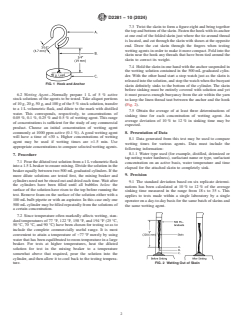
4.1.1 The hook of a standard weight and the attached anchor
conversions to SI units that are provided for information only
shall be prepared as follows: Bend a piece of No. 10 B&S
and are not considered standard.
gauge copper wire about 2 ⁄16 in. (14.1 mm) long into the form
1.3 This standard does not purport to address all of the
of a hook as illustrated by A in Fig. 1 and then adjust the weight
safety concerns, if any, associated with its use. It is the
of the bent hook to exactly 3.0 g. Nickel, silver, and stainless
responsibility of the user of this standard to establish appro-
steel wire are even more suitable than copper for this purpose
priate safety, health, and environmental practices and deter-
because they are more corrosion resistant. The anchor, C, shall
mine the applicability of regulatory limitations prior to use.
be a flat, cylindrical, lead slug with a minimum weight of 40 g
1.4 This international standard was developed in accor-
and shall have a diameter of 1 in. (25 mm) and a thickness of
dance with internationally recognized principles on standard-
about ⁄16 in. (4.7 mm). In the center of the anchor solder a loop
ization established in the Decision on Principles for the
of wire to serve as a small ring, or eye, for attaching the anchor
Development of International Standards, Guides and Recom-
to the hook with a fine linen thread, B, at a distance apart of ⁄4
mendations issued by the World Trade Organization Technical
in. (19 mm). If many products are to be tested, prepare at least
Barriers to Trade (TBT) Committee.
two hooks and anchors.
4.1.2 In the comparison of wetting agents a trial must be run
2. Referenced Documents
to determine the surfactant concentration to give a meaningful
2.1 ASTM Standards:
result for sinking times between 1 min or less.
D459 Terminology Relating to Soaps and Other Detergents
5. Test Skein
3. Summary of Test Method
5.1 Test skeins for running the wetting evaluation can be
3.1 A weighted cotton test skein is dropped into a tall
purchased from an appropriate supplier. A Draves 40/2, 5 g
cylinder containing a wetting agent of known concentration
cotton skein is used for this testing method.
This test method is under the jurisdiction of ASTM Committee D12 on Soaps
6. Reagents
and Other Detergents and is the direct responsibility of Subcommittee D12.15 on
Physical Testing.
6.1 Water—The quality of the water used in the testing of
Current edition approved Jan. 1, 2024. Published January 2024. Originally
wetting agents must be given careful consideration. The stock
approved in 1964. Last previous edition approved in 2016 as D2281 – 10 (2016).
solution is best prepared with distilled or deionized water.
DOI: 10.1520/D2281-10R24.
This test method is based on the American Association of Textile Chemists and When it is not known under what conditions the wetting agent
Colorists Technical Manual, Test Methods—Physical Properties, Wetting Agents,
is to be employed, distilled or deionized water may likewise be
Evaluation of, Standard Test Method 17 – 1952, Vol XXXIX, 1963, pp. B-133-B-
used for final solution.
135, which is also American National Standard L 14.11 – 1956 of the American
National Standards Institute.
Draves, C. Z., and Clarkson, R. G., “A New Method for the Evaluation of
Wetting Agents,” American Dyestuff Reporter, Vol 20, 1931, pp. 201–208. The sole source of supply of the apparatus known to the committee at this time
For referenced ASTM standards, visit the ASTM website, www.astm.org, or is Testfabrics, Inc., 415 Delaware Ave. P.O. Box 26, West Pittston, PA 18643. If you
contact ASTM Customer Service at service@astm.org. For Annual Book of ASTM are aware of alternative suppliers, please provide this information to ASTM
Standards volume information, refer to the standard’s Document Summary page on Headquarters. Your comments will receive careful consideration at a meeting of the
the ASTM website. responsible technical committee, which you may attend.
Copyright © ASTM International, 100 Barr Harbor Drive, PO Box C700, West Conshohocken, PA 19428-2959. United States
---------------------
...