


ASTM D7039-15a(2020)
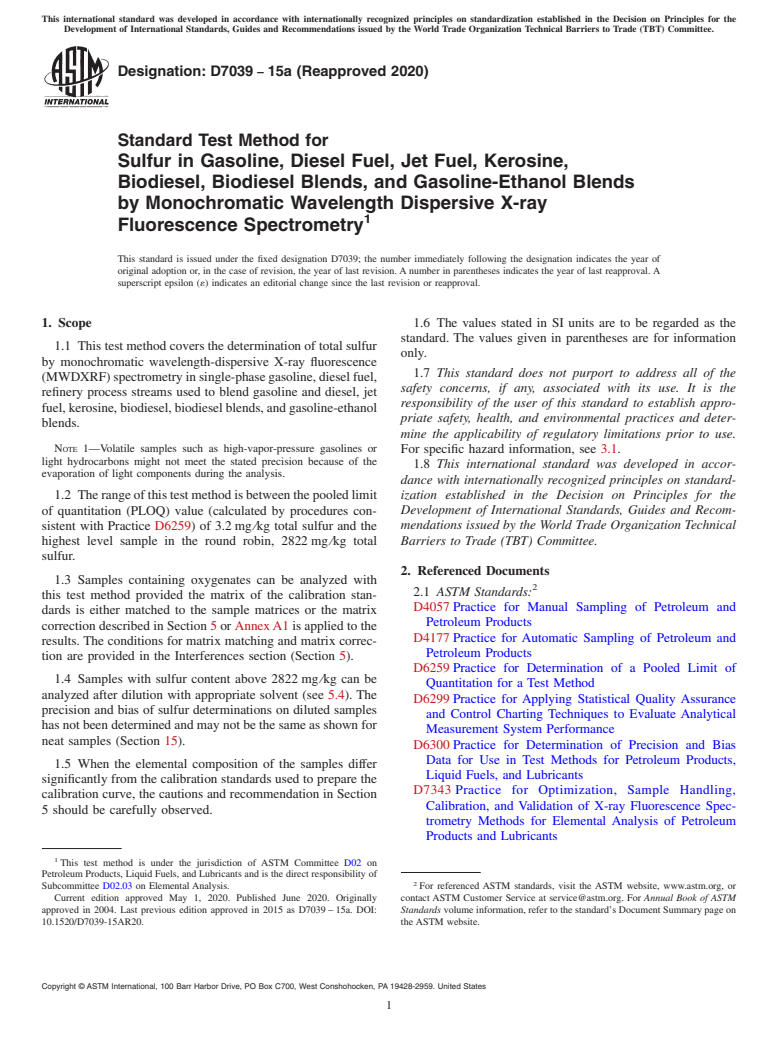
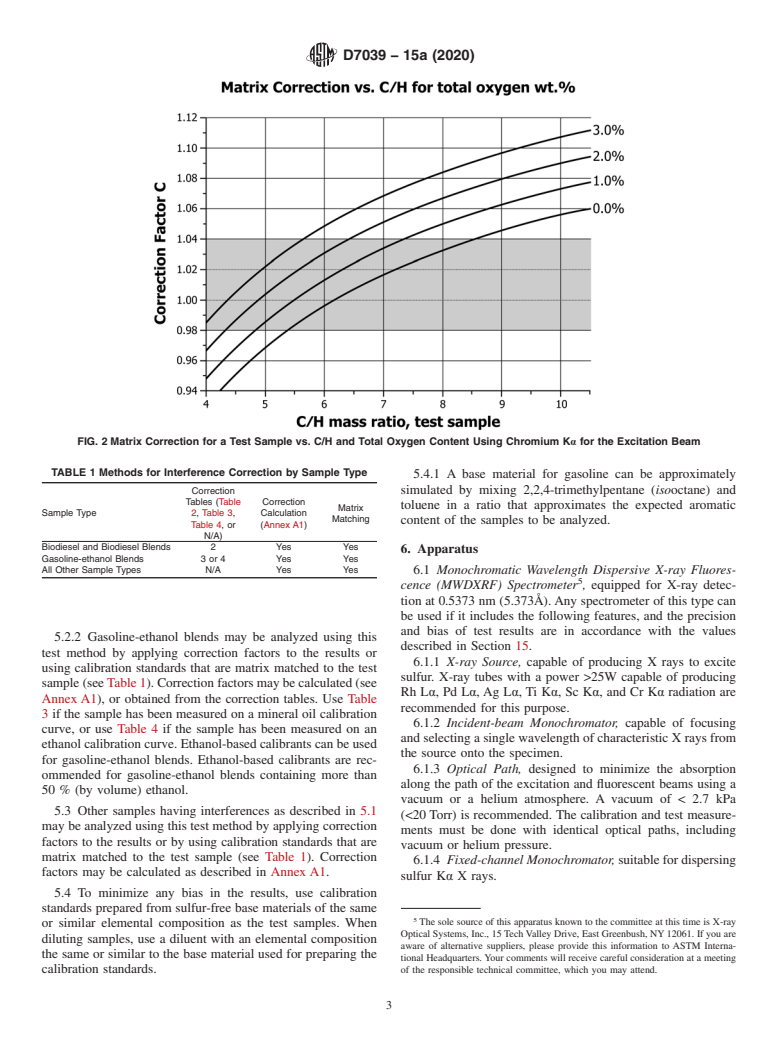
(Test Method)Standard Test Method for Sulfur in Gasoline, Diesel Fuel, Jet Fuel, Kerosine, Biodiesel, Biodiesel Blends, and Gasoline-Ethanol Blends by Monochromatic Wavelength Dispersive X-ray Fluorescence Spectrometry
Standard Test Method for Sulfur in Gasoline, Diesel Fuel, Jet Fuel, Kerosine, Biodiesel, Biodiesel Blends, and Gasoline-Ethanol Blends by Monochromatic Wavelength Dispersive X-ray Fluorescence Spectrometry
SIGNIFICANCE AND USE
4.1 This test method provides for the precise measurement of the total sulfur content of samples within the scope of this test method with minimal sample preparation and analyst involvement. The typical time for each analysis is five minutes.
4.2 Knowledge of the sulfur content of diesel fuels, gasolines, and refinery process streams used to blend gasolines is important for process control as well as the prediction and control of operational problems such as unit corrosion and catalyst poisoning, and in the blending of products to commodity specifications.
4.3 Various federal, state, and local agencies regulate the sulfur content of some petroleum products, including gasoline and diesel fuel. Unbiased and precise determination of sulfur in these products is critical to compliance with regulatory standards.
SCOPE
1.1 This test method covers the determination of total sulfur by monochromatic wavelength-dispersive X-ray fluorescence (MWDXRF) spectrometry in single-phase gasoline, diesel fuel, refinery process streams used to blend gasoline and diesel, jet fuel, kerosine, biodiesel, biodiesel blends, and gasoline-ethanol blends.
Note 1: Volatile samples such as high-vapor-pressure gasolines or light hydrocarbons might not meet the stated precision because of the evaporation of light components during the analysis.
1.2 The range of this test method is between the pooled limit of quantitation (PLOQ) value (calculated by procedures consistent with Practice D6259) of 3.2 mg/kg total sulfur and the highest level sample in the round robin, 2822 mg/kg total sulfur.
1.3 Samples containing oxygenates can be analyzed with this test method provided the matrix of the calibration standards is either matched to the sample matrices or the matrix correction described in Section 5 or Annex A1 is applied to the results. The conditions for matrix matching and matrix correction are provided in the Interferences section (Section 5).
1.4 Samples with sulfur content above 2822 mg/kg can be analyzed after dilution with appropriate solvent (see 5.4). The precision and bias of sulfur determinations on diluted samples has not been determined and may not be the same as shown for neat samples (Section 15).
1.5 When the elemental composition of the samples differ significantly from the calibration standards used to prepare the calibration curve, the cautions and recommendation in Section 5 should be carefully observed.
1.6 The values stated in SI units are to be regarded as the standard. The values given in parentheses are for information only.
1.7 This standard does not purport to address all of the safety concerns, if any, associated with its use. It is the responsibility of the user of this standard to establish appropriate safety, health, and environmental practices and determine the applicability of regulatory limitations prior to use. For specific hazard information, see 3.1.
1.8 This international standard was developed in accordance with internationally recognized principles on standardization established in the Decision on Principles for the Development of International Standards, Guides and Recommendations issued by the World Trade Organization Technical Barriers to Trade (TBT) Committee.
General Information
Buy Standard
Standards Content (Sample)
This international standard was developed in accordance with internationally recognized principles on standardization established in the Decision on Principles for the
Development of International Standards, Guides and Recommendations issued by the World Trade Organization Technical Barriers to Trade (TBT) Committee.
Designation: D7039 − 15a (Reapproved 2020)
Standard Test Method for
Sulfur in Gasoline, Diesel Fuel, Jet Fuel, Kerosine,
Biodiesel, Biodiesel Blends, and Gasoline-Ethanol Blends
by Monochromatic Wavelength Dispersive X-ray
1
Fluorescence Spectrometry
This standard is issued under the fixed designation D7039; the number immediately following the designation indicates the year of
original adoption or, in the case of revision, the year of last revision. A number in parentheses indicates the year of last reapproval. A
superscript epsilon (´) indicates an editorial change since the last revision or reapproval.
1. Scope 1.6 The values stated in SI units are to be regarded as the
standard. The values given in parentheses are for information
1.1 This test method covers the determination of total sulfur
only.
by monochromatic wavelength-dispersive X-ray fluorescence
1.7 This standard does not purport to address all of the
(MWDXRF)spectrometryinsingle-phasegasoline,dieselfuel,
safety concerns, if any, associated with its use. It is the
refinery process streams used to blend gasoline and diesel, jet
responsibility of the user of this standard to establish appro-
fuel,kerosine,biodiesel,biodieselblends,andgasoline-ethanol
priate safety, health, and environmental practices and deter-
blends.
mine the applicability of regulatory limitations prior to use.
NOTE 1—Volatile samples such as high-vapor-pressure gasolines or
For specific hazard information, see 3.1.
light hydrocarbons might not meet the stated precision because of the
1.8 This international standard was developed in accor-
evaporation of light components during the analysis.
dance with internationally recognized principles on standard-
1.2 Therangeofthistestmethodisbetweenthepooledlimit ization established in the Decision on Principles for the
of quantitation (PLOQ) value (calculated by procedures con- Development of International Standards, Guides and Recom-
sistent with Practice D6259) of 3.2 mg⁄kg total sulfur and the mendations issued by the World Trade Organization Technical
highest level sample in the round robin, 2822 mg⁄kg total Barriers to Trade (TBT) Committee.
sulfur.
2. Referenced Documents
1.3 Samples containing oxygenates can be analyzed with
2
2.1 ASTM Standards:
this test method provided the matrix of the calibration stan-
D4057 Practice for Manual Sampling of Petroleum and
dards is either matched to the sample matrices or the matrix
Petroleum Products
correction described in Section 5 or AnnexA1 is applied to the
D4177 Practice for Automatic Sampling of Petroleum and
results. The conditions for matrix matching and matrix correc-
Petroleum Products
tion are provided in the Interferences section (Section 5).
D6259 Practice for Determination of a Pooled Limit of
1.4 Samples with sulfur content above 2822 mg⁄kg can be
Quantitation for a Test Method
analyzed after dilution with appropriate solvent (see 5.4). The
D6299 Practice for Applying Statistical Quality Assurance
precision and bias of sulfur determinations on diluted samples
and Control Charting Techniques to Evaluate Analytical
has not been determined and may not be the same as shown for
Measurement System Performance
neat samples (Section 15).
D6300 Practice for Determination of Precision and Bias
Data for Use in Test Methods for Petroleum Products,
1.5 When the elemental composition of the samples differ
Liquid Fuels, and Lubricants
significantly from the calibration standards used to prepare the
D7343 Practice for Optimization, Sample Handling,
calibration curve, the cautions and recommendation in Section
Calibration, and Validation of X-ray Fluorescence Spec-
5 should be carefully observed.
trometry Methods for Elemental Analysis of Petroleum
Products and Lubricants
1
This test method is under the jurisdiction of ASTM Committee D02 on
Petroleum Products, Liquid Fuels, and Lubricants and is the direct responsibility of
2
Subcommittee D02.03 on Elemental Analysis. For referenced ASTM standards, visit the ASTM website, www.astm.org, or
Current edition approved May 1, 2020. Published June 2020. Originally contact ASTM Customer Service at service@astm.org. For Annual Book of ASTM
approved in 2004. Last previous edition approved in 2015 as D7039 – 15a. DOI: Standards volume information, refer to the standard’s Document Summary page on
10.1520/D7039-15AR20. the ASTM website.
Copyright © ASTM International, 100 Barr Harbor Drive, PO Box C700, West Conshohocken, PA 19428-2959. United States
1
---------------------- Page: 1 ----------------------
D7039 − 15a (2020)
FIG. 1 Schematic of the MWDXRF Analyzer
3
2.2 EPA Documents: catalyst poisoning, and in the blending of products to com-
4
...
Questions, Comments and Discussion
Ask us and Technical Secretary will try to provide an answer. You can facilitate discussion about the standard in here.