

ASTM D5931-20
(Test Method)Standard Test Method for Density and Relative Density of Engine Coolant Concentrates and Aqueous Engine Coolants by Digital Density Meter
General Information
- Abstract
SIGNIFICANCE AND USE
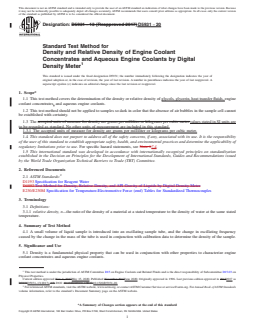
5.1 Density is a fundamental physical property that can be used in conjunction with other properties to characterize engine coolant concentrates and aqueous engine coolants.
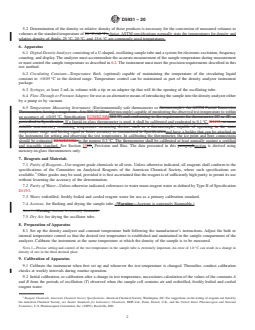
5.2 Determination of the density or relative density of these products is necessary for the conversion of measured volumes to volumes at the standard temperature of choice. ASTM specifications normally state the temperatures for density and relative density of fluids; 25 °C, 20 °C, and 15.6 °C are commonly used temperatures.
SCOPE
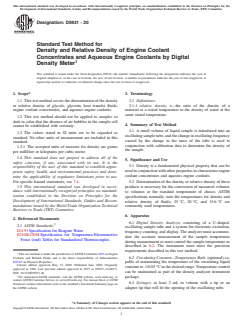
1.1 This test method covers the determination of the density or relative density of glycols, glycerin, heat transfer fluids, engine coolant concentrates, and aqueous engine coolants.
1.2 This test method should not be applied to samples so dark in color that the absence of air bubbles in the sample cell cannot be established with certainty.
1.3 The values stated in SI units are to be regarded as standard. No other units of measurement are included in this standard.
1.3.1 The accepted units of measure for density are grams per milliliter or kilograms per cubic meter.
1.4 This standard does not purport to address all of the safety concerns, if any, associated with its use. It is the responsibility of the user of this standard to establish appropriate safety, health, and environmental practices and determine the applicability of regulatory limitations prior to use. For specific hazard statements, see 7.4.
1.5 This international standard was developed in accordance with internationally recognized principles on standardization established in the Decision on Principles for the Development of International Standards, Guides and Recommendations issued by the World Trade Organization Technical Barriers to Trade (TBT) Committee.
- Status
- Published
- Publication Date
- 14-May-2020
- Technical Committee
- D15 - Engine Coolants and Related Fluids
- Drafting Committee
- D15.03 - Physical Properties
Buy Documents
ASTM D5931-20 - Standard Test Method for Density and Relative Density of Engine Coolant Concentrates and Aqueous Engine Coolants by Digital Density Meter
REDLINE ASTM D5931-20 - Standard Test Method for Density and Relative Density of Engine Coolant Concentrates and Aqueous Engine Coolants by Digital Density Meter
Overview
ASTM D5931-20, titled "Standard Test Method for Density and Relative Density of Engine Coolant Concentrates and Aqueous Engine Coolants by Digital Density Meter," is published by ASTM International. This standard specifies procedures for determining the density and relative density of engine coolant concentrates, aqueous engine coolants, glycols, glycerin, and heat transfer fluids using a digital density meter. Precise measurement of density is essential for characterizing coolants, ensuring quality, and facilitating accurate volume conversions at standard temperatures. The method ensures that measurements are conducted under controlled conditions, using accepted SI units of grams per milliliter or kilograms per cubic meter. The standard emphasizes quality control, calibration, and the need for homogeneous sampling to achieve reliable and consistent results.
Key Topics
- Density and Relative Density Measurement: The standard outlines the determination of both the absolute density and the relative density (ratio of sample density to water density at a given temperature).
- Digital Density Meter Usage: The procedure relies on using a digital density analyzer with an oscillating sample tube, ensuring precise and repeatable measurements.
- Sample Requirements: Only homogeneous, bubble-free, and appropriately colored samples are suitable for testing, as clarity is necessary for accuracy.
- Temperature Calibration: The method requires strict temperature control, typically at 25 °C, 20 °C, or 15.6 °C, to meet ASTM specifications and ensure comparability.
- Quality Assurance: Regular calibration, cleaning, and quality control checks (such as weekly analysis of control samples) are integral to maintaining accuracy.
- Reporting and Units: Results must be reported with the test temperature and in SI units, ensuring international consistency and clarity.
Applications
ASTM D5931-20 provides practical value to industries where glycol-based engine coolants and heat transfer fluids are formulated, tested, and used, including:
- Automotive and Heavy-Duty Engines: Reliable density measurement helps control coolant formulation and blend ratios, which are critical for performance and freeze/boil protection.
- Manufacturing and Research Laboratories: Streamlined procedures support product development, batch release, and quality assurance for coolant concentrates and ready-to-use formulations.
- Chemical Production: Glycol and glycerin manufacturers utilize this standard for consistent product specification and customer assurance.
- Thermal Management Systems: Facilities using custom heat transfer fluids depend on accurate density data to monitor and optimize operational thermophysical properties.
Proper application of this test method enables laboratories and manufacturers to:
- Convert measured volumes to standard reference temperatures for regulatory and technical documentation.
- Characterize product purity, composition, and concentration, directly impacting system safety and life expectancy.
- Meet international and industry-wide specification requirements for coolant products.
Related Standards
For broader context and supporting methodologies, ASTM D5931-20 references and relates to several standards, including:
- ASTM D4052: Test Method for Density, Relative Density, and API Gravity of Liquids by Digital Density Meter.
- ASTM D1193: Specification for Reagent Water, ensuring the use of high-purity water in testing and calibration.
- ASTM E230/E230M: Specification for Temperature-Electromotive Force (emf) Tables for Standardized Thermocouples, crucial for temperature measurement accuracy.
Summary
Adhering to ASTM D5931-20 ensures standardized, accurate, and repeatable density measurements for engine coolant concentrates and aqueous engine coolants. This promotes product quality, safety, and regulatory compliance within the automotive, manufacturing, and chemical industries. Using the digital density meter method streamlines laboratory operations, supports quality assurance, and reinforces confidence in engine coolant and heat transfer fluid performance through internationally recognized best practices.
Relations
- Effective Date
- 15-May-2020
- Effective Date
- 01-Nov-2023
- Effective Date
- 01-May-2023
- Effective Date
- 15-May-2011
- Effective Date
- 15-May-2011
- Effective Date
- 01-Mar-2006
- Effective Date
- 10-Feb-1999
- Effective Date
- 10-Feb-1999
- Effective Date
- 15-May-2020
- Effective Date
- 15-May-2020
- Effective Date
- 15-May-2020
- Effective Date
- 15-May-2020
- Effective Date
- 15-May-2020
- Effective Date
- 15-May-2020
- Effective Date
- 15-May-2020
Buy Documents
ASTM D5931-20 - Standard Test Method for Density and Relative Density of Engine Coolant Concentrates and Aqueous Engine Coolants by Digital Density Meter
REDLINE ASTM D5931-20 - Standard Test Method for Density and Relative Density of Engine Coolant Concentrates and Aqueous Engine Coolants by Digital Density Meter
Get Certified
Connect with accredited certification bodies for this standard

DNV
DNV is an independent assurance and risk management provider.

Lloyd's Register
Lloyd's Register is a global professional services organisation specialising in engineering and technology.

ECOCERT
Organic and sustainability certification.
Sponsored listings
Frequently Asked Questions
ASTM D5931-20 is a standard published by ASTM International. Its full title is "Standard Test Method for Density and Relative Density of Engine Coolant Concentrates and Aqueous Engine Coolants by Digital Density Meter". This standard covers: SIGNIFICANCE AND USE 5.1 Density is a fundamental physical property that can be used in conjunction with other properties to characterize engine coolant concentrates and aqueous engine coolants. 5.2 Determination of the density or relative density of these products is necessary for the conversion of measured volumes to volumes at the standard temperature of choice. ASTM specifications normally state the temperatures for density and relative density of fluids; 25 °C, 20 °C, and 15.6 °C are commonly used temperatures. SCOPE 1.1 This test method covers the determination of the density or relative density of glycols, glycerin, heat transfer fluids, engine coolant concentrates, and aqueous engine coolants. 1.2 This test method should not be applied to samples so dark in color that the absence of air bubbles in the sample cell cannot be established with certainty. 1.3 The values stated in SI units are to be regarded as standard. No other units of measurement are included in this standard. 1.3.1 The accepted units of measure for density are grams per milliliter or kilograms per cubic meter. 1.4 This standard does not purport to address all of the safety concerns, if any, associated with its use. It is the responsibility of the user of this standard to establish appropriate safety, health, and environmental practices and determine the applicability of regulatory limitations prior to use. For specific hazard statements, see 7.4. 1.5 This international standard was developed in accordance with internationally recognized principles on standardization established in the Decision on Principles for the Development of International Standards, Guides and Recommendations issued by the World Trade Organization Technical Barriers to Trade (TBT) Committee.
SIGNIFICANCE AND USE 5.1 Density is a fundamental physical property that can be used in conjunction with other properties to characterize engine coolant concentrates and aqueous engine coolants. 5.2 Determination of the density or relative density of these products is necessary for the conversion of measured volumes to volumes at the standard temperature of choice. ASTM specifications normally state the temperatures for density and relative density of fluids; 25 °C, 20 °C, and 15.6 °C are commonly used temperatures. SCOPE 1.1 This test method covers the determination of the density or relative density of glycols, glycerin, heat transfer fluids, engine coolant concentrates, and aqueous engine coolants. 1.2 This test method should not be applied to samples so dark in color that the absence of air bubbles in the sample cell cannot be established with certainty. 1.3 The values stated in SI units are to be regarded as standard. No other units of measurement are included in this standard. 1.3.1 The accepted units of measure for density are grams per milliliter or kilograms per cubic meter. 1.4 This standard does not purport to address all of the safety concerns, if any, associated with its use. It is the responsibility of the user of this standard to establish appropriate safety, health, and environmental practices and determine the applicability of regulatory limitations prior to use. For specific hazard statements, see 7.4. 1.5 This international standard was developed in accordance with internationally recognized principles on standardization established in the Decision on Principles for the Development of International Standards, Guides and Recommendations issued by the World Trade Organization Technical Barriers to Trade (TBT) Committee.
ASTM D5931-20 is classified under the following ICS (International Classification for Standards) categories: 17.060 - Measurement of volume, mass, density, viscosity; 47.020.20 - Marine engines and propulsion systems; 71.100.45 - Refrigerants and antifreezes. The ICS classification helps identify the subject area and facilitates finding related standards.
ASTM D5931-20 has the following relationships with other standards: It is inter standard links to ASTM D5931-13(2017), ASTM E230/E230M-23a, ASTM E230/E230M-23, ASTM E230/E230M-11e1, ASTM E230/E230M-11, ASTM D1193-06, ASTM D1193-99, ASTM D1193-99e1, ASTM D7388-23, ASTM E1177-23, ASTM D1176-14(2019), ASTM D7714-11(2021), ASTM D7713-18, ASTM D7640-16(2021), ASTM D7518-20. Understanding these relationships helps ensure you are using the most current and applicable version of the standard.
ASTM D5931-20 is available in PDF format for immediate download after purchase. The document can be added to your cart and obtained through the secure checkout process. Digital delivery ensures instant access to the complete standard document.
Standards Content (Sample)
This international standard was developed in accordance with internationally recognized principles on standardization established in the Decision on Principles for the
Development of International Standards, Guides and Recommendations issued by the World Trade Organization Technical Barriers to Trade (TBT) Committee.
Designation: D5931 − 20
Standard Test Method for
Density and Relative Density of Engine Coolant
Concentrates and Aqueous Engine Coolants by Digital
Density Meter
This standard is issued under the fixed designation D5931; the number immediately following the designation indicates the year of
original adoption or, in the case of revision, the year of last revision.Anumber in parentheses indicates the year of last reapproval.A
superscript epsilon (´) indicates an editorial change since the last revision or reapproval.
1. Scope* 3. Terminology
1.1 Thistestmethodcoversthedeterminationofthedensity 3.1 Definitions:
or relative density of glycols, glycerin, heat transfer fluids, 3.1.1 relative density, n—the ratio of the density of a
engine coolant concentrates, and aqueous engine coolants. material at a stated temperature to the density of water at the
same stated temperature.
1.2 This test method should not be applied to samples so
dark in color that the absence of air bubbles in the sample cell
4. Summary of Test Method
cannot be established with certainty.
4.1 A small volume of liquid sample is introduced into an
1.3 The values stated in SI units are to be regarded as
oscillatingsampletube,andthechangeinoscillatingfrequency
standard. No other units of measurement are included in this
caused by the change in the mass of the tube is used in
standard.
conjunction with calibration data to determine the density of
1.3.1 The accepted units of measure for density are grams
the sample.
per milliliter or kilograms per cubic meter.
1.4 This standard does not purport to address all of the
5. Significance and Use
safety concerns, if any, associated with its use. It is the
5.1 Density is a fundamental physical property that can be
responsibility of the user of this standard to establish appro-
usedinconjunctionwithotherpropertiestocharacterizeengine
priate safety, health, and environmental practices and deter-
coolant concentrates and aqueous engine coolants.
mine the applicability of regulatory limitations prior to use.
For specific hazard statements, see 7.4.
5.2 Determination of the density or relative density of these
1.5 This international standard was developed in accor-
products is necessary for the conversion of measured volumes
dance with internationally recognized principles on standard-
to volumes at the standard temperature of choice. ASTM
ization established in the Decision on Principles for the
specifications normally state the temperatures for density and
Development of International Standards, Guides and Recom-
relative density of fluids; 25°C, 20°C, and 15.6°C are
mendations issued by the World Trade Organization Technical
commonly used temperatures.
Barriers to Trade (TBT) Committee.
6. Apparatus
2. Referenced Documents
6.1 Digital Density Analyzer, consisting of a U-shaped,
2.1 ASTM Standards:
oscillating sample tube and a system for electronic excitation,
D1193Specification for Reagent Water
frequency counting, and display.The analyzer must accommo-
E230/E230MSpecification for Temperature-Electromotive
date the accurate measurement of the sample temperature
Force (emf) Tables for Standardized Thermocouples
duringmeasurementormustcontrolthesampletemperatureas
described in 6.2. The instrument must meet the precision
requirements described in this test method.
This test method is under the jurisdiction ofASTM Committee D15 on Engine
6.2 Circulating Constant—Temperature Bath, (optional) ca-
Coolants and Related Fluids and is the direct responsibility of Subcommittee
D15.03 on Physical Properties.
pable of maintaining the temperature of the circulating liquid
Current edition approved May 15, 2020. Published June 2020. Originally
constantto 60.05°Cinthedesiredrange.Temperaturecontrol
approved in 1996. Last previous edition approved in 2017 as D5931–13(2017).
can be maintained as part of the density analyzer instrument
DOI: 10.1520/D5931-20.
For referenced ASTM standards, visit the ASTM website, www.astm.org, or package.
contact ASTM Customer Service at service@astm.org. For Annual Book of ASTM
6.3 Syringes, at least 2 mL in volume with a tip or an
Standards volume information, refer to the standard’s Document Summary page on
the ASTM website. adapter tip that will fit the opening of the oscillating tube.
*A Summary of Changes section appears at the end of this standard
Copyright © ASTM International, 100 Barr Harbor Drive, PO Box C700, West Conshohocken, PA 19428-2959. United States
D5931 − 20
A
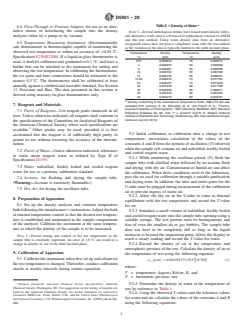
TABLE 1 Density of Water
6.4 Flow-Through or Pressure Adapter, for use as an alter-
native means of introducing the sample into the density
NOTE1—Severalmetrologicalentitieshaveissuedwaterdensitytables,
analyzer either by a pump or by vacuum. and alternative water data is referenced in publications external toASTM
and this test method. Using water density data from an alternative
6.5 Temperature Measuring Instrument, (Environmentally
recognized source does not pose a compliance issue with this test method
safe thermometer or thermocouple) capable of monitoring the
as the variation in the data is typically limited to the sixth decimal place.
observed test temperature to within an accuracy of 60.05°C,
Temperature, Density, Temperature, Density,
°C g/mL °C g/mL
Specification E230/E230M. If a liquid-in-glass thermometer is
0.01 0.999844 45 0.990213
used, it shall be calibrated and graduated to 0.1°C, and have a
4 0.999975 50 0.988035
holder that can be attached to the instrument for setting and
5 0.999967 55 0.985693
observing the test temperature. In calibrating the thermometer,
10 0.999703 60 0.983196
15 0.999103 65 0.980551
the ice point and bore connections should be estimated to the
15.56 0.999016 70 0.977765
nearest 0.3°C. The thermometer shall be calibrated at least
20 0.998207 75 0.974843
annually against a certified and traceable standard. See Section
25 0.997048 80 0.971790
30 0.995650 85 0.968611
13, Precision and Bias. The data presented in this section is
35 0.994033 90 0.965310
derived using mercury-in-glass thermometers only.
40 0.992216 99 0.958421
A
Density conforming to the International Temperature Scale 1990 (ITS 90) was
7. Reagents and Materials
extracted from Lemmon, E. W., McLinden, M. O., and Friend, D. G., “Thermo-
physical Properties of Fluid Systems,” NIST Chemistry WebBook, NIST Standard
7.1 Purity of Reagents—Use reagent grade chemicals in all
Reference Database No. 68., Eds. P. J. Linstrom and W. G. Mallard, National
tests. Unless otherwise indicated, all reagents shall conform to
Institute of Standards and Technology, Gaithersburg, MD, http://webbook.nist.gov
(retrieved July 24, 2013).
the specifications of the Committee onAnalytical Reagents of
theAmerican Chemical Society, where such specifications are
available. Other grades may be used, provided it is first
9.2 Initial calibration, or calibration after a change in test
ascertained that the reagent is of sufficiently high purity to
temperature, necessitates calculation of the values of the
permit its use without lessening the accuracy of the determi-
constants A and B from the periods of oscillation (T) observed
nation.
whenthesamplecellcontainsairandredistilled,freshlyboiled
7.2 Purity of Water—Unless otherwise indicated, references
and cooled reagent water.
to water mean reagent water as defined by Type II of
9.2.1 While monitoring the oscillator period, (T), flush the
Specification D1193.
sample tube with distilled water followed by an acetone flush
7.3 Water, redistilled, freshly boiled and cooled reagent
and drying with dry air. Contaminated or humid air can affect
water for use as a primary calibration standard.
the calibration. When these conditions exist in the laboratory,
pass the air used for calibration through a suitable purification
7.4 Acetone, for flushing and drying the sample tube.
and drying train. In addition, the inlet and outlet ports for the
(Warning—Acetone is extremely flammable.)
U-tubemustbepluggedduringmeasurementofthecalibration
7.5 Dry Air, for drying the oscillator tube.
air to prevent ingress of moist air.
9.2.2 Allow the dry air in the U-tube to come to thermal
8. Preparation of Apparatus
equilibrium with the test temperature and record the T-value
8.1 Set up the density analyzer and constant temperature
for air.
bath following the manufacturer’s instructions.Adjust the bath
9.2.3 Introduce a small volume of redistilled, freshly boiled
orinternaltemperaturecontrolsothatthedesiredtesttempera-
and cooled reagent water into the sample tube opening using a
ture is established and maintained in the sample compartment
suitable syringe. The test portion must be homogeneous and
of the analyzer. Calibrate the instrument at the same tempera-
free of even the smallest air or gas bubbles. The sample tube
ture at which the density of the sample is to be measured.
does not have to be completely full as long as the liquid
meniscus is beyond the suspension point.Allow the display to
NOTE 1—Precise setting and control of the test temperature in the
reach a steady reading and record the T-value for water.
sample tube is extremely important. An error of 1.0°C can result in a
change in density of one in the third decimal place.
9.2.4 Record the density of air at the temperature and
atmospheric pressure of the test. Calculate the density of air at
9. Calibration of Apparatus
the temperature of test using the following equation:
9.1 Calibrate the instrument when first set up and whenever
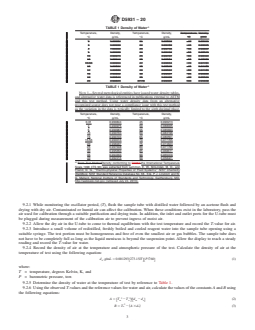
d , g/mL 5 0.001293 273.15/T P/760 (1)
@ #@ #
a
thetesttemperatureischanged.Thereafter,conductcalibration
where:
checks at weekly intervals during routine operation.
T = temperature, degrees Kelvin, K, and
P = barometric pressure, torr.
9.2.5 Determine the density of water at the temperature of
Reagent Chemicals, American Chemical Society Specifications, American
Chemical Society, Washington, DC. For suggestions on the testing of reagents not
test by reference to Table 1.
listed by the American Chemical Society, see Analar Standards for Laboratory
9.2.6 Using the observed T-values and the reference values
Chemicals, BDH Ltd., Poole, Dorset, U.K., and the United States Pharmacopeia
for water and air, calculate the values of the constants A and B
and National Formulary, U.S. Pharmacopeial Convention, Inc. (USPC), Rockville,
MD. using the following equations:
D5931 − 20
2 2
A 5 T 2 T / d 2 d (2) calibrationrequiresthedeterminationofaninstrumentconstant
@ # @ #
w a w a
2 K, which must be used to calculate the density or relative
B 5 T 2
...
This document is not an ASTM standard and is intended only to provide the user of an ASTM standard an indication of what changes have been made to the previous version. Because
it may not be technically possible to adequately depict all changes accurately, ASTM recommends that users consult prior editions as appropriate. In all cases only the current version
of the standard as published by ASTM is to be considered the official document.
Designation: D5931 − 13 (Reapproved 2017) D5931 − 20
Standard Test Method for
Density and Relative Density of Engine Coolant
Concentrates and Aqueous Engine Coolants by Digital
Density Meter
This standard is issued under the fixed designation D5931; the number immediately following the designation indicates the year of
original adoption or, in the case of revision, the year of last revision. A number in parentheses indicates the year of last reapproval. A
superscript epsilon (´) indicates an editorial change since the last revision or reapproval.
1. Scope*
1.1 This test method covers the determination of the density or relative density of glycols, glycerin, heat transfer fluids, engine
coolant concentrates, and aqueous engine coolants.
1.2 This test method should not be applied to samples so dark in color that the absence of air bubbles in the sample cell cannot
be established with certainty.
1.3 The accepted units of measure for density are grams per milliliter or kilograms per cubic meter.values stated in SI units are
to be regarded as standard. No other units of measurement are included in this standard.
1.3.1 The accepted units of measure for density are grams per milliliter or kilograms per cubic meter.
1.4 This standard does not purport to address all of the safety concerns, if any, associated with its use. It is the responsibility
of the user of this standard to establish appropriate safety, health, and environmental practices and determine the applicability of
regulatory limitations prior to use. For specific hazard statements, see Note 17.4.
1.5 This international standard was developed in accordance with internationally recognized principles on standardization
established in the Decision on Principles for the Development of International Standards, Guides and Recommendations issued
by the World Trade Organization Technical Barriers to Trade (TBT) Committee.
2. Referenced Documents
2.1 ASTM Standards:
D1193 Specification for Reagent Water
D4052 Test Method for Density, Relative Density, and API Gravity of Liquids by Digital Density Meter
E230/E230M Specification for Temperature-Electromotive Force (emf) Tables for Standardized Thermocouples
3. Terminology
3.1 Definitions:
3.1.1 relative density, n—the ratio of the density of a material at a stated temperature to the density of water at the same stated
temperature.
4. Summary of Test Method
4.1 A small volume of liquid sample is introduced into an oscillating sample tube, and the change in oscillating frequency
caused by the change in the mass of the tube is used in conjunction with calibration data to determine the density of the sample.
5. Significance and Use
5.1 Density is a fundamental physical property that can be used in conjunction with other properties to characterize engine
coolant concentrates and aqueous engine coolants.
This test method is under the jurisdiction of ASTM Committee D15 on Engine Coolants and Related Fluids and is the direct responsibility of Subcommittee D15.03 on
Physical Properties.
Current edition approved Nov. 1, 2017May 15, 2020. Published November 2017June 2020. Originally approved in 1996. Last previous edition approved in 20132017 as
D5931D5931–13(2017).–13. DOI: 10.1520/D5931-13R17.10.1520/D5931-20.
For referenced ASTM standards, visit the ASTM website, www.astm.org, or contact ASTM Customer Service at service@astm.org. For Annual Book of ASTM Standards
volume information, refer to the standard’s Document Summary page on the ASTM website.
*A Summary of Changes section appears at the end of this standard
Copyright © ASTM International, 100 Barr Harbor Drive, PO Box C700, West Conshohocken, PA 19428-2959. United States
D5931 − 20
5.2 Determination of the density or relative density of these products is necessary for the conversion of measured volumes to
volumes at the standard temperature of 20 °C (68 °F).choice. ASTM specifications normally state the temperatures for density and
relative density of fluids; 25 °C, 20 °C, and 15.6 °C are commonly used temperatures.
6. Apparatus
6.1 Digital Density Analyzer, consisting of a U-shaped, oscillating sample tube and a system for electronic excitation, frequency
counting, and display. The analyzer must accommodate the accurate measurement of the sample temperature during measurement
or must control the sample temperature as described in 6.2. The instrument must meet the precision requirements described in this
test method.
6.2 Circulating Constant—Temperature Bath, (optional) capable of maintaining the temperature of the circulating liquid
constant to 60.05 °C in the desired range. Temperature control can be maintained as part of the density analyzer instrument
package.
6.3 Syringes, at least 2 mL in volume with a tip or an adapter tip that will fit the opening of the oscillating tube.
6.4 Flow-Through or Pressure Adapter, for use as an alternative means of introducing the sample into the density analyzer either
by a pump or by vacuum.
6.5 Temperature Measuring Instrument, (Environmentally safe thermometer or thermocouple). An ASTM Partial Immersion
Thermometer, having a range from –5 to 300 °C (20 tothermocouple) capable of monitoring the observed test temperature to within
an accuracy of 60.05 °C, Specification E230/E230M580 °F) and conforming to the requirements for thermometer 2C or 2F, as
prescribed in Specification. If a liquid-in-glass thermometer is used, it shall be calibrated and graduated to 0.1 °C, D1193, or some
suitable non-mercury containing temperature measuring device, such as a thermocouple, capable of operating in the same
temperature range and having equal or better accuracy as summarized in Specificationand have a holder that can be attached to
the instrument for setting and observing the test temperature. In calibrating the thermometer, the ice point and bore connections
should be estimated E230/E230M. to the nearest 0.3 °C. The thermometer shall be calibrated at least annually against a certified
and traceable standard. See Section 1313,, Precision and Bias. The data presented in this paragraphsection is derived using
mercury-in-glass thermometers only.
7. Reagents and Materials
7.1 Purity of Reagents—Use reagent grade chemicals in all tests. Unless otherwise indicated, all reagents shall conform to the
specifications of the Committee on Analytical Reagents of the American Chemical Society, where such specifications are
available. Other grades may be used, provided it is first ascertained that the reagent is of sufficiently high purity to permit its use
without lessening the accuracy of the determination.
7.2 Purity of Water—Unless otherwise indicated, references to water mean reagent water as defined by Type II of Specification
D1193.
7.3 Water, redistilled, freshly boiled and cooled reagent water for use as a primary calibration standard.
7.4 Acetone, for flushing and drying the sample tube. (Warning—Acetone is extremely flammable.)
NOTE 1—Warning: Acetone is extremely flammable.
7.5 Dry Air, for drying the oscillator tube.
8. Preparation of Apparatus
8.1 Set up the density analyzer and constant temperature bath following the manufacturer’s instructions. Adjust the bath or
internal temperature control so that the desired test temperature is established and maintained in the sample compartment of the
analyzer. Calibrate the instrument at the same temperature at which the density of the sample is to be measured.
NOTE 1—Precise setting and control of the test temperature in the sample tube is extremely important. An error of 1.0 °C can result in a change in
density of one in the third decimal place.
9. Calibration of Apparatus
9.1 Calibrate the instrument when first set up and whenever the test temperature is changed. Thereafter, conduct calibration
checks at weekly intervals during routine operation.
9.2 Initial calibration, or calibration after a change in test temperature, necessitates calculation of the values of the constants A
and B from the periods of oscillation (T) observed when the sample cell contains air and redistilled, freshly boiled and cooled
reagent water.
Reagent Chemicals, American Chemical Society Specifications, American Chemical Society, Washington, DC. For suggestions on the testing of reagents not listed by
the American Chemical Society, see Analar Standards for Laboratory Chemicals, BDH Ltd., Poole, Dorset, U.K., and the United States Pharmacopeia and National
Formulary, U.S. Pharmacopeial Convention, Inc. (USPC), Rockville, MD.
D5931 − 20
A
TABLE 1 Density of Water
Temperature, Density, Temperature, Density, Temperature, Density,
°C g/mL °C g/mL °C g/mL
0 0.99987 21 0.99802 40 0.99224
3 0.99999 22 0.99780 45 0.99025
4 1.00000 23 0.99756 50 0.98807
5 0.99999 24 0.99732 55 0.98573
10 0.99973 25 0.99707 60 0.98324
15 0.99913 26 0.99681 65 0.98059
15.56 0.99904 27 0.99654 70 0.97781
16 0.99897 28 0.99626 75 0.97489
17 0.99880 29 0.99597 80 0.97183
18 0.99862 30 0.99567 85 0.96865
19 0.99843 35 0.99406 90 0.96534
20 0.99823 37.78 0.99307 100 0.95838
A
TABLE 1 Density of Water
NOTE 1—Several metrological entities have issued water density tables,
and alternative water data is referenced in publications external to ASTM
and this test method. Using water density data from an alternative
recognized source does not pose a compliance issue with this test method
as the variation in the data is typically limited to the sixth decimal place.
Temperature, Density, Temperature, Density,
°C g/mL °C g/mL
0.01 0.999844 45 0.990213
4 0.999975 50 0.988035
5 0.999967 55 0.985693
10 0.999703 60 0.983196
15 0.999103 65 0.980551
15.56 0.999016 70 0.977765
20 0.998207 75 0.974843
25 0.997048 80 0.971790
30 0.995650 85 0.968611
35 0.994033 90 0.965310
40 0.992216 99 0.958421
A
From Test MethodDensity conforming to D4052.the International Temperature
Scale 1990 (ITS 90) was extracted from Lemmon, E. W., McLinden, M. O., and
Friend, D. G., “Thermo-physical Properties of Fluid Systems,” NIST Chemistry
WebBook, NIST Standard Reference Database No. 68., Eds. P. J. Linstrom and W.
G. Mallard, National Institute of Standards and Technology, Gaithersburg, MD,
http://webbook.nist.gov (retrieved July 24, 2013).
9.2.1 While monitoring the oscillator period, (T), flush the sample tube with distilled water followed by an acetone flush and
drying with dry air. Contaminated or humid air can affect the calibration. When these conditions exist in the laboratory, pass the
air used for calibration through a suitable purification and drying train. In addition, the inlet and outlet ports for the U-tube must
be plugged during measurement of the calibration air to prevent ingress of moist air.
9.2.2 Allow the dry air in the U-tube to come to thermal equilibrium with the test temperature and record the T-value for air.
9.2.3 Introduce a small volume of redistilled, freshly boiled and cooled reagent water into the sample tube opening using a
suitable syringe. The test portion must be homogeneous and free of even the smallest air or gas bubbles. The sample tube does
not have to be completely full as long as the liquid meniscus is beyond the suspension point. Allow the display to reach a steady
reading and record the T-value for water.
9.2.4 Record the density of air at the temperature and atmospheric pressure of the test. Calculate the density of air at the
temperature of test using the following equation:
d , g/mL 5 0.001293@273.15/T#@P/760# (1)
a
where:
T = temperature, degrees Kelvin, K, and
P = barometric pressure, torr.
9.2.5 Determine the
...