

ASTM B1015-20
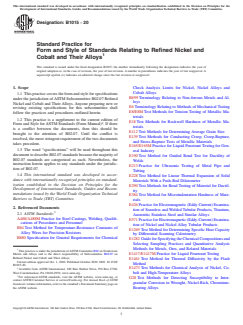
(Practice)Standard Practice for Form and Style of Standards Relating to Refined Nickel and Cobalt and Their Alloys
General Information
- Abstract
SCOPE
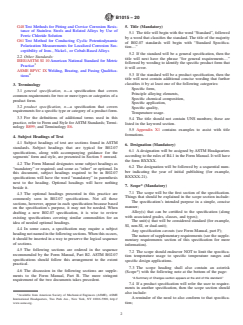
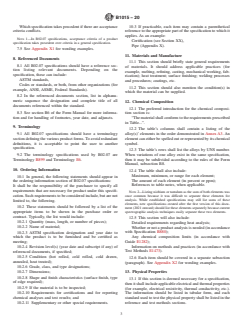
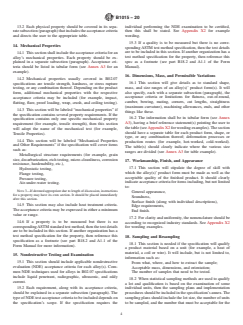
1.1 This practice covers the form and style for specifications under the jurisdiction of ASTM Subcommittee B02.07 Refined Nickel and Cobalt and Their Alloys. Anyone preparing new or revising existing specifications for this subcommittee shall follow the practices and procedures outlined herein.
1.2 This practice is a supplement to the current edition of Form and Style for ASTM Standards (Form Manual)2. If there is a conflict between the documents, then this should be brought to the attention of B02.07. Until the conflict is resolved, the more stringent requirement of the two documents takes precedent.
1.3 The word “specifications” will be used throughout this document to describe B02.07 standards because the majority of B02.07 standards are categorized as such. Nevertheless, the instruction herein applies to any standards under the jurisdiction of B02.07.
1.4 This international standard was developed in accordance with internationally recognized principles on standardization established in the Decision on Principles for the Development of International Standards, Guides and Recommendations issued by the World Trade Organization Technical Barriers to Trade (TBT) Committee.
- Status
- Published
- Publication Date
- 30-Sep-2020
- Technical Committee
- B02 - Nonferrous Metals and Alloys
- Drafting Committee
- B02.07 - Refined Nickel and Cobalt and Their Alloys
Overview
ASTM B1015-20: Standard Practice for Form and Style of Standards Relating to Refined Nickel and Cobalt and Their Alloys is a foundational document developed by ASTM International. This standard details the guidelines and recommended structure for all specifications produced by ASTM Subcommittee B02.07, which governs refined nickel, cobalt, and their alloys. By adhering to ASTM B1015-20, technical writers and industry stakeholders can ensure clarity, consistency, and compliance throughout the lifecycle of specification documents for these critical materials.
Created in alignment with the internationally recognized principles set by the World Trade Organization (WTO) Technical Barriers to Trade (TBT) Committee, ASTM B1015-20 supplements the broader Form and Style for ASTM Standards (Form Manual). When prepared or updated, specifications for refined nickel and cobalt alloys must follow these practices to facilitate international trade, industry adoption, and regulatory acceptance.
Key Topics
Document Structure and Format
- Guidelines for mandatory and optional section headings in specifications.
- Rules for proper sequence, clarity, and use of section titles such as Scope, Referenced Documents, Terminology, Mechanical Properties, and Chemical Composition.
Specification Title and Designation
- Standardized approach for titling, starting with "Standard..." (e.g., "Standard Specification for...").
- Assignment of sequential designations (e.g., BXXXX-YY) to identify and track revisions.
Referenced Documents
- Clear listing of ASTM and other relevant standards.
- Direction on referencing external codes, such as ANSI, ASME, and IEEE documents.
Content Requirements
- Descriptions of product forms, chemical composition, mechanical and physical property tables.
- Procedures for test methods, sampling, inspection, certification, identification, and packaging.
Flexibility and Compliance
- Procedures for handling conflicts between ASTM B1015-20 and the Form Manual.
- Process for supplementing standard requirements with additional criteria in purchase contracts when necessary.
Applications
ASTM B1015-20 is primarily intended for technical writers, standards developers, and quality assurance professionals working on specifications for refined nickel, cobalt, and their alloys. Its practical value and applications include:
- Specification Development: Ensures that new or revised ASTM standards for nickel and cobalt alloys meet industry expectations for clarity, consistency, and completeness.
- Quality Assurance: Assists auditors and engineers in verifying that documentation and product descriptions align with formalized ASTM methodologies, promoting reliability from raw material to finished product.
- Procurement and Contracts: Provides purchasing managers with clear, enforceable criteria for order requirements, product marking, test reporting, and traceability.
- International Trade: Facilitates global trade and regulatory compliance by adhering to WTO principles, reducing technical barriers and ambiguities in transnational commerce.
- Technical Communication: Supports technical communication efforts, making technical documents more accessible and easier to navigate for a diverse, international audience.
Related Standards
Professionals referencing ASTM B1015-20 will also find these ASTM and industry standards integral to specifications for refined nickel and cobalt alloys:
- ASTM B899: Terminology Relating to Nonferrous Metals and Alloys
- ASTM B880: General Requirements for Chemical Analysis
- ASTM E8/E8M: Test Methods for Tension Testing of Metallic Materials
- ASTM E18: Test Methods for Rockwell Hardness of Metallic Materials
- ASTM E112: Test Methods for Determining Average Grain Size
- ASTM E139: Test Methods for Conducting Creep, Creep-Rupture, and Stress-Rupture Tests
- IEEE/ASTM SI 10: American National Standard for Metric Practice
- ASME BPVC IX: Welding, Brazing, and Fusing Qualifications
Keywords: ASTM B1015, specification structure, refined nickel, cobalt alloys, nickel alloy standards, form and style, test methods, chemical composition, mechanical properties, international standards, B02.07, metallic materials documentation, procurement, quality assurance.
Relations
- Effective Date
- 01-Mar-2024
- Effective Date
- 01-Jan-2024
- Effective Date
- 01-Jul-2019
- Effective Date
- 01-Apr-2019
- Effective Date
- 01-Jul-2018
- Effective Date
- 01-Jul-2018
- Effective Date
- 01-Jul-2018
- Effective Date
- 01-May-2018
- Effective Date
- 01-Apr-2018
- Effective Date
- 01-Jul-2017
- Effective Date
- 01-May-2017
- Effective Date
- 01-Oct-2016
- Effective Date
- 01-Sep-2016
- Effective Date
- 15-Jul-2016
- Effective Date
- 01-Mar-2016
Get Certified
Connect with accredited certification bodies for this standard

Element Materials Technology
Materials testing and product certification.

Inštitut za kovinske materiale in tehnologije
Institute of Metals and Technology. Materials testing, metallurgical analysis, NDT.
Sponsored listings
Frequently Asked Questions
ASTM B1015-20 is a standard published by ASTM International. Its full title is "Standard Practice for Form and Style of Standards Relating to Refined Nickel and Cobalt and Their Alloys". This standard covers: SCOPE 1.1 This practice covers the form and style for specifications under the jurisdiction of ASTM Subcommittee B02.07 Refined Nickel and Cobalt and Their Alloys. Anyone preparing new or revising existing specifications for this subcommittee shall follow the practices and procedures outlined herein. 1.2 This practice is a supplement to the current edition of Form and Style for ASTM Standards (Form Manual)2. If there is a conflict between the documents, then this should be brought to the attention of B02.07. Until the conflict is resolved, the more stringent requirement of the two documents takes precedent. 1.3 The word “specifications” will be used throughout this document to describe B02.07 standards because the majority of B02.07 standards are categorized as such. Nevertheless, the instruction herein applies to any standards under the jurisdiction of B02.07. 1.4 This international standard was developed in accordance with internationally recognized principles on standardization established in the Decision on Principles for the Development of International Standards, Guides and Recommendations issued by the World Trade Organization Technical Barriers to Trade (TBT) Committee.
SCOPE 1.1 This practice covers the form and style for specifications under the jurisdiction of ASTM Subcommittee B02.07 Refined Nickel and Cobalt and Their Alloys. Anyone preparing new or revising existing specifications for this subcommittee shall follow the practices and procedures outlined herein. 1.2 This practice is a supplement to the current edition of Form and Style for ASTM Standards (Form Manual)2. If there is a conflict between the documents, then this should be brought to the attention of B02.07. Until the conflict is resolved, the more stringent requirement of the two documents takes precedent. 1.3 The word “specifications” will be used throughout this document to describe B02.07 standards because the majority of B02.07 standards are categorized as such. Nevertheless, the instruction herein applies to any standards under the jurisdiction of B02.07. 1.4 This international standard was developed in accordance with internationally recognized principles on standardization established in the Decision on Principles for the Development of International Standards, Guides and Recommendations issued by the World Trade Organization Technical Barriers to Trade (TBT) Committee.
ASTM B1015-20 is classified under the following ICS (International Classification for Standards) categories: 77.120.40 - Nickel, chromium and their alloys; 77.120.70 - Cadmium, cobalt and their alloys. The ICS classification helps identify the subject area and facilitates finding related standards.
ASTM B1015-20 has the following relationships with other standards: It is inter standard links to ASTM A488/A488M-24, ASTM E8/E8M-24, ASTM E571-19, ASTM B84-07(2019), ASTM A488/A488M-18e1, ASTM A488/A488M-18, ASTM E18-18, ASTM G61-86(2018), ASTM E1269-11(2018), ASTM E18-17, ASTM A488/A488M-17, ASTM B899-16, ASTM E228-11(2016), ASTM E8/E8M-16, ASTM A488/A488M-16. Understanding these relationships helps ensure you are using the most current and applicable version of the standard.
ASTM B1015-20 is available in PDF format for immediate download after purchase. The document can be added to your cart and obtained through the secure checkout process. Digital delivery ensures instant access to the complete standard document.
Standards Content (Sample)
This international standard was developed in accordance with internationally recognized principles on standardization established in the Decision on Principles for the
Development of International Standards, Guides and Recommendations issued by the World Trade Organization Technical Barriers to Trade (TBT) Committee.
Designation:B1015 −20
Standard Practice for
Form and Style of Standards Relating to Refined Nickel and
Cobalt and Their Alloys
This standard is issued under the fixed designation B1015; the number immediately following the designation indicates the year of
original adoption or, in the case of revision, the year of last revision. A number in parentheses indicates the year of last reapproval. A
superscript epsilon (´) indicates an editorial change since the last revision or reapproval.
1. Scope Check Analysis Limits for Nickel, Nickel Alloys and
Cobalt Alloys
1.1 Thispracticecoverstheformandstyleforspecifications
B899 Terminology Relating to Non-ferrous Metals and Al-
under the jurisdiction ofASTM Subcommittee B02.07 Refined
loys
Nickel and Cobalt and TheirAlloys.Anyone preparing new or
E6 Terminology Relating to Methods of Mechanical Testing
revising existing specifications for this subcommittee shall
E8/E8M Test Methods for Tension Testing of Metallic Ma-
follow the practices and procedures outlined herein.
terials
1.2 This practice is a supplement to the current edition of
E18 Test Methods for Rockwell Hardness of Metallic Ma-
Form and Style forASTM Standards (Form Manual) . If there
terials
is a conflict between the documents, then this should be
E112 Test Methods for Determining Average Grain Size
brought to the attention of B02.07. Until the conflict is
E139 Test Methods for Conducting Creep, Creep-Rupture,
resolved, the more stringent requirement of the two documents
and Stress-Rupture Tests of Metallic Materials
takes precedent.
E165/E165M Practice for Liquid Penetrant Testing for Gen-
1.3 The word “specifications” will be used throughout this
eral Industry
documenttodescribeB02.07standardsbecausethemajorityof
E190 Test Method for Guided Bend Test for Ductility of
B02.07 standards are categorized as such. Nevertheless, the
Welds
instruction herein applies to any standards under the jurisdic-
E213 Practice for Ultrasonic Testing of Metal Pipe and
tion of B02.07.
Tubing
1.4 This international standard was developed in accor-
E228 Test Method for Linear Thermal Expansion of Solid
dance with internationally recognized principles on standard-
Materials With a Push-Rod Dilatometer
ization established in the Decision on Principles for the
E290 Test Methods for Bend Testing of Material for Ductil-
Development of International Standards, Guides and Recom-
ity
mendations issued by the World Trade Organization Technical
E384 Test Method for Microindentation Hardness of Mate-
Barriers to Trade (TBT) Committee.
rials
E426 Practice for Electromagnetic (Eddy Current) Examina-
2. Referenced Documents
tion of Seamless and Welded Tubular Products, Titanium,
2.1 ASTM Standards:
Austenitic Stainless Steel and Similar Alloys
A488/A488M Practice for Steel Castings, Welding, Qualifi-
E571 PracticeforElectromagnetic(Eddy-Current)Examina-
cations of Procedures and Personnel
tion of Nickel and Nickel Alloy Tubular Products
B84 Test Method for Temperature-Resistance Constants of
E1269 Test Method for Determining Specific Heat Capacity
Alloy Wires for Precision Resistors
by Differential Scanning Calorimetry
B880 Specification for General Requirements for Chemical
E1282 GuideforSpecifyingtheChemicalCompositionsand
Selecting Sampling Practices and Quantitative Analysis
Methods for Metals, Ores, and Related Materials
This practice is under the jurisdiction ofASTM Committee B02 on Nonferrous
E1417/E1417M Practice for Liquid Penetrant Testing
Metals and Alloys and is the direct responsibility of Subcommittee B02.07 on
Refined Nickel and Cobalt and Their Alloys.
E1461 Test Method for Thermal Diffusivity by the Flash
Current edition approved Oct. 1, 2020. Published October 2020. DOI: 10.1520/
Method
B1015-20.
2 E1473 Test Methods for Chemical Analysis of Nickel, Co-
Available from ASTM International, 100 Barr Harbor Drive, PO Box C700,
West Conshohocken, PA 19428-2959, www.astm.org.
balt and High-Temperature Alloys
For referenced ASTM standards, visit the ASTM website, www.astm.org, or
G28 Test Methods for Detecting Susceptibility to Inter-
contact ASTM Customer Service at service@astm.org. For Annual Book of ASTM
granular Corrosion in Wrought, Nickel-Rich, Chromium-
Standards volume information, refer to the standard’s Document Summary page on
the ASTM website. Bearing Alloys
Copyright © ASTM International, 100 Barr Harbor Drive, PO Box C700, West Conshohocken, PA 19428-2959. United States
B1015−20
G48 Test Methods for Pitting and Crevice Corrosion Resis- 5. Title (Mandatory)
tance of Stainless Steels and Related Alloys by Use of
5.1 The title will begin with the word “Standard”, followed
Ferric Chloride Solution
by a word that classifies the standard. The title of the majority
G61 Test Method for Conducting Cyclic Potentiodynamic
of B02.07 standards will begin with “Standard Specifica-
Polarization Measurements for Localized Corrosion Sus-
tion…”
ceptibility of Iron-, Nickel-, or Cobalt-Based Alloys
5.2 If the standard will be a general specification, then the
2.2 Other Standards:
title will next have the phrase “for general requirements…”
IEEE/ASTM SI 10 American National Standard for Metric
followed by wording to identify the specific product form that
Practice
it will cover.
ASME BPVC IX Welding, Brazing, and Fusing Qualifica-
5.3 If the standard will be a product specification, then the
tions
title will next contain additional concise wording that further
classifies it by at least one of the following categories:
3. Terminology
Specific form,
3.1 general specification, n—a specification that covers
Principle alloying elements,
common requirements for two or more types or categories of a
Specific chemical composition,
product form.
Specific application,
3.2 product specification, n—a specification that covers
Specific quality,
requirements for a specific type or category of a product form.
Temperature usage.
3.3 For the definitions of additional terms used in this
5.4 The title should not contain UNS numbers; these are
practice, refer to Form and Style for ASTM Standards; Termi-
listed in the keyword section.
nology B899; and Terminology E6.
5.5 Appendix X1 contains examples to assist with title
formations.
4. Subject Headings of Text
4.1 Subject headings of text are sections found in ASTM
6. Designation (Mandatory)
standards. Subject headings that are typical for B02.07
6.1 A designation will be assigned by ASTM Headquarters
specifications, along with accompanying guidance for the
according to the rules of B4.1 in the Form Manual. It will have
segments’ form and style, are presented in Section 5 onward.
the form BXXXX.
4.2 The Form Manual designates some subject headings as
6.2 The designation will be followed by a sequential num-
“mandatory” or required; and some as “other” or optional. In
ber indicating the year of initial publishing (for example,
this document, subject headings required to be in B02.07
BXXXX-21).
specifications will have the word “mandatory” in parenthesis
next to the heading. Optional headings will have nothing
7. Scope* (Mandatory)
beside it.
7.1 The scope will be the first section of the specification.
4.3 The optional headings presented in this practice are
Things that should be explained in the scope section include:
commonly seen in B02.07 specifications. Not all these
The specification’s intended purpose in a simple, concise
sections, however, appear in each specification because based
manner;
on the specification’s purpose, it may not be needed. When
Alloy(s) that can be certified to the specification (along
drafting a new B02.07 specification, it is wise to review
with associated grades, classes, and types);
existing specifications covering similar commodities for an
The unit(s) that will be considered standard (for example,
idea of needed optional headings.
SI, non-SI, or dual-unit);
4.4 In some cases, a specification may require a subject
Any specification caveats (see Form Manual, part F);
headingnotnamedinthefollowingsections.Whenthisoccurs,
The nature of supplementary requirements (see the supple-
it should be inserted in a way to preserve the logical sequence
mentary requirements section of this specification for more
of sections.
information).
4.5 The following sections are ordered in the sequence
7.2 The scope should endeavor NOT to limit the specifica-
recommended by the Form Manual, Part B2. ASTM B02.07
tion temperature usage to specific temperature ranges and
specifications should follow this arrangement to the extent
specific design applications.
practical.
7.3 The scope heading shall also contain an asterisk
4.6 The discussion in the following sections are supple-
(Scope*) with the following note at the bottom of the page:
ments to the Form Manual, Part B. The more stringent
“A Summary of Changes section appears at the end of this standard.”
requirement of the two documents takes precedent.
7.4 If a product specification will refer the user to require-
ments in another specification, then the scope section should
also include:
Available from American Society of Mechanical Engineers (ASME), ASME
A reminder of the need to also conform to that specifica-
International Headquarters, Two Park Ave., New York, NY 10016-5990, http://
www.asme.org. tion;
B1015−20
Which specification takes precedent if there are acceptance 10.3 If practicable, each item may contain a parenthetical
criteria conflicts. reference to the appropriate part of the specification to which it
applies. As an example:
NOTE 1—In B02.07 specifications, acceptance criteria of a product
Certification (see Section XX),
specification takes precedent over criteria in a general specification.
Pipe (Appendix X).
7.5 See Appendix X1 for wording examples.
11. Materials and Manufacture
8. Referenced Documents
11.1 This section should briefly state general requirements
8.1 All B02.07 specifications should have a reference sec-
of materials. It should address applicable practices (for
tion listing relevant documents. Depending on the
example, melting, refining, casting, mechanical working, fab-
specification, these can include:
rication); heat treatment; surface finishing; welding processes
ASTM standards,
and procedures; coatings, etc.
Codes or standards, or both, from other organizations (for
11.2 This section should also mention the condition(s) in
example, ANSI, ASME, Federal Standards).
which the material can be supplied.
8.2 In the referenced documents section, list in alphanu-
meric sequence the designation and complete title of all
12. Chemical Composition
documents referenced within the standard.
12.1 The preferred introduction for the chemical composi-
8.3 See section B6 of the Form Manual for more informa-
tion section is:
tion and for handling of footnotes, year date, and adjuncts.
“The material shall conform to the requirements prescribed
in Table.”.
9. Terminology
12.2 The table’s columns shall contain a listing of the
9.1 All B02.07 specifications should have a terminology alloy(s)’ elements in the order demonstrated in Annex A3.An
section defining the various product forms.To avoid redundant elementcaneitherbespelledoutorrepresentedbyitschemical
definitions, it is acceptable to point the user to another symbol.
specification.
12.3 The table’s rows shall list the alloys by UNS number.
When variations of one alloy exist in the same specification,
9.2 The terminology specifications used by B02.07 are
then it may be subdivided according to the rules of the Form
Terminology B899 and Terminology E6.
Manual, subsection B8.
10. Ordering Information
12.4 The table shall also include:
Maximum, minimum, or range for each element;
10.1 In general, the following statements should appear in
The amount of each element (in percent or ppm);
the ordering information section of B02.07 specifications:
References to table notes, when applicable.
It shall be the responsibility of the purchaser to specify all
requirements that are necessary for product under this specifi-
NOTE 2—Listing niobium or tantalum as the sum of both elements was
cation. Such requirements to be considered include, but are not
once common because it was difficult to separate these elements for
analysis. While established specifications may still list sums of these
limited to, the following.
elements, new specifications created after the first version of this docu-
10.2 These statements should be followed by a list of the
ment (2021 onward) should list these elements separately because current
appropriate items to be shown in the purchase order or spectrographic analysis techniques easily separate these two elements.
contract. Typically, the list would include:
12.5 This section will also include:
10.2.1 Quantity (mass, length, or number of pieces);
Detailed requirements regarding heat analysis;
10.2.2 Name of material; Whether or not a product analysis is needed (in accordance
10.2.3 ASTM specification designation and year date to with Specification B880);
Any chemical composition limits (in accordance with
which the product is to be furnished and be certified as
meeting; Guide E1282);
Information on methods and practices (in accordance with
10.2.4 Revision level(s) (year date and subscript if any) of
Test Methods E1473).
referenced documents, if specified;
10.2.5 Condition (hot rolled, cold rolled, cold drawn,
12.6 Each item should be covered in a separate subsection
annealed, heat treated);
(paragraph). See Appendix X2 for wording examples.
10.2.6 Grade, class, and type designations;
10.2.7 Dimensions; 13. Physical Properties
10.2.8 Shape and finish characteristics (surface finish, type
13.1 If this section is deemed necessary for a specification,
of edge required);
thenitshallincludeapplicableelectricalandthermalproperties
10.2.9 If the material is to be inspected;
(for example, electrical resistivity, thermal conductivity, etc.).
10.2.10 Requirements for certifications and for reporting
The information should be listed in tabular form, and each
chemical analyses and test results; and
standard used to test the physical property shall be listed in the
10.2.11 Supplementary or other special requirements. reference and test methods sections.
B1015−20
13.2 Each physical property should be covered in its sepa- individual performing the NDE examination to be certified,
ratesubsection(paragraph)thatincludestheacceptancecriteria then this shall be stated. See Appendix X2 for example
and directs the user to the appropriate table. wording.
15.3 If a quality is to be measured but there is no corre-
14. Mechanical Properties
spondingASTM test method specification, then the test details
are to be included in this section. If another organization has a
14.1 This section shall include the acceptance criteria for an
test method specification for the property, then reference this
alloy’s mechanical properties. Each property should be ex-
spec as a footnote (see part B18.2 and A1.1 of the Form
plained in a separate subsection (paragraph). Acceptance cri-
Manual).
teria should be listed in tabular form (see Annex A3 for an
example).
16. Dimensions, Mass, and Permissible Variations
14.2 Mechanical properties usually covered in B02.07
16.1 This section will give details as to standard shape,
specifications are tensile strength, hardness, or stress rupture
mass, and size ranges of an alloy(s)’ product form(s). It will
testing, or any combination thereof. Depending on the product
also specify, each with a separate subsection (paragraph), the
form, additional mechanical properties with the respective
acceptance criteria or limitations for flatness, out-of-round,
acceptance criteria may be included (for example, impact,
camber, bowing, mating, corners, cut lengths, straightness
flatting, flare, proof loading, wrap, crush, and coiling testing).
(maximum curvature), machining allowances, ends, and other
14.3 This section will be labeled “mechanical properties” if
things like these.
the specification contains several property requirements. If the
16.2 The information shall be in tabular form (see Annex
specification contains only one specific mechanical property
A3), having a brief reference statement(s) pointing the user to
requirement (for example, tensile strength), then this section
thetable(seeAppendixX2forwordingexamples).Thesection
will adopt the name of the mechanical test (for example,
should have a separate table for each product form, shape, or
Tensile Properties).
type, or any combination thereof; deformation processes or
14.4 This section will be labeled “Mechanical Properties
production routes (for example, hot-worked, cold-worked).
and Other Requirements” if the specification will cover items
The table(s) should clearly indicate where the various size
such as:
ranges are divided (see Annex A3 for table example).
Metallurgical structure requirements (for example, grain
size, decarburization, etch testing, micro-cleanliness, corrosion
17. Workmanship, Finish, and Appearance
resistance, hardenability, etc.),
17.1 This section will stipulate the degree of skill with
Hydrostatic testing,
which the alloy(s)’ product form must be made as well as the
Flange testing,
acceptable quality of the finished product. It should clearly
Pressure testing,
indicate acceptance criteria for items including, but not limited
Air-under-water testing.
to:
NOTE3—Ifdeemedappropriateduetolengthofdiscussion,instructions
General appearance,
for a property may have its own section. It should be placed immediately
Soundness,
after this section.
Surface finish (along with individual descriptions),
14.5 This section may also include heat treatment criteria.
Edge requirements,
The acceptance criteria may be expressed in either a minimum
End finish.
value or range.
17.2 For clarity and uniformity, the nomenclature should be
14.6 If a property is to be measured but there is no
according to recognized industry standards. See Appendix X2
correspondingASTMstandardtestmethod,thenthetestdetails
for wording examples.
are to be included in this section. If another organization has a
test method specification for the property, then reference this
18. Sampling and Resampling
specification as a footnote (see part B18.2 and A1.1 of the
18.1 This section is needed if the specification will qualify
Form Manual for more information).
a product material based on a unit (for example, a heat of
material, a coil or wire). It will include, but is not limited to,
15. Nondestructive Testing and Examination
information such as:
15.1 This section should include applicable nondestructive
From what, where, and how to extract the sample;
evaluation (NDE) acceptance criteria for each alloy(s). Com-
Acceptable mass, dimensions, and orientation;
mon NDE techniques used for alloys in B02.07 specifications
The number of samples that need to be tested.
include liquid penetrant, radiographic, ultrasonic, and eddy
18.2 When statistical sampling methods are used to qualify
current.
a lot and qualification is based on the examination of some
15.2 Each requirement, along with its acceptance criteria, individual units, then the sampling plans and implementation
should be explained in a separate subsection (paragraph). The proceduresshouldbeincludedinthespecification’sannex.The
type of NDE test acceptance criteria to be included depends on sampling plans should include the lot size, the number of units
the specification’s scope. If the specification requires the to be sampled, and the number that must be acceptable for the
B1015−20
lot to be qualified. If the plans and procedures are in another 21.2 See Appendix X2 for wording examples. Figures are
ASTM standard, then a reference to them is sufficient. also acceptable to use for explanations.
21.3 If ASTM test methods exist for all needed specimen
18.3 Aspecification may include sample replacement (resa-
mpling)provisionsforoccasionswhenaspecimenisdamaged/ preparations, then this section is not needed. The correspond-
ing standards will be listed in the “Reference” and “Test
fails for reasons not attributable to typical material properties
or conditions (for example, defective machining, casting Method” sections of the specification.
imperfections, errors during sample preparation). Such provi-
22. Test Methods
sions will be listed in this section. See Appendix X2 for
wording examples.
22.1 After a brief explanatory sentence(s), this section will
list in tabular form applicable ASTM standard test methods
19. Number of Tests and Retests
needed to measure property conformance. Ones to be included
depend on the specification’s scope.
19.1 Thissectionshouldstipulatetheamountoftestunitsor
specimens, or both, required to determine an alloy(s)’ product
22.2 Common test methods used for alloys under B02.07’s
conformance. It will specify the amounts needed for each
jurisdiction are listed in Table 1.
property test method.
23. Inspection
19.2 If a specification allows retesting, then this section will
23.1 This section should contain brief sentences on stipula-
have a separate subsection (paragraph) explaining the stipula-
tions for product inspection. Common stipulations include, but
tions. This will include, but is not limited to, the following:
are not limited to, the following:
Retesting criteria (for example, original specimen broke
Whether or not the purchaser and manufacturer have to
out gauge marks);
agree on the inspection requirements;
The number of additional tests needed;
Whether or not the inspection requirements shall be stated
Limits of acceptance;
in either the contract or the purchase order.
Whether or not there are any procedural differences when
dealing with replacement samples.
23.2 Thesectionwillexplainsuchdetailsaswhowilldothe
inspection, where it will be done, assurance that the producer
19.3 See Appendix X2 for wording examples.
will not impede the inspection, assurance that the test will not
cause unnecessary interference, etc. See Appendix X2 for
20. Rework and Retreatment
wording examples.
20.1 This section is needed in a specification if it is
permissible to rework (for example, grind or weld repair),
24. Rejection and Rehearing
reheat treat, or retest, or any combination thereof, the samples
24.1 If this section is included in a specification, it will
of a lot that failed to meet requirements. This section should
define the benchmarks of rejected test results. It will include
indicate how many re-dos are permitted. It should also indicate
such information as:
whether additional or different samples, or both, can/need to be
Who should be notified of the rejection;
included.
How the notification will be transmitted;
20.2 When welding is permitted to bring a deficient product
What recourse a manufacturer has if a product form is
up to par with specification requirements, it is necessary to
rejected;
define the appropriate processes and procedures (for example,
the ones applicable based on the intended end use of the part).
They can either be defined in this section; or the specification
TABLE 1 Common Test Methods used for B02.07 Alloys
can refer the user to anotherASTM standard or industry code.
Test Method ASTM Designation
See Appendix X2 for wording examples.
Electrical Resistivity B84
Tension E8/E8M
21. Specimen Preparation Rockwell Hardness E18
Grain Size E112
21.1 This section is included in a specification only if
Stress Rupture E139
Liquid Penetrant E165/E165M
existing ASTM test methods do not explain specimen prepa-
E1417/E1417M
ration for a particular test. It would include information such
Bend Testing E190
as, but not limited to, the following: E290
Ultrasonic Testing E213
How to make specimens with enough details to ensure
Thermal Expansion E228
reproducibility;
Microhardness E384
Whether or not specimens are to be prepared in accordance
Electromagnetic (Eddy-Current) Testing E426
E571
with the recommendations of the manufacturer;
Specific Heat E1269
Whether or not material from which specimens are to be
Thermal Diffusivity E1461
machined should come from a certain area; or be attached to a Chemical Analysis E1473
Corrosion Test G28
certain area of the product;
G48
If a specimen can be used to satisfy more than one test
G61
requirement.
B1015−20
What should be done with the rejected product, pending 28. Keywords
disposition.
28.1 Thissectionwillbethelastsectioninthemainbodyof
24.2 This section will also indicate if the manufacturer is
a specification. It will contain terms for indexing. Appropriate
allowedtomakeaclaimforarehear(retest)ofrejectedproduct
terms for indexing include, but are not limited to:
forms. If allowed, then the stipulations will be listed in this
The product form (for example, plate, sheet, pipe);
section. See Appendix X2 for wording examples. UNS number of all alloys contained in the specification;
Specific application(s) addressed in the specification (for
24.3 If desired, separate sections for “Rejection” and “Re-
example, seamless, precipitation hardened).
hearing” can be created in a specification.
28.2 See Section 33 for the keywords pertaining to this
25. Certification
practice.
25.1 This section will explain if and what type of documen-
tation is needed to be given to the purchaser as guarantee that 29. Supplementary Requirements
the product form was tested in accordance with and meets all
29.1 IfB02.07decidesthatsupplementaryrequirementscan
acceptance criteria of the specification.
be stipulated for a product form of an alloy(s); then the
25.2 This section should also indicate if certificates need respective specification will have this section.
notarization; and if electronic certificates are acceptable. See
NOTE4—Ifthesamesupplementalrequirementsofanotherwidelyused
Appendix X2 for wording examples.
specification will be added to the new specification, then these require-
ments should be structured in the same order (for example, same subject
25.3 B02.07 specifications shall require a test report and
heading, same numbering, same sequence). If practical, the new specifi-
cer
...