


ASTM E685-93(2021)
(Practice)Standard Practice for Testing Fixed-Wavelength Photometric Detectors Used in Liquid Chromatography
Standard Practice for Testing Fixed-Wavelength Photometric Detectors Used in Liquid Chromatography
SIGNIFICANCE AND USE
4.1 Although it is possible to observe and measure each of the several characteristics of a detector under different and unique conditions, it is the intent of this practice that a complete set of detector specifications should be obtained under the same operating conditions. It should also be noted that to completely specify a detector’s capability, its performance should be measured at several sets of conditions within the useful range of the detector. The terms and tests described in this practice are sufficiently general that they may be used regardless of the ultimate operating parameters.
4.2 Linearity and response time of the recorder or other readout device used should be such that they do not distort or otherwise interfere with the performance of the detector. This requires adjusting the gain, damping, and calibration in accordance with the manufacturer's directions. If additional electronic filters or amplifiers are used between the detector and the final readout device, their characteristics should also first be established.
SCOPE
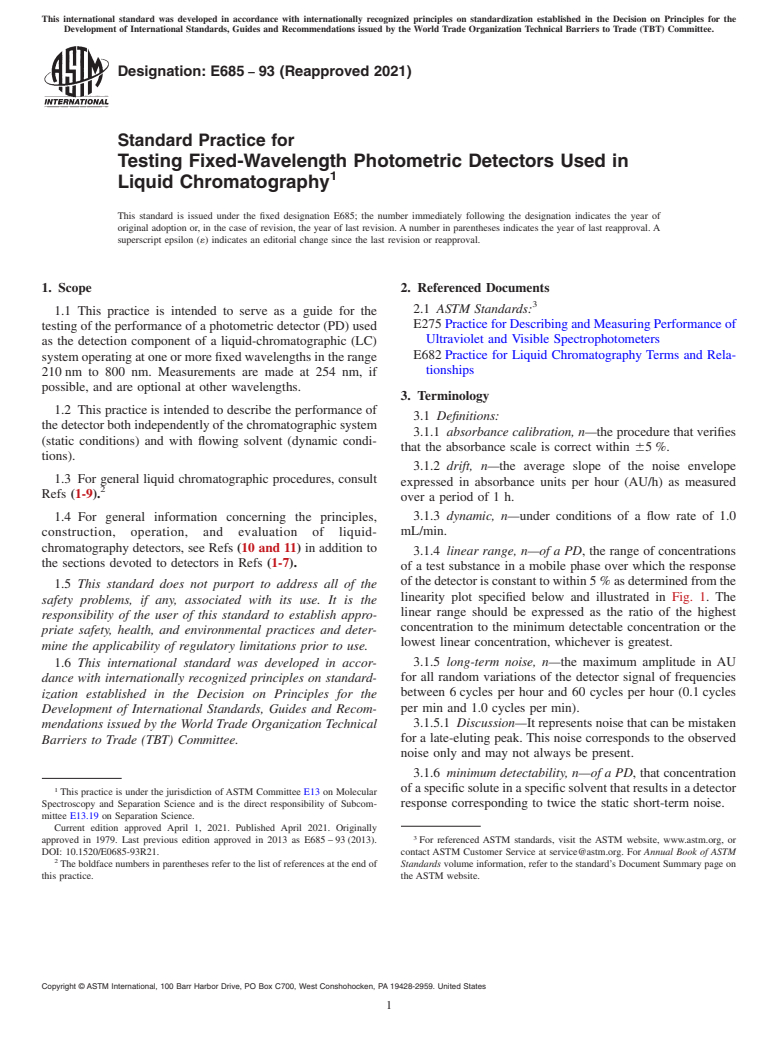
1.1 This practice is intended to serve as a guide for the testing of the performance of a photometric detector (PD) used as the detection component of a liquid-chromatographic (LC) system operating at one or more fixed wavelengths in the range 210 nm to 800 nm. Measurements are made at 254 nm, if possible, and are optional at other wavelengths.
1.2 This practice is intended to describe the performance of the detector both independently of the chromatographic system (static conditions) and with flowing solvent (dynamic conditions).
1.3 For general liquid chromatographic procedures, consult Refs (1-9).2
1.4 For general information concerning the principles, construction, operation, and evaluation of liquid-chromatography detectors, see Refs (10 and 11) in addition to the sections devoted to detectors in Refs (1-7).
1.5 This standard does not purport to address all of the safety problems, if any, associated with its use. It is the responsibility of the user of this standard to establish appropriate safety, health, and environmental practices and determine the applicability of regulatory limitations prior to use.
1.6 This international standard was developed in accordance with internationally recognized principles on standardization established in the Decision on Principles for the Development of International Standards, Guides and Recommendations issued by the World Trade Organization Technical Barriers to Trade (TBT) Committee.
General Information
Standards Content (Sample)
This international standard was developed in accordance with internationally recognized principles on standardization established in the Decision on Principles for the
Development of International Standards, Guides and Recommendations issued by the World Trade Organization Technical Barriers to Trade (TBT) Committee.
Designation: E685 − 93 (Reapproved 2021)
Standard Practice for
Testing Fixed-Wavelength Photometric Detectors Used in
1
Liquid Chromatography
This standard is issued under the fixed designation E685; the number immediately following the designation indicates the year of
original adoption or, in the case of revision, the year of last revision.Anumber in parentheses indicates the year of last reapproval.A
superscript epsilon (´) indicates an editorial change since the last revision or reapproval.
1. Scope 2. Referenced Documents
3
2.1 ASTM Standards:
1.1 This practice is intended to serve as a guide for the
E275PracticeforDescribingandMeasuringPerformanceof
testingoftheperformanceofaphotometricdetector(PD)used
Ultraviolet and Visible Spectrophotometers
as the detection component of a liquid-chromatographic (LC)
E682Practice for Liquid Chromatography Terms and Rela-
systemoperatingatoneormorefixedwavelengthsintherange
tionships
210nm to 800 nm. Measurements are made at 254 nm, if
possible, and are optional at other wavelengths.
3. Terminology
1.2 This practice is intended to describe the performance of
3.1 Definitions:
thedetectorbothindependentlyofthechromatographicsystem
3.1.1 absorbance calibration, n—the procedure that verifies
(static conditions) and with flowing solvent (dynamic condi-
that the absorbance scale is correct within 65%.
tions).
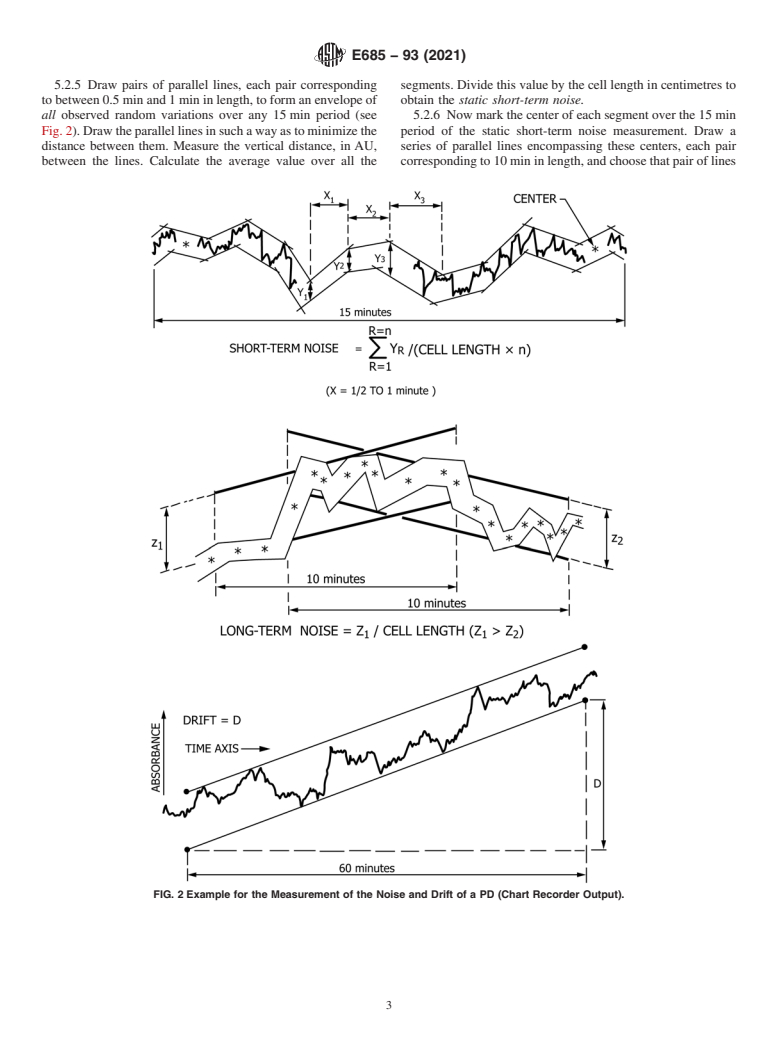
3.1.2 drift, n—the average slope of the noise envelope
1.3 For general liquid chromatographic procedures, consult
expressed in absorbance units per hour (AU/h) as measured
2
Refs (1-9).
over a period of 1 h.
3.1.3 dynamic, n—under conditions of a flow rate of 1.0
1.4 For general information concerning the principles,
construction, operation, and evaluation of liquid- mL/min.
chromatography detectors, see Refs (10 and 11) in addition to
3.1.4 linear range, n—of a PD, the range of concentrations
the sections devoted to detectors in Refs (1-7).
of a test substance in a mobile phase over which the response
ofthedetectorisconstanttowithin5%asdeterminedfromthe
1.5 This standard does not purport to address all of the
linearity plot specified below and illustrated in Fig. 1. The
safety problems, if any, associated with its use. It is the
linear range should be expressed as the ratio of the highest
responsibility of the user of this standard to establish appro-
concentration to the minimum detectable concentration or the
priate safety, health, and environmental practices and deter-
lowest linear concentration, whichever is greatest.
mine the applicability of regulatory limitations prior to use.
3.1.5 long-term noise, n—the maximum amplitude in AU
1.6 This international standard was developed in accor-
for all random variations of the detector signal of frequencies
dance with internationally recognized principles on standard-
between 6cycles per hour and 60 cycles per hour (0.1cycles
ization established in the Decision on Principles for the
per min and 1.0 cycles per min).
Development of International Standards, Guides and Recom-
3.1.5.1 Discussion—Itrepresentsnoisethatcanbemistaken
mendations issued by the World Trade Organization Technical
for a late-eluting peak. This noise corresponds to the observed
Barriers to Trade (TBT) Committee.
noise only and may not always be present.
3.1.6 minimum detectability, n—of a PD, that concentration
1 ofaspecificsoluteinaspecificsolventthatresultsinadetector
This practice is under the jurisdiction ofASTM Committee E13 on Molecular
Spectroscopy and Separation Science and is the direct responsibility of Subcom- response corresponding to twice the static short-term noise.
mittee E13.19 on Separation Science.
Current edition approved April 1, 2021. Published April 2021. Originally
3
approved in 1979. Last previous edition approved in 2013 as E685–93(2013). For referenced ASTM standards, visit the ASTM website, www.astm.org, or
DOI: 10.1520/E0685-93R21. contact ASTM Customer Service at service@astm.org. For Annual Book of ASTM
2
Theboldfacenumbersinparenthesesrefertothelistofreferencesattheendof Standards volume information, refer to the standard’s Document Summary page on
this practice. the ASTM website.
Copyright © ASTM International, 100 Barr Harbor Drive, PO Box C700, West Conshohocken, PA 19428-2959. United States
1
---------------------- Page: 1 ----------------------
E685 − 93 (2021)
otherwise interfere with the performance of the detector. This
requires adjusting the gain, damping, and calibration in accor-
dance with the manufacturer’s directions. If additional elec-
tronicfiltersoramplifiersareusedbetweenthedetectorandthe
final readout device, their characteristics should also first be
established.
5. Noise and Drift
5.1 Test Co
...
Questions, Comments and Discussion
Ask us and Technical Secretary will try to provide an answer. You can facilitate discussion about the standard in here.