

ASTM B745/B745M-15(2021)
(Specification)Standard Specification for Corrugated Aluminum Pipe for Sewers and Drains
General Information
- Abstract
ABSTRACT
This specification covers corrugated aluminum pipe intended for use for storm water drainage, underdrains, the construction of culverts, and similar uses. Pipe covered by this specification is not normally used for the conveyance of sanitary or industrial wastes. All pipe fabricated under this specification shall be formed from aluminum-alloy sheet conforming to the requirements specified. The sheet used in fabricating coupling bands shall conform to the requirements specified. The material used for rivets in riveted pipe shall conform to the requirements specified. Bolts and nuts for coupling bands shall conform to the required specification. If gaskets are used in couplings, they shall be a band of expanded rubber meeting the specified requirements. The fabrication requirements for type I, type II, type IA, and type IR pipe are presented. The corrugations shall be either annular or helical as provided. The different pipe requirements like pipe dimensions, sheet thickness, pipe-arch dimensions, longitudinal seams, and perforations are presented in details. Field joints for each type of corrugated aluminum pipe shall maintain pipe alignment during construction and prevent infiltration of fill material during the life of the installation.
SCOPE
1.1 This specification covers corrugated aluminum pipe intended for use for storm water drainage, underdrains, the construction of culverts, and similar uses. Pipe covered by this specification is not normally used for the conveyance of sanitary or industrial wastes.
1.2 This specification does not include requirements for bedding, backfill, or the relationship between earth-cover load and sheet thickness of the pipe. Experience has shown that the successful performance of this product depends upon the proper selection of sheet thickness, type of bedding and backfill, controlled manufacture in the plant, and care in the installation. The purchaser must correlate the above factors and also the corrosion and abrasion requirements of the field installation with the sheet thickness. The structural design of corrugated aluminum pipe and the proper installation procedures are given in Practices B790/B790M and B788/B788M, respectively. A procedure for using life-cycle cost analysis techniques to evaluate alternative drainage system designs using corrugated metal pipe is given in Practice A930.
1.3 The values stated in either SI units or inch-pound units are to be regarded separately as standard. The values stated in each system may not be exact equivalents; therefore, each system shall be used independently of the other. Combining values from the two systems may result in non-conformance with the standard.
1.4 This standard does not purport to address all of the safety concerns, if any, associated with its use. It is the responsibility of the user of this standard to establish appropriate safety, health, and environmental practices and determine the applicability of regulatory limitations prior to use.
1.5 This international standard was developed in accordance with internationally recognized principles on standardization established in the Decision on Principles for the Development of International Standards, Guides and Recommendations issued by the World Trade Organization Technical Barriers to Trade (TBT) Committee.
- Status
- Published
- Publication Date
- 30-Nov-2021
- Technical Committee
- B07 - Light Metals and Alloys
Overview
ASTM B745/B745M-15(2021): Standard Specification for Corrugated Aluminum Pipe for Sewers and Drains outlines the requirements for the manufacture and use of corrugated aluminum pipes used primarily in stormwater drainage, underdrain systems, culvert construction, and similar non-sanitary applications. Developed by ASTM International, this standard provides guidance on material specifications, fabrication techniques, joint types, and product classifications to ensure performance and reliability in drainage infrastructure projects. The pipes covered are not intended for sanitary or industrial wastewater conveyance.
Key Topics
- Scope of Use: The standard addresses corrugated aluminum pipes used in stormwater systems, culverts, and underdrains-excluding pipes for sanitary or industrial wastes.
- Material Specifications: Pipe, coupling bands, rivets, bolts, and gaskets must all conform to referenced material standards ensuring corrosion resistance and structural integrity.
- Pipe Types and Classifications: Several types of pipe constructions are defined, including:
- Type I: Single thickness, circular cross-section with corrugations.
- Type IA: Dual wall (corrugated shell and smooth liner), helically fabricated.
- Type IR: Helically formed with outward ribs.
- Pipe-Arches (Type II, IIA, IIR): Reformed pipes with flatter bases for special site requirements.
- Types III and IIIR: Pipes perforated for drainage or disposal, including different perforation classes and specifications.
- Fabrication Requirements: Detailing of corrugation forms (annular or helical), longitudinal seams (riveted or lock-seam), end finishes, and dimensional tolerances.
- Joint and Coupling Design: Specifications for coupling bands and gaskets, essential for maintaining alignment, preventing infiltration, and ensuring watertight field joints throughout installation and service life.
- Use of Dual Units: The standard provides both SI and inch-pound units but requires using one system consistently to avoid compliance issues.
Applications
Corrugated aluminum pipes specified by ASTM B745/B745M-15(2021) are widely used in:
- Stormwater Management Systems: For efficient transportation of surface water to prevent flooding.
- Culverts and Access Ways: Under roads, driveways, and railways to facilitate water movement without disrupting transport infrastructure.
- Subsurface Drainage: In agricultural fields, sports complexes, or landscaped areas to control groundwater and avoid waterlogging.
- Underdrains: Beside roads and highways to extend pavement life by removing excess water.
Note: The successful long-term performance of corrugated aluminum pipes depends not only on product compliance with ASTM B745/B745M-15(2021) but also on correct selection (regarding sheet thickness and pipe type), proper bedding and backfill practices, installation care, and consideration of site-specific corrosion or abrasion risks.
Related Standards
To fully implement ASTM B745/B745M-15(2021) and ensure an integrated drainage solution, consult these related standards:
- ASTM B744/B744M: Specification for Aluminum Alloy Sheet for Corrugated Pipe
- ASTM B790/B790M: Practice for Structural Design of Corrugated Aluminum Pipe and Arches
- ASTM B788/B788M: Practice for Installation of Corrugated Aluminum Culverts and Storm Sewer Pipe
- ASTM A930: Practice for Life-Cycle Cost Analysis of Corrugated Metal Pipe
- ASTM A153/A153M, F467, F468, F593, F594: Specifications covering hardware (bolts, nuts, fasteners, and protective coatings)
- ASTM D1056, C443: For gaskets and joint materials
To ensure compliance with international trade and technical barrier policies, ASTM B745/B745M-15(2021) was developed in accordance with WTO TBT Committee principles.
By specifying ASTM B745/B745M-15(2021) corrugated aluminum pipe for sewers and drains, engineers and contractors can achieve high-performance, durable, and cost-effective drainage infrastructure for a wide range of civil engineering and public works projects.
Relations
- Effective Date
- 01-Jul-2019
- Effective Date
- 01-May-2019
- Effective Date
- 01-Sep-2018
- Effective Date
- 01-Sep-2018
- Effective Date
- 01-Sep-2018
- Effective Date
- 01-Sep-2017
- Effective Date
- 01-May-2016
- Effective Date
- 01-May-2016
- Effective Date
- 01-Dec-2015
- Effective Date
- 01-Dec-2015
- Effective Date
- 01-Dec-2015
- Effective Date
- 01-Sep-2015
- Effective Date
- 01-Sep-2015
- Effective Date
- 01-Apr-2014
- Effective Date
- 01-Dec-2013
Get Certified
Connect with accredited certification bodies for this standard

Institut za varilstvo d.o.o. (Welding Institute)
Slovenia's leading welding institute since 1952. ISO 3834, EN 1090, pressure equipment certification, NDT personnel, welder qualification. Only IIW Au
Sponsored listings
Frequently Asked Questions
ASTM B745/B745M-15(2021) is a technical specification published by ASTM International. Its full title is "Standard Specification for Corrugated Aluminum Pipe for Sewers and Drains". This standard covers: ABSTRACT This specification covers corrugated aluminum pipe intended for use for storm water drainage, underdrains, the construction of culverts, and similar uses. Pipe covered by this specification is not normally used for the conveyance of sanitary or industrial wastes. All pipe fabricated under this specification shall be formed from aluminum-alloy sheet conforming to the requirements specified. The sheet used in fabricating coupling bands shall conform to the requirements specified. The material used for rivets in riveted pipe shall conform to the requirements specified. Bolts and nuts for coupling bands shall conform to the required specification. If gaskets are used in couplings, they shall be a band of expanded rubber meeting the specified requirements. The fabrication requirements for type I, type II, type IA, and type IR pipe are presented. The corrugations shall be either annular or helical as provided. The different pipe requirements like pipe dimensions, sheet thickness, pipe-arch dimensions, longitudinal seams, and perforations are presented in details. Field joints for each type of corrugated aluminum pipe shall maintain pipe alignment during construction and prevent infiltration of fill material during the life of the installation. SCOPE 1.1 This specification covers corrugated aluminum pipe intended for use for storm water drainage, underdrains, the construction of culverts, and similar uses. Pipe covered by this specification is not normally used for the conveyance of sanitary or industrial wastes. 1.2 This specification does not include requirements for bedding, backfill, or the relationship between earth-cover load and sheet thickness of the pipe. Experience has shown that the successful performance of this product depends upon the proper selection of sheet thickness, type of bedding and backfill, controlled manufacture in the plant, and care in the installation. The purchaser must correlate the above factors and also the corrosion and abrasion requirements of the field installation with the sheet thickness. The structural design of corrugated aluminum pipe and the proper installation procedures are given in Practices B790/B790M and B788/B788M, respectively. A procedure for using life-cycle cost analysis techniques to evaluate alternative drainage system designs using corrugated metal pipe is given in Practice A930. 1.3 The values stated in either SI units or inch-pound units are to be regarded separately as standard. The values stated in each system may not be exact equivalents; therefore, each system shall be used independently of the other. Combining values from the two systems may result in non-conformance with the standard. 1.4 This standard does not purport to address all of the safety concerns, if any, associated with its use. It is the responsibility of the user of this standard to establish appropriate safety, health, and environmental practices and determine the applicability of regulatory limitations prior to use. 1.5 This international standard was developed in accordance with internationally recognized principles on standardization established in the Decision on Principles for the Development of International Standards, Guides and Recommendations issued by the World Trade Organization Technical Barriers to Trade (TBT) Committee.
ABSTRACT This specification covers corrugated aluminum pipe intended for use for storm water drainage, underdrains, the construction of culverts, and similar uses. Pipe covered by this specification is not normally used for the conveyance of sanitary or industrial wastes. All pipe fabricated under this specification shall be formed from aluminum-alloy sheet conforming to the requirements specified. The sheet used in fabricating coupling bands shall conform to the requirements specified. The material used for rivets in riveted pipe shall conform to the requirements specified. Bolts and nuts for coupling bands shall conform to the required specification. If gaskets are used in couplings, they shall be a band of expanded rubber meeting the specified requirements. The fabrication requirements for type I, type II, type IA, and type IR pipe are presented. The corrugations shall be either annular or helical as provided. The different pipe requirements like pipe dimensions, sheet thickness, pipe-arch dimensions, longitudinal seams, and perforations are presented in details. Field joints for each type of corrugated aluminum pipe shall maintain pipe alignment during construction and prevent infiltration of fill material during the life of the installation. SCOPE 1.1 This specification covers corrugated aluminum pipe intended for use for storm water drainage, underdrains, the construction of culverts, and similar uses. Pipe covered by this specification is not normally used for the conveyance of sanitary or industrial wastes. 1.2 This specification does not include requirements for bedding, backfill, or the relationship between earth-cover load and sheet thickness of the pipe. Experience has shown that the successful performance of this product depends upon the proper selection of sheet thickness, type of bedding and backfill, controlled manufacture in the plant, and care in the installation. The purchaser must correlate the above factors and also the corrosion and abrasion requirements of the field installation with the sheet thickness. The structural design of corrugated aluminum pipe and the proper installation procedures are given in Practices B790/B790M and B788/B788M, respectively. A procedure for using life-cycle cost analysis techniques to evaluate alternative drainage system designs using corrugated metal pipe is given in Practice A930. 1.3 The values stated in either SI units or inch-pound units are to be regarded separately as standard. The values stated in each system may not be exact equivalents; therefore, each system shall be used independently of the other. Combining values from the two systems may result in non-conformance with the standard. 1.4 This standard does not purport to address all of the safety concerns, if any, associated with its use. It is the responsibility of the user of this standard to establish appropriate safety, health, and environmental practices and determine the applicability of regulatory limitations prior to use. 1.5 This international standard was developed in accordance with internationally recognized principles on standardization established in the Decision on Principles for the Development of International Standards, Guides and Recommendations issued by the World Trade Organization Technical Barriers to Trade (TBT) Committee.
ASTM B745/B745M-15(2021) is classified under the following ICS (International Classification for Standards) categories: 23.040.15 - Non-ferrous metal pipes. The ICS classification helps identify the subject area and facilitates finding related standards.
ASTM B745/B745M-15(2021) has the following relationships with other standards: It is inter standard links to ASTM C443-19a, ASTM C443-19, ASTM F467-13(2018), ASTM F467M-06a(2018), ASTM F468M-06(2018), ASTM C443-12(2017), ASTM F836M-16, ASTM F836M-16e1, ASTM F468-15, ASTM F468-15e1, ASTM B633-15, ASTM F594-09(2015), ASTM F836M-02(2015), ASTM A563-07a(2014), ASTM F593-13ae1. Understanding these relationships helps ensure you are using the most current and applicable version of the standard.
ASTM B745/B745M-15(2021) is available in PDF format for immediate download after purchase. The document can be added to your cart and obtained through the secure checkout process. Digital delivery ensures instant access to the complete standard document.
Standards Content (Sample)
This international standard was developed in accordance with internationally recognized principles on standardization established in the Decision on Principles for the
Development of International Standards, Guides and Recommendations issued by the World Trade Organization Technical Barriers to Trade (TBT) Committee.
Designation:B745/B745M −15 (Reapproved 2021)
Standard Specification for
Corrugated Aluminum Pipe for Sewers and Drains
This standard is issued under the fixed designation B745/B745M; the number immediately following the designation indicates the year
of original adoption or, in the case of revision, the year of last revision. A number in parentheses indicates the year of last reapproval.
A superscript epsilon (´) indicates an editorial change since the last revision or reapproval.
1. Scope 2. Referenced Documents
1.1 This specification covers corrugated aluminum pipe 2.1 ASTM Standards:
intended for use for storm water drainage, underdrains, the A153/A153M Specification for Zinc Coating (Hot-Dip) on
construction of culverts, and similar uses. Pipe covered by this Iron and Steel Hardware
specification is not normally used for the conveyance of A307 Specification for Carbon Steel Bolts, Studs, and
sanitary or industrial wastes. Threaded Rod 60 000 PSI Tensile Strength
A563 SpecificationforCarbonandAlloySteelNuts(Metric)
1.2 This specification does not include requirements for
A0563_A0563M
bedding, backfill, or the relationship between earth-cover load
A563M Specification for Carbon andAlloy Steel Nuts (Met-
and sheet thickness of the pipe. Experience has shown that the
ric) (Withdrawn 2021)
successful performance of this product depends upon the
A796/A796M Practice for Structural Design of Corrugated
proper selection of sheet thickness, type of bedding and
Steel Pipe, Pipe-Arches, and Arches for Storm and Sani-
backfill, controlled manufacture in the plant, and care in the
tary Sewers and Other Buried Applications
installation.Thepurchasermustcorrelatetheabovefactorsand
A930 Practice for Life-Cycle Cost Analysis of Corrugated
also the corrosion and abrasion requirements of the field
Metal Pipe Used for Culverts, Storm Sewers, and Other
installation with the sheet thickness. The structural design of
Buried Conduits
corrugated aluminum pipe and the proper installation proce-
B209 Specification for Aluminum and Aluminum-Alloy
dures are given in Practices B790/B790M and B788/B788M,
Sheet and Plate (Metric) B0209_B0209M
respectively. A procedure for using life-cycle cost analysis
B209M Specification for Aluminum and Aluminum-Alloy
techniques to evaluate alternative drainage system designs
Sheet and Plate (Metric) (Withdrawn 2021)
using corrugated metal pipe is given in Practice A930.
B221 Specification forAluminum andAluminum-Alloy Ex-
1.3 The values stated in either SI units or inch-pound units
truded Bars, Rods, Wire, Profiles, and Tubes
are to be regarded separately as standard. The values stated in
B221M Specification for Aluminum and Aluminum-Alloy
each system may not be exact equivalents; therefore, each
Extruded Bars, Rods, Wire, Profiles, and Tubes (Metric)
system shall be used independently of the other. Combining
B316/B316M Specification for Aluminum and Aluminum-
values from the two systems may result in non-conformance
Alloy Rivet and Cold-Heading Wire and Rods
with the standard.
B633 Specification for Electrodeposited Coatings of Zinc on
1.4 This standard does not purport to address all of the
Iron and Steel
safety concerns, if any, associated with its use. It is the B666/B666M Practice for Identification Marking of Alumi-
responsibility of the user of this standard to establish appro-
num and Magnesium Products
priate safety, health, and environmental practices and deter- B695 Specification for Coatings of Zinc Mechanically De-
mine the applicability of regulatory limitations prior to use.
posited on Iron and Steel
1.5 This international standard was developed in accor- B744/B744M Specification for Aluminum Alloy Sheet for
dance with internationally recognized principles on standard-
Corrugated Aluminum Pipe
ization established in the Decision on Principles for the B788/B788M Practice for Installing Factory-Made Corru-
Development of International Standards, Guides and Recom-
gated Aluminum Culverts and Storm Sewer Pipe
mendations issued by the World Trade Organization Technical B790/B790M Practice for Structural Design of Corrugated
Barriers to Trade (TBT) Committee.
1 2
This specification is under the jurisdiction of ASTM Committee B07 on Light For referenced ASTM standards, visit the ASTM website, www.astm.org, or
Metals and Alloys and is the direct responsibility of Subcommittee B07.08 on contact ASTM Customer Service at service@astm.org. For Annual Book of ASTM
Corrugated Aluminum Pipe and Corrugated Aluminum Structural Plate. Standards volume information, refer to the standard’s Document Summary page on
Current edition approved Dec. 1, 2021. Published December 2021. Originally the ASTM website.
approved in 1985. Last previous edition approved in 2015 as B745/B745M – 15. The last approved version of this historical standard is referenced on
DOI: 10.1520/B0745_B0745M-15R21. www.astm.org.
Copyright © ASTM International, 100 Barr Harbor Drive, PO Box C700, West Conshohocken, PA 19428-2959. United States
B745/B745M−15 (2021)
Aluminum Pipe, Pipe-Arches, and Arches for Culverts, 4.1.6 Type IIR—This pipe shall be aType IR pipe which has
Storm Sewers, and Other Buried Conduits been reformed into a pipe-arch, having an approximately flat
C443 Specification for Joints for Concrete Pipe and bottom.
Manholes, Using Rubber Gaskets
4.1.7 Type III—This pipe, intended for use as underdrains or
D1056 Specification for Flexible Cellular Materials—
for underground disposal of water, shall be aType I pipe which
Sponge or Expanded Rubber
has been perforated to permit the in-flow or out-flow of water.
F467 Specification for Nonferrous Nuts for General Use
4.1.8 Type IIIR—This pipe, intended for the underground
F467M Specification for Nonferrous Nuts for General Use
disposal of water or for subsurface drainage, shall be aType IR
(Metric)
pipe which has been perforated to permit the outflow or inflow
F468 Specification for Nonferrous Bolts, Hex Cap Screws,
of water.
Socket Head Cap Screws, and Studs for General Use
4.2 Perforations in Type III pipe are classified as Class 1 or
F468M SpecificationforNonferrousBolts,HexCapScrews,
Class 2 and perforations in Type IIIR pipe are classified as
and Studs for General Use (Metric)
Class 4, as described in 8.3.2.
F568M Specification for Carbon and Alloy Steel Externally
Threaded Metric Fasteners (Metric) (Withdrawn 2012)
5. Ordering Information
F593 Specification for Stainless Steel Bolts, Hex Cap
Screws, and Studs
5.1 Orders for material to this specification shall include the
F594 Specification for Stainless Steel Nuts
following information as necessary, to adequately describe the
F738M Specification for Stainless Steel Metric Bolts,
desired product:
Screws, and Studs (Withdrawn 2014)
5.1.1 Name of material (corrugated aluminum pipe),
F836M Specification for Style 1 Stainless Steel Metric Nuts
5.1.2 ASTM designation and year of issue, as B745-_ for
(Metric)
inch-pound units or B745M-_ for SI units,
2.2 AASHTO Standard:
5.1.3 Type of pipe (4.1),
T 249 Test for Helical Lock Seam Corrugated Pipe
5.1.4 Method of fabrication for Type I and Type II pipe
2.3 AISI Standard:
(7.1),
AISI S100 North American Specification for the Design of
5.1.5 Diameter of circular pipe (8.1.1), or span and rise of
Cold-Formed Steel Structural Members
pipe-arch section (8.2.1),
5.1.6 Length, either total length or length of each piece and
3. Terminology
number of pieces,
3.1 Definitions of Terms Specific to This Standard:
5.1.7 Description of corrugations (7.2),
3.1.1 fabricator, n—the producer of the pipe.
5.1.8 Sheet thickness (8.1.2),
3.1.2 manufacturer, n—the producer of the sheet. 5.1.9 Coupling bands, number, and type (9.1) if special type
is required,
3.1.3 purchaser, n—the purchaser of the finished product.
5.1.10 Gaskets for coupling bands, if required (9.3),
4. Classification
5.1.11 For perforated pipe, the class of perforations. If no
class is specified for Type III pipe, Class 1 perforations will be
4.1 The corrugated aluminum pipe covered by this specifi-
furnished.TypeIIIRpipeisfurnishedwithClass4perforations
cation is classified as follows:
only (8.3.2.1 and 8.3.2.3),
4.1.1 Type I—This pipe shall have a full circular cross-
5.1.12 Certification, if required (13.1), and
section, with a single thickness of corrugated sheet, fabricated
5.1.13 Special requirements.
with annular (circumferential) or helical corrugations.
4.1.2 Type IA—This pipe shall have a full circular cross-
section, with an outer shell of corrugated sheet and an inner 6. Materials
liner of smooth (uncorrugated) sheet, fabricated with helical
6.1 Aluminum Sheet for Pipe—Allpipefabricatedunderthis
corrugations and lock seams.
specification shall be formed from aluminum-alloy sheet con-
4.1.3 Type IR—This pipe shall have a full circular cross-
forming to Specification B744/B744M.
section, with a single thickness of smooth sheet, fabricated
6.2 Aluminum Sheet for Coupling Bands—The sheet used in
with helical ribs projecting outwardly.
fabricating coupling bands shall conform to Specification
4.1.4 Type II—This pipe shall be a Type I pipe which has
B744/B744M.
been reformed into a pipe-arch, having an approximately flat
bottom.
6.3 Rivets—The material used for rivets in riveted pipe shall
4.1.5 Type IIA—This pipe shall be aType IApipe which has
conform to the requirements of Specification B316/B316M for
been reformed into a pipe-arch, having an approximately flat
alloy 6053-T61 and alloy 5056 H32, to meet or exceed the
bottom.
following mechanical properties:
Tensile Strength, min, ksi [MPa] 25 [170]
Yield Strength, min, ksi [MPa] 14 [95]
Shear Strength, min, ksi [MPa] 15 [105]
Available from American Association of State Highway and Transportation
Elongation in 2 in., 50 mm, or 4x dia., min, % 14 [95]
Officials (AASHTO), 444 N. Capitol St., NW, Suite 249, Washington, DC 20001.
B745/B745M−15 (2021)
If bolts and nuts are substituted for rivets (see 7.3.1), they 7.2 Corrugations—The corrugations shall be either annular
shall meet the following requirements for either steel bolts and or helical as provided in 7.1. The direction of the crests and
nuts, stainless steel bolts and nuts, or aluminum alloy bolts and valleys of helical corrugations shall not be less than 60° from
nuts: the axis of the pipe for pipe diameters larger than 21 in.
[525 mm], and not less than 45° from the axis for pipe
Bolts Nuts
diameters of 21 in. [525 mm] and smaller.
For B745 pipe
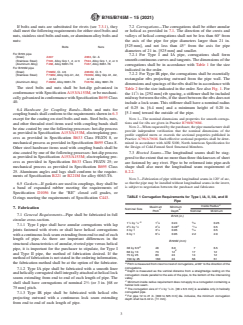
7.2.1 For Type I and IA pipe, corrugations shall form
(Steel) A307 A563,Gr.A
smooth continuous curves and tangents. The dimensions of the
(Stainless Steel) F593, Alloy Grp 1, 2, or 3 F594, Alloy Grp 1, 2, or 3
(Aluminum Alloy) F468, Alloy 6061-T6 F467, Alloy 6061-T6
corrugations shall be in accordance with Table 1 for the size
For B745M pipe
indicated in the order.
(Steel) F568M, Cl. 4.6 A563M, Cl. 5
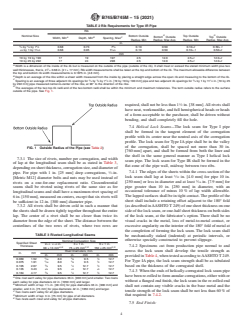
7.2.2 For Type IR pipe, the corrugations shall be essentially
(Stainless Steel) F738M, Alloy Grp A1, A2, F836M, Alloy Grp A1, A2,
or A4 or A4
rectangular ribs projecting outward from the pipe wall. The
(Aluminum Alloy) F468M, Alloy 6061-T6 F467M, Alloy 6061-T6
dimensionsandspacingsoftheribsshallbeinaccordancewith
The steel bolts and nuts shall be hot-dip galvanized in
Table 2 for the size indicated in the order. See also Fig. 1. For
conformance with Specification A153/A153M, or be mechani-
the 11 ⁄2 in. [292 mm] rib spacing, a stiffener shall be included
callygalvanizedinconformancewithSpecificationB695Class
midway between the ribs, if the sheet between the ribs does not
40.
include a lock seam. This stiffener shall have a nominal radius
of 0.25 in. [6.4 mm] and a minimum height of 0.20 in.
6.4 Hardware for Coupling Bands—Bolts and nuts for
[5.1 mm] toward the outside of the pipe.
coupling bands shall conform to the requirements shown in 6.3
except for the coating on steel bolts and nuts. Steel bolts, nuts, NOTE 1—The nominal dimensions and properties for smooth corruga-
tions and for ribs are given in Practice B790/B790M.
and other threaded steel items used with coupling bands shall
NOTE 2—When requested by the purchaser, the pipe manufacturer shall
be zinc coated by one the following processes: hot-dip process
provide independent verification that the nominal dimensions of the
as provided in Specification A153/A153M, electroplating pro-
profile supplied meets or exceeds the sectional properties published in
cess as provided in Specification B633 Class FE/ZN 8, or
Practice A796/A796M. Such effective sectional properties shall be deter-
mechanical process as provided in Specification B695 Class 8. mined in accordance with AISI S100, North American Specification for
the Design of Cold-Formed Steel Structural Members.
Other steel hardware items used with coupling bands shall be
zinc-coated by one of the following processes: hot-dip process
7.3 Riveted Seams—The longitudinal seams shall be stag-
as provided in Specification A153/A153M; electroplating pro-
gered to the extent that no more than three thicknesses of sheet
cess as provided in Specification B633 Class FE/ZN 25; or
are fastened by any rivet. Pipe to be reformed into pipe-arch
mechanical process as provided in Specification B695 Class
shape shall also meet the longitudinal seam requirement of
25. Aluminum angles and lugs shall conform to the require-
8.2.2.
ments of Specification B221 or B221M for alloy 6063-T6.
NOTE 3—Fabrication of pipe without longitudinal seams in 120° of arc,
so that the pipe may be installed without longitudinal seams in the invert,
6.5 Gaskets—If gaskets are used in couplings, they shall be
is subject to negotiation between the purchaser and fabricator.
a band of expanded rubber meeting the requirements of
Specification D1056 for the “RE” closed cell grades, or
TABLE 1 Corrugation Requirements for Type I, IA, II, IIA, and III
O-rings meeting the requirements of Specification C443.
Pipe
C
Inside Radius
Maximum Minimum
7. Fabrication
Nominal Size
A B
Pitch Depth
Nominal Minimum
7.1 General Requirements—Pipe shall be fabricated in full
B745 (in.)
circular cross-section.
D
1 1 7 9
1 ⁄2 by ⁄4 1 ⁄8 0.24 ⁄32 0.25
7.1.1 Type I pipe shall have annular corrugations with lap
E
2 1 7 11
2 ⁄2 by ⁄2 2 ⁄8 0.48 ⁄16 0.5
1 9
joints fastened with rivets or shall have helical corrugations
3by1 3 ⁄4 0.95 ⁄16 0.5
6by1 6 ⁄4 0.95 2.2 2.0
with a continuous lock seam extending from end to end of each
length of pipe. As there are important differences in the
B745M (mm)
structural characteristics of annular, riveted pipe versus helical
D
38 by 6.5 48 6.0 7 6.5
pipe, it is important for the purchaser to stipulate, for Type I
E
68 by 13 73 12 17 12
and Type II pipe, the method of fabrication desired. If the
75 by 25 83 24 14 12
method of fabrication is not stated in the ordering information,
150 by 25 160 24 56 51
A
the fabrication method shall be at the option of the fabricator.
Pitchismeasuredfromcresttocrestofcorrugations,at90°tothedirectionofthe
corrugations.
7.1.2 Type IA pipe shall be fabricated with a smooth liner
B
Depth is measured as the vertical distance from a straightedge resting on the
andhelicallycorrugatedshellintegrallyattachedathelicallock
corrugation crests parallel to the axis of the pipe, to the bottom of the intervening
seams extending from end to end of each length of pipe. The valley.
C
Minimum inside radius requirement does not apply to a corrugation containing a
shell shall have corrugations of nominal 2 ⁄3 (or 3 in. [68 or
helical lock seam.
D
75 mm] pitch. 1 1
The corrugation size of 1 ⁄2 by ⁄4 in. [38 x 6.5 mm] is available only in helically
corrugated pipe.
7.1.3 Type IR pipe shall be fabricated with helical ribs
E
For pipe 12 to 21 in. [300 to 525 mm] dia. inclusive, the minimum corrugation
projecting outward with a continuous lock seam extending
depth shall be 0.42 in. [11 mm].
from end to end of each length of pipe.
B745/B745M−15 (2021)
TABLE 2 Rib Requirements for Type IR Pipe
Rib
D D
Nominal Size
Bottom Outside Top Outside
Bottom Outside Top Outside
A B C
Width, Min Depth, Min Spacing, Max
Radius, Max Avg. Radius, Max Avg.
Radius, Min Radius, Min
in.
3 3 1 3
⁄4 by ⁄4 by 7 ⁄2 0.68 0.73 7 ⁄4 0.10 0.50 0.10+t 0.50+ t
3 1 3
⁄4by1by11 ⁄2 0.68 0.95 11 ⁄4 0.10 0.50 0.10+ t 0.50+t
mm
19 by 19 by 190 17 19 197 2.5 12.0 2.5+t 12.0+t
19 by 25 by 292 17 24 298 2.5 12.0 2.5+t 12.0+t
A
Width is a dimension of the inside of the rib but is measured on the outside of the pipe (outside of the rib). It shall meet or exceed the stated minimum widthplustwo
wall thicknesses, that is, 2T + 0.68 in. [2 t + 17 mm]. Rib width measurements shall be taken at the top and bottom of the rib.The maximum allowable difference between
the top and bottom rib width measurements is 0.1875 in. [4.8 mm].
B
Depth is an average of the ribs within a sheet width measured from the inside by placing a straight edge across the open rib and measuring to the bottom of the rib.
C
3 3 1 3 1
Spacing is an average of three adjacent rib spacings for ⁄4 by ⁄4 by 7 ⁄2 in. [19 by 19 by 190 mm] pipe and two adjacent rib spacings for ⁄4by1by11 ⁄2 in. [19 by 25
by 292 mm] pipe measured center-to-center of the ribs, at 90° to the direction of the ribs.
D
The averages of the two top rib radii and of the two bottom radii shall be within the minimum and maximum tolerances. The term outside radius refers to the surface
outside of the pipe. See Fig. 1.
required, shall not be less than 1 ⁄2 in. [38 mm].All rivets shall
have neat, workmanlike, and full hemispherical heads or heads
of a form acceptable to the purchaser, shall be driven without
bending, and shall completely fill the hole.
7.4 Helical Lock Seams—The lock seam for Type I pipe
shall be formed in the tangent element of the corrugation
profile with its center near the neutral axis of the corrugation
profile. The lock seam for Type IA pipe shall be in the valley
of the corrugation, shall be spaced not more than 30 in.
FIG. 1 Outside Radius of the Pipe (see Table 2)
[760 mm] apart, and shall be formed from both the liner and
the shell in the same general manner as Type I helical lock
7.3.1 The size of rivets, number per corrugation, and width
seam pipe. The lock seam for Type IR shall be formed in the
of lap at the longitudinal seam shall be as stated in Table 3,
flat zone of the pipe wall, midway between two ribs.
dependingonsheetthickness,corrugationsize,anddiameterof
1 7.4.1 The edges of the sheets within the cross-section of the
pipe. For pipe with 1 in. [25 mm] deep corrugations, ⁄2-in.
lock seam shall lap at least ⁄32 in. [4.0 mm] for pipe 10 in.
[Metric M12] diameter bolts and nuts may be used instead of
[250 mm] or less in diameter and at least ⁄16 in. [7.9 mm] for
rivets on a one-for-one replacement ratio. Circumferential
pipe greater than 10 in. [250 mm] in diameter, with an
seams shall be riveted using rivets of the same size as for
occasional tolerance of minus 10 % of lap width allowable.
longitudinal seams and shall have a maximum rivet spacing of
The lapped surfaces shall be in tight contact. The profile of the
6 in. [150 mm], measured on centers, except that six rivets will
sheet shall include a retaining offset adjacent to the 180° fold
be sufficient in 12-in. [300 mm] diameter pipe.
7.3.2 All rivets shall be driven cold in such a manner that (asdescribedinAASHTOT 249)ofonesheetthicknessonone
side of the lock seam, or one-half sheet thickness on both sides
the sheets shall be drawn tightly together throughout the entire
lap. The center of a rivet shall be no closer than twice its of the lock seam, at the fabricator’s option. There shall be no
diameter from the edge of the sheet. The distance between the visual cracks in the metal, loss of metal-to-metal contact, or
centerlines of the two rows of rivets, where two rows are
excessive angularity on the interior of the 180° fold of metal at
the completion of forming the lock seam. The lock seam shall
TABLE 3 Riveted Longitudinal Seams be mechanically staked (indented) at periodic intervals, or
otherwise specially constructed to prevent slippage.
Nominal Corrugation Size
Specified Sheet
2 1
2 ⁄3 × ⁄2 in. 3×1in. 6×1in.
Thickness 7.4.2 Specimens cut from production pipe normal to and
A,B C,D E,D
68×13mm 75×25mm 150×25mm
across the lock seam shall develop the tensile strength as
Rivet Diameters, min.
in. mm
in. mm in. mm in. mm
provided in Table 4, when tested according toAASHTOT 249.
5 3 1
0.060 1.52 ⁄16 8.0 ⁄8 9.5 ⁄2 12.7
For Type IA pipe, the lock seam strength shall be as tabulated
5 3 1
0.075 1.91 ⁄16 8.0 ⁄8 9.5 ⁄2 12.7
3 1 1
based on the thickness of the corrugated shell.
0.105 2.67 ⁄8 9.5 ⁄2 12.7 ⁄2 12.7
3 1 1
0.135 3.43 ⁄8 9.5 ⁄2 12.7 ⁄2 12.7
7.4.3 When the ends of helically-corrugated lock seam pipe
3 1 1
0.164 4.17 ⁄8 9.5 ⁄2 12.7 ⁄2 12.7
have been re-rolled to form annular corrugations, either with or
A
One rivet each valley for pipe diameters 36 in. [900 mm] and smaller.Two rivets
without a flanged end finish, the lock seam in the re-rolled end
each valley for pipe diameters 42 in. [1050 mm] and larger.
B
Minimum width of lap: 1 ⁄2 in. [38 mm] for pipe diameters 36 in. [900 mm] and
shall not contain any visible cracks in the base metal and the
smaller, and 3 in. [75 mm] for pipe diameters 42 in. [1050 mm] and larger.
tensile strength of the lock seam shall be not less than 60 % of
C
Two rivets each valley for all pipe diameters.
D
that required in 7.4.2.
Minimum width of lap: 3 in. [75 mm] for pipe of all diameters.
E
Two rivets each crest and valley for all pipe diameters.
7.5 End Finish:
B745/B745M−15 (2021)
TABLE 4 Specified Aluminum Alloy Sheet Thicknesses and Lock
7.5.3 If a flanged finish is used on the ends of individual
Seam Tensile Strength
pipe sections to facilitate field jointing, the flange shall be
A,B
Specified Sheet Thickness Lock Seam Tensile Strength, min. 1
uniform in width, be not less than ⁄2 in. [13 mm] wide, and
in. mm lbf/in. kN/m
shall be square to the longitudinal axis of the pipe.
0.036 0.91 100 17
7.5.4 The ends of all pipe which will form the inlet and
0.048 1.22 145 25
outlet of culverts, fabricated of sheets having normal thick-
0.060 1.52 170 30
0.075 1.91 245 43 nesses of 0.075 in. [1.91 mm] and less, shall be reinforced in
0.105 2.67 425 74
a manner approved by the purchaser, when specified.
0.135 3.43 550 96
0.164 4.17 700 122
8. Pipe Requirements
A
Thicknesses listed are those included in Specification B744/B744M.
B
For Type IApipe, the lock seam tensile strength requirement shall be based on
8.1 Type I, Type IA, and Type IR Pipe:
the thickness of the corrugated shell.
8.1.1 Pipe Dimensions—The nominal diameter of the pipe
shall be as stated in the order, selected from the sizes listed in
Table 5. The size of corrugations, which are standard for each
size of pipe, are also shown in Table 5. The average inside
7.5.1 To facilitate field jointing, the ends of individual pipe diameter of circular pipe and pipe to be reformed into
sections with helical corrugations or ribs may be re-rolled to pipe-arches shall not vary more than 1 % or ⁄2 in. [13 mm],
form annular corrugations extending at least two corrugations whichever is greater, from the nominal diameter when mea-
from the pipe end, or to form an upturned flange meeting the sured on the inside crest of the corrugations. Alternately, for
requirements in 7.5.3, or both. The diameter of ends shall not pipe having annular corrugations, conformance with the inside
exceed that of the pipe barrel by more than the depth of the diameter requirement may be determined by measuring the
corrugation. All types of pipe ends, whether re-rolled or not, outside circumference, for which minimum values are given in
shall be matched in a joint such that the maximum difference Table 5.
in the diameter of abutting pipe ends is ⁄2 in. [13 mm].
NOTE 4—The outside circumference of helically corrugated pipe is
7.5.2 Whenpipewithhelicalcorrugationsorribsisre-rolled
influenced by the corrugation size and the angle of the corrugations,
to form annular corrugations in the ends, the usual size of
affecting the number of corruga
...