


ASTM D1792-17(2023)
(Test Method)Standard Test Method for Long-Term Removability Properties of Emulsion Floor Polishes
Standard Test Method for Long-Term Removability Properties of Emulsion Floor Polishes
SIGNIFICANCE AND USE
4.1 This test method is used to predict removability of floor polish after a treatment period that simulates aging in the field. It allows for uniform mechanical and detergent action leaving the only variable the actual removability of the polish.
SCOPE
1.1 This test method covers the determination of the relative ease of removal of dried films of water-emulsion floor polishes from common flooring substrates under accelerated conditions, which correspond to extended service aging.
1.2 This standard does not purport to address all of the safety concerns, if any, associated with its use. It is the responsibility of the user of this standard to establish appropriate safety, health, and environmental practices and determine the applicability of regulatory limitations prior to use.
1.3 This international standard was developed in accordance with internationally recognized principles on standardization established in the Decision on Principles for the Development of International Standards, Guides and Recommendations issued by the World Trade Organization Technical Barriers to Trade (TBT) Committee.
General Information
- Status
- Published
- Publication Date
- 31-Aug-2023
- Technical Committee
- D21 - Polishes
- Drafting Committee
- D21.04 - Performance Tests
Relations
- Effective Date
- 01-Mar-2017
- Effective Date
- 01-Nov-2015
- Effective Date
- 01-Mar-2008
- Effective Date
- 10-Sep-1997
Overview
ASTM D1792-17(2023) is the internationally recognized standard test method for evaluating the long-term removability properties of emulsion floor polishes. Developed by ASTM International, this standard provides a reliable methodology to determine how easily water-emulsion-based floor polish films can be removed from common flooring substrates after simulated aging. The method mimics real-world wear and aging using accelerated test conditions to ensure uniform mechanical and detergent action, making removability of the polish the only variable.
This test method supports manufacturers, custodial professionals, and facility managers in objectively assessing the performance and serviceability of floor polishes over time, ultimately guiding choices in product development and maintenance practices.
Key Topics
- Removability Measurement: Assesses the ease with which dried films of floor polishes can be removed using a standardized mechanical action and detergent solution, reflecting extended service aging.
- Accelerated Aging Simulation: Conditions coated panels at controlled temperatures to simulate the natural aging process that polishes would undergo in practical use.
- Repeatability and Objectivity: Utilizes precise application and removal apparatus to ensure consistent and reproducible results across different polish formulations.
- Safety and Environmental Awareness: Reminds users to establish safe practices and consider regulatory requirements when applying the procedure.
Applications
ASTM D1792-17(2023) is instrumental in numerous settings for:
- Product Development: Floor polish manufacturers use this standard to evaluate and compare the removability of new and existing emulsion polish formulations. Understanding removability is vital in balancing polish durability with maintenance efficiency.
- Quality Control: Consistent application of the test method helps companies ensure that product batches meet desired performance standards for removability, leading to uniform end-user experiences.
- Maintenance Planning: Facility managers and cleaning service providers leverage results from ASTM D1792-17(2023) to select polishes that meet facility-specific maintenance needs, optimizing cleaning protocols for both ease of removal and long-term floor care.
- Comparative Marketing: Objective removability data supports transparent claims regarding product performance, aiding customers in making informed purchasing decisions.
Related Standards
The following standards are closely associated with ASTM D1792-17(2023):
- ASTM D1436: Provides test methods for the application of emulsion floor polishes to substrates for testing purposes, which is referenced for proper polish application in this standard.
- International Principles: This standard adheres to World Trade Organization (WTO) TBT Committee guidelines, ensuring international harmonization in testing procedures.
- Other ASTM Standards: Additional performance and safety standards from ASTM Committee D21 on Polishes may complement or be used alongside this method for a comprehensive assessment of floor finishes.
Keywords: ASTM D1792-17, emulsion floor polishes, polish removability, floor finish testing, accelerated aging, floor care standards, floor polish testing, mechanical removal, custodial maintenance, international floor care standards
By following ASTM D1792-17(2023), industries and professionals benefit from a robust, standardized approach to evaluating the long-term removability of emulsion floor polishes, ultimately enhancing maintenance strategies, product quality, and user satisfaction.


Get Certified
Connect with accredited certification bodies for this standard

ECOCERT
Organic and sustainability certification.

Eurofins Food Testing Global
Global leader in food, environment, and pharmaceutical product testing.

Intertek Bangladesh
Intertek certification and testing services in Bangladesh.
Sponsored listings
Frequently Asked Questions
ASTM D1792-17(2023) is a standard published by ASTM International. Its full title is "Standard Test Method for Long-Term Removability Properties of Emulsion Floor Polishes". This standard covers: SIGNIFICANCE AND USE 4.1 This test method is used to predict removability of floor polish after a treatment period that simulates aging in the field. It allows for uniform mechanical and detergent action leaving the only variable the actual removability of the polish. SCOPE 1.1 This test method covers the determination of the relative ease of removal of dried films of water-emulsion floor polishes from common flooring substrates under accelerated conditions, which correspond to extended service aging. 1.2 This standard does not purport to address all of the safety concerns, if any, associated with its use. It is the responsibility of the user of this standard to establish appropriate safety, health, and environmental practices and determine the applicability of regulatory limitations prior to use. 1.3 This international standard was developed in accordance with internationally recognized principles on standardization established in the Decision on Principles for the Development of International Standards, Guides and Recommendations issued by the World Trade Organization Technical Barriers to Trade (TBT) Committee.
SIGNIFICANCE AND USE 4.1 This test method is used to predict removability of floor polish after a treatment period that simulates aging in the field. It allows for uniform mechanical and detergent action leaving the only variable the actual removability of the polish. SCOPE 1.1 This test method covers the determination of the relative ease of removal of dried films of water-emulsion floor polishes from common flooring substrates under accelerated conditions, which correspond to extended service aging. 1.2 This standard does not purport to address all of the safety concerns, if any, associated with its use. It is the responsibility of the user of this standard to establish appropriate safety, health, and environmental practices and determine the applicability of regulatory limitations prior to use. 1.3 This international standard was developed in accordance with internationally recognized principles on standardization established in the Decision on Principles for the Development of International Standards, Guides and Recommendations issued by the World Trade Organization Technical Barriers to Trade (TBT) Committee.
ASTM D1792-17(2023) is classified under the following ICS (International Classification for Standards) categories: 71.100.99 - Other products of the chemical industry; 97.080 - Cleaning appliances. The ICS classification helps identify the subject area and facilitates finding related standards.
ASTM D1792-17(2023) has the following relationships with other standards: It is inter standard links to ASTM D1436-17, ASTM D1436-97(2015), ASTM D1436-97(2008), ASTM D1436-97(2002). Understanding these relationships helps ensure you are using the most current and applicable version of the standard.
ASTM D1792-17(2023) is available in PDF format for immediate download after purchase. The document can be added to your cart and obtained through the secure checkout process. Digital delivery ensures instant access to the complete standard document.
Standards Content (Sample)
This international standard was developed in accordance with internationally recognized principles on standardization established in the Decision on Principles for the
Development of International Standards, Guides and Recommendations issued by the World Trade Organization Technical Barriers to Trade (TBT) Committee.
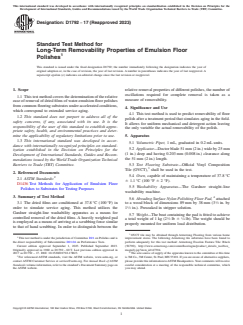
Designation: D1792 − 17 (Reapproved 2023)
Standard Test Method for
Long-Term Removability Properties of Emulsion Floor
Polishes
This standard is issued under the fixed designation D1792; the number immediately following the designation indicates the year of
original adoption or, in the case of revision, the year of last revision. A number in parentheses indicates the year of last reapproval. A
superscript epsilon (´) indicates an editorial change since the last revision or reapproval.
1. Scope relative removal properties of different polishes, the number of
oscillations required for complete removal is taken as a
1.1 This test method covers the determination of the relative
measure of removability.
ease of removal of dried films of water-emulsion floor polishes
from common flooring substrates under accelerated conditions,
4. Significance and Use
which correspond to extended service aging.
4.1 This test method is used to predict removability of floor
1.2 This standard does not purport to address all of the
polish after a treatment period that simulates aging in the field.
safety concerns, if any, associated with its use. It is the
It allows for uniform mechanical and detergent action leaving
responsibility of the user of this standard to establish appro-
the only variable the actual removability of the polish.
priate safety, health, and environmental practices and deter-
mine the applicability of regulatory limitations prior to use. 5. Apparatus
1.3 This international standard was developed in accor-
5.1 Volumetric Pipet, 1 mL, graduated in 0.2 mL units.
dance with internationally recognized principles on standard-
5.2 Applicator—Doctor blade 51 mm (2 in.) wide by 25 mm
ization established in the Decision on Principles for the
(1 in.) deep and having 0.203 mm (0.008 in.) clearance along
Development of International Standards, Guides and Recom-
the 51 mm (2 in.) length.
mendations issued by the World Trade Organization Technical
Barriers to Trade (TBT) Committee.
5.3 Test Flooring Substrate—Official Vinyl Composition
Tile (OVCT), shall be used in the test.
2. Referenced Documents
5.4 Oven, capable of maintaining a temperature of 37.8 °C
2.1 ASTM Standards:
6 1.1 °C (100 °F 6 2 °F).
D1436 Test Methods for Application of Emulsion Floor
5.5 Washability Apparatus—The Gardner straight-line
Polishes to Substrates for Testing Purposes
washability machine.
3. Summary of Test Method 4
5.6 Abrading Surface Nylon Polishing Floor Pad, attached
3.1 The dried films are conditioned at 37.8 °C (100 °F) in to a wood block of dimensions 89 mm by 38 mm (3 ⁄2 in. by
order to simulate service aging. This method utilizes the 1 ⁄2 in.). Presoaked in stripper solution.
Gardner straight-line washability apparatus as a means for
5.7 Weight—The boat containing the pad is fitted to achieve
controlled removal of the dried films. A heavily weighted pad
1 1
a total weight of 1 kg (2 ⁄2 lb 6 ⁄4 lb). The weight should be
is employed as a means of arriving at a scrubbing force similar
properly mounted for uniform load distribution.
to that of hand scrubbing. In order to distinguish between the
OVCT tile may be obtained through Armstrong Flooring from various home
This test method is under the jurisdiction of Committee D21 on Polishes and is improvement stores. The following Armstrong tile substrates have been found to
the direct responsibility of Subcommittee D21.04 on Performance Tests. perform adequately for this test method: Armstrong Excelon Feature Tile: Black
Current edition approved September 1, 2023. Published September 2023. (56790), http://www.armstrong.com/commflooringna/product_details_toolbox_
Originally approved in 1960 as D1792 – 60 T. Last previous edition approved in magnify.jsp?item_id=47394.
2017 as D1792 – 17. DOI: 10.1520/D1792-17R23. The sole source of supply of the apparatus known to the committee at this time
For referenced ASTM standards, visit the ASTM website, www.astm.org, or is 3M Co., 3M Center, St. Paul, MN 55101. If you are aware of alternative suppliers,
contact ASTM Customer Service at service@astm.org. For Annual Book of ASTM please provide this information to ASTM Headquarters. Your comments will receive
Standards volume information, refer to the standard’s Document Summary page on careful consideration at a meeting of the responsible technical committee, which
the ASTM website. you may a
...
Questions, Comments and Discussion
Ask us and Technical Secretary will try to provide an answer. You can facilitate discussion about the standard in here.
Loading comments...