

ASTM F1350-24
(Specification)Standard Specification for Wrought 18Chromium-14Nickel-2.5Molybdenum Stainless Steel Surgical Fixation Wire (UNS S31673)
General Information
- Abstract
ABSTRACT
This specification covers UNS S31673 chromium-nickel-molybdenum wrought annealed stainless steel surgical fixation wires. The wires should conform to the required values of tensile strength and elongation. Wire surfaces should be processed to minimize tool marks, nicks, scratches, cracks, cavities, spurs, and other imperfections that would impair wire serviceability.
SCOPE
1.1 This specification covers the chemical, mechanical, and metallurgical requirements for the manufacture of wrought 18chromium-14nickel-2.5molybdenum stainless steel in the form of surgical fixation wire.
1.2 Units—The values stated in either SI units or inch-pound units are to be regarded separately as standard. The values stated in each system are not necessarily exact equivalents; therefore, to ensure conformance with the standard, each system shall be used independently of the other, and values from the two systems shall not be combined.
1.3 This standard does not purport to address all of the safety concerns, if any, associated with its use. It is the responsibility of the user of this standard to establish appropriate safety, health, and environmental practices and determine the applicability of regulatory limitations prior to use.
1.4 This international standard was developed in accordance with internationally recognized principles on standardization established in the Decision on Principles for the Development of International Standards, Guides and Recommendations issued by the World Trade Organization Technical Barriers to Trade (TBT) Committee.
- Status
- Published
- Publication Date
- 14-Mar-2024
- Technical Committee
- F04 - Medical and Surgical Materials and Devices
- Drafting Committee
- F04.12 - Metallurgical Materials
Buy Documents
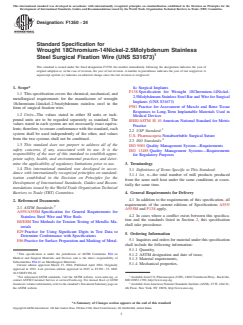
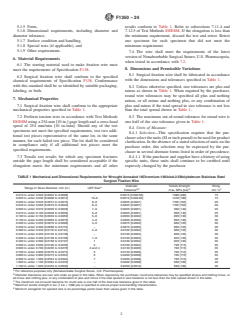
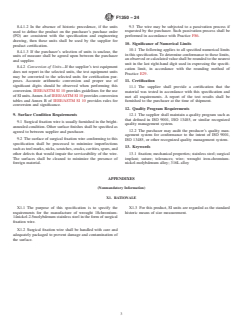

ASTM F1350-24 - Standard Specification for Wrought 18Chromium-14Nickel-2.5Molybdenum Stainless Steel Surgical Fixation Wire (UNS S31673)
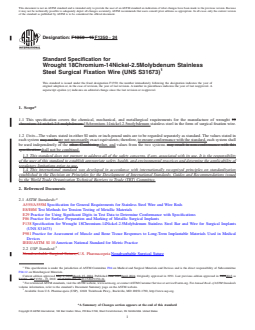
REDLINE ASTM F1350-24 - Standard Specification for Wrought 18Chromium-14Nickel-2.5Molybdenum Stainless Steel Surgical Fixation Wire (UNS S31673)
Overview
ASTM F1350-24: Standard Specification for Wrought 18Chromium-14Nickel-2.5Molybdenum Stainless Steel Surgical Fixation Wire (UNS S31673) establishes comprehensive chemical, mechanical, and metallurgical requirements for wrought stainless steel wire used in surgical fixation. Developed by ASTM International, this standard provides guidelines to ensure the suitability and reliability of UNS S31673 alloy used for surgical applications, emphasizing critical properties like tensile strength, elongation, and surface quality. ASTM F1350-24 supports global best practices in medical device manufacturing by aligning with international quality management principles.
Key Topics
- Material Composition: Defines chemical requirements for surgical fixation wire produced from 18chromium-14nickel-2.5molybdenum stainless steel (UNS S31673).
- Mechanical Properties: Specifies tensile strength and elongation requirements, as well as procedures for tension testing.
- Dimensional Tolerances: Sets strict criteria for wire dimensions, diameter tolerances, and permissible size variations to ensure product uniformity.
- Surface Quality: Requires wire surfaces to be free from tool marks, nicks, scratches, cracks, cavities, and other imperfections that could impair performance.
- Quality Assurance: Mandates quality management programs compliant with ISO 9001 or ISO 13485 and requires certification and documentation for each batch.
- Dual Units: Allows for specification and certification in either SI or inch-pound units, which must be used independently for each order.
- Biocompatibility: Recognizes the long-standing clinical use of this alloy in implantable applications involving soft tissue and bone, highlighting its expected biological response when processed correctly.
Applications
This standard is specifically geared toward the medical device and surgical implant sector, providing manufacturers and suppliers with clear guidelines for producing high-quality surgical fixation wire. Key applications include:
- Orthopedic Fixation: Used in surgical procedures to secure bone fragments, support fractures, or fixate implants.
- Biomedical Wire Forms: Employed in the manufacture of nonabsorbable surgical sutures and other medical devices that demand high corrosion resistance and mechanical strength.
- Custom Medical Devices: Serves as a baseline specification for wire forms in custom surgical implants, ensuring they meet industry-recognized safety and functional standards.
- Regulatory Compliance: Assists manufacturers in meeting global regulatory requirements for material properties, documentation, and traceability, facilitating international trade and approval.
Related Standards
ASTM F1350-24 references and is closely aligned with the following standards, which are vital to those working with surgical stainless steel wire and related medical devices:
- ASTM F138: Specification for Wrought 18Chromium-14Nickel-2.5Molybdenum Stainless Steel Bar and Wire for Surgical Implants (UNS S31673)
- ASTM A555/A555M: General Requirements for Stainless Steel Wire and Wire Rods
- ASTM E8/E8M: Test Methods for Tension Testing of Metallic Materials
- ASTM E29: Practice for Using Significant Digits in Test Data to Determine Conformance with Specifications
- ASTM F86: Practice for Surface Preparation and Marking of Metallic Surgical Implants
- ASTM F981: Practice for Assessment of Muscle and Bone Tissue Responses to Long-Term Implantable Materials Used in Medical Devices
- ISO 9001 and ISO 13485: International standards for quality management systems with relevance for regulatory purposes in the medical device industry
- USP Nonabsorbable Surgical Suture: U.S. Pharmacopeia standard referenced for additional wire performance criteria
Practical Value
Adhering to ASTM F1350-24 ensures that surgical fixation wires meet rigorous international standards for mechanical strength, corrosion resistance, and reliability. This benefits manufacturers, regulatory agencies, and health care providers by maximizing patient safety and device performance-reinforcing the global foundation for quality in medical device manufacturing.
Relations
- Effective Date
- 15-Mar-2024
- Effective Date
- 15-Mar-2024
Buy Documents
ASTM F1350-24 - Standard Specification for Wrought 18Chromium-14Nickel-2.5Molybdenum Stainless Steel Surgical Fixation Wire (UNS S31673)
REDLINE ASTM F1350-24 - Standard Specification for Wrought 18Chromium-14Nickel-2.5Molybdenum Stainless Steel Surgical Fixation Wire (UNS S31673)
Get Certified
Connect with accredited certification bodies for this standard

BSI Group
BSI (British Standards Institution) is the business standards company that helps organizations make excellence a habit.

TÜV Rheinland
TÜV Rheinland is a leading international provider of technical services.

TÜV SÜD
TÜV SÜD is a trusted partner of choice for safety, security and sustainability solutions.
Sponsored listings
Frequently Asked Questions
ASTM F1350-24 is a technical specification published by ASTM International. Its full title is "Standard Specification for Wrought 18Chromium-14Nickel-2.5Molybdenum Stainless Steel Surgical Fixation Wire (UNS S31673)". This standard covers: ABSTRACT This specification covers UNS S31673 chromium-nickel-molybdenum wrought annealed stainless steel surgical fixation wires. The wires should conform to the required values of tensile strength and elongation. Wire surfaces should be processed to minimize tool marks, nicks, scratches, cracks, cavities, spurs, and other imperfections that would impair wire serviceability. SCOPE 1.1 This specification covers the chemical, mechanical, and metallurgical requirements for the manufacture of wrought 18chromium-14nickel-2.5molybdenum stainless steel in the form of surgical fixation wire. 1.2 Units—The values stated in either SI units or inch-pound units are to be regarded separately as standard. The values stated in each system are not necessarily exact equivalents; therefore, to ensure conformance with the standard, each system shall be used independently of the other, and values from the two systems shall not be combined. 1.3 This standard does not purport to address all of the safety concerns, if any, associated with its use. It is the responsibility of the user of this standard to establish appropriate safety, health, and environmental practices and determine the applicability of regulatory limitations prior to use. 1.4 This international standard was developed in accordance with internationally recognized principles on standardization established in the Decision on Principles for the Development of International Standards, Guides and Recommendations issued by the World Trade Organization Technical Barriers to Trade (TBT) Committee.
ABSTRACT This specification covers UNS S31673 chromium-nickel-molybdenum wrought annealed stainless steel surgical fixation wires. The wires should conform to the required values of tensile strength and elongation. Wire surfaces should be processed to minimize tool marks, nicks, scratches, cracks, cavities, spurs, and other imperfections that would impair wire serviceability. SCOPE 1.1 This specification covers the chemical, mechanical, and metallurgical requirements for the manufacture of wrought 18chromium-14nickel-2.5molybdenum stainless steel in the form of surgical fixation wire. 1.2 Units—The values stated in either SI units or inch-pound units are to be regarded separately as standard. The values stated in each system are not necessarily exact equivalents; therefore, to ensure conformance with the standard, each system shall be used independently of the other, and values from the two systems shall not be combined. 1.3 This standard does not purport to address all of the safety concerns, if any, associated with its use. It is the responsibility of the user of this standard to establish appropriate safety, health, and environmental practices and determine the applicability of regulatory limitations prior to use. 1.4 This international standard was developed in accordance with internationally recognized principles on standardization established in the Decision on Principles for the Development of International Standards, Guides and Recommendations issued by the World Trade Organization Technical Barriers to Trade (TBT) Committee.
ASTM F1350-24 is classified under the following ICS (International Classification for Standards) categories: 11.040.40 - Implants for surgery, prosthetics and orthotics. The ICS classification helps identify the subject area and facilitates finding related standards.
ASTM F1350-24 has the following relationships with other standards: It is inter standard links to ASTM F1350-15, ASTM F138-19. Understanding these relationships helps ensure you are using the most current and applicable version of the standard.
ASTM F1350-24 is available in PDF format for immediate download after purchase. The document can be added to your cart and obtained through the secure checkout process. Digital delivery ensures instant access to the complete standard document.
Standards Content (Sample)
This international standard was developed in accordance with internationally recognized principles on standardization established in the Decision on Principles for the
Development of International Standards, Guides and Recommendations issued by the World Trade Organization Technical Barriers to Trade (TBT) Committee.
Designation: F1350 − 24
Standard Specification for
Wrought 18Chromium-14Nickel-2.5Molybdenum Stainless
Steel Surgical Fixation Wire (UNS S31673)
This standard is issued under the fixed designation F1350; the number immediately following the designation indicates the year of
original adoption or, in the case of revision, the year of last revision. A number in parentheses indicates the year of last reapproval. A
superscript epsilon (´) indicates an editorial change since the last revision or reapproval.
1. Scope* lic Surgical Implants
F138 Specification for Wrought 18Chromium-14Nickel-
1.1 This specification covers the chemical, mechanical, and
2.5Molybdenum Stainless Steel Bar and Wire for Surgical
metallurgical requirements for the manufacture of wrought
Implants (UNS S31673)
18chromium-14nickel-2.5molybdenum stainless steel in the
F981 Practice for Assessment of Muscle and Bone Tissue
form of surgical fixation wire.
Responses to Long-Term Implantable Materials Used in
1.2 Units—The values stated in either SI units or inch-
Medical Devices
pound units are to be regarded separately as standard. The
IEEE/ASTM SI 10 American National Standard for Metric
values stated in each system are not necessarily exact equiva-
Practice
lents; therefore, to ensure conformance with the standard, each 3
2.2 USP Standard:
system shall be used independently of the other, and values
U.S. Pharmacopeia Nonabsorbable Surgical Suture
from the two systems shall not be combined.
2.3 ISO Standards:
1.3 This standard does not purport to address all of the
ISO 9001 Quality Management System—Requirements
safety concerns, if any, associated with its use. It is the
ISO 13485 Quality Management Systems—Requirements
responsibility of the user of this standard to establish appro-
for Regulatory Purposes
priate safety, health, and environmental practices and deter-
mine the applicability of regulatory limitations prior to use. 3. Terminology
1.4 This international standard was developed in accor-
3.1 Definitions of Terms Specific to This Standard:
dance with internationally recognized principles on standard-
3.1.1 lot, n—the total number of mill products produced
ization established in the Decision on Principles for the
from the same melt heat under the same conditions at essen-
Development of International Standards, Guides and Recom-
tially the same time.
mendations issued by the World Trade Organization Technical
Barriers to Trade (TBT) Committee.
4. General Requirements for Delivery
4.1 In addition to the requirements of this specification, all
2. Referenced Documents
requirements of the current editions of Specifications A555/
2.1 ASTM Standards:
A555M and F138 apply.
A555/A555M Specification for General Requirements for
4.2 In cases where a conflict exists between this specifica-
Stainless Steel Wire and Wire Rods
tion and the standards listed in Section 2, this specification
E8/E8M Test Methods for Tension Testing of Metallic Ma-
shall take precedence.
terials
E29 Practice for Using Significant Digits in Test Data to
5. Ordering Information
Determine Conformance with Specifications
5.1 Inquiries and orders for material under this specification
F86 Practice for Surface Preparation and Marking of Metal-
shall include the following information:
5.1.1 Quantity,
This specification is under the jurisdiction of ASTM Committee F04 on
5.1.2 ASTM designation and date of issue,
Medical and Surgical Materials and Devices and is the direct responsibility of
5.1.3 Material requirements,
Subcommittee F04.12 on Metallurgical Materials.
5.1.4 Mechanical properties,
Current edition approved March 15, 2024. Published April 2024. Originally
approved in 1991. Last previous edition approved in 2015 as F1350 – 15. DOI:
10.1520/F1350-24.
2 3
For referenced ASTM standards, visit the ASTM website, www.astm.org, or Available from U.S. Pharmacopeia (USP), 12601 Twinbrook Pkwy., Rockville,
contact ASTM Customer Service at service@astm.org. For Annual Book of ASTM MD 20852-1790, http://www.usp.org.
Standards volume information, refer to the standard’s Document Summary page on Available from American National Standards Institute (ANSI), 25 W. 43rd St.,
the ASTM website. 4th Floor, New York, NY 10036, http://www.ansi.org.
*A Summary of Changes section appears at the end of this standard
Copyright © ASTM International, 100 Barr Harbor Drive, PO Box C700, West Conshohocken, PA 19428-2959. United States
F1350 − 24
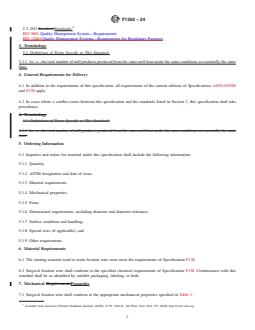
5.1.5 Form, results conform to Table 1. Refer to subsections 7.11.4 and
5.1.6 Dimensional requirements, including diameter and 7.12.5 of Test Methods E8/E8M. If the elongation is less than
diameter tolerance, the minimum requirement, discard the test and retest. Retest
5.1.7 Surface condition and handling, one specimen for each specimen that did not meet the
5.1.8 Special tests (if applicable), and minimum requirement.
5.1.9 Other requirements.
7.4 The wire shall meet the requirements of the latest
version of Nonabsorbable Surgical Suture, U.S. Pharmacopeia,
6. Material Requirements
when tested in accordance with 7.2.
6.1 The starting material used to make fixation wire must
8. Dimensions and Permissible Variations
meet the requirements of Specification F138.
8.1 Surgical fixation wire shall be fabricated in accordance
6.2 Surgical fixation wire shall conform to the specified
with the dimensions and tolerances specified in Table 1.
chemical requirements of Specification F138. Conformance
with this standard shall be so identified by suitable packaging,
8.2 Unless otherwise specified, size tolerances are plus and
labeling, or both.
minus as shown in Table 1. When required by the purchaser,
round wire tolerances may be specified all plus and nothing
7. Mechanical Properties
minus, or all minus and nothing plus, or any combination of
7.1 Surgical fixation wire shall conform to the appropriate plus and minus if the total spread in size tolerance is not less
mechanical properties specified in Table 1.
than the total spread shown in Table 1.
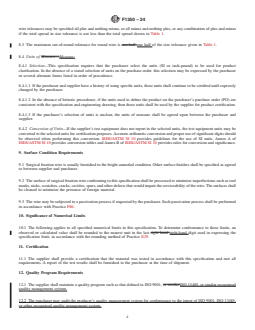
7.2 Perform tension tests in accordance with Test Methods 8.3 The maximum out-of-round tolerance for round wire is
E8/E8M using a 254 mm [10 in.] gage length and a cross-head one half of the size tolerance given in Table 1.
speed of 254 mm/min [10 in./min]. Should any of the test
8.4 Units of Measure:
specimens not meet the specified requirements, test two addi-
8.4.1 Selection—This specification requires that the pur-
tional test pieces representative of the same lot, in the same
chaser select the units (SI or inch-pound) to be used for product
manner, for each failed test piece. The lot shall be considered
clarification. In the absence of a stated selection of units on the
in compliance only if all additional test pieces meet the
purchase order, this selection may be expressed by the pur-
specified requirements.
chaser in several alternate forms listed in order of precedence.
7.3 Tensile test results for which any specimen fractures 8.4.1.1 If the purchaser and supplier have a history of using
outside the gage length shall be considered acceptable if the specific units, these units shall continue to be certified until
elongation meets the minimum requirements and all other expressly changed by the purchaser.
TABLE 1 Mechanical and Dimensional Requirements for Wrought Annealed 18Chromium-14Nickel-2.5Molybdenum Stainless Steel
Surgical Fixation Wire
Diameter Tensile Strength Elong.
A
Range of Sizes Diameter, mm [in.] USP Size
BC D E
Tolerance max, MPa [ksi] min %
0.010 to under 0.020 [0.0004 to 0.0008] . 0.0015 [0.000 06] 1380 [200] 15
0.020 to under 0.030 [0.0008 to 0.0012] 10–0 0.0015 [0.000 06] 1240 [180] 15
0.030 to under 0.040 [0.0012 to 0.0016] 9–0 0.0025 [0.0001] 1100 [160] 20
0.040 to under 0.050 [0.0016 to 0.0020] 8–0 0.0025 [0.0001] 1100 [160] 20
0.050 to under 0.070 [0.0020 to 0.0028] 7–0 0.0025 [0.0001] 960
...
This document is not an ASTM standard and is intended only to provide the user of an ASTM standard an indication of what changes have been made to the previous version. Because
it may not be technically possible to adequately depict all changes accurately, ASTM recommends that users consult prior editions as appropriate. In all cases only the current version
of the standard as published by ASTM is to be considered the official document.
Designation: F1350 − 15 F1350 − 24
Standard Specification for
Wrought 18Chromium-14Nickel-2.5Molybdenum Stainless
Steel Surgical Fixation Wire (UNS S31673)
This standard is issued under the fixed designation F1350; the number immediately following the designation indicates the year of
original adoption or, in the case of revision, the year of last revision. A number in parentheses indicates the year of last reapproval. A
superscript epsilon (´) indicates an editorial change since the last revision or reapproval.
1. Scope*
1.1 This specification covers the chemical, mechanical, and metallurgical requirements for the manufacture of wrought 18
chromium-14 nickel-2.5 molybdenum 18chromium-14nickel-2.5molybdenum stainless steel in the form of surgical fixation wire.
1.2 Units—The values stated in either SI units or inch-pound units are to be regarded separately as standard. The values stated in
each system may not beare not necessarily exact equivalents; therefore, to ensure conformance with the standard, each system shall
be used independently of the other. Combiningother, and values from the two systems may result in non-conformance with this
specification.shall not be combined.
1.3 This standard does not purport to address all of the safety concerns, if any, associated with its use. It is the responsibility
of the user of this standard to establish appropriate safety, health, and environmental practices and determine the applicability of
regulatory limitations prior to use.
1.4 This international standard was developed in accordance with internationally recognized principles on standardization
established in the Decision on Principles for the Development of International Standards, Guides and Recommendations issued
by the World Trade Organization Technical Barriers to Trade (TBT) Committee.
2. Referenced Documents
2.1 ASTM Standards:
A555/A555M Specification for General Requirements for Stainless Steel Wire and Wire Rods
E8/E8M Test Methods for Tension Testing of Metallic Materials
E29 Practice for Using Significant Digits in Test Data to Determine Conformance with Specifications
F86 Practice for Surface Preparation and Marking of Metallic Surgical Implants
F138 Specification for Wrought 18Chromium-14Nickel-2.5Molybdenum Stainless Steel Bar and Wire for Surgical Implants
(UNS S31673)
F981 Practice for Assessment of Muscle and Bone Tissue Responses to Long-Term Implantable Materials Used in Medical
Devices
IEEE/ASTM SI 10 American National Standard for Metric Practice
2.2 USP Standard:
Nonabsorbable Surgical Suture, U.S. Pharmacopeia Nonabsorbable Surgical Suture
This specification is under the jurisdiction of ASTM Committee F04 on Medical and Surgical Materials and Devices and is the direct responsibility of Subcommittee
F04.12 on Metallurgical Materials.
Current edition approved May 1, 2015March 15, 2024. Published June 2015April 2024. Originally approved in 1991. Last previous edition approved in 20082015 as
F1350 – 08.F1350 – 15. DOI: 10.1520/F1350-15.10.1520/F1350-24.
For referenced ASTM standards, visit the ASTM website, www.astm.org, or contact ASTM Customer Service at service@astm.org. For Annual Book of ASTM Standards
volume information, refer to the standard’s Document Summary page on the ASTM website.
Available from U.S. Pharmacopeia (USP), 12601 Twinbrook Pkwy., Rockville, MD 20852-1790, http://www.usp.org.
*A Summary of Changes section appears at the end of this standard
Copyright © ASTM International, 100 Barr Harbor Drive, PO Box C700, West Conshohocken, PA 19428-2959. United States
F1350 − 24
2.3 ISO Standard:Standards:
ISO 9001 Quality Management System—Requirements
ISO 13485 Quality Management Systems—Requirements for Regulatory Purposes
3. Terminology
3.1 Definitions of Terms Specific to This Standard:
3.1.1 lot, n—the total number of mill products produced from the same melt heat under the same conditions at essentially the same
time.
4. General Requirements for Delivery
4.1 In addition to the requirements of this specification, all requirements of the current editions of Specifications A555/A555M
and F138 apply.
4.2 In cases where a conflict exists between this specification and the standards listed in Section 2, this specification shall take
precedence.
4. Terminology
4.1 Definitions of Terms Specific to This Standard:
4.1.1 lot, n—the total number of mill products produced from the same melt heat under the same conditions at essentially the same
time.
5. Ordering Information
5.1 Inquiries and orders for material under this specification shall include the following information:
5.1.1 Quantity,
5.1.2 ASTM designation and date of issue,
5.1.3 Material requirements,
5.1.4 Mechanical properties,
5.1.5 Form,
5.1.6 Dimensional requirements, including diameter and diameter tolerance,
5.1.7 Surface condition and handling,
5.1.8 Special tests (if applicable), and
5.1.9 Other requirements.
6. Material Requirements
6.1 The starting material used to make fixation wire must meet the requirements of Specification F138.
6.2 Surgical fixation wire shall conform to the specified chemical requirements of Specification F138. Conformance with this
standard shall be so identified by suitable packaging, labeling, or both.
7. Mechanical RequirementsProperties
7.1 Surgical fixation wire shall conform to the appropriate mechanical properties specified in Table 1.
Available from American National Standards Institute (ANSI), 25 W. 43rd St., 4th Floor, New York, NY 10036, http://www.ansi.org.
F1350 − 24
TABLE 1 Mechanical and Dimensional Requirements for Wrought Annealed 18 Chromium-14 Nickel-2.5 Molybdenum 18Chromium-
14Nickel-2.5Molybdenum Stainless Steel Surgical Fixation Wire
Diameter Tensile Strength Elong.
A
Range of Sizes Diameter, mm [in.] USP Size
BC D E
Tolerance max, MPa [ksi] min %
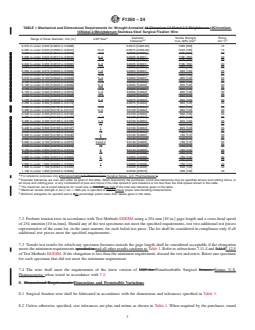
0.010 to under 0.020 [0.0004 to 0.0008] . 0.0015 [0.000 06] 1380 [200] 15
0.020 to under 0.030 [0.0008 to 0.0012] 10–0 0.0015 [0.000 06] 1240 [180] 15
0.030 to under 0.040 [0.0012 to 0.0016] 9–0 0.0025 [0.0001] 1100 [160] 20
0.030 to under 0.040 [0.0012 to 0.0016] 9–0 0.0025 [0.0001] 1100 [160] 20
0.040 to under 0.050 [0.0016 to 0.0020] 8–0 0.0025 [0.0001] 1100 [160] 20
0.040 to under 0.050 [0.0016 to 0.0020] 8–0 0.0025 [0.0001] 1100 [160] 20
0.050 to under 0.070 [0.0020 to 0.0028] 7–0 0.0025 [0.0001] 960 [140] 25
0.050 to under 0.070 [0.0020 to 0.0028] 7–0 0.0025 [0.0001] 960 [140] 25
0.070 to under 0.100 [0.0028 to 0.0039] 6–0 0.0025 [0.0001] 965 [140] 25
0.070 to under 0.100 [0.0028 to 0.0039] 6–0 0.0025 [0.0001] 965 [140] 25
0.100 to under 0.150 [0.0039 to 0.0059] 5–0 0.0050 [0.0002] 895 [130] 30
0.100 to under 0.150 [0.0039 to 0.0059] 5–0 0.0050 [0.0002] 895 [130] 30
0.150 to under 0.200 [0.0059 to 0.0079] 4–0 0.0050 [0.0002] 895 [130] 30
0.150 to under 0.200 [0.0059 to 0.0079] 4–0 0.0050 [0.0002] 895 [130] 30
0.200 to under 0.250 [0.0079 to 0.0098] 3–0 0.0075 [0.0003] 860 [125] 30
0.200 to under 0.250 [0.0079 to 0.0098] 3–0 0.0075 [0.0003] 860 [125] 30
0.250 to under 0.300 [0.0098 to 0.0118] . 0.0075 [0.0003] 860 [125] 30
0.300 to under 0.340 [0.0118 to 0.0134] 2–0 0.0100 [0.0004] 860 [125] 30
0.300 to under 0.340 [0.0118 to 0.0134] 2–0 0.0100 [0.0004] 860 [125] 30
0.340 to under 0.350 [0.0134 to 0.0138] . 0.0100 [0.0004] 860 [125] 30
0.350 to under 0.400 [0.0138 to 0.0158] 1–0 0.0100 [0.0004] 825 [120] 35
0.350 to under 0.400 [0.0138 to 0.0158] 1–0 0.0100 [0.0004] 825 [120] 35
0.400 to under 0.500 [0.0158 to 0.0197] 1 0.0100 [0.0004] 825 [120] 35
0.400 to under 0.500 [0.0158 to 0.0197] 1 0.0100 [0.0004] 825 [120] 35
0.500 to under 0.600 [0.0196 to 0.0236] 2 0.0100 [0.0004] 790 [115] 35
0.500 to under 0.600 [0.0196 to 0.0236] 2 0.0100 [0.0004] 790 [115] 35
0.600 to under 0.700 [0.0236 to 0.0276] 3 and 4 0.0130 [0.0005] 790 [115] 35
0.600 to under 0.700 [0.0236 to 0.0276] 3 and 4 0.0130 [0.0005] 790 [115] 35
0.700 to under 0.800 [0.0276 to 0.0315] 5 0.0130 [0.0005] 760 [110] 35
0.700 to under 0.800 [0.0276 to 0.0315] 5 0.0130 [0.0005] 760 [110] 35
0.800 to under 0.900 [0.0315 to 0.0354] 6 0.0200 [0.0008] 760 [110] 35
0.800 to under 0.900 [0.0315 to 0.0354] 6 0.0200 [0.0008] 760 [110] 35
0.900 to under 1.000 [0.0354 to 0.0394] 7 0.0200 [0.0008] 760 [110] 40
0.900 to under 1.000 [0.0354 to 0.0394] 7 0.0200 [0.0008] 760 [110] 40
1.000 to under 1.100 [0.0394 to 0.0433] . 0.0200 [0.0008] 690 [100] 40
1.100 to under 1.600 [0.0433 to 0.0630] . 0.0250 [0.0010] 690 [100] 40
A
For reference purposes only ((NonabsorbableU.S. Pharmacopeia Surgical Suture, U.S. Pharmacopeia).).
B
Diameter tolerances are over and under as given in this table. When required by the purchaser, round wire tolerances may be specified all plus and nothing minus, or
all minus and nothing plus, or any combination of plus
...