

ASTM A1012-10(2021)
(Specification)Standard Specification for Seamless and Welded Ferritic, Austenitic and Duplex Alloy Steel Condenser and Heat Exchanger Tubes With Integral Fins
General Information
- Abstract
ABSTRACT
This specification describes seamless and welded ferritic, austenitic and duplex alloy steel tubing on which the external or internal surface, or both, has been modified by a cold forming process to produce and integral enhanced surface for improved heat transfer. The integrally enhanced (finned) tubes shall be manufactured from seamless, welded, or welded/cold worked plain tubes that conform to the specified requirements. The tube shall conform to the requirements for tensile properties prescribed in the governing plain tube specification. Pneumatic tests, eddy-current tests, air underwater pressure tests, pressure differential tests, and hydrostatic tests shall be made in accordance with the requirements specified.
SCOPE
1.1 This specification describes seamless and welded ferritic, austenitic and duplex alloy steel tubing on which the external or internal surface, or both, has been modified by a cold forming process to produce an integral enhanced surface for improved heat transfer. The tubes are used in surface condensers, evaporators, heat exchangers and similar heat transfer apparatus in unfinned end diameters up to and including 1 in. (25.4 mm). Boiler tubes are excluded.
1.2 The values stated in inch-pound units are to be regarded as the standard. The values given in parentheses are for information only.
1.3 The following precautionary statement pertains to the test method portion only, Section 12, of this specification: This standard does not purport to address all of the safety concerns, if any, associated with its use. It is the responsibility of the user of this standard to establish appropriate safety, health, and environmental practices and determine the applicability of regulatory limitations prior to use.
1.4 This international standard was developed in accordance with internationally recognized principles on standardization established in the Decision on Principles for the Development of International Standards, Guides and Recommendations issued by the World Trade Organization Technical Barriers to Trade (TBT) Committee.
- Status
- Published
- Publication Date
- 28-Feb-2021
- Technical Committee
- A01 - Steel, Stainless Steel and Related Alloys
- Drafting Committee
- A01.10 - Stainless and Alloy Steel Tubular Products

Overview
ASTM A1012-10(2021) sets the standard specification for seamless and welded ferritic, austenitic, and duplex alloy steel condenser and heat exchanger tubes with integral fins. Developed by ASTM International, this standard outlines the requirements for tubes whose surfaces have been modified through a cold-forming process to create integral, enhanced surfaces (finned tubes) optimized for improved heat transfer. These tubes are widely used in condensers, evaporators, heat exchangers, and similar heat transfer equipment, excluding boiler tubes.
The specification applies to tubes with unfinned end diameters up to and including 1 inch (25.4 mm). It includes detailed requirements for materials, manufacturing processes, mechanical properties, testing, inspection, and certification to ensure the tubes' performance in demanding industrial applications.
Key Topics
- Material Types: Covers ferritic, austenitic, and duplex alloy steels, delivering options for various operating environments.
- Tube Construction: Specifies seamless, welded, or welded and cold-worked tubes as the base material for integral fin manufacturing.
- Enhanced Surfaces: Tubes are cold-formed to feature internal or external fins, increasing the surface area for more effective heat transfer.
- Performance Testing: Involves mechanical property verification, nondestructive eddy-current testing, pneumatic or hydrostatic leak testing, and dimensional checks.
- Dimensional Control: Strict tolerances on outside diameter, wall thickness, fin geometry, and overall tube straightness to meet design and installation requirements.
- Quality Assurance: Manufacturers must provide certified test reports, and finished tubes must be clean, free of defects, and within specified tolerances.
- Product Certification: Documentation must include material type, dimensions, mechanical test results, and testing methods.
Applications
The tubes defined by ASTM A1012-10(2021) are specifically engineered for:
- Surface Condensers: Used in power plants and process industries to condense exhaust steam or vapors, benefiting from the enhanced heat transfer surfaces.
- Evaporators: Integral fin tubes improve efficiency in heating and cooling cycles in chemical, process, and HVAC systems.
- Heat Exchangers: Essential for shell-and-tube and other configurations, where increased surface area translates into better thermal performance and energy savings.
- Feedwater Heaters: Ideal for preheating water in steam cycles, ensuring reliability and performance under cycling conditions.
- General Heat Transfer Apparatus: Any system requiring robust, efficient heat transfer components will benefit from integrally finned alloy steel tubes built to this standard.
Note: This specification explicitly excludes boiler tubes.
Related Standards
ASTM A1012-10(2021) references and aligns with several companion ASTM standards that regulate alloy steel tubes for related applications:
- ASTM A213/A213M: Seamless ferritic and austenitic alloy-steel boiler, superheater, and heat-exchanger tubes
- ASTM A249/A249M: Welded austenitic steel boiler, superheater, heat-exchanger, and condenser tubes
- ASTM A268/A268M: Seamless and welded ferritic and martensitic stainless steel tubing for general service
- ASTM A269: Seamless and welded austenitic stainless steel tubing for general service
- ASTM A688/A688M: Seamless and welded austenitic stainless steel feedwater heater tubes
- ASTM A789/A789M: Seamless and welded ferritic/austenitic stainless steel tubing for general service
- ASTM A803/A803M: Seamless and welded ferritic stainless steel feedwater heater tubes
- ASTM A941: Terminology relating to steel, stainless steel, related alloys, and ferroalloys
- ASTM A1016/A1016M: General requirements for ferritic, austenitic, and stainless steel tubes
These related documents provide comprehensive coverage from terminology to dimensional, mechanical, and chemical properties, supporting consistent industry practice for finned alloy steel tubes.
Keywords: ASTM A1012, alloy steel tubes, seamless condenser tubes, welded heat exchanger tubes, finned tubes, integral fins, austenitic stainless steel, ferritic stainless steel, duplex stainless steel, heat transfer tubing, industrial heat exchangers, surface condensers, standard specification.
Relations
- Effective Date
- 01-Mar-2024
- Effective Date
- 01-Mar-2024
- Effective Date
- 01-Mar-2024
- Effective Date
- 01-Mar-2024
- Effective Date
- 01-Mar-2024
- Effective Date
- 01-Nov-2023
- Effective Date
- 01-Nov-2019
- Effective Date
- 01-Sep-2018
- Effective Date
- 01-Sep-2018
- Effective Date
- 01-Jul-2018
- Effective Date
- 01-Mar-2018
- Effective Date
- 01-Mar-2018
- Effective Date
- 01-Sep-2017
- Effective Date
- 01-Sep-2017
- Effective Date
- 01-Sep-2017
Get Certified
Connect with accredited certification bodies for this standard

Element Materials Technology
Materials testing and product certification.

Inštitut za kovinske materiale in tehnologije
Institute of Metals and Technology. Materials testing, metallurgical analysis, NDT.
Sponsored listings
Frequently Asked Questions
ASTM A1012-10(2021) is a technical specification published by ASTM International. Its full title is "Standard Specification for Seamless and Welded Ferritic, Austenitic and Duplex Alloy Steel Condenser and Heat Exchanger Tubes With Integral Fins". This standard covers: ABSTRACT This specification describes seamless and welded ferritic, austenitic and duplex alloy steel tubing on which the external or internal surface, or both, has been modified by a cold forming process to produce and integral enhanced surface for improved heat transfer. The integrally enhanced (finned) tubes shall be manufactured from seamless, welded, or welded/cold worked plain tubes that conform to the specified requirements. The tube shall conform to the requirements for tensile properties prescribed in the governing plain tube specification. Pneumatic tests, eddy-current tests, air underwater pressure tests, pressure differential tests, and hydrostatic tests shall be made in accordance with the requirements specified. SCOPE 1.1 This specification describes seamless and welded ferritic, austenitic and duplex alloy steel tubing on which the external or internal surface, or both, has been modified by a cold forming process to produce an integral enhanced surface for improved heat transfer. The tubes are used in surface condensers, evaporators, heat exchangers and similar heat transfer apparatus in unfinned end diameters up to and including 1 in. (25.4 mm). Boiler tubes are excluded. 1.2 The values stated in inch-pound units are to be regarded as the standard. The values given in parentheses are for information only. 1.3 The following precautionary statement pertains to the test method portion only, Section 12, of this specification: This standard does not purport to address all of the safety concerns, if any, associated with its use. It is the responsibility of the user of this standard to establish appropriate safety, health, and environmental practices and determine the applicability of regulatory limitations prior to use. 1.4 This international standard was developed in accordance with internationally recognized principles on standardization established in the Decision on Principles for the Development of International Standards, Guides and Recommendations issued by the World Trade Organization Technical Barriers to Trade (TBT) Committee.
ABSTRACT This specification describes seamless and welded ferritic, austenitic and duplex alloy steel tubing on which the external or internal surface, or both, has been modified by a cold forming process to produce and integral enhanced surface for improved heat transfer. The integrally enhanced (finned) tubes shall be manufactured from seamless, welded, or welded/cold worked plain tubes that conform to the specified requirements. The tube shall conform to the requirements for tensile properties prescribed in the governing plain tube specification. Pneumatic tests, eddy-current tests, air underwater pressure tests, pressure differential tests, and hydrostatic tests shall be made in accordance with the requirements specified. SCOPE 1.1 This specification describes seamless and welded ferritic, austenitic and duplex alloy steel tubing on which the external or internal surface, or both, has been modified by a cold forming process to produce an integral enhanced surface for improved heat transfer. The tubes are used in surface condensers, evaporators, heat exchangers and similar heat transfer apparatus in unfinned end diameters up to and including 1 in. (25.4 mm). Boiler tubes are excluded. 1.2 The values stated in inch-pound units are to be regarded as the standard. The values given in parentheses are for information only. 1.3 The following precautionary statement pertains to the test method portion only, Section 12, of this specification: This standard does not purport to address all of the safety concerns, if any, associated with its use. It is the responsibility of the user of this standard to establish appropriate safety, health, and environmental practices and determine the applicability of regulatory limitations prior to use. 1.4 This international standard was developed in accordance with internationally recognized principles on standardization established in the Decision on Principles for the Development of International Standards, Guides and Recommendations issued by the World Trade Organization Technical Barriers to Trade (TBT) Committee.
ASTM A1012-10(2021) is classified under the following ICS (International Classification for Standards) categories: 77.140.01 - Iron and steel products in general. The ICS classification helps identify the subject area and facilitates finding related standards.
ASTM A1012-10(2021) has the following relationships with other standards: It is inter standard links to ASTM A268/A268M-24, ASTM A249/A249M-24, ASTM A688/A688M-24, ASTM A789/A789M-24, ASTM A941-24, ASTM A1016/A1016M-23, ASTM A213/A213M-19, ASTM A1016/A1016M-18a, ASTM A213/A213M-18a, ASTM A249/A249M-18, ASTM A213/A213M-18, ASTM A1016/A1016M-18, ASTM A941-17, ASTM A1016/A1016M-17a, ASTM A789/A789M-17a. Understanding these relationships helps ensure you are using the most current and applicable version of the standard.
ASTM A1012-10(2021) is available in PDF format for immediate download after purchase. The document can be added to your cart and obtained through the secure checkout process. Digital delivery ensures instant access to the complete standard document.
Standards Content (Sample)
This international standard was developed in accordance with internationally recognized principles on standardization established in the Decision on Principles for the
Development of International Standards, Guides and Recommendations issued by the World Trade Organization Technical Barriers to Trade (TBT) Committee.
Designation:A1012 −10 (Reapproved 2021)
Standard Specification for
Seamless and Welded Ferritic, Austenitic and Duplex Alloy
Steel Condenser and Heat Exchanger Tubes With Integral
Fins
This standard is issued under the fixed designation A1012; the number immediately following the designation indicates the year of
original adoption or, in the case of revision, the year of last revision. A number in parentheses indicates the year of last reapproval. A
superscript epsilon (´) indicates an editorial change since the last revision or reapproval.
1. Scope tenitic Alloy-Steel Boiler, Superheater, and Heat-
Exchanger Tubes
1.1 This specification describes seamless and welded
A249/A249M Specification for Welded Austenitic Steel
ferritic, austenitic and duplex alloy steel tubing on which the
Boiler, Superheater, Heat-Exchanger, and Condenser
external or internal surface, or both, has been modified by a
Tubes
cold forming process to produce an integral enhanced surface
A268/A268M Specification for Seamless and Welded Fer-
for improved heat transfer. The tubes are used in surface
ritic and Martensitic Stainless Steel Tubing for General
condensers, evaporators, heat exchangers and similar heat
Service
transfer apparatus in unfinned end diameters up to and includ-
A269 Specification for Seamless and Welded Austenitic
ing 1 in. (25.4 mm). Boiler tubes are excluded.
Stainless Steel Tubing for General Service
1.2 The values stated in inch-pound units are to be regarded
A688/A688M Specification for Seamless and Welded Aus-
as the standard. The values given in parentheses are for
tenitic Stainless Steel Feedwater Heater Tubes
information only.
A789/A789M Specification for Seamless and Welded
1.3 The following precautionary statement pertains to the Ferritic/Austenitic Stainless Steel Tubing for General
test method portion only, Section 12, of this specification: This
Service
standard does not purport to address all of the safety concerns, A803/A803M Specification for Seamless and Welded Fer-
if any, associated with its use. It is the responsibility of the user
ritic Stainless Steel Feedwater Heater Tubes
of this standard to establish appropriate safety, health, and A941 TerminologyRelatingtoSteel,StainlessSteel,Related
environmental practices and determine the applicability of Alloys, and Ferroalloys
regulatory limitations prior to use.
A1016/A1016M Specification for General Requirements for
1.4 This international standard was developed in accor- Ferritic Alloy Steel, Austenitic Alloy Steel, and Stainless
dance with internationally recognized principles on standard-
Steel Tubes
ization established in the Decision on Principles for the
Development of International Standards, Guides and Recom- 3. Terminology
mendations issued by the World Trade Organization Technical
3.1 Definitions—For definition of general terms used in this
Barriers to Trade (TBT) Committee.
specification, refer to Specification A941.
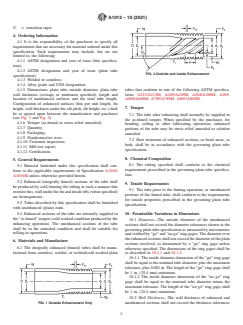
3.2 Symbols (Integral Fin Tube Nomenclature):
2. Referenced Documents
2.1 ASTM Standards:
D = outside diameter of unenhanced section
A213/A213M Specification for Seamless Ferritic and Aus-
D = inside diameter of unenhanced section
i
d = root diameter of enhanced section outside of tube
r
d = outside diameter of enhanced section
o
This specification is under the jurisdiction of ASTM Committee A01 on Steel,
d = inside diameter of enhanced section
i
Stainless Steel and Related Alloys and is the direct responsibility of Subcommittee
W = wall thickness of unenhanced section
A01.10 on Stainless and Alloy Steel Tubular Products.
W = wall thickness of enhanced section
f
Current edition approved March 1, 2021. Published April 2021. Originally
F = height of fin—enhanced section outside of tube
approved in 2000. Last previous edition approved in 2015 as A1012 – 10 (2015). h
F = mean fin thickness—enhanced section outside of tube
DOI: 10.1520/A1012-10R21.
m
For referenced ASTM standards, visit the ASTM website, www.astm.org, or
P = mean rib pitch—enhanced section inside of tube
contact ASTM Customer Service at service@astm.org. For Annual Book of ASTM
R = height of rib—enhanced section inside of tube
h
Standards volume information, refer to the standard’s Document Summary page on
H = rib helix angle—enhanced section inside of tube
a
the ASTM website.
*A Summary of Changes section appears at the end of this standard
Copyright © ASTM International, 100 Barr Harbor Drive, PO Box C700, West Conshohocken, PA 19428-2959. United States
A1012−10 (2021)
T = transition taper
t
4. Ordering Information
4.1 It is the responsibility of the purchaser to specify all
requirements that are necessary for material ordered under this
specification. Such requirements may include, but are not
limited to, the following:
4.1.1 ASTM designation and year of issue (this specifica-
tion);
4.1.2 ASTM designation and year of issue (plain tube
FIG. 2Outside and Inside Enhancement
specification);
4.1.3 Welded or seamless;
4.1.4 Alloy grade and UNS designation;
4.1.5 Dimensions; plain tube outside diameter, plain tube tubes that conform to one of the following ASTM specifica-
wall thickness (average or minimum specified), length and tions: A213/A213M, A249/A249M, A268/A268M, A269,
location of unenhanced surfaces and the total tube length. A688/A688M, A789/A789M, A803/A803M.
Configuration of enhanced surfaces (fins per unit length, fin
7. Temper
height, wall thickness under fin, rib pitch, rib height, etc.) shall
be as agreed upon between the manufacturer and purchaser
7.1 The tube after enhancing shall normally be supplied in
(see Fig. 1 and Fig. 2).
the as-finned temper. When specified by the purchaser, for
4.1.6 Temper (as-finned or stress relief annealed);
bending, coiling or other fabricating operations, enhanced
4.1.7 Quantity;
portions of the tube may be stress relief annealed or solution
4.1.8 Packaging;
annealed.
4.1.9 Nondestructive tests;
7.2 Heat treatment of enhanced sections, or bend areas, or
4.1.10 Customer inspection;
both, shall be in accordance with the governing plain tube
4.1.11 Mill test report;
specification.
4.1.12 Certification.
8. Chemical Composition
5. General Requirements
8.1 The tubing specified shall conform to the chemical
5.1 Material furnished under this specification shall con-
requirements prescribed in the governing plain tube specifica-
form to the applicable requirements of Specification A1016/
tion.
A1016M unless otherwise provided herein.
5.2 Enhanced (integrally finned) sections of the tube shall
9. Tensile Requirements
be produced by cold forming the tubing in such a manner that
9.1 The tube prior to the finning operation, or unenhanced
exterior fins, wall under the fin and inside ribs (when specified)
portions of the finned tube, shall conform to the requirements
are homogeneous.
for tensile properties prescribed in the governing plain tube
5.3 Tubes described by this specification shall be furnished
specification.
with unenhanced (plain) ends.
10. Permissible Variations in Dimensions
5.4 Enhanced sections of the tube are normally supplied in
the “as finned” temper (cold worked condition produced by the
10.1 Diameter—The outside diameter of the unenhanced
enhancing operation). The unenhanced sections of the tube
sections shall not exceed the diameter tolerances shown in the
shall be in the annealed condition and shall be suitable for
governing plain tube specification as measured by micrometers
rolling-in operations.
andverifiedby“go”and“nogo”ringgages.Thediameterover
theenhancedsectionsshallnotexceedthediameteroftheplain
6. Materials and Manufacture
sections involved, as determined by a “go” ring gage unless
6.1 The integrally enhanced (finned) tubes shall be manu-
otherwise specified. The dimensions of the ring gages shall be
factured from seamless, welded, or welded/cold worked plain
as described in 10.1.1 and 10.1.2.
10.1.1 The inside diameter dimension of the “go” ring gage
shall be equal to the nominal tube diameter, plus the maximum
tolerance, plus 0.002 in. The length of the “go” ring gage shall
be 1 in. (25.4 mm) minimum.
10.1.2 The inside diameter dimension of the “no go” ring
gage shall be equal to the nominal tube diameter minus the
maximum tolerance. The length of the “no go” ring gage shall
be 1 in. (25.4 mm) minimum.
10.2 Wall Thickness—The wall thickness of enhanced and
FIG. 1Outside Enhancement Only unenhanced sections shall not exceed the thickness tolerances
A1012−10 (2021)
shown in the governing plain tube specification unless other- (406 mm) apart to provide signal resolution adequate for
wise agreed to between the manufacture and purchaser. No interpretation.Discardandreplacethereferencestandardwhen
tube at any point shall be less than the minimum thickness erroneous signals are produced from mechanical,
specified in the plain sections or in the enhanced sections. metallurgical, or other damage to the tube.
12.1.1.2 Adjust the eddy current test unit to obtain an
10.3 Length—The length of the tubes shall not be less than
optimum signal-to-noise ratio with the minimum sensitivity
that specified, but may exceed the specified value by the
required to detect all four artificial defects in the reference
amounts given in Table 1.
standard on a repeatable basis. Equipment adjustments and
10.3.1 The length of plain ends, as measured from the tube
tube speed maintained during calibration shall be the same for
end
...