

ASTM D8102-17
(Practice)Standard Practice for Manufacturing Quality Control of Geotextiles
General Information
- Abstract
SIGNIFICANCE AND USE
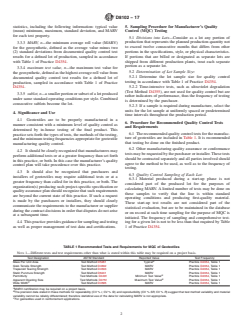
4.1 Geotextiles are to be properly manufactured in a manner consistent with a minimum level of quality control as determined by in-house testing of the final product. This practice sets forth the types of tests, the methods of the testing, and the minimum testing frequencies appropriate for geotextile manufacturing quality control.
4.2 It should be clearly recognized that manufacturers may perform additional tests or at a greater frequency than set forth in this practice, or both. In this case the manufacturer’s quality control plan will take precedence over this practice.
4.3 It should also be recognized that purchasers and installers of geotextiles may require additional tests or at a greater frequency than called for in this practice, or both. The organization(s) producing such project-specific specification or quality assurance plan should recognize that such requirements are beyond the current state of this practice. If such a request is made by the purchasers or installers, they should clearly communicate the requirements to the manufacturer or supplier during the contract decisions in order that disputes do not arise at a subsequent time.
4.4 This practice provides guidance for sampling and testing as well as proper management of test data and certifications.
SCOPE
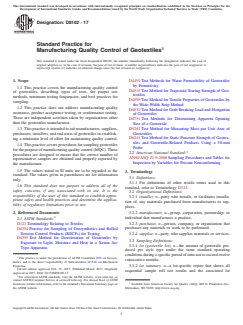
1.1 This practice covers the manufacturing quality control of geotextiles, describing types of tests, the proper test methods, minimum testing frequencies, and best practices for sampling.
1.2 This practice does not address manufacturing quality assurance, product acceptance testing, or conformance testing. These are independent activities taken by organizations other than the geotextiles manufacturer.
1.3 This practice is intended to aid manufacturers, suppliers, purchasers, installers, and end users of geotextiles in establishing a minimum level of effort for maintaining quality control.
1.4 This practice covers procedures for sampling geotextiles for the purpose of manufacturing quality control (MQC). These procedures are designed to ensure that the correct number of representative samples are obtained and properly reported by the manufacturer.
1.5 The values stated in SI units are to be regarded as the standard. The values given in parentheses are for information only.
1.6 This standard does not purport to address all of the safety concerns, if any, associated with its use. It is the responsibility of the user of this standard to establish appropriate safety and health practices and determine the applicability of regulatory limitations prior to use.
- Status
- Published
- Publication Date
- 14-Feb-2017
- Technical Committee
- D35 - Geosynthetics
- Drafting Committee
- D35.01 - Mechanical Properties
Overview
ASTM D8102-17: Standard Practice for Manufacturing Quality Control of Geotextiles establishes best practices for ensuring geotextile products are manufactured with consistent quality. Developed by ASTM International, this standard guides manufacturers, suppliers, purchasers, and installers in implementing minimum levels of quality control through documented in-house testing, sampling procedures, and proper test data management. Its intent is to promote reliability and consistency in geotextile manufacturing, improve stakeholder communication, and support regulatory compliance in various civil engineering and construction applications.
Key Topics
- Quality Control in Manufacturing: Defines minimum acceptable levels for in-house quality control during geotextile production, including designated test methods, testing frequencies, and procedures for representative product sampling.
- Testing Requirements: Specifies types of tests such as mass per unit area, tensile properties, tearing strength, puncture strength, permeability, and apparent opening size, referencing established ASTM geotextile test methods.
- Sampling Procedures: Recommends structured sampling techniques to ensure tested samples accurately reflect entire production lots, improving the reliability of test data.
- Statistical Analysis & Reporting: Introduces the use of statistical tools like Minimum Average Roll Value (MARV) for objective product qualification, and details reporting requirements to ensure traceability and transparency for all tested attributes.
- Roles and Responsibilities: Clarifies the distinction between manufacturer-led quality control and downstream quality assurance or acceptance testing, highlighting the importance of stakeholder communication for additional project-specific requirements.
Applications
The scope of ASTM D8102-17 covers a broad range of practical applications in the geotextile industry, notably:
- Manufacturing Consistency: Helps geotextile manufacturers establish robust, standardized quality control programs, ensuring every production lot meets predefined quality benchmarks.
- Supply Chain Confidence: Offers objective criteria to suppliers and distributors for evaluating final product quality prior to shipment.
- Purchasing Specifications: Enables purchasers and project owners to communicate and verify minimum quality expectations during procurement, reducing the risk of disputes.
- Installer Verification: Supports installers and contractors in confirming that geotextiles delivered and deployed in the field meet the required manufacturing quality characteristics.
- Regulatory and Certification Documentation: Provides a framework for maintaining comprehensive records and certification documentation, which can facilitate regulatory approval and support contractual compliance.
Related Standards
ASTM D8102-17 references and aligns with several other international standards and guides to ensure comprehensive coverage of geotextile testing and quality control:
- ASTM D123 - Terminology Relating to Textiles
- ASTM D4354 - Practice for Sampling of Geosynthetics and Rolled Erosion Control Products for Testing
- ASTM D4355 - Test Method for Deterioration of Geotextiles by Exposure to Light, Moisture, and Heat
- ASTM D4491 - Test Methods for Water Permeability of Geotextiles by Permittivity
- ASTM D4533 - Test Method for Trapezoid Tearing Strength of Geotextiles
- ASTM D4595 - Test Method for Tensile Properties of Geotextiles by the Wide-Width Strip Method
- ASTM D4632 - Test Method for Grab Breaking Load and Elongation of Geotextiles
- ASTM D4751 - Test Methods for Determining Apparent Opening Size of a Geotextile
- ASTM D5261 - Test Method for Measuring Mass per Unit Area of Geotextiles
- ASTM D6241 - Test Method for Static Puncture Strength of Geotextiles
- ANSI/ASQ Z1.9 - Sampling Procedures and Tables for Inspection by Variables for Percent Nonconforming
- ASTM D4873 - Guide for Identification, Storage, and Handling of Geosynthetic Rolls and Samples
Practical Value
Implementing ASTM D8102-17 enhances the reliability and traceability of geotextile products throughout the supply chain. By establishing minimum testing and documentation requirements, the standard reduces inconsistencies, minimizes risk of product failure, and promotes stakeholder confidence-making it a foundational reference for those involved in geotextile manufacturing, supply, installation, and quality management.
Relations
- Effective Date
- 01-May-2020
- Effective Date
- 01-Jan-2020
- Effective Date
- 01-Jul-2018
- Effective Date
- 01-Mar-2017
- Effective Date
- 01-Jul-2016
- Effective Date
- 15-Sep-2015
- Effective Date
- 01-Sep-2015
- Effective Date
- 01-Apr-2015
- Refers
ASTM D4491-99a(2014)e1 - Standard Test Methods for Water Permeability of Geotextiles by Permittivity - Effective Date
- 01-Jan-2014
- Effective Date
- 15-Jun-2013
- Effective Date
- 15-Jun-2013
- Effective Date
- 15-May-2013
- Effective Date
- 01-Jul-2012
- Effective Date
- 01-Jul-2012
- Effective Date
- 01-Feb-2012
Get Certified
Connect with accredited certification bodies for this standard

Control Union Certifications
Global certification for agriculture and sustainability.

Hohenstein Institut
Textile testing and certification.

Bureau Veritas Bangladesh
Bureau Veritas certification services in Bangladesh.
Sponsored listings
Frequently Asked Questions
ASTM D8102-17 is a standard published by ASTM International. Its full title is "Standard Practice for Manufacturing Quality Control of Geotextiles". This standard covers: SIGNIFICANCE AND USE 4.1 Geotextiles are to be properly manufactured in a manner consistent with a minimum level of quality control as determined by in-house testing of the final product. This practice sets forth the types of tests, the methods of the testing, and the minimum testing frequencies appropriate for geotextile manufacturing quality control. 4.2 It should be clearly recognized that manufacturers may perform additional tests or at a greater frequency than set forth in this practice, or both. In this case the manufacturer’s quality control plan will take precedence over this practice. 4.3 It should also be recognized that purchasers and installers of geotextiles may require additional tests or at a greater frequency than called for in this practice, or both. The organization(s) producing such project-specific specification or quality assurance plan should recognize that such requirements are beyond the current state of this practice. If such a request is made by the purchasers or installers, they should clearly communicate the requirements to the manufacturer or supplier during the contract decisions in order that disputes do not arise at a subsequent time. 4.4 This practice provides guidance for sampling and testing as well as proper management of test data and certifications. SCOPE 1.1 This practice covers the manufacturing quality control of geotextiles, describing types of tests, the proper test methods, minimum testing frequencies, and best practices for sampling. 1.2 This practice does not address manufacturing quality assurance, product acceptance testing, or conformance testing. These are independent activities taken by organizations other than the geotextiles manufacturer. 1.3 This practice is intended to aid manufacturers, suppliers, purchasers, installers, and end users of geotextiles in establishing a minimum level of effort for maintaining quality control. 1.4 This practice covers procedures for sampling geotextiles for the purpose of manufacturing quality control (MQC). These procedures are designed to ensure that the correct number of representative samples are obtained and properly reported by the manufacturer. 1.5 The values stated in SI units are to be regarded as the standard. The values given in parentheses are for information only. 1.6 This standard does not purport to address all of the safety concerns, if any, associated with its use. It is the responsibility of the user of this standard to establish appropriate safety and health practices and determine the applicability of regulatory limitations prior to use.
SIGNIFICANCE AND USE 4.1 Geotextiles are to be properly manufactured in a manner consistent with a minimum level of quality control as determined by in-house testing of the final product. This practice sets forth the types of tests, the methods of the testing, and the minimum testing frequencies appropriate for geotextile manufacturing quality control. 4.2 It should be clearly recognized that manufacturers may perform additional tests or at a greater frequency than set forth in this practice, or both. In this case the manufacturer’s quality control plan will take precedence over this practice. 4.3 It should also be recognized that purchasers and installers of geotextiles may require additional tests or at a greater frequency than called for in this practice, or both. The organization(s) producing such project-specific specification or quality assurance plan should recognize that such requirements are beyond the current state of this practice. If such a request is made by the purchasers or installers, they should clearly communicate the requirements to the manufacturer or supplier during the contract decisions in order that disputes do not arise at a subsequent time. 4.4 This practice provides guidance for sampling and testing as well as proper management of test data and certifications. SCOPE 1.1 This practice covers the manufacturing quality control of geotextiles, describing types of tests, the proper test methods, minimum testing frequencies, and best practices for sampling. 1.2 This practice does not address manufacturing quality assurance, product acceptance testing, or conformance testing. These are independent activities taken by organizations other than the geotextiles manufacturer. 1.3 This practice is intended to aid manufacturers, suppliers, purchasers, installers, and end users of geotextiles in establishing a minimum level of effort for maintaining quality control. 1.4 This practice covers procedures for sampling geotextiles for the purpose of manufacturing quality control (MQC). These procedures are designed to ensure that the correct number of representative samples are obtained and properly reported by the manufacturer. 1.5 The values stated in SI units are to be regarded as the standard. The values given in parentheses are for information only. 1.6 This standard does not purport to address all of the safety concerns, if any, associated with its use. It is the responsibility of the user of this standard to establish appropriate safety and health practices and determine the applicability of regulatory limitations prior to use.
ASTM D8102-17 is classified under the following ICS (International Classification for Standards) categories: 59.080.70 - Geotextiles. The ICS classification helps identify the subject area and facilitates finding related standards.
ASTM D8102-17 has the following relationships with other standards: It is inter standard links to ASTM D4354-12(2020), ASTM D4751-20, ASTM D5261-10(2018), ASTM D123-17, ASTM D4751-16, ASTM D123-15b, ASTM D123-15a, ASTM D123-15, ASTM D4491-99a(2014)e1, ASTM D123-13ae1, ASTM D123-13a, ASTM D123-13, ASTM D4354-12, ASTM D4751-12, ASTM D123-12e1. Understanding these relationships helps ensure you are using the most current and applicable version of the standard.
ASTM D8102-17 is available in PDF format for immediate download after purchase. The document can be added to your cart and obtained through the secure checkout process. Digital delivery ensures instant access to the complete standard document.
Standards Content (Sample)
This international standard was developed in accordance with internationally recognized principles on standardization established in the Decision on Principles for the
Development of International Standards, Guides and Recommendations issued by the World Trade Organization Technical Barriers to Trade (TBT) Committee.
Designation: D8102 − 17
Standard Practice for
Manufacturing Quality Control of Geotextiles
This standard is issued under the fixed designation D8102; the number immediately following the designation indicates the year of
original adoption or, in the case of revision, the year of last revision. A number in parentheses indicates the year of last reapproval. A
superscript epsilon (´) indicates an editorial change since the last revision or reapproval.
1. Scope D4491 Test Methods for Water Permeability of Geotextiles
by Permittivity
1.1 This practice covers the manufacturing quality control
D4533 Test Method for Trapezoid Tearing Strength of Geo-
of geotextiles, describing types of tests, the proper test
textiles
methods, minimum testing frequencies, and best practices for
D4595 Test Method for Tensile Properties of Geotextiles by
sampling.
the Wide-Width Strip Method
1.2 This practice does not address manufacturing quality
D4632 Test Method for Grab Breaking Load and Elongation
assurance, product acceptance testing, or conformance testing.
of Geotextiles
These are independent activities taken by organizations other
D4751 Test Methods for Determining Apparent Opening
than the geotextiles manufacturer.
Size of a Geotextile
1.3 Thispracticeisintendedtoaidmanufacturers,suppliers, D5261 Test Method for Measuring Mass per Unit Area of
Geotextiles
purchasers, installers, and end users of geotextiles in establish-
ing a minimum level of effort for maintaining quality control. D6241 Test Method for Static Puncture Strength of Geotex-
tiles and Geotextile-Related Products Using a 50-mm
1.4 Thispracticecoversproceduresforsamplinggeotextiles
Probe
forthepurposeofmanufacturingqualitycontrol(MQC).These
2.2 American National Standard:
procedures are designed to ensure that the correct number of
ANSI/ASQ Z1.9-2008 Sampling Procedures and Tables for
representative samples are obtained and properly reported by
Inspection by Variables for Percent Nonconforming
the manufacturer.
1.5 The values stated in SI units are to be regarded as the
3. Terminology
standard. The values given in parentheses are for information
3.1 Definitions:
only.
3.1.1 For definitions of other textile terms used in this
1.6 This standard does not purport to address all of the
standard, refer to Terminology D123.
safety concerns, if any, associated with its use. It is the
3.2 Organizational Definitions:
responsibility of the user of this standard to establish appro-
3.2.1 installer, n—party who installs, or facilitates installa-
priate safety and health practices and determine the applica-
tion of, any materials purchased from manufacturers or sup-
bility of regulatory limitations prior to use.
pliers.
2. Referenced Documents 3.2.2 manufacturer, n—group, corporation, partnership, or
2 individual that manufactures a product.
2.1 ASTM Standards:
3.2.3 purchaser, n—person, company, or organization that
D123 Terminology Relating to Textiles
purchases any materials or work to be performed.
D4354 Practice for Sampling of Geosynthetics and Rolled
Erosion Control Products (RECPs) for Testing
3.2.4 supplier, n—party who supplies materials or services.
D4355 Test Method for Deterioration of Geotextiles by
3.3 Sampling Definitions:
Exposure to Light, Moisture and Heat in a Xenon Arc
3.3.1 lot (geotextile lot), n—the amount of geotextile pro-
Type Apparatus
duced per style type under the same standard operating
conditionsduringaspecificperiodoftimenottoexceedtwelve
This practice is under the jurisdiction of ASTM Committee D35 on Geosyn-
consecutive months.
thetics and is the direct responsibility of Subcommittee D35.01 on Mechanical
Properties.
3.3.2 lot summary, n—a lot-specific report that shows all
Current edition approved Feb. 15, 2017. Published March 2017. Originally
sequential sample roll test results and the associated lot
approved in 2017. DOI: 10.1520/D8102-17.
For referenced ASTM standards, visit the ASTM website, www.astm.org, or
contact ASTM Customer Service at service@astm.org. For Annual Book of ASTM
Standards volume information, refer to the standard’s Document Summary page on Available from American Society for Quality (ASQ), 600 N. Plankinton Ave.,
the ASTM website. Milwaukee, WI 53203, http://www.asq.org.
Copyright © ASTM International, 100 Barr Harbor Drive, PO Box C700, West Conshohocken, PA 19428-2959. United States
D8102 − 17
statistics, including the following information: typical value 5. Sampling Procedure for Manufacturer’s Quality
(mean) minimum, maximum, standard deviation, and MARV Control (MQC) Testing
for each test property.
5.1 Divisions into Lots—Consider as a lot any portion of
production that represents the planned production quantity not
3.3.3 MARV, n—the minimum average roll value (MARV)
for the geosynthetic, defined as the average value minus two to exceed twelve consecutive months that differs from other
portions in the specifications, style, or physical characteristics.
(2) standard deviations from documented quality control test
results for a defined lot of production, sampled in accordance If portions that are billed or designated as separate lots are
shipped from different production plants, treat each separate
with Table 1 of Practice D4354.
portion as a separate lot.
3.3.4 maximum test value, n—the maximum test value for
5.2 Determination of Lot Sample Size:
the geosynthetic, defined as the highest average roll value from
5.2.1 Determine the lot sample size for quality control
documented quality control test results for a defined lot of
testing in accordance with Table 1 of Practice D4354.
production, sampled in accordance with Table 1 of Practice
5.2.2 Time-intensive tests, such as ultraviolet degradation
D4354.
(Test Method D4355), are not used for quality control but are
3.3.5 sublot, n—asmallerportionorsubsetofalotproduced
rather indicators of performance, thus the frequency of testing
under same standard operating conditions per style. Combined
is determined by the purchaser.
consecutive sublots become the lot.
5.2.3 If a sample is required during manufacture, select the
units for the lot sample at uniformly spaced or predetermined
4. Significance and Use
time intervals throughout the production period.
4.1 Geotextiles are to be properly manufactured in a
6. Procedure for Recommended Quality Control Tests
manner consistent with a minimum level of quality control as
and Requirements
determined by in-house testing of the final product. This
6.1 The recommended quality control tests for the manufac-
practice sets forth the types of tests, the methods of the testing,
ture of geotextiles are included in Table 1. It is recommended
and the minimum testing frequencies appropriate for geotextile
that testing be done on the finished product.
manufacturing quality control.
6.2 Other manufacturing quality assurance or conformance
4.2 It should be clearly recognized that manufacturers may
tests may be requested by the purchaser or installer.These tests
perform additional tests or at a greater frequency than set forth
should be contracted separately and all parties involved should
in this practice, or both. In this case the manufacturer’s quality
agree to the method to be used, as well as to the frequency of
control plan will take precedence over this practice.
testing.
4.3 It should also be recognized that purchasers and
6.3 Quality Control Sampling of Each Lot:
installers of geotextiles may require additional tests or at a
6.3.1 Material produced during a start-up phase is not
greater frequency than called for in this practice, or both. The
considered part of the produced lot for the purposes of
organization(s) producing such project-specific specification or
calculating MARV. A limited number of tests may be done on
quality assurance plan should recognize that such requirements
these samples to verify that the line is within standard
are beyond the current state of this practice. If such a request
operating conditions and producing first-quality material.
is made by the purchasers or installers, they should clearly
These start-up test results are not considered part of the
communicate the requirements to the manufacturer or supplier
statistical evaluation, but are to be maintained in the database
during the contract decisions in order that disputes do not arise
or on record at such time sampling for the purpose of MQC is
at a subsequent time.
initiated. The frequency of sampling and comprehensive test-
4.4 Thispracticeprovidesguidanceforsamplingandtesting ing for a given lot is not to be less than that required by Table
as well as proper management of test data and certifications. 1 of Pract
...