

ASTM D6158-23
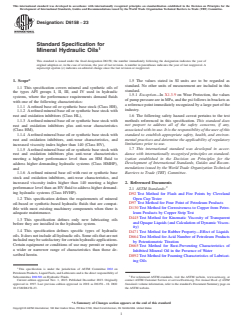
(Specification)Standard Specification for Mineral Hydraulic Oils
General Information
- Abstract
ABSTRACT
This specification covers the standard for mineral oils used in hydraulic systems which require refined base oil (Class HH), refined mineral base oil with rust and oxidation inhibitors (Class HL) or refined mineral base oil with rust and oxidation inhibitors plus antiwear characteristics (Class HM). This specification only covers lubricating oils before they are installed in the hydraulic system and does not include all hydraulic oils. Requirements for the mineral oils shall include, but not limited to, viscosity, specific gravity, appearance, flash point, chemical acid number, corrosion, water separation, elastomer compatibility, air release, and thermal stability.
SCOPE
1.1 This specification covers mineral and synthetic oils of the types API groups I, II, III, and IV used in hydraulic systems, where the performance requirements demand fluids with one of the following characteristics:
1.1.1 A refined base oil or synthetic base stock (Class HH),
1.1.2 A refined mineral base oil or synthetic base stock with rust and oxidation inhibitors (Class HL),
1.1.3 A refined mineral base oil or synthetic base stock with rust and oxidation inhibitors plus anti-wear characteristics (Class HM),
1.1.4 A refined mineral base oil or synthetic base stock with rust and oxidation inhibitors, anti-wear characteristics, and increased viscosity index higher than 140 (Class HV),
1.1.5 A refined mineral base oil or synthetic base stock with rust and oxidation inhibitors plus anti-wear characteristics meeting a higher performance level than an HM fluid to address higher demanding hydraulic systems (Class HMHP), and
1.1.6 A refined mineral base oil with rust or synthetic base stock and oxidation inhibitors, anti-wear characteristics, and increased viscosity index higher than 140 meeting a higher performance level than an HV fluid to address higher demanding hydraulic systems (Class HVHP).
1.2 This specification defines the requirements of mineral oil-based or synthetic-based hydraulic fluids that are compatible with most existing machinery components when there is adequate maintenance.
1.3 This specification defines only new lubricating oils before they are installed in the hydraulic system.
1.4 This specification defines specific types of hydraulic oils. It does not include all hydraulic oils. Some oils that are not included may be satisfactory for certain hydraulic applications. Certain equipment or conditions of use may permit or require a wider or narrower range of characteristics than those described herein.
1.5 The values stated in SI units are to be regarded as standard. No other units of measurement are included in this standard.
1.5.1 Exception—In X1.3.9 on Wear Protection, the values of pump pressure are in MPa, and the psi follows in brackets as a reference point immediately recognized by a large part of the industry.
1.6 The following safety hazard caveat pertains to the test methods referenced in this specification. This standard does not purport to address all of the safety concerns, if any, associated with its use. It is the responsibility of the user of this standard to establish appropriate safety, health, and environmental practices and determine the applicability of regulatory limitations prior to use.
1.7 This international standard was developed in accordance with internationally recognized principles on standardization established in the Decision on Principles for the Development of International Standards, Guides and Recommendations issued by the World Trade Organization Technical Barriers to Trade (TBT) Committee.
- Status
- Published
- Publication Date
- 31-Oct-2023
- Technical Committee
- D02 - Petroleum Products, Liquid Fuels, and Lubricants
- Drafting Committee
- D02.N0 - Hydraulic Fluids
Overview
ASTM D6158-23 is the internationally recognized standard specification for mineral and synthetic hydraulic oils used in hydraulic systems. Developed by ASTM International, this standard defines essential physical, chemical, and performance requirements for various classes of hydraulic fluids. ASTM D6158-23 is widely referenced by manufacturers, equipment designers, and quality control professionals to ensure hydraulic fluids provide reliable performance, compatibility, and protection in a wide range of industrial and mobile applications.
Key Topics
Hydraulic Fluid Classification
Hydraulic oils are classified by performance characteristics and base oil type:- HH: Refined mineral or synthetic base stock without additives, for systems with minimal performance demands.
- HL: Rust and oxidation-inhibited oils for systems exposed to humidity or higher temperatures.
- HM: Oils with rust, oxidation, and anti-wear additives for general and high-pressure hydraulic systems.
- HV: Multigrade anti-wear oils with high viscosity index for variable or extreme temperature operation.
- HMHP/HVHP: High-performance anti-wear or multigrade oils for demanding or severe applications.
Physical Requirements
Fluids must meet strict criteria regarding:- ISO viscosity grade (as per ISO VG classification)
- Kinematic viscosity
- Viscosity index
- Flash point and pour point
- Appearance and specific gravity
Chemical and Performance Properties
The standard specifies limits and test protocols for:- Acid number (to monitor oxidation and degradation)
- Corrosion and rust protection (particularly on copper and steel surfaces)
- Water separability, foam tendency, and air release characteristics
- Oxidation and thermal stability
- Elastomer compatibility with seals and system components
- Anti-wear protection and filterability
Applications
ASTM D6158-23 is applicable to a broad spectrum of hydraulic system designs and industrial sectors:
- Industrial Hydraulic Equipment: Hydraulic presses, injection molding machines, and robotics that require fluids with proven anti-wear, oxidation stability, and cleanliness.
- Mobile Equipment: Construction, agriculture, and mining machinery benefit from oils meeting this standard, ensuring performance in variable temperatures and harsh environments.
- Fluid Power Systems: Products are specified for everything from stationary systems to dynamic, high-pressure pumps and actuators where reliability and performance dictate operational uptime.
- OEM and Maintenance Specifications: Manufacturers reference D6158-23 to set baseline requirements, while equipment owners use it to select, evaluate, or replace hydraulic fluids.
By adhering to ASTM D6158-23, organizations maximize equipment life, minimize downtime, and ensure safety and environmental compliance.
Related Standards
Hydraulic oil properties and testing are referenced in conjunction with several ASTM and ISO standards:
- ASTM D445: Kinematic Viscosity of Transparent and Opaque Liquids
- ASTM D665: Rust-Preventing Characteristics of Inhibited Mineral Oil
- ASTM D974/D664: Acid Number Determination
- ASTM D892: Foaming Characteristics of Lubricating Oils
- ASTM D943: Oxidation Characteristics of Inhibited Mineral Oils
- ASTM D1401: Water Separability of Petroleum Oils and Synthetic Fluids
- ISO 13226: Reference Elastomers for Liquid Compatibility Testing
- ISO 13357-1 and ISO 13357-2: Filterability of Lubricating Oils
Practical Value
Utilizing mineral and synthetic hydraulic oils that comply with ASTM D6158-23 helps stakeholders:
- Ensure consistent performance, wear protection, and long-term fluid stability
- Improve system efficiency and reduce maintenance costs
- Achieve compatibility with a broad range of components and materials
- Meet regulatory and OEM requirements for hydraulic fluid quality
ASTM D6158-23 remains the benchmark for selecting and certifying hydraulic oils that support optimal system operation, safety, and lifecycle cost management.
Relations
- Effective Date
- 01-Nov-2023
- Effective Date
- 01-Apr-2024
- Effective Date
- 01-Mar-2024
- Effective Date
- 01-Dec-2023
- Effective Date
- 01-Nov-2023
- Effective Date
- 01-Jul-2023
- Effective Date
- 01-Nov-2022
- Effective Date
- 01-Dec-2019
- Effective Date
- 15-Jul-2017
- Effective Date
- 01-Nov-2023
- Referred By
ASTM D7752-18 - Standard Practice for Evaluating Compatibility of Mixtures of Hydraulic Fluids - Effective Date
- 01-Nov-2023
Get Certified
Connect with accredited certification bodies for this standard

Element Materials Technology
Materials testing and product certification.

ABS Group Brazil
ABS Group certification services in Brazil.

ABS Quality Evaluations Inc.
American Bureau of Shipping quality certification.
Sponsored listings
Frequently Asked Questions
ASTM D6158-23 is a technical specification published by ASTM International. Its full title is "Standard Specification for Mineral Hydraulic Oils". This standard covers: ABSTRACT This specification covers the standard for mineral oils used in hydraulic systems which require refined base oil (Class HH), refined mineral base oil with rust and oxidation inhibitors (Class HL) or refined mineral base oil with rust and oxidation inhibitors plus antiwear characteristics (Class HM). This specification only covers lubricating oils before they are installed in the hydraulic system and does not include all hydraulic oils. Requirements for the mineral oils shall include, but not limited to, viscosity, specific gravity, appearance, flash point, chemical acid number, corrosion, water separation, elastomer compatibility, air release, and thermal stability. SCOPE 1.1 This specification covers mineral and synthetic oils of the types API groups I, II, III, and IV used in hydraulic systems, where the performance requirements demand fluids with one of the following characteristics: 1.1.1 A refined base oil or synthetic base stock (Class HH), 1.1.2 A refined mineral base oil or synthetic base stock with rust and oxidation inhibitors (Class HL), 1.1.3 A refined mineral base oil or synthetic base stock with rust and oxidation inhibitors plus anti-wear characteristics (Class HM), 1.1.4 A refined mineral base oil or synthetic base stock with rust and oxidation inhibitors, anti-wear characteristics, and increased viscosity index higher than 140 (Class HV), 1.1.5 A refined mineral base oil or synthetic base stock with rust and oxidation inhibitors plus anti-wear characteristics meeting a higher performance level than an HM fluid to address higher demanding hydraulic systems (Class HMHP), and 1.1.6 A refined mineral base oil with rust or synthetic base stock and oxidation inhibitors, anti-wear characteristics, and increased viscosity index higher than 140 meeting a higher performance level than an HV fluid to address higher demanding hydraulic systems (Class HVHP). 1.2 This specification defines the requirements of mineral oil-based or synthetic-based hydraulic fluids that are compatible with most existing machinery components when there is adequate maintenance. 1.3 This specification defines only new lubricating oils before they are installed in the hydraulic system. 1.4 This specification defines specific types of hydraulic oils. It does not include all hydraulic oils. Some oils that are not included may be satisfactory for certain hydraulic applications. Certain equipment or conditions of use may permit or require a wider or narrower range of characteristics than those described herein. 1.5 The values stated in SI units are to be regarded as standard. No other units of measurement are included in this standard. 1.5.1 Exception—In X1.3.9 on Wear Protection, the values of pump pressure are in MPa, and the psi follows in brackets as a reference point immediately recognized by a large part of the industry. 1.6 The following safety hazard caveat pertains to the test methods referenced in this specification. This standard does not purport to address all of the safety concerns, if any, associated with its use. It is the responsibility of the user of this standard to establish appropriate safety, health, and environmental practices and determine the applicability of regulatory limitations prior to use. 1.7 This international standard was developed in accordance with internationally recognized principles on standardization established in the Decision on Principles for the Development of International Standards, Guides and Recommendations issued by the World Trade Organization Technical Barriers to Trade (TBT) Committee.
ABSTRACT This specification covers the standard for mineral oils used in hydraulic systems which require refined base oil (Class HH), refined mineral base oil with rust and oxidation inhibitors (Class HL) or refined mineral base oil with rust and oxidation inhibitors plus antiwear characteristics (Class HM). This specification only covers lubricating oils before they are installed in the hydraulic system and does not include all hydraulic oils. Requirements for the mineral oils shall include, but not limited to, viscosity, specific gravity, appearance, flash point, chemical acid number, corrosion, water separation, elastomer compatibility, air release, and thermal stability. SCOPE 1.1 This specification covers mineral and synthetic oils of the types API groups I, II, III, and IV used in hydraulic systems, where the performance requirements demand fluids with one of the following characteristics: 1.1.1 A refined base oil or synthetic base stock (Class HH), 1.1.2 A refined mineral base oil or synthetic base stock with rust and oxidation inhibitors (Class HL), 1.1.3 A refined mineral base oil or synthetic base stock with rust and oxidation inhibitors plus anti-wear characteristics (Class HM), 1.1.4 A refined mineral base oil or synthetic base stock with rust and oxidation inhibitors, anti-wear characteristics, and increased viscosity index higher than 140 (Class HV), 1.1.5 A refined mineral base oil or synthetic base stock with rust and oxidation inhibitors plus anti-wear characteristics meeting a higher performance level than an HM fluid to address higher demanding hydraulic systems (Class HMHP), and 1.1.6 A refined mineral base oil with rust or synthetic base stock and oxidation inhibitors, anti-wear characteristics, and increased viscosity index higher than 140 meeting a higher performance level than an HV fluid to address higher demanding hydraulic systems (Class HVHP). 1.2 This specification defines the requirements of mineral oil-based or synthetic-based hydraulic fluids that are compatible with most existing machinery components when there is adequate maintenance. 1.3 This specification defines only new lubricating oils before they are installed in the hydraulic system. 1.4 This specification defines specific types of hydraulic oils. It does not include all hydraulic oils. Some oils that are not included may be satisfactory for certain hydraulic applications. Certain equipment or conditions of use may permit or require a wider or narrower range of characteristics than those described herein. 1.5 The values stated in SI units are to be regarded as standard. No other units of measurement are included in this standard. 1.5.1 Exception—In X1.3.9 on Wear Protection, the values of pump pressure are in MPa, and the psi follows in brackets as a reference point immediately recognized by a large part of the industry. 1.6 The following safety hazard caveat pertains to the test methods referenced in this specification. This standard does not purport to address all of the safety concerns, if any, associated with its use. It is the responsibility of the user of this standard to establish appropriate safety, health, and environmental practices and determine the applicability of regulatory limitations prior to use. 1.7 This international standard was developed in accordance with internationally recognized principles on standardization established in the Decision on Principles for the Development of International Standards, Guides and Recommendations issued by the World Trade Organization Technical Barriers to Trade (TBT) Committee.
ASTM D6158-23 is classified under the following ICS (International Classification for Standards) categories: 75.120 - Hydraulic fluids. The ICS classification helps identify the subject area and facilitates finding related standards.
ASTM D6158-23 has the following relationships with other standards: It is inter standard links to ASTM D6158-18, ASTM D445-24, ASTM D2070-24, ASTM D665-23, ASTM D445-23, ASTM D2070-23, ASTM D974-22, ASTM D665-19, ASTM D1298-12b(2017)e1, ASTM D8506-23, ASTM D7752-18. Understanding these relationships helps ensure you are using the most current and applicable version of the standard.
ASTM D6158-23 is available in PDF format for immediate download after purchase. The document can be added to your cart and obtained through the secure checkout process. Digital delivery ensures instant access to the complete standard document.
Standards Content (Sample)
This international standard was developed in accordance with internationally recognized principles on standardization established in the Decision on Principles for the
Development of International Standards, Guides and Recommendations issued by the World Trade Organization Technical Barriers to Trade (TBT) Committee.
Designation: D6158 − 23
Standard Specification for
Mineral Hydraulic Oils
This standard is issued under the fixed designation D6158; the number immediately following the designation indicates the year of
original adoption or, in the case of revision, the year of last revision. A number in parentheses indicates the year of last reapproval. A
superscript epsilon (´) indicates an editorial change since the last revision or reapproval.
1. Scope* 1.5 The values stated in SI units are to be regarded as
standard. No other units of measurement are included in this
1.1 This specification covers mineral and synthetic oils of
standard.
the types API groups I, II, III, and IV used in hydraulic
1.5.1 Exception—In X1.3.9 on Wear Protection, the values
systems, where the performance requirements demand fluids
of pump pressure are in MPa, and the psi follows in brackets as
with one of the following characteristics:
a reference point immediately recognized by a large part of the
1.1.1 A refined base oil or synthetic base stock (Class HH),
industry.
1.1.2 A refined mineral base oil or synthetic base stock with
1.6 The following safety hazard caveat pertains to the test
rust and oxidation inhibitors (Class HL),
methods referenced in this specification. This standard does
1.1.3 A refined mineral base oil or synthetic base stock with
not purport to address all of the safety concerns, if any,
rust and oxidation inhibitors plus anti-wear characteristics
associated with its use. It is the responsibility of the user of this
(Class HM),
standard to establish appropriate safety, health, and environ-
1.1.4 A refined mineral base oil or synthetic base stock with
mental practices and determine the applicability of regulatory
rust and oxidation inhibitors, anti-wear characteristics, and
limitations prior to use.
increased viscosity index higher than 140 (Class HV),
1.7 This international standard was developed in accor-
1.1.5 A refined mineral base oil or synthetic base stock with
dance with internationally recognized principles on standard-
rust and oxidation inhibitors plus anti-wear characteristics
ization established in the Decision on Principles for the
meeting a higher performance level than an HM fluid to
Development of International Standards, Guides and Recom-
address higher demanding hydraulic systems (Class HMHP),
mendations issued by the World Trade Organization Technical
and
Barriers to Trade (TBT) Committee.
1.1.6 A refined mineral base oil with rust or synthetic base
stock and oxidation inhibitors, anti-wear characteristics, and
2. Referenced Documents
increased viscosity index higher than 140 meeting a higher
performance level than an HV fluid to address higher demand- 2
2.1 ASTM Standards:
ing hydraulic systems (Class HVHP).
D92 Test Method for Flash and Fire Points by Cleveland
1.2 This specification defines the requirements of mineral Open Cup Tester
D97 Test Method for Pour Point of Petroleum Products
oil-based or synthetic-based hydraulic fluids that are compat-
ible with most existing machinery components when there is D130 Test Method for Corrosiveness to Copper from Petro-
leum Products by Copper Strip Test
adequate maintenance.
D445 Test Method for Kinematic Viscosity of Transparent
1.3 This specification defines only new lubricating oils
and Opaque Liquids (and Calculation of Dynamic Viscos-
before they are installed in the hydraulic system.
ity)
1.4 This specification defines specific types of hydraulic
D471 Test Method for Rubber Property—Effect of Liquids
oils. It does not include all hydraulic oils. Some oils that are not
D664 Test Method for Acid Number of Petroleum Products
included may be satisfactory for certain hydraulic applications.
by Potentiometric Titration
Certain equipment or conditions of use may permit or require
D665 Test Method for Rust-Preventing Characteristics of
a wider or narrower range of characteristics than those de-
Inhibited Mineral Oil in the Presence of Water
scribed herein.
D892 Test Method for Foaming Characteristics of Lubricat-
ing Oils
This specification is under the jurisdiction of ASTM Committee D02 on
Petroleum Products, Liquid Fuels, and Lubricants and is the direct responsibility of
Subcommittee D02.N0 on Hydraulic Fluids. For referenced ASTM standards, visit the ASTM website, www.astm.org, or
Current edition approved Nov. 1, 2023. Published December 2023. Originally contact ASTM Customer Service at service@astm.org. For Annual Book of ASTM
approved in 1997. Last previous edition approved in 2018 as D6158 – 18. DOI: Standards volume information, refer to the standard’s Document Summary page on
10.1520/D6158-23. the ASTM website.
*A Summary of Changes section appears at the end of this standard
Copyright © ASTM International, 100 Barr Harbor Drive, PO Box C700, West Conshohocken, PA 19428-2959. United States
D6158 − 23
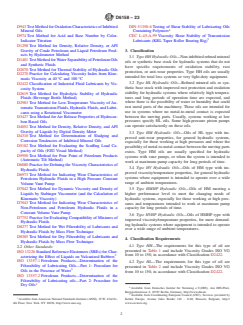
D943 Test Method for Oxidation Characteristics of Inhibited DIN 51350-6 Testing of Shear Stability of Lubricating Oils
Mineral Oils Containing Polymers
D974 Test Method for Acid and Base Number by Color- CEC L-45-A-99 Viscosity Shear Stability of Transmission
Indicator Titration Lubricants (KRL Taper Roller Bearing Rig)
D1298 Test Method for Density, Relative Density, or API
Gravity of Crude Petroleum and Liquid Petroleum Prod- 3. Classification
ucts by Hydrometer Method
3.1 Type HH Hydraulic Oils—Non-inhibited refined mineral
D1401 Test Method for Water Separability of Petroleum Oils
oils or synthetic base stock for hydraulic systems that do not
and Synthetic Fluids
have specific requirements of oxidation stability, rust
D2070 Test Method for Thermal Stability of Hydraulic Oils
protection, or anti-wear properties. Type HH oils are usually
D2270 Practice for Calculating Viscosity Index from Kine-
intended for total loss systems or very light-duty equipment.
matic Viscosity at 40 °C and 100 °C
3.2 Type HL Hydraulic Oils—Refined mineral oils or syn-
D2422 Classification of Industrial Fluid Lubricants by Vis-
thetic base stock with improved rust protection and oxidation
cosity System
stability for hydraulic systems where relatively high tempera-
D2619 Test Method for Hydrolytic Stability of Hydraulic
tures and long periods of operation time are expected, and
Fluids (Beverage Bottle Method)
where there is the possibility of water or humidity that could
D2983 Test Method for Low-Temperature Viscosity of Au-
rust metal parts of the machinery. These oils are intended for
tomatic Transmission Fluids, Hydraulic Fluids, and Lubri-
use in systems where no metal-to-metal contact is expected
cants using a Rotational Viscometer
between the moving parts. Usually, systems working at low
D3427 Test Method for Air Release Properties of Hydrocar-
pressures specify HL oils. Some high-pressure piston pumps
bon Based Oils
can operate satisfactorily on these oils.
D4052 Test Method for Density, Relative Density, and API
Gravity of Liquids by Digital Density Meter
3.3 Type HM Hydraulic Oils—Oils of HL type with im-
D4310 Test Method for Determination of Sludging and
proved anti-wear properties, for general hydraulic systems,
Corrosion Tendencies of Inhibited Mineral Oils
especially for those working at high pressures and where the
D5182 Test Method for Evaluating the Scuffing Load Ca-
possibility of metal-to-metal contact between the moving parts
pacity of Oils (FZG Visual Method)
exists. Type HM oils are usually specified for hydraulic
D5950 Test Method for Pour Point of Petroleum Products
systems with vane pumps, or when the system is intended to
(Automatic Tilt Method)
work at maximum pump capacity for long periods of time.
D6080 Practice for Defining the Viscosity Characteristics of
3.4 Type HV Hydraulic Oils—Oils of HM type with im-
Hydraulic Fluids
proved viscosity/temperature properties, for general hydraulic
D6973 Test Method for Indicating Wear Characteristics of
systems where equipment is intended to operate over a wide
Petroleum Hydraulic Fluids in a High Pressure Constant
range of ambient temperatures.
Volume Vane Pump
D7042 Test Method for Dynamic Viscosity and Density of
3.5 Type HMHP Hydraulic Oils—Oils of HM meeting a
Liquids by Stabinger Viscometer (and the Calculation of
higher performance level to meet the changing needs of
Kinematic Viscosity)
hydraulic systems, especially for those working at high pres-
D7043 Test Method for Indicating Wear Characteristics of
sures and temperatures intended to work at maximum pump
Non-Petroleum and Petroleum Hydraulic Fluids in a
capacity for long periods of time.
Constant Volume Vane Pump
3.6 Type HVHP Hydraulic Oils—Oils of HMHP type with
D7752 Practice for Evaluating Compatibility of Mixtures of
improved viscosity/temperature properties, for more demand-
Hydraulic Fluids
ing hydraulic systems where equipment is intended to operate
D8277 Test Method for Wet Filterability of Lubricants and
over a wide range of ambient temperatures.
Hydraulic Fluids by Mass Flow Technique
D8385 Test Method for Dry Filterability of Lubricants and
4. Classification Requirements
Hydraulic Fluids by Mass Flow Technique
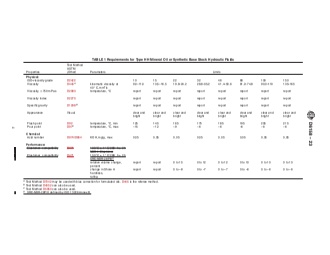
4.1 Type HH—The requirements for this type of oil are
2.2 Other Standards:
presented in Table 1 and include Viscosity Grades ISO VG
ISO 13226 Standard Reference Elastomers (SREs) for Char-
from 10 to 150, in accordance with Classification D2422.
acterizing the Effect of Liquids on Vulcanized Rubbers
ISO 13357-1 Petroleum Products—Determination of the
4.2 Type HL—The requirements for this type of oil are
Filterability of Lubricating Oils—Part 1: Procedure for
presented in Table 2 and include Viscosity Grades ISO VG
Oils in the Presence of Water
from 10 to 150, in accordance with Classification D2422.
ISO 13357-2 Petroleum Products—Determination of the
Filterability of Lubricating oils—Part 2: Procedure for
Dry Oils
Available from Deutsches Institut für Normung e.V.(DIN), Am DIN-Platz,
Burggrafenstrasse 6, 10787 Berlin, Germany, http://www.din.de.
Available from Coordinating European Council (CEC), Services provided by
Available from American National Standards Institute (ANSI), 25 W. 43rd St., Kellen Europe, Avenue Jules Bordet 142 - 1140, Brussels, Belgium, http://
4th Floor, New York, NY 10036, http://www.ansi.org. www.cectests.org.
D6158 − 23
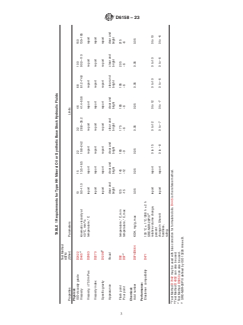
TABLE 1 Requirements for Type HH Mineral Oil or Synthetic Base Stock Hydraulic Fluids
Test Method
ASTM
Properties (Other) Parameters Limits
Physical:
ISO-viscosity grade D2422 10 15 22 32 46 68 100 150
A
Viscosity D445 kinematic viscosity at 9.0–11.0 13.5–16.5 19.8–24.2 28.8–35.2 41.4–50.6 61.2–74.8 90.0–110 135–165
40 °C, mm /s
Viscosity, #750 mPa·s D2983 temperature, °C report report report report report report report report
Viscosity index D2270 report report report report report report report report
B
Specific gravity D1298 report report report report report report report report
Appearance Visual clear and clear and clear and clear and clear and clear and clear and clear and
bright bright bright bright bright bright bright bright
Flash point D92 temperature, °C, min 125 145 165 175 185 195 205 215
C
Pour point D97 temperature, °C, max –15 –12 –9 –6 –6 –6 –6 –6
Chemical:
Acid number D974/D664 KOH, mg/g, max 0.05 0.05 0.05 0.05 0.05 0.05 0.05 0.05
Performance:
Elastomer compatibility D471 100 °C ± 1 °C ⁄288 h ± 2 h
D
SRE-NBR-28P/X
relative volume change, report report 0 to 15 0 to 12 0 to 12 0 to 10 0 to 10 0 to 10
percent
change in Shore A report report 0 to –8 0 to –7 0 to –7 0 to –6 0 to –6 0 to –6
hardness,
rating
A
Test Method D7042 may be used with bias correction for formulated oils. D445 is the referee method.
B
Test Method D4052 can also be used.
C
Test Method D5950 can also be used.
D
SRE-NBR-28P/X defined by ISO 13226 Annex B.
D6158 − 23
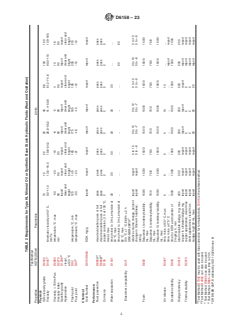
TABLE 2 Requirements for Type HL Mineral Oil or Synthetic Base Stock Hydraulic Fluids (Rust and Oxidation)
Test Method
Properties ASTM (Other) Parameters Limits
Physical:
ISO-viscosity grade D2422 10 15 22 32 46 68 100 150
A
Viscosity D445 kinematic viscosity at 40 °C, 9.0–11.0 13.5–16.5 19.8–24.2 28.8–35.2 41.4–50.6 61.2–74.8 90.0–110 135–165
mm /s
Viscosity, #750 mPa·s D2983 temperature, °C, max –33 –23 –15 –8 –2 4 10 16
Viscosity index D2270 min 90 90 90 90 90 90 90 90
B
Specific gravity D1298 report report report report report report report report
Appearance visual, clear and clear and clear and clear and clear and clear and clear and clear and
at 20 °C bright bright bright bright bright bright bright bright
Flash point D92 temperature, °C, min 125 145 165 175 185 195 205 215
C
Pour point D97 temperature, °C, max –33 –24 –21 –18 –15 –12 –12 –12
Chemical:
Acid Number D974/D664 KOH, mg/g report report report report report report report report
Performance:
D
Rust prevention D665A visual evaluation pass or fail pass pass pass pass pass pass pass pass
D
D665B visual evaluation pass or fail pass pass pass pass pass pass pass pass
Corrosion D130 copper corrosion, 3 h at 100 °C, 2 2 2 2 2 2 2 2
visual, max
Water separation D1401 time (mins) to 3 mL emulsion at 30 30 30 30 30 30 . .
54 °C, max
time (mins) to 3 mL emulsion at . . . . . . 60 60
82 °C, max
Elastomer compatibility D471 100 °C ± 1 °C ⁄288 h ± 2 h
E
SRE-NBR-28P/X
relative volume change, percent report report 0 to 15 0 to 12 0 to 12 0 to 10 0 to 10 0 to 10
change in Shore A hardness, report report 0 to –8 0 to –7 0 to –7 0 to –6 0 to –6 0 to –6
rating
Foam D892 Sequence I, tendency/stability, 150/0 150/0 150/0 150/0 150/0 150/0 150/0 150/0
mL, max
Sequence II, tendency/stability, 75/0 75/0 75/0 75/0 75/0 75/0 75/0 75/0
mL, max
Sequence III, tendency/stability, 150/0 150/0 150/0 150/0 150/0 150/0 150/0 150/0
mL, max
Air release D3427 time, mins. at 50 °C, max 5 5 5 5 10 10 . .
time, mins. at 75 °C . . . . . . report report
Oxidation stability D943 time for KOH acid number of 1000 1000 1000 1000 1000 1000 1000 1000
2 mg/kg, h, min
Sludge tendency D4310 total insoluble sludge, mg, max 200 200 200 200 200 200 200 200
copper in oil/water/sludge, mg report report report report report report report report
Thermal stability D2070 copper appearance, visual max report report report 5 5 5 report report
steel appearance, visual max report report report 2 2 2 report report
sludge, mg/100 mL, max report report report 25 25 25 report report
A
Test Method D7042 may be used with bias correction for formulated oils. D445 is the referee method.
B
Test Method D4052 can also be used.
C
Test Method D5950 can also be used.
D
Test Method D665—soak time is 24 h.
E
SRE-NBR-28P ⁄X defined by ISO 13226 Annex B.
D6158 − 23
4.3 Type HM—The requirements for this type of oil are 6. Packaging and Package Marking
presented in Table 3 and include Viscosity Grades ISO VG
6.1 The material shall be suitably packaged to permit
from 10 to 150, in accordance with Classification D2422.
acceptance by the carrier and to afford adequate protection
4.4 Type HV—The requirements for this type of oil are from normal hazards of handling and shipping. Packaging shall
presented in Table 4 and include Viscosity Grades ISO VG conform to applicable carrier rules and regulations.
from 10 to 150, in accordance with Classification D2422.
6.2 Packaging and labeling shall comply with state or
4.5 Type HMHP—The requirements for this type of oil are federal regulations.
presented in Table 5 and include Viscosity Grades ISO VG
6.3 Each container shall be plainly marked with the manu-
from 22 to 150 in accordance with Classification D2422.
facturer’s name and brand, production code or lot number, type
4.6 Type HVHP—The requirements for this type of oil are of material, volume content, and any other information re-
presented in Table 6 and include Viscosity Grades ISO VG quired by state or federal law.
from 22 to 150 in accordance with Classification D2422.
7. Keywords
5. Inspection
7.1 antiwear protection; guideline; hydraulic oils; mineral
5.1 Inspection of the material shall be agreed upon between oils; rust and oxidation protection; synthetic base stocks;
the purchaser and the supplier. viscosity index
D6158 − 23
TABLE 3 Requirements for Type HM Mineral Oil or Synthetic Base Stock Hydraulic Fluids (Anti-wear)
Test Method
Properties ASTM (Other) Parameters Limits
Physical:
ISO-viscosity grade D2422 10 15 22 32 46 68 100 150
A 2
Viscosity D445 kinematic viscosity at 40 °C, mm /s 9.0–11.0 13.5–16.5 19.8–24.2 28.8–35.2 41.4–50.6 61.2–74.8 90.0–110 135–165
Viscosity #750 mPa·s D2983 temperature, °C, max –33 –23 –15 (–8) –2 4 10 16
Viscosity index D2270 min 90 90 90 90 90 90 90 90
B
Specific gravity D1298 report report report report report report report report
Appearance Visual, clear and clear and clear and clear and clear and clear and clear and clear and
at 20 °C bright bright bright bright bright bright bright bright
Flash point D92 temperature, °C, min 125 145 165 175 185 195 205 215
C
Pour point D97 temperature, °C, max –33 –24 –21 –18 –15 –12 –12 –12
Chemical:
Acid number D974/D664 KOH, mg/g report report report report report report report report
Performance:
D
Rust prevention D665A visual evaluation, pass or fail pass pass pass pass pass pass pass pass
D
D665B visual evaluation, pass or fail pass pass pass pass pass pass pass pass
Corrosion D130 copper corrosion, 3 h at 100 °C, 2 2 2 2 2 2 2 2
visual, max
Water separability D1401 time (mins) to 3 mL emulsion 30 30 30 30 30 30 . .
max at 54 °C
time (mins) to 3 mL emulsion . . . . . . 60 60
max at 82 °C
Elastomer compatibility D471 100 °C ± 1 °C ⁄288 h ± 2 h
E
SRE-NBR-28P/X
relative volume change, percent report report 0 to 15 0 to 12 0 to 12 0 to 10 0 to 10 0 to 10
change in Shore A hardness, rating report report 0 to –8 0 to –7 0 to –7 0 to –6 0 to –6 0 to –6
Foam D892 Sequence I tendency/stability mL 150/0 150/0 150/0 150/0 150/0 150/0 150/0 150/0
max
Sequence II tendency/stability mL 75/0 75/0 75/0 75/0 75/0 75/0 75/0 75/0
max
Sequence III tendency/stability mL 150/0 150/0 150/0 150/0 150/0 150/0 150/0 150/0
max
Air release D3427 time (mins) at 50 °C, max 5 5 5 5 10 13 . .
time (mins) at 75 °C . . . . . . report report
Oxidation stability D943 time for KOH acid number of 1000 1000 1000 1000 1000 1000 1000 1000
2 mg/kg, h, min
Sludge tendency D4310 total insoluble sludge, mg, max 200 200 200 200 200 200 200 200
copper oil/water/sludge, mg report report report report report report report report
Thermal stability D2070 copper appearance, visual report report report 5 5 5 report report
steel appearance, visual report report report 2 2 2 report report
sludge, mg/100 mL report report report 25 25 25 report report
Wear protection D7043 mass loss vanes + ring, mg, . . report report report . . .
max at 65.6 °C ⁄100 h
mass loss vanes + ring, mg, . . . . . report report report
max at 79.4 °C ⁄100 h
A
Test Method D7042 may be used with bias correction for formulated oils. D445 is the referee method.
B
Test Method D4052 can also be used.
C
Test Method D5950 can also be used.
D
Test Method D665—soak time is 24 h.
E
SRE-NBR-28P ⁄X defined by ISO 13226 Annex B.
D6158 − 23
TABLE 4 Requirements for Type HV Mineral Oil or Synthetic Base Stock Hydraulic Fluids (Multigrade Anti-wear)
Test
Method
ASTM
Properties (Other) Parameters Limits
Physical:
ISO-viscosity grade D2422 10 15 22 32 46 68 100 150
A
Viscosity of fresh oil D445 kinematic viscosity at 9.0–11.0 13.5–16.5 19.8–24.2 28.8–35.2 41.4–50.6 61.2–74.8 90.0–110 135–165
40 °C, mm /s
Viscosity #750 mPa·s D2983 temperature, °C, max –33 –23 –15 –8 –2 4 10 16
Low temperature viscosity D6080 report report report report report report report report
grade
Viscosity index of fresh oil D2270 min 140 140 140 140 140 140 140 140
Viscosity after shear D6080 kinematic viscosity at report report report report report report report report
40 °C, mm /s
Viscosity index after shear D6080 report report report report report report report report
B
Specific gravity D1298 report report report report report report report report
Appearance Visual, clear and clear and clear and clear and clear and clear and clear and clear and
at 20 °C bright bright bright bright bright bright bright bright
Flash point D92 temperature, °C, min 125 145 165 175 185 195 205 215
C
Pour point D97 temperature, °C, max –33 –24 –21 –18 –15 –12 –12 –12
Chemical:
Acid number D974/D664 KOH, mg/g report report report report report report report report
Performance:
D
Rust prevention D665A visual evaluation, pass pass pass pass pass pass pass pass
pass or fail
D
D665B visual evaluation, pass pass pass pass pass pass pass pass
pass or fail
Corrosion D130 copper corrosion, 3 h 2 2 2 2 2 2 2 2
at 100 °C, visual, max
Water separability D1401 time (mins) to 3 mL emulsion max 30 30 30 30 30 30 . .
at 54 °C
time (mins) to 3 mL emulsion max . . . . . . 60 60
at 82 °C
Elastomer compatibility D471 100 °C ± 1 °C ⁄288 h ± 2 h
E
SRE-NBR-28P/X
relative volum
...
This document is not an ASTM standard and is intended only to provide the user of an ASTM standard an indication of what changes have been made to the previous version. Because
it may not be technically possible to adequately depict all changes accurately, ASTM recommends that users consult prior editions as appropriate. In all cases only the current version
of the standard as published by ASTM is to be considered the official document.
Designation: D6158 − 18 D6158 − 23
Standard Specification for
Mineral Hydraulic Oils
This standard is issued under the fixed designation D6158; the number immediately following the designation indicates the year of
original adoption or, in the case of revision, the year of last revision. A number in parentheses indicates the year of last reapproval. A
superscript epsilon (´) indicates an editorial change since the last revision or reapproval.
1. Scope*
1.1 This specification covers mineral and synthetic oils of the types API groups I, II, III, and IV used in hydraulic systems, where
the performance requirements demand fluids with one of the following characteristics:
1.1.1 A refined base oil or synthetic base stock (Class HH),
1.1.2 A refined mineral base oil or synthetic base stock with rust and oxidation inhibitors (Class HL),
1.1.3 A refined mineral base oil or synthetic base stock with rust and oxidation inhibitors plus anti-wear characteristics (Class
HM),
1.1.4 A refined mineral base oil or synthetic base stock with rust and oxidation inhibitors, anti-wear characteristics, and increased
viscosity index higher than 140 (Class HV),
1.1.5 A refined mineral base oil or synthetic base stock with rust and oxidation inhibitors plus anti-wear characteristics meeting
a higher performance level than an HM fluid to address higher demanding hydraulic systems (Class HMHP), and
1.1.6 A refined mineral base oil with rust or synthetic base stock and oxidation inhibitors, anti-wear characteristics, and increased
viscosity index higher than 140 meeting a higher performance level than an HV fluid to address higher demanding hydraulic
systems (Class HVHP).
1.2 This specification defines the requirements of mineral oil-based or synthetic-based hydraulic fluids that are compatible with
most existing machinery components when there is adequate maintenance.
1.3 This specification defines only new lubricating oils before they are installed in the hydraulic system.
1.4 This specification defines specific types of hydraulic oils. It does not include all hydraulic oils. Some oils that are not included
may be satisfactory for certain hydraulic applications. Certain equipment or conditions of use may permit or require a wider or
narrower range of characteristics than those described herein.
1.5 The values stated in SI units are to be regarded as standard. No other units of measurement are included in this standard.
This specification is under the jurisdiction of ASTM Committee D02 on Petroleum Products, Liquid Fuels, and Lubricants and is the direct responsibility of Subcommittee
D02.N0 on Hydraulic Fluids.
Current edition approved Oct. 1, 2018Nov. 1, 2023. Published October 2018December 2023. Originally approved in 1997. Last previous edition approved in 20162018
as D6158 – 16.D6158 – 18. DOI: 10.1520/D6158-18. 10.1520/D6158-23.
*A Summary of Changes section appears at the end of this standard
Copyright © ASTM International, 100 Barr Harbor Drive, PO Box C700, West Conshohocken, PA 19428-2959. United States
D6158 − 23
1.5.1 Exception—In X1.3.9 on Wear Protection, the values of pump pressure are in MPa, and the psi follows in brackets as a
reference point immediately recognized by a large part of the industry.
1.6 The following safety hazard caveat pertains to the test methods referenced in this specification. This standard does not
purport to address all of the safety concerns, if any, associated with its use. It is the responsibility of the user of this standard to
establish appropriate safety, health, and environmental practices and determine the applicability of regulatory limitations prior
to use.
1.7 This international standard was developed in accordance with internationally recognized principles on standardization
established in the Decision on Principles for the Development of International Standards, Guides and Recommendations issued
by the World Trade Organization Technical Barriers to Trade (TBT) Committee.
2. Referenced Documents
2.1 ASTM Standards:
D92 Test Method for Flash and Fire Points by Cleveland Open Cup Tester
D97 Test Method for Pour Point of Petroleum Products
D130 Test Method for Corrosiveness to Copper from Petroleum Products by Copper Strip Test
D445 Test Method for Kinematic Viscosity of Transparent and Opaque Liquids (and Calculation of Dynamic Viscosity)
D471 Test Method for Rubber Property—Effect of Liquids
D664 Test Method for Acid Number of Petroleum Products by Potentiometric Titration
D665 Test Method for Rust-Preventing Characteristics of Inhibited Mineral Oil in the Presence of Water
D892 Test Method for Foaming Characteristics of Lubricating Oils
D943 Test Method for Oxidation Characteristics of Inhibited Mineral Oils
D974 Test Method for Acid and Base Number by Color-Indicator Titration
D1298 Test Method for Density, Relative Density, or API Gravity of Crude Petroleum and Liquid Petroleum Products by
Hydrometer Method
D1401 Test Method for Water Separability of Petroleum Oils and Synthetic Fluids
D2070 Test Method for Thermal Stability of Hydraulic Oils
D2270 Practice for Calculating Viscosity Index from Kinematic Viscosity at 40 °C and 100 °C
D2422 Classification of Industrial Fluid Lubricants by Viscosity System
D2619 Test Method for Hydrolytic Stability of Hydraulic Fluids (Beverage Bottle Method)
D2983 Test Method for Low-Temperature Viscosity of Automatic Transmission Fluids, Hydraulic Fluids, and Lubricants using
a Rotational Viscometer
D3427 Test Method for Air Release Properties of Hydrocarbon Based Oils
D4052 Test Method for Density, Relative Density, and API Gravity of Liquids by Digital Density Meter
D4310 Test Method for Determination of Sludging and Corrosion Tendencies of Inhibited Mineral Oils
D5182 Test Method for Evaluating the Scuffing Load Capacity of Oils (FZG Visual Method)
D5950 Test Method for Pour Point of Petroleum Products (Automatic Tilt Method)
D6080 Practice for Defining the Viscosity Characteristics of Hydraulic Fluids
D6973 Test Method for Indicating Wear Characteristics of Petroleum Hydraulic Fluids in a High Pressure Constant Volume Vane
Pump
D7042 Test Method for Dynamic Viscosity and Density of Liquids by Stabinger Viscometer (and the Calculation of Kinematic
Viscosity)
D7043 Test Method for Indicating Wear Characteristics of Non-Petroleum and Petroleum Hydraulic Fluids in a Constant Volume
Vane Pump
D7752 Practice for Evaluating Compatibility of Mixtures of Hydraulic Fluids
D8277 Test Method for Wet Filterability of Lubricants and Hydraulic Fluids by Mass Flow Technique
D8385 Test Method for Dry Filterability of Lubricants and Hydraulic Fluids by Mass Flow Technique
2.2 Other Standards:
ISO 13226 Standard Reference Elastomers (SREs) for Characterizing the Effect of Liquids on Vulcanized Rubbers
ISO 13357-1 Petroleum Products—Determination of the Filterability of Lubricating Oils—Part 1: Procedure for Oils in the
Presence of Water
ISO 13357-2 Petroleum Products—Determination of the Filterability of Lubricating oils—Part 2: Procedure for Dry Oils
For referenced ASTM standards, visit the ASTM website, www.astm.org, or contact ASTM Customer Service at service@astm.org. For Annual Book of ASTM Standards
volume information, refer to the standard’s Document Summary page on the ASTM website.
Available from American National Standards Institute (ANSI), 25 W. 43rd St., 4th Floor, New York, NY 10036, http://www.ansi.org.
D6158 − 23
DIN 51350-6 Testing of Shear Stability of Lubricating Oils Containing Polymers
CEC L-45-A-99 Viscosity Shear Stability of Transmission Lubricants (KRL Taper Roller Bearing Rig)
3. Classification
3.1 Type HH Hydraulic Oils—Non-inhibited refined mineral oils or synthetic base stock for hydraulic systems that do not have
specific requirements of oxidation stability, rust protection, or anti-wear properties. Type HH oils are usually intended for total loss
systems or very light-duty equipment.
3.2 Type HL Hydraulic Oils—Refined mineral oils or synthetic base stock with improved rust protection and oxidation stability
for hydraulic systems where relatively high temperatures and long periods of operation time are expected, and where there is the
possibility of water or humidity that could rust metal parts of the machinery. These oils are intended for use in systems where no
metal-to-metal contact is expected between the moving parts. Usually, systems working at low pressures specify HL oils. Some
high-pressure piston pumps can operate satisfactorily on these oils.
3.3 Type HM Hydraulic Oils—Oils of HL type with improved anti-wear properties, for general hydraulic systems, especially for
those working at high pressures and where the possibility of metal-to-metal contact between the moving parts exists. Type HM oils
are usually specified for hydraulic systems with vane pumps, or when the system is intended to work at maximum pump capacity
for long periods of time.
3.4 Type HV Hydraulic Oils—Oils of HM type with improved viscosity/temperature properties, for general hydraulic systems
where equipment is intended to operate over a wide range of ambient temperatures.
3.5 Type HMHP Hydraulic Oils—Oils of HM meeting a higher performance level to meet the changing needs of hydraulic
systems, especially for those working at high pressures and temperatures intended to work at maximum pump capacity for long
periods of time.
3.6 Type HVHP Hydraulic Oils—Oils of HMHP type with improved viscosity/temperature properties, for more demanding
hydraulic systems where equipment is intended to operate over a wide range of ambient temperatures.
4. Classification Requirements
4.1 Type HH—The requirements for this type of oil are presented in Table 1 and include Viscosity Grades ISO VG from 10 to 150,
in accordance with Classification D2422.
4.2 Type HL—The requirements for this type of oil are presented in Table 2 and include Viscosity Grades ISO VG from 10 to 150,
in accordance with Classification D2422.
4.3 Type HM—The requirements for this type of oil are presented in Table 3 and include Viscosity Grades ISO VG from 10 to
150, in accordance with Classification D2422.
4.4 Type HV—The requirements for this type of oil are presented in Table 4 and include Viscosity Grades ISO VG from 10 to 150,
in accordance with Classification D2422.
4.5 Type HMHP—The requirements for this type of oil are presented in Table 5 and include Viscosity Grades ISO VG from 22
to 150 in accordance with Classification D2422.
4.6 Type HVHP—The requirements for this type of oil are presented in Table 6 and include Viscosity Grades ISO VG from 22
to 150 in accordance with Classification D2422.
Available from Deutsches Institut für Normung e.V.(DIN), Am DIN-Platz, Burggrafenstrasse 6, 10787 Berlin, Germany, http://www.din.de.
Available from Coordinating European Council (CEC), Services provided by Kellen Europe, Avenue Jules Bordet 142 - 1140, Brussels, Belgium, http://www.cectests.org.
D6158 − 23
TABLE 1 Requirements for Type HH Mineral Oil or Synthetic Base Stock Hydraulic Fluids
Test Method
ASTM
Properties (Other) Parameters Limits
Physical:
ISO-viscosity grade D2422 10 15 22 32 46 68 100 150
A
Viscosity D445 kinematic viscosity at 9.0–11.0 13.5–16.5 19.8–24.2 28.8–35.2 41.4–50.6 61.2–74.8 90.0–110 135–165
40 °C, mm /s
Viscosity, #750 mPa·s D2983 temperature, °C report report report report report report report report
Viscosity index D2270 report report report report report report report report
B
Specific gravity D1298 report report report report report report report report
Appearance Visual clear and clear and clear and clear and clear and clear and clear and clear and
bright bright bright bright bright bright bright bright
Flash point D92 temperature, °C, min 125 145 165 175 185 195 205 215
C
Pour point D97 temperature, °C, max –15 –12 –9 –6 –6 –6 –6 –6
Chemical:
Acid number D974/D664 KOH, mg/g, max 0.05 0.05 0.05 0.05 0.05 0.05 0.05 0.05
Performance:
Elastomer compatibility D471 100 °C ± 1 °C ⁄288 h ± 2 h
NBR-1 Elastomer
Elastomer compatibility D471 100 °C ± 1 °C ⁄288 h ± 2 h
D
SRE-NBR-28P/X
relative volume change, report report 0 to 15 0 to 12 0 to 12 0 to 10 0 to 10 0 to 10
percent
change in Shore A report report 0 to –8 0 to –7 0 to –7 0 to –6 0 to –6 0 to –6
hardness,
rating
A
Test Method D7042 may be used with bias correction for formulated oils. D445 is the referee method.
B
Test Method D4052 can also be used.
C
Test Method D5950 can also be used.
D
SRE-NBR-28P/X defined by ISO 13226 Annex B.
D6158 − 23
TABLE 2 Requirements for Type HL Mineral Oil or Synthetic Base Stock Hydraulic Fluids (Rust and Oxidation)
Test Method
Properties ASTM (Other) Parameters Limits
Physical:
ISO-viscosity grade D2422 10 15 22 32 46 68 100 150
A
Viscosity D445 kinematic viscosity at 40 °C, 9.0–11.0 13.5–16.5 19.8–24.2 28.8–35.2 41.4–50.6 61.2–74.8 90.0–110 135–165
mm /s
Viscosity, #750 mPa·s D2983 temperature, °C, max –33 –23 –15 –8 –2 4 10 16
Viscosity index D2270 min 90 90 90 90 90 90 90 90
B
Specific gravity D1298 report report report report report report report report
Appearance visual, clear and clear and clear and clear and clear and clear and clear and clear and
at 20 °C bright bright bright bright bright bright bright bright
Flash point D92 temperature, °C, min 125 145 165 175 185 195 205 215
C
Pour point D97 temperature, °C, max –33 –24 –21 –18 –15 –12 –12 –12
Chemical:
Acid Number D974/D664 KOH, mg/g report report report report report report report report
Performance:
D
Rust prevention D665A visual evaluation pass or fail pass pass pass pass pass pass pass pass
D
D665B visual evaluation pass or fail pass pass pass pass pass pass pass pass
Corrosion D130 copper corrosion, 3 h at 100 °C, 2 2 2 2 2 2 2 2
visual, max
Water separation D1401 time (mins) to 3 mL emulsion at 30 30 30 30 30 30 . .
54 °C, max
time (mins) to 3 mL emulsion at . . . . . . 60 60
82 °C, max
Elastomer compatibility D471 100 °C ± 1 °C ⁄288 h ± 2 h
NBR-1 Elastomer
Elastomer compatibility D471 100 °C ± 1 °C ⁄288 h ± 2 h
E
SRE-NBR-28P/X
relative volume change, percent report report 0 to 15 0 to 12 0 to 12 0 to 10 0 to 10 0 to 10
change in Shore A hardness, report report 0 to –8 0 to –7 0 to –7 0 to –6 0 to –6 0 to –6
rating
Foam D892 Sequence I, tendency/stability, 150/0 150/0 150/0 150/0 150/0 150/0 150/0 150/0
mL, max
Sequence II, tendency/stability, 75/0 75/0 75/0 75/0 75/0 75/0 75/0 75/0
mL, max
Sequence III, tendency/stability, 150/0 150/0 150/0 150/0 150/0 150/0 150/0 150/0
mL, max
Air release D3427 time, mins. at 50 °C, max 5 5 5 5 10 10 . .
time, mins. at 75 °C . . . . . . report report
Oxidation stability D943 time for KOH acid number of 1000 1000 1000 1000 1000 1000 1000 1000
2 mg/kg, h, min
Sludge tendency D4310 total insoluble sludge, mg, max 200 200 200 200 200 200 200 200
copper in oil/water/sludge, mg report report report report report report report report
Thermal stability D2070 copper appearance, visual max report report report 5 5 5 report report
steel appearance, visual max report report report 2 2 2 report report
sludge, mg/100 mL, max report report report 25 25 25 report report
A
Test Method D7042 may be used with bias correction for formulated oils. D445 is the referee method.
B
Test Method D4052 can also be used.
C
Test Method D5950 can also be used.
D
Test Method D665—soak time is 24 h.
E
SRE-NBR-28P ⁄X defined by ISO 13226 Annex B.
D6158 − 23
TABLE 3 Requirements for Type HM Mineral Oil or Synthetic Base Stock Hydraulic Fluids (Anti-wear)
Test Method
Properties ASTM (Other) Parameters Limits
Physical:
ISO-viscosity grade D2422 10 15 22 32 46 68 100 150
A 2
Viscosity D445 kinematic viscosity at 40 °C, mm /s 9.0–11.0 13.5–16.5 19.8–24.2 28.8–35.2 41.4–50.6 61.2–74.8 90.0–110 135–165
Viscosity #750 mPa·s D2983 temperature, °C, max –33 –23 –15 (–8) –2 4 10 16
Viscosity index D2270 min 90 90 90 90 90 90 90 90
B
Specific gravity D1298 report report report report report report report report
Appearance Visual, clear and clear and clear and clear and clear and clear and clear and clear and
at 20 °C bright bright bright bright bright bright bright bright
Flash point D92 temperature, °C, min 125 145 165 175 185 195 205 215
C
Pour point D97 temperature, °C, max –33 –24 –21 –18 –15 –12 –12 –12
Chemical:
Acid number D974/D664 KOH, mg/g report report report report report report report report
Performance:
D
Rust prevention D665A visual evaluation, pass or fail pass pass pass pass pass pass pass pass
D
D665B visual evaluation, pass or fail pass pass pass pass pass pass pass pass
Corrosion D130 copper corrosion, 3 h at 100 °C, 2 2 2 2 2 2 2 2
visual, max
Water separability D1401 time (mins) to 3 mL emulsion 30 30 30 30 30 30 . .
max at 54 °C
time (mins) to 3 mL emulsion . . . . . . 60 60
max at 82 °C
Elastomer compatibility D471 100 °C ± 1 °C ⁄288 h ± 2 h
NBR-1 Elastomer
E
SRE-NBR-28P/X
relative volume change, percent report report 0 to 15 0 to 12 0 to 12 0 to 10 0 to 10 0 to 10
change in Shore A hardness, rating report report 0 to –8 0 to –7 0 to –7 0 to –6 0 to –6 0 to –6
Foam D892 Sequence I tendency/stability mL 150/0 150/0 150/0 150/0 150/0 150/0 150/0 150/0
max
Sequence II tendency/stability mL 75/0 75/0 75/0 75/0 75/0 75/0 75/0 75/0
max
Sequence III tendency/stability mL 150/0 150/0 150/0 150/0 150/0 150/0 150/0 150/0
max
Air release D3427 time (mins) at 50 °C, max 5 5 5 5 10 13 . .
time (mins) at 75 °C . . . . . . report report
Oxidation stability D943 time for KOH acid number of 1000 1000 1000 1000 1000 1000 1000 1000
2 mg/kg, h, min
Sludge tendency D4310 total insoluble sludge, mg, max 200 200 200 200 200 200 200 200
copper oil/water/sludge, mg report report report report report report report report
Thermal stability D2070 copper appearance, visual report report report 5 5 5 report report
steel appearance, visual report report report 2 2 2 report report
sludge, mg/100 mL report report report 25 25 25 report report
Wear protection D7043 mass loss vanes + ring, mg, . . report report report . . .
max at 65.6 °C ⁄100 h
mass loss vanes + ring, mg, . . . . . report report report
max at 79.4 °C ⁄100 h
A
Test Method D7042 may be used with bias correction for formulated oils. D445 is the referee method.
B
Test Method D4052 can also be used.
C
Test Method D5950 can also be used.
D
Test Method D665—soak time is 24 h.
E
SRE-NBR-28P ⁄X defined by ISO 13226 Annex B.
D6158 − 23
TABLE 4 Requirements for Type HV Mineral Oil or Synthetic Base Stock Hydraulic Fluids (Multigrade Anti-wear)
Test
Method
ASTM
Properties (Other) Parameters Limits
Physical:
ISO-viscosity grade D2422 10 15 22 32 46 68 100 150
A
Viscosity of fresh oil D445 kinematic viscosity at 9.0–11.0 13.5–16.5 19.8–24.2 28.8–35.2 41.4–50.6 61.2–74.8 90.0–110 135–165
40 °C, mm /s
Viscosity #750 mPa·s D2983 temperature, °C, max –33 –23 –15 –8 –2 4 10 16
Low temperature viscosity D6080 report report report report report report report report
grade
Viscosity index of fresh oil D2270 min 140 140 140 140 140 140 140 140
Viscosity after shear D6080 kinematic viscosity at report report report report report report report report
40 °C, mm /s
Viscosity index after shear D6080 report report report report report report report report
B
Specific gravity D1298 report report report report report report report report
Appearance Visual, clear and clear and clear and clear and clear and clear and clear and clear and
at 20 °C bright bright bright bright bright bright bright bright
Flash point D92 temperature, °C, min 125 145 165 175 185 195 205 215
C
Pour point D97 temperature, °C, max –33 –24 –21 –18 –15 –12 –12 –12
Chemical:
Acid number D974/D664 KOH, mg/g report report report report report report report report
Performance:
D
Rust prevention D665A visual evaluation, pass pass pass pass pass pass pass pass
pass or fail
D
D665B visual evaluation, pass pass pass pass pass pass pass pass
pass or fail
Corrosion D130 copper corrosion, 3 h 2 2 2 2 2 2 2 2
at 100 °C, visual, max
Water separability D1401 time (mins) to 3 mL emulsion max 30 30 30 30 30 30 . .
at 54 °C
time (mins) to 3 mL emulsion max . . . . . . 60 60
at 82 °C
Elastomer compatibility D471 100 °C ± 1 °C ⁄288 h ± 2 h
NBR-1 Elastomer
E
SRE-NBR-28P/X
relative volume report report 0 to 15 0 to 12 0 to 12 0 to 10 0 to 10 0 to 10
change, percent
change in Shore A hardness, rating report report 0 to –8 0 to –7 0 to –7 0 to –6 0 to –6 0 to –6
Foam D892 Sequence I tendency/stability mL 150/0 150/0 150/0 150/0 150/0 150/0 150/0 150/0
max
Sequence II tendency/stability mL 75/0 75/0 75/0 75/0 75/0 75/0 75/0 75/0
max
Sequence III tendency/stability mL 150/0 150/0 150/0 150/0 150/0 150/0 150/0 150/0
max
Air release D3427 time (mins) at 50 °C, max 5 5 5 5 10 13 . .
time (mins) at 75 °C . . . . . . report report
Oxidation stability D943 time for KOH acid number of 1000 1000 1000 1000 1000 1000 1000 1000
2 mg/kg, h, min
Sludge tendency D4310 total insoluble sludge, mg, max 200 200 200 200 200 200 200 200
copper oil/water/sludge, mg report report report report report report report report
Thermal stability D2070 copper appearance, visual report report report 5 5 5 report report
steel appearance, visual report report report 2 2 2 report report
...