

ASTM D4212-16(2023)
(Test Method)Standard Test Method for Viscosity by Dip-Type Viscosity Cups
General Information
- Abstract
SIGNIFICANCE AND USE
5.1 Viscosity is a measure of the fluidity of a material. Viscosity data are useful in the determination of the ease of stirring, pumping, dip coating, or other flow-related properties of paints and related fluids.
5.2 This type of cup is used to measure viscosity because it is easy to use, robust, and may be used in tanks, reservoirs, and reactors.
5.3 There are other types of apparatus for measuring viscosity in the laboratory that provide better precision and bias, including the Ford viscosity cup (Test Method D1200), and the rotational viscometer (Test Methods D2196).
5.4 Certain higher shear rate devices such as cone/plate viscometers (Test Method D4287) provide more information about sprayability, roll coatability, and other high-shear rate related properties of coatings.
SCOPE
1.1 This test method covers the determination of viscosity of paints, varnishes, lacquers, inks, and related liquid materials by dip-type viscosity cups. This test method is recommended for viscosity control work within one plant or laboratory and should be used to check compliance with specifications only when sufficient controls have been instituted to ensure adequate comparability of results.
1.2 Viscosity cups are designed for testing of Newtonian and near-Newtonian liquids. If the test material is non-Newtonian, for example, shear-thinning or thixotropic, another method, such as Test Methods D2196, should be used. Under controlled conditions, comparisons of the viscosity of non-newtonian materials may be helpful, but viscosity determination methods using controlled shear rate or shear stress are preferred.
1.3 The values stated in SI units are to be regarded as the standard. The values given in parentheses are for information only.
1.4 This standard does not purport to address all of the safety concerns, if any, associated with its use. It is the responsibility of the user of this standard to establish appropriate safety, health, and environmental practices and determine the applicability of regulatory limitations prior to use.
1.5 This international standard was developed in accordance with internationally recognized principles on standardization established in the Decision on Principles for the Development of International Standards, Guides and Recommendations issued by the World Trade Organization Technical Barriers to Trade (TBT) Committee.
- Status
- Published
- Publication Date
- 30-Jun-2023
- Technical Committee
- D01 - Paint and Related Coatings, Materials, and Applications
- Drafting Committee
- D01.24 - Physical Properties of Liquid Paints & Paint Materials
Overview
ASTM D4212-16(2023): Standard Test Method for Viscosity by Dip-Type Viscosity Cups establishes a reliable procedure for determining the viscosity of paints, varnishes, lacquers, inks, and similar liquid materials. Developed by ASTM International, this method utilizes readily available, robust dip-type viscosity cups, such as Zahn and Shell cups. It is particularly useful for viscosity control work within a single plant or laboratory setting, supporting process consistency and quality assurance. This standard plays an essential role in industries where fluid properties impact application, processing, and end-use performance.
Key Topics
Scope and Applicability
- Focuses on measuring viscosity for Newtonian and near-Newtonian liquids using dip-type viscosity cups.
- Best suited for internal process control and not recommended as a universal specification reference unless strict comparability is ensured.
Significance of Viscosity Measurement
- Viscosity quantifies the fluidity of materials, providing essential data for stirring, pumping, dip coating, and other flow-related processes in coatings and inks.
- Effective viscosity control influences performance and consistency during processing.
Procedure Highlights
- Immersing the selected viscosity cup in the fluid, withdrawing it, and timing the flow through the cup's orifice.
- Measurements are most accurate when temperature is controlled, recognizing that viscosity is highly temperature-dependent.
Cup Types and Selection
- Zahn and Shell cups are widely used, with varying orifice sizes suited for different viscosity ranges.
- Each manufacturer’s cups may vary slightly; therefore, results are most comparable when cups from the same batch and manufacturer are used.
Calibration and Maintenance
- Regular checking and calibration of dip cups are vital, with temperature-stabilized standard fluids recommended for accuracy.
- Cups should be cleaned after each use to maintain performance and precision.
Applications
Industrial Coatings and Inks
- Ensures batch consistency for paints, varnishes, lacquers, and printing inks.
- Supports quality assurance in coating, dip tanks, and ink reservoirs by maintaining optimal viscosity ranges.
Process Control
- Used for routine monitoring of production lines and mixing operations.
- Provides rapid feedback for adjusting formulations or process parameters within a facility.
Research and Quality Control
- Useful for development, testing, and verification of new fluid formulations.
- Supports in-lab comparisons to set or maintain production standards.
Regulatory and Specification Compliance
- Assists in checking compliance with company or industry-specific viscosity requirements, where appropriate controls and cup compatibility are ensured.
Related Standards
To ensure best practices and optimal test selection, consider the following associated ASTM standards:
- ASTM D1200: Standard Test Method for Viscosity by Ford Viscosity Cup - Offers alternative cup method with potentially greater precision.
- ASTM D2196: Test Methods for Rheological Properties of Non-Newtonian Materials by Rotational Viscometer - Recommended for materials with non-Newtonian flow characteristics.
- ASTM D4287: Test Method for High-Shear Viscosity Using a Cone/Plate Viscometer - Provides detailed viscosity data at high shear rates relevant to spraying and roll application processes.
- ASTM E1: Specification for ASTM Liquid-in-Glass Thermometers - Governs temperature measurement tools used in viscosity testing.
By following ASTM D4212, organizations benefit from consistent, efficient viscosity measurements of paints and related liquids, enabling better process control and finished product quality. Whether used in manufacturing, laboratory, or QC settings, proper application and maintenance of dip-type viscosity cups ensure reliable results and support ongoing operational excellence in coating and ink industries.
Relations
- Refers
ASTM D4287-00(2023) - Standard Test Method for High-Shear Viscosity Using a Cone/Plate Viscometer - Effective Date
- 01-Oct-2023
- Refers
ASTM D4287-00(2019) - Standard Test Method for High-Shear Viscosity Using a Cone/Plate Viscometer - Effective Date
- 01-May-2019
- Effective Date
- 01-Jun-2018
- Effective Date
- 01-Dec-2014
- Refers
ASTM D4287-00(2014) - Standard Test Method for High-Shear Viscosity Using a Cone/Plate Viscometer - Effective Date
- 01-Dec-2014
- Effective Date
- 01-May-2013
- Effective Date
- 01-Jul-2010
- Effective Date
- 01-Jul-2010
- Refers
ASTM D4287-00(2010) - Standard Test Method for High-Shear Viscosity Using a Cone/Plate Viscometer - Effective Date
- 01-Feb-2010
- Effective Date
- 01-Nov-2007
- Effective Date
- 01-Nov-2005
- Effective Date
- 01-Jul-2005
- Refers
ASTM D4287-00(2005) - Standard Test Method for High-Shear Viscosity Using a Cone/Plate Viscometer - Effective Date
- 15-May-2005
- Effective Date
- 15-May-2005
- Effective Date
- 01-Nov-2003
Get Certified
Connect with accredited certification bodies for this standard

BSMI (Bureau of Standards, Metrology and Inspection)
Taiwan's standards and inspection authority.
Sponsored listings
Frequently Asked Questions
ASTM D4212-16(2023) is a standard published by ASTM International. Its full title is "Standard Test Method for Viscosity by Dip-Type Viscosity Cups". This standard covers: SIGNIFICANCE AND USE 5.1 Viscosity is a measure of the fluidity of a material. Viscosity data are useful in the determination of the ease of stirring, pumping, dip coating, or other flow-related properties of paints and related fluids. 5.2 This type of cup is used to measure viscosity because it is easy to use, robust, and may be used in tanks, reservoirs, and reactors. 5.3 There are other types of apparatus for measuring viscosity in the laboratory that provide better precision and bias, including the Ford viscosity cup (Test Method D1200), and the rotational viscometer (Test Methods D2196). 5.4 Certain higher shear rate devices such as cone/plate viscometers (Test Method D4287) provide more information about sprayability, roll coatability, and other high-shear rate related properties of coatings. SCOPE 1.1 This test method covers the determination of viscosity of paints, varnishes, lacquers, inks, and related liquid materials by dip-type viscosity cups. This test method is recommended for viscosity control work within one plant or laboratory and should be used to check compliance with specifications only when sufficient controls have been instituted to ensure adequate comparability of results. 1.2 Viscosity cups are designed for testing of Newtonian and near-Newtonian liquids. If the test material is non-Newtonian, for example, shear-thinning or thixotropic, another method, such as Test Methods D2196, should be used. Under controlled conditions, comparisons of the viscosity of non-newtonian materials may be helpful, but viscosity determination methods using controlled shear rate or shear stress are preferred. 1.3 The values stated in SI units are to be regarded as the standard. The values given in parentheses are for information only. 1.4 This standard does not purport to address all of the safety concerns, if any, associated with its use. It is the responsibility of the user of this standard to establish appropriate safety, health, and environmental practices and determine the applicability of regulatory limitations prior to use. 1.5 This international standard was developed in accordance with internationally recognized principles on standardization established in the Decision on Principles for the Development of International Standards, Guides and Recommendations issued by the World Trade Organization Technical Barriers to Trade (TBT) Committee.
SIGNIFICANCE AND USE 5.1 Viscosity is a measure of the fluidity of a material. Viscosity data are useful in the determination of the ease of stirring, pumping, dip coating, or other flow-related properties of paints and related fluids. 5.2 This type of cup is used to measure viscosity because it is easy to use, robust, and may be used in tanks, reservoirs, and reactors. 5.3 There are other types of apparatus for measuring viscosity in the laboratory that provide better precision and bias, including the Ford viscosity cup (Test Method D1200), and the rotational viscometer (Test Methods D2196). 5.4 Certain higher shear rate devices such as cone/plate viscometers (Test Method D4287) provide more information about sprayability, roll coatability, and other high-shear rate related properties of coatings. SCOPE 1.1 This test method covers the determination of viscosity of paints, varnishes, lacquers, inks, and related liquid materials by dip-type viscosity cups. This test method is recommended for viscosity control work within one plant or laboratory and should be used to check compliance with specifications only when sufficient controls have been instituted to ensure adequate comparability of results. 1.2 Viscosity cups are designed for testing of Newtonian and near-Newtonian liquids. If the test material is non-Newtonian, for example, shear-thinning or thixotropic, another method, such as Test Methods D2196, should be used. Under controlled conditions, comparisons of the viscosity of non-newtonian materials may be helpful, but viscosity determination methods using controlled shear rate or shear stress are preferred. 1.3 The values stated in SI units are to be regarded as the standard. The values given in parentheses are for information only. 1.4 This standard does not purport to address all of the safety concerns, if any, associated with its use. It is the responsibility of the user of this standard to establish appropriate safety, health, and environmental practices and determine the applicability of regulatory limitations prior to use. 1.5 This international standard was developed in accordance with internationally recognized principles on standardization established in the Decision on Principles for the Development of International Standards, Guides and Recommendations issued by the World Trade Organization Technical Barriers to Trade (TBT) Committee.
ASTM D4212-16(2023) is classified under the following ICS (International Classification for Standards) categories: 17.060 - Measurement of volume, mass, density, viscosity. The ICS classification helps identify the subject area and facilitates finding related standards.
ASTM D4212-16(2023) has the following relationships with other standards: It is inter standard links to ASTM D4287-00(2023), ASTM D4287-00(2019), ASTM D2196-18, ASTM D1200-10(2014), ASTM D4287-00(2014), ASTM E1-13, ASTM D1200-10, ASTM D2196-10, ASTM D4287-00(2010), ASTM E1-07, ASTM E1-05, ASTM D2196-05, ASTM D4287-00(2005), ASTM D1200-94(2005), ASTM E1-03a. Understanding these relationships helps ensure you are using the most current and applicable version of the standard.
ASTM D4212-16(2023) is available in PDF format for immediate download after purchase. The document can be added to your cart and obtained through the secure checkout process. Digital delivery ensures instant access to the complete standard document.
Standards Content (Sample)
This international standard was developed in accordance with internationally recognized principles on standardization established in the Decision on Principles for the
Development of International Standards, Guides and Recommendations issued by the World Trade Organization Technical Barriers to Trade (TBT) Committee.
Designation: D4212 − 16 (Reapproved 2023)
Standard Test Method for
Viscosity by Dip-Type Viscosity Cups
This standard is issued under the fixed designation D4212; the number immediately following the designation indicates the year of
original adoption or, in the case of revision, the year of last revision. A number in parentheses indicates the year of last reapproval. A
superscript epsilon (´) indicates an editorial change since the last revision or reapproval.
1. Scope D2196 Test Methods for Rheological Properties of Non-
Newtonian Materials by Rotational Viscometer
1.1 This test method covers the determination of viscosity
D4287 Test Method for High-Shear Viscosity Using a Cone/
of paints, varnishes, lacquers, inks, and related liquid materials
Plate Viscometer
by dip-type viscosity cups. This test method is recommended
E1 Specification for ASTM Liquid-in-Glass Thermometers
for viscosity control work within one plant or laboratory and
should be used to check compliance with specifications only
3. Terminology
when sufficient controls have been instituted to ensure ad-
3.1 Definitions:
equate comparability of results.
3.1.1 near-Newtonian liquid, n—a liquid in which the varia-
1.2 Viscosity cups are designed for testing of Newtonian
tion of viscosity with shear rate is small and the effect on
and near-Newtonian liquids. If the test material is non-
viscosity of mechanical disturbances such as stirring is negli-
Newtonian, for example, shear-thinning or thixotropic, another
gible.
method, such as Test Methods D2196, should be used. Under
3.1.2 Newtonian liquid, n—a liquid in which the viscosity is
controlled conditions, comparisons of the viscosity of non-
independent of the shear stress or shear rate. If the ratio of
newtonian materials may be helpful, but viscosity determina-
shear stress to shear rate is not constant, the liquid is non-
tion methods using controlled shear rate or shear stress are
Newtonian.
preferred.
1.3 The values stated in SI units are to be regarded as the
4. Summary of Test Method
standard. The values given in parentheses are for information
4.1 The cup is completely immersed in the material to be
only.
tested, withdrawn, and the time for the material to flow through
1.4 This standard does not purport to address all of the
a hole in the base of the cup is measured.
safety concerns, if any, associated with its use. It is the
responsibility of the user of this standard to establish appro-
5. Significance and Use
priate safety, health, and environmental practices and deter-
5.1 Viscosity is a measure of the fluidity of a material.
mine the applicability of regulatory limitations prior to use.
Viscosity data are useful in the determination of the ease of
1.5 This international standard was developed in accor-
stirring, pumping, dip coating, or other flow-related properties
dance with internationally recognized principles on standard-
of paints and related fluids.
ization established in the Decision on Principles for the
Development of International Standards, Guides and Recom-
5.2 This type of cup is used to measure viscosity because it
mendations issued by the World Trade Organization Technical
is easy to use, robust, and may be used in tanks, reservoirs, and
Barriers to Trade (TBT) Committee.
reactors.
5.3 There are other types of apparatus for measuring vis-
2. Referenced Documents
cosity in the laboratory that provide better precision and bias,
2.1 ASTM Standards:
including the Ford viscosity cup (Test Method D1200), and the
D1200 Test Method for Viscosity by Ford Viscosity Cup
rotational viscometer (Test Methods D2196).
1 5.4 Certain higher shear rate devices such as cone/plate
This test method is under the jurisdiction of ASTM Committee D01 on Paint
and Related Coatings, Materials, and Applications and is the direct responsibility of viscometers (Test Method D4287) provide more information
Subcommittee D01.24 on Physical Properties of Liquid Paints & Paint Materials.
about sprayability, roll coatability, and other high-shear rate
Current edition approved July 1, 2023. Published August 2023. Originally
related properties of coatings.
approved in 1982. Last previous edition approved in 2016 as D4212 – 16. DOI:
10.1520/D4212-16R23.
For referenced ASTM standards, visit the ASTM website, www.astm.org, or 6. Apparatus
contact ASTM Customer Service at service@astm.org. For Annual Book of ASTM
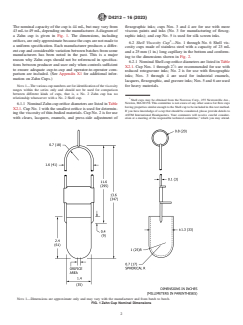
6.1 Zahn Viscosity Cup—No. 1 through No. 5 Zahn viscos-
Standards volume information, refer to the standard’s Document Summary page on
the ASTM website. ity cups made of corrosion- and solvent-resistant materials.
Copyright © ASTM International, 100 Barr Harbor Drive, PO Box C700, West Conshohocken, PA 19428-2959. United States
D4212 − 16 (2023)
The nominal capacity of the cup is 44 mL, but may vary from flexographic inks; cups Nos. 3 and 4 are for use with more
43 mL to 49 mL, depending on the manufacturer. A diagram of viscous paints and inks (No. 3 for manufacturing of flexog-
a Zahn cup is given in Fig. 1. The dimensions, including raphic inks); and cup No. 5 is used for silk screen inks.
orifices, are only approximate because the cups are not made to 3
6.2 Shell Viscosity Cup —No. 1 through No. 6 Shell vis-
a uniform specification. Each manufacturer produces a differ-
cosity cups made of stainless steel with a capacity of 23 mL
ent cup and considerable variation between batches from some
and a 25 mm (1 in.) long capillary in the bottom and conform-
manufacturers has been noted in the past. This is a major
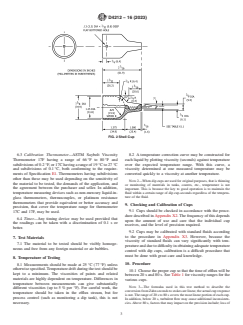
ing to the dimensions shown in Fig. 2.
reason why Zahn cups should not be referenced in specifica-
6.2.1 Nominal Shell cup orifice diameters are listed in Table
tions between producer and user only when controls sufficient
X2.1. Cup Nos. 1 through 2 ⁄2 are recommended for use with
to ensure adequate cup-to-cup and operator-to-operator com-
reduced rotogravure inks; No. 2 is for use with flexographic
parison are included. (See Appendix X1 for additional infor-
inks; Nos. 3 through 4 are used for industrial enamels,
mation on Zahn Cups.)
lacquers, flexographic, and gravure inks; Nos. 5 and 6 are used
for heavy materials.
NOTE 1—The various cup numbers are for identification of the viscosity
ranges within the series only and should not be used for comparison
between different kinds of cups, that is, a No. 2 Zahn cup has no
relationship whatsoever with a No. 2 Shell cup.
Shell cups may be obtained from the Norcross Corp., 255 Newtonville Ave.,
Newton, MA 02158. This committee is not aware of any other source for flow cups
6.1.1 Nominal Zahn cup orifice diameters are listed in Table
having properties similar enough to the Shell cup to be included in this test method.
X2.1. Cup No. 1 with the smallest orifice is used for determin-
If you have knowledge of a cup that should be considered, please provide details to
ing the viscosity of thin-bodied materials. Cup No. 2 is for use
ASTM International Headquarters. Your comments will receive careful consider-
with clears, lacquers, enamels, and press-side adjustment of ation at a meeting of the responsible technical committee, which you may attend.
NOTE 1—Dimensions are approximate only and may vary with the manufacturer and from batch to batch.
FIG. 1 Zahn Cup Nominal Dimensions
D4212 − 16 (2023)
FIG. 2 Shell Cup
6.3 Calibration Thermometer—ASTM Saybolt Viscosity 8.2 A temperature correction curve may be constructed for
Thermometer 17F having a range of 66 °F to 80 °F and each liquid by plotting viscosity (seconds) against temperature
subdivisions of 0.2 °F, or 17C having a range of 19 °C to 27 °C over the expected temperature range. With this curve, a
and subdivisions of 0.1 °C, both conforming to the require- viscosity determined at one measured temperature may be
ments of Specification E1. Thermometers having subdivisions converted quickly to a viscosity at another temperature.
other than these may be used depending on the sensitivity of
NOTE 2—When dip cups are used for original purposes, that is thinning
the material to be tested, the demands of the application, and
or monitoring of materials in tanks, coaters, etc., temperature is not
the agreement between the purchaser and seller. In addition,
important. This is because the key to good operation is to maintain the
fluid within a certain range of dip cup-seconds regardless of the tempera-
temperature measuring devices such as non-mercury liquid-in-
ture of the fluid.
glass thermometers, thermocouples, or platinum resistance
thermometers that provide equivalent or better accuracy and
9. Checking and Calibration of Cups
precision, that cover the temperature range for thermometer
9.1 Cups should be checked in accordance with the proce-
17C and 17F, may be used.
dure described in Appendix X2. The frequency of this depends
6.4 Timer—Any timing device may be used provided that
upon the amount of use and care that the individual cup
the readings can be taken with a discrimination of 0.1 s or
receives, and the level of precision required.
better.
9.2 Cups may be calibrated with standard fluids according
to the procedure in Appendix X3. However, because the
7. Test Materials
viscosity of standard fluids can vary significantly with tem-
7.1 The material to be tested should be visibly homoge-
perature and due to difficulty in obtaining adequate temperature
neous and free from any foreign material or air bubbles.
control with dip cups, calibration is a difficult procedure that
must be done with great care and knowledge.
8. Temperature of Testing
10. Procedure
8.1 Measurements should be made at 25 °C (77 °F) unless
otherwise specified. Temperature drift during the test should be
10.1 Choose the proper cup so that the time of efflux will be
kept to a minimum. The viscosities of paints and related
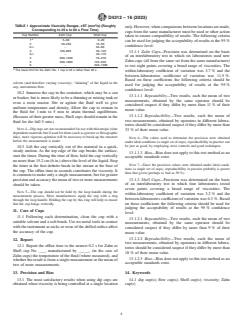
between 20 s and 80 s. See Table 1 for viscosity ranges for the
materials are highly dependent on temperature. Differences in
various cups.
temperature between measurements can give substantially
NOTE 3—The formulas used in this test method to describe the
different viscosities (up to 5 % per °F). For careful work, the
conversion from Zahn seconds to stokes are linear, the actual cup response
temperature should be taken in the efflux stream, but for
is not. The range of 20 s to 80 s covers the most linear portion of each cup.
process control (such as monitoring a dip tank), this is not
In addition, below 20 s, turbulent flow may cause additional inconsisten-
necessary. cies. Above 80 s, factors that may impact on the precision include; loss of
D4212 − 16 (2023)
TABLE 1 Approximate Viscosity Ranges, cST (mm /s) (Roughly
only. However, when comparisons between locations are made,
Corresponding to 20 s to 80 s Flow Time)
cups from the same manufacturer must be used or other action
Cup Number Zahn Cup Shell Cup
taken to ensure compatibility of results. The following criteria
A
1 5–60 2–20
can be used for judging the acceptability of results at the 95 %
2 20–250 10–50
confidence level:
2 ⁄2 . 20–80
3 100–800 30–120
13.1.1 Zahn Cups—Precision was determined on the basis
3 ⁄2 . 40–170
of an interlaboratory test in which six laboratories used new
4 200–1200 70–270
Zahn cups (all from the same set from the same manufacturer)
5 400–1800 125–520
6 . 320–1300
to test eight paints covering a broad range of viscosities. The
A
The lower limit for the Zahn No. 1 cup is 35 s rather than 20 s.
within-laboratory coefficient of variation was 3.7 % and the
between-laboratories coefficient of variation was 11.5 %.
Based on these coefficients the following criteria should be
solvent (and therefore varying viscosity), “skinning” of the liquid in
...