

ASTM A707/A707M-19
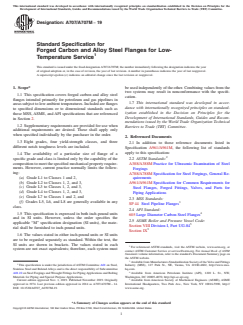
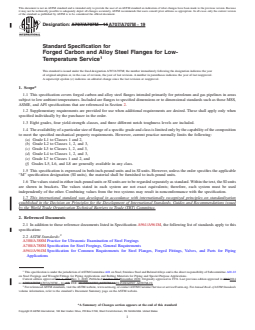
(Specification)Standard Specification for Forged Carbon and Alloy Steel Flanges for Low-Temperature Service
General Information
- Abstract
ABSTRACT
This specification covers forged carbon and alloy steel flanges intended primarily for petroleum and gas pipelines in areas subject to low ambient temperatures. Eight grades, four yield-strength classes, and three different notch toughness levels are included. All material shall be heat treated by annealing, normalizing, precipitation hardening, quenching-and-tempering, normalizing-and-tempering, normalizing-and-precipitation hardening, or quenching-and-precipitation hardening. A chemical heat analysis shall be made and conform to the requirements as to chemical composition specified. The material in the weld neck shall conform to the mechanical property requirements specified. Hardness test, impact test, ultrasonic test, tension test, and hydrostatic test shall be made to conform to the specified requirements.
SCOPE
1.1 This specification covers forged carbon and alloy steel flanges intended primarily for petroleum and gas pipelines in areas subject to low ambient temperatures. Included are flanges to specified dimensions or to dimensional standards such as those MSS, ASME, and API specifications that are referenced in Section 2.
1.2 Supplementary requirements are provided for use when additional requirements are desired. These shall apply only when specified individually by the purchaser in the order.
1.3 Eight grades, four yield-strength classes, and three different notch toughness levels are included.
1.4 The availability of a particular size of flange of a specific grade and class is limited only by the capability of the composition to meet the specified mechanical property requirements. However, current practice normally limits the following:
(a) Grade L1 to Classes 1 and 2,
(b) Grade L2 to Classes 1, 2, and 3,
(c) Grade L3 to Classes 1, 2, and 3,
(d) Grade L4 to Classes 1, 2, and 3,
(e) Grade L7 to Classes 1 and 2, and
(f) Grades L5, L6, and L8 are generally available in any class.
1.5 This specification is expressed in both inch-pound units and in SI units. However, unless the order specifies the applicable “M” specification designation (SI units), the material shall be furnished to inch-pound units.
1.6 The values stated in either inch-pound units or SI units are to be regarded separately as standard. Within the text, the SI units are shown in brackets. The values stated in each system are not exact equivalents; therefore, each system must be used independently of the other. Combining values from the two systems may result in nonconformance with the specification.
1.7 This international standard was developed in accordance with internationally recognized principles on standardization established in the Decision on Principles for the Development of International Standards, Guides and Recommendations issued by the World Trade Organization Technical Barriers to Trade (TBT) Committee.
- Status
- Published
- Publication Date
- 31-Oct-2019
- Technical Committee
- A01 - Steel, Stainless Steel and Related Alloys
Buy Documents
ASTM A707/A707M-19 - Standard Specification for Forged Carbon and Alloy Steel Flanges for Low-Temperature Service
REDLINE ASTM A707/A707M-19 - Standard Specification for Forged Carbon and Alloy Steel Flanges for Low-Temperature Service
Overview
ASTM A707/A707M-19 is the international standard specification developed by ASTM for forged carbon and alloy steel flanges specifically designed for low-temperature service. This standard addresses the mechanical and chemical requirements for flanges primarily used in petroleum and gas pipelines exposed to low ambient temperatures. Adherence to ASTM A707/A707M-19 ensures reliable performance in demanding environments where notch toughness and low-temperature ductility are critical, promoting both safety and durability in pipeline systems.
Key Topics
- Grades and Classes: The specification includes eight grades, each tailored for specific service conditions, along with four yield-strength classes and three different notch toughness levels. Availability of a particular grade-class combination is mainly based on the ability to meet mechanical property requirements.
- Heat Treatment: All materials must be subjected to appropriate heat treatments, such as annealing, normalizing, precipitation hardening, quenching-and-tempering, or combinations thereof, to ensure optimal mechanical properties.
- Mechanical and Chemical Properties: Detailed requirements for chemical composition and mechanical properties-including yield strength, tensile strength, elongation, reduction of area, hardness, and notch toughness-are established to guarantee consistent material performance.
- Testing Requirements: Flanges covered by ASTM A707/A707M-19 undergo rigorous testing:
- Hardness Tests
- Impact (Charpy V-notch) Tests
- Ultrasonic Examination (particularly for larger sizes)
- Tension and Hydrostatic Tests
- Dimensional Standards and Markings: Flanges are manufactured to either customer-specified dimensions or referenced dimensional standards like those from MSS, ASME, and API. Marking and certification protocols ensure traceability and compliance with design requirements.
- Supplementary Requirements: Optional provisions allow purchasers to specify additional requirements such as enhanced ultrasonic testing and additional mechanical or impact tests.
Applications
- Petroleum and Gas Pipelines: The primary use of ASTM A707/A707M-19 flanges is in oil and gas transportation pipelines that require reliable performance in low-temperature environments.
- Pressure-Containing Components: The specification supports the manufacture of pressure-containing parts where fracture toughness and resistance to brittle failure at low temperatures are essential.
- Cryogenic and Arctic Service: Grades capable of withstanding very low temperatures make these flanges ideal for use in arctic conditions and cryogenic processing facilities.
- Industrial and Process Piping: Any application demanding high notch toughness and mechanical reliability at sub-zero temperatures benefits from compliant flanges made per ASTM A707/A707M-19.
Practical benefits of using flanges as per this standard include:
- Enhanced safety and reliability in critical infrastructure
- Increased service longevity and resistance to low-temperature embrittlement
- Compliance with international procurement and operational standards
Related Standards
For full compliance and optimum integration into piping systems, consider referencing the following allied standards:
- ASTM A961/A961M – Common requirements for steel flanges, forged fittings, valves, and parts for piping applications
- ASTM A788/A788M – General requirements for steel forgings
- ASTM A388/A388M – Ultrasonic examination of steel forgings
- MSS SP 44 – Steel pipeline flanges
- API 605 – Large-diameter carbon steel flanges
- ASME B16.5 – Pipe flanges and flanged fittings
- ASME Boiler and Pressure Vessel Code (Section VIII, Section IX)
- AWS A5.5 – Welding electrodes for use in repair and fabrication
Implementing ASTM A707/A707M-19 helps ensure the resilience and safety of pipeline flanges under challenging low-temperature conditions, aligning with international best practices for material specification and performance.
Relations
- Effective Date
- 01-Nov-2019
- Effective Date
- 01-Nov-2023
- Effective Date
- 01-Nov-2019
- Effective Date
- 01-May-2019
- Effective Date
- 01-Nov-2018
- Effective Date
- 01-Sep-2018
- Effective Date
- 01-Mar-2018
- Effective Date
- 01-Nov-2017
- Effective Date
- 01-May-2017
- Effective Date
- 01-Dec-2016
- Effective Date
- 01-Jun-2016
- Effective Date
- 01-Nov-2015
- Effective Date
- 01-May-2015
- Effective Date
- 01-Nov-2014
- Effective Date
- 01-Oct-2014
Buy Documents
ASTM A707/A707M-19 - Standard Specification for Forged Carbon and Alloy Steel Flanges for Low-Temperature Service
REDLINE ASTM A707/A707M-19 - Standard Specification for Forged Carbon and Alloy Steel Flanges for Low-Temperature Service
Get Certified
Connect with accredited certification bodies for this standard

Institut za varilstvo d.o.o. (Welding Institute)
Slovenia's leading welding institute since 1952. ISO 3834, EN 1090, pressure equipment certification, NDT personnel, welder qualification. Only IIW Au
Sponsored listings
Frequently Asked Questions
ASTM A707/A707M-19 is a technical specification published by ASTM International. Its full title is "Standard Specification for Forged Carbon and Alloy Steel Flanges for Low-Temperature Service". This standard covers: ABSTRACT This specification covers forged carbon and alloy steel flanges intended primarily for petroleum and gas pipelines in areas subject to low ambient temperatures. Eight grades, four yield-strength classes, and three different notch toughness levels are included. All material shall be heat treated by annealing, normalizing, precipitation hardening, quenching-and-tempering, normalizing-and-tempering, normalizing-and-precipitation hardening, or quenching-and-precipitation hardening. A chemical heat analysis shall be made and conform to the requirements as to chemical composition specified. The material in the weld neck shall conform to the mechanical property requirements specified. Hardness test, impact test, ultrasonic test, tension test, and hydrostatic test shall be made to conform to the specified requirements. SCOPE 1.1 This specification covers forged carbon and alloy steel flanges intended primarily for petroleum and gas pipelines in areas subject to low ambient temperatures. Included are flanges to specified dimensions or to dimensional standards such as those MSS, ASME, and API specifications that are referenced in Section 2. 1.2 Supplementary requirements are provided for use when additional requirements are desired. These shall apply only when specified individually by the purchaser in the order. 1.3 Eight grades, four yield-strength classes, and three different notch toughness levels are included. 1.4 The availability of a particular size of flange of a specific grade and class is limited only by the capability of the composition to meet the specified mechanical property requirements. However, current practice normally limits the following: (a) Grade L1 to Classes 1 and 2, (b) Grade L2 to Classes 1, 2, and 3, (c) Grade L3 to Classes 1, 2, and 3, (d) Grade L4 to Classes 1, 2, and 3, (e) Grade L7 to Classes 1 and 2, and (f) Grades L5, L6, and L8 are generally available in any class. 1.5 This specification is expressed in both inch-pound units and in SI units. However, unless the order specifies the applicable “M” specification designation (SI units), the material shall be furnished to inch-pound units. 1.6 The values stated in either inch-pound units or SI units are to be regarded separately as standard. Within the text, the SI units are shown in brackets. The values stated in each system are not exact equivalents; therefore, each system must be used independently of the other. Combining values from the two systems may result in nonconformance with the specification. 1.7 This international standard was developed in accordance with internationally recognized principles on standardization established in the Decision on Principles for the Development of International Standards, Guides and Recommendations issued by the World Trade Organization Technical Barriers to Trade (TBT) Committee.
ABSTRACT This specification covers forged carbon and alloy steel flanges intended primarily for petroleum and gas pipelines in areas subject to low ambient temperatures. Eight grades, four yield-strength classes, and three different notch toughness levels are included. All material shall be heat treated by annealing, normalizing, precipitation hardening, quenching-and-tempering, normalizing-and-tempering, normalizing-and-precipitation hardening, or quenching-and-precipitation hardening. A chemical heat analysis shall be made and conform to the requirements as to chemical composition specified. The material in the weld neck shall conform to the mechanical property requirements specified. Hardness test, impact test, ultrasonic test, tension test, and hydrostatic test shall be made to conform to the specified requirements. SCOPE 1.1 This specification covers forged carbon and alloy steel flanges intended primarily for petroleum and gas pipelines in areas subject to low ambient temperatures. Included are flanges to specified dimensions or to dimensional standards such as those MSS, ASME, and API specifications that are referenced in Section 2. 1.2 Supplementary requirements are provided for use when additional requirements are desired. These shall apply only when specified individually by the purchaser in the order. 1.3 Eight grades, four yield-strength classes, and three different notch toughness levels are included. 1.4 The availability of a particular size of flange of a specific grade and class is limited only by the capability of the composition to meet the specified mechanical property requirements. However, current practice normally limits the following: (a) Grade L1 to Classes 1 and 2, (b) Grade L2 to Classes 1, 2, and 3, (c) Grade L3 to Classes 1, 2, and 3, (d) Grade L4 to Classes 1, 2, and 3, (e) Grade L7 to Classes 1 and 2, and (f) Grades L5, L6, and L8 are generally available in any class. 1.5 This specification is expressed in both inch-pound units and in SI units. However, unless the order specifies the applicable “M” specification designation (SI units), the material shall be furnished to inch-pound units. 1.6 The values stated in either inch-pound units or SI units are to be regarded separately as standard. Within the text, the SI units are shown in brackets. The values stated in each system are not exact equivalents; therefore, each system must be used independently of the other. Combining values from the two systems may result in nonconformance with the specification. 1.7 This international standard was developed in accordance with internationally recognized principles on standardization established in the Decision on Principles for the Development of International Standards, Guides and Recommendations issued by the World Trade Organization Technical Barriers to Trade (TBT) Committee.
ASTM A707/A707M-19 is classified under the following ICS (International Classification for Standards) categories: 23.040.60 - Flanges, couplings and joints. The ICS classification helps identify the subject area and facilitates finding related standards.
ASTM A707/A707M-19 has the following relationships with other standards: It is inter standard links to ASTM A707/A707M-14, ASTM A388/A388M-23, ASTM A961/A961M-19a, ASTM A788/A788M-19, ASTM A788/A788M-18b, ASTM A788/A788M-18a, ASTM A788/A788M-18, ASTM A788/A788M-17a, ASTM A788/A788M-17, ASTM A788/A788M-16a, ASTM A961/A961M-16, ASTM A961/A961M-15, ASTM A788/A788M-15, ASTM A961/A961M-14, ASTM A788/A788M-14a. Understanding these relationships helps ensure you are using the most current and applicable version of the standard.
ASTM A707/A707M-19 is available in PDF format for immediate download after purchase. The document can be added to your cart and obtained through the secure checkout process. Digital delivery ensures instant access to the complete standard document.
Standards Content (Sample)
This international standard was developed in accordance with internationally recognized principles on standardization established in the Decision on Principles for the
Development of International Standards, Guides and Recommendations issued by the World Trade Organization Technical Barriers to Trade (TBT) Committee.
Designation:A707/A707M −19
Standard Specification for
Forged Carbon and Alloy Steel Flanges for Low-
Temperature Service
This standard is issued under the fixed designationA707/A707M; the number immediately following the designation indicates the year
of original adoption or, in the case of revision, the year of last revision. A number in parentheses indicates the year of last reapproval.
A superscript epsilon (´) indicates an editorial change since the last revision or reapproval.
1. Scope* be used independently of the other. Combining values from the
two systems may result in nonconformance with the specifi-
1.1 This specification covers forged carbon and alloy steel
cation.
flanges intended primarily for petroleum and gas pipelines in
1.7 This international standard was developed in accor-
areassubjecttolowambienttemperatures.Includedareflanges
dance with internationally recognized principles on standard-
to specified dimensions or to dimensional standards such as
ization established in the Decision on Principles for the
those MSS, ASME, and API specifications that are referenced
Development of International Standards, Guides and Recom-
in Section 2.
mendations issued by the World Trade Organization Technical
1.2 Supplementary requirements are provided for use when
Barriers to Trade (TBT) Committee.
additional requirements are desired. These shall apply only
when specified individually by the purchaser in the order.
2. Referenced Documents
1.3 Eight grades, four yield-strength classes, and three
2.1 In addition to those reference documents listed in
different notch toughness levels are included.
Specification A961/A961M, the following list of standards
apply to this specification:
1.4 The availability of a particular size of flange of a
specific grade and class is limited only by the capability of the
2.2 ASTM Standards:
composition to meet the specified mechanical property require-
A388/A388M Practice for Ultrasonic Examination of Steel
ments. However, current practice normally limits the follow-
Forgings
ing:
A788/A788M Specification for Steel Forgings, General Re-
(a) Grade L1 to Classes 1 and 2,
quirements
(b) Grade L2 to Classes 1, 2, and 3,
A961/A961M Specification for Common Requirements for
(c) Grade L3 to Classes 1, 2, and 3,
Steel Flanges, Forged Fittings, Valves, and Parts for
(d) Grade L4 to Classes 1, 2, and 3,
Piping Applications
(e) Grade L7 to Classes 1 and 2, and
2.3 MSS Standards:
(f) Grades L5, L6, and L8 are generally available in any
SP 44 Steel Pipeline Flanges
class.
2.4 API Standard:
1.5 This specification is expressed in both inch-pound units
605 Large Diameter Carbon Steel Flanges
and in SI units. However, unless the order specifies the
2.5 ASME Boiler and Pressure Vessel Code:
applicable “M” specification designation (SI units), the mate-
Section VIII Division I, Part UG-84
rial shall be furnished to inch-pound units.
Section IX
1.6 The values stated in either inch-pound units or SI units
are to be regarded separately as standard. Within the text, the
SI units are shown in brackets. The values stated in each
For referenced ASTM standards, visit the ASTM website, www.astm.org, or
system are not exact equivalents; therefore, each system must
contact ASTM Customer Service at service@astm.org. For Annual Book of ASTM
Standards volume information, refer to the standard’s Document Summary page on
the ASTM website.
AvailablefromManufacturersStandardizationSocietyoftheValveandFittings
This specification is under the jurisdiction of ASTM Committee A01 on Steel, Industry (MSS), 127 Park St., NE, Vienna, VA 22180-4602, http://www.mss-
Stainless Steel and Related Alloys and is the direct responsibility of Subcommittee hq.com.
A01.22 on Steel Forgings and Wrought Fittings for PipingApplications and Bolting Available from American Petroleum Institute (API), 1220 L. St., NW,
Materials for Piping and Special Purpose Applications. Washington, DC 20005-4070, http://api-ec.api.org.
Current edition approved Nov. 1, 2019. Published November 2019. Originally Available from American Society of Mechanical Engineers (ASME), ASME
approved in 1974. Last previous edition approved in 2014 as A707/A707M – 14. International Headquarters, Two Park Ave., New York, NY 10016-5990, http://
DOI: 10.1520/A0707_A0707M-19. www.asme.org.
*A Summary of Changes section appears at the end of this standard
Copyright © ASTM International, 100 Barr Harbor Drive, PO Box C700, West Conshohocken, PA 19428-2959. United States
A707/A707M−19
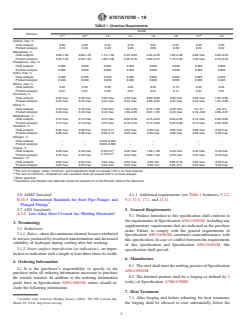
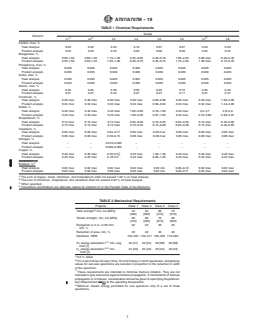
TABLE 1 Chemical Requirements
Grade
Element
A A B
L1 L2 L3 L4 L5 L6 L7 L8
Carbon, max, %
Heat analysis 0.20 0.30 0.22 0.18 0.07 0.07 0.20 0.20
Product analysis 0.23 0.33 0.25 0.20 0.09 0.09 0.22 0.22
Manganese, %
Heat analysis 0.60-1.50 0.60-1.35 1.15–1.50 0.45–0.65 0.40–0.70 1.85–2.20 0.90 max 0.20–0.40
Product analysis 0.55-1.60 0.55-1.45 1.05–1.60 0.40–0.70 0.35–0.75 1.75–2.30 1.00 max 0.15–0.45
Phosphorus, max, %
Heat analysis 0.030 0.030 0.025 0.025 0.025 0.025 0.025 0.020
Product analysis 0.035 0.035 0.030 0.030 0.030 0.030 0.030 0.025
Sulfur, max, %
Heat analysis 0.030 0.030 0.025 0.025 0.025 0.025 0.025 0.020
Product analysis 0.040 0.040 0.035 0.035 0.035 0.035 0.035 0.025
Silicon, max, %
Heat analysis 0.35 0.35 0.30 0.35 0.35 0.15 0.35 0.35
Product analysis 0.37 0.37 0.32 0.37 0.37 0.17 0.37 0.37
Chromium, %
Heat analysis 0.30 max 0.30 max 0.30 max 0.30 max 0.60–0.90 0.30 max 0.30 max 1.50–2.00
Product analysis 0.34 max 0.34 max 0.34 max 0.34 max 0.56–0.94 0.34 max 0.34 max 1.44–2.06
Nickel, %
Heat analysis 0.40 max 0.40 max 0.40 max 1.65–2.00 0.70–1.00 0.40 max 3.2–3.7 2.8–3.9
Product analysis 0.43 max 0.43 max 0.43 max 1.60–2.05 0.67–1.03 0.43 max 3.18–3.82 2.68–3.97
Molybdenum, %
Heat analysis 0.12 max 0.12 max 0.12 max 0.20–0.30 0.15–0.25 0.25–0.35 0.12 max 0.40–0.60
Product analysis 0.13 max 0.13 max 0.13 max 0.19–0.33 0.14–0.28 0.22–0.38 0.13 max 0.35–0.65
Vanadium, %
Heat analysis 0.05 max 0.05 max 0.04–0.11 0.05 max 0.05 max 0.05 max 0.05 max 0.05 max
Product analysis 0.06 max 0.06 max 0.03–0.13 0.06 max 0.06 max 0.06 max 0.06 max 0.06 max
Nitrogen, %
Heat analysis . . 0.010–0.030 . . . . .
Product analysis . . 0.005–0.035 . . . . .
Copper, %
C
Heat analysis 0.40 max 0.40 max 0.20 min 0.40 max 1.00–1.30 0.40 max 0.40 max 0.40 max
C
0.18 min
Product analysis 0.43 max 0.43 max 0.43 max 0.95–1.35 0.43 max 0.43 max 0.43 max
D
Niobium, %
Heat analysis 0.02 max 0.02 max 0.02 max 0.02 max 0.03 min 0.06–0.10 0.02 max 0.02 max
Product analysis 0.03 max 0.03 max 0.03 max 0.03 max 0.02 min 0.05–0.11 0.03 max 0.03 max
A
The sum of copper, nickel, chromium, and molybdenum shall not exceed 1.00 % on heat analysis.
B
The sum of chromium, molybdenum and vanadium shall not exceed 0.32 % on heat analysis.
C
When specified.
D
Columbium and Niobium are alternate names for element 41 in the Periodic Table of the Elements.
2.6 ASME Standard: 4.1.1 Additional requirements (see Table 1 footnotes, 9.2.2,
B 16.5 Dimensional Standards for Steel Pipe Flanges and 9.3, 11.5, 17.1, and 21.1).
Flanged Fittings
2.7 AWS Standards:
5. General Requirements
A 5.5 Low-Alloy Steel Covered Arc-Welding Electrodes
5.1 Product furnished to this specification shall conform to
the requirements of Specification A961/A961M, including any
3. Terminology
supplementary requirements that are indicated in the purchase
3.1 Definitions:
order. Failure to comply with the general requirements of
3.1.1 flakes—short discontinuous internal fissures attributed
Specification A961/A961M constitutes nonconformance with
to stresses produced by localized transformation and decreased
this specification. In case of conflict between the requirements
solubility of hydrogen during cooling after hot working.
of this specification and Specification A961/A961M, this
3.1.2 linear surface imperfection (or indication)—an imper-
specification shall prevail.
fection or indication with a length at least three times its width.
6. Manufacture
4. Ordering Information
6.1 ThesteelshallmeetthemeltingpracticeofSpecification
4.1 It is the purchaser’s responsibility to specify in the
A961/A961M.
purchase order all ordering information necessary to purchase
6.2 The finished product shall be a forging as defined by 3
the needed material. In addition to the ordering information
(only) of Specification A788/A788M.
guide lines in Specification A961/A961M, orders should in-
clude the following information:
7. Heat Treatment
7.1 After forging and before reheating for heat treatment,
Available from American Welding Society (AWS), 550 NW LeJeune Rd.,
Miami, FL 33126, http://www.aws.org. the forging shall be allowed to cool substantially below the
A707/A707M−19
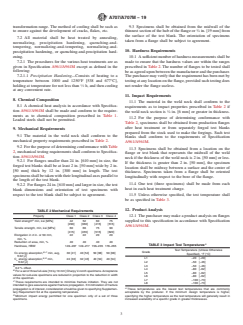
transformation range. The method of cooling shall be such as 9.3 Specimens shall be obtained from the midwall of the
to ensure against the development of cracks, flakes, etc. thinnest section of the hub of the flange or ⁄4 in. [19 mm] from
the surface of the test blank. The orientation of specimens
7.2 All material shall be heat treated by annealing,
taken from a flange shall be subject to agreement.
normalizing, precipitation hardening, quenching-and-
tempering, normalizing-and-tempering, normalizing-and-
10. Hardness Requirements
precipitation hardening, or quenching-and-precipitation hard-
ening.
10.1 Asufficient number of hardness measurements shall be
7.2.1 The procedures for the various heat treatments are as made to ensure that the hardness values are within the ranges
given in Specification A961/A961M except as defined in the
prescribed in Table 2. The number of flanges to be tested shall
following: be as agreed upon between the manufacturer and the purchaser.
7.2.1.1 Precipitation Hardening—Consists of heating to a
The purchaser may verify that the requirement has been met by
temperature between 1000 and 1250°F [538 and 677°C], testingatanylocationontheflange,providedsuchtestingdoes
holding at temperature for not less than ⁄2 h, and then cooling
not render the flange useless.
at any convenient rate.
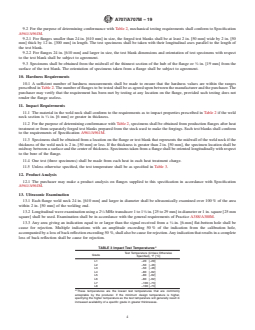
11. Impact Requirements
8. Chemical Composition
11.1 The material in the weld neck shall conform to the
8.1 A chemical heat analysis in accordance with Specifica-
requirements as to impact properties prescribed in Table 2 if
tion A961/A961M shall be made and conform to the require- 1
the weld neck section is ⁄4 in. [6 mm] or greater in thickness.
ments as to chemical composition prescribed in Table 1.
11.2 For the purpose of determining conformance with
Leaded steels shall not be permitted.
Table 2, specimens shall be obtained from production flanges
after heat treatment or from separately forged test blanks
9. Mechanical Requirements
prepared from the stock used to make the forgings. Such test
9.1 The material in the weld neck shall conform to the
blanks shall conform to the requirements of Specification
mechanical property requirements prescribed in Table 2.
A961/A961M.
9.2 For the purpose of determining conformance with Table
11.3 Specimens shall be obtained from a location on the
2, mechanical testing requirements shall conform to Specifica-
flange or test blank that represents the midwall of the weld
tion A961/A961M.
neck if the thickness of the weld neck is 2 in. [50 mm] or less.
9.2.1 For flanges smaller than 24 in. [610 mm] in size, the
If the thickness is greater than 2 in. [50 mm], the specimen
forged test blanks shall be at least 2 in. [50 mm] wide by 2 in.
location shall be midway between a surface and the center of
[50 mm] thick by 12 in. [300 mm] in length. The test
thickness. Specimens taken from a flange shall be oriented
specimensshallbetakenwiththeirlongitudinalaxesparallelto
longitudinally with respect to the bore of the flange.
the length of the test blank.
11.4 One test (three specimens) shall be made from
...
This document is not an ASTM standard and is intended only to provide the user of an ASTM standard an indication of what changes have been made to the previous version. Because
it may not be technically possible to adequately depict all changes accurately, ASTM recommends that users consult prior editions as appropriate. In all cases only the current version
of the standard as published by ASTM is to be considered the official document.
Designation: A707/A707M − 14 A707/A707M − 19
Standard Specification for
Forged Carbon and Alloy Steel Flanges for Low-
Temperature Service
This standard is issued under the fixed designation A707/A707M; the number immediately following the designation indicates the year
of original adoption or, in the case of revision, the year of last revision. A number in parentheses indicates the year of last reapproval.
A superscript epsilon (´) indicates an editorial change since the last revision or reapproval.
1. Scope*
1.1 This specification covers forged carbon and alloy steel flanges intended primarily for petroleum and gas pipelines in areas
subject to low ambient temperatures. Included are flanges to specified dimensions or to dimensional standards such as those MSS,
ASME, and API specifications that are referenced in Section 2.
1.2 Supplementary requirements are provided for use when additional requirements are desired. These shall apply only when
specified individually by the purchaser in the order.
1.3 Eight grades, four yield-strength classes, and three different notch toughness levels are included.
1.4 The availability of a particular size of flange of a specific grade and class is limited only by the capability of the composition
to meet the specified mechanical property requirements. However, current practice normally limits the following:
(a) Grade L1 to Classes 1 and 2,
(b) Grade L2 to Classes 1, 2, and 3,
(c) Grade L3 to Classes 1, 2, and 3,
(d) Grade L4 to Classes 1, 2, and 3,
(e) Grade L7 to Classes 1 and 2, and
(f) Grades L5, L6, and L8 are generally available in any class.
1.5 This specification is expressed in both inch-pound units and in SI units. However, unless the order specifies the applicable
“M” specification designation (SI units), the material shall be furnished to inch-pound units.
1.6 The values stated in either inch-pound units or SI units are to be regarded separately as standard. Within the text, the SI units
are shown in brackets. The values stated in each system are not exact equivalents; therefore, each system must be used
independently of the other. Combining values from the two systems may result in nonconformance with the specification.
1.7 This international standard was developed in accordance with internationally recognized principles on standardization
established in the Decision on Principles for the Development of International Standards, Guides and Recommendations issued
by the World Trade Organization Technical Barriers to Trade (TBT) Committee.
2. Referenced Documents
2.1 In addition to those reference documents listed in Specification A961/A961M, the following list of standards apply to this
specification:
2.2 ASTM Standards:
A388/A388M Practice for Ultrasonic Examination of Steel Forgings
A788/A788M Specification for Steel Forgings, General Requirements
A961/A961M Specification for Common Requirements for Steel Flanges, Forged Fittings, Valves, and Parts for Piping
Applications
This specification is under the jurisdiction of ASTM Committee A01 on Steel, Stainless Steel and Related Alloys and is the direct responsibility of Subcommittee A01.22
on Steel Forgings and Wrought Fittings for Piping Applications and Bolting Materials for Piping and Special Purpose Applications.
Current edition approved Oct. 1, 2014Nov. 1, 2019. Published October 2014November 2019. Originally approved in 1974. Last previous edition approved in 20132014
as A707/A707MA707/A707M – 14.–13. DOI: 10.1520/A0707_A0707M-14.10.1520/A0707_A0707M-19.
For referenced ASTM standards, visit the ASTM website, www.astm.org, or contact ASTM Customer Service at service@astm.org. For Annual Book of ASTM Standards
volume information, refer to the standard’s Document Summary page on the ASTM website.
*A Summary of Changes section appears at the end of this standard
Copyright © ASTM International, 100 Barr Harbor Drive, PO Box C700, West Conshohocken, PA 19428-2959. United States
A707/A707M − 19
2.3 MSS Standards:
SP 44 Steel Pipeline Flanges
2.4 API Standard:
605 Large Diameter Carbon Steel Flanges
2.5 ASME Boiler and Pressure Vessel Code:
Section VIII Division I, Part UG-84
Section IX
2.6 ASME Standard:
B 16.5 Dimensional Standards for Steel Pipe Flanges and Flanged Fittings
2.7 AWS Standards:
A 5.5 Low-Alloy Steel Covered Arc-Welding Electrodes
3. Terminology
3.1 Definitions:
3.1.1 flakes—short discontinuous internal fissures attributed to stresses produced by localized transformation and decreased
solubility of hydrogen during cooling after hot working.
3.1.2 linear surface imperfection (or indication)—an imperfection or indication with a length at least three times its width.
4. Ordering Information
4.1 It is the purchaser’s responsibility to specify in the purchase order all ordering information necessary to purchase the needed
material. In addition to the ordering information guide lines in Specification A961/A961M, orders should include the following
information:
4.1.1 Additional requirements (see Table 1 footnotes, 9.2.2, 9.3, 11.5, 17.1, and 21.1).
5. General Requirements
5.1 Product furnished to this specification shall conform to the requirements of Specification A961/A961M, including any
supplementary requirements that are indicated in the purchase order. Failure to comply with the general requirements of
Specification A961/A961M constitutes nonconformance with this specification. In case of conflict between the requirements of this
specification and Specification A961/A961M, this specification shall prevail.
6. Manufacture
6.1 The steel shall meet the melting practice of Specification A961/A961M.
6.2 The finished product shall be a forging as defined by 3 (only) of Specification A788/A788M.
7. Heat Treatment
7.1 After forging and before reheating for heat treatment, the forging shall be allowed to cool substantially below the
transformation range. The method of cooling shall be such as to ensure against the development of cracks, flakes, etc.
7.2 All material shall be heat treated by annealing, normalizing, precipitation hardening, quenching-and-tempering,
normalizing-and-tempering, normalizing-and-precipitation hardening, or quenching-and-precipitation hardening.
7.2.1 The procedures for the various heat treatments are as given in Specification A961/A961M except as defined in the
following:
7.2.1.1 Precipitation Hardening—Consists of heating to a temperature between 1000 and 1250°F [538 and 677°C], holding at
temperature for not less than ⁄2 h, and then cooling at any convenient rate.
8. Chemical Composition
8.1 A chemical heat analysis in accordance with Specification A961/A961M shall be made and conform to the requirements as
to chemical composition prescribed in Table 1. Leaded steels shall not be permitted.
9. Mechanical Requirements
9.1 The material in the weld neck shall conform to the mechanical property requirements prescribed in Table 2.
Available from Manufacturers Standardization Society of the Valve and Fittings Industry (MSS), 127 Park St., NE, Vienna, VA 22180-4602, http://www.mss-hq.com.
Available from American Petroleum Institute (API), 1220 L. St., NW, Washington, DC 20005-4070, http://api-ec.api.org.
Available from American Society of Mechanical Engineers (ASME), ASME International Headquarters, Two Park Ave., New York, NY 10016-5990, http://
www.asme.org.
Available from American Welding Society (AWS), 550 NW LeJeune Rd., Miami, FL 33126, http://www.aws.org.
A707/A707M − 19
TABLE 1 Chemical Requirements
Grade
Element
A A B
L1 L2 L3 L4 L5 L6 L7 L8
Carbon, max, %
Heat analysis 0.20 0.30 0.22 0.18 0.07 0.07 0.20 0.20
Product analysis 0.23 0.33 0.25 0.20 0.09 0.09 0.22 0.22
Manganese, %
Heat analysis 0.60-1.50 0.60-1.35 1.15–1.50 0.45–0.65 0.40–0.70 1.85–2.20 0.90 max 0.20–0.40
Product analysis 0.55-1.60 0.55-1.45 1.05–1.60 0.40–0.70 0.35–0.75 1.75–2.30 1.00 max 0.15–0.45
Phosphorus, max, %
Heat analysis 0.030 0.030 0.025 0.025 0.025 0.025 0.025 0.020
Product analysis 0.035 0.035 0.030 0.030 0.030 0.030 0.030 0.025
Sulfur, max, %
Heat analysis 0.030 0.030 0.025 0.025 0.025 0.025 0.025 0.020
Product analysis 0.040 0.040 0.035 0.035 0.035 0.035 0.035 0.025
Silicon, max, %
Heat analysis 0.35 0.35 0.30 0.35 0.35 0.15 0.35 0.35
Product analysis 0.37 0.37 0.32 0.37 0.37 0.17 0.37 0.37
Chromium, %
Heat analysis 0.30 max 0.30 max 0.30 max 0.30 max 0.60–0.90 0.30 max 0.30 max 1.50–2.00
Product analysis 0.34 max 0.34 max 0.34 max 0.34 max 0.56–0.94 0.34 max 0.34 max 1.44–2.06
Nickel, %
Heat analysis 0.40 max 0.40 max 0.40 max 1.65–2.00 0.70–1.00 0.40 max 3.2–3.7 2.8–3.9
Product analysis 0.43 max 0.43 max 0.43 max 1.60–2.05 0.67–1.03 0.43 max 3.18–3.82 2.68–3.97
Molybdenum, %
Heat analysis 0.12 max 0.12 max 0.12 max 0.20–0.30 0.15–0.25 0.25–0.35 0.12 max 0.40–0.60
Product analysis 0.13 max 0.13 max 0.13 max 0.19–0.33 0.14–0.28 0.22–0.38 0.13 max 0.35–0.65
Vanadium, %
Heat analysis 0.05 max 0.05 max 0.04–0.11 0.05 max 0.05 max 0.05 max 0.05 max 0.05 max
Product analysis 0.06 max 0.06 max 0.03–0.13 0.06 max 0.06 max 0.06 max 0.06 max 0.06 max
Nitrogen, %
Heat analysis . . 0.010–0.030 . . . . .
Product analysis . . 0.005–0.035 . . . . .
Copper, %
C
Heat analysis 0.40 max 0.40 max 0.20 min 0.40 max 1.00–1.30 0.40 max 0.40 max 0.40 max
C
0.18 min
Product analysis 0.43 max 0.43 max 0.43 max 0.95–1.35 0.43 max 0.43 max 0.43 max
Columbium, %
D
Niobium, %
Heat analysis 0.02 max 0.02 max 0.02 max 0.02 max 0.03 min 0.06–0.10 0.02 max 0.02 max
Product analysis 0.03 max 0.03 max 0.03 max 0.03 max 0.02 min 0.05–0.11 0.03 max 0.03 max
A
The sum of copper, nickel, chromium, and molybdenum shall not exceed 1.00 % on heat analysis.
B
The sum of chromium, molybdenum and vanadium shall not exceed 0.32 % on heat analysis.
C
When specified.
D
Columbium and Niobium are alternate names for element 41 in the Periodic Table of the Elements.
TABLE 2 Mechanical Requirements
Property Class 1 Class 2 Class 3 Class 4
A
Yield strength min, ksi [MPa] 42 52 60 75
[290] [360] [415] [515]
Tensile strength, min, ksi [MPa] 60 66 75 90
[415] [455] [515] [620]
Elongation in 2 in. or 50 mm, 22 22 20 20
min, %
Reduction of area, min, % 40 40 40 40
Hardness, HBW 149–207 149–217 156–235 179–265
B,C
Cv energy absorption, min, avg, 30 [41] 40 [54] 50 [68] 50 [68]
ft·lbf [J]
B,D
C energy absorption, min, 24 [33] 32 [43] 40 [54] 40 [54]
v
ft·lbf [J]
A
0.2 % offset.
B
For a set of three full-size [10 by 10 mm] Charpy V-notch specimens. Acceptance
values for sub-size specimens are reduced in proportion to the reduction in width
of the specimen.
C
These requirements are intended to minimize fracture initiation. They are not
intended to give assurance against fracture propagation. If minimization of fracture
propagation is of interest, consideration should be given to specifying Supplemen-
tary Requirement S7S4 at the operating temperature.
D
Minimum impact energy permitted for one specimen only of a set of three
specimens.
A707/A707M − 19
9.2 For the purpose of determining conformance with Table 2, mechanical testing requirements shall conform to Specification
A961/A961M.
9.2.1 For flanges smaller than 24 in. [610 mm] in size, the forged test blanks shall be at least 2 in. [50 mm] wide by 2 in. [50
mm] thick by 12 in. [300 mm] in length. The test specimens shall be taken with their longitudinal axes parallel to the length of
the test blank.
9.2.2 For flanges 24 in. [610 mm] and larger in size, the test blank dimensions and orientation of test specimens with respect
to the test blank shall be subject to agreement.
9.3 Specimens shall be obtained from the midwall of the thinnest section of the hub of the flange or ⁄4 in. [19 mm] from the
surface of the test blank. The orientation of specimens taken from a flange shall be subject to agreement.
10. Hardness Requirements
10.1 A sufficient number of hardness measurements shall be made to ensure that the hardness values are within the ranges
prescribed in Table 2. The number of flanges to b
...