

ASTM B783-19
(Specification)Standard Specification for Materials for Ferrous Powder Metallurgy (PM) Structural Parts
General Information
- Abstract
ABSTRACT
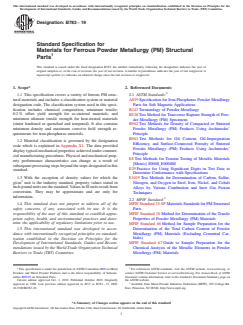
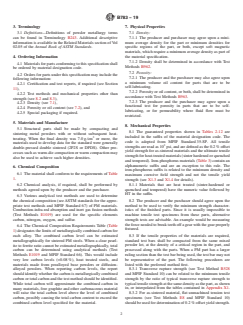
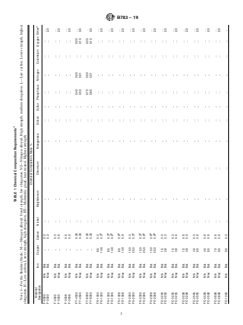
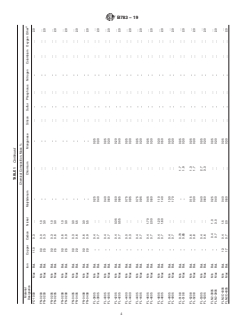
This specification covers a variety of ferrous powder metallurgy structural materials and includes a classification system or material designation code. The classification system includes chemical composition, minimum offset yield strength for as-sintered materials, minimum ultimate tensile strength for heat-treated materials (sinter hardened or quenched and tempered), minimum density, and maximum coercive field strength requirements for iron-phosphorus materials. Structural parts shall be made by pressing and sintering metal powders with or without subsequent heat treatment. Parts may also be made by repressing or repressing and resintering sintered parts, if necessary, with or without subsequent heat treatment to produce finished parts conforming to the requirements of this specification. The material shall conform to the chemical composition requirements for iron, copper, carbon, nickel, molybdenum, chromium, manganese, silicon, sulfur, phosphorus, nitrogen, columbium, and oxygen. The material shall be subjected to chemical analysis and mechanical tests.
SCOPE
1.1 This specification covers a variety of ferrous PM structural materials and includes a classification system or material designation code. The classification system used in this specification includes chemical composition, minimum tensile; 0.2 % offset yield strength for as-sintered materials; and minimum ultimate tensile strength for heat-treated materials (sinter hardened or quenched and tempered). It also contains minimum density and maximum coercive field strength requirements for iron-phosphorus materials.
1.2 Material classification is governed by the designation code which is explained in Appendix X1. The data provided display typical mechanical properties achieved under commercial manufacturing procedures. Physical and mechanical property performance characteristics can change as a result of subsequent processing steps beyond the steps designated in this standard.
1.3 With the exception of density values for which the g/cm3 unit is the industry standard, property values stated in inch-pound units are the standard. Values in SI units result from conversion. They may be approximate and are only for information.
1.4 This standard does not purport to address all of the safety concerns, if any, associated with its use. It is the responsibility of the user of this standard to establish appropriate safety, health, and environmental practices and determine the applicability of regulatory limitations prior to use.
1.5 This international standard was developed in accordance with internationally recognized principles on standardization established in the Decision on Principles for the Development of International Standards, Guides and Recommendations issued by the World Trade Organization Technical Barriers to Trade (TBT) Committee.
- Status
- Published
- Publication Date
- 30-Sep-2019
- Technical Committee
- B09 - Metal Powders and Metal Powder Products
- Drafting Committee
- B09.05 - Structural Parts
Buy Documents
ASTM B783-19 - Standard Specification for Materials for Ferrous Powder Metallurgy (PM) Structural Parts
REDLINE ASTM B783-19 - Standard Specification for Materials for Ferrous Powder Metallurgy (PM) Structural Parts
Overview
ASTM B783-19 establishes the requirements for materials used in ferrous powder metallurgy (PM) structural parts. Published by ASTM International, this standard provides a comprehensive classification system and material designation code based on chemical composition and mechanical properties. It is widely recognized in the PM industry for ensuring consistent quality and performance of structural parts made by pressing and sintering metal powders.
This specification is essential for manufacturers, suppliers, and end-users involved in the production or procurement of ferrous PM components. It covers various classes of materials, including iron, iron alloys, steels, and stainless steels, enabling the selection of the appropriate material for diverse structural applications.
Key Topics
Material Classification System
ASTM B783-19 introduces a coding system that uniquely identifies each PM material by its chemical composition, strength level, and processing condition. The code helps streamline ordering, production, and quality control.Chemical Composition Requirements
The standard specifies limits for key elements, including iron, copper, carbon, nickel, molybdenum, chromium, manganese, silicon, sulfur, phosphorus, nitrogen, columbium, and oxygen.Mechanical Properties
- As-Sintered Materials: Minimum 0.2% offset yield strength values.
- Heat-Treated Materials: Minimum ultimate tensile strength for sinter-hardened or quenched and tempered conditions.
- Iron-Phosphorus Materials: Minimum density and maximum coercive field strength requirements for magnetic applications.
Manufacturing Processes
PM structural parts covered under this standard may be produced by:- Pressing and sintering of metal powders.
- Optional heat treatment (sinter hardening, quenching, and tempering).
- Additional optional steps, such as repressing, resintering, and further heat treatments.
Testing and Inspection
Chemical analysis and mechanical testing (such as tensile and density tests) are required to verify that materials conform to specified requirements. The methods of testing and number of samples should be mutually agreed upon by producers and purchasers.
Applications
ASTM B783-19 is widely referenced in industries utilizing ferrous powder metallurgy structural parts, such as:
- Automotive Components: Gears, bearings, bushings, and pulley systems benefit from the precision and material uniformity specified in this standard.
- Industrial Machinery: Structural components, fasteners, and couplings produced via PM for high consistency and strength.
- Consumer Goods: Appliances and tools with intricate metal parts made more efficiently by PM processes.
- Magnetic Applications: Iron-phosphorus materials specified in ASTM B783-19 are used in components requiring defined magnetic properties, such as solenoids and relays.
Related Standards
- ASTM A839 - Specification for Iron-Phosphorus Powder Metallurgy Parts for Soft Magnetic Applications.
- ASTM B243 - Terminology of Powder Metallurgy.
- ASTM B528 - Test Method for Transverse Rupture Strength of PM Specimens.
- ASTM B962 - Test Methods for Density of Compacted or Sintered PM Products.
- MPIF Standard 35 - Materials Standards for PM Structural Parts.
- MPIF Standard 10 - Method for Determination of Tensile Properties of PM Materials.
- ASTM E8 - Test Methods for Tension Testing of Metallic Materials.
Practical Value
By adhering to the guidelines and requirements of ASTM B783-19, organizations can:
- Ensure reliable mechanical strength and desired chemical composition in ferrous PM parts.
- Streamline material selection and ordering processes using standardized designation codes.
- Facilitate compliance with quality assurance and regulatory expectations.
- Enhance the performance and service life of PM structural parts across various demanding applications.
For manufacturers and buyers, ASTM B783-19 is an indispensable standard that underpins material reliability, industry credibility, and global competitiveness in the field of powder metallurgy.
Relations
- Effective Date
- 01-Oct-2019
- Effective Date
- 01-Feb-2024
- Effective Date
- 01-Oct-2018
- Effective Date
- 01-Jul-2016
- Effective Date
- 01-Apr-2015
- Effective Date
- 01-Sep-2014
- Effective Date
- 01-Sep-2014
- Effective Date
- 01-Nov-2013
- Effective Date
- 01-Apr-2013
- Effective Date
- 01-Apr-2013
- Effective Date
- 01-Nov-2012
- Effective Date
- 15-Jul-2012
- Effective Date
- 15-Nov-2011
- Effective Date
- 01-May-2011
- Effective Date
- 15-Mar-2011
Buy Documents
ASTM B783-19 - Standard Specification for Materials for Ferrous Powder Metallurgy (PM) Structural Parts
REDLINE ASTM B783-19 - Standard Specification for Materials for Ferrous Powder Metallurgy (PM) Structural Parts
Get Certified
Connect with accredited certification bodies for this standard

Element Materials Technology
Materials testing and product certification.

Inštitut za kovinske materiale in tehnologije
Institute of Metals and Technology. Materials testing, metallurgical analysis, NDT.
Sponsored listings
Frequently Asked Questions
ASTM B783-19 is a technical specification published by ASTM International. Its full title is "Standard Specification for Materials for Ferrous Powder Metallurgy (PM) Structural Parts". This standard covers: ABSTRACT This specification covers a variety of ferrous powder metallurgy structural materials and includes a classification system or material designation code. The classification system includes chemical composition, minimum offset yield strength for as-sintered materials, minimum ultimate tensile strength for heat-treated materials (sinter hardened or quenched and tempered), minimum density, and maximum coercive field strength requirements for iron-phosphorus materials. Structural parts shall be made by pressing and sintering metal powders with or without subsequent heat treatment. Parts may also be made by repressing or repressing and resintering sintered parts, if necessary, with or without subsequent heat treatment to produce finished parts conforming to the requirements of this specification. The material shall conform to the chemical composition requirements for iron, copper, carbon, nickel, molybdenum, chromium, manganese, silicon, sulfur, phosphorus, nitrogen, columbium, and oxygen. The material shall be subjected to chemical analysis and mechanical tests. SCOPE 1.1 This specification covers a variety of ferrous PM structural materials and includes a classification system or material designation code. The classification system used in this specification includes chemical composition, minimum tensile; 0.2 % offset yield strength for as-sintered materials; and minimum ultimate tensile strength for heat-treated materials (sinter hardened or quenched and tempered). It also contains minimum density and maximum coercive field strength requirements for iron-phosphorus materials. 1.2 Material classification is governed by the designation code which is explained in Appendix X1. The data provided display typical mechanical properties achieved under commercial manufacturing procedures. Physical and mechanical property performance characteristics can change as a result of subsequent processing steps beyond the steps designated in this standard. 1.3 With the exception of density values for which the g/cm3 unit is the industry standard, property values stated in inch-pound units are the standard. Values in SI units result from conversion. They may be approximate and are only for information. 1.4 This standard does not purport to address all of the safety concerns, if any, associated with its use. It is the responsibility of the user of this standard to establish appropriate safety, health, and environmental practices and determine the applicability of regulatory limitations prior to use. 1.5 This international standard was developed in accordance with internationally recognized principles on standardization established in the Decision on Principles for the Development of International Standards, Guides and Recommendations issued by the World Trade Organization Technical Barriers to Trade (TBT) Committee.
ABSTRACT This specification covers a variety of ferrous powder metallurgy structural materials and includes a classification system or material designation code. The classification system includes chemical composition, minimum offset yield strength for as-sintered materials, minimum ultimate tensile strength for heat-treated materials (sinter hardened or quenched and tempered), minimum density, and maximum coercive field strength requirements for iron-phosphorus materials. Structural parts shall be made by pressing and sintering metal powders with or without subsequent heat treatment. Parts may also be made by repressing or repressing and resintering sintered parts, if necessary, with or without subsequent heat treatment to produce finished parts conforming to the requirements of this specification. The material shall conform to the chemical composition requirements for iron, copper, carbon, nickel, molybdenum, chromium, manganese, silicon, sulfur, phosphorus, nitrogen, columbium, and oxygen. The material shall be subjected to chemical analysis and mechanical tests. SCOPE 1.1 This specification covers a variety of ferrous PM structural materials and includes a classification system or material designation code. The classification system used in this specification includes chemical composition, minimum tensile; 0.2 % offset yield strength for as-sintered materials; and minimum ultimate tensile strength for heat-treated materials (sinter hardened or quenched and tempered). It also contains minimum density and maximum coercive field strength requirements for iron-phosphorus materials. 1.2 Material classification is governed by the designation code which is explained in Appendix X1. The data provided display typical mechanical properties achieved under commercial manufacturing procedures. Physical and mechanical property performance characteristics can change as a result of subsequent processing steps beyond the steps designated in this standard. 1.3 With the exception of density values for which the g/cm3 unit is the industry standard, property values stated in inch-pound units are the standard. Values in SI units result from conversion. They may be approximate and are only for information. 1.4 This standard does not purport to address all of the safety concerns, if any, associated with its use. It is the responsibility of the user of this standard to establish appropriate safety, health, and environmental practices and determine the applicability of regulatory limitations prior to use. 1.5 This international standard was developed in accordance with internationally recognized principles on standardization established in the Decision on Principles for the Development of International Standards, Guides and Recommendations issued by the World Trade Organization Technical Barriers to Trade (TBT) Committee.
ASTM B783-19 is classified under the following ICS (International Classification for Standards) categories: 77.160 - Powder metallurgy. The ICS classification helps identify the subject area and facilitates finding related standards.
ASTM B783-19 has the following relationships with other standards: It is inter standard links to ASTM B783-13, ASTM B963-24, ASTM B243-18, ASTM B243-16, ASTM B962-15, ASTM B963-14, ASTM B962-14, ASTM B243-13, ASTM B963-13, ASTM B962-13, ASTM B528-12, ASTM B243-12, ASTM B243-11, ASTM B963-11, ASTM E1019-11. Understanding these relationships helps ensure you are using the most current and applicable version of the standard.
ASTM B783-19 is available in PDF format for immediate download after purchase. The document can be added to your cart and obtained through the secure checkout process. Digital delivery ensures instant access to the complete standard document.
Standards Content (Sample)
This international standard was developed in accordance with internationally recognized principles on standardization established in the Decision on Principles for the
Development of International Standards, Guides and Recommendations issued by the World Trade Organization Technical Barriers to Trade (TBT) Committee.
Designation:B783 −19
Standard Specification for
Materials for Ferrous Powder Metallurgy (PM) Structural
Parts
This standard is issued under the fixed designation B783; the number immediately following the designation indicates the year of
original adoption or, in the case of revision, the year of last revision.Anumber in parentheses indicates the year of last reapproval.A
superscript epsilon (´) indicates an editorial change since the last revision or reapproval.
1. Scope* 2. Referenced Documents
1.1 This specification covers a variety of ferrous PM struc- 2.1 ASTM Standards:
tural materials and includes a classification system or material
A839Specification for Iron-Phosphorus Powder Metallurgy
designation code. The classification system used in this speci- Parts for Soft Magnetic Applications
fication includes chemical composition, minimum tensile; B243Terminology of Powder Metallurgy
0.2% offset yield strength for as-sintered materials; and
B528Test Method for Transverse Rupture Strength of Pow-
minimum ultimate tensile strength for heat-treated materials
der Metallurgy (PM) Specimens
(sinter hardened or quenched and tempered). It also contains B962Test Methods for Density of Compacted or Sintered
minimum density and maximum coercive field strength re-
Powder Metallurgy (PM) Products Using Archimedes’
quirements for iron-phosphorus materials.
Principle
B963 Test Methods for Oil Content, Oil-Impregnation
1.2 Material classification is governed by the designation
Efficiency, and Surface-Connected Porosity of Sintered
code which is explained in Appendix X1. The data provided
Powder Metallurgy (PM) Products Using Archimedes’
display typical mechanical properties achieved under commer-
Principle
cial manufacturing procedures. Physical and mechanical prop-
E8Test Methods for Tension Testing of Metallic Materials
erty performance characteristics can change as a result of
[Metric] E0008_E0008M
subsequentprocessingstepsbeyondthestepsdesignatedinthis
E29Practice for Using Significant Digits in Test Data to
standard.
Determine Conformance with Specifications
1.3 With the exception of density values for which the
E1019Test Methods for Determination of Carbon, Sulfur,
g/cm unit is the industry standard, property values stated in
Nitrogen, and Oxygen in Steel, Iron, Nickel, and Cobalt
inch-poundunitsarethestandard.ValuesinSIunitsresultfrom
Alloys by Various Combustion and Inert Gas Fusion
conversion. They may be approximate and are only for
Techniques
information.
2.2 MPIF Standard:
1.4 This standard does not purport to address all of the
MPIFStandard35-SPMaterialsStandardsforPMStructural
safety concerns, if any, associated with its use. It is the
Parts
responsibility of the user of this standard to establish appro-
MPIF Standard 10Method for Determination of the Tensile
priate safety, health, and environmental practices and deter-
Properties of Powder Metallurgy (PM) Materials
mine the applicability of regulatory limitations prior to use.
MPIF Standard 66Method for Sample Preparation for the
Determination of the Total Carbon Content of Powder
1.5 This international standard was developed in accor-
dance with internationally recognized principles on standard- Metallurgy (PM) Materials (Excluding Cemented Car-
bides)
ization established in the Decision on Principles for the
Development of International Standards, Guides and Recom- MPIF Standard 67Guide to Sample Preparation for the
mendations issued by the World Trade Organization Technical Chemical Analysis of the Metallic Elements in Powder
Barriers to Trade (TBT) Committee. Metallurgy (PM) Materials
1 2
This specification is under the jurisdiction ofASTM Committee B09 on Metal For referenced ASTM standards, visit the ASTM website, www.astm.org, or
Powders and Metal Powder Products and is the direct responsibility of Subcom- contact ASTM Customer Service at service@astm.org. For Annual Book of ASTM
mittee B09.05 on Structural Parts. Standards volume information, refer to the standard’s Document Summary page on
Current edition approved Oct. 1, 2019. Published October 2019. Originally the ASTM website.
approved in 1988. Last previous edition approved in 2013 as B783–13. DOI: Available from Metal Powder Industries Federation (MPIF), 105 College Rd.
10.1520/B0783-19. East, Princeton, NJ 08540, http://www.mpif.org.
*A Summary of Changes section appears at the end of this standard
Copyright © ASTM International, 100 Barr Harbor Drive, PO Box C700, West Conshohocken, PA 19428-2959. United States
B783−19
3. Terminology 7. Physical Properties
3.1 Definitions—Definitions of powder metallurgy terms 7.1 Density:
can be found in Terminology B243. Additional descriptive 7.1.1 The producer and purchaser may agree upon a mini-
information is available in the Related Materials section ofVol mum average density for the part or minimum densities for
02.05 of the Annual Book of ASTM Standards. specific regions of the part, or both, except soft magnetic
materials, which require a minimum average density as part of
4. Ordering Information the material specification.
7.1.2 Density shall be determined in accordance with Test
4.1 Materialsforpartsconformingtothisspecificationshall
Methods B962.
be ordered by material designation code.
7.2 Porosity:
4.2 Ordersforpartsunderthisspecificationmayincludethe
7.2.1 The producer and the purchaser may also agree upon
following information:
a minimum volume oil content for parts that are to be
4.2.1 Certification and test reports, if required (see Section
self-lubricating.
11),
7.2.2 Porosity or oil content, or both, shall be determined in
4.2.2 Test methods and mechanical properties other than
accordance with Test Methods B963.
strength (see 8.2 and 8.3),
7.2.3 The producer and the purchaser may agree upon a
4.2.3 Density (see 7.1),
functional test for porosity in parts that are to be self-
4.2.4 Porosity or oil content (see 7.2), and
lubricating, or for permeability where fluid flow must be
4.2.5 Special packaging if required.
restricted.
5. Materials and Manufacture
8. Mechanical Properties
5.1 Structural parts shall be made by compacting and
8.1 The guaranteed properties shown in Tables 2-12 are
sintering metal powders with or without subsequent heat-
3 included in the suffix of the material designation code. The
treating. When the final density was 7.0g⁄cm or more, the
code is adopted from MPIF Standard35-SP. All tensile
materials used to develop data for the standard were generally
strengthsarereadas10 psi,andaredefinedasthe0.2%offset
double-pressed double sintered (2P2S or DPDS). Other pro-
yield strength for as-sintered materials and the ultimate tensile
cessessuchaswarm-diecompactionorwarmcompactionmay
strengthforheat-treatedmaterials(sinterhardenedorquenched
also be used to achieve such higher densities.
and tempered). Iron-phosphorus materials (Table 3) contain an
alphanumeric suffix and are an exception to this rule. The
6. Chemical Composition
iron-phosphorus suffix is related to the minimum density and
6.1 The material shall conform to the requirements of Table
maximum coercive field strength and not the tensile yield
1.
strength (see X1.3 and X1.4 for details).
8.1.1 Materials that are heat treated (sinter-hardened or
6.2 Chemical analysis, if required, shall be performed by
methods agreed upon by the producer and the purchaser. quenched and tempered) have the numeric value followed by
HT in the suffix.
6.3 Various analytical test methods are used to determine
the chemical composition (seeASTM standards for the appro- 8.2 The producer and the purchaser should agree upon the
method to be used to verify the minimum strength character-
priate test methods and MPIF Standard 67) of PM materials.
Combustion-infra-red absorption and inert gas fusion methods istics of the finished parts. Since it is usually impossible to
machine tensile test specimens from these parts, alternative
(Test Methods E1019) are used for the specific elements
carbon, nitrogen, oxygen, and sulfur. strength tests are advisable. An example would be measuring
theforceneededtobreakteethoffagearwiththegearproperly
6.4 The Chemical Composition Requirements Table (Table
fixtured.
1)designatesthelimitsofmetallurgicallycombinedcarbonfor
each alloy. The combined carbon level can be estimated 8.3 If the tensile properties of the materials are required,
metallographically for sintered PM steels. When a clear pearl- standard test bars shall be compacted from the same mixed
ite to ferrite ratio cannot be estimated metallographically, total powder lot, at the density of a critical region in the part, and
carbon can be determined using analytical methods (Test processed along with the parts. When a PM part has a larger
Methods E1019 and MPIF Standard 66). This would include ruling section than the test bar being used, the test bar may not
very low carbon levels (<0.08%), heat treated steels, and be representative of the part. The following procedures are
materials made from prealloyed base powders or diffusion- listed with the preferred method first.
alloyed powders. When reporting carbon levels, the report 8.3.1 Transverse rupture strength (see Test Method B528
shouldidentifywhetherthecarbonismetallurgicallycombined and MPIF Standard 10) can be related to the minimum tensile
carbonortotalcarbonandthetestmethodshouldbeidentified. strength by the ratio of typical transverse rupture strength to
While total carbon will approximate the combined carbon in typicaltensilestrengthatthesamedensityasthepart,asshown
many materials, free graphite and other carbonaceous material in, or interpolated from the tables contained in Appendix X1.
will raise the total carbon level above the level of combined 8.3.2 For as-sintered material, flat unmachined tension test
carbon, possibly causing the total carbon content to exceed the specimens (see Test Methods E8 and MPIF Standard 10)
combined carbon level specified for the material. shouldbeusedfordeterminationof0.2%offsetyieldstrength.
B783−19
A
TABLE 1 Chemical Composition Requirements
NOTE 1—For the Stainless Steels: N1—Nitrogen alloyed. Good strength, low elongation. N2—Nitrogen alloyed. High strength, medium elongation. L—Low carbon. Lower strength, highest
elongation. H—Low carbon. Lower strength, high elongation. HT—Martensitic grade, heat treated. Highest strength.
Chemical Composition, Mass %
Material
D
Iron Copper Carbon Nickel Molybdenum Chromium Manganese Silicon Sulfur Phosphorus Nitrogen Columbium Oxygen Other
Designation
F-0000 Min Bal. . 0.0 . . . . . . . . . . .
F-0000 Max Bal. . 0.3 . . . . . . . . . . 2.0
F-0005 Min Bal. . 0.3 . . . . . . . . . . .
F-0005 Max Bal. . 0.6 . . . . . . . . . . 2.0
F-0008 Min Bal. . 0.6 . . . . . . . . . . .
F-0008 Max Bal. . 0.9 . . . . . . . . . . 2.0
FY-4500 Min Bal. . 0.00 . . . . . . 0.40 0.00 . 0.00 .
FY-4500 Max Bal. . 0.03 . . . . . . 0.50 0.01 . 0.10 0.5
FY-8000 Min Bal. . 0.00 . . . . . . 0.75 0.00 . 0.00 {
FY-8000 Max Bal. . 0.03 . . . . . . 0.85 0.01 . 0.10 0.5
FX-1000 Min Bal. 8.0 0.0 . . . . . . . . . . .
B
FX-1000 Max Bal. 14.9 0.3 . . . . . . . . . . 2.0
B
FX-1005 Min Bal. 8.0 0.3 . . . . . . . . . . .
B
FX-1005 Max Bal. 14.9 0.6 . . . . . . . . . . 2.0
B
FX-1008 Min Bal. 8.0 0.6 . . . . . . . . . . .
FX-1008 Max Bal. 14.9 0.9 . . . . . . . . . . 2.0
FX-2000 Min Bal. 15.0 0.0 . . . . . . . . . . .
B
FX-2000 Max Bal. 25.0 0.3 . . . . . . . . . . 2.0
B
FX-2005 Min Bal. 15.0 0.3 . . . . . . . . . . .
B
FX-2005 Max Bal. 25.0 0.6 . . . . . . . . . . 2.0
B
FX-2008 Min Bal. 15.0 0.6 . . . . . . . . . . .
B
FX-2008 Max Bal. 25.0 0.9 . . . . . . . . . . 2.0
FC-0200 Min Bal. 1.5 0.0 . . . . . . . . . . .
FC-0200 Max Bal. 3.9 0.3 . . . . . . . . . . 2.0
FC-0205 Min Bal. 1.5 0.3 . . . . . . . . . . .
FC-0205 Max Bal. 3.9 0.6 . . . . . . . . . . 2.0
FC-0208 Min Bal. 1.5 0.6 . . . . . . . . . . .
FC-0208 Max Bal. 3.9 0.9 . . . . . . . . . . 2.0
FC-0505 Min Bal. 4.0 0.3 . . . . . . . . . . .
FC-0505 Max Bal. 6.0 0.6 . . . . . . . . . . 2.0
FC-0508 Min Bal. 4.0 0.6 . . . . . . . . . . .
FC-0508 Max Bal. 6.0 0.9 . . . . . . . . . . 2.0
FC-0808 Min Bal. 7.0 0.6 . . . . . . . . . . .
FC-0808 Max Bal. 9.0 0.9 . . . . . . . . . . 2.0
FC-1000 Min Bal. 9.0 0.0 . . . . . . . . . . .
B783−19
TABLE1 Continued
Chemical Composition, Mass %
Material
D
Iron Copper Carbon Nickel Molybdenum Chromium Manganese Silicon Sulfur Phosphorus Nitrogen Columbium Oxygen Other
Designation
FC-1000 Max Bal. 11.0 0.3 . . . . . . . . . . 2.0
FN-0200 Min Bal. 0.0 0.0 1.0 . . . . . . . . . .
FN-0200 Max Bal. 2.5 0.3 3.0 . . . . . . . . . 2.0
FN-0205 Min Bal. 0.0 0.3 1.0 . . . . . . . . . .
FN-0205 Max Bal. 2.5 0.6 3.0 . . . . . . . . . 2.0
FN-0208 Min Bal. 0.0 0.6 1.0 . . . . . . . . . .
FN-0208 Max Bal. 2.5 0.9 3.0 . . . . . . . . . 2.0
FN-0405 Min Bal. 0.0 0.3 3.0 . . . . . . . . . .
FN-0405 Max Bal. 2.0 0.6 5.5 . . . . . . . . . 2.0
FN-0408 Min Bal. 0.0 0.6 3.0 . . . . . . . . . .
FN-0408 Max Bal. 2.0 0.9 5.5 . . . . . . . . . 2.0
FL-3905 Min Bal. . 0.4 . 0.25 . 0.05 . . . . . . .
FL-3905 Max Bal. . 0.7 . 0.40 . 0.30 . . . . . . 2.0
FL-4005 Min Bal. . 0.4 . 0.40 . 0.05 . . . . . . .
FL-4005 Max Bal. . 0.7 . 0.60 . 0.30 . . . . . . 2.0
FL-4205 Min Bal. . 0.4 0.35 0.50 . 0.20 . . . . . . .
FL-4205 Max Bal. . 0.7 0.55 0.85 . 0.40 . . . . . . 2.0
FL-4400 Min Bal. . 0.0 . 0.75 . 0.05 . . . . . . .
FL-4400 Max Bal. . 0.3 . 0.95 . 0.30 . . . . . . 2.0
FL-4405 Min Bal. . 0.4 . 0.75 . 0.05 . . . . . . .
FL-4405 Max Bal. . 0.7 . 0.95 . 0.30 . . . . . . 2.0
FL-4605 Min Bal. . 0.4 1.70 0.45 . 0.05 . . . . . . .
FL-4605 Max Bal. . 0.7 2.00 0.60 . 0.30 . . . . . . 2.0
FL-4805 Min Bal. . 0.4 1.20 1.10 . 0.30 . . . . . . .
FL-4805 Max Bal. . 0.7 1.60 1.40 . 0.50 . . . . . . 2.0
FL-4905 Min Bal. . 0.4 . 1.30 . 0.05 . . . . . . .
FL-4905 Max Bal. . 0.7 . 1.70 . 0.30 . . . . . . 2.0
FL-5108 Min Bal. . 0.70 . . 1.7 0.05 . . . . . . .
FL-5108 Max Bal. . 0.85 . . 1.9 0.30 . . . . . . 2.0
FL-5208 Min Bal. . 0.6 . 0.15 1.3 0.05 . . . . . . .
FL-5208 Max Bal. . 0.8 . 0.30 1.7 0.30 . . . . . . 2.0
FL-5305 Min Bal. . 0.4 . 0.40 2.7 0.05 . . . . . . .
FL-5305 Max Bal. . 0.6 . 0.60 3.3 0.30 . . . . . . 2.0
FLN2-3905 Min Bal. . 0.4 1.0 0.25 . 0.05 . . . . . . .
FLN2-3905 Max Bal. . 0.7 3.0 0.40 . 0.30 . . . . . . 2.0
FLN2C-4005 Min Bal. 1.3 0.4 1.5 0.40 . 0.05 . . . . . . .
FLN2C-4005 Max Bal. 1.7 0.7 2.0 0.60 . 0.30 . . . . . . 2.0
B783−19
TABLE1 Continued
Chemical Composition, Mass %
Material
D
Iron Copper Carbon Nickel Molybdenum Chromium Manganese Silicon Sulfur Phosphorus Nitrogen Columbium Oxygen Other
Designation
FLN4C-4005 Min Bal. 1.3 0.4 3.6 0.40 . 0.05 . . . . . . .
FLN4C-4005 Max Bal. 1.7 0.7 4.4 0.60 . 0.30 . . . . . . 2.0
C
FLN-4205 Min Bal. . 0.4 1.3 0.49 . 0.20 . . . . . . .
C
FLN-4205 Max Bal. . 0.7 2.5 0.85 . 0.40 . . . . . . 2.0
FLN2-4400 Min Bal. . 0.0 1.0 0.65 . 0.05 . . . . . . .
FLN2–4400 Max Bal. . 0.3 3.0 0.95 . 0.30 . . . . . . 2.0
FLN2-4405 Min Bal. . 0.4 1.0 0.65 . 0.05 . . . . . . .
FLN2-4405 Max Bal. . 0.7 3.0 0.95 . 0.30 . . . . . . 2.0
FLN4–4400 Min Bal. . 0.0 3.0 0.65 . 0.05 . . . . . . .
FLN4–4400 Max Bal. . 0.3 5.0 0.95 . 0.30 . . . . . . 2.0
FLN4–4405 Min Bal. . 0.4 3.0 0.65 . 0.05 . . . . . . .
FLN4–4405 Max Bal. . 0.7 5.0 0.95 . 0.30 . . . . . . 2.0
FLN6-4405 Min Bal. . 0.4 5.0 0.65 . 0.05 . . . . . . .
FLN6-4405 Max Bal. . 0.7 7.0 0.95 . 0.30 . . . . . . 2.0
FLNC-4405 Min Bal. 1.0 0.4 1.0 0.65 . 0.05 . . . . . . .
FLNC-4405 Max Bal. 3.0 0.7 3.0 0.95 . 0.30 . . . . . . 2.0
FLN2-4408 Min Bal. . 0.6 1.0 0.65 . 0.05 . . . . . . .
FLN2-4408 Max Bal. . 0.9 3.0 0.95 . 0.30 . . . . . . 2.0
FLN4-4408 Min Bal. . 0.6 3.0 0.65 . 0.05 . . . . . . .
FLN4-4408 Max Bal. . 0.9 5.0 0.95 . 0.30 . . . . . . 2.0
FLN6-4408 Min Bal. . 0.6 5.0 0.65 . 0.05 . . . . . . .
FLN6-4408 Max Bal. . 0.9 7.0 0.95 . 0.30 . . . . . . 2.0
FLNC-4408 Min Bal. 1.0 0.6 1.0 0.65 . 0.05 . . . . . . .
FLNC-4408 Max Bal. 3.0 0.9 3.0 0.95 . 0.30 . . . . . . 2.0
FLC-4608 Min Bal. 1.0 0.6 1.6 0.43 . 0.05 . . . . . . .
FLC-4608 Max Bal. 3.0 0.9 2.0 0.60 . 0.30 . . . . . . 2.0
FLC-4805 Min Bal. 0.7 0.5 1.2 1.1 . 0.30 . . . . . . .
FLC-4805 Max Bal. 1.4 0.7 1.6 1.4 . 0.50 . . . . . . 2.0
FLC2–4808 Min Bal. 1.0 0.6 1.2 1.1 . 0.30 . . . . . . .
FLC2–4808 Max Bal 3.0 0.9 1.6 1.4 . 0.50 . . . . . . 2.0
FLC-4908 Min Bal. 1.0 0.6 . 1.3 . 0.50 . . . . . . .
FLC-4908 Max Bal. 3.0 0.9 . 1.7 . 0.30 . . . . . . 2.0
FLC2–5208 Min Bal. 1.0 0.6 . 0.15 1.3 0.05 . . . . . . .
FLC2–5208 Max Bal. 3.0 0.8 . 0.30 1.7 0.30 . . . . . . 2.0
FD-0105 Min Bal. . 0.4 0.40 0.4 . 0.05 . . . . . . .
FD-0105 Max Bal. . 0.7 0.60 0.6 . 0.30 . . . . . . 2.0
B783−19
TABLE1 Continued
Chemical Composition, Mass %
Material
D
Iron Copper Carbon Nickel Molybdenum Chromium Manganese Silicon Sulfur Phosphorus Nitrogen Columbium Oxygen Other
Designation
FD-0200 Min Bal. 1.3 0.0 1.55 0.4 . 0.05 . . . . . . .
FD-0200 Max Bal. 1.7 0.3 1.95 0.6 . 0.30 . . . . . . 2.0
FD-0205 Min Bal. 1.3 0.3 1.55 0.4 . 0.05 . . . . . . .
FD-0205 Max Bal. 1.7 0.6 1.95 0.6 . 0.30 . . . . . . 2.0
FD-0208 Min Bal. 1.3 0.6 1.55 0.4 . 0.05 . . . . . . .
FD-0208 Max Bal. 1.7 0.9 1.95 0.6 . 0.30 . . . . . . 2.0
FD-0400 Min Bal. 1.3 0.0 3.60 0.4 . 0.05 . . . . . . .
FD-0400 Max Bal. 1.7 0.3 4.40 0.6 . 0.30 . . . . . . 2.0
FD-0405 Min Bal. 1.3 0.3 3.60 0.4 . 0.05 . . . . . . .
FD-0405 Max Bal. 1.7 0.6 4.40 0.6 . 0.30 . . . . . . 2.0
FD-0408 Min Bal. 1.3 0.6 3.60 0.4 . 0.05 . . . . . . .
FD-0408 Max Bal. 1.7 0.9 4.40 0.6 . 0.30 . . . . . . 2.0
E
FLDN2–4908 Min Bal. . 0.6 1.85 1.3 . 0.05 . . . . . . .
E
FLDN2–4908 Max Bal. . 0.9 2.25 1.7 . 0.30 . . . . . . 2.0
E
FLDN4C2–4905 Min Bal. 1.6 0.3 3.60 1.3 . 0.05 . . . . . . .
E
FLDN4C2–4905 Max Bal. 2.4 0.6 4.40 1.7 . 0.30 . . . . . . 2.0
SS-303N1,N2 Min Bal. . 0.00 8.0 . 17.0 0.0 0.0 0.15 0.00 0.20 . . .
SS-303N1,N2 Max Bal. . 0.15 13.0 . 19.0 2.0 1.0 0.30 0.20 0.60 . . 2.0
SS-303L Min Bal. . 0.00 8.0 . 17.0 0.0 0.0 0.15 0.00 0.00 . . .
SS-303L Max Bal. . 0.03 13.0 . 19.0 2.0 1.0 0.30 0.20 0.03 . . 2.0
SS-304N1,N2 Min Bal. . 0.00 8.0 . 18.0 0.0 0.0 0.00 0.00 0.20 . . .
SS-304N1,N2 Max Bal. . 0.08 12.0 . 20.0 2.0 1.0 0.03 0.04 0.60 . . 2.0
SS-304H,L Min Bal. . 0.00 8.0 . 18.0 0.0 0.0 0.00 0.00 0.00 . . .
SS-304H,L Max Bal. . 0.03 12.0 . 20.0 2.0 1.0 0.03 0.04 0.03 . . 2.0
SS-316N1,N2 Min Bal. . 0.00 10.0 2.0 16.0 0.0 0.0 0.00 0.00 0.20 . . .
SS-316N1,N2 Max Bal. . 0.08 14.0 3.0 18.0 2.0 1.0 0.03 0.04 0.60 . . 2.0
SS-316H,L Min Bal. . 0.00 10.0 2.0 16.0 0.0 0.0 0.00 0.00 0.00 . . .
SS-316H,L Max Bal. . 0.03 14.0 3.0 18.0 2.0 1.0 0.03 0.04 0.03 . . 2.0
SS-409L Min Bal. . 0.00 . . 10.50 0.0 0.0 0.00 0.00 0.00 0.30 . .
SS-409L Max Bal. . 0.03 . . 11.75 1.0 1.0 0.03 0.04 0.03 0.80 . 2.0
F
SS-409LE Min Bal. . 0.00 0.0 0.00 10.50 0.0 0.0 0.00 0.00 0.00 0.30 . .
F
SS-409LE Max Bal. . 0.03 0.5 0.30 13.50 1.0 1.0 0.03 0.04 0.03 0.80 . 2.0
G
SS-409LNi Min Bal. . 0.00 1.1 0.00 10.50 0.0 0.0 0.00 0.00 0.00 0.30 . .
G
SS-409LNi Max Bal. . 0.03 1.4 0.30 13.50 1.0 1.0 0.03 0.04 0.03 0.80 . 2.0
SS-410 Min Bal. . 0.05 . . 11.50 0.0 0.0 0.00 0.00 0.00 . . .
SS-410 Max Bal. . 0.25 . . 13.50 1.0 1.0 0.03 0.04 0.60 . . 2.0
B783−19
TABLE1 Continued
Chemical Composition, Mass %
Material
D
Iron Copper Carbon Nickel Molybdenum Chromium Manganese Silicon Sulfur Phosphorus Nitrogen Columbium Oxygen Other
Designation
SS-410L Min Bal. . 0.00 . . 11.50 0.0 0.0 0.00 0.00 0.00 . . .
SS-410L Max Bal. . 0.03 . . 13.50 1.0 1.0 0.03 0.04 0.03 . . 2.0
SS-430N2 Min Bal. . 0.00 . . 16.00 0.0 0.0 0.00 0.00 0.20 . . .
SS-430N2 Max Bal. . 0.08 . . 18.00 1.0 1.0 0.03 0.04 0.60 . . 2.0
SS-430L Min Bal. . 0.00 . . 16.00 0.0 0.0 0.00 0.00 0.00 . . .
SS- 430L Max Bal. . 0.03 . . 18.00 1.0 1.0 0.03 0.04 0.03 . . 2.0
SS-434N2 Min Bal. . 0.00 . 0.75 16.00 0.0 0.0 0.00 0.00 0.20 . . .
SS-434N2 Max Bal. . 0.08 . 1.25 18.00 1.0 1.0 0.03 0.04 0.60 . . 2.0
SS-434L Min Bal. . 0.00 . 0.75 16.00 0.0 0.0 0.00 0.00 0.00 . . .
SS-434L Max Bal. . 0.03 . 1.25 18.00 1.0 1.0 0.03 0.04 0.03 . . 2.0
SS-434L Cb Min Bal. . 0.00 . 0.75 16.00 0.0 0.0 0.00 0.00 0.00 0.4 . .
SS-434L Cb Max Bal. . 0.03 . 1.25 18.00 1.0 1.0 0.03 0.04 0.03 0.6 . 2.0
A
For the purpose of determining conformance with this specification, measured values shall be rounded “to the nearest unit” in the last right-hand digit used in expressing the specification limit, in accordance with the
rounding-off method of Practice E29.
B
Carbon, on basis of iron only, may be a metallographic estimate.
C
At least 1 % of the nickel is admixed as elemental powder.
D
Other Elements: 2 % maximum may include other minor elements added for specific purposes.
E
Prealloyed in the base powder.
F
LE = L grade with extended chemical composition.
G
LNi = Ferritic-martensitic grade.
B783−19
A
TABLE 2 Minimum Tensile Strength for Iron and Carbon Steel
Minimum Strength
Material Designation Code Yield Ultimate
3 B
10 psi
F-0000-10 10 .
-15 15 .
-20 20 .
F-0005-15 15 .
-20 20 .
-25 25 .
F-0005-50HT . 50
-60HT . 60
-70HT . 70
F-0008-20 20 .
-25 25 .
-30 30 .
-35 35 .
F-0008-55HT . 55
-65HT . 65
-75HT . 75
-85HT . 85
A
For the purpose of determining conformance with this specification, measured
values shall be rounded “to the nearest unit” in the last right-hand digit used in
expressing the specification limit, in accordance with the rounding-off method of
Practice E29.
B 3 2
10 psi = 6.895 MPa (6.895 N/mm )
TABLE 3 Minimum Density and Maximum Coercive Field
A
Strength for Iron-Phosphorus
Maximum
Minimum
Coercive
Density
Material Designation Code
Field Strength
g/cm Oe
B
FY-4500 -20V 6.7 2.0
-20W 6.9 2.0
-17W 6.9 1.7
-20X 7.1 2.0
-17X 7.1 1.7
-20Y 7.3 2.0
-17Y 7.3 1.7
FY-8000-17V 6.7 1.7
-17W 6.9 1.7
-15W 6.9 1.5
-17X 7.1 1.7
-15X 7.1 1.5
-15Y 7.3 1.5
A
For the purpose of determining conformance with this specification, measured
values shall be rounded “to the nearest unit” in the last right-hand digit used in
expressing the specification limit, in accordance with the rounding-off method of
Practice E29.
B
These materials are frequently used in magnetic applications and are specified
with minimum density and maximum coercive field strength. One oersted is equal
to 79.6 A/m in SI units. Typical magnetic properties can be found in Specification
A839.
8.3.3 For determining the tensile strength of heat-treated 9.2 Mechanical Tests—Theproducerandthepurchasershall
(sinter-hardened or quenched and tempered) material, round agree on the number of specimens for mechanical tests.
test bars should be machined from specially compacted,
10. Rejection and Rehearing
as-sintered bars because heat-treated, unmachined specimens
yield lower values. The machined tension test specimens (see 10.1 Parts that fail to conform to the requirements of this
MPIF Standard 10 and Test Methods E8) shall be heat-treated specification may be rejected. Rejection should be reported to
with the production parts. the producer or supplier promptly and in writing.
9. Sampling 11. Certification and Test Reports
9.1 Chemical Analysis—When requested on the purchase 11.1 When specified in the purchase order or contract, a
order, at least one sample for chemical analysis shall be taken producer’s certification shall be furnished to the user that the
from each lot. The analysis shall be performed by a mutually parts were manufactured, sampled, tested, and inspected in
agreed upon method. accordancewiththisspecificationandhavebeenfoundtomeet
B783−19
TABLE 4 Minimum Tensile Strength for Copper-Infiltrated Iron
A
and Steel
Minimum Strength
Material Designation Code Yield Ultimate
3 B
10 psi
FX-1000-25 25 .
FX-1005-40 40 .
FX-1005-110HT . 110
FX-1008-50 50 .
FX-1008-110HT . 110
FX-2000-25 25 .
FX-2005-45 45 .
FX-2005-90HT . 90
FX-2008-60 60 .
FX-2008-90HT . 90
A
For the purpose of determining conformance with this specification, measured
values shall be rounded “to the nearest unit” in the last right-hand digit used in
expressing the specification limit, in accordance with the rounding-off method of
Practice E29.
B 3 2
10 psi = 6.895 MPa (6.895 N/mm )
TABLE 5 Minimum Tensile Strength for Iron-Copper and Copper
A
Steel
Minimum Strength
Material Designation Code Yield Ultimate
3 B
10 psi
FC-0200-15 15 .
-18 18 .
-21 21 .
-24 24 .
FC-0205-30 30 .
-35 35 .
-40 40 .
-45 45 .
FC-0205-60HT . 60
-70HT . 70
-80HT . 80
-90HT . 90
FC-0208-30 30 .
-40 40 .
-50 50 .
-60 60 .
FC-0208-50HT . 50
-65HT . 65
-80HT . 80
-95HT . 95
FC-0505-30 30 .
-40 40 .
-50 50 .
FC-0508-40 40 .
-50 50 .
-60 60 .
FC-0808-45 45 .
FC-1000-20 20 .
A
For the purpose of determining conformance with this specification, measured
values shall be rounded “to the nearest unit” in the last right-hand digit used in
expressing the specification limit, in accordance with the rounding-off method of
Practice E29
B 3 2
10 psi = 6.895 MPa (6.895 N/mm )
the requirements. When specified in the purchase order or microindentation; PM steel; Poisson’s Ratio; prealloyed;
contract, a report of the test results shall be furnished. sinter-hardened; stainless; tensile strength; Young’s Modulus
12. Keywords
12.1 compressivestrength;diffusion-alloyed;ductility;elas-
tic; endurance; fatigue; hardness; hybrid; impact; low-alloy;
B783−19
A
TABLE 6 Minimum Tensile Strength for Iron-Nickel and Nickel TABLE 7 Minimum Tensile Strength for Prealloyed Steel
A
Steel
Minimum Strength
Minimum Strength
Material Designation Code Yield Ultimate
Material Designation Code Yield Ultimate 3 B
10 psi
3 B
10 psi
FL-3905-90HT 90
FN-0200-15 15 . -120HT 120
-150HT 150
-20 20 .
-185HT 185
-25 25 .
FL-4005-110HT 110
FN-0205-20 20 .
-140HT 140
-25 25 .
-165HT 165
-30 30 .
-190HT 190
-35 35 .
FL-4205-35 35 .
FN-0205-80HT . 80
-40 40 .
-105HT . 105
-45 45 .
-130HT . 130
-50 50 .
-155HT . 155
FL-4205-80HT . 80
-180HT . 180
-100HT . 100
FN-0208-30 30 .
-120HT . 120
-35 35 .
-140HT . 140
-40 40 .
FL-4405-35 35 .
-45 45 .
-50 50 . -40 40 .
-45 45 .
FN-0208-80HT . 80
-50 50 .
-105HT . 105
FL-4405-100HT . 100
-130HT . 130
-125HT . 125
-155HT . 155
-150HT . 150
-180HT . 180
-175HT . 175
FN-0405-25 25 .
FL-4605-35 35 .
-35 35 .
-40 40 .
-45 45 .
FN-0405-80HT . 80 -45 45 .
-50 50 .
-105HT . 105
FL-4605-80HT . 80
-130HT . 130
-100HT . 100
-155HT . 155
-120HT . 120
-180HT . 180
-140HT . 140
FN-0408-35 35 .
FL-4805-105HT 105
-45 45 .
-130HT 130
-55 55 .
-160HT 160
A
For the purpose of determining conformance with this specification, measured
-190HT 190
values shall be rounded “to the nearest unit” in the last right-hand digit used in
FL-4905-110HT 110
expressing the specification limit, in accordance with the rounding-off method of
-135HT 135
Practice E29.
-160HT 160
B 3 2
10 psi = 6.895 MPa (6.895 N/mm )
-180HT 180
FL-5108-55 55
-65 65
-70 70
-75 75
FLN-5208-65 65 .
-76 75 .
-80 80 .
-85 85 .
FL-5305-75 75 .
-90 90 .
-105 105 .
-120 120 .
A
For the purpose of determining conformance with this specification, measured
values shall be rounded “to the nearest unit” in the last right-hand digit used in
expressing the specification limit, in accordance with the rounding-off method of
Practice E29.
B 3 2
10 psi = 6.895 MPa (6.895 N/mm )
B783−19
A A
TABLE 8 Minimum Tensile Strength for Hybrid Low-Alloy Steel TABLE 9 Minimum Tensile Strength for Sinter-Hardened Steel
Minimum Strength Minimum Strength
Material Designation Code Yield Ultimate Material Designation Code Yield Ultimate
3 B 3 B
10 psi 10 psi
FLN2-3905-30 30 FLNC-4408-60HT . 60
-35 35 -85HT . 85
-45 45 -105HT . 105
-50 50 -130HT . 130
FLN2-3905-95HT 95 FLC-4608-60HT . 60
-125HT 125 -75HT . 75
-155HT 155 -95HT . 95
-175HT 175 -115HT . 115
FLN2C-4005-60 60 . FLC-4805-70HT . 70
-65 65 . -100HT . 100
-70 70 . -140HT . 140
-75 75 . -175HT . 175
FLN2C-4005-105HT . 105 FLC2-4808-70HT . 70
-140HT . 140 -85HT . 85
-170HT . 170 -110HT . 110
-220HT . 220 -145HT . 145
FLN4C-4005-70 70 . FLC-48108-50HT . 50
-75 75 . -70HT . 70
-80 80 . -90HT . 90
-85 85 . -110HT . 110
FLN4C-4005-115HT . 115 FLC2-5208-85HT . 85
-135HT . 135 -95HT . 95
-170HT . 170 -110HT . 110
-210HT . 210 -120HT . 120
FLN-4205-40 40 . FLC-48108-105HT . 105
-45 45 . -7120HT . 120
-50 50 . -135HT . 135
-55 55 . -150HT . 150
FLN-4205-80HT . 80
A
For the purpose of determining conformance with this specification, measured
-105HT . 105
values shall be rounded “to the nearest unit” in the last right-hand digit used in
-140HT . 140
expressing the specification limit, in accordance with the rounding-off method of
-175HT . 175
Practice E29
FLN2–4405-45 45 .
B 3 2
10 psi = 6.895 MPa (6.895 N/mm )
-50 50 .
-55 55 .
-60 60 .
FLN2-4405-90HT . 90
-120HT . 120
-160HT . 160
-190HT . 190
FLN4-4405-55 55 .
-70 70 .
-85 85 .
-100 100 .
FLN4-4405-70HT . 70
-115HT . 115
-155HT . 155
-190HT . 190
FLN4-4405 (HTS)-70 70 .
-80 80 .
-85 85 .
-90 90 .
FLN4-4405 (HTS)-75HT . 75
-80HT . 120
-85HT . 160
-90HT . 200
A
For the purpose of determining conformance with this specification, measured
values shall be rounded “to the nearest unit” in the last right-hand digit used in
expressing the specification limit, in accordance with the rounding-off method of
Practice E29.
B 3 2
10 psi = 6.895 MPa (6.895 N/mm )
B783−19
A
TABLE 10 Minimum Tensile Strength for Diffusion-Alloyed Steel
Minimum Strength
Material Designation Code Yield Ultimate
3 B
10 psi
FD-0105-35 35
-40 40
-45 45
-50 50
FD-0105-110HT 110
-135HT 135
-165HT 165
-180HT 180
FD-0205-45 45 .
-50 50 .
-55 55 .
-60 60 .
FD-0205-95HT . 95
-120HT . 120
-140HT . 140
-160HT . 160
FD-0208-50 50 .
-55 55 .
-60 60 .
-65 65 .
FD-0405-55 55 .
-60 60 .
-65 65 .
FD-0405-100HT . 100
-130HT . 130
-155HT . 155
FD-0408-50 50 .
-55 55 .
-60 60 .
-65 65 .
FLDN-09082-70 70 .
-80 80 .
-90 90 .
-100 100 .
FLDN4C2-4905-50 50 .
-60 60 .
-70 70 .
-80 80 .
A
For the purpose of determining conformance with this specification, measured
values shall be rounded “to the nearest unit” in the last right-hand digit used in
expressing the specification limit, in accordance with the rounding-off method of
Practice E29.
B 3 2
10 psi = 6.895 MPa (6.895 N/mm )
B783−19
TABLE 11 Minimum Tensile Strength for Austenitic-300 Series
A
Stainless Steel
NOTE 1—For the Stainless Steels: N1—Nitrogen alloyed. Good
strength, low elongation. N2—Nitrogen alloyed. High strength, medium
elongation. L—Low carbon. Lower strength, highest elongation.
Mini-
mum
Minimum Strength
Elon-
Material
gation
Designation Code
(in 1
Yield Ultimate
in.)
3 B
10 psi %
SS-303N1-25 25 . 0
SS-303N2-35 35 . 3
SS-303N2-38 38 . 6
SS-303L-12 12 . 12
SS-303L-15 15 . 15
SS-304N1-30 30 . 0
SS-304N2-33 33 . 5
SS-304N2-38 38 . 8
SS-304L-13 13 . 15
SS-304L-18 18 . 18
SS-304H-20 20 . 7
SS-316N1-25 25 . 0
SS-316N2-33 33 . 5
SS-316N2-38 38 . 8
SS-316L-15 15 . 12
SS-316L-22 22 . 15
SS-316H-20 20 . 5
SS-316L-15 15 . 12
SS-316L-22 22 . 15
A
For the purpose of determining conformance with this specification, measured
values shall be rounded “to the nearest unit” in the last right-hand digit used in
expressing the specification limit, in accordance with the rounding-off method of
Practice E29.
B 3 2
10 psi = 6.895 MPa (6.895 N/mm )
TABLE 12 Minimum Tensile Strength for Ferritic and Martensitic-
A
400 Series Stainless Steel
NOTE 1—For the Stainless Steels: N1—Nitrogen alloyed. Good
strength, low elongation. N2—Nitrogen alloyed. High strength, medium
elongation. L—Low carbon. Lower strength, highest elongation. HT—
Martensitic grade, heat treated. Highest strength.
Mini-
mum
Minimum Strength
Elon-
Material
gation
Designation Code
(in 1
Yield Ultimate
in.)
3 B
10 psi %
SS-409LE-28 28 10
S-409LNi-58 58 3
SS-410-90HT . 90 0
SS-410L-20 20 . 10
SS-430N2-28 28 . 3
SS-430L-24 24 . 14
SS-434N2-28 28 . 4
SS-434L-24 24 . 10
A
For the purpose of determining conformance with this specification, measured
values shall be rounded “to the nearest unit” in the last right-hand digit used in
expressing the specification limit, in accordance with the rounding-off method of
Practice E29.
B 3 2
10 psi = 6.895 MPa (6.895 N/mm )
B783−19
APPENDIX
(Nonmandatory Information)
X1. USE OF THIS SPECIFICATION
X1.1 PM Material Designation Code X1.1.4.8 FLN, FLNC, or FLC—Prealloyed Low-Alloy
Steel Powder, with Elemental Additions.
X1.1.1 The PM material designation code or identifying
X1.1.4.9 FD—Diffusion-Alloyed Steel.
code for structural PM parts defines a specific material as to
3 X1.1.4.10 FLD—Diffusion-Alloyed Steel (prealloyed
chemical composition and minimum strength expressed in 10
base).
psi (6.895 MPa). For example, FC-0208-60 is a PM copper
X1.1.4.11 N—Nickel.
steel material containing nominally 2% copper and 0.8%
X1.1.4.12 SS—Stainless Steel.
combined carbon possessing a minimum yield strength of
X1.1.5 For an illustration of PM ferrous material designa-
60×10 psi (60000 psi) in the as-sintered condition.
tion coding, see Fig. X1.1.
X1.1.2 The system offers a convenient means for designat-
ing both the chemical composition and minimum strength
X1.2 Prefix and Four-Digit Code
value of any standard PM material. The density is given for
X1.2.1 In ferrous materials, the major alloying elements
each standard material as one of the typical values and is no
(exceptcombinedcarbon)areincludedintheprefixlettercode.
longerarequirementofthespecification,withtheexceptionof
Other elements are excluded from the code but are represented
the iron-phosphorus materials as detailed in Table X1.3 and
in the chemical composition that appears with each standard
Table X1.4.
material. The first two digits of the numeric code indicate the
X1.1.3 Designation codes in this specification and revisions percentage of the major alloying constituent present. In the
thereof apply only to PM materials for which specifications
case of PM stainless steels and PM prealloyed steels, the
have been adopted. In order to avoid confusion, the PM numeric code is replaced with a designation derived from
material designation coding system is intended for use only
modifications of the American Iron and Steel Institute alloy
with such materials and shall not be used to create non- coding system, for example, SS-316L-15, FL-4605-100HT.
standard materials. Nevertheless, the use of designations such
When a prealloyed steel powder is modified with elemental
as FC-0208 or FN-0205 to denote materials of a specified additionstocreateahybridlow-alloysteelorasinter-hardened
composition is permitted. The explanatory notes, property
steel, an alpha-numeric designator is used, for example, FLN-
values, and other contents of this standard have no application 4205-40, FLN2-4405-120HT, or FLN4C-4005-60. In the iron-
to any other materials.
phosphorus material, the first two digits represent the percent-
age of phosphorus multiplied by 100 to indicate the nominal
X1.1.4 In the coding system, the prefix letters denote the
amount of phosphorus.
general type of material. For example, the prefix FC represents
iron (F) and copper (C), which is known as iron-copper and X1.2.2 Combined carbon content and the chemical compo-
copper steel. The prefix letter codes are as follows: sition limits in ferrous materials are designated in Table 1.
X1.1.4.1 C—Copper.
X1.3 Suffix Digit Code
X1.1.4.2 F—Iron.
X1.3.1 The two- or three-digit suffix represents the mini-
X1.1.4.3 FY—Iron-phosphorus.
mum strength value, expressed in 10 psi (6.895 MPa
X1.1.4.4 FC—Iron-copper and Copper Steel.
(6.895N⁄mm )) that the user can expect from the PM material
X1.1.4.5 FN—Iron-nickel and Nickel Steel.
possessing that chemical composition. In the as-sintered
X1.1.4.6 FX—Infiltrated Iron or Steel.
condition, the strength is tensile yield; in the heat-treated
X1.1.4.7 FL—Prealloyed Ferrous material except Stainless
condition, it is ultimate tensile (see Minimum Value in
Steel.
TablesX1.1–X1.22). An exception to this is found in the soft
magnetic “FY” material in which the suffix represents the
minimum density and maximum coercive field strength. The
suffix number represents the maximum coercive field strength
(ten times the value in oersteds) instead of the yield or tensile
strength. For example, FY-4500-20W would represent an
iron-0.45-% phosphorus alloy with a minimum density of 6.9
FIG. X1.1 Illustration of PM Ferrous Material Designation Coding g/cm and a maximum coercive field strength of 2.0 oersteds.
B783−19
TABLE X1.1 Iron and Carbon Steel
3 2
NOTE 1—10 psi=6.895 MPa (6.895 N/mm ).
NOTE 2—1 in.=25.4 mm.
NOTE 3—1 ft•lbf=1.356 J.
NOTE 4—N/D—Not Determined for the purposes of this standard.
PM Material Properties
A B
Minimum Values Typical Values
Minimum Un- Compres-
Tensile Properties Trans- Hardness Fatigue
A,C
Strength notched sive
Material verse Limit
Yield Charpy Yield Micro- Density
Designation Ultimate Elongation Young’s Poisson’s Rupture Macro 90 %
Yield Ultimate Strength Impact Strength indentation
Code Strength (in1in.) Modulus Ratio Strength (apparent) Survival
(0.2 %) Energy (0.1 %) (converted)
3 3 3 6 3 3 3 3
10 psi 10 psi 10 psi % 10 psi ftlbf 10 psi 10 psi Rockwell 10 psi g/cm
F-0000-10 10 . 18 13 1 15.0 0.25 3 36 16 40 HRF 76.1
N/D
-15 15 . 25 18 2 17.5 0.25 6 50 18 60 10 6.7
-20 20 . 38 25 7 23.5 0.28 35 95 19 80 14 7.3
F-0005-15 15 . 24 18 <1 15.0 0.25 3 48 18 25 HRB 96.1
-20 20 . 32 23 1 16.5 0.25 4 64 23 40 N/D 12 6.6
-25 25 . 38 28 1 19.5 0.27 5 76 28 55 15 6.9
F-0005-50HT . 50 60 <1 16.5 0.25 3 105 43 20 HRC 58 HRC 23 6.6
D
-60HT . 60 70 <1 18.5 0.27 3 120 52 22 58 27 6.8
-70HT . 70 80 <1 20.5 0.27 4 140 61 25 58 32 7.0
F-0008-20 20 . 29 25 <1 12.5 0.25 2 51 28 35 HRB 11 5.8
-25 25 . 35 30 <1 16.0 0.25 3 61 31 50 14 6.2
N/D
-30 30 . 42 35 <1 16.5 0.25 4 74 31 60 17 6.6
-35 35 . 57 40 1 20.5 0.27 5 100 36 70 25 7.0
F-0008-55HT . 55 65 <1 16.5 0.25 3 100 70 22 HRC 60 HRC 26 6.3
-65HT . 65 75 <1 16.5 0.25 4 115 80 28 60 30 6.6
D
-75HT . 75 85 <1 19.5 0.27 4 130 90 32 60 34 6.9
-85HT . 85 95 <1 21.5 0.27 5 145 100 35 60 38 7.1
A 3
Suffix numbers represent minimum strength values in 10 psi; yield in the as-sintered condition and ultimate in the heat-treated condition.
B
Mechanical property data derived from laboratory prepared test specimens sintered under commercial manufacturing conditions.
C
Tempering temperature for heat-treated (HT) materials: 350 °F.
D
Yield and ultimate tensile strength are approximately the same for heat-treated materials.
B783−19
TABLE X1.2 Iron and Carbon Steel (SI)
NOTE 1—N/D—Not Determined for the purposes of this standard.
PM Material Properties
A B
Minimum Values Typical Values
Minimum
Tensile Properties Elastic Constants Hardness
A,C Fatigue
Strength
Unnotched Compres-
Limit
Material
Density
Yield Elongation Charpy Transverse sive Yield Micro-
90 %
Designation Ultimate Young’s Poisson’s
Yield Ultimate Strength (in 25.4 Impact Rupture Strength Macro indentation
Survival
Code Strength Modulus Ratio
(0.2 %) mm) Energy Strength (0.1 %) (apparent) (converted)
MPa MPa MPa % GPa J MPa MPa Rockwell MPa g/cm
F-0000-10 70 . . . 120 90 1 105 0.25 4 250 110 40 HRF 46 6.1
-15 100 . . . 170 120 2 120 0.25 8 340 120 60 N/D 65 6.7
-20 140 . . . 260 170 7 160 0.28 47 660 130 80 99 7.3
F-0005-15 100 . . . 170 120 <1 105 0.25 4 330 125 25 HRB 60 6.1
-20 140 . . . 220 160 1 115 0.25 5 440 160 40 N/D 80 6.6
-25 170 . . . 260 190 1 135 0.27 7 520 190 55 100 6.9
F-0005-50HT . . . 340 410 <1 115 0.25 4 720 300 20 HRC 58 HRC 160 6.6
D
-60HT . . . 410 480 <1 130 0.27 5 830 360 22 58 190 6.8
-70HT . . . 480 550 <1 140 0.27 5 970 420 25 58 220 7.0
F-0008-20 140 . . . 200 170 <1 85 0.25 3 350 190 35 HRB 80 5.8
-25 170 . . . 240 210 <1 110 0.25 4 420 210 50 N/D 100 6.2
-30 210 . . . 290 240 <1 115 0.25 5 510 210 60 120 6.6
-35 240 . . . 390 260 1 140 0.27 7 690 250 70 170 7.0
F-0008-55HT . . . 380 450 <1 115 0.25 4 690 480 22 HRC 60 HRC 180 6.3
D
-65HT . . . 450 520 <1 115 0.25 5 790 550 28 60 210 6.6
-75HT . . . 520 590 <1 135 0.27 6 900 620 32 60 240 6.9
-85HT . . . 590 660 <1 150 0.27 7 1000 690 35 60 280 7.1
A 3
Suffix numbers represent minimum strength values in 10 psi; yield in the as-sintered condition and ultimate in the heat-treated condition.
B
Mechanical property data derived from laboratory prepared test specimens sintered under commercial manufacturing conditions.
C
Tempering temperature for heat-treated (HT) materials: 180 °C.
D
Yield and ultimate tensile strength are approximately the same for heat-treated materials.
B783−19
TABLE X1.3 Iron-Phosphorus
3 2
NOTE 1—10 psi=6.895 MPa (6.895 N/mm ).
NOTE 2—1 in.=25.4 mm.
NOTE 3—1 ft•lbf=1.356 J.
NOTE 4—N/D—Not Determined for the purposes of this standard.
NOTE 5—Processing Conditions used to generate the data for the iron-phosphorus alloys; other conditions may be used.
(1)Sintered at 2050°F in dissociated ammonia: FY-4500-20V, -20W, -20X, -20Y, and FY-8000-17V, -17W, -17X materials.
(2)Sintered at 2050°F in hydrogen (this leads to a lower coercive field strength than for the conditions listed above): FY-4500-17W, -17X, -17Y, and FY-8000-15W, -15X, -15Y materials.
Lower coercive field strength may be obtained by sintering
...
This document is not an ASTM standard and is intended only to provide the user of an ASTM standard an indication of what changes have been made to the previous version. Because
it may not be technically possible to adequately depict all changes accurately, ASTM recommends that users consult prior editions as appropriate. In all cases only the current version
of the standard as published by ASTM is to be considered the official document.
Designation: B783 − 13 B783 − 19
Standard Specification for
Materials for Ferrous Powder Metallurgy (PM) Structural
Parts
This standard is issued under the fixed designation B783; the number immediately following the designation indicates the year of
original adoption or, in the case of revision, the year of last revision. A number in parentheses indicates the year of last reapproval. A
superscript epsilon (´) indicates an editorial change since the last revision or reapproval.
1. Scope Scope*
1.1 This specification covers a variety of ferrous PM structural materials and includes a classification system or material
designation code. The classification system used in this specification includes chemical composition, minimum tensile; 0.2 % offset
yield strength for as-sintered materialsmaterials; and minimum ultimate tensile strength for heat-treated materials (sinter hardened
or quenched and tempered). It also contains minimum density and maximum coercive field strength requirements for
iron-phosphorus materials.
1.2 Material classification is governed by the designation code which is explained in Appendix X1. The data provided display
typical mechanical properties achieved under commercial manufacturing procedures. Physical and mechanical property
performance characteristics can change as a result of subsequent processing steps beyond the steps designated in this standard.
1.3 With the exception of density values for which the g/cm unit is the industry standard, property values stated in inch-pound
units are the standard. Values in SI units result from conversion. They may be approximate and are only for information.
1.4 This standard does not purport to address all of the safety concerns, if any, associated with its use. It is the responsibility
of the user of this standard to establish appropriate safety, health, and environmental practices and determine the applicability of
regulatory limitations prior to use.
1.5 This international standard was developed in accordance with internationally recognized principles on standardization
established in the Decision on Principles for the Development of International Standards, Guides and Recommendations issued
by the World Trade Organization Technical Barriers to Trade (TBT) Committee.
2. Referenced Documents
2.1 ASTM Standards:
A839 Specification for Iron-Phosphorus Powder Metallurgy Parts for Soft Magnetic Applications
B243 Terminology of Powder Metallurgy
B528 Test Method for Transverse Rupture Strength of Powder Metallurgy (PM) Specimens
B962 Test Methods for Density of Compacted or Sintered Powder Metallurgy (PM) Products Using Archimedes’ Principle
B963 Test Methods for Oil Content, Oil-Impregnation Efficiency, and Surface-Connected Porosity of Sintered Powder
Metallurgy (PM) Products Using Archimedes’ Principle
E8 Test Methods for Tension Testing of Metallic Materials [Metric] E0008_E0008M
E29 Practice for Using Significant Digits in Test Data to Determine Conformance with Specifications
E1019 Test Methods for Determination of Carbon, Sulfur, Nitrogen, and Oxygen in Steel, Iron, Nickel, and Cobalt Alloys by
Various Combustion and Inert Gas Fusion Techniques
2.2 MPIF Standard:
MPIF Standard 35Standard 35-SP Materials Standards for PM Structural Parts
MPIF Standard 10 Method for Determination of the Tensile Properties of Powder Metallurgy (PM) Materials
MPIF Standard 66 Method for Sample Preparation for the Determination of the Total Carbon Content of Powder Metallurgy
(PM) Materials (Excluding Cemented Carbides)
This specification is under the jurisdiction of ASTM Committee B09 on Metal Powders and Metal Powder Products and is the direct responsibility of Subcommittee
B09.05 on Structural Parts.
Current edition approved Nov. 1, 2013Oct. 1, 2019. Published November 2013October 2019. Originally approved in 1988. Last previous edition approved in 20102013
as B783B783 – 13.– 10. DOI: 10.1520/B0783-13.10.1520/B0783-19.
For referenced ASTM standards, visit the ASTM website, www.astm.org, or contact ASTM Customer Service at service@astm.org. For Annual Book of ASTM Standards
volume information, refer to the standard’s Document Summary page on the ASTM website.
Available from MPIF, Metal Powder Industries Federation (MPIF), 105 College RoadRd. East, Princeton, NJ 08540.08540, http://www.mpif.org.
*A Summary of Changes section appears at the end of this standard
Copyright © ASTM International, 100 Barr Harbor Drive, PO Box C700, West Conshohocken, PA 19428-2959. United States
B783 − 19
MPIF Standard 67 Guide to Sample Preparation for the Chemical Analysis of the Metallic Elements in Powder Metallurgy (PM)
Materials
3. Terminology
3.1 Definitions—Definitions of powder metallurgy terms can be found in Terminology B243. Additional descriptive information
is available in the Related Materials section of Vol 02.05 of the Annual Book of ASTM Standards.
4. Ordering Information
4.1 Materials for parts conforming to this specification shall be ordered by material designation code.
4.2 Orders for parts under this specification may include the following information:
4.2.1 Certification and test reports, if required (see Section 11),
4.2.2 Test methods and mechanical properties other than strength (see 8.2 and 8.3),
4.2.3 Density (see 7.1),
4.2.4 Porosity or oil content (see 7.2), and
4.2.5 Special packaging if required.
5. Materials and Manufacture
5.1 Structural parts shall be made by compacting and sintering metal powders with or without subsequent heat -treating. Parts
may also be madeheat-treating. When the final density was 7.0 g ⁄cm by repressing or repressing and resintering sintered parts,
if necessary, with or without subsequent heat treatment to produce finished parts conforming to the requirements of this
specification. or more, the materials used to develop data for the standard were generally double-pressed double sintered (2P2S
or DPDS). Other processes such as warm-die compaction or warm compaction may also be used to achieve such higher densities.
6. Chemical Composition
6.1 The material shall conform to the requirements of Table 1.
6.2 Chemical analysis, if required, shall be performed by methods agreed upon by the producer and the user.purchaser.
6.3 Various analytical test methods are used to determine the chemical composition (see ASTM standards for the appropriate
test methods) methods and MPIF Standard 67) of PM materials. Combustion-infra-red absorption and inert gas fusion methods
(Test Methods E1019) are used for the specific elements carbon, nitrogen, oxygen, and sulfur.
6.4 The Chemical Composition Requirements Table (Table 1) designates the limits of metallurgically combined carbon for each
alloy. The combined carbon level can be estimated metallographically for sintered PM steels. When a clear pearlite to ferrite ratio
cannot be estimated metallographically, total carbon can be determined using analytical methods (Test Methods E1019). and MPIF
Standard 66). This would include very low carbon levels (<0.08 %), heat treated steels, and materials made from prealloyed base
powders or diffusion alloyed diffusion-alloyed powders. When reporting carbon levels, the report should identify whether the
carbon is metallurgically combined carbon or total carbon and the test method should be identified. While total carbon will
approximate the combined carbon in many materials, free graphite and other carbonaceous material will raise the total carbon level
above the level of combined carbon, possibly causing the total carbon content to exceed the combined carbon level specified for
the material.
7. Physical Properties
7.1 Density:
7.1.1 The userproducer and producerpurchaser may agree upon a minimum average density for the part or minimum densities
for specific regions of the part, or both, except soft magnetic materials, which require a minimum average density as part of the
material specification.
7.1.2 Density shall be determined in accordance with Test MethodMethods B962.
7.2 Porosity:
7.2.1 The producer and the userpurchaser may also agree upon a minimum volume oil content for parts that are to be
self-lubricating.
7.2.2 Porosity or oil content, or both, shall be determined in accordance with Test MethodMethods B963.
7.2.3 The producer and the userpurchaser may agree upon a functional test for porosity in parts that are to be self-lubricating,
or for permeability where fluid flow must be restricted.
8. Mechanical Properties
8.1 The guaranteed properties shown in Tables 2-12 are included in the suffix of the material designation code. The code is
adopted from MPIF Standard 35.Standard 35-SP. All tensile strengths are read as 10 psi, and are defined as the 0.2 % offset yield
strength for as-sintered materials and the ultimate tensile strength for heat-treated materials (sinter hardened or quenched and
B783 − 19
A
TABLE 1 Chemical Composition Requirements
NOTE 1—For the Stainless Steels: N1—Nitrogen alloyed. Good strength, low elongation. N2—Nitrogen alloyed. High strength, medium elongation. L—Low carbon. Lower strength, highest
elongation. H—Low carbon. Lower strength, high elongation. HT—Martensitic grade, heat treated. Highest strength.
Chemical Composition, Mass %
Phos- Nitro- Colum-
Material Molyb-Molybdenum Chro-Chromium Man-Manganese
D
Iron Copper Carbon Nickel Silicon Sulfur Phosphorus Nitrogen Columbium Oxygen Other
Designation denum mium ganese
phorus gen bium
F-0000 Min Bal. . 0.0 . . . . . . . . . . .
F-0000 Max Bal. . 0.3 . . . . . . . . . . 2.0
F-0005 Min Bal. . 0.3 . . . . . . . . . . .
F-0005 Max Bal. . 0.6 . . . . . . . . . . 2.0
F-0008 Min Bal. . 0.6 . . . . . . . . . . .
F-0008 Max Bal. . 0.9 . . . . . . . . . . 2.0
FY-4500 Min Bal. . 0.00 . . . . . . 0.40 0.00 . 0.00 .
FY-4500 Max Bal. . 0.03 . . . . . . 0.50 0.01 . 0.10 0.5
FY-8000 Min Bal. . 0.00 . . . . . . 0.75 0.00 . 0.00 {
FY-8000 Max Bal. . 0.03 . . . . . . 0.85 0.01 . 0.10 0.5
FX-1000 Min Bal. 8.0 0.0 . . . . . . . . . . .
B
FX-1000 Max Bal. 14.9 0.3 . . . . . . . . . . 2.0
B
FX-1005 Min Bal. 8.0 0.3 . . . . . . . . . . .
B
FX-1005 Max Bal. 14.9 0.6 . . . . . . . . . . 2.0
B
FX-1008 Min Bal. 8.0 0.6 . . . . . . . . . . .
FX-1008 Max Bal. 14.9 0.9 . . . . . . . . . . 2.0
FX-2000 Min Bal. 15.0 0.0 . . . . . . . . . . .
B
FX-2000 Max Bal. 25.0 0.3 . . . . . . . . . . 2.0
B
FX-2005 Min Bal. 15.0 0.3 . . . . . . . . . . .
B
FX-2005 Max Bal. 25.0 0.6 . . . . . . . . . . 2.0
B
FX-2008 Min Bal. 15.0 0.6 . . . . . . . . . . .
B
FX-2008 Max Bal. 25.0 0.9 . . . . . . . . . . 2.0
FC-0200 Min Bal. 1.5 0.0 . . . . . . . . . . .
FC-0200 Max Bal. 3.9 0.3 . . . . . . . . . . 2.0
FC-0205 Min Bal. 1.5 0.3 . . . . . . . . . . .
FC-0205 Max Bal. 3.9 0.6 . . . . . . . . . . 2.0
FC-0208 Min Bal. 1.5 0.6 . . . . . . . . . . .
FC-0208 Max Bal. 3.9 0.9 . . . . . . . . . . 2.0
FC-0505 Min Bal. 4.0 0.3 . . . . . . . . . . .
FC-0505 Max Bal. 6.0 0.6 . . . . . . . . . . 2.0
FC-0508 Min Bal. 4.0 0.6 . . . . . . . . . . .
FC-0508 Max Bal. 6.0 0.9 . . . . . . . . . . 2.0
FC-0808 Min Bal. 7.0 0.6 . . . . . . . . . . .
FC-0808 Max Bal. 9.0 0.9 . . . . . . . . . . 2.0
B783 − 19
TABLE 1 Continued
Chemical Composition, Mass %
Phos- Nitro- Colum-
Material Molyb-Molybdenum Chro-Chromium Man-Manganese
D
Iron Copper Carbon Nickel Silicon Sulfur Phosphorus Nitrogen Columbium Oxygen Other
Designation denum mium ganese
phorus gen bium
FC-1000 Min Bal. 9.0 0.0 . . . . . . . . . . .
FC-1000 Max Bal. 11.0 0.3 . . . . . . . . . . 2.0
FN-0200 Min Bal. 0.0 0.0 1.0 . . . . . . . . . .
FN-0200 Max Bal. 2.5 0.3 3.0 . . . . . . . . . 2.0
FN-0205 Min Bal. 0.0 0.3 1.0 . . . . . . . . . .
FN-0205 Max Bal. 2.5 0.6 3.0 . . . . . . . . . 2.0
FN-0208 Min Bal. 0.0 0.6 1.0 . . . . . . . . . .
FN-0208 Max Bal. 2.5 0.9 3.0 . . . . . . . . . 2.0
FN-0405 Min Bal. 0.0 0.3 3.0 . . . . . . . . . .
FN-0405 Max Bal. 2.0 0.6 5.5 . . . . . . . . . 2.0
FN-0408 Min Bal. 0.0 0.6 3.0 . . . . . . . . . .
FN-0408 Max Bal. 2.0 0.9 5.5 . . . . . . . . . 2.0
FL-3905 Min Bal. . 0.4 . 0.25 . 0.05 . . . . . . .
FL-3905 Max Bal. . 0.7 . 0.40 . 0.30 . . . . . . 2.0
FL-4005 Min Bal. . 0.4 . 0.40 . 0.05 . . . . . . .
FL-4005 Max Bal. . 0.7 . 0.60 . 0.30 . . . . . . 2.0
FL-4205 Min Bal. . 0.4 0.35 0.50 . 0.20 . . . . . . .
FL-4205 Max Bal. . 0.7 0.55 0.85 . 0.40 . . . . . . 2.0
FL-4400 Min Bal. . 0.0 . 0.75 . 0.05 . . . . . . .
FL-4400 Max Bal. . 0.3 . 0.95 . 0.30 . . . . . . 2.0
FL-4405 Min Bal. . 0.4 . 0.75 . 0.05 . . . . . . .
FL-4405 Max Bal. . 0.7 . 0.95 . 0.30 . . . . . . 2.0
FL-4605 Min Bal. . 0.4 1.70 0.45 . 0.05 . . . . . . .
FL-4605 Max Bal. . 0.7 2.00 0.60 . 0.30 . . . . . . 2.0
FL-4805 Min Bal. . 0.4 1.20 1.10 . 0.30 . . . . . . .
FL-4805 Max Bal. . 0.7 1.60 1.40 . 0.50 . . . . . . 2.0
FL-48105 Min Bal. . 0.4 1.65 0.85 . 0.30 . . . . . . .
FL-4905 Min Bal. . 0.4 . 1.30 . 0.05 . . . . . . .
FL-48105 Max Bal. . 0.7 2.05 1.15 . 0.55 . . . . . . 2.0
FL-4905 Max Bal. . 0.7 . 1.70 . 0.30 . . . . . . 2.0
FL-4905 Min Bal. . 0.4 . 1.30 . 0.05 . . . . . . .
FL-5108 Min Bal. . 0.70 . . 1.7 0.05 . . . . . . .
FL-4905 Max Bal. . 0.7 . 1.70 . 0.30 . . . . . . 2.0
FL-5108 Max Bal. . 0.85 . . 1.9 0.30 . . . . . . 2.0
FL-5208 Min Bal. . 0.6 . 0.15 1.3 0.05 . . . . . . .
FL-5208 Max Bal. . 0.8 . 0.30 1.7 0.30 . . . . . . 2.0
FL-5305 Min Bal. . 0.4 . 0.40 2.7 0.05 . . . . . . .
FL-5305 Max Bal. . 0.6 . 0.60 3.3 0.30 . . . . . . 2.0
B783 − 19
TABLE 1 Continued
Chemical Composition, Mass %
Phos- Nitro- Colum-
Material Molyb-Molybdenum Chro-Chromium Man-Manganese
D
Iron Copper Carbon Nickel Silicon Sulfur Phosphorus Nitrogen Columbium Oxygen Other
Designation denum mium ganese
phorus gen bium
FLN2-3905 Min Bal. . 0.4 1.0 0.25 . 0.05 . . . . . . .
FLN2-3905 Max Bal. . 0.7 3.0 0.40 . 0.30 . . . . . . 2.0
FLN2C-4005 Min Bal. 1.3 0.4 1.5 0.40 . 0.05 . . . . . . .
FLN2C-4005 Max Bal. 1.7 0.7 2.0 0.60 . 0.30 . . . . . . 2.0
FLN4C-4005 Min Bal. 1.3 0.4 3.6 0.40 . 0.05 . . . . . . .
FLN4C-4005 Max Bal. 1.7 0.7 4.4 0.60 . 0.30 . . . . . . 2.0
C
FLN-4205 Min Bal. . 0.4 1.3 0.49 . 0.20 . . . . . . .
(formerly
Low
-Alloy
Steel)
C
FLN-4205 Min Bal. . 0.4 1.3 0.49 . 0.20 . . . . . . .
C
FLN-4205 Max Bal. . 0.7 2.5 0.85 . 0.40 . . . . . . 2.0
FLN2-4400 Min Bal. . 0.0 1.0 0.65 . 0.05 . . . . . . .
FLN2–4400 Max Bal. . 0.3 3.0 0.95 . 0.30 . . . . . . 2.0
FLN2-4405 Min Bal. . 0.4 1.0 0.65 . 0.05 . . . . . . .
(formerly
Low
-Alloy
Steel)
FLN2-4405 Min Bal. . 0.4 1.0 0.65 . 0.05 . . . . . . .
FLN2-4405 Max Bal. . 0.7 3.0 0.95 . 0.30 . . . . . . 2.0
FLN4–4400 Min Bal. . 0.0 3.0 0.65 . 0.05 . . . . . . .
FLN4–4400 Max Bal. . 0.3 5.0 0.95 . 0.30 . . . . . . 2.0
FLN4–4405 Min Bal. . 0.4 3.0 0.65 . 0.05 . . . . . . .
(formerly
Low
-Alloy
Steel)
FLN4–4405 Min Bal. . 0.4 3.0 0.65 . 0.05 . . . . . . .
FLN4–4405 Max Bal. . 0.7 5.0 0.95 . 0.30 . . . . . . 2.0
FLN6-4405 Min Bal. . 0.4 5.0 0.65 . 0.05 . . . . . . .
(formerly)
Low
-Alloy
Steel)
B783 − 19
TABLE 1 Continued
Chemical Composition, Mass %
Phos- Nitro- Colum-
Material Molyb-Molybdenum Chro-Chromium Man-Manganese
D
Iron Copper Carbon Nickel Silicon Sulfur Phosphorus Nitrogen Columbium Oxygen Other
Designation denum mium ganese
phorus gen bium
FLN6-4405 Min Bal. . 0.4 5.0 0.65 . 0.05 . . . . . . .
FLN6-4405 Max Bal. . 0.7 7.0 0.95 . 0.30 . . . . . . 2.0
FLNC-4405 Min Bal. 1.0 0.4 1.0 0.65 . 0.05 . . . . . . .
(formerly
Low
-Alloy
Steel)
FLNC-4405 Min Bal. 1.0 0.4 1.0 0.65 . 0.05 . . . . . . .
FLNC-4405 Max Bal. 3.0 0.7 3.0 0.95 . 0.30 . . . . . . 2.0
FLN2-4408 Min Bal. . 0.6 1.0 0.65 . 0.05 . . . . . . .
FLN2-4408 Max Bal. . 0.9 3.0 0.95 . 0.30 . . . . . . 2.0
FLN4-4408 Min Bal. . 0.6 3.0 0.65 . 0.05 . . . . . . .
FLN4-4408 Max Bal. . 0.9 5.0 0.95 . 0.30 . . . . . . 2.0
FLN6-4408 Min Bal. . 0.6 5.0 0.65 . 0.05 . . . . . . .
FLN6-4408 Max Bal. . 0.9 7.0 0.95 . 0.30 . . . . . . 2.0
FLNC-4408 Min Bal. 1.0 0.6 1.0 0.65 . 0.05 . . . . . . .
FLNC-4408 Max Bal. 3.0 0.9 3.0 0.95 . 0.30 . . . . . . 2.0
FLC-4608 Min Bal. 1.0 0.6 1.6 0.43 . 0.05 . . . . . . .
FLC-4608 Max Bal. 3.0 0.9 2.0 0.60 . 0.30 . . . . . . 2.0
FLC-4805 Min Bal. 0.7 0.5 1.2 1.1 . 0.30 . . . . . . .
FLC-4805 Max Bal. 1.4 0.7 1.6 1.4 . 0.50 . . . . . . 2.0
FLC2–4808 Min Bal. 1.0 0.6 1.2 1.1 . 0.30 . . . . . . .
FLC2–4808 Max Bal 3.0 0.9 1.6 1.4 . 0.50 . . . . . . 2.0
FLC-48108 Min Bal. 1.0 0.6 1.6 0.80 . 0.30 . . . . . . .
FLC-4908 Min Bal. 1.0 0.6 . 1.3 . 0.50 . . . . . . .
FLC 48108 Max Bal. 3.0 0.9 2.0 1.1 . 0.50 . . . . . . 2.0
FLC-4908 Max Bal. 3.0 0.9 . 1.7 . 0.30 . . . . . . 2.0
D
FLN-48108 Min Bal. . 0.6 3.6 0.80 . 0.30 . . . . . . .
(formerly
FLN
-4608)
D
FLN-48108 Max Bal. . 0.9 5.0 1.1 . 0.50 . . . . . . 2.0
FLC-4908 Min Bal. 1.0 0.6 . 1.3 . 0.50 . . . . . . .
FLC2–5208 Min Bal. 1.0 0.6 . 0.15 1.3 0.05 . . . . . . .
FLC-4908 Max Bal. 3.0 0.9 . 1.7 . 0.30 . . . . . . 2.0
B783 − 19
TABLE 1 Continued
Chemical Composition, Mass %
Phos- Nitro- Colum-
Material Molyb-Molybdenum Chro-Chromium Man-Manganese
D
Iron Copper Carbon Nickel Silicon Sulfur Phosphorus Nitrogen Columbium Oxygen Other
Designation denum mium ganese
phorus gen bium
FLC2–5208 Max Bal. 3.0 0.8 . 0.30 1.7 0.30 . . . . . . 2.0
FLC2–5208 Min Bal. 1.0 0.6 . 0.15 1.3 0.05 . . . . . . .
FD-0105 Min Bal. . 0.4 0.40 0.4 . 0.05 . . . . . . .
FLC2–5208 Max Bal. 3.0 0.8 . 0.30 1.7 0.30 . . . . . . 2.0
FD-0105 Max Bal. . 0.7 0.60 0.6 . 0.30 . . . . . . 2.0
FD-0200 Min Bal. 1.3 0.0 1.55 0.4 . 0.05 . . . . . . .
FD-0200 Max Bal. 1.7 0.3 1.95 0.6 . 0.30 . . . . . . 2.0
FD-0205 Min Bal. 1.3 0.3 1.55 0.4 . 0.05 . . . . . . .
FD-0205 Max Bal. 1.7 0.6 1.95 0.6 . 0.30 . . . . . . 2.0
FD-0208 Min Bal. 1.3 0.6 1.55 0.4 . 0.05 . . . . . . .
FD-0208 Max Bal. 1.7 0.9 1.95 0.6 . 0.30 . . . . . . 2.0
FD-0400 Min Bal. 1.3 0.0 3.60 0.4 . 0.05 . . . . . . .
FD-0400 Max Bal. 1.7 0.3 4.40 0.6 . 0.30 . . . . . . 2.0
FD-0405 Min Bal. 1.3 0.3 3.60 0.4 . 0.05 . . . . . . .
FD-0405 Max Bal. 1.7 0.6 4.40 0.6 . 0.30 . . . . . . 2.0
FD-0408 Min Bal. 1.3 0.6 3.60 0.4 . 0.05 . . . . . . .
FD-0408 Max Bal. 1.7 0.9 4.40 0.6 . 0.30 . . . . . . 2.0
E
FLDN2–4908 Min Bal. . 0.6 1.85 1.3 . 0.05 . . . . . . .
E
FLDN2–4908 Max Bal. . 0.9 2.25 1.7 . 0.30 . . . . . . 2.0
E
FLDN4C2–4905 Min Bal. 1.6 0.3 3.60 1.3 . 0.05 . . . . . . .
E
FLDN4C2–4905 Max Bal. 2.4 0.6 4.40 1.7 . 0.30 . . . . . . 2.0
SS-303N1,N2 Min Bal. . 0.00 8.0 . 17.0 0.0 0.0 0.15 0.00 0.20 . . .
SS-303N1,N2 Max Bal. . 0.15 13.0 . 19.0 2.0 1.0 0.30 0.20 0.60 . . 2.0
SS-303L Min Bal. . 0.00 8.0 . 17.0 0.0 0.0 0.15 0.00 0.00 . . .
SS-303L Max Bal. . 0.03 13.0 . 19.0 2.0 1.0 0.30 0.20 0.03 . . 2.0
SS-304N1,N2 Min Bal. . 0.00 8.0 . 18.0 0.0 0.0 0.00 0.00 0.20 . . .
SS-304N1,N2 Max Bal. . 0.08 12.0 . 20.0 2.0 1.0 0.03 0.04 0.60 . . 2.0
SS-304H,L Min Bal. . 0.00 8.0 . 18.0 0.0 0.0 0.00 0.00 0.00 . . .
SS-304H,L Max Bal. . 0.03 12.0 . 20.0 2.0 1.0 0.03 0.04 0.03 . . 2.0
SS-316N1,N2 Min Bal. . 0.00 10.0 2.0 16.0 0.0 0.0 0.00 0.00 0.20 . . .
SS-316N1,N2 Max Bal. . 0.08 14.0 3.0 18.0 2.0 1.0 0.03 0.04 0.60 . . 2.0
SS-316H,L Min Bal. . 0.00 10.0 2.0 16.0 0.0 0.0 0.00 0.00 0.00 . . .
SS-316H,L Max Bal. . 0.03 14.0 3.0 18.0 2.0 1.0 0.03 0.04 0.03 . . 2.0
SS-409L Min Bal. { 0.00 . . 10.50 0.0 0.0 0.00 0.00 0.00 8 × %C . .
SS-409L Min Bal. . 0.00 . . 10.50 0.0 0.0 0.00 0.00 0.00 0.30 . .
SS-409L Max Bal. . 0.03 . . 11.75 1.0 1.0 0.03 0.04 0.03 0.80 . 2.0
F
SS-409LE Min Bal. . 0.00 0.0 . 11.50 0.0 0.0 0.00 0.00 0.00 8 × %C . .
B783 − 19
TABLE 1 Continued
Chemical Composition, Mass %
Phos- Nitro- Colum-
Material Molyb-Molybdenum Chro-Chromium Man-Manganese
D
Iron Copper Carbon Nickel Silicon Sulfur Phosphorus Nitrogen Columbium Oxygen Other
Designation denum mium ganese
phorus gen bium
F
SS-409LE Min Bal. . 0.00 0.0 0.00 10.50 0.0 0.0 0.00 0.00 0.00 0.30 . .
F
SS-409LE Max Bal. . 0.03 0.5 . 13.50 1.0 1.0 0.03 0.04 0.03 0.80 . 2.0
F
SS-409LE Max Bal. . 0.03 0.5 0.30 13.50 1.0 1.0 0.03 0.04 0.03 0.80 . 2.0
G
SS-409LNi Min Bal. . 0.00 1.1 0.00 10.50 0.0 0.0 0.00 0.00 0.00 0.30 . .
G
SS-409LNi Max Bal. . 0.03 1.4 0.30 13.50 1.0 1.0 0.03 0.04 0.03 0.80 . 2.0
SS-410 Min Bal. . 0.00 . . 11.50 0.0 0.0 0.00 0.00 0.00 . . .
SS-410 Min Bal. . 0.05 . . 11.50 0.0 0.0 0.00 0.00 0.00 . . .
SS-410 Max Bal. . 0.25 . . 13.50 1.0 1.0 0.03 0.04 0.60 . . 2.0
SS-410L Min Bal. . 0.00 . . 11.50 0.0 0.0 0.00 0.00 0.00 . . .
SS-410L Max Bal. . 0.03 . . 13.50 1.0 1.0 0.03 0.04 0.03 . . 2.0
SS-430N2 Min Bal. . 0.00 . . 16.00 0.0 0.0 0.00 0.00 0.20 . . .
SS-430N2 Max Bal. . 0.08 . . 18.00 1.0 1.0 0.03 0.04 0.60 . . 2.0
SS-430L Min Bal. . 0.00 . . 16.00 0.0 0.0 0.00 0.00 0.00 . . .
SS- 430L Max Bal. . 0.03 . . 18.00 1.0 1.0 0.03 0.04 0.03 . . 2.0
SS-434N2 Min Bal. . 0.00 . 0.75 16.00 0.0 0.0 0.00 0.00 0.20 . . .
SS-434N2 Max Bal. . 0.08 . 1.25 18.00 1.0 1.0 0.03 0.04 0.60 . . 2.0
SS-434L Min Bal. . 0.00 . 0.75 16.00 0.0 0.0 0.00 0.00 0.00 . . .
SS-434L Max Bal. . 0.03 . 1.25 18.00 1.0 1.0 0.03 0.04 0.03 . . 2.0
SS-434L Cb Min Bal. . 0.00 . 0.75 16.00 0.0 0.0 0.00 0.00 0.00 0.4 . .
SS-434L Cb Max Bal. . 0.03 . 1.25 18.00 1.0 1.0 0.03 0.04 0.03 0.6 . 2.0
A
For the purpose of determining conformance with this specification, measured values shall be rounded “to the nearest unit” in the last right-hand digit used in expressing the specification limit, in accordance with the
rounding-off method of Practice E29.
B
Carbon, on basis of iron only, may be a metallographic estimate.
C
At least 1 % of the nickel is admixed as elemental powder.
D
At least 2 % of the nickel is admixed as elemental powder. Other Elements: 2 % maximum may include other minor elements added for specific purposes.
E
Prealloyed in the base powder.
F
LE = L grade with extended chemical composition.
G
LNi = Ferritic-martensitic grade.
B783 − 19
A
TABLE 2 Minimum Tensile Strength for Iron and Carbon Steel
Minimum Strength
Material Designation Code Yield Ultimate
3 B
10 psi
F-0000-10 10 .
-15 15 .
-20 20 .
F-0005-15 15 .
-20 20 .
-25 25 .
F-0005-50HT . 50
-60HT . 60
-70HT . 70
F-0008-20 20 .
-25 25 .
-30 30 .
-35 35 .
F-0008-55HT . 55
-65HT . 65
-75HT . 75
-85HT . 85
A
For the purpose of determining conformance with this specification, measured
values shall be rounded “to the nearest unit” in the last right-hand digit used in
expressing the specification limit, in accordance with the rounding-off method of
Practice E29.
B 3 2
10 psi = 6.895 MPa (6.895 N/mm )
TABLE 3 Minimum Density and Maximum Coercive Field
A
Strength for Iron-Phosphorus
Maximum
Minimum
Coercive
Density
Material Designation Code
Field Strength
g/cm Oe
B
FY-4500 -20V 6.7 2.0
-20W 6.9 2.0
-17W 6.9 1.7
-20X 7.1 2.0
-17X 7.1 1.7
-20Y 7.3 2.0
-17Y 7.3 1.7
FY-8000-17V 6.7 1.7
-17W 6.9 1.7
-15W 6.9 1.5
-17X 7.1 1.7
-15X 7.1 1.5
-15Y 7.3 1.5
A
For the purpose of determining conformance with this specification, measured
values shall be rounded “to the nearest unit” in the last right-hand digit used in
expressing the specification limit, in accordance with the rounding-off method of
Practice E29.
B
These materials are frequently used in magnetic applications and are specified
with minimum density and maximum coercive field strength. One oersted is equal
to 79.6 A/m in SI units. Typical magnetic properties can be found in Specification
A839.
tempered). Iron-phosphorus materials (Table 3) contain an alphanumeric suffix and are an exception to this rule. The
iron-phosphorus suffix is related to the minimum density and maximum coercive field strength and not the tensile yield strength
(see X1.3 and X1.4 for details).
8.1.1 Materials that are heat treated (sinter-hardened or quenched and tempered) have the numeric value followed by HT in the
suffix.
8.2 The producer and the userpurchaser should agree upon the method to be used to verify the minimum strength characteristics
of the finished parts. Since it is usually impossible to machine tensile test specimens from these parts, alternative strength tests are
advisable. An example would be measuring the force needed to break teeth off a gear with the gear properly fixtured.
8.3 If the tensile properties of the materials are required, standard test bars shall be compacted from the same mixed powder
lot, at the density of a critical region in the part, and processed along with the parts. When a PM part has a larger ruling section
than the test bar being used, the test bar may not be representative of the part. The following procedures are listed with the preferred
method first.
B783 − 19
TABLE 4 Minimum Tensile Strength for Copper-Infiltrated Iron
A
and Steel
Minimum Strength
Material Designation Code Yield Ultimate
3 B
10 psi
FX-1000-25 25 .
FX-1005-40 40 .
FX-1005-110HT . 110
FX-1008-50 50 .
FX-1008-110HT . 110
FX-2000-25 25 .
FX-2005-45 45 .
FX-2005-90HT . 90
FX-2008-60 60 .
FX-2008-90HT . 90
A
For the purpose of determining conformance with this specification, measured
values shall be rounded “to the nearest unit” in the last right-hand digit used in
expressing the specification limit, in accordance with the rounding-off method of
Practice E29.
B 3 2
10 psi = 6.895 MPa (6.895 N/mm )
TABLE 5 Minimum Tensile Strength for Iron-Copper and Copper
A
Steel
Minimum Strength
Material Designation Code Yield Ultimate
3 B
10 psi
FC-0200-15 15 .
-18 18 .
-21 21 .
-24 24 .
FC-0205-30 30 .
-35 35 .
-40 40 .
-45 45 .
FC-0205-60HT . 60
-70HT . 70
-80HT . 80
-90HT . 90
FC-0208-30 30 .
-40 40 .
-50 50 .
-60 60 .
FC-0208-50HT . 50
-65HT . 65
-80HT . 80
-95HT . 95
FC-0505-30 30 .
-40 40 .
-50 50 .
FC-0508-40 40 .
-50 50 .
-60 60 .
FC-0808-45 45 .
FC-1000-20 20 .
A
For the purpose of determining conformance with this specification, measured
values shall be rounded “to the nearest unit” in the last right-hand digit used in
expressing the specification limit, in accordance with the rounding-off method of
Practice E29
B 3 2
10 psi = 6.895 MPa (6.895 N/mm )
8.3.1 Transverse rupture strength (see Test Method B528) and MPIF Standard 10) can be related to the minimum tensile strength
by the ratio of typical transverse rupture strength to typical tensile strength at the same density as the part, as shown in, or
interpolated from the tables contained in Appendix X1.
8.3.2 For as-sintered material, flat unmachined tension test specimens (see Test Methods E8) and MPIF Standard 10) should be
used for determination of 0.2 % offset yield strength.
8.3.3 For determining the tensile strength of heat-treated (sinter-hardened or quenched and tempered) material, round test bars
should be machined from specially compacted, as-sintered bars because heat-treated, unmachined specimens yield lower values.
The machined tension test specimens (see MPIF Standard 10 and Test Methods E8) shall be heat-treated with the production parts.
B783 − 19
TABLE 6 Minimum Tensile Strength for Iron-Nickel and Nickel
A
Steel
Minimum Strength
Material Designation Code Yield Ultimate
3 B
10 psi
FN-0200-15 15 .
-20 20 .
-25 25 .
FN-0205-20 20 .
-25 25 .
-30 30 .
-35 35 .
FN-0205-80HT . 80
-105HT . 105
-130HT . 130
-155HT . 155
-180HT . 180
FN-0208-30 30 .
-35 35 .
-40 40 .
-45 45 .
-50 50 .
FN-0208-80HT . 80
-105HT . 105
-130HT . 130
-155HT . 155
-180HT . 180
FN-0405-25 25 .
-35 35 .
-45 45 .
FN-0405-80HT . 80
-105HT . 105
-130HT . 130
-155HT . 155
-180HT . 180
FN-0408-35 35 .
-45 45 .
-55 55 .
A
For the purpose of determining conformance with this specification, measured
values shall be rounded “to the nearest unit” in the last right-hand digit used in
expressing the specification limit, in accordance with the rounding-off method of
Practice E29.
B 3 2
10 psi = 6.895 MPa (6.895 N/mm )
9. Sampling
9.1 Chemical Analysis—When requested on the purchase order, at least one sample for chemical analysis shall be taken from
each lot. The analysis shall be performed by a mutually agreed upon method.
9.2 Mechanical Tests—The producer and the userpurchaser shall agree on the number of specimens for mechanical tests.
10. Rejection and Rehearing
10.1 Parts that fail to conform to the requirements of this specification may be rejected. Rejection should be reported to the
producer or supplier promptly and in writing.
11. Certification and Test Reports
11.1 When specified in the purchase order or contract, a producer’s certification shall be furnished to the user that the parts were
manufactured, sampled, tested, and inspected in accordance with this specification and have been found to meet the requirements.
When specified in the purchase order or contract, a report of the test results shall be furnished.
12. Keywords
12.1 compressive strength; diffusion-alloyed; ductility; elastic; endurance; fatigue; hardness; hybrid; impact; low-alloy;
microindentation; PM steel; Poisson’s Ratio; prealloyed; sinter-hardened; stainless; tensile strength; Young’s Modulus
B783 − 19
A A
TABLE 7 Minimum Tensile Strength for Prealloyed Steel TABLE 8 Minimum Tensile Strength for Hybrid Low-Alloy Steel
Minimum Strength Minimum Strength
Material Designation Code Yield Ultimate Material Designation Code Yield Ultimate
3 B 3 B
10 psi 10 psi
FL-3905-90HT 90 FLN2-3905-30 30
-120HT 120 -35 35
-150HT 150 -45 45
-185HT 185 -50 50
FL-4005-110HT 110 FLN2-3905-95HT 95
-140HT 140 -125HT 125
-165HT 165 -155HT 155
-190HT 190 -175HT 175
FL-4205-35 35 . FLN2C-4005-60 60 .
-40 40 . -65 65 .
-45 45 . -70 70 .
-50 50 . -75 75 .
FL-4205-80HT . 80 FLN2C-4005-105HT . 105
-100HT . 100 -140HT . 140
-120HT . 120 -170HT . 170
-140HT . 140 -220HT . 220
FL-4405-35 35 . FLN4C-4005-70 70 .
-40 40 . -75 75 .
-45 45 . -80 80 .
-50 50 . -85 85 .
FL-4405-100HT . 100 FLN4C-4005-115HT . 115
-125HT . 125 -135HT . 135
-150HT . 150 -170HT . 170
-175HT . 175 -210HT . 210
FL-4605-35 35 . FLN-4205-40 40 .
-40 40 . (Formerly low-alloy-45 45 .
-45 45 . steel) -45 45 .
-50 50 . -50 50 .
FL-4605-80HT . 80 -55 55 .
-100HT . 100 FLN-4205-80HT . 80
-120HT . 120 (Formerly low-alloy-105HT . 105
-140HT . 140 steel) -105HT . 105
FL-4805-105HT 105 -140HT . 140
-130HT 130 -175HT . 175
-160HT 160 FLN2–4405-45 45 .
-190HT 190 (Formerly low-alloy-50 50 .
FL-4905-110HT 110 steel) -50 50 .
-135HT 135 -55 55 .
-160HT 160 -60 60 .
-180HT 180 FLN2-4405-90HT . 90
FL-5108-55 55 (Formerly low-alloy-120HT . 120
-65 65 steel) -120HT . 120
-70 70 -160HT . 160
-75 75 -190HT . 190
FLN-5208-65 65 . FLN4-4405-55 55 .
-76 75 . -70 70 .
-80 80 . -85 85 .
-85 85 . -100 100 .
FL-5305-75 75 . FLN4-4405-90HT . 90
-90 90 . FLN4-4405-70HT . 70
-105 105 . -120HT . 120
-120 120 . -115HT . 115
-165HT . 165
A
For the purpose of determining conformance with this specification, measured
-155HT . 155
values shall be rounded “to the nearest unit” in the last right-hand digit used in
-195HT . 195
expressing the specification limit, in accordance with the rounding-off method of
-190HT . 190
Practice E29.
FLN4-4405 (HTS)-70 70 .
B 3 2
10 psi = 6.895 MPa (6.895 N/mm )
-80 80 .
-85 85 .
-90 90 .
FLN4-4405 (HTS)-75HT . 75
-80HT . 120
-85HT . 160
-90HT . 200
A
For the purpose of determining conformance with this specification, measured
values shall be rounded “to the nearest unit” in the last right-hand digit used in
expressing the specification limit, in accordance with the rounding-off method of
Practice E29.
B 3 2
10 psi = 6.895 MPa (6.895 N/mm )
B783 − 19
A
TABLE 9 Minimum Tensile Strength for Sinter-Hardened Steel
Minimum Strength
Material Designation Code Yield Ultimate
3 B
10 psi
FLNC-4408-60HT . 60
-85HT . 85
-105HT . 105
-130HT . 130
FLC-4608-60HT . 60
-75HT . 75
-95HT . 95
-115HT . 115
FLC-4805-70HT . 70
-100HT . 100
-140HT . 140
-175HT . 175
FLC2-4808-70HT . 70
-85HT . 85
-110HT . 110
-145HT . 145
FLC-48108-50HT . 50
-70HT . 70
-90HT . 90
-110HT . 110
FLC2-5208-85HT . 85
-95HT . 95
-110HT . 110
-120HT . 120
FLC-48108-105HT . 105
-7120HT . 120
-135HT . 135
-150HT . 150
A
For the purpose of determining conformance with this specification, measured
values shall be rounded “to the nearest unit” in the last right-hand digit used in
expressing the specification limit, in accordance with the rounding-off method of
Practice E29
B 3 2
10 psi = 6.895 MPa (6.895 N/mm )
B783 − 19
A
TABLE 10 Minimum Tensile Strength for Diffusion-Alloyed Steel
Minimum Strength
Material Designation Code Yield Ultimate
3 B
10 psi
FD-0105-35 35
-40 40
-45 45
-50 50
FD-0105-110HT 110
-135HT 135
-165HT 165
-180HT 180
FD-0205-45 45 .
-50 50 .
-55 55 .
-60 60 .
FD-0205-95HT . 95
-120HT . 120
-140HT . 140
-160HT . 160
FD-0208-50 50 .
-55 55 .
-60 60 .
-65 65 .
FD-0405-55 55 .
-60 60 .
-65 65 .
FD-0405-100HT . 100
-130HT . 130
-155HT . 155
FD-0408-50 50 .
-55 55 .
-60 60 .
-65 65 .
FLDN-09082-70 70 .
-80 80 .
-90 90 .
-100 100 .
FLDN4C2-4905-50 50 .
-60 60 .
-70 70 .
-80 80 .
A
For the purpose of determining conformance with this specification, measured
values shall be rounded “to the nearest unit” in the last right-hand digit used in
expressing the specification limit, in accordance with the rounding-off method of
Practice E29.
B 3 2
10 psi = 6.895 MPa (6.895 N/mm )
B783 − 19
TABLE 11 Minimum Tensile Strength for Austenitic-300 Series
A
Stainless Steel
NOTE 1—For the Stainless Steels: N1—Nitrogen alloyed. Good
strength, low elongation. N2—Nitrogen alloyed. High strength, medium
elongation. L—Low carbon. Lower strength, highest elongation.
Mini-
mum
Minimum Strength
Elon-
Material
gation
Designation Code
(in 1
Yield Ultimate
in.)
3 B
10 psi %
SS-303N1-25 25 . 0
SS-303N2-35 35 . 3
SS-303N2-38 38 . 6
SS-303L-12 12 . 12
SS-303L-15 15 . 15
SS-304N1-30 30 . 0
SS-304N2-33 33 . 5
SS-304N2-38 38 . 8
SS-304L-13 13 . 15
SS-304L-18 18 . 18
SS-304H-20 20 . 7
SS-316N1-25 25 . 0
SS-316N2-33 33 . 5
SS-316N2-38 38 . 8
SS-316L-15 15 . 12
SS-316L-22 22 . 15
SS-316H-20 20 . 5
SS-316L-15 15 . 12
SS-316L-22 22 . 15
A
For the purpose of determining conformance with this specification, measured
values shall be rounded “to the nearest unit” in the last right-hand digit used in
expressing the specification limit, in accordance with the rounding-off method of
Practice E29.
B 3 2
10 psi = 6.895 MPa (6.895 N/mm )
TABLE 12 Minimum Tensile Strength for Ferritic and Martensitic-
A
400 Series Stainless Steel
NOTE 1—For the Stainless Steels: N1—Nitrogen alloyed. Good
strength, low elongation. N2—Nitrogen alloyed. High strength, medium
elongation. L—Low carbon. Lower strength, highest elongation. HT—
Martensitic grade, heat treated. Highest strength.
Mini-
mum
Minimum Strength
Elon-
Material
gation
Designation Code
(in 1
Yield Ultimate
in.)
3 B
10 psi %
SS-409LE-28 28 10
S-409LNi-58 58 3
SS-410-90HT . 90 0
SS-410L-20 20 . 10
SS-430N2-28 28 . 3
SS-430L-24 24 . 14
SS-434N2-28 28 . 4
SS-434L-24 24 . 10
A
For the purpose of determining conformance with this specification, measured
values shall be rounded “to the nearest unit” in the last right-hand digit used in
expressing the specification limit, in accordance with the rounding-off method of
Practice E29.
B 3 2
10 psi = 6.895 MPa (6.895 N/mm )
B783 − 19
APPENDIX
(Nonmandatory Information)
X1. USE OF THIS SPECIFICATION
X1.1 PM Material Designation Code
X1.1.1 The PM material designation code or identifying code for structural PM parts defines a specific material as to chemical
composition and minimum strength expressed in 10 psi (6.895 MPa). For example, FC-0208-60 is a PM copper steel material
containing nominally 2 % copper and 0.8 % combined carbon possessing a minimum yield strength of 60 × 10 psi (60 000 psi)
in the as-sintered condition.
X1.1.2 The system offers a convenient means for designating both the chemical composition and minimum strength value of any
standard PM material. The density is given for each standard material as one of the typical values and is no longer a requirement
of the specification, with the exception of the iron-phosphorus materials as detailed in Table X1.3 and Table X1.4.
X1.1.3 Designation codes in this specification and revisions thereof apply only to PM materials for which specifications have been
adopted. In order to avoid confusion, the PM material designation coding system is intended for use only with such materials and
shouldshall not be used to create non-standard materials. Nevertheless, the use of designations such as FC-0208 or FN-0205 to
denote materials of a specified composition is permitted. The explanatory notes, property values, and other contents of this standard
have no application to any other materials.
X1.1.4 In the coding system, the prefix letters denote the general type of material. For example, the prefix FC represents iron (F)
and copper (C), which is known as iron-copper and copper steel. The prefix letter codes are as follows:
X1.1.4.1 C—Copper.
X1.1.4.2 F—Iron.
X1.1.4.3 FY—Iron-phosphorus.
X1.1.4.4 FC—Iron-copper and Copper Steel.
X1.1.4.5 FN—Iron-nickel and Nickel Steel.
X1.1.4.6 FX—Infiltrated Iron or Steel.
X1.1.4.7 FL—Prealloyed Ferrous material except Stainless Steel.
X1.1.4.8 FLN, FLNC, or FLC Prealloyed Low Alloy FLC—Prealloyed Low-Alloy Steel Powder, with Elemental Additions.
X1.1.4.9 FD—Diffusion Alloyed FD—Diffusion-Alloyed Steel.
X1.1.4.10 FLD—Diffusion-Alloyed Steel (prealloyed base).
X1.1.4.11 N—Nickel.
X1.1.4.12 SS—Stainless Steel.
FIG. X1.1 Illustration of PM Ferrous Material Designation Coding
B783 − 19
TABLE X1.1 Iron and Carbon Steel
3 2
NOTE 1—10 psi = 6.895 MPa (6.895 N/mm ).
NOTE 2—1 in. = 25.4 mm.
NOTE 3—1 ft•lbf = 1.356 J.
NOTE 4—N/D—Not Determined for the purposes of this standard.
PM Material Properties
A B
Minimum Values Typical Values
Minimum Un- Compres-
Tensile Properties Trans- Hardness Fatigue
A,C
Strength notched sive
Material verse Limit
Yield Charpy Yield Micro- Density
Designation Ultimate Elongation Young’s Poisson’s Rupture Macro 90 %
Yield Ultimate Strength Impact Strength indentation
Code Strength (in 1 in.) Modulus Ratio Strength (apparent) Survival
Energy (0.1 %)
(0.2 %) (converted)
3 3 3 6 3 3 3 3
10 psi 10 psi 10 psi % 10 psi ft•lbf 10 psi 10 psi Rockwell 10 psi g/cm
F-0000-10 10 . 18 13 1 15.0 0.25 3 36 16 40 HRF 7 6.1
-15 15 . 25 18 2 17.5 0.25 6 50 18 60 N/D 10 6.7
-20 20 . 38 25 7 23.5 0.28 35 95 19 80 14 7.3
F-0005-15 15 . 24 18 <1 15.0 0.25 3 48 18 25 HRB 9 6.1
-20 20 . 32 23 1 16.5 0.25 4 64 23 40 N/D 12 6.6
-25 25 . 38 28 1 19.5 0.27 5 76 28 55 15 6.9
F-0005-50HT . 50 60 <1 16.5 0.25 3 105 43 20 HRC 58 HRC 23 6.6
D
-60HT . 60 70 <1 18.5 0.27 3 120 52 22 58 27 6.8
-70HT . 70 80 <1 20.5 0.27 4 140 61 25 58 32 7.0
F-0008-20 20 . 29 25 <1 12.5 0.25 2 51 28 35 HRB 11 5.8
-25 25 . 35 30 <1 16.0 0.25 3 61 31 50 14 6.2
N/D
-30 30 . 42 35 <1 16.5 0.25 4 74 31 60 17 6.6
-35 35 . 57 40 1 20.5 0.27 5 100 36 70 25 7.0
F-0008-55HT . 55 65 <1 16.5 0.25 3 100 70 22 HRC 60 HRC 26 6.3
-65HT . 65 75 <1 16.5 0.25 4 115 80 28 60 30 6.6
D
-75HT . 75 85 <1 19.5 0.27 4 130 90 32 60 34 6.9
-85HT . 85 95 <1 21.5 0.27 5 145 100 35 60 38 7.1
A 3
Suffix numbers represent minimum strength values in 10 psi; yield in the as-sintered condition and ultimate in the heat-treated condition.
B
Mechanical property data derived from laboratory prepared test specimens sintered under commercial manufacturing conditions.
C
Tempering temperature for heat-treated (HT) materials: 350°F .350 °F.
D
Yield and ultimate tensile strength are approximately the same for heat-treated materials.
B783 − 19
TABLE X1.2 Iron and Carbon Steel (SI)
NOTE 1—N/D—Not Determined for the purposes of this standard.
PM Material Properties
A B
Minimum Values Typical Values
Minimum
Tensile Properties Elastic Constants Hardness
A,C Fatigue
Strength
Unnotched Compres-
Limit
Material
Density
Yield Elongation Charpy Transverse sive Yield Micro-
90 %
Designation Ultimate Young’s Poisson’s
Yield Ultimate Strength (in 25.4 Impact Rupture Strength Macro indentation
Survival
Code Strength Modulus Ratio
(0.2 %) mm) Energy Strength (0.1 %) (apparent) (converted)
MPa MPa MPa % GPa J MPa MPa Rockwell MPa g/cm
F-0000-10 70 . . . 120 90 1 105 0.25 4 250 110 40 HRF 46 6.1
-15 100 . . . 170 120 2 120 0.25 8 340 120 60 N/D 65 6.7
-20 140 . . . 260 170 7 160 0.28 47 660 130 80 99 7.3
F-0005-15 100 . . . 170 120 <1 105 0.25 4 330 125 25 HRB 60 6.1
-20 140 . . . 220 160 1 115 0.25 5 440 160 40 N/D 80 6.6
-25 170 . . . 260 190 1 135 0.27 7 520 190 55 100 6.9
F-0005-50HT . . . 340 410 <1 115 0.25 4 720 300 20 HRC 58 HRC 160 6.6
D
-60HT . . . 410 480 <1 130 0.27 5 830 360 22 58 190 6.8
-70HT . . . 480 550 <1 140 0.27 5 970 420 25 58 220 7.0
F-0008-20 140 . . . 200 170 <1 85 0.25 3 350 190 35 HRB 80 5.8
-25 170 . . . 240 210 <1 110 0.25 4 420 210 50 N/D 100 6.2
-30 210 . . . 290 240 <1 11
...