


ASTM G106-89(2023)
(Practice)Standard Practice for Verification of Algorithm and Equipment for Electrochemical Impedance Measurements
Standard Practice for Verification of Algorithm and Equipment for Electrochemical Impedance Measurements
SIGNIFICANCE AND USE
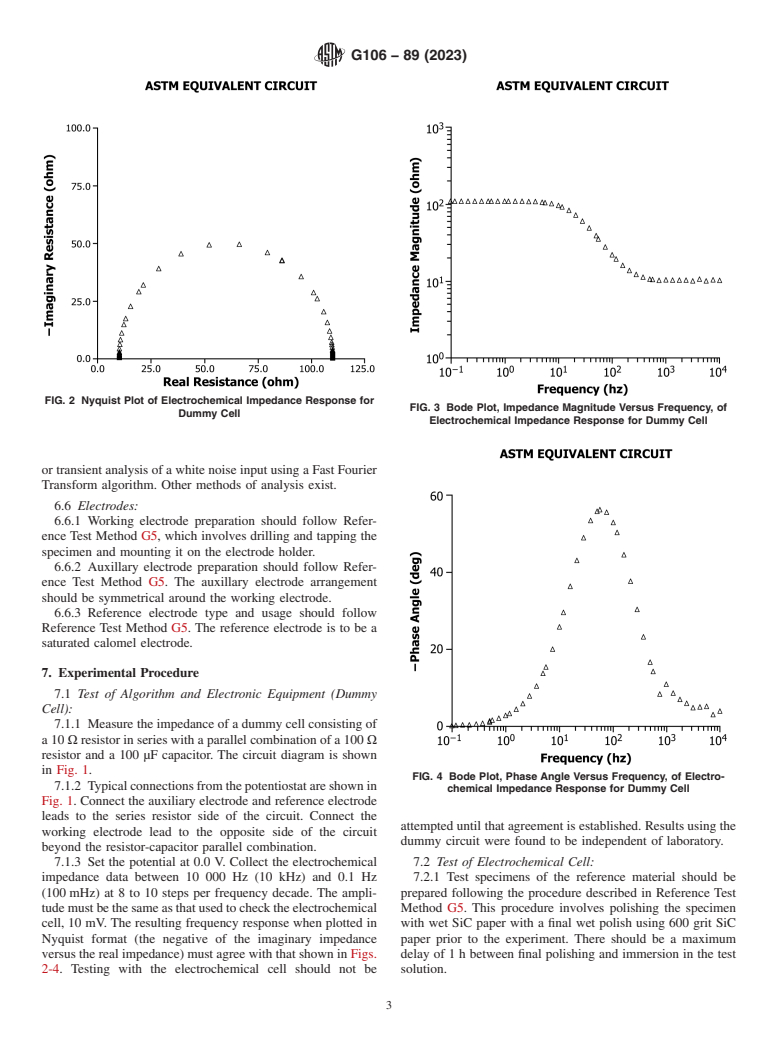
5.1 The availability of a standard procedure, standard material, and standard plots should allow the investigator to check his laboratory technique. This practice should lead to electrochemical impedance curves in the literature which can be compared easily and with confidence.
5.2 Samples of a standard ferritic type 430 stainless steel (UNS 430000) used to obtain the reference plots are available for those who wish to check their equipment. Suitable resistors and capacitors can be obtained from electronics supply houses.
5.3 This test method may not be appropriate for electrochemical impedance measurements of all materials or in all environments.
SCOPE
1.1 This practice covers an experimental procedure which can be used to check one's instrumentation and technique for collecting and presenting electrochemical impedance data. If followed, this practice provides a standard material, electrolyte, and procedure for collecting electrochemical impedance data at the open circuit or corrosion potential that should reproduce data determined by others at different times and in different laboratories. This practice may not be appropriate for collecting impedance information for all materials or in all environments.
1.2 The values stated in SI units are to be regarded as standard. No other units of measurement are included in this standard.
1.3 This standard does not purport to address all of the safety concerns, if any, associated with its use. It is the responsibility of the user of this standard to establish appropriate safety, health, and environmental practices and determine the applicability of regulatory limitations prior to use.
1.4 This international standard was developed in accordance with internationally recognized principles on standardization established in the Decision on Principles for the Development of International Standards, Guides and Recommendations issued by the World Trade Organization Technical Barriers to Trade (TBT) Committee.
General Information
Standards Content (Sample)
This international standard was developed in accordance with internationally recognized principles on standardization established in the Decision on Principles for the
Development of International Standards, Guides and Recommendations issued by the World Trade Organization Technical Barriers to Trade (TBT) Committee.
Designation: G106 − 89 (Reapproved 2023)
Standard Practice for
Verification of Algorithm and Equipment for Electrochemical
1
Impedance Measurements
This standard is issued under the fixed designation G106; the number immediately following the designation indicates the year of
original adoption or, in the case of revision, the year of last revision. A number in parentheses indicates the year of last reapproval. A
superscript epsilon (´) indicates an editorial change since the last revision or reapproval.
1. Scope G5 Reference Test Method for Making Potentiodynamic
Anodic Polarization Measurements
1.1 This practice covers an experimental procedure which
G15 Terminology Relating to Corrosion and Corrosion Test-
can be used to check one’s instrumentation and technique for
3
ing (Withdrawn 2010)
collecting and presenting electrochemical impedance data. If
G59 Test Method for Conducting Potentiodynamic Polariza-
followed, this practice provides a standard material,
tion Resistance Measurements
electrolyte, and procedure for collecting electrochemical im-
pedance data at the open circuit or corrosion potential that
3. Terminology
should reproduce data determined by others at different times
3.1 Definitions—For definitions of corrosion related terms,
and in different laboratories. This practice may not be appro-
see Terminology G15.
priate for collecting impedance information for all materials or
in all environments. 3.2 Symbols:
1.2 The values stated in SI units are to be regarded as
standard. No other units of measurement are included in this −2
C = capacitance (farad-cm )
standard.
Eʹ = real component of voltage (volts)
1.3 This standard does not purport to address all of the E" = imaginary component of voltage (volts)
E = complex voltage (volts)
safety concerns, if any, associated with its use. It is the
−1
f = frequency (s )
responsibility of the user of this standard to establish appro-
−2
Iʹ = real component of current (amp-cm )
priate safety, health, and environmental practices and deter-
−2
I" = imaginary component of current (amp-cm )
mine the applicability of regulatory limitations prior to use.
−2
I = complex current (amp-cm )
1.4 This international standard was developed in accor-
j =
=21
dance with internationally recognized principles on standard-
2
L = inductance (henry − cm )
ization established in the Decision on Principles for the
2
R = solution resistance (ohm-cm )
s
Development of International Standards, Guides and Recom-
2
R = polarization resistance (ohm-cm )
p
mendations issued by the World Trade Organization Technical
2
R = charge transfer resistance (ohm-cm )
t
Barriers to Trade (TBT) Committee.
2
Zʹ = real component of impedance (ohm-cm )
2
Z" = imaginary component of impedance (ohm-cm )
2. Referenced Documents
2
Z = complex impedance (ohm-cm )
2
2.1 ASTM Standards:
α = phenomenological coefficients caused by depression
D1193 Specification for Reagent Water
of the Nyquist plot below the real axis, α is the
G3 Practice for Conventions Applicable to Electrochemical
exponent and τ is the time constant(s).
Measurements in Corrosion Testing
θ = phase angle (deg)
−1
ω = frequency (radians-s )
1
3.3 Subscripts:
This practice is under the jurisdiction of ASTM Committee G01 on Corrosion
of Metals and is the direct responsibility of Subcommittee G01.11 on Electrochemi-
cal Measurements in Corrosion Testing.
Current edition approved June 1, 2023. Published June 2023. Originally
x = in-phase component
approved in 1989. Last previous edition approved in 2015 as G106 – 89 (2015).
y = out-of-phase component
DOI: 10.1520/G0106-89R23.
2
For referenced ASTM standards, visit the ASTM website, www.astm.org, or
contact ASTM Customer Service at service@astm.org. For Annual Book of ASTM
3
Standards volume information, refer to the standard’s Document Summary page on The last approved version of this historical standard is referenced on
the ASTM website. www.astm.org.
Copyright © ASTM International, 100 Barr Harbor Drive, PO Box C700, West Conshohocken, PA 19428-2959. United States
1
---------------------- Page: 1 ----------------------
G106 − 89 (2023)
FIG. 1 Circuit Diagram for Dummy Cell Showing Positions for Hook-Up to Potentiostat
4. Summary of Practice have a stated precision of 60.1 %. The capacitor can have a
precision of 620 %. The cell can be constructed from readily
4.1 Reference impedance plots in both Nyquist and Bode
available circuit elements by following the circuit diagram
format are included. These reference plots are derived from the
shown in Fig. 1.
results from nine different laboratories that used a standard
dummy cell and followed the standard procedure using a
6.2 Test Cell—
...
Questions, Comments and Discussion
Ask us and Technical Secretary will try to provide an answer. You can facilitate discussion about the standard in here.