


ASTM D240-14
(Test Method)Standard Test Method for Heat of Combustion of Liquid Hydrocarbon Fuels by Bomb Calorimeter
Standard Test Method for Heat of Combustion of Liquid Hydrocarbon Fuels by Bomb Calorimeter
SIGNIFICANCE AND USE
5.1 The heat of combustion is a measure of the energy available from a fuel. A knowledge of this value is essential when considering the thermal efficiency of equipment for producing either power or heat.
5.2 The heat of combustion as determined by this test method is designated as one of the chemical and physical requirements of both commercial and military turbine fuels and aviation gasolines.
5.3 The mass heat of combustion, the heat of combustion per unit mass of fuel, is a critical property of fuels intended for use in weight-limited craft such as airplanes, surface effect vehicles, and hydrofoils. The range of such craft between refueling is a direct function of the heat of combustion and density of the fuel.
SCOPE
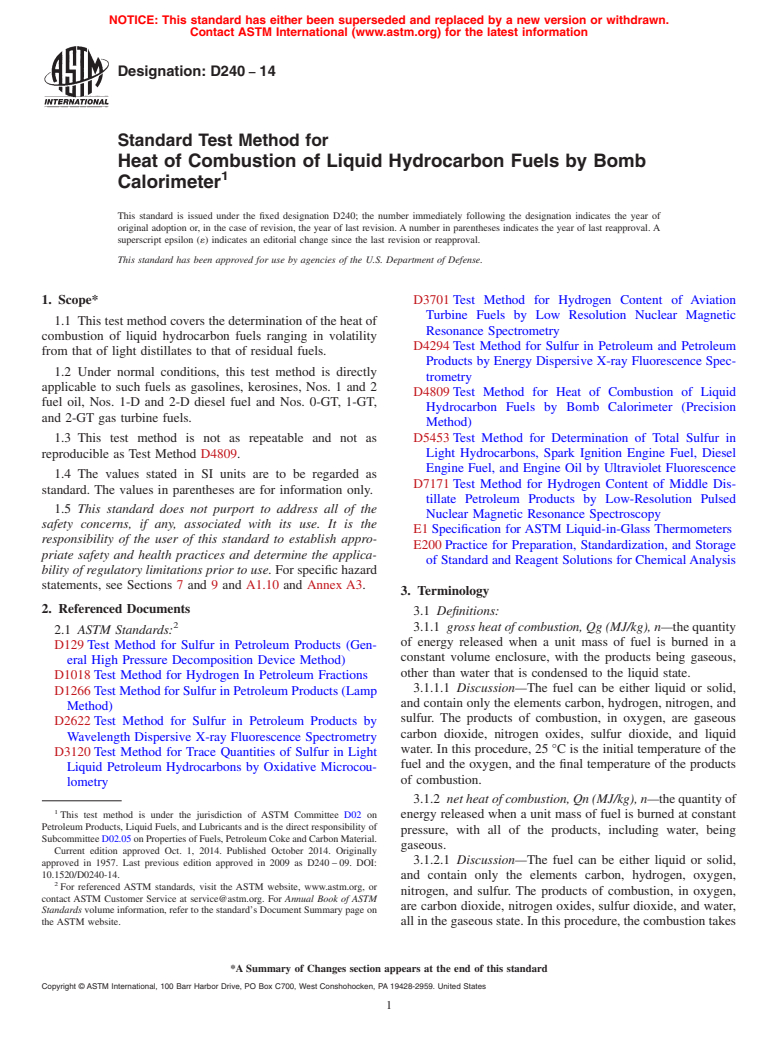
1.1 This test method covers the determination of the heat of combustion of liquid hydrocarbon fuels ranging in volatility from that of light distillates to that of residual fuels.
1.2 Under normal conditions, this test method is directly applicable to such fuels as gasolines, kerosines, Nos. 1 and 2 fuel oil, Nos. 1-D and 2-D diesel fuel and Nos. 0-GT, 1-GT, and 2-GT gas turbine fuels.
1.3 This test method is not as repeatable and not as reproducible as Test Method D4809.
1.4 The values stated in SI units are to be regarded as standard. The values in parentheses are for information only.
1.5 This standard does not purport to address all of the safety concerns, if any, associated with its use. It is the responsibility of the user of this standard to establish appropriate safety and health practices and determine the applicability of regulatory limitations prior to use. For specific hazard statements, see Sections 7 and 9 and A1.10 and Annex A3.
General Information
Relations
Buy Standard
Standards Content (Sample)
NOTICE: This standard has either been superseded and replaced by a new version or withdrawn.
Contact ASTM International (www.astm.org) for the latest information
Designation: D240 − 14
Standard Test Method for
Heat of Combustion of Liquid Hydrocarbon Fuels by Bomb
1
Calorimeter
This standard is issued under the fixed designation D240; the number immediately following the designation indicates the year of
original adoption or, in the case of revision, the year of last revision.Anumber in parentheses indicates the year of last reapproval.A
superscript epsilon (´) indicates an editorial change since the last revision or reapproval.
This standard has been approved for use by agencies of the U.S. Department of Defense.
1. Scope* D3701Test Method for Hydrogen Content of Aviation
Turbine Fuels by Low Resolution Nuclear Magnetic
1.1 This test method covers the determination of the heat of
Resonance Spectrometry
combustion of liquid hydrocarbon fuels ranging in volatility
D4294Test Method for Sulfur in Petroleum and Petroleum
from that of light distillates to that of residual fuels.
Products by Energy Dispersive X-ray Fluorescence Spec-
1.2 Under normal conditions, this test method is directly
trometry
applicable to such fuels as gasolines, kerosines, Nos. 1 and 2
D4809Test Method for Heat of Combustion of Liquid
fuel oil, Nos. 1-D and 2-D diesel fuel and Nos. 0-GT, 1-GT,
Hydrocarbon Fuels by Bomb Calorimeter (Precision
and 2-GT gas turbine fuels.
Method)
D5453Test Method for Determination of Total Sulfur in
1.3 This test method is not as repeatable and not as
reproducible as Test Method D4809. Light Hydrocarbons, Spark Ignition Engine Fuel, Diesel
Engine Fuel, and Engine Oil by Ultraviolet Fluorescence
1.4 The values stated in SI units are to be regarded as
D7171Test Method for Hydrogen Content of Middle Dis-
standard. The values in parentheses are for information only.
tillate Petroleum Products by Low-Resolution Pulsed
1.5 This standard does not purport to address all of the
Nuclear Magnetic Resonance Spectroscopy
safety concerns, if any, associated with its use. It is the
E1Specification for ASTM Liquid-in-Glass Thermometers
responsibility of the user of this standard to establish appro-
E200Practice for Preparation, Standardization, and Storage
priate safety and health practices and determine the applica-
of Standard and Reagent Solutions for ChemicalAnalysis
bility of regulatory limitations prior to use. For specific hazard
statements, see Sections 7 and 9 and A1.10 and Annex A3.
3. Terminology
2. Referenced Documents
3.1 Definitions:
2
3.1.1 grossheatofcombustion,Qg(MJ/kg),n—thequantity
2.1 ASTM Standards:
of energy released when a unit mass of fuel is burned in a
D129Test Method for Sulfur in Petroleum Products (Gen-
constant volume enclosure, with the products being gaseous,
eral High Pressure Decomposition Device Method)
other than water that is condensed to the liquid state.
D1018Test Method for Hydrogen In Petroleum Fractions
3.1.1.1 Discussion—The fuel can be either liquid or solid,
D1266TestMethodforSulfurinPetroleumProducts(Lamp
and contain only the elements carbon, hydrogen, nitrogen, and
Method)
sulfur. The products of combustion, in oxygen, are gaseous
D2622Test Method for Sulfur in Petroleum Products by
carbon dioxide, nitrogen oxides, sulfur dioxide, and liquid
Wavelength Dispersive X-ray Fluorescence Spectrometry
water. In this procedure, 25°C is the initial temperature of the
D3120Test Method for Trace Quantities of Sulfur in Light
fuel and the oxygen, and the final temperature of the products
Liquid Petroleum Hydrocarbons by Oxidative Microcou-
of combustion.
lometry
3.1.2 netheatofcombustion,Qn(MJ/kg),n—thequantityof
1
This test method is under the jurisdiction of ASTM Committee D02 on
energy released when a unit mass of fuel is burned at constant
Petroleum Products, Liquid Fuels, and Lubricants and is the direct responsibility of
pressure, with all of the products, including water, being
SubcommitteeD02.05onPropertiesofFuels,PetroleumCokeandCarbonMaterial.
gaseous.
Current edition approved Oct. 1, 2014. Published October 2014. Originally
3.1.2.1 Discussion—The fuel can be either liquid or solid,
approved in 1957. Last previous edition approved in 2009 as D240–09. DOI:
10.1520/D0240-14.
and contain only the elements carbon, hydrogen, oxygen,
2
For referenced ASTM standards, visit the ASTM website, www.astm.org, or
nitrogen, and sulfur. The products of combustion, in oxygen,
contact ASTM Customer Service at service@astm.org. For Annual Book of ASTM
are carbon dioxide, nitrogen oxides, sulfur dioxide, and water,
Standards volume information, refer to the standard’s Document Summary page on
the ASTM website. allinthegaseousstate.Inthisprocedure,thecombustiontakes
*A Summary of Changes section appears at the end of this standard
Copyright © ASTM International, 100 Barr Harbor Drive, PO Box C700, West Conshohocken, PA 19428-2959. United States
1
---------------------- Page: 1 ----------------------
...
This document is not an ASTM standard and is intended only to provide the user of an ASTM standard an indication of what changes have been made to the previous version. Because
it may not be technically possible to adequately depict all changes accurately, ASTM recommends that users consult prior editions as appropriate. In all cases only the current version
of the standard as published by ASTM is to be considered the official document.
Designation: D240 − 09 D240 − 14
Standard Test Method for
Heat of Combustion of Liquid Hydrocarbon Fuels by Bomb
1
Calorimeter
This standard is issued under the fixed designation D240; the number immediately following the designation indicates the year of
original adoption or, in the case of revision, the year of last revision. A number in parentheses indicates the year of last reapproval. A
superscript epsilon (´) indicates an editorial change since the last revision or reapproval.
This standard has been approved for use by agencies of the U.S. Department of Defense.
1. Scope*
1.1 This test method covers the determination of the heat of combustion of liquid hydrocarbon fuels ranging in volatility from
that of light distillates to that of residual fuels.
1.2 Under normal conditions, this test method is directly applicable to such fuels as gasolines, kerosines, Nos. 1 and 2 fuel oil,
Nos. 1-D and 2-D diesel fuel and Nos. 0-GT, 1-GT, and 2-GT gas turbine fuels.
1.3 This test method is not as repeatable and not as reproducible as Test Method D4809.
1.4 The values stated in SI units are to be regarded as standard. The values in parentheses are for information only.
1.5 This standard does not purport to address all of the safety concerns, if any, associated with its use. It is the responsibility
of the user of this standard to establish appropriate safety and health practices and determine the applicability of regulatory
limitations prior to use. For specific hazard statements, see Sections 7 and 9 and A1.10 and Annex A3.
2. Referenced Documents
2
2.1 ASTM Standards:
D129 Test Method for Sulfur in Petroleum Products (General High Pressure Decomposition Device Method)
D1018 Test Method for Hydrogen In Petroleum Fractions
D1266 Test Method for Sulfur in Petroleum Products (Lamp Method)
D2622 Test Method for Sulfur in Petroleum Products by Wavelength Dispersive X-ray Fluorescence Spectrometry
D3120 Test Method for Trace Quantities of Sulfur in Light Liquid Petroleum Hydrocarbons by Oxidative Microcoulometry
D3701 Test Method for Hydrogen Content of Aviation Turbine Fuels by Low Resolution Nuclear Magnetic Resonance
Spectrometry
D4294 Test Method for Sulfur in Petroleum and Petroleum Products by Energy Dispersive X-ray Fluorescence Spectrometry
D4809 Test Method for Heat of Combustion of Liquid Hydrocarbon Fuels by Bomb Calorimeter (Precision Method)
D5453 Test Method for Determination of Total Sulfur in Light Hydrocarbons, Spark Ignition Engine Fuel, Diesel Engine Fuel,
and Engine Oil by Ultraviolet Fluorescence
D7171 Test Method for Hydrogen Content of Middle Distillate Petroleum Products by Low-Resolution Pulsed Nuclear Magnetic
Resonance Spectroscopy
E1 Specification for ASTM Liquid-in-Glass Thermometers
E200 Practice for Preparation, Standardization, and Storage of Standard and Reagent Solutions for Chemical Analysis
3. Terminology
3.1 Definitions:
3.1.1 gross heat of combustion, Qg (MJ/kg)—(MJ/kg), n—the quantity of energy released when a unit mass of fuel is burned
in a constant volume enclosure, with the products being gaseous, other than water that is condensed to the liquid state.
1
This test method is under the jurisdiction of ASTM Committee D02 on Petroleum Products Products, Liquid Fuels, and Lubricants and is the direct responsibility of
Subcommittee D02.05 on Properties of Fuels, Petroleum Coke and Carbon Material.
Current edition approved July 1, 2009Oct. 1, 2014. Published September 2009October 2014. Originally approved in 1957. Last previous edition approved in 20072009
as D240–02(2007).D240 – 09. DOI: 10.1520/D0240-09.10.1520/D0240-14.
2
For referenced ASTM standards, visit the ASTM website, www.astm.org, or contact ASTM Customer Service at service@astm.org. For Annual Book of ASTM Standards
volume information, refer to the standard’s Document Summary page on the ASTM website.
*A Summary of Changes section appears at the end of this standard
Copyright © ASTM International, 100 Barr Harbor Drive, PO Box C700, West Conshohocken, PA 19428-2959. United States
1
---------------------- Page: 1 ----------------------
D240 − 14
3.1.1.1 Discussion—
The fuel can be either liquid or solid, and contain only the elements carbon, hydrogen, nitrogen, and sulfur. The products of
combustion, in oxygen, are gaseous carbon dioxide, nitrogen oxides, sulfur dioxide, and liquid water. In this procedure, 25°C25 °C
is the initial temperature of the fuel and the oxygen, and the final temperature of the products of combustion.
3.1.2 net heat of combustion, Qn (MJ/kg)—(MJ/kg), n—the quantity
...
Questions, Comments and Discussion
Ask us and Technical Secretary will try to provide an answer. You can facilitate discussion about the standard in here.