

ASTM A1013-00(2020)
(Test Method)Standard Test Method for High-Frequency (10 kHz-1 MHz) Core Loss of Soft Magnetic Core Components at Controlled Temperatures Using the Voltmeter-Ammeter-Wattmeter Method
General Information
- Abstract
SIGNIFICANCE AND USE
4.1 This test method is designed for testing of either toroidal or mated soft magnetic core components over a range of temperatures, frequencies, and flux densities.
4.2 The reproducibility and repeatability of this test method are such that it is suitable for design, specification acceptance, service evaluation, and research and development.
SCOPE
1.1 This test method covers the equipment, procedures, and measurement of core loss of either toroidal or mated soft magnetic core components, such as soft ferrite cores, iron powder cores, and so forth, over ranges of controlled ambient temperatures typically from −20 to +120°C, frequencies from 10 kHz to 1 MHz, under sinusoidal flux conditions.
1.2 The values and equations stated in customary (cgs-emu and inch-pound) or SI units are to be regarded separately as standard. Within this test method, SI units are shown in brackets except for the sections concerning calculations where there are separate sections for the respective unit systems. The values stated in each system may not be exact equivalents; therefore, each system shall be used independently of the other. Combining values from the two systems may result in nonconformance with this standard.
1.3 This standard does not purport to address all of the safety concerns, if any, associated with its use. It is the responsibility of the user of this standard to establish appropriate safety, health, and environmental practices and determine the applicability of regulatory limitations prior to use.
1.4 This international standard was developed in accordance with internationally recognized principles on standardization established in the Decision on Principles for the Development of International Standards, Guides and Recommendations issued by the World Trade Organization Technical Barriers to Trade (TBT) Committee.
- Status
- Published
- Publication Date
- 31-May-2020
- Technical Committee
- A06 - Magnetic Properties
- Drafting Committee
- A06.01 - Test Methods
Overview
ASTM A1013-00(2020) is an internationally recognized standard test method developed by ASTM International for measuring the high-frequency core loss characteristics of soft magnetic core components. This standard specifically utilizes the voltmeter-ammeter-wattmeter (VAW) method to measure core loss in toroidal and mated core assemblies, such as soft ferrite cores and iron powder cores. The standard is intended for use over a broad range of frequencies (10 kHz to 1 MHz) and controlled ambient temperatures (−20°C to +120°C) under sinusoidal flux conditions. The method provides results that are reproducible and repeatable, suitable for applications in design, specification acceptance, service evaluation, and research and development of magnetic materials and components.
Key Topics
- Scope of Measurement: Covers both toroidal and mated soft magnetic core components, applicable to core materials like soft ferrite and iron powder.
- Test Conditions: Measurements are conducted over controlled temperature and frequency ranges, allowing for evaluation of material performance under operational conditions.
- Procedure: Involves preparing the core in a specific configuration, maintaining precise environmental control, and utilizing standard VAW electronic instrumentation for data collection.
- Units of Measurement: Supports both customary (cgs-emu/inch-pound) and SI units, but requires that each system be used independently.
- Data Reporting: Emphasizes clear reporting of core identification, test frequencies, flux densities, temperatures, and core loss density results.
- Precision & Reproducibility: Demonstrates high levels of repeatability and reproducibility, suitable for verifying specifications and supporting quality assurance.
Applications
ASTM A1013-00(2020) is instrumental for a wide array of applications involving soft magnetic materials:
- Electronic Component Manufacturing: Used in the production and validation of ferrite and iron powder cores found in transformers, inductors, and other high-frequency magnetic applications.
- Research and Development: Supports the evaluation of new materials and product designs by providing a standardized methodology for core loss measurement under varying operational parameters.
- Quality Assurance: Helps ensure that soft magnetic core components meet design and specification requirements before deployment in end-use applications.
- Comparative Testing: Facilitates the assessment of material property variations due to changes in frequency, flux density, or temperature, enabling informed material selection and design optimization.
- Acceptance Testing: Used as a basis for specification acceptance between suppliers and purchasers of soft magnetic components.
Related Standards
For comprehensive magnetic materials testing and terminology, the following ASTM standards complement and support ASTM A1013-00(2020):
- ASTM A34/A34M - Sampling and procurement testing of magnetic materials
- ASTM A340 - Terminology of symbols and definitions relating to magnetic testing
- ASTM E177 - Use of the terms precision and bias in ASTM test methods
These related documents provide additional guidance for sampling, defining terminology, and supporting statistical analysis of test results.
By adhering to ASTM A1013-00(2020), manufacturers, researchers, and quality professionals can ensure high-frequency soft magnetic core components are assessed accurately and consistently, enabling better product performance and compliance with international standards. This standard plays a crucial role in fields relying on precise high-frequency magnetic measurements, including electronics, energy, telecommunications, and advanced materials development.
Relations
- Effective Date
- 01-Jun-2020
- Effective Date
- 01-Dec-2023
- Effective Date
- 15-Oct-2019
- Effective Date
- 15-Jun-2019
- Effective Date
- 15-Feb-2019
- Effective Date
- 01-Jun-2018
- Effective Date
- 15-Oct-2017
- Effective Date
- 01-Jul-2017
- Effective Date
- 01-May-2016
- Effective Date
- 01-May-2016
- Effective Date
- 01-Oct-2015
- Effective Date
- 01-Oct-2014
- Effective Date
- 01-May-2014
- Effective Date
- 01-May-2013
- Effective Date
- 01-Nov-2012
Get Certified
Connect with accredited certification bodies for this standard

IMQ S.p.A. (Certification)
Italian electrical product certification.

SLG Prüf- und Zertifizierungs GmbH
German testing and certification body.

UL Solutions
Global safety science company with testing, inspection and certification.
Sponsored listings
Frequently Asked Questions
ASTM A1013-00(2020) is a standard published by ASTM International. Its full title is "Standard Test Method for High-Frequency (10 kHz-1 MHz) Core Loss of Soft Magnetic Core Components at Controlled Temperatures Using the Voltmeter-Ammeter-Wattmeter Method". This standard covers: SIGNIFICANCE AND USE 4.1 This test method is designed for testing of either toroidal or mated soft magnetic core components over a range of temperatures, frequencies, and flux densities. 4.2 The reproducibility and repeatability of this test method are such that it is suitable for design, specification acceptance, service evaluation, and research and development. SCOPE 1.1 This test method covers the equipment, procedures, and measurement of core loss of either toroidal or mated soft magnetic core components, such as soft ferrite cores, iron powder cores, and so forth, over ranges of controlled ambient temperatures typically from −20 to +120°C, frequencies from 10 kHz to 1 MHz, under sinusoidal flux conditions. 1.2 The values and equations stated in customary (cgs-emu and inch-pound) or SI units are to be regarded separately as standard. Within this test method, SI units are shown in brackets except for the sections concerning calculations where there are separate sections for the respective unit systems. The values stated in each system may not be exact equivalents; therefore, each system shall be used independently of the other. Combining values from the two systems may result in nonconformance with this standard. 1.3 This standard does not purport to address all of the safety concerns, if any, associated with its use. It is the responsibility of the user of this standard to establish appropriate safety, health, and environmental practices and determine the applicability of regulatory limitations prior to use. 1.4 This international standard was developed in accordance with internationally recognized principles on standardization established in the Decision on Principles for the Development of International Standards, Guides and Recommendations issued by the World Trade Organization Technical Barriers to Trade (TBT) Committee.
SIGNIFICANCE AND USE 4.1 This test method is designed for testing of either toroidal or mated soft magnetic core components over a range of temperatures, frequencies, and flux densities. 4.2 The reproducibility and repeatability of this test method are such that it is suitable for design, specification acceptance, service evaluation, and research and development. SCOPE 1.1 This test method covers the equipment, procedures, and measurement of core loss of either toroidal or mated soft magnetic core components, such as soft ferrite cores, iron powder cores, and so forth, over ranges of controlled ambient temperatures typically from −20 to +120°C, frequencies from 10 kHz to 1 MHz, under sinusoidal flux conditions. 1.2 The values and equations stated in customary (cgs-emu and inch-pound) or SI units are to be regarded separately as standard. Within this test method, SI units are shown in brackets except for the sections concerning calculations where there are separate sections for the respective unit systems. The values stated in each system may not be exact equivalents; therefore, each system shall be used independently of the other. Combining values from the two systems may result in nonconformance with this standard. 1.3 This standard does not purport to address all of the safety concerns, if any, associated with its use. It is the responsibility of the user of this standard to establish appropriate safety, health, and environmental practices and determine the applicability of regulatory limitations prior to use. 1.4 This international standard was developed in accordance with internationally recognized principles on standardization established in the Decision on Principles for the Development of International Standards, Guides and Recommendations issued by the World Trade Organization Technical Barriers to Trade (TBT) Committee.
ASTM A1013-00(2020) is classified under the following ICS (International Classification for Standards) categories: 29.100.10 - Magnetic components. The ICS classification helps identify the subject area and facilitates finding related standards.
ASTM A1013-00(2020) has the following relationships with other standards: It is inter standard links to ASTM A1013-00(2013)e1, ASTM A340-23a, ASTM A340-19b, ASTM A340-19a, ASTM A340-19, ASTM A340-18, ASTM A340-17a, ASTM A340-17, ASTM A340-16e1, ASTM A340-16, ASTM A340-15, ASTM A340-14, ASTM E177-14, ASTM E177-13, ASTM A34/A34M-06(2012). Understanding these relationships helps ensure you are using the most current and applicable version of the standard.
ASTM A1013-00(2020) is available in PDF format for immediate download after purchase. The document can be added to your cart and obtained through the secure checkout process. Digital delivery ensures instant access to the complete standard document.
Standards Content (Sample)
This international standard was developed in accordance with internationally recognized principles on standardization established in the Decision on Principles for the
Development of International Standards, Guides and Recommendations issued by the World Trade Organization Technical Barriers to Trade (TBT) Committee.
Designation: A1013 − 00 (Reapproved 2020)
Standard Test Method for
High-Frequency (10 kHz-1 MHz) Core Loss of Soft Magnetic
Core Components at Controlled Temperatures Using the
Voltmeter-Ammeter-Wattmeter Method
This standard is issued under the fixed designation A1013; the number immediately following the designation indicates the year of
original adoption or, in the case of revision, the year of last revision.Anumber in parentheses indicates the year of last reapproval.A
superscript epsilon (´) indicates an editorial change since the last revision or reapproval.
1. Scope A34/A34MPractice for Sampling and Procurement Testing
of Magnetic Materials
1.1 This test method covers the equipment, procedures, and
A340Terminology of Symbols and Definitions Relating to
measurement of core loss of either toroidal or mated soft
Magnetic Testing
magnetic core components, such as soft ferrite cores, iron
E177Practice for Use of the Terms Precision and Bias in
powder cores, and so forth, over ranges of controlled ambient
ASTM Test Methods
temperatures typically from −20 to +120°C, frequencies from
10 kHz to 1 MHz, under sinusoidal flux conditions.
3. Terminology
1.2 The values and equations stated in customary (cgs-emu
3.1 The definitions of terms, symbols, and conversion fac-
and inch-pound) or SI units are to be regarded separately as
tors relating to magnetic testing, used in this test method, are
standard. Within this test method, SI units are shown in
found in Terminology A340.
brackets except for the sections concerning calculations where
there are separate sections for the respective unit systems. The 3.2 Definitions of Terms Specific to This Standard:
values stated in each system may not be exact equivalents; 3.2.1 bifilar transformer—a transformer in which the turns
therefore,eachsystemshallbeusedindependentlyoftheother. oftheprimaryandsecondarywindingsarewoundtogetherside
Combining values from the two systems may result in noncon- by side and in the same direction. This type of winding results
formance with this standard. in near unity coupling, so that there is a very efficient transfer
of energy from primary to secondary.
1.3 This standard does not purport to address all of the
safety concerns, if any, associated with its use. It is the 3.2.2 core-loss density, P —core loss per unit volume in
cd
3 3
responsibility of the user of this standard to establish appro- mW/cm [W⁄m ].
priate safety, health, and environmental practices and deter-
3.2.3 effective permeability—the relative permeability of a
mine the applicability of regulatory limitations prior to use.
magneticcircuitincludingtheeffectofairgapsinthemagnetic
1.4 This international standard was developed in accor-
path length.
dance with internationally recognized principles on standard-
3.2.4 mated core set—twoormorecoresegmentsassembled
ization established in the Decision on Principles for the
with the magnetic flux path perpendicular to the mating
Development of International Standards, Guides and Recom-
surface.
mendations issued by the World Trade Organization Technical
Barriers to Trade (TBT) Committee.
4. Significance and Use
4.1 Thistestmethodisdesignedfortestingofeithertoroidal
2. Referenced Documents
or mated soft magnetic core components over a range of
2.1 ASTM Standards:
temperatures, frequencies, and flux densities.
4.2 The reproducibility and repeatability of this test method
are such that it is suitable for design, specification acceptance,
This test method is under the jurisdiction of ASTM Committee A06 on
service evaluation, and research and development.
MagneticPropertiesandisthedirectresponsibilityofSubcommitteeA06.01onTest
Methods.
CurrenteditionapprovedJune1,2020.PublishedJuly2020.Originallyapproved
5. Apparatus
ɛ1
in 2000. Last previous edition approved in 2013 as A1013 – 00 (2013) .
DOI:10.1520/A1013-00R20.
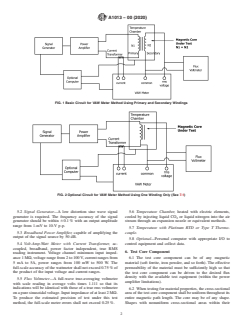
5.1 Theapparatusshallconsistofasmanyofthecomponent
For referenced ASTM standards, visit the ASTM website, www.astm.org, or
partsasshownintheblockcircuitdiagrams(Figs.1and2)and
contact ASTM Customer Service at service@astm.org. For Annual Book of ASTM
described as follows and in the appendix, as required to
Standards volume information, refer to the standard’s Document Summary page on
the ASTM website. perform the tests.
Copyright © ASTM International, 100 Barr Harbor Drive, PO Box C700, West Conshohocken, PA 19428-2959. United States
A1013 − 00 (2020)
FIG. 1 Basic Circuit for VAW Meter Method Using Primary and Secondary Windings
FIG. 2 Optional Circuit for VAW Meter Method Using One Winding Only (See 7.1)
5.2 Signal Generator—A low distortion sine wave signal 5.6 Temperature Chamber, heated with electric elements,
generator is required. The frequency accuracy of the signal cooled by injecting liquid CO or liquid nitrogen into the air
generator should be within 60.1% with an output amplitude stream through an expansion nozzle or equivalent methods.
range from 1-mV to 10-V p-p.
5.7 Temperature with Platinum RTD or Type T Thermo-
5.3 Broadband Power Amplifier, capable of amplifying the couple.
output of the signal source by 50 dB.
5.8 Optional—Personal computer with appropriate I/O to
5.4 Volt-Amp-Watt Meter with Current Transformer, ac- control equipment and collect data.
coupled, broadband, power factor independent, true RMS
6. Test Core Component
reading instrument. Voltage channel minimum input imped-
ance1MΩ,voltagerangefrom2to100V,currentrangesfrom 6.1 The test core component can be of any magnetic
5 mA to 5A, power ranges from 100 mW to 500 W. The material (soft ferrite, iron powder, and so forth). The effective
full-scaleaccuracyofthewattmetershallnotexceed0.75%of permeability of the material must be sufficiently high so that
the product of the input voltage and current ranges. the test core component can be driven to the desired flux
density with the available test equipment (within the power
5.5 Flux Voltmeter—A full-wave true-averaging voltmeter
amplifier limitations).
with scale reading in average volts times 1.111 so that its
indications will be identical with those of a true rms voltmeter 6.2 When testing for material properties, the cross-sectional
onapuresinusoidalvoltage.Inputimpedanceofatleast2MΩ. areaofthetestcorecomponentshallbeuniformthroughoutits
To produce the estimated precision of test under this test entire magnetic path length. The core may be of any shape.
method, the full-scale meter errors shall not exceed 0.25%. Shapes with nonuniform cross-sectional areas within their
A1013 − 00 (2020)
magnetic path length can be tested for specific core shape 8. Calculation (Customary Units)
performance comparisons; however, the core-loss density will
8.1 The effective dimensional core parameters of the test
not be accurate, since the flux density and core loss vary
specimen are computed by normalizing the core area (A)
throughout the magnetic path length and are not uniform.
throughout the core’s magnetic path length (l). Core constants
6.3 Mated core set assembled around a prewound coil can C and C are calculated and used to calculate effective
1 2
be used, as well as toroidal cores. magnetic path length (l ), effective core cross-sectional area
6.3.1 Mating surfaces must be ground smooth and flat to (A ), and effective core volume (V ), as follows:
e e
minimize air gaps. Air gaps cause reluctance in the flux path n
n
and cause flux to fringe, both of which contribute to higher Coreconstant, C 5 cm (1)
1 (
A
n
measured losses.
n
n
6.3.2 Clamping pressure for the mated core set needs to be
Coreconstant, C 5 cm (2)
2 ( 2
An
sufficient to hold the cores together with minimum air gaps but
not so strong that it affects the properties of the material
~C !
...