

ASTM B165-19
(Specification)Standard Specification for Nickel-Copper Alloy Seamless Pipe and Tube
General Information
- Abstract
ABSTRACT
This specification covers nickel-copper alloy UNS N04400 in the form of cold-worked seamless pipe and tube. The material shall conform to the composition limits specified. Tension test, hydrostatic test, nondestructive electric test, and rounding method shall be done in accordance to the specified requirements.
SCOPE
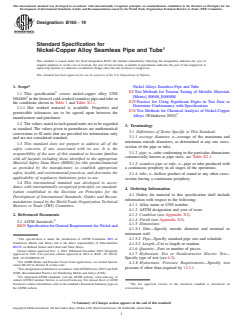
1.1 This specification2 covers nickel-copper alloy UNS N044003 in the form of cold-worked seamless pipe and tube in the conditions shown in Table 1 and Table X1.1.
1.1.1 Hot worked material is available. Properties and permissible tolerances are to be agreed upon between the manufacturer and purchaser.
1.2 The values stated in inch-pound units are to be regarded as standard. The values given in parentheses are mathematical conversions to SI units that are provided for information only and are not considered standard.
1.3 This standard does not purport to address all of the safety concerns, if any, associated with its use. It is the responsibility of the user of this standard to become familiar with all hazards including those identified in the appropriate Material Safety Data Sheet (MSDS) for this product/material as provided by the manufacturer, to establish appropriate safety, health, and environmental practices, and determine the applicability of regulatory limitations prior to use.
1.4 This international standard was developed in accordance with internationally recognized principles on standardization established in the Decision on Principles for the Development of International Standards, Guides and Recommendations issued by the World Trade Organization Technical Barriers to Trade (TBT) Committee.
- Status
- Published
- Publication Date
- 31-Oct-2019
- Technical Committee
- B02 - Nonferrous Metals and Alloys
- Drafting Committee
- B02.07 - Refined Nickel and Cobalt and Their Alloys
Buy Documents
ASTM B165-19 - Standard Specification for Nickel-Copper Alloy Seamless Pipe and Tube
REDLINE ASTM B165-19 - Standard Specification for Nickel-Copper Alloy Seamless Pipe and Tube
Overview
ASTM B165-19 is the standard specification issued by ASTM International for Nickel-Copper Alloy Seamless Pipe and Tube. This standard covers requirements for seamless pipes and tubes manufactured from nickel-copper alloy UNS N04400, commonly known for its excellent resistance to corrosion and high mechanical strength. The specification details chemical composition, permissible tolerances, mechanical properties, testing, and certification requirements, ensuring that products comply with rigorous industrial and quality standards.
This standard is widely referenced in industries where robust, high-performance piping is essential, particularly in environments exposed to corrosive liquids or gases.
Key Topics
- Material Scope: Covers both cold-worked and hot-worked seamless pipes and tubes in nickel-copper alloy UNS N04400.
- Chemical Composition: The alloy must meet strict composition limits for elements including nickel, copper, iron, manganese, carbon, silicon, and sulfur.
- Mechanical Properties: Specifies minimum tensile strength, yield strength, and elongation for annealed and stress-relieved products.
- Dimensional Tolerances: Details permissible variations in outside diameter, wall thickness, and length, supporting high precision manufacturing standards.
- Testing Requirements: Mandates tension tests, hydrostatic tests, and nondestructive electric tests to verify material quality and integrity.
- Workmanship and Finish: Calls for uniform material free from defects, custom finish conditions, and specific criteria for appearance and straightness.
- Certification and Marking: Requires manufacturers to certify conformance and ensures traceability through detailed product marking.
Applications
ASTM B165-19 nickel-copper alloy seamless pipes and tubes are utilized across a variety of demanding applications, including:
- Marine Engineering: Resistance to seawater corrosion makes these pipes ideal for saltwater piping, offshore platforms, and shipbuilding.
- Chemical Processing: Suitable for handling aggressive chemicals and acids due to their corrosion resistance, used in reactors, heat exchangers, and processing lines.
- Oil & Gas Industry: Used in environments with corrosive fluids, including oil refineries, petrochemical plants, and gas processing facilities.
- Power Generation: Steam piping and condensers benefit from the alloy’s high strength and resistance to stress corrosion cracking.
- Desalination Plants: Preferred for brine handling due to excellent performance against saline environments.
- Pulp and Paper Industry: Suitable for processes involving acidic or caustic media.
- General Industrial Use: Ideal for any system requiring secure, long-lasting, and corrosion-resistant tubing or piping.
Related Standards
For comprehensive compliance, ASTM B165-19 should be considered alongside other relevant ASTM and industry standards:
- ASTM B829: General requirements for nickel and nickel alloys seamless pipe and tube.
- ASTM E8/E8M: Test methods for tension testing of metallic materials.
- ASTM E29: Practices for using significant digits in test data.
- ASME SB-165: The ASME equivalent for boiler and pressure vessel code applications.
- Federal and Military Standards: Includes additional packaging, marking, and quality assurance requirements when specified by the purchaser.
By adhering to ASTM B165-19, manufacturers and end users ensure the reliability, safety, and performance of nickel-copper alloy piping and tubing in critical applications, supporting both compliance and long-term operational resilience.
Relations
- Effective Date
- 01-Nov-2019
- Effective Date
- 01-Apr-2019
- Effective Date
- 01-Nov-2018
- Effective Date
- 01-Apr-2017
- Effective Date
- 15-Apr-2009
- Effective Date
- 01-Oct-2008
- Effective Date
- 15-Nov-2006
- Effective Date
- 15-Sep-2006
- Effective Date
- 01-May-2006
- Effective Date
- 01-Dec-2004
- Effective Date
- 01-Oct-2004
- Effective Date
- 01-Apr-2004
- Effective Date
- 01-Feb-2004
- Effective Date
- 10-Jul-2003
- Effective Date
- 10-May-2002
Buy Documents
ASTM B165-19 - Standard Specification for Nickel-Copper Alloy Seamless Pipe and Tube
REDLINE ASTM B165-19 - Standard Specification for Nickel-Copper Alloy Seamless Pipe and Tube
Get Certified
Connect with accredited certification bodies for this standard

Element Materials Technology
Materials testing and product certification.

Inštitut za kovinske materiale in tehnologije
Institute of Metals and Technology. Materials testing, metallurgical analysis, NDT.
Sponsored listings
Frequently Asked Questions
ASTM B165-19 is a technical specification published by ASTM International. Its full title is "Standard Specification for Nickel-Copper Alloy Seamless Pipe and Tube". This standard covers: ABSTRACT This specification covers nickel-copper alloy UNS N04400 in the form of cold-worked seamless pipe and tube. The material shall conform to the composition limits specified. Tension test, hydrostatic test, nondestructive electric test, and rounding method shall be done in accordance to the specified requirements. SCOPE 1.1 This specification2 covers nickel-copper alloy UNS N044003 in the form of cold-worked seamless pipe and tube in the conditions shown in Table 1 and Table X1.1. 1.1.1 Hot worked material is available. Properties and permissible tolerances are to be agreed upon between the manufacturer and purchaser. 1.2 The values stated in inch-pound units are to be regarded as standard. The values given in parentheses are mathematical conversions to SI units that are provided for information only and are not considered standard. 1.3 This standard does not purport to address all of the safety concerns, if any, associated with its use. It is the responsibility of the user of this standard to become familiar with all hazards including those identified in the appropriate Material Safety Data Sheet (MSDS) for this product/material as provided by the manufacturer, to establish appropriate safety, health, and environmental practices, and determine the applicability of regulatory limitations prior to use. 1.4 This international standard was developed in accordance with internationally recognized principles on standardization established in the Decision on Principles for the Development of International Standards, Guides and Recommendations issued by the World Trade Organization Technical Barriers to Trade (TBT) Committee.
ABSTRACT This specification covers nickel-copper alloy UNS N04400 in the form of cold-worked seamless pipe and tube. The material shall conform to the composition limits specified. Tension test, hydrostatic test, nondestructive electric test, and rounding method shall be done in accordance to the specified requirements. SCOPE 1.1 This specification2 covers nickel-copper alloy UNS N044003 in the form of cold-worked seamless pipe and tube in the conditions shown in Table 1 and Table X1.1. 1.1.1 Hot worked material is available. Properties and permissible tolerances are to be agreed upon between the manufacturer and purchaser. 1.2 The values stated in inch-pound units are to be regarded as standard. The values given in parentheses are mathematical conversions to SI units that are provided for information only and are not considered standard. 1.3 This standard does not purport to address all of the safety concerns, if any, associated with its use. It is the responsibility of the user of this standard to become familiar with all hazards including those identified in the appropriate Material Safety Data Sheet (MSDS) for this product/material as provided by the manufacturer, to establish appropriate safety, health, and environmental practices, and determine the applicability of regulatory limitations prior to use. 1.4 This international standard was developed in accordance with internationally recognized principles on standardization established in the Decision on Principles for the Development of International Standards, Guides and Recommendations issued by the World Trade Organization Technical Barriers to Trade (TBT) Committee.
ASTM B165-19 is classified under the following ICS (International Classification for Standards) categories: 77.150.40 - Nickel and chromium products. The ICS classification helps identify the subject area and facilitates finding related standards.
ASTM B165-19 has the following relationships with other standards: It is inter standard links to ASTM B165-05(2014), ASTM B829-19, ASTM B829-18, ASTM B829-04a(2017), ASTM B829-04a(2009), ASTM E29-08, ASTM E29-06b, ASTM E29-06a, ASTM E29-06, ASTM E29-04, ASTM B829-04a, ASTM E8-04, ASTM B829-04, ASTM E8-03, ASTM E29-02e1. Understanding these relationships helps ensure you are using the most current and applicable version of the standard.
ASTM B165-19 is available in PDF format for immediate download after purchase. The document can be added to your cart and obtained through the secure checkout process. Digital delivery ensures instant access to the complete standard document.
Standards Content (Sample)
This international standard was developed in accordance with internationally recognized principles on standardization established in the Decision on Principles for the
Development of International Standards, Guides and Recommendations issued by the World Trade Organization Technical Barriers to Trade (TBT) Committee.
Designation:B165 −19
Standard Specification for
Nickel-Copper Alloy Seamless Pipe and Tube
This standard is issued under the fixed designation B165; the number immediately following the designation indicates the year of
original adoption or, in the case of revision, the year of last revision. A number in parentheses indicates the year of last reapproval. A
superscript epsilon (´) indicates an editorial change since the last revision or reapproval.
This standard has been approved for use by agencies of the U.S. Department of Defense.
1. Scope* Nickel Alloys Seamless Pipe and Tube
2 E8 Test Methods for Tension Testing of Metallic Materials
1.1 This specification covers nickel-copper alloy UNS
3 [Metric] E0008_E0008M
N04400 in the form of cold-worked seamless pipe and tube in
E29 Practice for Using Significant Digits in Test Data to
the conditions shown in Table 1 and Table X1.1.
Determine Conformance with Specifications
1.1.1 Hot worked material is available. Properties and
E76 Test Methods for Chemical Analysis of Nickel-Copper
permissible tolerances are to be agreed upon between the
Alloys (Withdrawn 2003)
manufacturer and purchaser.
1.2 The values stated in inch-pound units are to be regarded
3. Terminology
as standard. The values given in parentheses are mathematical
3.1 Definitions of Terms Specific to This Standard:
conversions to SI units that are provided for information only
3.1.1 average diameter, n—average of the maximum and
and are not considered standard.
minimum outside diameters, as determined at any one cross-
1.3 This standard does not purport to address all of the
section of the pipe or tube.
safety concerns, if any, associated with its use. It is the
3.1.2 pipe, n—tube conforming to the particular dimensions
responsibility of the user of this standard to become familiar
commercially known as pipe sizes, see Table X2.1.
with all hazards including those identified in the appropriate
Material Safety Data Sheet (MSDS) for this product/material 3.1.3 seamless pipe or tube, n—pipe or tube produced with
as provided by the manufacturer, to establish appropriate a continuous periphery in all stages of the operations.
safety, health, and environmental practices, and determine the
3.1.4 tube, n—hollow product of round or any other cross-
applicability of regulatory limitations prior to use.
section having a continuous periphery.
1.4 This international standard was developed in accor-
dance with internationally recognized principles on standard-
4. Ordering Information
ization established in the Decision on Principles for the
4.1 Orders for material to this specification shall include
Development of International Standards, Guides and Recom-
information with respect to the following:
mendations issued by the World Trade Organization Technical
4.1.1 Alloy name or UNS number.
Barriers to Trade (TBT) Committee.
4.1.2 ASTM designation and year of issue.
4.1.3 Condition (see Appendix X3).
2. Referenced Documents
4 4.1.4 Finish (see Appendix X3).
2.1 ASTM Standards:
4.1.5 Dimensions:
B829 Specification for General Requirements for Nickel and
4.1.5.1 Tube—Specify outside diameter and nominal or
minimum wall.
This specification is under the jurisdiction of ASTM Committee B02 on 4.1.5.2 Pipe—Specify standard pipe size and schedule.
Nonferrous Metals and Alloys and is the direct responsibility of Subcommittee
4.1.5.3 Length—Cut to length or random.
B02.07 on Refined Nickel and Cobalt and Their Alloys.
4.1.6 Quantity—Feet or number of pieces.
Current edition approved Nov. 1, 2019. Published November 2019. Originally
4.1.7 Hydrostatic Test or Nondestructive Electric Test—
approved in 1941. Last previous edition approved in 2014 as B165 – 05 (2014).
DOI: 10.1520/B0165-19.
Specify type of test (see 6.2).
For ASME Boiler and Pressure Vessel Code applications, see related Specifi-
4.1.8 Hydrostatic Pressure Requirements—Specify test
cation SB-165 in Section II of that code.
pressure if other than required by 12.3.1.
New designation established in accordance withASTM Practice E527 and SAE
J1086, Recommended Practice for Numbering Metals and Alloys (UNS).
For referenced ASTM standards, visit the ASTM website, www.astm.org, or
contact ASTM Customer Service at service@astm.org. For Annual Book of ASTM
Standards volume information, refer to the standard’s Document Summary page on The last approved version of this historical standard is referenced on
the ASTM website. www.astm.org.
*A Summary of Changes section appears at the end of this standard
Copyright © ASTM International, 100 Barr Harbor Drive, PO Box C700, West Conshohocken, PA 19428-2959. United States
B165−19
TABLE 1 Mechanical Properties of Pipe and Tube
7. Dimensions and Permissible Variations
Yield Strength, Elongation in
7.1 Diameter and Wall Thickness—The permissible varia-
Tensile Strength, min. (0.2 % 2 in. or 50
Condition and Size
tions in the outside diameter and wall thickness shall conform
min, psi (MPa) offset), min, mm (or 4 D),
psi (MPa) min, %
to the permissible variations prescribed in Table 3.
Annealed:
7.2 Length—When material is ordered cut-to-length, the
5 in. (127 mm) outside
diameter and under 70 000 (480) 28 000 (195) 35 length shall conform to the permissible variations prescribed in
Over 5 in. (127 mm) outside
Table 4.
diameter 70 000 (480) 25 000 (170) 35
Stress-Relieved:
7.3 Straightness—Material shall be reasonably straight and
All sizes 85 000 (585) 55 000 (380) 15
free of bends and kinks.
7.4 Ends—Ends shall be plain cut and deburred.
7.5 Permissible variations for material specified as small-
diameter tube and tube with specified wall thickness 3 % or
4.1.9 Samples for Product (Check) Analysis—State whether
less of the specified outside diameter (converter size) shall
samples for product (check) analysis should be furnished (see
conform to the permissible variations prescribed in Table X1.2.
5.2).
4.1.10 Purchaser Inspection—If purchaser wishes to wit-
8. Workmanship, Finish, and Appearance
ness tests or inspection of material at place of manufacture, the
8.1 The material shall be uniform in quality and temper,
purchase order must so state indicating which tests or inspec-
smooth, commercially straight, and free of injurious imperfec-
tions are to be witnessed (Section 13).
tions.
4.1.11 Small-Diameter Tube and Tube with Specified Wall
Thickness 3 % or Less of the Specified Outside Diameter
9. Sampling
(Converter Sizes)—See Appendix X1.
9.1 Lot Definition:
5. Chemical Composition 9.1.1 A lot for chemical analysis shall consist of one heat.
9.1.2 A lot for all other testing shall consist of all material
5.1 The material shall conform to the composition limits
from the same heat, nominal size (excepting length), and
specified in Table 2.
condition.
5.2 If a product (check) analysis is performed by the
9.1.2.1 Where material cannot be identified by heat, a lot
purchaser, the material shall conform to the product (check)
shall consist of not more than 500 lb (227 kg) of material in the
analysis variations in Table 2.
same condition and nominal size (excepting length).
9.2 Test Material Selection:
6. Mechanical and Other Requirements
9.2.1 Chemical Analysis—Representative samples from
6.1 Tension Test—The material shall conform to the tensile
each lot shall be taken during pouring or subsequent process-
properties specified in Table 1.
ing.
6.1.1 Tensile properties for material specified as small-
9.2.1.1 Product (Check) Analysis shall be wholly the re-
diameter tube and tube with specified wall thickness 3 % or
sponsibility of the purchaser.
less of the specified outside diameter (converter sizes) shall be
9.2.2 Mechanical and other Properties—Samples of the
in accordance with Table X1.1.
material to provide test specimens for mechanical and other
6.2 Hydrostatic or Nondestructive Electric Test—Each pipe properties shall be taken from such locations in each lot as to
or tube shall be subjected to either the hydrostatic test or the berepresentativeofthatlot.Testspecimensshallbetakenfrom
nondestructive electric test. The type of test to be used shall be material in the final condition.
at the option of the manufacturer, unless otherwise specified in
10. Number of Tests
the purchase order.
10.1 Chemical Analysis—One test per lot.
10.2 Tension—One test per lot.
TABLE 2 Chemical Requirements
10.3 Hydrostatic or Nondestructive Electric Test—Each
Product (Check) Analysis
piece in each lot.
Variations, under min or
Element Composition Limits, %
over max, of the Specified
11. Specimen Preparation
Limit of Element
A
Ni 63.0 min 0.45
11.1 Room Temperature Tensile Specimen—Material shall
Cu 28.0 min 0.15
be tested in the direction of fabrication. Whenever possible, all
34.0 max 0.20
pipe and tube shall be tested in full tubular size. When testing
Fe 2.5 max 0.05
Mn 2.0 max 0.04
in full tubular size is not possible, longitudinal strip specimens,
C 0.3 max 0.02
or the largest possible round specimen, shall be used. In the
Si 0.5 max 0.03
event of disagreement when full tubular testing is not possible,
S 0.024 max 0.005
A a longitudinal strip specimen with reduced gauge length as
Element shall be determined arithmetically by difference.
contained in Test Methods E8 shall be used.
B165−19
A,B
TABLE 3 Permissible Variations for Outside Diameter and Wall Thickness of Seamless Cold Worked Pipe and Tube
Permissible Variations
% of Thickness of Specified
% of Thickness of Specified
Minimum Wall
Nominal Outside diameter, in. (mm) Outside Diameter, in. (mm)
Nominal Wall
+− + − + −
Over 0.400 (10) to ⁄8 (16), excl 0.005 (0.13) 0.005 (0.13) 15.0 15.0 30 0
5 1
⁄8 (16) to 1 ⁄2 (38), incl 0.0075 (0.19) 0.0075 (0.19) 10.0 10.0 22 0
Over 1 ⁄2 (38) to 3 (76), incl 0.010 (0.25) 0.010 (0.25) 10.0 10.0 22 0
Over 3 (76) to 4 ⁄2 (114), incl 0.015 (0.38) 0.015 (0.38) 10.0 10.0 22 0
Over 4 ⁄2 (114) to 6 (152), incl 0.020 (0.51) 0.020 (0.51) 12.5 12.5 28 0
Over 6 (152) to 6 ⁄8 (168), incl 0.025 (0.64) 0.025 (0.64) 12.5 12.5 28 0
5 5
Over 6 ⁄8 (168) to 8 ⁄8 (219), incl 0.031 (0.79) 0.031 (0.79) 12.5 12.5 28 0
A
Ovality—The permissible variations in this table apply to individual measurements, including out-of-roundness (ovality) except for the following:
Forpipeandtubehavinganominalwallthicknessof3 %orlessofthenominaloutsidediameter,themeanoutsidediametershallconformtothepermissiblevariations
of this table and individual measurements (including ovality) shall conform to the plus and minus values of the table, with the values increased by 0.5 % of the nominal
outside diameter.
Forpipeandtubeover4 ⁄2in.(114mm)inoutsidediameterwithanominalwallthicknessgreaterthan3 %ofthenominaloutsidediameter,themeanoutsidediameter
shall conform to the permissible variations of this table and individual measurements shall not exceed twice the permissible variations of the table.
B
Eccentricity—The permissible variations in this table apply to individual measurements including eccentricity.
A
TABLE 4 Permissible Variations in Length
t = minimum wall thickness, in. (or mm), equal to the
Cut Length, in. (mm)
specified nominal wall minus the permissible minus wall
Outside Diameter, in. (mm)
Over Under
1 tolerance, or the specified minimum wall thickness, and,
Under 2 (50.8) ⁄8 (3.2) 0
2 (50.8) and over ⁄16 (4.8) 0 D = outside diameter of the pipe or tube, in. (or mm).
A
These permissible variations in length apply to pipe or tube in straight lengths.
12.3.1 When so agreed upon between the manufacturer and
They apply to cut lengths up to and including 24 ft (7.3 m). For lengths over 24 ft,
an additional over-tolerance of ⁄8 in. (3.2 mm) for each 10 ft (3.0 m) or fraction purchaser, pipe or tube may be tested to 1 ⁄2 times the
thereof shall be permissible up to a maximum additional over-tolerance of ⁄2 in.
allowable fiber stress given above.
(12.7 mm).
12.3.2 If any pipe or tube shows leaks during hydrostatic
testing, it shall be rejected.
12.4 Nondestructive Electric Test—Each pipe or tube shall
be examined with a nondestructive electric test in accordance
12. Test Methods
with Specification B829.
12.1 Chemical Composition—In case of disagreement, the
12.5 Rounding Method—For purposes of determining com-
chemical composition shall be determined in accordance with
pliance with the specified limits for requirements of the
Test Methods E76.
properties listed in the following table, an observed value, or a
12.2 Tension Test—Tension testing shall be conducted in
calculated value, shall be rounded as indicated below, in
accordance with Test Methods E8.
accordance with the rounding method of Practice E29:
Rounded Unit for Observed
12.3 Hydrostatic or Nondestructive Electric Test—Each
Test
or Calculated Value
pipe or tube with an outside diameter ⁄8 in. (3 mm) and larger
Chemical composition and nearest unit in the last right-hand place of
and with wall thickness of 0.015 in. (0.38 mm) and over shall
tolerances (when expressed
...
This document is not an ASTM standard and is intended only to provide the user of an ASTM standard an indication of what changes have been made to the previous version. Because
it may not be technically possible to adequately depict all changes accurately, ASTM recommends that users consult prior editions as appropriate. In all cases only the current version
of the standard as published by ASTM is to be considered the official document.
Designation: B165 − 05 (Reapproved 2014) B165 − 19
Standard Specification for
Nickel-Copper Alloy (UNS N04400) Seamless Pipe and Tube
This standard is issued under the fixed designation B165; the number immediately following the designation indicates the year of
original adoption or, in the case of revision, the year of last revision. A number in parentheses indicates the year of last reapproval. A
superscript epsilon (´) indicates an editorial change since the last revision or reapproval.
This standard has been approved for use by agencies of the U.S. Department of Defense.
1. Scope Scope*
2 3
1.1 This specification covers nickel-copper alloy UNS N04400 in the form of cold-worked seamless pipe and tube in the
conditions shown in Table 1 and Table X1.1.
1.1.1 Hot worked material is available. Properties and permissible tolerances are to be agreed upon between the manufacturer
and purchaser.
1.2 The values stated in inch-pound units are to be regarded as standard. The values given in parentheses are mathematical
conversions to SI units that are provided for information only and are not considered standard.
1.3 This standard does not purport to address all of the safety concerns, if any, associated with its use. It is the responsibility
of the user of this standard to become familiar with all hazards including those identified in the appropriate Material Safety Data
Sheet (MSDS) for this product/material as provided by the manufacturer, to establish appropriate safety safety, health, and
healthenvironmental practices, and determine the applicability of regulatory limitations prior to use.
1.4 This international standard was developed in accordance with internationally recognized principles on standardization
established in the Decision on Principles for the Development of International Standards, Guides and Recommendations issued
by the World Trade Organization Technical Barriers to Trade (TBT) Committee.
2. Referenced Documents
2.1 ASTM Standards:
B829 Specification for General Requirements for Nickel and Nickel Alloys Seamless Pipe and Tube
E8 Test Methods for Tension Testing of Metallic Materials [Metric] E0008_E0008M
E29 Practice for Using Significant Digits in Test Data to Determine Conformance with Specifications
E76 Test Methods for Chemical Analysis of Nickel-Copper Alloys (Withdrawn 2003)
3. Terminology
3.1 Definitions of Terms Specific to This Standard:
3.1.1 average diameter, n—average of the maximum and minimum outside diameters, as determined at any one cross-section
of the pipe or tube.
3.1.2 pipe, n—tube conforming to the particular dimensions commercially known as pipe sizes, see Table X2.1.
3.1.3 seamless pipe or tube, n—pipe or tube produced with a continuous periphery in all stages of the operations.
3.1.4 tube, n—hollow product of round or any other cross-section having a continuous periphery.
4. Ordering Information
4.1 Orders for material to this specification shall include information with respect to the following:
4.1.1 Alloy name or UNS number.
This specification is under the jurisdiction of ASTM Committee B02 on Nonferrous Metals and Alloys and is the direct responsibility of Subcommittee B02.07 on Refined
Nickel and Cobalt and Their Alloys.
Current edition approved Oct. 1, 2014Nov. 1, 2019. Published October 2014November 2019. Originally approved in 1941. Last previous edition approved in 20092014
as B165 – 05 (2009).(2014). DOI: 10.1520/B0165–05R14.10.1520/B0165-19.
For ASME Boiler and Pressure Vessel Code applications, see related Specification SB-165 in Section II of that code.
New designation established in accordance with ASTM Practice E527 and SAE J1086, Recommended Practice for Numbering Metals and Alloys (UNS).
For referenced ASTM standards, visit the ASTM website, www.astm.org, or contact ASTM Customer Service at service@astm.org. For Annual Book of ASTM Standards
volume information, refer to the standard’s Document Summary page on the ASTM website.
The last approved version of this historical standard is referenced on www.astm.org.
*A Summary of Changes section appears at the end of this standard
Copyright © ASTM International, 100 Barr Harbor Drive, PO Box C700, West Conshohocken, PA 19428-2959. United States
B165 − 19
TABLE 1 Mechanical Properties of Pipe and Tube
Yield Strength, Elongation in
Tensile Strength, min. (0.2 % 2 in. or 50
Condition and Size
min, psi (MPa) offset), min, mm (or 4 D),
psi (MPa) min, %
Annealed:
5 in. (127 mm) outside
diameter and under 70 000 (480) 28 000 (195) 35
Over 5 in. (127 mm) outside
diameter 70 000 (480) 25 000 (170) 35
Stress-Relieved:
All sizes 85 000 (585) 55 000 (380) 15
4.1.2 ASTM designation and year of issue.
4.1.3 Condition (see Appendix X3).
4.1.4 Finish (see Appendix X3).
4.1.5 Dimensions:
4.1.5.1 Tube—Specify outside diameter and nominal or minimum wall.
4.1.5.2 Pipe—Specify standard pipe size and schedule.
4.1.5.3 Length—Cut to length or random.
4.1.6 Quantity—Feet or number of pieces.
4.1.7 Hydrostatic Test or Nondestructive Electric Test—Specify type of test (see 6.2).
4.1.8 Hydrostatic Pressure Requirements—Specify test pressure if other than required by 12.3.1.
4.1.9 Certification—State if certification or a report of test results is required (Section 15).
4.1.9 Samples for Product (Check) Analysis—State whether samples for product (check) analysis should be furnished (see 5.2).
4.1.10 Purchaser Inspection—If purchaser wishes to witness tests or inspection of material at place of manufacture, the
purchase order must so state indicating which tests or inspections are to be witnessed (Section 13).
4.1.11 Small-Diameter Tube and Light-Wall Tube Tube with Specified Wall Thickness 3 % or Less of the Specified Outside
Diameter (Converter Sizes)—See Appendix X1.
5. Chemical Composition
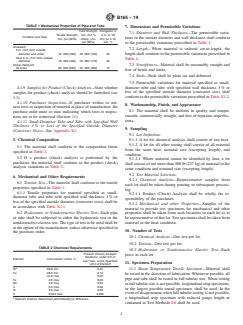
5.1 The material shall conform to the composition limits specified in Table 2.
5.2 If a product (check) analysis is performed by the purchaser, the material shall conform to the product (check) analysis
variations in Table 2.
6. Mechanical and Other Requirements
6.1 Tension Test—The material shall conform to the tensile properties specified in Table 1.
6.1.1 Tensile properties for material specified as small-diameter tube and light-wall tube tube with specified wall thickness 3 %
or less of the specified outside diameter (converter sizes) shall be in accordance with Table X1.1.
6.2 Hydrostatic or Nondestructive Electric Test—Each pipe or tube shall be subjected to either the hydrostatic test or the
nondestructive electric test. The type of test to be used shall be at the option of the manufacturer, unless otherwise specified in the
purchase order.
TABLE 2 Chemical Requirements
Product (Check) Analysis
Variations, under min or
Element Composition Limits, %
over max, of the Specified
Limit of Element
A
Ni 63.0 min 0.45
Cu 28.0 min 0.15
34.0 max 0.20
Fe 2.5 max 0.05
Mn 2.0 max 0.04
C 0.3 max 0.02
Si 0.5 max 0.03
S 0.024 max 0.005
A
Element shall be determined arithmetically by difference.
B165 − 19
7. Dimensions and Permissible Variations
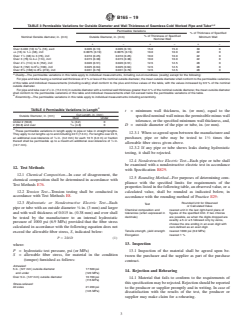
7.1 Diameter and Wall Thickness—The permissible variations in the outside diameter and wall thickness shall conform to the
permissible variations prescribed in Table 3.
7.2 Length—When material is ordered cut-to-length, the length shall conform to the permissible variations prescribed in Table
4.
7.3 Straightness—Material shall be reasonably straight and free of bends and kinks.
7.4 Ends—Ends shall be plain cut and deburred.
7.5 Permissible variations for material specified as small-diameter tube and light-wall tube tube with specified wall thickness
3 % or less of the specified outside diameter (converter size) shall conform to the permissible variations prescribed in Table X1.2.
8. Workmanship, Finish, and Appearance
8.1 The material shall be uniform in quality and temper, smooth, commercially straight, and free of injurious imperfections.
9. Sampling
9.1 Lot Definition:
9.1.1 A lot for chemical analysis shall consist of one heat.
9.1.2 A lot for all other testing shall consist of all material from the same heat, nominal size (excepting length), and condition.
9.1.2.1 Where material cannot be identified by heat, a lot shall consist of not more than 500 lb (227 kg) of material in the same
condition and nominal size (excepting length).
9.2 Test Material Selection:
9.2.1 Chemical Analysis—Representative samples from each lot shall be taken during pouring or subsequent processing.
9.2.1.1 Product (Check) Analysis shall be wholly the responsibility of the purchaser.
9.2.2 Mechanical and other Properties—Samples of the material to provide test specimens for mechanical and other properties
shall be taken from such locations in each lot as to be representative of that lot. Test specimens shall be taken from material in
the final condition.
10. Number of Tests
10.1 Chemical Analysis—One test per lot.
10.2 Tension—One test per lot.
10.3 Hydrostatic or Nondestructive Electric Test—Each piece in each lot.
11. Specimen Preparation
11.1 Room Temperature Tensile Specimen—Material shall be tested in the direction of fabrication. Whenever possible, all pipe
and tube shall be tested in full tubular size. When testing in full tubular size is not possible, longitudinal strip specimens, or the
largest possible round specimen, shall be used. In the event of disagreement when full tubular testing is not possible, a longitudinal
strip specimen with reduced gauge length as contained in Test Methods E8 shall be used.
A,B
TABLE 3 Permissible Variations for Outside Diameter and Wall Thickness of Seamless Cold Worked Pipe and Tube
Permissible Variations
% of Thickness of Specified
% of Thickness of Specified
Minimum Wall
Nominal Outside diameter, in. (mm) Outside Diameter, in. (mm)
Nominal Wall
+ − + − + −
Over 0.400 (10) to ⁄8 (16), excl 0.005 (0.13) 0.005 (0.13) 15.0 15.0 30 0
5 1
⁄8 (16) to 1 ⁄2 (38), incl 0.0075 (0.19) 0.0075 (0.19) 10.0 10.0 22 0
Over 1 ⁄2 (38) to 3 (76), incl 0.010 (0.25) 0.010 (0.25) 10.0 10.0 22 0
Over 3 (76) to 4 ⁄2 (114), incl 0.015 (0.38) 0.015 (0.38) 10.0 10.0 22 0
Over 4 ⁄2 (114) to 6 (152), incl 0.020 (0.51) 0.020 (0.51) 12.5 12.5 28 0
Over 6 (152) to 6 ⁄8 (168), incl 0.025 (0.64) 0.025 (0.64) 12.5 12.5 28 0
5 5
Over 6 ⁄8 (168) to 8 ⁄8 (219), incl 0.031 (0.79) 0.031 (0.79) 12.5 12.5 28 0
A
Ovality—The permissible variations in this table apply to individual measurements, including out-of-roundness (ovality) except for the following:
For pipe and tube having a nominal wall thickness of 3 % or less of the nominal outside diameter, the mean outside diameter shall conform to the permissible variations
of this table and individual measurements (including ovality) shall conform to the plus and minus values of the table, with the values increased by 0.5 % of the nominal
outside diameter.
For pipe and tube over 4 ⁄2 in. (114 mm) in outside diameter with a nominal wall thickness greater than 3 % of the nominal outside diameter, the mean outside diameter
shall conform to the permissible variations of this table and individual measurements shall not exceed twice the permissible variations of the table.
B
Eccentricity—The permissible variations in this table apply to individual measurements including eccentricity.
B165 − 19
A
TABLE 4 Permissible Variations in Length
Cut Length, in. (mm)
Outside Diameter, in. (mm)
Over Under
Under 2 (50.8) ⁄8 (3.2) 0
2 (50.8) and over ⁄16 (4.8) 0
A
These permissible variations in length apply to pipe or tube in straight lengths.
They apply to cut lengths up to and including 24 ft (7.3 m). For lengths over 24 ft,
an additional over-tolerance of ⁄8 in. (3.2 mm) for each 10 ft (3.0 m) or fraction
thereof shall be permissible up to a maximum additional over-tolerance of ⁄2 in. in.
(12.7 mm).
12. Test Methods
12.1 Chemical Composition—In case of disagreement, the chemical composition shall be determined in accordance with Test
Methods E76.
12.2 Tension Test—Tension testing shall be conducted in accordance with Test Methods E8.
12.3 Hydrostatic or Nondestructive Electric Test—Each pipe or tube with an outside diameter ⁄8 in. (3 mm) and larger and with
wall thickness of 0.015 in. (0.38 mm) and over shall be tested by the manufacturer to an internal hydrostatic pressure of 1000 psi
(6.9 MPa) provided that the fiber stress calculated in accordance with the following equation does not exceed the allowable fiber
stress, S, indicated below:
P 5 2St/D (1)
where:
P = hydrostatic test pressure, psi (or MPa)
S = allowable fiber stress, for material in the condition (temper) furnished as follows:
Annealed:
5 in. (127 mm) outside diameter 17 500 psi
and under (120 MPa)
Over 5 in. (127 mm) outside diameter 16 700 psi
(115 MPa)
Stress-relieved:
All sizes 21 200 psi
(145 MPa)
t = minimum wall thickness, in. (or mm), equal to the specified nominal wall minus the permissible minus wall tolerance, or
the specified minimum wall thickness, and,
D = outside diameter of the pipe or tube, in. (or mm).
12.3.1 When so agreed upon between the manufacturer and purchaser, pipe or tube may be tested to 1 ⁄2 times the allowable
fiber stress given above.
12.3.2 If any pipe or tube shows leaks during hydro
...