

ASTM F3019/F3019M-19
(Specification)Standard Specification for Chromium Free Zinc-Flake Composite, with or without Integral Lubricant, Corrosion Protective Coatings for Fasteners
General Information
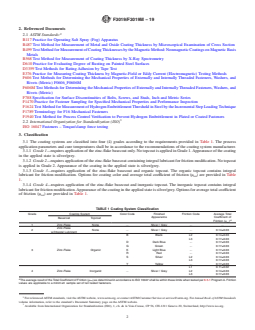
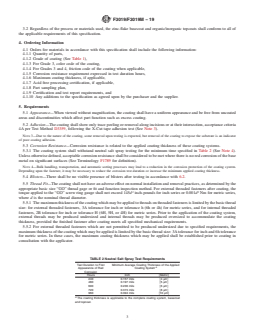
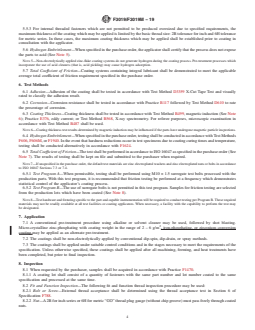
- Abstract
ABSTRACT
This specification establishes the basic requirements for non-electrolytically applied zinc-flake composite corrosion protective coating systems for fasteners. The requirements apply to appearance, adhesion, corrosion resistance, blisters, thread fit, hydrogen embrittlement, and total coefficient of friction. The coating systems covered by this specification do not contain hexavalent chromium, lead, cadmium, or mercury. This specification is intended for corrosion protection of inch and metric series threaded fasteners as well as for non-threaded fasteners such as washers and pins. This specification also covers test methods, application, inspection, and certification.
SCOPE
1.1 This specification covers the basic requirements for non-electrolytically applied zinc-flake composite corrosion protective coating systems for fasteners (See Note 1).
Note 1: The coating systems do not contain hexavalent chromium, lead, cadmium, or mercury.
1.2 This specification is intended for corrosion protection of inch and metric series threaded fasteners with minimum nominal diameters of 0.250 in. for inch series and [6.00 mm] for metric as well as for non-threaded fasteners such as washers and pins.
1.3 This coating system may be specified to consist of a zinc-flake basecoat, or a zinc-flake basecoat and topcoat (See Note 2).
Note 2: For threaded fasteners, the coating system will typically consist of a zinc-flake basecoat and topcoat.
1.3.1 The basecoat is a zinc-rich material containing aluminum flakes dispersed in a compatible liquid medium. The zinc-flake basecoat may be specified to contain integral lubricant.
1.3.2 Topcoats may be organic or inorganic in composition depending upon the specified requirements.
1.3.2.1 Organic topcoats consist of polymer resins, aluminum, dispersed pigments, and are colored in their applied state.
1.3.2.2 Inorganic topcoats consist of water-dispersed silicate compounds and are transparent in their applied state.
1.3.2.3 Topcoats contain integral lubricants and are applied in conjunction with zinc-flake basecoats to form a coating system with enhanced performance attributes such as increased corrosion resistance, total coefficient of friction properties, chemical resistance, and color.
1.4 These zinc-flake basecoats and topcoats are applied by conventional dip-spin, dip-drain, or spray methods to fasteners which can be handled through a cleaning, coating, and curing operation. The maximum curing temperature is 482 °F [250 °C].
1.5 The friction properties of the coating system may be determined by a standard test to verify process control or by a part specific test which requires the purchaser to establish and communicate technical criteria.
1.6 The values stated in either SI units or inch-pound units are to be regarded separately as standard. The values stated in each system are not necessarily exact equivalents; therefore, to ensure conformance with the standard, each system shall be used independently of the other, and values from the two systems shall not be combined.
1.7 This standard does not purport to address all of the safety concerns, if any, associated with its use. It is the responsibility of the user of this standard to establish appropriate safety, health, and environmental practices and determine the applicability of regulatory limitations prior to use.
1.8 This international standard was developed in accordance with internationally recognized principles on standardization established in the Decision on Principles for the Development of International Standards, Guides and Recommendations issued by the World Trade Organization Technical Barriers to Trade (TBT) Committee.
- Status
- Published
- Publication Date
- 30-Nov-2019
- Technical Committee
- F16 - Fasteners
- Drafting Committee
- F16.03 - Coatings on Fasteners
Buy Documents

ASTM F3019/F3019M-19 - Standard Specification for Chromium Free Zinc-Flake Composite, with or without Integral Lubricant, Corrosion Protective Coatings for Fasteners
REDLINE ASTM F3019/F3019M-19 - Standard Specification for Chromium Free Zinc-Flake Composite, with or without Integral Lubricant, Corrosion Protective Coatings for Fasteners
Overview
ASTM F3019/F3019M-19 sets forth the requirements for chromium-free zinc-flake composite corrosion protective coating systems, with or without integral lubricant, for fasteners. Developed by ASTM International, this standard helps ensure that coated fasteners provide robust corrosion protection without utilizing hazardous substances such as hexavalent chromium, lead, cadmium, or mercury. The specification covers both inch and metric series threaded and non-threaded fasteners, including washers and pins. By addressing coating appearance, adhesion, friction, corrosion resistance, and hydrogen embrittlement, this specification is essential for industries seeking durable, environmentally responsible fastener coatings.
Key Topics
- Non-Electrolytically Applied Coatings: The standard specifies zinc-flake coatings applied by dip-spin, dip-drain, or spray processes - not by electroplating.
- Chromium-Free Protection: All systems covered are free from hexavalent chromium, lead, cadmium, and mercury, aiding compliance with global environmental regulations.
- Grades of Coating Systems: Four grades are defined based on combinations of zinc-flake basecoats and organic/inorganic topcoats, along with options for integral lubricants and color coding.
- Performance Requirements:
- Appearance: Uniform coating free of uncoated areas or defects affecting fastener functionality
- Adhesion: Tested via tape test (ASTM D3359)
- Corrosion Resistance: Assessed through salt spray testing (ASTM B117), with performance tiered by coating thickness
- Blistering: Explicitly addressed in post-test inspections
- Thread Fit: Verified to ensure proper assembly and removal, with defined tolerancing for external and internal threads
- Hydrogen Embrittlement: Process controls to minimize risk, with testing when specified
- Friction Properties: Assessed for systems with integral lubricants per ISO 16047
- Test Methods & Inspection: Includes robust procedures for coating thickness, adhesion, corrosion resistance, and friction values, ensuring consistent coating performance.
Applications
ASTM F3019/F3019M-19 is widely used in sectors requiring high-performance, environmentally safe corrosion protective fastener coatings. Typical applications include:
- Automotive & Transportation: Protecting chassis and engine fasteners from corrosion while ensuring assembly efficiency and long-term reliability.
- Construction & Infrastructure: Safeguarding structural bolts, washers, and pins exposed to harsh outdoor or marine environments.
- Industrial Equipment: Extending service life of machinery fasteners exposed to chemical or high-humidity conditions.
- Electronics & Appliances: Maintaining thread integrity and appearance of small fasteners without introducing hazardous substances.
- Renewable Energy: Utilized in wind, solar, and other installations where robust, low-maintenance coatings are required.
The standard’s flexibility for different fastener diameters, thread types, and application methods supports its use across a diverse range of industries and component types.
Related Standards
For optimal results and compliance, ASTM F3019/F3019M-19 references or can be used in conjunction with several related standards:
- ASTM B117: Practice for salt spray (fog) corrosion testing
- ASTM B487, B499, B568, E376: Methods for measuring coating thickness by various methods
- ASTM D610, D3359: Practices for evaluating coatings’ rust resistance and adhesion
- ASTM F606/F606M, F788, F1470, F1624, F1789, F1940: Mechanical testing, sampling, and terminology for fasteners
- ISO 16047: Test methods for determining torque/clamp force and friction on fasteners
Keywords: corrosion protective coatings, zinc-flake, chromium free, fastener coatings, friction coatings, non-electrolytic, ASTM F3019, environmentally friendly fastener protection, thread fit, industrial coatings, dip-spin process, lubricant coatings, automotive fasteners
By referencing and applying this standard, manufacturers, specifiers, and users ensure compliance, reliability, and environmental responsibility in fastener applications worldwide.
Relations
- Effective Date
- 01-Dec-2019
- Effective Date
- 01-Jan-2024
- Effective Date
- 01-Nov-2023
- Effective Date
- 01-Aug-2019
- Effective Date
- 01-May-2019
- Refers
ASTM D610-08(2019) - Standard Practice for Evaluating Degree of Rusting on Painted Steel Surfaces - Effective Date
- 01-Jan-2019
- Effective Date
- 01-Nov-2018
- Effective Date
- 01-Sep-2018
- Effective Date
- 01-Feb-2018
- Effective Date
- 01-Nov-2017
- Effective Date
- 01-Jun-2017
- Effective Date
- 01-Aug-2016
- Effective Date
- 01-Mar-2015
- Effective Date
- 01-Feb-2015
- Effective Date
- 01-Sep-2014
Buy Documents
ASTM F3019/F3019M-19 - Standard Specification for Chromium Free Zinc-Flake Composite, with or without Integral Lubricant, Corrosion Protective Coatings for Fasteners
REDLINE ASTM F3019/F3019M-19 - Standard Specification for Chromium Free Zinc-Flake Composite, with or without Integral Lubricant, Corrosion Protective Coatings for Fasteners
Frequently Asked Questions
ASTM F3019/F3019M-19 is a technical specification published by ASTM International. Its full title is "Standard Specification for Chromium Free Zinc-Flake Composite, with or without Integral Lubricant, Corrosion Protective Coatings for Fasteners". This standard covers: ABSTRACT This specification establishes the basic requirements for non-electrolytically applied zinc-flake composite corrosion protective coating systems for fasteners. The requirements apply to appearance, adhesion, corrosion resistance, blisters, thread fit, hydrogen embrittlement, and total coefficient of friction. The coating systems covered by this specification do not contain hexavalent chromium, lead, cadmium, or mercury. This specification is intended for corrosion protection of inch and metric series threaded fasteners as well as for non-threaded fasteners such as washers and pins. This specification also covers test methods, application, inspection, and certification. SCOPE 1.1 This specification covers the basic requirements for non-electrolytically applied zinc-flake composite corrosion protective coating systems for fasteners (See Note 1). Note 1: The coating systems do not contain hexavalent chromium, lead, cadmium, or mercury. 1.2 This specification is intended for corrosion protection of inch and metric series threaded fasteners with minimum nominal diameters of 0.250 in. for inch series and [6.00 mm] for metric as well as for non-threaded fasteners such as washers and pins. 1.3 This coating system may be specified to consist of a zinc-flake basecoat, or a zinc-flake basecoat and topcoat (See Note 2). Note 2: For threaded fasteners, the coating system will typically consist of a zinc-flake basecoat and topcoat. 1.3.1 The basecoat is a zinc-rich material containing aluminum flakes dispersed in a compatible liquid medium. The zinc-flake basecoat may be specified to contain integral lubricant. 1.3.2 Topcoats may be organic or inorganic in composition depending upon the specified requirements. 1.3.2.1 Organic topcoats consist of polymer resins, aluminum, dispersed pigments, and are colored in their applied state. 1.3.2.2 Inorganic topcoats consist of water-dispersed silicate compounds and are transparent in their applied state. 1.3.2.3 Topcoats contain integral lubricants and are applied in conjunction with zinc-flake basecoats to form a coating system with enhanced performance attributes such as increased corrosion resistance, total coefficient of friction properties, chemical resistance, and color. 1.4 These zinc-flake basecoats and topcoats are applied by conventional dip-spin, dip-drain, or spray methods to fasteners which can be handled through a cleaning, coating, and curing operation. The maximum curing temperature is 482 °F [250 °C]. 1.5 The friction properties of the coating system may be determined by a standard test to verify process control or by a part specific test which requires the purchaser to establish and communicate technical criteria. 1.6 The values stated in either SI units or inch-pound units are to be regarded separately as standard. The values stated in each system are not necessarily exact equivalents; therefore, to ensure conformance with the standard, each system shall be used independently of the other, and values from the two systems shall not be combined. 1.7 This standard does not purport to address all of the safety concerns, if any, associated with its use. It is the responsibility of the user of this standard to establish appropriate safety, health, and environmental practices and determine the applicability of regulatory limitations prior to use. 1.8 This international standard was developed in accordance with internationally recognized principles on standardization established in the Decision on Principles for the Development of International Standards, Guides and Recommendations issued by the World Trade Organization Technical Barriers to Trade (TBT) Committee.
ABSTRACT This specification establishes the basic requirements for non-electrolytically applied zinc-flake composite corrosion protective coating systems for fasteners. The requirements apply to appearance, adhesion, corrosion resistance, blisters, thread fit, hydrogen embrittlement, and total coefficient of friction. The coating systems covered by this specification do not contain hexavalent chromium, lead, cadmium, or mercury. This specification is intended for corrosion protection of inch and metric series threaded fasteners as well as for non-threaded fasteners such as washers and pins. This specification also covers test methods, application, inspection, and certification. SCOPE 1.1 This specification covers the basic requirements for non-electrolytically applied zinc-flake composite corrosion protective coating systems for fasteners (See Note 1). Note 1: The coating systems do not contain hexavalent chromium, lead, cadmium, or mercury. 1.2 This specification is intended for corrosion protection of inch and metric series threaded fasteners with minimum nominal diameters of 0.250 in. for inch series and [6.00 mm] for metric as well as for non-threaded fasteners such as washers and pins. 1.3 This coating system may be specified to consist of a zinc-flake basecoat, or a zinc-flake basecoat and topcoat (See Note 2). Note 2: For threaded fasteners, the coating system will typically consist of a zinc-flake basecoat and topcoat. 1.3.1 The basecoat is a zinc-rich material containing aluminum flakes dispersed in a compatible liquid medium. The zinc-flake basecoat may be specified to contain integral lubricant. 1.3.2 Topcoats may be organic or inorganic in composition depending upon the specified requirements. 1.3.2.1 Organic topcoats consist of polymer resins, aluminum, dispersed pigments, and are colored in their applied state. 1.3.2.2 Inorganic topcoats consist of water-dispersed silicate compounds and are transparent in their applied state. 1.3.2.3 Topcoats contain integral lubricants and are applied in conjunction with zinc-flake basecoats to form a coating system with enhanced performance attributes such as increased corrosion resistance, total coefficient of friction properties, chemical resistance, and color. 1.4 These zinc-flake basecoats and topcoats are applied by conventional dip-spin, dip-drain, or spray methods to fasteners which can be handled through a cleaning, coating, and curing operation. The maximum curing temperature is 482 °F [250 °C]. 1.5 The friction properties of the coating system may be determined by a standard test to verify process control or by a part specific test which requires the purchaser to establish and communicate technical criteria. 1.6 The values stated in either SI units or inch-pound units are to be regarded separately as standard. The values stated in each system are not necessarily exact equivalents; therefore, to ensure conformance with the standard, each system shall be used independently of the other, and values from the two systems shall not be combined. 1.7 This standard does not purport to address all of the safety concerns, if any, associated with its use. It is the responsibility of the user of this standard to establish appropriate safety, health, and environmental practices and determine the applicability of regulatory limitations prior to use. 1.8 This international standard was developed in accordance with internationally recognized principles on standardization established in the Decision on Principles for the Development of International Standards, Guides and Recommendations issued by the World Trade Organization Technical Barriers to Trade (TBT) Committee.
ASTM F3019/F3019M-19 is classified under the following ICS (International Classification for Standards) categories: 87.040 - Paints and varnishes. The ICS classification helps identify the subject area and facilitates finding related standards.
ASTM F3019/F3019M-19 has the following relationships with other standards: It is inter standard links to ASTM F3019/F3019M-14, ASTM F1470-24, ASTM F1789-23, ASTM F1940-07a(2019), ASTM E376-19, ASTM D610-08(2019), ASTM F1624-12(2018), ASTM F788-13(2018), ASTM F1470-18, ASTM E376-17, ASTM F1789-17, ASTM F1789-16, ASTM F1789-15a, ASTM F1789-15, ASTM F1789-14a. Understanding these relationships helps ensure you are using the most current and applicable version of the standard.
ASTM F3019/F3019M-19 is available in PDF format for immediate download after purchase. The document can be added to your cart and obtained through the secure checkout process. Digital delivery ensures instant access to the complete standard document.
Standards Content (Sample)
This international standard was developed in accordance with internationally recognized principles on standardization established in the Decision on Principles for the
Development of International Standards, Guides and Recommendations issued by the World Trade Organization Technical Barriers to Trade (TBT) Committee.
Designation:F3019/F3019M −19
Standard Specification for
Chromium Free Zinc-Flake Composite, with or without
Integral Lubricant, Corrosion Protective Coatings for
Fasteners
ThisstandardisissuedunderthefixeddesignationF3019/F3019M;thenumberimmediatelyfollowingthedesignationindicatestheyear
of original adoption or, in the case of revision, the year of last revision.Anumber in parentheses indicates the year of last reapproval.
A superscript epsilon (´) indicates an editorial change since the last revision or reapproval.
1. Scope* 1.4 These zinc-flake basecoats and topcoats are applied by
conventional dip-spin, dip-drain, or spray methods to fasteners
1.1 This specification covers the basic requirements for
which can be handled through a cleaning, coating, and curing
non-electrolytically applied zinc-flake composite corrosion
operation. The maximum curing temperature is 482 °F
protective coating systems for fasteners (See Note 1).
[250°C].
NOTE 1—The coating systems do not contain hexavalent chromium,
1.5 The friction properties of the coating system may be
lead, cadmium, or mercury.
determined by a standard test to verify process control or by a
1.2 Thisspecificationisintendedforcorrosionprotectionof
part specific test which requires the purchaser to establish and
inch and metric series threaded fasteners with minimum
communicate technical criteria.
nominal diameters of 0.250 in. for inch series and [6.00 mm]
1.6 The values stated in either SI units or inch-pound units
formetricaswellasfornon-threadedfastenerssuchaswashers
are to be regarded separately as standard. The values stated in
and pins.
each system are not necessarily exact equivalents; therefore, to
1.3 This coating system may be specified to consist of a
ensure conformance with the standard, each system shall be
zinc-flake basecoat, or a zinc-flake basecoat and topcoat (See
used independently of the other, and values from the two
Note 2).
systems shall not be combined.
NOTE 2—For threaded fasteners, the coating system will typically
1.7 This standard does not purport to address all of the
consist of a zinc-flake basecoat and topcoat.
safety concerns, if any, associated with its use. It is the
responsibility of the user of this standard to establish appro-
1.3.1 The basecoat is a zinc-rich material containing alumi-
num flakes dispersed in a compatible liquid medium. The priate safety, health, and environmental practices and deter-
mine the applicability of regulatory limitations prior to use.
zinc-flake basecoat may be specified to contain integral lubri-
1.8 This international standard was developed in accor-
cant.
dance with internationally recognized principles on standard-
1.3.2 Topcoats may be organic or inorganic in composition
ization established in the Decision on Principles for the
depending upon the specified requirements.
Development of International Standards, Guides and Recom-
1.3.2.1 Organic topcoats consist of polymer resins,
mendations issued by the World Trade Organization Technical
aluminum,dispersedpigments,andarecoloredintheirapplied
Barriers to Trade (TBT) Committee.
state.
1.3.2.2 Inorganictopcoatsconsistofwater-dispersedsilicate
2. Referenced Documents
compounds and are transparent in their applied state.
2.1 ASTM Standards:
1.3.2.3 Topcoats contain integral lubricants and are applied
in conjunction with zinc-flake basecoats to form a coating B117Practice for Operating Salt Spray (Fog) Apparatus
systemwithenhancedperformanceattributessuchasincreased B487Test Method for Measurement of Metal and Oxide
corrosion resistance, total coefficient of friction properties, Coating Thickness by Microscopical Examination of
chemical resistance, and color. Cross Section
B499Test Method for Measurement of CoatingThicknesses
by the Magnetic Method: Nonmagnetic Coatings on
This specification is under the jurisdiction of ASTM Committee F16 on
Fasteners and is the direct responsibility of Subcommittee F16.03 on Coatings on
Fasteners. For referenced ASTM standards, visit the ASTM website, www.astm.org, or
Current edition approved Dec. 1, 2019. Published February 2020 Originally contact ASTM Customer Service at service@astm.org. For Annual Book of ASTM
approved in 2014. Last previous edition approved in 2014 as E3019/E3019M. DOI: Standards volume information, refer to the standard’s Document Summary page on
10.1520/F3019_F3019M–19. the ASTM website.
*A Summary of Changes section appears at the end of this standard
Copyright © ASTM International, 100 Barr Harbor Drive, PO Box C700, West Conshohocken, PA 19428-2959. United States
F3019/F3019M−19
Magnetic Basis Metals 3.1.1 Grade 1—requires application of the zinc-flake
B568Test Method for Measurement of Coating Thickness basecoatonly.NotopcoatisappliedinGrade1.Appearanceof
by X-Ray Spectrometry the coating in the applied state is silver/grey.
D610Practice for Evaluating Degree of Rusting on Painted
3.1.2 Grade 2—requires application of the zinc-flake
Steel Surfaces
basecoatcontainingintegrallubricantforfrictionmodification.
D3359Test Methods for Rating Adhesion by Tape Test
No topcoat is applied in Grade 2.Appearance of the coating in
E376 Practice for Measuring Coating Thickness by
the applied state is silver/grey.
Magnetic-Field or Eddy Current (Electromagnetic) Test-
3.1.3 Grade 3—requires application of the zinc-flake
ing Methods
basecoat and organic topcoat. The organic topcoat contains
F606Test Methods for Determining the Mechanical Proper-
integral lubricant for friction modification. Options for coating
ties of Externally and Internally Threaded Fasteners,
colorandaveragetotalcoefficientoffriction(µ )areprovided
tot
Washers, and Rivets (Metric) F0606_F0606M
in Table 1.
F606MTest Methods for Determining the Mechanical Prop-
3.1.4 Grade 4—requires application of the zinc-flake
erties of Externally and Internally Threaded Fasteners,
basecoatandinorganictopcoat.Theinorganictopcoatcontains
Washers, and Rivets (Metric)
integral lubricant for friction modification. Appearance of the
F788Specification for Surface Discontinuities of Bolts,
coating in the applied state is silver/grey. Options for average
Screws, and Studs, Inch and Metric Series
total coefficient of friction (µ ) are provided in Table 1.
tot
F1470Practice for Fastener Sampling for Specified Me-
3.2 Regardless of the process or materials used, the zinc-
chanical Properties and Performance Inspection
flake basecoat and organic/inorganic topcoats shall conform to
F1624Test Method for Measurement of Hydrogen Em-
all of the applicable requirements of this specification.
brittlement Threshold in Steel by the Incremental Step
Loading Technique
4. Ordering Information
F1789Terminology for F16 Mechanical Fasteners
F1940Test Method for Process Control Verification to
4.1 Orders for materials in accordance with this specifica-
Prevent Hydrogen Embrittlement in Plated or Coated
tion shall include the following information:
Fasteners
4.1.1 Quantity of parts,
2.2 International Organization for Standardization (ISO)
4.1.2 Grade of coating (See Table 1),
ISO 16047Fasteners – Torque/clamp force testing
4.1.3 For Grade 3, color code of the coating,
4.1.4 For Grades 3 and 4, friction code of the coating when
3. Classification
applicable,
3.1 The coating systems are classified into four (4) grades
4.1.5 Corrosion resistance requirement expressed in test
accordingtotherequirementsprovidedinTable1.Theprocess
duration hours,
application parameters and cure temperatures shall be in
4.1.6 Maximum coating thickness, if applicable,
accordance to the recommendations of the coating system
4.1.7 Acid free processing certification, if applicable,
manufacturer.
4.1.8 Part sampling plan,
4.1.9 Certification and test report requirements, and
4.1.10 Any additions to the specification as agreed upon by
the purchaser and the supplier.
Available from International Organization for Standardization (ISO), 1, ch. de
la Voie-Creuse, CP 56, CH-1211 Geneva 20, Switzerland, http://www.iso.org.
TABLE 1 Coating System Classification
Grade Coating System Color Code Finished Friction Code Average Total
Basecoat Topcoat Appearance Coefficient of
A
Friction (µ )
tot
1 Zinc-Flake None . Silver / Grey . .
Zinc-Flake
2 None . Silver / Grey . 0.14±0.03
w/Integral Lubricant
B Black L2 0.14±0.03
L3 0.17±0.03
D Dark Blue . 0.17±0.03
G Green . 0.17±0.03
3 Zinc-Flake Organic K Light Blue . 0.17±0.03
R Red . 0.17±0.03
S Silver L2 0.14±0.03
L3 0.17±0.03
Y Yellow . 0.17±0.03
L1 0.11±0.02
4 Zinc-Flake Inorganic . Silver / Grey L2 0.14±0.03
L3 0.17±0.03
A
The average result of the Total Coefficient of Friction (µ ) as determined in accordance to ISO 16047 shall lie within these limits when tested per 6.5.1 ProgramA. Friction
tot
values are applicable to a minimum sample set of ten tested fasteners.
F3019/F3019M−19
5. Requirements themaximumthicknessofthecoatingwhichmaybeappliedis
limited by the basic thread size: 3A tolerance for inch and 6h
5.1 Appearance—When viewed without magnification, the
tolerance for metric series. In these cases, the maximum
coating shall have a uniform appearance and be free from
coating thickness which may be applied shall be established
uncoated areas and discontinuities which affect part function
prior to coating in consultation with the applicator.
such as excess coating.
5.5.3 For internal threaded fasteners which are not permit-
5.2 Adhesion—The coati
...
This document is not an ASTM standard and is intended only to provide the user of an ASTM standard an indication of what changes have been made to the previous version. Because
it may not be technically possible to adequately depict all changes accurately, ASTM recommends that users consult prior editions as appropriate. In all cases only the current version
of the standard as published by ASTM is to be considered the official document.
Designation: F3019/F3019M − 14 F3019/F3019M − 19
Standard Specification for
Chromium Free Zinc-Flake Composite, with or without
Integral Lubricant, Corrosion Protective Coatings for
Fasteners
This standard is issued under the fixed designation F3019/F3019M; the number immediately following the designation indicates the year
of original adoption or, in the case of revision, the year of last revision. A number in parentheses indicates the year of last reapproval.
A superscript epsilon (´) indicates an editorial change since the last revision or reapproval.
1. Scope Scope*
1.1 This specification covers the basic requirements for non-electrolytically applied zinc-flake composite corrosion protective
coating systems for fasteners (See Note 1).
NOTE 1—The coating systems do not contain hexavalent chromium, lead, cadmium, or mercury.
1.2 This specification is intended for corrosion protection of inch and metric series threaded fasteners with minimum nominal
diameters of 0.250 in. for inch series and [6.00 mm] for metric as well as for non-threaded fasteners such as washers and pins.
1.3 This coating system may be specified to consist of a zinc-flake basecoat, or a zinc-flake basecoat and topcoat (See Note 2).
NOTE 2—For threaded fasteners, the coating system will typically consist of a zinc-flake basecoat and topcoat.
1.3.1 The basecoat is a zinc-rich material containing aluminum flakes dispersed in a compatible liquid medium. The zinc-flake
basecoat may be specified to contain integral lubricant.
1.3.2 Topcoats may be organic or inorganic in composition depending upon the specified requirements.
1.3.2.1 Organic topcoats consist of polymer resins, aluminum, dispersed pigments, and are colored in their applied state.
1.3.2.2 Inorganic topcoats consist of water-dispersed silicate compounds and are transparent in their applied state.
1.3.2.3 Topcoats contain integral lubricants and are applied in conjunction with zinc-flake basecoats to form a coating system
with enhanced performance attributes such as increased corrosion resistance, total coefficient of friction properties, chemical
resistance, and color.
1.4 These zinc-flake basecoats and topcoats are applied by conventional dip-spin, dip-drain, or spray methods to fasteners which
can be handled through a cleaning, coating, and curing operation. The maximum curing temperature is 482°F [250°C].482 °F
[250 °C].
1.5 The friction properties of the coating system may be determined by a standard test to verify process control or by a part
specific test which requires the purchaser to establish and communicate technical criteria.
1.6 The values stated in either SI units or inch-pound units are to be regarded separately as standard. The values stated in each
system are not necessarily exact equivalents; therefore, to ensure conformance with the standard, each system shall be used
independently of the other, and values from the two systems shall not be combined.
1.7 This standard does not purport to address all of the safety concerns, if any, associated with its use. It is the responsibility
of the user of this standard to establish appropriate safety and health practices and determine the applicability of regulatory
limitations prior to use.
1.7 This standard does not purport to address all of the safety concerns, if any, associated with its use. It is the responsibility
of the user of this standard to establish appropriate safety, health, and environmental practices and determine the applicability of
regulatory limitations prior to use.
1.8 This international standard was developed in accordance with internationally recognized principles on standardization
established in the Decision on Principles for the Development of International Standards, Guides and Recommendations issued
by the World Trade Organization Technical Barriers to Trade (TBT) Committee.
This specification is under the jurisdiction of ASTM Committee F16 on Fasteners and is the direct responsibility of Subcommittee F16.03 on Coatings on Fasteners.
Current edition approved Oct. 1, 2014Dec. 1, 2019. Published November 2014February 2020 Originally approved in 2014. Last previous edition approved in 2014 as
E3019/E3019M. DOI: 10.1520/F3019_F3019M–14.10.1520/F3019_F3019M–19.
*A Summary of Changes section appears at the end of this standard
Copyright © ASTM International, 100 Barr Harbor Drive, PO Box C700, West Conshohocken, PA 19428-2959. United States
F3019/F3019M − 19
2. Referenced Documents
2.1 ASTM Standards:
B117 Practice for Operating Salt Spray (Fog) Apparatus
B487 Test Method for Measurement of Metal and Oxide Coating Thickness by Microscopical Examination of Cross Section
B499 Test Method for Measurement of Coating Thicknesses by the Magnetic Method: Nonmagnetic Coatings on Magnetic Basis
Metals
B568 Test Method for Measurement of Coating Thickness by X-Ray Spectrometry
D610 Practice for Evaluating Degree of Rusting on Painted Steel Surfaces
D3359 Test Methods for Rating Adhesion by Tape Test
E376 Practice for Measuring Coating Thickness by Magnetic-Field or Eddy Current (Electromagnetic) Testing Methods
F606 Test Methods for Determining the Mechanical Properties of Externally and Internally Threaded Fasteners, Washers, and
Rivets (Metric) F0606_F0606M
F606M Test Methods for Determining the Mechanical Properties of Externally and Internally Threaded Fasteners, Washers, and
Rivets (Metric)
F788 Specification for Surface Discontinuities of Bolts, Screws, and Studs, Inch and Metric Series
F1470 Practice for Fastener Sampling for Specified Mechanical Properties and Performance Inspection
F1624 Test Method for Measurement of Hydrogen Embrittlement Threshold in Steel by the Incremental Step Loading Technique
F1789 Terminology for F16 Mechanical Fasteners
F1940 Test Method for Process Control Verification to Prevent Hydrogen Embrittlement in Plated or Coated Fasteners
2.2 International Organization for Standardization (ISO)
ISO 16047 Fasteners – Torque/clamp force testing
3. Classification
3.1 The coating systems are classified into four (4) grades according to the requirements provided in Table 1. The process
application parameters and cure temperatures shall be in accordance to the recommendations of the coating system manufacturer.
3.1.1 Grade 1—requires application of the zinc-flake basecoat only. No topcoat is applied in Grade 1. Appearance of the coating
in the applied state is silver/grey.
3.1.2 Grade 2—requires application of the zinc-flake basecoat containing integral lubricant for friction modification. No topcoat
is applied in Grade 2. Appearance of the coating in the applied state is silver/grey.
3.1.3 Grade 3—requires application of the zinc-flake basecoat and organic topcoat. The organic topcoat contains integral
lubricant for friction modification. Options for coating color and average total coefficient of friction (μ ) are provided in Table
tot
1.
3.1.4 Grade 4—requires application of the zinc-flake basecoat and inorganic topcoat. The inorganic topcoat contains integral
lubricant for friction modification. Appearance of the coating in the applied state is silver/grey. Options for average total coefficient
of friction (μ ) are provided in Table 1.
tot
TABLE 1 Coating System Classification
Grade Coating System Color Code Finished Friction Code Average Total
Basecoat Topcoat Appearance Coefficient of
A
Friction (μ )
tot
1 Zinc-Flake None . Silver / Grey . .
Zinc-Flake
2 None . Silver / Grey . 0.14±0.03
w/Integral Lubricant
B Black L2 0.14±0.03
L3 0.17±0.03
D Dark Blue . 0.17±0.03
G Green . 0.17±0.03
3 Zinc-Flake Organic K Light Blue . 0.17±0.03
R Red . 0.17±0.03
S Silver L2 0.14±0.03
L3 0.17±0.03
Y Yellow . 0.17±0.03
L1 0.11±0.02
4 Zinc-Flake Inorganic . Silver / Grey L2 0.14±0.03
L3 0.17±0.03
A
The average result of the Total Coefficient of Friction (μ ) as determined in accordance to ISO 16047 shall lie within these limits when tested per 6.5.1 Program A. Friction
tot
values are applicable to a minimum sample set of ten tested fasteners.
For referenced ASTM standards, visit the ASTM website, www.astm.org, or contact ASTM Customer Service at service@astm.org. For Annual Book of ASTM Standards
volume information, refer to the standard’s Document Summary page on the ASTM website.
Available from International Organization for Standardization (ISO), 1, ch. de la Voie-Creuse, CP 56, CH-1211 Geneva 20, Switzerland, http://www.iso.org.
F3019/F3019M − 19
3.2 Regardless of the process or materials used, the zinc-flake basecoat and organic/inorganic topcoats shall conform to all of
the applicable requirements of this specification.
4. Ordering Information
4.1 Orders for materials in accordance with this specification shall include the following information:
4.1.1 Quantity of parts,
4.1.2 Grade of coating (See Table 1),
4.1.3 For Grade 3, color code of the coating,
4.1.4 For Grades 3 and 4, friction code of the coating when applicable,
4.1.5 Corrosion resistance requirement expressed in test duration hours,
4.1.6 Maximum coating thickness, if applicable,
4.1.7 Acid free processing certification, if applicable,
4.1.8 Part sampling plan,
4.1.9 Certification and test report requirements, and
4.1.10 Any additions to the specification as agreed upon by the purchaser and the supplier.
5. Requirements
5.1 Appearance—When viewed without magnification, the coating shall have a uniform appearance and be free from uncoated
areas and discontinuities which affect part function such as excess coating.
5.2 Adhesion—The coating shall show only trace peeling or removal along incisions or at their intersection, acceptance criteria
4A per Test Method D3359, following the X-
...