

ASTM D1384-24
(Test Method)Standard Test Method for Corrosion Test for Engine Coolants in Glassware
General Information
- Abstract
SIGNIFICANCE AND USE
5.1 This test method will generally distinguish between coolants that are definitely deleterious from the corrosion standpoint and those that are suitable for further evaluation. However, the results of this test method cannot stand alone as evidence of satisfactory corrosion inhibition. The actual service value of an engine coolant formulation can be determined only by more comprehensive bench, dynamometer, and field tests.
SCOPE
1.1 This test method covers a simple beaker-type procedure for evaluating the effects of engine coolants on metal specimens under controlled laboratory conditions (see Appendix X1).
Note 1: For more information on engine coolants, see (Refs 1-8).2
1.2 The values stated in SI units are to be regarded as standard. The values given in parentheses after SI units are provided for information only and are not considered standard.
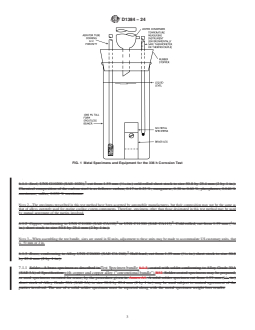
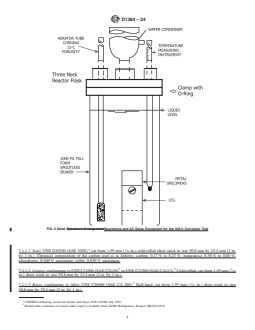
1.3 This standard does not purport to address all of the safety concerns, if any, associated with its use. It is the responsibility of the user of this standard to establish appropriate safety, health, and environmental practices and determine the applicability of regulatory limitations prior to use. Specific hazard statements are given in 11.1.7.2, 11.1.7.3, and 11.1.7.4.
1.4 This international standard was developed in accordance with internationally recognized principles on standardization established in the Decision on Principles for the Development of International Standards, Guides and Recommendations issued by the World Trade Organization Technical Barriers to Trade (TBT) Committee.
- Status
- Published
- Publication Date
- 31-Dec-2023
- Technical Committee
- D15 - Engine Coolants and Related Fluids
- Drafting Committee
- D15.06 - Glassware Performance Tests
Overview
ASTM D1384-24: Standard Test Method for Corrosion Test for Engine Coolants in Glassware provides a laboratory procedure to evaluate the corrosion effects of engine coolants on metal specimens that simulate automobile cooling system components. This standardized glassware test is intended to serve as an initial screening tool to identify coolants that may be corrosive and unsuitable for further testing.
While the ASTM D1384-24 method helps distinguish coolants that are definitely deleterious from those potentially suitable for further evaluation, it should not be used as definitive proof of corrosion inhibition in service. Further testing through bench, dynamometer, or field trials is required for a full assessment of coolant performance.
Key Topics
Test Scope and Approach
- The method uses a beaker-type procedure in controlled laboratory conditions, immersing standard specimens of metals found in engine cooling systems (such as steel, copper, brass, solder, cast aluminum, and cast iron) in aerated engine coolant solutions.
- Tests are conducted for a set period (336 hours) at elevated temperatures to simulate operating conditions.
- Metal weight changes after immersion indicate the corrosive effect of the coolant.
Laboratory Conditions
- Use of heat-resistant glassware and precise temperature control is essential.
- Specimens are cleaned and prepared according to detailed procedural steps to ensure reliable, repeatable results.
- The method notes the technical limitations and inherent variability (precision and bias) due to differences in laboratory practices.
Safety and Compliance
- Users must establish and follow appropriate safety and environmental protocols.
- This standard aligns with recognized international principles for developing standards, taking into account regulatory limitations and hazard statements.
Applications
Coolant Quality Screening
- Used by coolant manufacturers, automotive OEMs, and testing laboratories to identify unsuitable or potentially damaging coolants before moving to more resource-intensive testing phases.
Product Development and Benchmarking
- Assists in the early comparison of different coolant formulations regarding their basic corrosion performance.
- Supports benchmarking against industry reference coolants to ensure new products do not negatively interact with common engine metals.
Regulatory and Industry Compliance
- Helps verify that an engine coolant meets basic corrosion-resistance criteria as required by automotive and heavy-duty engine manufacturers or regulatory bodies.
Quality Control
- Used as part of ongoing quality control programs for both coolants and cooling system components' material selection.
Related Standards
Testing and interpretation of results according to ASTM D1384-24 may reference several important related standards, including:
- ASTM D1176: Practice for Sampling and Preparing Aqueous Solutions of Engine Coolants or Antirusts for Testing Purposes
- ASTM D4725: Terminology for Engine Coolants and Related Fluids
- ASTM B32: Specification for Solder Metal
- ASTM B36/B36M: Specification for Brass Plate, Sheet, Strip, and Rolled Bar
- ASTM E1: Specification for ASTM Liquid-in-Glass Thermometers
- ASTM E177: Practice for Use of the Terms Precision and Bias in ASTM Test Methods
- ASTM G31: Guide for Laboratory Immersion Corrosion Testing of Metals
Practical Value
Adopting ASTM D1384-24 helps ensure that engine coolants undergo standardized corrosion assessment, supporting safer, more reliable vehicle operation. By establishing a common framework for testing, it enables meaningful comparison of products across the automotive coolant industry, supporting innovation while upholding essential quality and performance requirements. Using this method early in coolant development or procurement helps reduce risk, cost, and operational issues related to coolant-induced corrosion.
Keywords: ASTM D1384-24, corrosion test, engine coolants, laboratory glassware, coolant screening, automotive standards, metal corrosion, coolant quality control.
Relations
- Replaces
ASTM D1384-05(2019) - Standard Test Method for Corrosion Test for Engine Coolants in Glassware - Effective Date
- 01-Jan-2024
- Referred By
ASTM D7935-20 - Standard Test Method for Corrosion Test for Non-Aqueous Engine Coolants in Glassware - Effective Date
- 01-Jan-2024
- Effective Date
- 01-Jan-2024
- Effective Date
- 01-Jan-2024
- Referred By
ASTM D8040-18(2023) - Standard Test Method for Corrosion Test for Heat Transfer Fluids in Glassware - Effective Date
- 01-Jan-2024
- Effective Date
- 01-Jan-2024
- Effective Date
- 01-Jan-2024
- Effective Date
- 01-Jan-2024
- Effective Date
- 01-Jan-2024
- Effective Date
- 01-Jan-2024
- Referred By
ASTM D2570-16 - Standard Test Method for Simulated Service Corrosion Testing of Engine Coolants - Effective Date
- 01-Jan-2024
- Effective Date
- 01-Jan-2024
- Referred By
ASTM D8485-23 - Standard Test Method for Corrosion Test for Electric Vehicle Coolants in Glassware - Effective Date
- 01-Jan-2024
Get Certified
Connect with accredited certification bodies for this standard

ECOCERT
Organic and sustainability certification.

Eurofins Food Testing Global
Global leader in food, environment, and pharmaceutical product testing.

Intertek Bangladesh
Intertek certification and testing services in Bangladesh.
Sponsored listings
Frequently Asked Questions
ASTM D1384-24 is a standard published by ASTM International. Its full title is "Standard Test Method for Corrosion Test for Engine Coolants in Glassware". This standard covers: SIGNIFICANCE AND USE 5.1 This test method will generally distinguish between coolants that are definitely deleterious from the corrosion standpoint and those that are suitable for further evaluation. However, the results of this test method cannot stand alone as evidence of satisfactory corrosion inhibition. The actual service value of an engine coolant formulation can be determined only by more comprehensive bench, dynamometer, and field tests. SCOPE 1.1 This test method covers a simple beaker-type procedure for evaluating the effects of engine coolants on metal specimens under controlled laboratory conditions (see Appendix X1). Note 1: For more information on engine coolants, see (Refs 1-8).2 1.2 The values stated in SI units are to be regarded as standard. The values given in parentheses after SI units are provided for information only and are not considered standard. 1.3 This standard does not purport to address all of the safety concerns, if any, associated with its use. It is the responsibility of the user of this standard to establish appropriate safety, health, and environmental practices and determine the applicability of regulatory limitations prior to use. Specific hazard statements are given in 11.1.7.2, 11.1.7.3, and 11.1.7.4. 1.4 This international standard was developed in accordance with internationally recognized principles on standardization established in the Decision on Principles for the Development of International Standards, Guides and Recommendations issued by the World Trade Organization Technical Barriers to Trade (TBT) Committee.
SIGNIFICANCE AND USE 5.1 This test method will generally distinguish between coolants that are definitely deleterious from the corrosion standpoint and those that are suitable for further evaluation. However, the results of this test method cannot stand alone as evidence of satisfactory corrosion inhibition. The actual service value of an engine coolant formulation can be determined only by more comprehensive bench, dynamometer, and field tests. SCOPE 1.1 This test method covers a simple beaker-type procedure for evaluating the effects of engine coolants on metal specimens under controlled laboratory conditions (see Appendix X1). Note 1: For more information on engine coolants, see (Refs 1-8).2 1.2 The values stated in SI units are to be regarded as standard. The values given in parentheses after SI units are provided for information only and are not considered standard. 1.3 This standard does not purport to address all of the safety concerns, if any, associated with its use. It is the responsibility of the user of this standard to establish appropriate safety, health, and environmental practices and determine the applicability of regulatory limitations prior to use. Specific hazard statements are given in 11.1.7.2, 11.1.7.3, and 11.1.7.4. 1.4 This international standard was developed in accordance with internationally recognized principles on standardization established in the Decision on Principles for the Development of International Standards, Guides and Recommendations issued by the World Trade Organization Technical Barriers to Trade (TBT) Committee.
ASTM D1384-24 is classified under the following ICS (International Classification for Standards) categories: 71.100.45 - Refrigerants and antifreezes. The ICS classification helps identify the subject area and facilitates finding related standards.
ASTM D1384-24 has the following relationships with other standards: It is inter standard links to ASTM D1384-05(2019), ASTM D7935-20, ASTM D3585-08(2020), ASTM D7820-19, ASTM D8040-18(2023), ASTM D5752-10(2017), ASTM D4985-10(2023), ASTM D3306-21, ASTM G1-03(2017)e1, ASTM D7518-20, ASTM D2570-16, ASTM D7714-11(2021), ASTM D8485-23. Understanding these relationships helps ensure you are using the most current and applicable version of the standard.
ASTM D1384-24 is available in PDF format for immediate download after purchase. The document can be added to your cart and obtained through the secure checkout process. Digital delivery ensures instant access to the complete standard document.
Standards Content (Sample)
This international standard was developed in accordance with internationally recognized principles on standardization established in the Decision on Principles for the
Development of International Standards, Guides and Recommendations issued by the World Trade Organization Technical Barriers to Trade (TBT) Committee.
Designation: D1384 − 24
Standard Test Method for
Corrosion Test for Engine Coolants in Glassware
This standard is issued under the fixed designation D1384; the number immediately following the designation indicates the year of
original adoption or, in the case of revision, the year of last revision. A number in parentheses indicates the year of last reapproval. A
superscript epsilon (´) indicates an editorial change since the last revision or reapproval.
1. Scope E177 Practice for Use of the Terms Precision and Bias in
ASTM Test Methods
1.1 This test method covers a simple beaker-type procedure
E178 Practice for Dealing With Outlying Observations
for evaluating the effects of engine coolants on metal speci-
E230 Specification for Temperature-Electromotive Force
mens under controlled laboratory conditions (see Appendix
(emf) Tables for Standardized Thermocouples
X1).
E691 Practice for Conducting an Interlaboratory Study to
NOTE 1—For more information on engine coolants, see (Refs 1-8).
Determine the Precision of a Test Method
G31 Guide for Laboratory Immersion Corrosion Testing of
1.2 The values stated in SI units are to be regarded as
standard. The values given in parentheses after SI units are Metals
2.2 ASTM Adjuncts:
provided for information only and are not considered standard.
All-glass apparatus for corrosion test (2 drawings)
1.3 This standard does not purport to address all of the
safety concerns, if any, associated with its use. It is the
3. Terminology
responsibility of the user of this standard to establish appro-
3.1 Definitions—For definitions of general terms used in
priate safety, health, and environmental practices and deter-
D15 standards, refer to Terminology D4725.
mine the applicability of regulatory limitations prior to use.
Specific hazard statements are given in 11.1.7.2, 11.1.7.3, and 3.2 Abbreviations:
11.1.7.4.
3.2.1 PTFE, n—Polytetrafluoroethylene
1.4 This international standard was developed in accor-
4. Summary of Test Method
dance with internationally recognized principles on standard-
ization established in the Decision on Principles for the 4.1 In this test method, specimens of metals typical of those
Development of International Standards, Guides and Recom- present in engine cooling systems are totally immersed in
mendations issued by the World Trade Organization Technical aerated engine coolant solutions for 336 h at 88 °C (190 °F).
Barriers to Trade (TBT) Committee. The corrosion-inhibitive properties of the test solution are
evaluated on the basis of the weight changes incurred by the
2. Referenced Documents
specimens. Each test is run in triplicate, and the average weight
2.1 ASTM Standards: change is determined for each metal. A single test may
B32 Specification for Solder Metal occasionally be completely out of line (see 12.2).
B36/B36M Specification for Brass Plate, Sheet, Strip, And
5. Significance and Use
Rolled Bar
D1176 Practice for Sampling and Preparing Aqueous Solu- 5.1 This test method will generally distinguish between
tions of Engine Coolants or Antirusts for Testing Purposes coolants that are definitely deleterious from the corrosion
standpoint and those that are suitable for further evaluation.
D4725 Terminology for Engine Coolants and Related Fluids
E1 Specification for ASTM Liquid-in-Glass Thermometers However, the results of this test method cannot stand alone as
evidence of satisfactory corrosion inhibition. The actual ser-
vice value of an engine coolant formulation can be determined
This test method is under the jurisdiction of ASTM Committee D15 on Engine
only by more comprehensive bench, dynamometer, and field
Coolants and Related Fluids and is the direct responsibility of Subcommittee
D15.06 on Glassware Performance Tests.
tests.
Current edition approved Jan. 1, 2024. Published February 2024. Originally
approved in 1955. Last previous edition approved in 2019 as D1384 – 05 (2019).
6. Apparatus
DOI: 10.1520/D1384-24.
6.1 Container—A 1000 mL, tall-form, spoutless beaker,
The boldface numbers in parentheses refer to the list of references at the end of
this standard.
made of heat-resistant glass, for containing the engine coolant
For referenced ASTM standards, visit the ASTM website, www.astm.org, or
contact ASTM Customer Service at service@astm.org. For Annual Book of ASTM
Standards volume information, refer to the standard’s Document Summary page on Details available from: ASTM International Headquarters. Order Adjunct No.
the ASTM website. ADJD1384. Original adjunct produced in (1980).
Copyright © ASTM International, 100 Barr Harbor Drive, PO Box C700, West Conshohocken, PA 19428-2959. United States
D1384 − 24
solution and test specimens. The beaker shall be tightly closed 7. Metal Test Specimens
with a No. 15 rubber stopper, having drill holes to accommo-
7.1 Type—Either one or both of the following metal test
date a water condenser, an aerator tube, and a thermometer as
specimen bundles, representative of cooling system metals,
shown in Fig. 1. Optionally, an all-glass apparatus may be used
may be used as agreed between customer and supplier (see
(Fig. 2).
Note 2):
6.2 Condenser—A water condenser of the reflux, glass-tube
NOTE 2—The specimens prescribed in this test method have been
accepted by automobile manufacturers, but their composition may not be
type, having a 400 mm (16 in.) condenser jacket.
the same as that of alloys currently used for engine cooling system
6.3 Aerator Tube—A gas-dispersion tube, porosity size
components. Therefore, specimens other than those designated in this test
method may be used by mutual agreement of the parties involved.
40 μm to 60 μm to ensure continuous aeration without plug-
NOTE 3—When assembling the test bundle, sizes are stated in SI units,
ging. Optionally, a capillary tip bleed tube with a 7 mm (0.28
adjustment to these units may be made to accommodate US customary
in.) bore and 280 mm (11.2 in.) length may be used when
units, that is, 51 mm or 2 in.
consistent early plugging of gas dispersion tubes occurs.
7.1.1 Test Specimen bundle with copper and copper alloy
6.4 Temperature Measuring Instrument (Environmentally
(“conventional bundle”).
Safe Thermometer or Thermocouple)—An ASTM Partial Im-
7.1.1.1 Steel, UNS G10200 (SAE 1020), cut from 1.59 mm
mersion Temperature Measuring Instrument having a range ( ⁄16 in.) cold-rolled sheet stock to size 50.8 mm by 25.4 mm
from −20 °C to 150 °C (0 °F to 302 °F) and conforming to the (2 in. by 1 in.). Chemical composition of the carbon steel is as
requirements for Thermometer 1C (1F), as prescribed in follows: carbon, 0.17 % to 0.23 %; manganese, 0.30 % to
Specification E1 or Thermocouple as summarized in Specifi- 0.60 %; phosphorus, 0.040 % maximum; sulfur, 0.050 % maxi-
mum.
cation E230.
7.1.1.2 Copper, conforming to UNS C11000 (SAE CA110)
6.5 Heater—A constant-temperature bath containing a high-
or UNS C11300 (SAE CA113). Cold-rolled, cut from 1.59
boiling liquid or another suitable heating device that is capable
mm ( ⁄16 in.) sheet stock to size 50.8 mm by 25.4 mm (2 in. by
of giving continuous service with the specified temperature
1 in.).
control.
7.1.1.3 Brass, conforming to Alloy UNS C26000 (SAE CA
260). Half-hard, cut from 1.59 mm ( ⁄16 in.) sheet stock to size
50.8 mm by 25.4 mm (2 in. by 1 in.).
7.1.1.4 Solder—A brass specimen as described in 7.1.1.3,
coated with solder conforming to Alloy Grade 30A (SAE 3A)
of Specification B32. Solder-coated specimens may be pre-
pared by the procedure given in Annex A1. A solid solder
specimen cut from 1.59 mm ( ⁄16 in.) sheet stock of Alloy
Grade 30A (SAE 3A) to size 50.8 mm by 25.4 mm (2 by 1 in.)
may be used subject to mutual agreement of the parties
involved. The use of a solid solder specimen must be reported
along with the metal specimen weight loss results.
(1) When agreed upon between the supplier and the pur-
chaser of engine coolants, the standard solder specimen may be
replaced with one having a different alloy composition than
standard Alloy Grade 30A or 30B. Use of specimens other than
standard Alloy Grade 30A or 30B shall be noted in the test
report.
NOTE 4—Where non-standard alloy is used, the standard flux shown in
A1.1.5 may not be satisfactory. A low corrosive flux may be required.
7.1.1.5 Cast Aluminum, conforming to Alloy UNS A23190
(SAE 329). Specimen size, 50.8 mm by 25.4 mm by 3.18 mm
(2 in. by 1 in. by ⁄8 in.).
7.1.1.6 Cast Iron, conforming to Alloy UNS F10007 (SAE
G3500). Specimen size, 50.8 mm by 25.4 mm by 3.18 mm
(2 in. by 1 in. by ⁄8 in.).
7.1.2 Test Specimen bundle with no copper, copper alloy, or
steel test specimen (“aluminum bundle”).
UNIFIED numbering system for metals and alloys, SAE-ASTM, July 1995.
FIG. 1 Metal Specimens and Equipment for the 336 h Corrosion Round-robin evaluation of coated solder report is available from ASTM
Test Headquarters. Request RR:D15-0132.
D1384 − 24
FIG. 2 Metal Specimens and All Glass Equipment for the 336 h Corrosion Test
7.1.2.1 Aluminum 3003, conforming to Alloy UNS A93003 7.1.2.6 Cast Iron, conforming to Alloy UNS F10007 (SAE
5 5
(SAE 3003). Specimen size, 50.8 mm by 25.4 mm by G3500). Specimen size, 50.8 mm by 25.4 mm by 3.18 mm
1 1
1.59 mm (2 in. by 1 in. by ⁄16 in.).
(2 in. by 1 in. by ⁄8 in.).
7.1.2.2 Aluminum 319, conforming to Alloy UNS A23190
5 7.2 Arrangement:
(SAE 329). Specimen size, 50.8 mm by 25.4 mm by 3.18 mm
7.2.1 Conventional Bundle (See Fig. 3): Metal Specimen
(2 in. by 1 in. by ⁄8 in.).
Arrangement—None of the hardware used in metal specimen
7.1.2.3 Aluminum 380.1, conforming to Alloy UNS A13801
arrangement (metal specimen, screws, washers, metal spacers,
(SAE 306). Specimen size, 50.8 mm by 25.4 mm by 3.18 mm
insulating sleeves, insulating spacers and nuts) can be reused
(2 in. by 1 in. by ⁄8 in.).
for a test. The metal test specimens shall be drilled through the
7.1.2.4 Aluminum 7075, conforming to Alloy UNS A97075
center with a 6.75 mm ( ⁄64 in.) drill to accommodate a
(SAE 7075). Specimen size, 50.8 mm by 25.4 mm by
50.8 mm (2 in.) 10–24 brass machine screw covered with a
1.59 mm (2 in. by 1 in. by ⁄16 in.).
7.1.2.5 Aluminum 7075 Clad, conforming to Alloy UNS thin-walled insulating sleeve. Polytetrafluoroethylene (PTFE)
tubing with a 6.35 mm ( ⁄4 in.) outside diameter 1.59 mm
A87075. Specimen size, 50.8 mm by 25.4 mm by 1.59 mm
1 1 1
(2 in. by 1 in. by ⁄16 in.). ( ⁄16 in.) wide and a wall thickness of 0.4 mm ( ⁄64 in.) is
D1384 − 24
thin-walled insulating sleeve. PTFE tubing with a 6.35 mm
1 1
( ⁄4 in.) outside diameter 1.59 mm ( ⁄16 in.) wide and a wall
thickness of 0.4 mm ( ⁄64 in.) is satisfactory. Two PTFE legs
shall be cut from 1.59 mm ( ⁄16 in.) sheet stock to size 50.8 mm
by 25.4 mm (2 in. by 1 in.). A 6.35 mm ( ⁄4 in.) diameter hole
shall be drilled in each leg with the center 6.35 mm ( ⁄4 in.)
from the top and 12.7 mm ( ⁄2 in.) from each side. The test
“bundle” shall be made up on the insulated screw with the
specimens in the following order: PTFE leg, AL3003, AL319,
AL380.1, AL7075, AL7075 Clad, cast iron, and PTFE leg. The
specimens shall be separated by 4.76 mm ( ⁄16 in.) thick solid
PTFE spacers having a 6.75 mm ( ⁄64 in.) inside diameter and
a 11.11 mm ( ⁄16 in.) outside diameter. Insulating spacers made
from PTFE shall be used between the PTFE legs and the
specimen “bundle,” and between the specimens. The nut shall
FIG. 3 Metal Specimen Arrangement
be tightened firmly.”
7.2.3.2 The use of alternate specimens and their arrange-
satisfactory. Two half-hard brass legs shall be cut from 1.59
ments shall be noted in the test report.
mm ( ⁄16 in.) sheet stock to size 50.8 mm by 25.4 mm (2 in. by
1 in.). A 6.35 mm ( ⁄4 in.) diameter hole shall be drilled in each
8. Preparation of Test Specimens
leg with the center 6.35 mm ( ⁄4 in.) from the top and 12.7 mm
8.1 Sand the cast iron and cast aluminum specimens on the
( ⁄2 in.) from each side. The test “bundle” shall be made up on
25.4 mm by 50.8 mm (1 in. by 2 in.) cut surfaces with “coarse”
the insulated screw with the specimens in the following order:
grade (No. 1) emery cloth. Remove any burrs from coupon
brass leg, copper, solder, brass, steel, cast iron, cast aluminum,
edges and hole. Scrub all specimens vigorously, using a
and brass leg. The specimens shall be separated by 4.76 mm
moistened bristle brush and ground pumice powder or fine
3 17
( ⁄16 in.) thick solid metal spacers having a 6.75 mm ( ⁄64 in.)
silicon carbide grit until the entire metal area is bright, shiny,
inside diameter and a 11.11 mm ( ⁄16 in.) outside diameter.
and free from any visible oxide film or tarnish.
Insulating spacers made from polytetrafluoroethylene shall be
8.2 Rinse the specimens thoroughly with tap water; then
used between the brass legs and the specimen “bundle,” and
rinse with acetone, dry, and weigh to the nearest 1 mg. Cast
between the brass and steel specimens. Brass spacers shall be
aluminum specimens should be dried in a 100 °C oven for 1 h,
used between the brass, solder, and copper specimens, and steel
to a constant weight, prior to recording the weight.
spacers between the cast iron, steel, and cast aluminum
specimens. The nut shall be tightened firmly to ensure good
NOTE 5—Test specimens that have been prepared by the specimen
electrical contact between the test specimens in each section of
supplier in the manner described in this section may be used as supplied
without further preparation.
the “bundle.”
NOTE 6—If the test specimens are not to be used immediately, keep
7.2.2 Alternate Metal Specimen Arrangement—When
them in a desiccator until required.
agreed upon between the supplier and the purchaser, an
alternate metal specimen arrangement may be used to evaluate
9. Test Solutions
multiple solder alloys, such as high lead Alloy Grade L50113
9.1 The concentration of the engine coolant to be tested
consisting of 97 % lead, 2.5 % tin, 0.3 % silver, concurrently
shall be as follows:
with Standard Alloy Grade 30A or 30B. It is recommended that
9.1.1 Engine Coolant—The engine coolant, EG or PG
the metal specimen arrangement be modified by replacing the
based, shall be mixed with the proper quantity of corrosive
copper specimen with the high lead solder specimen and
water to give a 33 ⁄3 volume % coolant test solution.
arranging specimens in the bundle as follows:
9.1.2 Corrosive Water (Note 7)—The corrosive water shall
High Lead Brass Alloy Grade Steel Cast Iron Cast
contain 100 ppm each of sulfate, chloride, and bicarbonate ions
Solder 30A or 30B Aluminum
introduced as sodium salts.
Use of alternate specimens and metal specimens arrange-
ments shall be noted in the test report.
9.2 Preparation of Sample—The preparation of the sample
7.2.3 Aluminum Bundle Metal Specimen Arrangement (See
shall be done in accordance with the section on Preparation of
Fig. 4)—When agreed upon between the supplier and the
Solutions Requiring Inclusion of Separated Solids and Liquids
purchaser, an aluminum metal specimen arrangement may be
in Test Method D1176, except that the corrosive water shall be
used to evaluate multiple aluminum alloys as specified in 7.1.2.
used for dilution instead of distilled water. Thus, any insoluble
The metal specimen arrangement shall be arranged as follows:
materials will be included in the representative sample.
7.2.3.1 All the hardware used in metal specimen arrange-
NOTE 7—The specified corrosive water can be prepared by dissolving
ment (metal specimen, screws, washers, metal spacers, insu-
the following amounts of anhydrous sodium salts in a quantity of distilled
lating sleeves, insulating spacers, and nuts) shall be new and
or deionized water.
unused. The metal test specimens shall be drilled through the
sodium sulfate 148 mg
center with a 6.75 mm ( ⁄64 in.) drill to accommodate a sodium chloride 165 mg
sodium bicarbonate 138 mg
50.8 mm (2 in.) 10–24 brass machine screw covered with a
D1384 − 24
Item Quantity Description
1 1 10-24 Hex Nut
2 1 10-24 x 2 ½” Pan Head Screw
3 2 #10 Flat Washer -Brass
4 1 AL3003 Corrosion Coupon
5 1 AL 319.0 Corrosion Coupon
6 1 AL380.1 Corrosion Coupon
7 1 AL7075 Corrosion Coupon
8 1 AL 7075 Clad (7-72 Cladding) Corrosion Coupon (edges bare)
9 1 Gray Cast Iron Corrosion Coupon
10 5 PTFE spacers
11 2 PTFE Leg
12 1 PTFE sleeve
13 2 PTFE spacers
FIG. 4 Aluminum Bundle Metal Specimen Arrangement
The resulting solution should be made up to a volume of 1 L with
12.7 mm ( ⁄2 in.) away from the test “bundle” to avoid direct
distilled or deionized water at 20 °C.
contact with the metal specimens.
If relatively large amounts of corrosive water are needed for testing, a
concentrate may be prepared by dissolving ten times the above amounts of 10.4 Test Duration—The test shall be run continuously for 2
the three chemicals, in distilled or deionized water, and adjusting the total
weeks (336 h).
volume to 1 L by further additions of distilled or deionized water. When
needed, the water concentrate is diluted to the ratio of one part by volume
11. Procedure
of concentrate to nine parts of distilled or deionized water.
11.1 Make triplicate tests concurrently on each engine
10. Test Conditions
coolant solution in accordance with the following procedure:
11.1.1 Carefully clean the test beaker, condenser, rubber
10.1 Beaker Assembly—The arrangement of the assembled
stopper, and aerator tube, and thoroughly rinse with water.
metal specimens with relation to the aerator tube and other
11.1.2 Bolt the specimens together in the order given in 7.2
components is shown in Fig. 1. Note that the tip of the
and place the “bundle” in the test beaker as shown in Fig. 1.
condenser just emerges from the bottom of the rubber stopper.
11.1.3 Pour 750 mL of the prepared test solution into the
10.2 Test Temperature—The test solution shall be main-
1000 mL beaker.
tained at a temperature of 88 °C 6 2 °C (190 °F 6 5 °F).
11.1.4 Fit the condenser and aeration tube to the beaker, and
10.3 Aeration Rate—The aeration rate shall be 100 mL ⁄min set the aeration rate at 100 mL/min, using a flow meter or other
6 10 mL/min. The aerator tube should be located at least suitable device.
D1384 − 24
11.1.5 Raise the temperature of the test solution to 88 °C 12. Report
(190 °F). Pass water through the condenser at a rate sufficient
12.1 Report corrosion weight loss as a positive value and
to maintain adequate cooling.
weight gain as a negative value. If no sign is given to the value
11.1.6 Check the tests once each working day to ensure
it will be interpreted as a weight loss. Example: Initial weight
proper solution temperature, aeration rate, and solution level.
of a brass specimen after cleaning was 405 mg. At the end of
The tests may operate unattended on weekends and holidays.
test after cleaning it was 398 mg. The cleaning blank was
Make up evaporation losses during the corrosion tests by
determined by taking the weight of a brass specimen after the
addition of distilled or deionized water.
initial cleaning, 406 mg, and then cleaning it alongside of the
brass specimen removed at the end of the test, 404 mg. Using
11.1.7 At the end of the test, immediately disassemble
specimens and brush very lightly with a soft bristle brush and the equation below, calculate the weight change of the speci-
men.
water to remove loosely held corrosion products. To remove
(Initial weight – end of test weight) – (Cleaning
the more tenacious corrosion products and films, the individual
blank – cleaning blank recleaned alongside of end of test
specimens shall then be subjected to additional cleaning
specimen) = Final reported weight change
treatments as follows:
(405 mg – 398 mg) – (406 mg – 404 mg) = 5 mg
11.1.7.1 Iron and Steel—Remove adherent deposits by
(positive value means that it is a weight loss)
means of a brass scraper or brass bristle brush, followed by
12.1.1 Report the corrected corrosion weight changes of
scrubbing with a wet bristle brush and fine pumice to clean the
individual specimens to the nearest 1 mg for each test.
specimen completely.
12.2 Report the average corrected metal weight change for
11.1.7.2 Copper and Brass—Dip in a 1 + 1 mixture of
triplicate tests on each engine coolant solution. A single weight
concentrated HCl (sp gr 1.19) and water for 15 s to remove
change that appears completely out of line should be dealt with
tarnish films, rinse with tap water to remove acid, and scrub
as described in Practice E178.
with a wet bristle brush and fine pumice powder. (Warning—
HCl is a strong acid. Avoid contact with skin and eyes. Handle
13. Precision and Bias
in a fume hood.)
13.1 The precision of this test method is based on an
11.1.7.3 Aluminum—In a fume hood, dip for 10 min in an
interlaboratory study of ASTM D1384 – Corrosion Test for
aqueous solution containing 4 parts concentrated nitric acid
Engine Coolants, completed in 2021. Eight laboratories
(HNO , 70 mass %) plus one part distilled water at 25 °C
participated, testing up to five different coolants against a
(76 °F). Rinse thoroughly with water, then brush very lightly
standard bundle of coupons and an alternate bundle (described
with a soft bristle brush to remove any loose films, and again
below). Two of the laboratories submitted repeatability data.
rinse with water. Dry the specimen in a 100 °C oven for 1 h,
Every “test result” represents an individual determination.
to a constant weight prior to recording the weight. (Warning—
Except for the lack of consistent replicates, Practice E691 was
HNO is a strong toxic oxidant and acid. Avoid contact with
followed for the design of the study and analysis of the data;
skin, eyes, and clothing. Do not breathe vapor. Handle in a
the details are given in ASTM Research Report No D15-2000.
fume hood.)
13.1.1 Repeatability limit (r)—The difference between re-
11.1.7.4 Solder—Immerse for 5 min in boiling 1 % glacial
petitive results obtained by the same operator in a given
acetic acid. Rinse in water to remove the acid, and brush very
laboratory applying the same test method with the same
gently with a soft bristle brush to remove any loosened
apparatus under constant operating conditions on identical test
material. (Warning—Avoid contact with skin and eyes with
material within short intervals of time would in the long run, in
glacial acetic acid. Handle in a fume hood.)
the normal and correct operation of the test method, exceed the
11.1.8 The acid dip times given in 11.1.7 for the cleaning of
following values only in one case in twenty.
nonferrous specimens are average values found to be adequate
13.1.1.1 Repeatability can be interpreted as maximum dif-
in most cases. Other times, suggested by experience, may be
ference between two results, obtained under repeatability
used if necessary, if gross weight losses are adjusted by the
conditions, that is accepted as plausible due to random causes
appropriate tare.
under normal and correct operation of the test method.
11.1.9 Follow each of the four operations noted above by
13.1.1.2 Repeatability standard deviations are listed in
thorough rinsing, first in tap water and then in acetone. Then
Tables 9 and 10.
dry and weigh the specimens to the nearest 1 mg. Store in a
13.1.2 Reproducibility limit (R)—The difference be
...
This document is not an ASTM standard and is intended only to provide the user of an ASTM standard an indication of what changes have been made to the previous version. Because
it may not be technically possible to adequately depict all changes accurately, ASTM recommends that users consult prior editions as appropriate. In all cases only the current version
of the standard as published by ASTM is to be considered the official document.
Designation: D1384 − 05 (Reapproved 2019) D1384 − 24
Standard Test Method for
Corrosion Test for Engine Coolants in Glassware
This standard is issued under the fixed designation D1384; the number immediately following the designation indicates the year of
original adoption or, in the case of revision, the year of last revision. A number in parentheses indicates the year of last reapproval. A
superscript epsilon (´) indicates an editorial change since the last revision or reapproval.
1. Scope
1.1 This test method covers a simple beaker-type procedure for evaluating the effects of engine coolants on metal specimens under
controlled laboratory conditions (see Appendix X1).
NOTE 1—For more information on engine coolants, see (Refs 1-8).
1.2 The values stated in SI units are to be regarded as standard. The values given in parentheses after SI units are provided for
information only and are not considered standard.
1.3 This standard does not purport to address all of the safety concerns, if any, associated with its use. It is the responsibility
of the user of this standard to establish appropriate safety, health, and environmental practices and determine the applicability of
regulatory limitations prior to use. Specific hazardshazard statements are given in 10.1.7.211.1.7.2, 10.1.7.311.1.7.3, and
10.1.7.411.1.7.4.
1.4 This international standard was developed in accordance with internationally recognized principles on standardization
established in the Decision on Principles for the Development of International Standards, Guides and Recommendations issued
by the World Trade Organization Technical Barriers to Trade (TBT) Committee.
2. Referenced Documents
2.1 ASTM Standards:
B32 Specification for Solder Metal
B36/B36M Specification for Brass Plate, Sheet, Strip, And Rolled Bar
D1176 Practice for Sampling and Preparing Aqueous Solutions of Engine Coolants or Antirusts for Testing Purposes
D4725 Terminology for Engine Coolants and Related Fluids
E1 Specification for ASTM Liquid-in-Glass Thermometers
E177 Practice for Use of the Terms Precision and Bias in ASTM Test Methods
E178 Practice for Dealing With Outlying Observations
E230 Specification for Temperature-Electromotive Force (emf) Tables for Standardized Thermocouples
E691 Practice for Conducting an Interlaboratory Study to Determine the Precision of a Test Method
G31 Guide for Laboratory Immersion Corrosion Testing of Metals
This test method is under the jurisdiction of ASTM Committee D15 on Engine Coolants and Related Fluids and is the direct responsibility of Subcommittee D15.06 on
Glassware Performance Tests.
Current edition approved Oct. 1, 2019Jan. 1, 2024. Published October 2019February 2024. Originally approved in 1955. Last previous edition approved in 20122019 as
D1384D1384 – 05 (2019).–05 (2012). DOI: 10.1520/D1384–05R19. DOI: 10.1520/D1384-24.
The boldface numbers in parentheses refer to the list of references at the end of this standard.
For referenced ASTM standards, visit the ASTM website, www.astm.org, or contact ASTM Customer Service at service@astm.org. For Annual Book of ASTM Standards
volume information, refer to the standard’s Document Summary page on the ASTM website.
Copyright © ASTM International, 100 Barr Harbor Drive, PO Box C700, West Conshohocken, PA 19428-2959. United States
D1384 − 24
2.2 ASTM Adjuncts:
All-glass apparatus for corrosion test (2 drawings)
3. Terminology
3.1 Definitions—For definitions of general terms used in D15 standards, refer to Terminology D4725.
3.2 Abbreviations:
3.2.1 PTFE, n—Polytetrafluoroethylene
4. Summary of Test Method
4.1 In this test method, specimens of metals typical of those present in engine cooling systems are totally immersed in aerated
engine coolant solutions for 336 h at 88 °C (190 °F). The corrosion-inhibitive properties of the test solution are evaluated on the
basis of the weight changes incurred by the specimens. Each test is run in triplicate, and the average weight change is determined
for each metal. A single test may occasionally be completely out of line (see 11.212.2).
5. Significance and Use
5.1 This test method will generally distinguish between coolants that are definitely deleterious from the corrosion standpoint and
those that are suitable for further evaluation. However, the results of this test method cannot stand alone as evidence of satisfactory
corrosion inhibition. The actual service value of an engine coolant formulation can be determined only by more comprehensive
bench, dynamometer, and field tests.
6. Apparatus
6.1 Container—A 1000 mL, tall-form, spoutless beaker, made of heat-resistant glass, for containing the engine coolant solution
and test specimens. The beaker shall be tightly closed with a No. 15 rubber stopper, having drill holes to accommodate a water
condenser, an aerator tube, and a thermometer as shown in Fig. 1. Optionally, an all-glass apparatus may be used.used (Fig. 2).
6.2 Condenser—A water condenser of the reflux, glass-tube type, having a 400 mm (16 in.) condenser jacket.
6.3 Aerator Tube—A gas-dispersion tube, porosity size 12-C,40 μm to 60 μm to ensure continuous aeration without plugging.
Optionally, a capillary tip bleed tube with a 7 mm (0.28 in.) bore and 280 mm (11.2 in.) length may be used when consistent early
plugging of gas dispersion tubes occurs.
6.4 Temperature Measuring Instrument (Environmentally Safe Thermometer or Thermocouple)—An ASTM Partial Immersion
Temperature Measuring Instrument having a range from − 20from −20 °C to 150 °C (0(0 °F to 302 °F) and conforming to the
requirements for Thermometer 1C (1F), as prescribed in Specification E1 or Thermocouple as summarized in Specification E230.
6.5 Heater—A constant-temperature bath containing a high-boiling liquid (seeor Note 2) another suitable heating device that is
capable of giving continuous service with the specified temperature control. The size of the bath will be determined by the number
of corrosion tests that are to be run concurrently.
7. Metal Test Specimens
NOTE 2—The specimens prescribed in this test method have been accepted by automobile manufacturers, but their composition may not be the same as
that of alloys currently used for engine cooling system components. Therefore, specimens other than those designated in this test method may be used
by mutual agreement of the parties involved.
7.1 Type—The Either one or both of the following metal test specimens,specimen bundles, representative of cooling system
metals, shall be used:may be used as agreed between customer and supplier (see Note 2):
Details available from: ASTM International Headquarters. Order Adjunct No. ADJD1384. Original adjunct produced in (1980).
D1384 − 24
FIG. 1 Metal Specimens and Equipment for the 336 h Corrosion Test
6.1.1 Steel, UNS G10200 (SAE 1020), cut from 1.59 mm ( ⁄16-in.) cold-rolled sheet stock to size 50.8 by 25.4 mm (2 by 1 in.).
Chemical composition of the carbon steel is as follows: carbon, 0.17 to 0.23 %; manganese, 0.30 to 0.60 %; phosphorus, 0.040 %
maximum; sulfur, 0.050 % maximum.
NOTE 2—The specimens prescribed in this test method have been accepted by automobile manufacturers, but their composition may not be the same as
that of alloys currently used for engine cooling system components. Therefore, specimens other than those designated in this test method may be used
by mutual agreement of the parties involved.
8 8
6.1.2 Copper, conforming to UNS C11000 (SAE CA110) or UNS C11300 (SAE CA113) . Cold-rolled, cut from 1.59 mm ( ⁄16
in.) sheet stock to size 50.8 by 25.4 mm (2 by 1 in.).
NOTE 3—When assembling the test bundle, sizes are stated in SI units, adjustment to these units may be made to accommodate US customary units, that
is, 51 mm or 2 in.
6.1.3 Brass, conforming to Alloy UNS C26000 (SAE CA 260). Half-hard, cut from 1.59 mm ( ⁄16 in.) sheet stock to size 50.8
by 25.4 mm (2 by 1 in.).
7.1.1 Solder—A brass specimen as described in Test Specimen bundle 6.1.3, coated with solder conforming to Alloy Grade 30A
(SAE 3A) of Specification with copper and copper alloy (“conventional bundle”).B32. Solder-coated specimens may be prepared,
or used specimens recoated for reuse, by the procedure given in Annex A1. A solid solder specimen cut from 1.59 mm ( ⁄16 in.)
sheet stock of Alloy Grade 30A (SAE 3A) to size 50.8 by 25.4 mm (2 by 1 in.) may be used subject to mutual agreement of the
parties involved. The use of a solid solder specimen must be reported along with the metal specimen weight loss results.
D1384 − 24
FIG. 2 Metal Specimen ArrangementSpecimens and All Glass Equipment for the 336 h Corrosion Test
7.1.1.1 Steel, UNS G10200 (SAE 1020), cut from 1.59 mm ( ⁄16 in.) cold-rolled sheet stock to size 50.8 mm by 25.4 mm (2 in.
by 1 in.). Chemical composition of the carbon steel is as follows: carbon, 0.17 % to 0.23 %; manganese, 0.30 % to 0.60 %;
phosphorus, 0.040 % maximum; sulfur, 0.050 % maximum.
5 5
7.1.1.2 Copper, conforming to UNS C11000 (SAE CA110) or UNS C11300 (SAE CA113). Cold-rolled, cut from 1.59 mm ( ⁄16
in.) sheet stock to size 50.8 mm by 25.4 mm (2 in. by 1 in.).
7.1.1.3 Brass, conforming to Alloy UNS C26000 (SAE CA 260). Half-hard, cut from 1.59 mm ( ⁄16 in.) sheet stock to size
50.8 mm by 25.4 mm (2 in. by 1 in.).
UNIFIED numbering system for metals and alloys, SAE-ASTM, July 1995.
Round-robin evaluation of coated solder report is available from ASTM Headquarters. Request RR:D15-0132.
D1384 − 24
7.1.1.4 Solder—When agreed upon between the supplierA brass specimen as described in 7.1.1.3and the purchaser of engine,
coated with solder conforming to Alloy Grade 30A (SAE 3A) of Specification B32coolants,. the standard solder specimen may
be replaced with one having a differentSolder-coated specimens may be prepared by the procedure given in Annex A1alloy
composition than standard . A solid solder specimen cut from 1.59 mm ( ⁄16 in.) sheet stock of Alloy Grade 30A or 30B. Use of
specimens other than standard Alloy Grade 30A or 30B shall be noted in the test report.(SAE 3A) to size 50.8 mm by 25.4 mm
(2 by 1 in.) may be used subject to mutual agreement of the parties involved. The use of a solid solder specimen must be reported
along with the metal specimen weight loss results.
(1) When agreed upon between the supplier and the purchaser of engine coolants, the standard solder specimen may be
replaced with one having a different alloy composition than standard Alloy Grade 30A or 30B. Use of specimens other than
standard Alloy Grade 30A or 30B shall be noted in the test report.
NOTE 4—Where non-standard alloy is used, the standard flux shown in A1.1.5 may not be satisfactory. A low corrosive flux may be required.
7.1.1.5 Cast Aluminum, conforming to Alloy UNS A23190 (SAE 329). Specimen size, 50.8 mm by 25.4 mm by 3.18 mm (2 in.
by 1 in. by ⁄8 in.).
7.1.1.6 Cast Iron, conforming to Alloy UNS F10007 (SAE G3500). Specimen size, 50.8 mm by 25.4 mm by 3.18 mm (2 in. by
1 in. by ⁄8 in.).
6.1.5 Cast Aluminum, conforming to Alloy UNS A23190 (SAE 329). Specimen size, 50.8 by 25.4 by 3.18 mm (2 by 1 by ⁄8 in.).
7.1.2 Cast Iron, conforming to Alloy UNS F10007 (SAE G3500).Test Specimen size, 50.8 by 25.4 by 3.18 mm (2 by 1 bybundle
with no copper, copper alloy, or steel test specimen (“aluminum ⁄8 in.).bundle”).
7.1.2.1 Aluminum 3003, conforming to Alloy UNS A93003 (SAE 3003). Specimen size, 50.8 mm by 25.4 mm by 1.59 mm (2 in.
by 1 in. by ⁄16 in.).
7.1.2.2 Aluminum 319, conforming to Alloy UNS A23190 (SAE 329). Specimen size, 50.8 mm by 25.4 mm by 3.18 mm (2 in.
by 1 in. by ⁄8 in.).
7.1.2.3 Aluminum 380.1, conforming to Alloy UNS A13801 (SAE 306). Specimen size, 50.8 mm by 25.4 mm by 3.18 mm (2 in.
by 1 in. by ⁄8 in.).
7.1.2.4 Aluminum 7075, conforming to Alloy UNS A97075 (SAE 7075). Specimen size, 50.8 mm by 25.4 mm by 1.59 mm (2 in.
by 1 in. by ⁄16 in.).
7.1.2.5 Aluminum 7075 Clad, conforming to Alloy UNS A87075. Specimen size, 50.8 mm by 25.4 mm by 1.59 mm (2 in. by 1 in.
by ⁄16 in.).
7.1.2.6 Cast Iron, conforming to Alloy UNS F10007 (SAE G3500). Specimen size, 50.8 mm by 25.4 mm by 3.18 mm (2 in. by
1 in. by ⁄8 in.).
7.2 Arrangement (See Arrangement: Fig. 2):
7.2.1 Conventional Bundle (See Fig. 3): Metal Specimen Arrangement—None of the hardware used in metal specimen
arrangement (metal specimen, screws, washers, metal spacers, insulating sleeves, insulating spacers and nuts) can be reused for
a test. The metal test specimens shall be drilled through the center with a 6.75 mm ( ⁄64 in.) drill to accommodate a 50.8 mm (2
in.) 50.8 mm (2 in.) 10–24 brass machine screw covered with a thin-walled insulating sleeve. Tetrafluoroethylene Polytetrafluo-
1 1
roethylene (PTFE) tubing with a 6.35 mm ( ⁄4 in.) outside diameter 1.59 mm ( ⁄16 in.) in.) wide and a wall thickness of 0.4 mm
1 1
( ⁄64 in.) is satisfactory. Two half-hard brass legs shall be cut from 1.59 mm ( ⁄16 in.) sheet stock to size 50.850.8 mm by 25.4 mm
1 1
(2 by 1 in.). (2 in. by 1 in.). A 6.35 mm ( ⁄4 in.) diameter hole shall be drilled in each leg with the center 6.35 mm ( ⁄4 in.) from
the top and 12.7 mm ( ⁄2 in.) from each side. The test “bundle” shall be made up on the insulated screw with the specimens in the
following order: brass leg, copper, solder, brass, steel, cast iron, cast aluminum, and brass leg. The specimens shall be separated
3 17 7
by 4.76 mm ( ⁄16-in.) in.) thick solid metal spacers having a 6.75 mm ( ⁄64 in.) inside diameter and a 11.11 mm ( ⁄16 in.) outside
diameter. Insulating spacers made from tetrafluoroethylenepolytetrafluoroethylene shall be used between the brass legs and the
specimen “bundle,” and between the brass and steel specimens. Brass spacers shall be used between the brass, solder, and copper
D1384 − 24
FIG. 3 Metal Specimen Arrangement
specimens, and steel spacers between the cast iron, steel, and cast aluminum specimens. The nut shall be tightened firmly to ensure
good electrical contact between the test specimens in each section of the “bundle.”
7.2.2 Alternate Metal Specimen Arrangement—When agreed upon between the supplier and the purchaser, an alternate metal
specimen arrangement may be used to evaluate multiple solder alloys, such as high lead Alloy Grade L50113 consisting of 97 %
lead, 2.5 % tin, 0.3 % silver, concurrently with Standard Alloy Grade 30A or 30B. It is recommended that the metal specimen
arrangement be modified by replacing the copper specimen with the high lead solder specimen and arranging specimens in the
bundle as follows:
High Lead Brass Alloy Grade Steel Cast Iron Cast
Solder 30A or 30B Aluminum
Use of alternate specimens and metal specimens arrangements shall be noted in the test report.
7.2.3 Aluminum Bundle Metal Specimen Arrangement (See Fig. 4)—When agreed upon between the supplier and the purchaser,
an aluminum metal specimen arrangement may be used to evaluate multiple aluminum alloys as specified in 7.1.2. The metal
specimen arrangement shall be arranged as follows:
7.2.3.1 All the hardware used in metal specimen arrangement (metal specimen, screws, washers, metal spacers, insulating sleeves,
insulating spacers, and nuts) shall be new and unused. The metal test specimens shall be drilled through the center with a 6.75 mm
( ⁄64 in.) drill to accommodate a 50.8 mm (2 in.) 10–24 brass machine screw covered with a thin-walled insulating sleeve. PTFE
1 1 1
tubing with a 6.35 mm ( ⁄4 in.) outside diameter 1.59 mm ( ⁄16 in.) wide and a wall thickness of 0.4 mm ( ⁄64 in.) is satisfactory.
1 1
Two PTFE legs shall be cut from 1.59 mm ( ⁄16 in.) sheet stock to size 50.8 mm by 25.4 mm (2 in. by 1 in.). A 6.35 mm ( ⁄4 in.)
1 1
diameter hole shall be drilled in each leg with the center 6.35 mm ( ⁄4 in.) from the top and 12.7 mm ( ⁄2 in.) from each side. The
test “bundle” shall be made up on the insulated screw with the specimens in the following order: PTFE leg, AL3003, AL319,
AL380.1, AL7075, AL7075 Clad, cast iron, and PTFE leg. The specimens shall be separated by 4.76 mm ( ⁄16 in.) thick solid PTFE
17 7
spacers having a 6.75 mm ( ⁄64 in.) inside diameter and a 11.11 mm ( ⁄16 in.) outside diameter. Insulating spacers made from PTFE
shall be used between the PTFE legs and the specimen “bundle,” and between the specimens. The nut shall be tightened firmly.”
7.2.3.2 The use of alternate specimens and their arrangements shall be noted in the test report.
8. Preparation of Test Specimens
8.1 Sand the cast iron and cast aluminum specimens on the 25.4 by 50.8 mm (1 by 2 in.) 25.4 mm by 50.8 mm (1 in. by 2 in.)
cut surfaces with “coarse” grade (No. 1) emery cloth. Remove any burrs from coupon edges and hole. Scrub all specimens
vigorously, using a moistened bristle brush and ground pumice powder or fine silicon carbide grit until the entire metal area is
bright, shiny, and free from any visible oxide film or tarnish.
8.2 Rinse the specimens thoroughly with tap water; then rinse with acetone, dry, and weigh to the nearest 1 mg. 1 mg. Cast
aluminum specimens should be dried in a 100 °C oven for 1 h, 1 h, to a constant weight, prior to recording the weight.
D1384 − 24
Item Quantity Description
1 1 10-24 Hex Nut
2 1 10-24 x 2 ½” Pan Head Screw
3 2 #10 Flat Washer -Brass
4 1 AL3003 Corrosion Coupon
5 1 AL 319.0 Corrosion Coupon
6 1 AL380.1 Corrosion Coupon
7 1 AL7075 Corrosion Coupon
8 1 AL 7075 Clad (7-72 Cladding) Corrosion Coupon (edges bare)
9 1 Gray Cast Iron Corrosion Coupon
10 5 PTFE spacers
11 2 PTFE Leg
12 1 PTFE sleeve
13 2 PTFE spacers
FIG. 4 Aluminum Bundle Metal Specimen Arrangement
NOTE 5—Test specimens that have been prepared by the specimen supplier in the manner described in this section may be used as supplied without further
preparation.
NOTE 6—If the test specimens are not to be used immediately, keep them in a desiccator until required.
9. Test Solutions
9.1 The concentration of the engine coolant to be tested shall be as follows:
9.1.1 Engine Coolant—The engine coolant, EG or PG based, shall be mixed with the proper quantity of corrosive water to give
a 33 ⁄3 volume % coolant test solution.
9.1.2 Corrosive Water (Note 47)—The corrosive water shall contain 100 ppm each of sulfate, chloride, and bicarbonate ions
introduced as sodium salts.
9.2 Preparation of Sample—The preparation of the sample shall be done in accordance with the section on Preparation of
Solutions Requiring Inclusion of Separated Solids and Liquids in Test Method D1176, except that the corrosive water shall be used
for dilution instead of distilled water. Thus, any insoluble materials will be included in the representative sample.
D1384 − 24
NOTE 7—The specified corrosive water can be prepared by dissolving the following amounts of anhydrous sodium salts in a quantity of distilled or
deionized water.
sodium sulfate 148 mg
sodium chloride 165 mg
sodium bicarbonate 138 mg
The resulting solution should be made up to a volume of 1 L 1 L with distilled or deionized water at 20 °C.
If relatively large amounts of corrosive water are needed for testing, a concentrate may be prepared by dissolving ten times the above amounts of the
three chemicals, in distilled or deionized water, and adjusting the total volume to 1 L 1 L by further additions of distilled or deionized water. When needed,
the water concentrate is diluted to the ratio of one part by volume of concentrate to nine parts of distilled or deionized water.
10. Test Conditions
10.1 Beaker Assembly—The arrangement of the assembled metal specimens with relation to the aerator tube and other components
is shown in Fig. 1. Note that the tip of the condenser just emerges from the bottom of the rubber stopper.
10.2 Test Temperature—The test solution shall be maintained at a temperature of 8888 °C 6 2 °C (190(190 °F 6 5 °F).
10.3 Aeration Rate—The aeration rate shall be 100100 mL ⁄min 6 10 mL/min. The aerator tube should be located at least 12.7
mm 12.7 mm ( ⁄2 in.) in.) away from the test “bundle” to avoid direct contact with the metal specimens.
10.4 Test Duration—The test shall be run continuously for 2 weeks (336 h).
11. Procedure
11.1 Make triplicate tests concurrently on each engine coolant solution in accordance with the following procedure:
11.1.1 Carefully clean the test beaker, condenser, rubber stopper, and aerator tube, and thoroughly rinse with water.
11.1.2 Bolt the specimens together in the order given in 6.27.2 and place the “bundle” in the test beaker as shown in Fig. 1.
11.1.3 Pour 750 mL of the prepared test solution into the 1000 mL beaker.
11.1.4 Fit the condenser and aeration tube to the beaker, and set the aeration rate at 100 mL/min, using a flow meter or other
suitable device.
11.1.5 Raise the temperature of the test solution to 88 °C (190 °F) for high-boiling engine coolants. (190 °F). Pass water through
the condenser at a rate sufficient to maintain adequate cooling.
11.1.6 Check the tests once each working day to ensure proper solution temperature, aeration rate, and solution level. The tests
may operate unattended on weekends and holidays. Make up evaporation losses during the corrosion tests by addition of distilled
or deionized water.
11.1.7 At the end of the test, immediately disassemble specimens and brush very lightly with a soft bristle brush and water to
remove loosely held corrosion products. To remove the more tenacious corrosion products and films, the individual specimens shall
then be subjected to additional cleaning treatments as follows:
11.1.7.1 Iron and Steel—Remove adherent deposits by means of a brass scraper or brass bristle brush, followed by scrubbing with
a wet bristle brush and fine pumice to clean the specimen completely.
11.1.7.2 Copper and Brass—Dip in a 1 + 1 mixture of concentrated HCl (sp gr 1.19) and water for 15 s 15 s to remove tarnish
films, rinse with tap water to remove acid, and scrub with a wet bristle brush and fine pumice powder. (Warning—HCl is a strong
acid. Avoid contact with skin and eyes. Handle in a fume hood.)
11.1.7.3 Aluminum—In a fume hood, dip for 10 min in an aqueous solution containing 4 parts concentrated nitric acid (HNO , 70
mass %) plus one part distilled water at 25 °C (76 °F). Rinse thoroughly with water, then brush very lightly with a soft bristle brush
D1384 − 24
to remove any loose films, and again rinse with water. Dry the specimen in a 100 °C oven for 1 h, to a constant weight prior to
recording the weight. (Warning—HNO is a strong toxic oxidant and acid. Avoid contact with skin, eyes, and clothing. Do not
breathe vapor. Handle in a fume hood.)
11.1.7.4 Solder—Immerse for 5 min in boiling 1 % glacial acetic acid. Rinse in water to remove the acid, and brush very gently
with a soft bristle brush to remove any loosened material. (Warning—Avoid contact with skin and eyes with glacial acetic acid.
Handle in a fume hood.)
11.1.8 The acid dip times given in 10.1.711.1.7 for the cleaning of nonferrous specimens are average values found to be adequate
in most cases. Other times, suggested by experience, may be used if necessary, if gross weight losses are adjusted by the
appropriate tare.
11.1.9 Follow each of the four operations noted above by thorough rinsing, first in tap water and then in acetone. Then dry and
weigh the specimens to the nearest 1 mg. Store in a desiccator specimens that cannot be weighed immediately.
11.1.10 Because cleaning methods and materials may vary among laboratories, occasionally determine cleaning losses obtained
by a particular operator on an untested set of triplicate metal specimens. Deduct the average cleaning losses from gross weight
differences to determine actual corrosion losses.
12. Report
12.1 Report corrosion weight loss as a positive value and weight gain as a negative value. If no sign is given to the value it will
be interpreted as a weight loss. Example: Initial weight of a brass specimen after cleaning was 405 mg. At the end of test after
cleaning it was 398 mg. The cleaning blank was determined by taking the weight of a brass specimen after the initial cleaning,
406 mg, and then cleaning it alongside of the brass specimen removed at the end of the test, 404 mg. Using the equation below,
calculate the weight change of the specimen.
(Initial weight – end of test weight) – (Cleaning
blank – cleaning blank recleaned alongside of end of test
specimen) = Final reported weight change
(405 mg – 398 mg) – (406 mg – 404 mg) = 5 mg
(positive value means that it is a weight loss)
12.1.1 Report the corrected corrosion weight changes of individual specimens to the nearest 1 mg 1 mg for each test.
12.2 Report the average corrected metal weight change for triplicate tests on each engine coolant solution. A single weight change
that appears completely out of line should be dealt with as described in Practice E178.
13. Precision and Bias
13.1 As indicated inThe precision of 1.1, this test method is intended only as a rough screening tool. Corrosion tests of this type
are inherently lacking in precision and bias, and specific weight-change values for metal specimens cannot be interpreted closely.
For information on significance of tests and interpretation ofbased on an interlaboratory study of ASTM D1384 – Corrosion Test
for Engine Coolants, completed in 2021. Eight laboratories participated, testing up to five different coolants against a standard
bundle of coupons and an alternate bundle (described bel
...