

ASTM D4683-20
(Test Method)Standard Test Method for Measuring Viscosity of New and Used Engine Oils at High Shear Rate and High Temperature by Tapered Bearing Simulator Viscometer at 150 °C
General Information
- Abstract
SIGNIFICANCE AND USE
5.1 Viscosity values at the shear rate and temperature of this test method have been indicated to be related to the viscosity providing hydrodynamic lubrication in automotive and heavy duty engines in severe service.7
5.2 The viscosities of engine oils under such high temperatures and shear rates are also related to their effects on fuel efficiency and the importance of high shear rate, high temperature viscosity has been addressed in a number of publications and presentations.7
SCOPE
1.1 This test method covers the laboratory determination of the viscosity of engine oils at 150 °C and 1.0·106 s−1 using a viscometer having a slightly tapered rotor and stator called the Tapered Bearing Simulator (TBS) Viscometer.2
1.2 The Newtonian calibration oils used to establish this test method range from approximately 1.2 mPa·s to 7.7 mPa·s at 150 °C. The precision has only been determined for the viscosity range 1.47 mPa·s to 5.09 mPa·s at 150 °C for the materials listed in the precision section.
1.3 The non-Newtonian reference oil used to establish the shear rate of 1.0·106 s−1 for this test method has a viscosity closely held to 3.55 mPa·s at 150 °C by using the absolute viscometry of the TBS.
1.4 Manual, semi-automated, and fully automated TBS viscometers were used in developing the precision statement for this test method.
1.5 Application to petroleum products such as base oils and formulated engine oils was determined in preparing the viscometric information for this test method.
1.6 The values stated in SI units are to be regarded as standard. No other units of measurement are included in this standard.
1.6.1 This test method uses the milliPascal·second (mPa·s) as the unit of viscosity. This unit is equivalent to the centipoise (cP).
1.7 This standard does not purport to address all of the safety concerns, if any, associated with its use. It is the responsibility of the user of this standard to establish appropriate safety, health, and environmental practices and determine the applicability of regulatory limitations prior to use.
1.8 This international standard was developed in accordance with internationally recognized principles on standardization established in the Decision on Principles for the Development of International Standards, Guides and Recommendations issued by the World Trade Organization Technical Barriers to Trade (TBT) Committee.
- Status
- Published
- Publication Date
- 31-May-2020
- Technical Committee
- D02 - Petroleum Products, Liquid Fuels, and Lubricants
- Drafting Committee
- D02.07 - Flow Properties
Buy Documents
ASTM D4683-20 - Standard Test Method for Measuring Viscosity of New and Used Engine Oils at High Shear Rate and High Temperature by Tapered Bearing Simulator Viscometer at 150 °C
REDLINE ASTM D4683-20 - Standard Test Method for Measuring Viscosity of New and Used Engine Oils at High Shear Rate and High Temperature by Tapered Bearing Simulator Viscometer at 150 °C
Overview
ASTM D4683-20 is the standard test method for measuring the viscosity of new and used engine oils at high shear rate and high temperature, specifically at 150 °C, using a Tapered Bearing Simulator (TBS) viscometer. Developed by ASTM International, this test method is widely employed in the lubricant industry to determine the key property of engine oils that correlates strongly with their in-service lubrication performance under severe operating conditions.
Engine oil viscosity at high temperature and high shear rate is a critical indicator of an oil's ability to provide hydrodynamic lubrication, particularly in automotive and heavy-duty engines. Testing at these conditions reflects the real-world environment experienced inside engines, where components operate under intense heat and mechanical stress.
Key Topics
- Viscosity Measurement: The method covers the laboratory determination of engine oil viscosity at 150 °C and a shear rate of 1.0 × 10⁶ s⁻¹ using the TBS viscometer.
- Reference Materials: Newtonian calibration oils (ranging ~1.2 to ~7.7 mPa·s at 150 °C) and a non-Newtonian reference oil are required for calibration and precision.
- Equipment: The standardized procedure allows for the use of manual, semi-automated, and fully automated TBS viscometers.
- Sample Applicability: The test method is applicable to petroleum products including base oils and formulated engine oils, both new and used.
- Reporting Units: Results are reported in milliPascal-seconds (mPa·s), equivalent to centipoise (cP), adhering to SI units.
- Test Precision: The standard provides repeatability and reproducibility criteria based on interlaboratory data, ensuring reliability and comparability of results.
- Relevance to Engine Operation: Viscosity at these conditions is directly linked to hydrodynamic lubrication and has implications for fuel efficiency and wear protection.
Applications
ASTM D4683-20 is crucial in multiple sectors, especially in research, quality control, and product development within the automotive and lubricant industries:
- Engine Oil Formulation: Used to assess and classify engine oils based on their high-temperature, high-shear (HTHS) viscosity, which is critical for compliance with manufacturer and industry specifications.
- Product Certification: Often referenced in OEM (Original Equipment Manufacturer) and industry standards for qualifying lubricants for use in modern engines.
- Used Oil Analysis: Allows for condition monitoring of engine oil in service, providing insights into oil performance degradation, contamination, or inappropriate viscosity loss.
- Fuel Efficiency: Viscosity data support the development of low-friction oils that can positively influence engine fuel consumption without compromising wear protection.
- Research and Development: Supports the study and comparison of lubricant technologies, especially when benchmarking oils or evaluating the impact of formulation changes under realistic engine conditions.
Related Standards
ASTM D4683-20 is part of a family of test methods and practices concerned with high temperature, high shear rate viscosity measurement and lubricant evaluation:
- ASTM D4741: Test Method for Measuring Viscosity at High Temperature and High Shear Rate by Tapered-Plug Viscometer.
- ASTM D5481: Test Method for Measuring Apparent Viscosity at High Temperature and High Shear Rate by Multicell Capillary Viscometer.
- ASTM D6300: Practice for Determination of Precision and Bias Data for Use in Test Methods for Petroleum Products, Liquid Fuels, and Lubricants.
- ASTM D6708: Practice for Statistical Assessment and Improvement of Expected Agreement Between Two Test Methods that Measure the Same Property.
- CEC L-36-90: European standard for the measurement of lubricant dynamic viscosity under high shear.
- IP 370: Energy Institute standard for measuring high shear lubricant viscosity.
Practical Value
Complying with ASTM D4683-20 ensures accurate and relevant viscosity data for engine oils, which directly supports engine performance, longevity, and regulatory compliance. This standard is a benchmark for lubricant manufacturers, automakers, and research institutions aiming to optimize lubrication under severe service conditions.
Relations
- Effective Date
- 01-Jun-2020
- Effective Date
- 01-Mar-2024
- Effective Date
- 01-Mar-2024
- Effective Date
- 01-Dec-2023
- Effective Date
- 01-May-2020
- Effective Date
- 01-Dec-2019
- Effective Date
- 01-May-2019
- Effective Date
- 01-Apr-2018
- Effective Date
- 01-Jan-2017
- Effective Date
- 01-Apr-2016
- Effective Date
- 01-Apr-2016
- Effective Date
- 01-Jan-2016
- Effective Date
- 01-Jul-2015
- Effective Date
- 01-Jun-2015
- Effective Date
- 01-Jun-2014
Buy Documents
ASTM D4683-20 - Standard Test Method for Measuring Viscosity of New and Used Engine Oils at High Shear Rate and High Temperature by Tapered Bearing Simulator Viscometer at 150 °C
REDLINE ASTM D4683-20 - Standard Test Method for Measuring Viscosity of New and Used Engine Oils at High Shear Rate and High Temperature by Tapered Bearing Simulator Viscometer at 150 °C
Get Certified
Connect with accredited certification bodies for this standard

Element Materials Technology
Materials testing and product certification.

ABS Group Brazil
ABS Group certification services in Brazil.

ABS Quality Evaluations Inc.
American Bureau of Shipping quality certification.
Sponsored listings
Frequently Asked Questions
ASTM D4683-20 is a standard published by ASTM International. Its full title is "Standard Test Method for Measuring Viscosity of New and Used Engine Oils at High Shear Rate and High Temperature by Tapered Bearing Simulator Viscometer at 150 °C". This standard covers: SIGNIFICANCE AND USE 5.1 Viscosity values at the shear rate and temperature of this test method have been indicated to be related to the viscosity providing hydrodynamic lubrication in automotive and heavy duty engines in severe service.7 5.2 The viscosities of engine oils under such high temperatures and shear rates are also related to their effects on fuel efficiency and the importance of high shear rate, high temperature viscosity has been addressed in a number of publications and presentations.7 SCOPE 1.1 This test method covers the laboratory determination of the viscosity of engine oils at 150 °C and 1.0·106 s−1 using a viscometer having a slightly tapered rotor and stator called the Tapered Bearing Simulator (TBS) Viscometer.2 1.2 The Newtonian calibration oils used to establish this test method range from approximately 1.2 mPa·s to 7.7 mPa·s at 150 °C. The precision has only been determined for the viscosity range 1.47 mPa·s to 5.09 mPa·s at 150 °C for the materials listed in the precision section. 1.3 The non-Newtonian reference oil used to establish the shear rate of 1.0·106 s−1 for this test method has a viscosity closely held to 3.55 mPa·s at 150 °C by using the absolute viscometry of the TBS. 1.4 Manual, semi-automated, and fully automated TBS viscometers were used in developing the precision statement for this test method. 1.5 Application to petroleum products such as base oils and formulated engine oils was determined in preparing the viscometric information for this test method. 1.6 The values stated in SI units are to be regarded as standard. No other units of measurement are included in this standard. 1.6.1 This test method uses the milliPascal·second (mPa·s) as the unit of viscosity. This unit is equivalent to the centipoise (cP). 1.7 This standard does not purport to address all of the safety concerns, if any, associated with its use. It is the responsibility of the user of this standard to establish appropriate safety, health, and environmental practices and determine the applicability of regulatory limitations prior to use. 1.8 This international standard was developed in accordance with internationally recognized principles on standardization established in the Decision on Principles for the Development of International Standards, Guides and Recommendations issued by the World Trade Organization Technical Barriers to Trade (TBT) Committee.
SIGNIFICANCE AND USE 5.1 Viscosity values at the shear rate and temperature of this test method have been indicated to be related to the viscosity providing hydrodynamic lubrication in automotive and heavy duty engines in severe service.7 5.2 The viscosities of engine oils under such high temperatures and shear rates are also related to their effects on fuel efficiency and the importance of high shear rate, high temperature viscosity has been addressed in a number of publications and presentations.7 SCOPE 1.1 This test method covers the laboratory determination of the viscosity of engine oils at 150 °C and 1.0·106 s−1 using a viscometer having a slightly tapered rotor and stator called the Tapered Bearing Simulator (TBS) Viscometer.2 1.2 The Newtonian calibration oils used to establish this test method range from approximately 1.2 mPa·s to 7.7 mPa·s at 150 °C. The precision has only been determined for the viscosity range 1.47 mPa·s to 5.09 mPa·s at 150 °C for the materials listed in the precision section. 1.3 The non-Newtonian reference oil used to establish the shear rate of 1.0·106 s−1 for this test method has a viscosity closely held to 3.55 mPa·s at 150 °C by using the absolute viscometry of the TBS. 1.4 Manual, semi-automated, and fully automated TBS viscometers were used in developing the precision statement for this test method. 1.5 Application to petroleum products such as base oils and formulated engine oils was determined in preparing the viscometric information for this test method. 1.6 The values stated in SI units are to be regarded as standard. No other units of measurement are included in this standard. 1.6.1 This test method uses the milliPascal·second (mPa·s) as the unit of viscosity. This unit is equivalent to the centipoise (cP). 1.7 This standard does not purport to address all of the safety concerns, if any, associated with its use. It is the responsibility of the user of this standard to establish appropriate safety, health, and environmental practices and determine the applicability of regulatory limitations prior to use. 1.8 This international standard was developed in accordance with internationally recognized principles on standardization established in the Decision on Principles for the Development of International Standards, Guides and Recommendations issued by the World Trade Organization Technical Barriers to Trade (TBT) Committee.
ASTM D4683-20 is classified under the following ICS (International Classification for Standards) categories: 75.100 - Lubricants, industrial oils and related products. The ICS classification helps identify the subject area and facilitates finding related standards.
ASTM D4683-20 has the following relationships with other standards: It is inter standard links to ASTM D4683-17, ASTM D6708-24, ASTM D6300-24, ASTM D6300-23a, ASTM D5481-13(2020), ASTM D6300-19a, ASTM D6708-19, ASTM D6708-18, ASTM D4741-17, ASTM D6708-16a, ASTM D6300-16, ASTM D6708-16, ASTM D6708-15, ASTM D6300-15, ASTM D6300-14ae1. Understanding these relationships helps ensure you are using the most current and applicable version of the standard.
ASTM D4683-20 is available in PDF format for immediate download after purchase. The document can be added to your cart and obtained through the secure checkout process. Digital delivery ensures instant access to the complete standard document.
Standards Content (Sample)
This international standard was developed in accordance with internationally recognized principles on standardization established in the Decision on Principles for the
Development of International Standards, Guides and Recommendations issued by the World Trade Organization Technical Barriers to Trade (TBT) Committee.
Designation: D4683 − 20
Standard Test Method for
Measuring Viscosity of New and Used Engine Oils at High
Shear Rate and High Temperature by Tapered Bearing
Simulator Viscometer at 150 °C
This standard is issued under the fixed designation D4683; the number immediately following the designation indicates the year of
original adoption or, in the case of revision, the year of last revision.Anumber in parentheses indicates the year of last reapproval.A
superscript epsilon (´) indicates an editorial change since the last revision or reapproval.
This standard has been approved for use by agencies of the U.S. Department of Defense.
1. Scope* responsibility of the user of this standard to establish appro-
priate safety, health, and environmental practices and deter-
1.1 This test method covers the laboratory determination of
6 −1 mine the applicability of regulatory limitations prior to use.
the viscosity of engine oils at 150°C and 1.0·10 s using a
1.8 This international standard was developed in accor-
viscometer having a slightly tapered rotor and stator called the
2 dance with internationally recognized principles on standard-
Tapered Bearing Simulator (TBS) Viscometer.
ization established in the Decision on Principles for the
1.2 TheNewtoniancalibrationoilsusedtoestablishthistest
Development of International Standards, Guides and Recom-
method range from approximately 1.2mPa·s to 7.7 mPa·s at
mendations issued by the World Trade Organization Technical
150°C. The precision has only been determined for the
Barriers to Trade (TBT) Committee.
viscosity range 1.47mPa·s to 5.09 mPa·s at 150°C for the
materials listed in the precision section.
2. Referenced Documents
1.3 The non-Newtonian reference oil used to establish the 2.1 ASTM Standards:
6 −1
shear rate of 1.0·10 s for this test method has a viscosity
D4741Test Method for Measuring Viscosity at High Tem-
closely held to 3.55 mPa·s at 150°C by using the absolute peratureandHighShearRatebyTapered-PlugViscometer
viscometry of the TBS. D5481Test Method for Measuring Apparent Viscosity at
High-TemperatureandHigh-ShearRatebyMulticellCap-
1.4 Manual, semi-automated, and fully automated TBS
illary Viscometer
viscometers were used in developing the precision statement
D6300Practice for Determination of Precision and Bias
for this test method.
Data for Use in Test Methods for Petroleum Products,
1.5 Application to petroleum products such as base oils and
Liquid Fuels, and Lubricants
formulated engine oils was determined in preparing the visco-
D6708Practice for StatisticalAssessment and Improvement
metric information for this test method.
of Expected Agreement Between Two Test Methods that
1.6 The values stated in SI units are to be regarded as Purport to Measure the Same Property of a Material
4,5
standard. No other units of measurement are included in this 2.2 Coordinating European Council (CEC) Standard:
standard.
CEC L-36-90 The Measurement of Lubricant Dynamic
1.6.1 This test method uses the milliPascal·second (mPa·s) Viscosity under Conditions of High Shear
6,5
astheunitofviscosity.Thisunitisequivalenttothecentipoise
2.3 Energy Institute Standard:
(cP). IP 370Test Method for the Measurement of Lubricant
DynamicViscosityUnderConditionsofHighShearUsing
1.7 This standard does not purport to address all of the
safety concerns, if any, associated with its use. It is the
For referenced ASTM standards, visit the ASTM website, www.astm.org, or
This test method is under the jurisdiction of ASTM Committee D02 on contact ASTM Customer Service at service@astm.org. For Annual Book of ASTM
Petroleum Products, Liquid Fuels, and Lubricants and is the direct responsibility of Standards volume information, refer to the standard’s Document Summary page on
Subcommittee D02.07 on Flow Properties. the ASTM website.
Current edition approved June 1, 2020. Published June 2020. Originally Available from Coordinating European Council (CEC), Services provided by
approved in 1987. Last previous edition approved in 2017 as D4683–17. DOI: Kellen Europe, Avenue Jules Bordet 142 - 1140, Brussels, Belgium, http://
10.1520/D4683-20. www.cectests.org.
2 5
The sole source of supply of the apparatus known to the committee at this time This test method is technically identical to that described in CEC L-36 (under
is Tannas Co., 4800 James Savage Rd., Midland, MI 48642. If you are aware of the jurisdiction of the CEC Engine Lubricants Technical Committee) and IP 370
alternative suppliers, please provide this information to ASTM International references CEC L-036.
Headquarters.Your comments will receive careful consideration at a meeting of the Available from Energy Institute, 61 New Cavendish St., London, W1G 7AR,
responsible technical committee, which you may attend. U.K., http://www.energyinst.org.
*A Summary of Changes section appears at the end of this standard
Copyright © ASTM International, 100 Barr Harbor Drive, PO Box C700, West Conshohocken, PA 19428-2959. United States
D4683 − 20
the Ravenfield Viscometer 3.2.4 mechanical or digital micrometer, n—mechanical or
electronic device to measure or adjust the position of the TBS
3. Terminology viscometer rotor in the stator.
3.2.4.1 Discussion—Mechanicalmicrometersincreaseread-
3.1 Definitions:
ingswithrotordepth.Thedigitalmicrometerinteractswiththe
3.1.1 apparent viscosity, n—viscosity of a non-Newtonian
TBS viscometer’s program and permits the program to main-
liquid determined by this test method at a particular shear rate
tain the rotor height at the desired shear rate using the
and shear stress.
non-Newton reference oil of 3.2.1.2.
3.1.2 Newtonian oil, n—an oil or fluid that at a given
temperature exhibits a constant viscosity at all shear rates or
3.2.5 reciprocal torque, 1/T, n—determined value of the
shear stresses. inverse of the torque generated by the TBS viscometer which
torque is indicated on the console or computer depending on
3.1.3 non-Newtonian oil, n—an oil or fluid that at a given
whether the viscometer is being used in the manual or
temperatureexhibitsaviscositythatvarieswithchangingshear
automated (programmed) mode.
stress or shear rate.
3.2.6 reciprocal torque intersection, 1/T,n—rotor position
3.1.4 shear rate, n—velocity gradient perpendicular to the
i
direction of flow. on the micrometer defined by the intersection of two lines
generatedbythereciprocalindicatedtorqueversusrotorheight
3.1.4.1 Discussion—The velocity gradient in the tapered
bearing simulator viscometer is constant at any chosen rotor- for both the non-Newtonian NNR-03 and the Newtonian
stator gap and rotor speed. R-400. The intersection indicates the rotor height at which the
6 −1
rotor/stator cell will generate 1.0·10 s shear rate.
3.1.5 shear stress, n—theforceperunitareainthedirection
of the flow.
3.2.6.1 Discussion—This technique of accurately establish-
3.1.6 viscosity, n—the ratio between the applied shear stress
ing the shear rate is called the Reciprocal Torque Intercept
and rate of shear which is sometimes called the coefficient of
Method and requires the absolute viscometry of the TBS (see
dynamic viscosity and is a measure of the resistance to flow of
10.1.4andAnnexA2)aswellastheuseofboththeNewtonian
the liquid.
reference oil of 3.2.1.3 and the non-Newtonian reference oil of
3.2.1.2.
3.2 Definitions of Terms Specific to This Standard:
3.2.1 calibration and reference oils , n—oils used to estab- 3.2.7 rotor height (rotor position), n—vertical position of
lish the viscosity-torque relationship of the TBS Viscometer at
therotorrelativetothestatorandmeasuredbyamechanicalor
150°C from which both appropriate rotor/stator gap and the electronic micrometer (see 3.2.4) depending on the Model of
viscosity of an unknown oil is calculated.
the TBS.
3.2.1.1 Newtonian calibration oils , n—Newtonian oils for- 3.2.7.1 Discussion—For all TBS viscometers, the rotor
decreases in position and approaches contact with the stator
mulated to span a viscosity range suitable for generating the
torque-viscosity relationship necessary to calculate the viscos- with indicated increasing values on the mechanical or elec-
ity of unknown liquids from their indicated torque values. tronic micrometers.
3.2.1.2 non-Newtonian reference oil , n—NNR-03—An oil
3.2.8 rubbing contact position, n—rotor height determined
specially formulated for, and critical to, this test method. The
whenthetaperedrotorisbroughtintoslippingcontactwiththe
reference oil NNR-03 produces a selected value of apparent
similarly tapered stator.
viscosity at a desired temperature and shear rate (see Note 1).
3.2.9 stored position of rotor height, n—rotor position with
3.2.1.3 Newtonian reference oil , n—R-400—A specially
the rotor 0.50 mm above the rubbing contact position (see
formulatedNewtonianoilthathasthesameviscosityat150°C
3.2.8) when the instrument is shut down.
as the non-Newtonian reference oil NNR-03 of 3.2.1.2.
3.2.10 test oil, n—anyoilforwhichtheapparentviscosityis
3.2.2 filter , n—special filter for removing particles poten-
to be determined by this test method.
tially damaging to the rotor-stator interface from the test oil
being injected.
4. Summary of Test Method
3.2.3 idling oil , n—oxidatively stable Newtonian oil in-
4.1 A motor turns a tapered rotor closely fitted inside a
jectedintotheoperatingviscometercellwhentheinstrumentis
matched tapered stator at a rotor-stator gap found by the
likely to be waiting for use and held at operating temperature
Reciprocal Torque Intersection Method (see Annex A2)to
for more than 20 min and up to two weeks without need for
6 −1
provide 1.0·10 s at 150°C, which are the test conditions of
replacing the idling oil.
this particular test method. When this operating condition is
3.2.3.1 Discussion—Use of this idling oil prevents forma-
established, test oils are introduced into the gap between the
tion of stator and rotor deposits of a test oil, which if left for
spinning rotor and stationary stator either directly by the
more than 20min at 150°C in the instrument may begin to
operator or indirectly by automated injection. When a test
decompose.The idling oil this permits continuous operation of
theTBSviscometerwithouttheneedtoshuttheinstrumentoff liquid is injected, the rotor experiences a reactive torque to the
liquid’s resistance to flow (viscous friction) and this torque
whennotbeingusedforextendedperiods,suchasovernightor
over several days, if desired. response level is used to determine the apparent viscosity.
D4683 − 20
Reference Oil, NNR-03, mentioned in 7.2 to, in this case, assure precise
5. Significance and Use
6 −1
operation at operation at 1.0·10 s and 150°C. Other reference oils are
5.1 Viscosityvaluesattheshearrateandtemperatureofthis
available for other temperatures and shear rates.
test method have been indicated to be related to the viscosity
6.1.1 Thestatorenclosedwithinitsinsulatedhousingisheld
providing hydrodynamic lubrication in automotive and heavy
immobile while the motor and the connected rotor are set
duty engines in severe service.
above and within the stator, respectively, on a cantilevered
5.2 The viscosities of engine oils under such high tempera-
platform attached to a mechanical elevator that can be moved
tures and shear rates are also related to their effects on fuel
vertically either manually or by a computer program using a
efficiency and the importance of high shear rate, high tempera-
stepper motor to change the platform height (see Annex A1).
ture viscosity has been addressed in a number of publications
6.1.2 The resistive force of the test oil is transferred to a
and presentations.
load cell that measures the torque required to turn the rotor at
the speed selected. Earlier models of the TBS viscometer
6. Apparatus
operated at 3500r⁄min or 3600 r/min depending on the
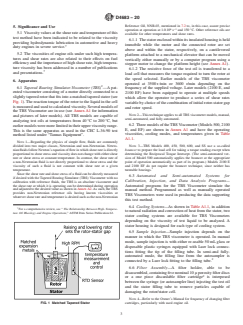
6.1 Tapered Bearing Simulator-Viscometer (TBS) —A pat-
frequency of the supplied voltage. Later models (2100 E, and
ented viscometer consisting of a motor directly connected to a
2100 EF) have been equipped to operate at multiple speeds
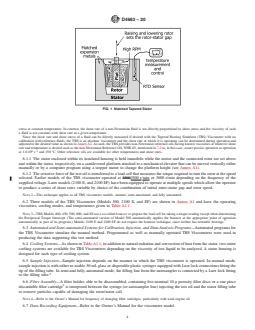
slightlytaperedrotorthatfitsintoamatchedtaperedstator(see
which allow the operator to produce a series of shear rates
Fig. 1).The reaction torque of the rotor to the liquid in the cell
variablebychoiceofthecombinationofinitialrotor-statorgap
ismeasuredandusedtocalculatedviscosity.Severalmodelsof
and rotor speed.
the TBS Viscometer are in use (see AnnexA1 for information
NOTE2—ThistechniqueappliestoallTBSviscometermodels,manual,
and pictures of later models). All TBS models are capable of
semi-automated, and fully automated.
analyzing test oils at temperatures from 40°C to 200°C, but
6.2 ThreemodelsoftheTBSViscometer(Models500,2100
earliermodelsweremorelimitedintheirupperviscosityrange.
E, and EF) are shown in Annex A1 and have the operating
This is the same apparatus as used in the CEC L-36-90 test
viscosities, cooling modes, and temperatures given in Table
method listed under “Tannas Equipment”.
A1.1.
NOTE 1—Regarding the physics of simple flow, fluids are commonly
divided into two major classes, Newtonian and non-Newtonian. Newto-
NOTE 3—TBS Models 400, 450, 500, 600, and SS use a so-called
nianfluidsfollowNewton’sequationofflowinwhichshearrateisdirectly bouncer to prepare the load cell for taking a torque reading except when
proportionaltoshearstressandviscositydoesnotchangewitheithershear
determining the Reciprocal Torque Intercept. (The semi-automated ver-
rate or shear stress at constant temperature. In contrast, the shear rate of sion of Model 500 automatically applies the bouncer at the appropriate
a non-Newtonian fluid is not directly proportional to shear stress and the
point of operation automatically as part of its program.) Models 2100 E
viscosity of such a fluid is not constant with shear rate at a given and 2100 EF do not require the bouncer technique, since neither has
temperature.
turntable bearings.
Sincetheshearrateandshearstressofafluidcanbedirectlymeasured
6.3 Automated and Semi-automated Systems for
if desired with the Tapered Bearing Simulator (TBS) Viscometer with no
Calibration, Injection, and Data Analysis Programs—
calibration with reference fluids, the TBS is an absolute viscometer and
the shear rate at which it is operating can be determined during operation
Automated programs for the TBS Viscometer simulate the
andadjustedtothedesiredvalueasshowninAnnexA2.Assuch,theTBS
manual method. Programmed as well as manually operated
provides non-Newtonian reference oils having known viscosities at
TBS Viscometers were used in producing the data supporting
whatevershearrateandtemperatureisdesiredsuchasthenon-Newtonian
this test method.
6.4 Cooling Systems—As shown in Table A1.1, in addition
For a comprehensive review, see “ The Relationship Between High- Tempera-
to natural radiation and convection of heat from the stator, two
ture Oil Rheology and Engine Operations,” ASTM Data Series Publication 62.
stator cooling systems are available for TBS Viscometers
depending on the viscosity of test liquid to be analyzed. A
stator housing is designed for each type of cooling system.
6.5 Sample Injection—Sample injection depends on the
manner in which the TBS viscometer is operated. In manual
mode, sample injection is with either re-usable 50mLglass or
disposable plastic syringes equipped with Luer lock connec-
tions fitting the tip of the filling tube. In semi-and fully-
automated mode, the filling line from the autosampler is
connected by a Luer lock fitting to the filling tube.
6.6 Filter Assembly—A filter holder, able to be
disassembled,containingfivenominal10µporosityfilterdiscs
or a one piece discardable filter cartridge is interposed
between the syringe (or autosampler line) injecting the test oil
and the stator filling tube to remove particles capable of
damaging the rotor/stator cell.
NOTE 4—Refer to the Owner’s Manual for frequency of changing filter
FIG. 1 Matched Tapered Stator cartridges, particularly with used engine oil.
D4683 − 20
6.7 Data Recording Equipment—Refer to the Owner’s 9.2 Check the accuracy of the RTD (Resistance Thermo-
Manual for the viscometer model. metric Device) as directed in the Owner’s Manual and using
boiling pure water and atmospheric pressure correction, make
7. Materials
whatever slight temperature offset is needed for the tempera-
7.1 Calibration Oils —These are Newtonian oils of known
ture controller to bring the readout to 100.0°C (the latter
dynamic viscosity at 150°C (see 3.2.1). Table 1 shows the alignment of temperature should be checked at least once per
dynamic viscosity values of eight Newtonian oils, R-100 to
year).
R-600, which are available from the manufacturer of the TBS
9.3 When the TBS Viscometer has been Turned Off for a
Viscometer and described in the Owner’s Manual.
Week or More—It is necessary to ensure that the viscometer
7.2 Non-Newtonian Reference Oil—This reference oil is
rotor and stator are still operating at the appropriate rotor
6 −1
6 −1
essential in setting the rotor/stator gap to 1.0·10 s shear rate
position to provide 1.0·10 s shear rate.
(see 3.2.1.3). The nominal apparent viscosity of non-
9.3.1 Follow the manufacturer’s instructions in the Owner’s
Newtonian Reference Oil, NNR-03 used in applying this test
Manualregardingset-upandalignmentoftherotorinthestator
method at 150°C is given in Table 1 and is matched to the
and the determination of the stored position of the rotor by
viscosity of R-400 both held closely to 3.55 mPa·s (see
determining rubbing contact followed by raising the rotor to
3.2.1.2).
the indicated height from rubbing contact before establishing
6 −1
7.3 Idling Oil—See 3.2.3 and the Owner’s Manual for
the appropriate rotor position to provide 1.0·10 s shear rate.
information and use.
9.3.2 Shut power off and go to 9.4.1.
7.4 Solvent—Such as VarClean, used to remove any var-
NOTE 6—Directions for preparation of theTBS viscometer and console
nish and deposits on the rotor/stator surfaces after extended
are supplied with the equipment in the Owner’s Manual. One of the most
use.Followmanufacturer’sinstructionsintheOwner’sManual
importantdirectionstobefollowedisthealignmentoftherotorandstator
for use in the TBS viscometer.
before initial use of the viscometer. For those TBS Models (other than
Models 2100E and 2100E-F), which require bearing inspection, bearing
7.5 Cooling Gas for Temperature Control—If gas is chosen
cleanliness and low levels of bearing hysteresis are also important to
to cool the stator, a source of moderate pressure <689kPa
obtaining reliable data.
(<100 psi) clean, dry air or nitrogen is required. Use of a dry
NOTE 7—For those TBS viscometer models using ball bearings to
gas is required to keep moisture from entering the stator
support the motor platform (all but Models 2100E and 2100E-F which
havenobearings),bearinghysteresisshouldbecheckedeveryfewmonths
housing.Flowratetothestatoriscontrolledbyaflowmeteron
according to the Owner’s Manual and if the values of increasing and
the left side of the console’s front panel (see Annex A1, Fig.
decreasingtorquebythishysteresisanalysisaresignificantlydifferent(by
A1.1, and Fig. A1.3).
approximately 2% or more), the bearing should be cleaned and then
re-checked by the same hysteresis measurement method.
8. Sampling
9.4 When the TBS Viscometer has been Turned Off for a
8.1 A representative, homogeneous sample of the oil is
Relatively Short Time—(More than 1 h, but less than a week):
required, particularly with used engine oil in which particles
9.4.1 Make sure the motor switch is in OFF position then
may have settled to the bottom of the container. Such homo-
turn on the main switch.
geneoussamplesareobtainedbyvigorousagitationandmixing
techniques (see Owner’s Manual).
NOTE 8—Turning the motor switch off before turning the main switch
on protects the flexible shaft connecting the motor and rotor.
NOTE 5—It is recommended that even fresh sample be mixed by gentle
stirring or inverting the closed container several times.
9.4.2 Slowly(~2mL/s)inject50mLofR-400intothestator
8.2 Fifty millilitres of a representative sample of the ho-
while also slowly turning the rotor between the thumb and
mogenized fresh or used engine test oil is drawn into a 50 mL
forefinger using the upper portion of the Siamese collet
syringe or into the sampling tubes of the auto-sampling
connecting the motor shaft and the drive wire.
apparatus.
9.4.3 Place the rotor in the stored position (see 9.3.1 and
8.3 The 50mL sample is injected either by hand or by the
Owner’s Manual).
auto-samplingapparatusthroughthespecial10µporosityfilter
9.4.4 Set the desired temperature to 150.0°C and when the
disc on the viscometer’s filling tube (see 6.6).
rotor/stator cell temperature reaches about 140°C, turn on the
motor and wait until the cell temperature settles at 150.0 6
9. Preparation of Apparatus
0.1°C for 1 h before proceeding with analysis.
9.1 Choose and Set Up Stator Cooling Mode—The modes
9.5 If the TBS Viscometer has been Operating at 150 °C—
are1.none,2.gas,3.cooledgas,or4.liquidmantleandareset
Proceed to Section 12, unless recalibration is desired.
up in accordance with the manufacturer’s directions in the
Owner’s Manual. 9.5.1 If recalibration is desired, proceed to Section 11.
TABLE 1 Nominal Reference Oil Viscosities at 150.0 °C
Reference Oil R-100 R-200 R-300 R-350 R-400 R-450 R-500 R-600 NNR-03
A
Viscosity, mPa·s ~1.2 ~1.5 ~1.8 ~2.7 ~3.55 ~4.1 ~5.0 ~7.7 ~3.55
A 6 −1
Value at 1.0·10 s shear rate
D4683 − 20
10. Establishing Operating Position of the Rotor for 11.1.2.5 Insert the indicated torque value obtained on Ref-
6 −1
1.0·10 s Shear Rate erence Oil NNR-03 into Eq 1, calculate its viscosity and
NOTE 9— If the rotor position has already been established, proceed to compare this to the viscosity on the NNR-03 container.
11.1.
11.1.2.6 If the viscosity value calculated for NNR-03 is
within 61.5% of the value on its container, proceed to 11.1.3.
10.1 Manual TBS Viscometer Method:
11.1.2.7 If the value of NNR-03 is not within 61.5% of its
10.1.1 Activating the Console—Confirm that the motor
container value, slowly (~2 mL/s) re-inject 50 mL of R-400
switch on the console is in the off position.Then turn the main
(first used in 10.1.4) and redetermine the R-400 torque value.
Powerswitchtothe onpositionfor1htopermittheelectronic
11.1.2.8 Substitute this new torque value of R-400 for its
circuits to come to equilibrium in this stand-by condition
previously determined value in 10.1.4, and determine the
before proceeding to calibrate the TBS viscometer.
NNR-03/R-400 torque ratio using NNR-03 data from 11.1.2.3.
10.1.2 Test Cell Filling—If there is no oil in the test cell,
11.1.2.9 If the NNR-03/R-400 torque ratio is within 1.000
slowly inject (~2 mL/s) 50 mL of Reference Oil R-400 in the
6 0.015, go to 11.1.3 and continue calibration of the rotor/
test cell and proceed with the determination of the so-called
stator cell.
stored position of the rotor as described in 9.3.1.
11.1.2.10 If the NNR-03/R-400 torque ratio is again outside
10.1.3 Bring the cell temperature to 150°C and allow the
of1.000 60.015,returnto10.1.4,re-establishthecorrectrotor
rotor-stator cell to stabilize.
position, and recalibrate the rotor/stator cell by following
10.1.4 Determination of Operating Position—Use the Re-
11.1.2.1 to 11.1.2.9.
ciprocal Torque Intersection Method in the Owner’s Manual
6 −1
11.1.2.11 If repeated efforts do not produce a value of
for setting the rotor-stator gap for 1.0·10 s shear rate. For
NNR-03 within 1.000 6 0.015 of the container value, contact
more understanding of the basis of the equations used by the
the instrument manufacturer.
program to obtain semi- and full-automated operation, see
11.1.2.12 When the NNR-03/R-400 torque ratio is within
Annex A2.
1.000 6 0.015, and the value of NNR-03 is within 1.5% of the
container value, record the new setting of the rotor and
11. Viscosity Calibration of TBS Viscometer
reinitiate 11.1.2 from 11.1.2.1 to 11.1.2.9.
11.1 Manual Method:
11.1.3 Continue the calibration of 11.1.2:
11.1.1 Setrotorpositionexactlytothatdeterminedin10.1.4
11.1.3.1 Sequentially and slowly (~2 mL/s) inject 50 mLof
and make sure the unit is warmed up for at least 1 h.
Newtonian Reference Oils R-350 and R-400. For each refer-
6 −1
ence oil, if the particular Model of TBS viscometer requires
NOTE 10—If desired, recheck or readjust rotor position at 1.0·10 s
shear rate accordi
...
This document is not an ASTM standard and is intended only to provide the user of an ASTM standard an indication of what changes have been made to the previous version. Because
it may not be technically possible to adequately depict all changes accurately, ASTM recommends that users consult prior editions as appropriate. In all cases only the current version
of the standard as published by ASTM is to be considered the official document.
Designation: D4683 − 17 D4683 − 20
Standard Test Method for
Measuring Viscosity of New and Used Engine Oils at High
Shear Rate and High Temperature by Tapered Bearing
Simulator Viscometer at 150 °C
This standard is issued under the fixed designation D4683; the number immediately following the designation indicates the year of
original adoption or, in the case of revision, the year of last revision. A number in parentheses indicates the year of last reapproval. A
superscript epsilon (´) indicates an editorial change since the last revision or reapproval.
This standard has been approved for use by agencies of the U.S. Department of Defense.
1. Scope*
6 −1
1.1 This test method covers the laboratory determination of the viscosity of engine oils at 150 °C and 1.0·10 s using a
viscometer having a slightly tapered rotor and stator called the Tapered Bearing Simulator (TBS) Viscometer.
1.2 The Newtonian calibration oils used to establish this test method range from approximately 1.2 mPa·s to 7.7 mPa·s at
150 °C. The precision has only been determined for the viscosity range 1.47 mPa·s to 5.09 mPa·s at 150 °C for the materials listed
in the precision section.
6 −1
1.3 The non-Newtonian reference oil used to establish the shear rate of 1.0·10 s for this test method has a viscosity closely
held to 3.55 mPa·s at 150 °C by using the absolute viscometry of the TBS.
1.4 Manual, semi-automated, and fully automated TBS viscometers were used in developing the precision statement for this test
method.
1.5 Application to petroleum products such as base oils and formulated engine oils was determined in preparing the viscometric
information for this test method.
1.6 The values stated in SI units are to be regarded as standard. No other units of measurement are included in this standard.
1.6.1 This test method uses the milliPascal·second (mPa·s) as the unit of viscosity. This unit is equivalent to the centipoise (cP).
1.7 This standard does not purport to address all of the safety concerns, if any, associated with its use. It is the responsibility
of the user of this standard to establish appropriate safety safety, health, and healthenvironmental practices and determine the
applicability of regulatory limitations prior to use.
1.8 This international standard was developed in accordance with internationally recognized principles on standardization
established in the Decision on Principles for the Development of International Standards, Guides and Recommendations issued
by the World Trade Organization Technical Barriers to Trade (TBT) Committee.
2. Referenced Documents
2.1 ASTM Standards:
D4741 Test Method for Measuring Viscosity at High Temperature and High Shear Rate by Tapered-Plug Viscometer
D5481 Test Method for Measuring Apparent Viscosity at High-Temperature and High-Shear Rate by Multicell Capillary
Viscometer
D6300 Practice for Determination of Precision and Bias Data for Use in Test Methods for Petroleum Products, Liquid Fuels, and
Lubricants
D6708 Practice for Statistical Assessment and Improvement of Expected Agreement Between Two Test Methods that Purport
to Measure the Same Property of a Material
This test method is under the jurisdiction of ASTM Committee D02 on Petroleum Products, Liquid Fuels, and Lubricants and is the direct responsibility of Subcommittee
D02.07 on Flow Properties.
Current edition approved Jan. 1, 2017June 1, 2020. Published Febraury 2017June 2020. Originally approved in 1987. Last previous edition approved in 20132017 as
D4683 – 13.D4683 – 17. DOI: 10.1520/D4683-17.10.1520/D4683-20.
The sole source of supply of the apparatus known to the committee at this time is Tannas Co., 4800 James Savage Rd., Midland, MI 48642. If you are aware of alternative
suppliers, please provide this information to ASTM International Headquarters. Your comments will receive careful consideration at a meeting of the responsible technical
committee, which you may attend.
For referenced ASTM standards, visit the ASTM website, www.astm.org, or contact ASTM Customer Service at service@astm.org. For Annual Book of ASTM Standards
volume information, refer to the standard’s Document Summary page on the ASTM website.
*A Summary of Changes section appears at the end of this standard
Copyright © ASTM International, 100 Barr Harbor Drive, PO Box C700, West Conshohocken, PA 19428-2959. United States
D4683 − 20
4,5
2.2 Coordinating European Council (CEC) Standard:
CEC L-36-90 The Measurement of Lubricant Dynamic Viscosity under Conditions of High Shear
6,5
2.3 Energy Institute Standard:
IP 370 Test Method for the Measurement of Lubricant Dynamic Viscosity Under Conditions of High Shear Using the Ravenfield
Viscometer
3. Terminology
3.1 Definitions:
3.1.1 apparent viscosity, n—viscosity of a non-Newtonian liquid determined by this test method at a particular shear rate and
shear stress.
3.1.2 Newtonian oil or liquid, oil, n—an oil or liquidfluid that at a given temperature exhibits a constant viscosity at all shear
rates andor shear stresses.
3.1.3 non-Newtonian oil or liquid, oil, n—an oil or liquid that fluid that at a given temperature exhibits a viscosity that varies
with changing shear stress andor shear rate.
3.1.4 shear rate, n—velocity gradient in liquid flow in millimetres per second per millimetre (mm/s per mm) resulting from
applied shear stress. The System International (SI) unit for shear rate is reciprocal seconds, sperpendicular to the direction of
-1
flow. .
3.1.4.1 Discussion—
The velocity gradient in the tapered bearing simulator viscometer is constant at any chosen rotor-stator gap and rotor speed.
3.1.5 shear stress, n—the force per unit area causing liquid flow over the area where viscous shear is being caused; in SI, the
unit of shear stress is the Pascal (Pa).in the direction of the flow.
3.1.6 viscosity, n—the ratio of between the applied shear stress and the resulting rate of shear. Itshear which is sometimes called
dynamic or absolute viscosity. Viscosity the coefficient of dynamic viscosity and is a measure of the resistance to flow of the liquid
at a given temperature. In SI, the unit of viscosity is the Pascal·second (Pa·s), often conveniently expressed as milliPascal·second
(mPa·s), which has the English system equivalent of the centipoise (cP).liquid.
3.2 Definitions of Terms Specific to This Standard:
3.2.1 calibration and reference oils , n—oils used to establish the viscosity-torque relationship of the TBS Viscometer at 150 °C
from which both appropriate rotor/stator gap and the viscosity of an unknown oil is calculated.
3.2.1.1 Newtonian calibration oils , n—Newtonian oils formulated to span a viscosity range suitable for generating the
torque-viscosity relationship necessary to calculate the viscosity of unknown liquids from their indicated torque values.
3.2.1.2 non-Newtonian reference oil , n—NNR-03—An oil specially formulated for, and critical to, this test method. The
reference oil NNR-03 produces a selected value of apparent viscosity at a desired temperature and shear rate (see Note 1).
3.2.1.3 Newtonian reference oil , n—R-400—A specially formulated Newtonian oil that has the same viscosity at 150 °C as the
non-Newtonian reference oil NNR-03 of 3.2.1.2.
3.2.2 filter , n—special filter for removing particles potentially damaging to the rotor-stator interface from the test oil being
injected.
3.2.3 idling oil , n—oxidatively stable Newtonian oil injected into the operating viscometer cell when the instrument is likely
to be waiting for use and held at operating temperature for more than 20 min and up to two weeks without need for replacing the
idling oil.
3.2.3.1 Discussion—
Use of this idling oil prevents formation of stator and rotor deposits of a test oil, which if left for more than 20 min at 150 °C in
the instrument may begin to decompose. The idling oil this permits continuous operation of the TBS viscometer without the need
to shut the instrument off when not being used for extended periods, such as overnight or over several days, if desired.
3.2.4 mechanical or digital micrometer, n—mechanical or electronic device to measure or adjust the position of the TBS
viscometer rotor in the stator.
Available from Coordinating European Council (CEC), Services provided by Kellen Europe, Avenue Jules Bordet 142 - 1140, Brussels, Belgium, http://www.cectests.org.
This test method is technically identical to that described in CEC L-36 (under the jurisdiction of the CEC Engine Lubricants Technical Committee) and IP 370 references
CEC L-036.
Available from Energy Institute, 61 New Cavendish St., London, W1G 7AR, U.K., http://www.energyinst.org.
D4683 − 20
3.2.4.1 Discussion—
Mechanical micrometers increase readings with rotor depth. The digital micrometer interacts with the TBS viscometer’s program
and permits the program to maintain the rotor height at the desired shear rate using the non-Newton reference oil of 3.2.1.2.
3.2.5 reciprocal torque, 1/T, n—determined value of the inverse of the torque generated by the TBS viscometer which torque
is indicated on the console or computer depending on whether the viscometer is being used in the manual or automated
(programmed) mode.
3.2.6 reciprocal torque intersection, 1/T , n—rotor position on the micrometer defined by the intersection of two lines generated
i
by the reciprocal indicated torque versus rotor height for both the non-Newtonian NNR-03 and the Newtonian R-400. The
6 −1
intersection indicates the rotor height at which the rotor/stator cell will generate 1.0·10 s shear rate.
3.2.6.1 Discussion—
This technique of accurately establishing the shear rate is called the Reciprocal Torque Intercept Method and requires the absolute
viscometry of the TBS (see 10.1.4 and Annex A2) as well as the use of both the Newtonian reference oil of 3.2.1.3 and the
non-Newtonian reference oil of 3.2.1.2.
3.2.7 rotor height (rotor position), n—vertical position of the rotor relative to the stator and measured by a mechanical or
electronic micrometer (see 3.2.4) depending on the Model of the TBS.
3.2.7.1 Discussion—
For all TBS viscometers, the rotor decreases in position and approaches contact with the stator with indicated increasing values
on the mechanical or electronic micrometers.
3.2.8 rubbing contact position, n—rotor height determined when the tapered rotor is brought into slipping contact with the
similarly tapered stator.
3.2.9 stored position of rotor height, n—rotor position with the rotor 0.50 mm above the rubbing contact position (see 3.2.8)
when the instrument is shut down.
3.2.10 test oil, n—any oil for which the apparent viscosity is to be determined by this test method.
4. Summary of Test Method
4.1 A motor turns a tapered rotor closely fitted inside a matched tapered stator at a rotor-stator gap found by the Reciprocal
6 −1
Torque Intersection Method (see Annex A2) to provide 1.0·10 s at 150 °C, which are the test conditions of this particular test
method. When this operating condition is established, test oils are introduced into the gap between the spinning rotor and stationary
stator either directly by the operator or indirectly by automated injection. When a test liquid is injected, the rotor experiences a
reactive torque to the liquid’s resistance to flow (viscous friction) and this torque response level is used to determine the apparent
viscosity.
5. Significance and Use
5.1 Viscosity values at the shear rate and temperature of this test method have been indicated to be related to the viscosity
providing hydrodynamic lubrication in automotive and heavy duty engines in severe service.
5.2 The viscosities of engine oils under such high temperatures and shear rates are also related to their effects on fuel efficiency
and the importance of high shear rate, high temperature viscosity has been addressed in a number of publications and
presentations.
6. Apparatus
6.1 Tapered Bearing Simulator-Viscometer (TBS) —A patented viscometer consisting of a motor directly connected to a slightly
tapered rotor that fits into a matched tapered stator (see Fig. 1). The reaction torque of the rotor to the liquid in the cell is measured
and used to calculated viscosity. Several models of the TBS Viscometer are in use (see Annex A1 for information and pictures of
later models). All TBS models are capable of analyzing test oils at temperatures from 40 °C to 200 °C, but earlier models were
more limited in their upper viscosity range. This is the same apparatus as used in the CEC L-36-90 test method listed under “Tannas
Equipment”.
NOTE 1—Regarding the physics of simple flow, fluids are commonly divided into two major classes, Newtonian and non-Newtonian. Newtonian fluids
follow Newton’s equation of flow in which shear rate is directly proportional to shear stress and viscosity does not change with either shear rate or shear
For a comprehensive review, see “ The Relationship Between High- Temperature Oil Rheology and Engine Operations,” ASTM Data Series Publication 62.
D4683 − 20
FIG. 1 Matched Tapered Stator
stress at constant temperature. In contrast, the shear rate of a non-Newtonian fluid is not directly proportional to shear stress and the viscosity of such
a fluid is not constant with shear rate at a given temperature.
Since the shear rate and shear stress of a fluid can be directly measured if desired with the Tapered Bearing Simulator (TBS) Viscometer with no
calibration with reference fluids, the TBS is an absolute viscometer and the shear rate at which it is operating can be determined during operation and
adjusted to the desired value as shown in Annex A2. As such, the TBS provides non-Newtonian reference oils having known viscosities at whatever shear
rate and temperature is desired such as the non-Newtonian Reference Oil, NNR-03, mentioned in 7.2 to, in this case, assure precise operation at operation
6 −1
at 1.0·10 s and 150 °C. Other reference oils are available for other temperatures and shear rates.
6.1.1 The stator enclosed within its insulated housing is held immobile while the motor and the connected rotor are set above
and within the stator, respectively, on a cantilevered platform attached to a mechanical elevator that can be moved vertically either
manually or by a computer program using a stepper motor to change the platform height (see Annex A1).
6.1.2 The resistive force of the test oil is transferred to a load cell that measures the torque required to turn the rotor at the speed
selected. Earlier models of the TBS viscometer operated at 35003500 r ⁄min or 3600 r/min depending on the frequency of the
supplied voltage. Later models (2100 E, and 2100 EF) have been equipped to operate at multiple speeds which allow the operator
to produce a series of shear rates variable by choice of the combination of initial rotor-stator gap and rotor speed.
NOTE 2—This technique applies to all TBS viscometer models, manual, semi-automated, and fully automated.
6.2 Three models of the TBS Viscometer (Models 500, 2100 E, and EF) are shown in Annex A1 and have the operating
viscosities, cooling modes, and temperatures given in Table A1.1.
NOTE 3—TBS Models 400, 450, 500, 600, and SS use a so-called bouncer to prepare the load cell for taking a torque reading except when determining
the Reciprocal Torque Intercept. (The semi-automated version of Model 500 automatically applies the bouncer at the appropriate point of operation
automatically as part of its program.) Models 2100 E and 2100 EF do not require the bouncer technique, since neither has turntable bearings.
6.3 Automated and Semi-automated Systems for Calibration, Injection, and Data Analysis Programs—Automated programs for
the TBS Viscometer simulate the manual method. Programmed as well as manually operated TBS Viscometers were used in
producing the data supporting this test method.
6.4 Cooling Systems—As shown in Table A1.1, in addition to natural radiation and convection of heat from the stator, two stator
cooling systems are available for TBS Viscometers depending on the viscosity of test liquid to be analyzed. A stator housing is
designed for each type of cooling system.
6.5 Sample Injection—Sample injection depends on the manner in which the TBS viscometer is operated. In manual mode,
sample injection is with either re-usable 50 mL glass or disposable plastic syringes equipped with Luer lock connections fitting the
tip of the filling tube. In semi-and fully-automated mode, the filling line from the autosampler is connected by a Luer lock fitting
to the filling tube.
6.6 Filter Assembly—A filter holder, able to be disassembled, containing five nominal 10 μ porosity filter discs or a one piece
discardable filter cartridge is interposed between the syringe (or autosampler line) injecting the test oil and the stator filling tube
to remove particles capable of damaging the rotor/stator cell.
NOTE 4—Refer to the Owner’s Manual for frequency of changing filter cartridges, particularly with used engine oil.
6.7 Data Recording Equipment—Refer to the Owner’s Manual for the viscometer model.
D4683 − 20
7. Materials
7.1 Calibration Oils —These are Newtonian oils of known dynamic viscosity at 150 °C (see 3.2.1). Table 1 shows the dynamic
viscosity values of eight Newtonian oils, R-100 to R-600, which are available from the manufacturer of the TBS Viscometer and
described in the Owner’s Manual.
6 −1
7.2 Non-Newtonian Reference Oil—This reference oil is essential in setting the rotor/stator gap to 1.0·10 s shear rate (see
3.2.1.3). The nominal apparent viscosity of non-Newtonian Reference Oil, NNR-03 used in applying this test method at 150 °C
is given in Table 1 and is matched to the viscosity of R-400 both held closely to 3.55 mPa·s (see 3.2.1.2).
7.3 Idling Oil—See 3.2.3 and the Owner’s Manual for information and use.
7.4 Solvent—Such as VarClean, used to remove any varnish and deposits on the rotor/stator surfaces after extended use. Follow
manufacturer’s instructions in the Owner’s Manual for use in the TBS viscometer.
7.5 Cooling Gas for Temperature Control—If gas is chosen to cool the stator, a source of moderate pressure <689 kPa (<100
psi) clean, dry air or nitrogen is required. Use of a dry gas is required to keep moisture from entering the stator housing. Flow rate
to the stator is controlled by a flowmeter on the left side of the console’s front panel (see Annex A1, Fig. A1.1, and Fig. A1.3).
8. Sampling
8.1 A representative, homogeneous sample of the oil is required, particularly with used engine oil in which particles may have
settled to the bottom of the container. Such homogeneous samples are obtained by vigorous agitation and mixing techniques (see
Owner’s Manual).
NOTE 5—It is recommended that even fresh sample be mixed by gentle stirring or inverting the closed container several times.
8.2 Fifty millilitres of a representative sample of the homogenized fresh or used engine test oil is drawn into a 50 mL syringe
or into the sampling tubes of the auto-sampling apparatus.
8.3 The 50 mL sample is injected either by hand or by the auto-sampling apparatus through the special 10 μ porosity filter disc
on the viscometer’s filling tube (see 6.6).
9. Preparation of Apparatus
9.1 Choose and Set Up Stator Cooling Mode—The modes are 1. none, 2. gas, 3. cooled gas, or 4. liquid mantle and are set up
in accordance with the manufacturer’s directions in the Owner’s Manual.
9.2 Check the accuracy of the RTD (Resistance Thermometric Device) as directed in the Owner’s Manual and using boiling
pure water and atmospheric pressure correction, make whatever slight temperature offset is needed for the temperature controller
to bring the readout to 100.0 °C (the latter alignment of temperature should be checked at least once per year).
9.3 When the TBS Viscometer has been Turned Off for a Week or More—It is necessary to ensure that the viscometer rotor and
6 −1
stator are still operating at the appropriate rotor position to provide 1.0·10 s shear rate.
9.3.1 Follow the manufacturer’s instructions in the Owner’s Manual regarding set-up and alignment of the rotor in the stator
and the determination of the stored position of the rotor by determining rubbing contact followed by raising the rotor to the
6 −1
indicated height from rubbing contact before establishing the appropriate rotor position to provide 1.0·10 s shear rate.
9.3.2 Shut power off and go to 9.4.1.
NOTE 6—Directions for preparation of the TBS viscometer and console are supplied with the equipment in the Owner’s Manual. One of the most
important directions to be followed is the alignment of the rotor and stator before initial use of the viscometer. For those TBS Models (other than Models
2100E and 2100E-F), which require bearing inspection, bearing cleanliness and low levels of bearing hysteresis are also important to obtaining reliable
data.
NOTE 7—For those TBS viscometer models using ball bearings to support the motor platform (all but Models 2100E and 2100E-F which have no
bearings), bearing hysteresis should be checked every few months according to the Owner’s Manual and if the values of increasing and decreasing torque
by this hysteresis analysis are significantly different (by approximately 2 % or more), the bearing should be cleaned and then re-checked by the same
hysteresis measurement method.
9.4 When the TBS Viscometer has been Turned Off for a Relatively Short Time—(More than 1 h, but less than a week):
9.4.1 Make sure the motor switch is in OFF position then turn on the main switch.
NOTE 8—Turning the motor switch off before turning the main switch on protects the flexible shaft connecting the motor and rotor.
9.4.2 Slowly (~2 mL/s) inject 50 mL of R-400 into the stator while also slowly turning the rotor between the thumb and
forefinger using the upper portion of the Siamese collet connecting the motor shaft and the drive wire.
TABLE 1 Nominal Reference Oil Viscosities at 150.0 °C
Reference Oil R-100 R-200 R-300 R-350 R-400 R-450 R-500 R-600 NNR-03
A
Viscosity, mPa·s ~1.2 ~1.5 ~1.8 ~2.7 ~3.55 ~4.1 ~5.0 ~7.7 ~3.55
A 6 −1
Value at 1.0·10 s shear rate
D4683 − 20
9.4.3 Place the rotor in the stored position (see 9.3.1 and Owner’s Manual).
9.4.4 Set the desired temperature to 150.0 °C and when the rotor/stator cell temperature reaches about 140 °C, turn on the motor
and wait until the cell temperature settles at 150.0 6 0.1 °C for 1 h before proceeding with analysis.
9.5 If the TBS Viscometer has been Operating at 150 °C—Proceed to Section 12, unless recalibration is desired.
9.5.1 If recalibration is desired, proceed to Section 11.
6 −1
10. Establishing Operating Position of the Rotor for 1.0·10 s Shear Rate
NOTE 9— If the rotor position has already been established, proceed to 11.1.
10.1 Manual TBS Viscometer Method:
10.1.1 Activating the Console—Confirm that the motor switch on the console is in the off position. Then turn the main Power
switch to the on position for 1 h to permit the electronic circuits to come to equilibrium in this stand-by condition before proceeding
to calibrate the TBS viscometer.
10.1.2 Test Cell Filling—If there is no oil in the test cell, slowly inject (~2 mL/s) 50 mL of Reference Oil R-400 in the test cell
and proceed with the determination of the so-called stored position of the rotor as described in 9.3.1.
10.1.3 Bring the cell temperature to 150 °C and allow the rotor-stator cell to stabilize.
10.1.4 Determination of Operating Position—Use the Reciprocal Torque Intersection Method in the Owner’s Manual for setting
6 −1
the rotor-stator gap for 1.0·10 s shear rate. For more understanding of the basis of the equations used by the program to obtain
semi- and full-automated operation, see Annex A2.
11. Viscosity Calibration of TBS Viscometer
11.1 Manual Method:
11.1.1 Set rotor position exactly to that determined in 10.1.4 and make sure the unit is warmed up for at least 1 h.
6 −1
NOTE 10—If desired, recheck or readjust rotor position at 1.0·10 s shear rate according to the Owner’s Manual.
NOTE 11—Slow expansion of the rotor and stator after start up of the TBS Viscometer may slightly change the originally determined position of the
6 −1
rotor at 1.0·10 s shear rate and it is, thus, prudent to recheck the rotor position and to make slight adjustments if necessary.
11.1.2 Calibration of the TBS viscometer cell with confirming recheck of the operationally correct rotor position to generate
6 −1
1.0·10 s shear rate:
11.1.2.1 Inject Newtonian Reference Oil R-200 slowly (~2 mL/s) and wait until torque/temperature equilibrium is obtained (see
Note 16). Use the Bouncer button briefly (only for older Models 400 through 600 and SS) after torque/temperature equilibrium,
allow the torque value to stabilize, and record the torque value.
11.1.2.2 Repeat 11.1.2.1 with Newtonian Reference Oil R-450.
11.1.2.3 Repeat 11.1.2.1 with Non-Newtonian Reference Oil NNR-03.
11.1.2.4 Use the known viscosities of Newtonian Reference Oils R-200 and R-450 and the torque values from 11.1.2.2 and
11.1.2.3 to algebraically calculate the slope, m, and intercept, b, of equation given by these two pairs of values with the torque read
from the console as variable τ , and viscosity as variable η,
...