

ASTM D3106-07(2018)
(Test Method)Standard Test Method for Permanent Deformation of Elastomeric Yarns
General Information
- Abstract
SIGNIFICANCE AND USE
5.1 Test Method D3106 for testing permanent deformation of elastomeric yarns is considered satisfactory for acceptance testing of commercial shipments when there is prior agreement as to the exact value of elongation to be used for testing, since current estimates of between-laboratory precision are acceptable.
5.1.1 If there are differences or practical significance between reported test results for two laboratories (or more) comparative tests should be performed to determine if there is a statistical bias between them, using competent statistical assistance. As a minimum, test samples that are as homogeneous as possible, drawn from the material from which the disparate test results were obtained, and randomly assigned in equal numbers to each laboratory for testing. The test results from the two laboratories should be compared using a statistical test for unpaired data, at a probability level chosen prior to the testing series. If bias is found, either its cause must be found and corrected, or future test results for that material must be adjusted in consideration of the known bias.
5.2 Yarns are subjected to long periods of tension resulting in an appreciable amount of stretch during normal use. A portion of the induced stretch may be permanent. The amount of permanent deformation is influenced by the amount of tension, the time the yarn is under tension and the time available for recovery between successive uses.
5.3 For optimum processing of elastomeric yarns, the permanent deformation value should be low or zero.
SCOPE
1.1 This test method covers the determination of the permanent deformation of bare, continuous elastomeric monofilaments and filament yarns made from rubber, spandex, anidex, or other elastomers subjected to prolonged periods of tension. This test method is applicable to elastomeric yarns having a linear density in the range from 4 to 320 tex (36 to 2900 den.).
1.2 This test method is not applicable to covered, wrapped, core-spun yarns, or yarns spun from elastomeric staple.
1.3 This test method was developed using yarns in the “as-received” condition, but may be used for treated yarns provided the treatment is specified.
1.4 The values stated in SI units are to be regarded as the standard. The values given in parentheses are for information only.
1.5 This standard does not purport to address all of the safety concerns, if any, associated with its use. It is the responsibility of the user of this standard to establish appropriate safety, health, and environmental practices and determine the applicability of regulatory limitations prior to use.
1.6 This international standard was developed in accordance with internationally recognized principles on standardization established in the Decision on Principles for the Development of International Standards, Guides and Recommendations issued by the World Trade Organization Technical Barriers to Trade (TBT) Committee.
- Status
- Published
- Publication Date
- 30-Jun-2018
- Technical Committee
- D13 - Textiles
- Drafting Committee
- D13.58 - Yarns and Fibers
Overview
ASTM D3106-07(2018), Standard Test Method for Permanent Deformation of Elastomeric Yarns, is a crucial international standard developed by ASTM International. This test method outlines procedures for determining the permanent deformation-also known as non-recoverable stretch-of bare, continuous elastomeric monofilaments and filament yarns made from materials such as rubber, spandex, anidex, or other elastomers. The method applies to yarns with a linear density in the range of 4 to 320 tex (36 to 2900 denier).
The standard is primarily intended for acceptance testing of commercial elastomeric yarn shipments, supporting manufacturers, suppliers, and end-users in ensuring product quality and uniformity. It also serves as a reference for laboratory comparison and statistical analysis to detect potential bias or inconsistencies.
Key Topics
Test Scope
- Applicable to bare, continuous elastomeric yarns and monofilaments
- Inapplicable to covered, wrapped, core-spun yarns, or those spun from elastomeric staple
- Usable for both “as-received” and specified treated yarns
Testing Procedure
- Determination of nominal linear density and elongation at breaking force
- Controlled stretching of specimens under standardized conditions
- Measurement of permanent deformation after specified relaxation periods (e.g., at 10 and 100 minutes)
- Statistical requirements for sampling and comparison between laboratories
Statistical Comparisons
- Guidance for troubleshooting results with potential lab-to-lab bias
- Recommendations on sampling, specimen preparation, and data reporting
- Emphasis on interlaboratory precision and the need for statistical analysis
Practical Considerations
- The value of permanent deformation reflects the material’s ability to recover after stretching-critical for durability and performance in textile applications
- A low or zero value is typically desired for optimal yarn processing and end-use performance
Applications
ASTM D3106-07(2018) is widely recognized in the textile and elastomeric yarn industry. Its main applications include:
- Quality Assurance: Used to assess and control the quality of elastomeric yarns in commercial shipments, ensuring consistency and compliance with buyer specifications.
- Product Development: Aids manufacturers in formulating and refining yarns with superior elastic recovery for critical end uses such as sportswear, hosiery, medical textiles, and high-performance fabrics.
- Research and Development: Applied in the evaluation of new elastomeric fibers and the effect of various treatments or processing conditions on yarn performance.
- Supplier and Buyer Agreements: Facilitates clear, standardized expectations and dispute resolution between trading partners regarding elongation and deformation properties.
Related Standards
For comprehensive material evaluation and terminology, ASTM D3106-07(2018) references several related standards:
- ASTM D123 – Terminology Relating to Textiles
- ASTM D4849 – Terminology Related to Yarns and Fibers
- Formerly ASTM D2433 – Test Methods for Rubber Thread (Withdrawn 2012)
Other relevant international standards include those dealing with textile yarn testing, mechanical properties, and laboratory sampling procedures.
By providing a standardized approach to evaluating permanent deformation in elastomeric yarns, ASTM D3106-07(2018) supports the production and trade of high-quality, durable elastic textiles for global markets. For further information or to purchase the standard, visit the ASTM website.
Relations
- Effective Date
- 01-Jul-2018
- Effective Date
- 01-Jul-2018
- Effective Date
- 01-Mar-2017
- Effective Date
- 15-Sep-2015
- Effective Date
- 01-Sep-2015
- Effective Date
- 01-Apr-2015
- Effective Date
- 01-Oct-2013
- Effective Date
- 01-Oct-2013
- Effective Date
- 01-Oct-2013
- Effective Date
- 01-Oct-2013
- Effective Date
- 15-Jun-2013
- Effective Date
- 15-Jun-2013
- Effective Date
- 15-May-2013
- Effective Date
- 01-Feb-2012
- Effective Date
- 01-Feb-2012
Get Certified
Connect with accredited certification bodies for this standard

Control Union Certifications
Global certification for agriculture and sustainability.

Hohenstein Institut
Textile testing and certification.

Bureau Veritas Bangladesh
Bureau Veritas certification services in Bangladesh.
Sponsored listings
Frequently Asked Questions
ASTM D3106-07(2018) is a standard published by ASTM International. Its full title is "Standard Test Method for Permanent Deformation of Elastomeric Yarns". This standard covers: SIGNIFICANCE AND USE 5.1 Test Method D3106 for testing permanent deformation of elastomeric yarns is considered satisfactory for acceptance testing of commercial shipments when there is prior agreement as to the exact value of elongation to be used for testing, since current estimates of between-laboratory precision are acceptable. 5.1.1 If there are differences or practical significance between reported test results for two laboratories (or more) comparative tests should be performed to determine if there is a statistical bias between them, using competent statistical assistance. As a minimum, test samples that are as homogeneous as possible, drawn from the material from which the disparate test results were obtained, and randomly assigned in equal numbers to each laboratory for testing. The test results from the two laboratories should be compared using a statistical test for unpaired data, at a probability level chosen prior to the testing series. If bias is found, either its cause must be found and corrected, or future test results for that material must be adjusted in consideration of the known bias. 5.2 Yarns are subjected to long periods of tension resulting in an appreciable amount of stretch during normal use. A portion of the induced stretch may be permanent. The amount of permanent deformation is influenced by the amount of tension, the time the yarn is under tension and the time available for recovery between successive uses. 5.3 For optimum processing of elastomeric yarns, the permanent deformation value should be low or zero. SCOPE 1.1 This test method covers the determination of the permanent deformation of bare, continuous elastomeric monofilaments and filament yarns made from rubber, spandex, anidex, or other elastomers subjected to prolonged periods of tension. This test method is applicable to elastomeric yarns having a linear density in the range from 4 to 320 tex (36 to 2900 den.). 1.2 This test method is not applicable to covered, wrapped, core-spun yarns, or yarns spun from elastomeric staple. 1.3 This test method was developed using yarns in the “as-received” condition, but may be used for treated yarns provided the treatment is specified. 1.4 The values stated in SI units are to be regarded as the standard. The values given in parentheses are for information only. 1.5 This standard does not purport to address all of the safety concerns, if any, associated with its use. It is the responsibility of the user of this standard to establish appropriate safety, health, and environmental practices and determine the applicability of regulatory limitations prior to use. 1.6 This international standard was developed in accordance with internationally recognized principles on standardization established in the Decision on Principles for the Development of International Standards, Guides and Recommendations issued by the World Trade Organization Technical Barriers to Trade (TBT) Committee.
SIGNIFICANCE AND USE 5.1 Test Method D3106 for testing permanent deformation of elastomeric yarns is considered satisfactory for acceptance testing of commercial shipments when there is prior agreement as to the exact value of elongation to be used for testing, since current estimates of between-laboratory precision are acceptable. 5.1.1 If there are differences or practical significance between reported test results for two laboratories (or more) comparative tests should be performed to determine if there is a statistical bias between them, using competent statistical assistance. As a minimum, test samples that are as homogeneous as possible, drawn from the material from which the disparate test results were obtained, and randomly assigned in equal numbers to each laboratory for testing. The test results from the two laboratories should be compared using a statistical test for unpaired data, at a probability level chosen prior to the testing series. If bias is found, either its cause must be found and corrected, or future test results for that material must be adjusted in consideration of the known bias. 5.2 Yarns are subjected to long periods of tension resulting in an appreciable amount of stretch during normal use. A portion of the induced stretch may be permanent. The amount of permanent deformation is influenced by the amount of tension, the time the yarn is under tension and the time available for recovery between successive uses. 5.3 For optimum processing of elastomeric yarns, the permanent deformation value should be low or zero. SCOPE 1.1 This test method covers the determination of the permanent deformation of bare, continuous elastomeric monofilaments and filament yarns made from rubber, spandex, anidex, or other elastomers subjected to prolonged periods of tension. This test method is applicable to elastomeric yarns having a linear density in the range from 4 to 320 tex (36 to 2900 den.). 1.2 This test method is not applicable to covered, wrapped, core-spun yarns, or yarns spun from elastomeric staple. 1.3 This test method was developed using yarns in the “as-received” condition, but may be used for treated yarns provided the treatment is specified. 1.4 The values stated in SI units are to be regarded as the standard. The values given in parentheses are for information only. 1.5 This standard does not purport to address all of the safety concerns, if any, associated with its use. It is the responsibility of the user of this standard to establish appropriate safety, health, and environmental practices and determine the applicability of regulatory limitations prior to use. 1.6 This international standard was developed in accordance with internationally recognized principles on standardization established in the Decision on Principles for the Development of International Standards, Guides and Recommendations issued by the World Trade Organization Technical Barriers to Trade (TBT) Committee.
ASTM D3106-07(2018) is classified under the following ICS (International Classification for Standards) categories: 59.080.20 - Yarns. The ICS classification helps identify the subject area and facilitates finding related standards.
ASTM D3106-07(2018) has the following relationships with other standards: It is inter standard links to ASTM D3106-07(2012), ASTM D4849-13(2018), ASTM D123-17, ASTM D123-15b, ASTM D123-15a, ASTM D123-15, ASTM D4849-13e2, ASTM D4849-13, ASTM D4849-13e3, ASTM D4849-13e1, ASTM D123-13a, ASTM D123-13ae1, ASTM D123-13, ASTM D123-12e1, ASTM D123-12. Understanding these relationships helps ensure you are using the most current and applicable version of the standard.
ASTM D3106-07(2018) is available in PDF format for immediate download after purchase. The document can be added to your cart and obtained through the secure checkout process. Digital delivery ensures instant access to the complete standard document.
Standards Content (Sample)
This international standard was developed in accordance with internationally recognized principles on standardization established in the Decision on Principles for the
Development of International Standards, Guides and Recommendations issued by the World Trade Organization Technical Barriers to Trade (TBT) Committee.
Designation: D3106 − 07 (Reapproved 2018)
Standard Test Method for
Permanent Deformation of Elastomeric Yarns
This standard is issued under the fixed designation D3106; the number immediately following the designation indicates the year of
original adoption or, in the case of revision, the year of last revision. A number in parentheses indicates the year of last reapproval. A
superscript epsilon (´) indicates an editorial change since the last revision or reapproval.
1. Scope 3. Terminology
1.1 This test method covers the determination of the perma- 3.1 For all terminology relating to D13.58, Yarns and
nent deformation of bare, continuous elastomeric monofila- Fibers, refer to Terminology D4849.
ments and filament yarns made from rubber, spandex, anidex, 3.1.1 The following terms are relevant to this standard:
or other elastomers subjected to prolonged periods of tension. breaking force, elastomeric yarn, elongation, elongation at
This test method is applicable to elastomeric yarns having a break, extension, force, linear density, length distribution,
linear density in the range from 4 to 320 tex (36 to 2900 den.). permanent deformation, velveteen.
1.2 This test method is not applicable to covered, wrapped, 3.2 For all other terminology related to textiles, refer to
core-spun yarns, or yarns spun from elastomeric staple. Terminology D123.
1.3 This test method was developed using yarns in the
4. Summary of Test Method
“as-received” condition, but may be used for treated yarns
4.1 The nominal linear density of the sample is known or
provided the treatment is specified.
determined and the elongation at the breaking force is deter-
1.4 The values stated in SI units are to be regarded as the
mined from representative specimens.
standard. The values given in parentheses are for information
4.2 A specimen from the sample is placed in a pair of
only.
line-contact clamps and held at a selected elongation for a
1.5 This standard does not purport to address all of the
specified period of time. The permanent deformation or non-
safety concerns, if any, associated with its use. It is the
recoverable stretch is measured after a specified recovery
responsibility of the user of this standard to establish appro-
period.
priate safety, health, and environmental practices and deter-
mine the applicability of regulatory limitations prior to use. 5. Significance and Use
1.6 This international standard was developed in accor-
5.1 Test Method D3106 for testing permanent deformation
dance with internationally recognized principles on standard-
of elastomeric yarns is considered satisfactory for acceptance
ization established in the Decision on Principles for the
testing of commercial shipments when there is prior agreement
Development of International Standards, Guides and Recom-
as to the exact value of elongation to be used for testing, since
mendations issued by the World Trade Organization Technical
current estimates of between-laboratory precision are accept-
Barriers to Trade (TBT) Committee.
able.
5.1.1 If there are differences or practical significance be-
2. Referenced Documents
tween reported test results for two laboratories (or more)
2.1 ASTM Standards:
comparative tests should be performed to determine if there is
D123 Terminology Relating to Textiles
a statistical bias between them, using competent statistical
D2433 Test Methods for Rubber Thread (Withdrawn 2012)
assistance. As a minimum, test samples that are as homoge-
D4849 Terminology Related to Yarns and Fibers
neous as possible, drawn from the material from which the
disparate test results were obtained, and randomly assigned in
equal numbers to each laboratory for testing. The test results
This test method is under the jurisdiction ofASTM Committee D13 on Textiles
from the two laboratories should be compared using a statis-
and is the direct responsibility of Subcommittee D13.58 on Yarns and Fibers.
tical test for unpaired data, at a probability level chosen prior
Current edition approved July 1, 2018. Published August 2018. Originally
approved in 1972. Last previous edition approved in 2012 as D3106 – 07(2012).
to the testing series. If bias is found, either its cause must be
DOI: 10.1520/D3106-07R18.
foundandcorrected,orfuturetestresultsforthatmaterialmust
For referenced ASTM standards, visit the ASTM website, www.astm.org, or
be adjusted in consideration of the known bias.
contact ASTM Customer Service at service@astm.org. For Annual Book of ASTM
Standards volume information, refer to the standard’s Document Summary page on
5.2 Yarns are subjected to long periods of tension resulting
the ASTM website.
in an appreciable amount of stretch during normal use. A
The last approved version of this historical standard is referenced on
www.astm.org. portion of the induced stretch may be permanent. The amount
Copyright © ASTM International, 100 Barr Harbor Drive, PO Box C700, West Conshohocken, PA 19428-2959. United States
D3106 − 07 (2018)
tensioning weights; the foil may be attached to the yarn by folding it over
of permanent deformation is influenced by the amount of
the yarn.
tension, the time the yarn is under tension and the time
available for recovery between successive uses. 6.3 Stop Watch or Timer.
5.3 For optimum processing of elastomeric yarns, the per-
7. Sampling
manent deformation value should be low or zero.
7.1 LotSample—Asalotsampleforacceptancetesting,take
at random the number of shipping cartons of elastomeric yarn
6. Apparatus
as directed in the applicable material specification or other
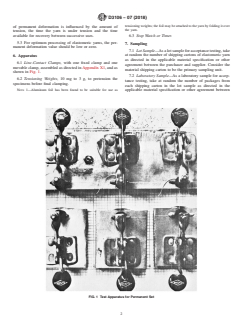
6.1 Line-Contact Clamps, with one fixed clamp and one
agreement between the purchaser and supplier. Consider the
movable clamp, assembled as directed in Appendix X1, and as
material shipping carton to be the primary sampling unit.
shown in Fig. 1.
7.2 Laboratory Sample—As a laboratory sample for accep-
6.2 Tensioning Weights, 10 mg to 3 g, to pretension the
tance testing, take at random the number of packages from
specimens before final clamping.
each shipping carton in the lot sample as directed in the
NOTE 1—Aluminum foil has been found to be suitable for use as applicable material specification or other agreement between
FIG. 1 Test Apparatus for Permanent Set
D3106 − 07 (2018)
the purchaser and the supplier. If differing numbers and 8.1.2 No Reliable Estimate of s—When there is no reliable
packages are to be taken from the shipping cartons in the lot estimate of s for the user’s laboratory, (Eq 1) should not be
sample, determine at random which shipping cartons are to used directly. Instead, specify the fixed number of ten speci-
have each number of packages drawn. mens. This number of specimens is calculated using s = 0.87
percentage point, which is a somewhat larger value of s than is
NOTE 2—An adequate specification or other agreement between the
usually found in practice. When a reliable estimate of s for the
purchaser and the supplier requires taking into account the variability
user’slaboratorybecomesavailable,(Eq1)willusuallyrequire
between shipping cartons, and the variability of the material within the
shipping carton, to provide a sampling plan with a meaningful producer’s
fewer than ten specimens.
risk, consumer’s risk, acceptable quality level, and limiting quality level.
7.3 Test Specimens—From each package in the laboratory 9. Conditioning
sample, take the number of specimens directed in Section 8.
9.1 Condition the specimens in the standard atmosphere for
Inspect each package after withdrawing at least five layers of
testing textiles, 65 6 2 % relative humidity and 21 6 1°C (70
yarn from the outside of the package. If there is evidence of
6 2°F) temperature, in moving air for a minimum time of 16
damage,continuetowithdrawunitsoffivelayersandreinspect
h. Preconditioning is not necessary for the currently produced
until there is no discernible damage. Withdraw yarn over the
rubber and other elastomers having a moisture regain below
end of the package and cut specimens approximately 150 mm
1.0 % and low moisture hysteresis.
long. Discard specimens that are damaged during withdrawal
or cutting. Withdraw at least2mof yarn between specimens
10. Procedure
from a single package.
10.1 Test all specimens in the standard atmosphere for
8. Specimens Per Package
testing textiles.
8.1 Take a number of specimens per package such that the
10.2 Determinetheelongationatthebreakingforceforeach
usermayexpectatthe95 %probabilitylevelthatthetestresult
specimen as directed in Test Method D2433.
is no more than 0.55 percentage points above or below the true
NOTE 3—When Test Method D3106 is used for acceptance testing, the
average of the package. Determine the number of specimens as
laboratory of the purchaser and the laboratory of the supplier should agree
follows:
on a specific value of the elongation at the breaking force.
8.1.1 Reliable Estimate of s—When there is a reliable
10.3 Determine the linear density for the sample as directed
estimate of s based on extensive past records for similar
in Test Method D2433. The nominal linear density value may
materials tested in the user’s laboratory as directed in the test
be used.
method, calculate the required number of specimens per
package using (Eq 1):
10.4 Adjust the line-contact clamps for a 100 mm nominal
gage length (see Fig. 1). This is the original length of a
n 5 ts/E (1)
~ !
specimen.
where:
NOTE 4—Aconvenient method for checking the gage length is to place
n = number of specimens per package (rounded upward to a
a piece of carbon paper and white paper in the clamps and close the
whole number),
clamps. The distance between the marks on the whitepaper (made by the
s = reliable estimate of the standard deviation of individual
carbon paper) is the nominal gage length. If the test apparatus is
observationsonsimilarmaterialsintheuser’slaboratory
assembled as described in Appendix X1, the nominal gage length may be
set directly.
under conditions of single-operator precision,
t = value of Student’s t for two-sided limits, a 95 %
10.5 Fasten one end of the specimen in the top cla
...