

ASTM E1300-24
(Practice)Standard Practice for Determining Load Resistance of Glass in Buildings
General Information
- Abstract
SIGNIFICANCE AND USE
6.1 This practice is used to determine the LR of specified glass types and constructions exposed to uniform lateral loads.
6.2 Use of this practice assumes:
6.2.1 The glass is free of edge damage and is properly glazed.
6.2.2 The glass has not been subjected to abuse.
6.2.3 The surface condition of the glass is typical of glass that has been in service for several years, and is weaker than freshly manufactured glass due to minor abrasions on exposed surfaces.
6.2.4 The glass edge support system is sufficiently stiff to limit the lateral deflections of the supported glass edges to no more than 1/175 of their lengths. The specified design load shall be used for this calculation.
6.2.5 The deflection of glass or support system, or both, shall not result in loss of glass edge support. The glass bite reduction or pullout shall be considered using the method referenced in (1).3
Note 2: Glass deflections are to be reviewed. This practice does not address aesthetic issues caused by glass deflection.
Note 3: This practice does not consider the effects of deflection on insulating glass unit seal performance.
Note 4: The designer/engineer must determine what constitutes sufficient glass edge support based on Annex A1, Non-Factored Load Charts.
6.3 Many other factors shall be considered in glass type and thickness selection. These factors include but are not limited to: thermal stresses, spontaneous breakage of tempered glass, the effects of windborne debris, excessive deflections, behavior of glass fragments after breakage, blast, seismic effects, building movement, heat flow, edge bite, noise abatement, and potential post-breakage consequences. In addition, considerations set forth in building codes along with criteria presented in safety-glazing standards and site-specific concerns may control the ultimate glass type and thickness selection.
6.4 For situations not specifically addressed in this standard, the design professional shall use enginee...
SCOPE
1.1 This practice covers procedures to determine the load resistance (LR) of specified glass types, including combinations of glass types used in a sealed insulating glass (IG) unit, exposed to a uniform lateral load of short or long duration, for a specified probability of breakage.
1.2 This practice applies to vertical and sloped glazing in buildings for which the specified design loads consist of wind load, snow load and self-weight with a total combined magnitude less than or equal to 15 kPa (315 psf). This practice shall not apply to other applications including, but not limited to, balustrades, glass floor panels, aquariums, structural glass members, and glass shelves.
1.3 This practice applies only to monolithic and laminated glass constructions of rectangular shape with continuous lateral support along one, two, three, or four edges. This practice assumes that (1) the supported glass edges for two, three, and four-sided support conditions are simply supported and free to slip in plane; (2) glass supported on two sides acts as a simply supported beam; and (3) glass supported on one side acts as a cantilever. For insulating glass units, this practice only applies to insulating glass units with four-sided edge support.
1.4 This practice does not apply to any form of wired, patterned, sandblasted, drilled, notched, or grooved glass. This practice does not apply to glass with surface or edge treatments that reduce the glass strength.
Note 1: Ceramic enamel is known to affect glass load resistance. Consult the manufacturer for guidance.
1.5 This practice addresses only the determination of the resistance of glass to uniform lateral loads. The final thickness and type of glass selected also depends upon a variety of other factors (see 6.3).
1.6 Charts in this practice provide a means to determine approximate maximum lateral glass deflection. Appendix X1 provides additional procedures to determine maximu...
- Status
- Published
- Publication Date
- 29-Feb-2024
- Technical Committee
- E06 - Performance of Buildings
- Drafting Committee
- E06.52 - Glass Use in Buildings
Overview
ASTM E1300-24: Standard Practice for Determining Load Resistance of Glass in Buildings provides comprehensive procedures for evaluating the load resistance (LR) of glass types-including monolithic, laminated, and insulating glass units-when subjected to uniform lateral loads. This standard applies to vertical and sloped glazing in buildings where the total combined design loads (such as wind, snow, and self-weight) do not exceed 15 kPa (315 psf). ASTM E1300-24 is a key resource for architects, structural engineers, and glazing professionals seeking standardized methods for glass load resistance calculation to ensure building safety and code compliance.
Key Topics
Load Resistance (LR) Determination
Outlines step-by-step procedures for calculating the LR of various glass constructions (monolithic, laminated, and insulating glass units) exposed to short or long duration lateral loads.Glazing Configurations
Covers rectangular glass panels with continuous lateral support along one, two, three, or four edges, including simply supported edges and cantilever conditions.Glass Type and Thickness Selection
Instructs on considering factors such as thermal stress, spontaneous breakage, windborne debris, seismic effects, building movement, and post-breakage behavior.Limitations and Exclusions
Excludes certain glass types and applications, including wired, patterned, sandblasted, drilled, or grooved glass, as well as glass with strength-reducing treatments.Design Assumptions
Assumes glass is free of edge damage, properly glazed, un-abused, with aged surface condition, and that support systems are sufficiently stiff to limit edge deflections (no more than 1/175 of glass edge length).Probability of Breakage
The practices in ASTM E1300-24 are based on achieving a specified probability of breakage, typically less than or equal to 8 in 1000 lites, for a given load and duration.Charts and Analytical Methods
Provides non-factored load charts and analytical guidance to estimate maximum lateral glass deflection and LR, referencing different glass types and load durations.
Applications
ASTM E1300-24 is widely used across the building and construction sector for:
Glazing System Design
Ensuring glass in windows, curtain walls, and skylights meets structural load requirements for wind, snow, and self-weight.Building Code Compliance
Helping designers demonstrate compliance with safety and performance requirements in building codes and safety glazing standards.Material Specification and Selection
Aiding specifiers in selecting suitable glass thickness and types based on calculated load resistance and service conditions.Performance Verification
Verifying that installed glass will maintain structural integrity without undue deflection, edge failure, or excessive risk of breakage throughout its service life.
Note: ASTM E1300-24 is not applicable to glass used in balustrades, floor panels, structural members, shelving, aquariums, non-rectangular shapes, or glazing with special surface treatments or modifications not addressed by the standard.
Related Standards
Professionals working with ASTM E1300-24 may also reference:
- ASTM C1036: Specification for Flat Glass
- ASTM C1048: Specification for Heat-Strengthened and Fully Tempered Flat Glass
- ASTM C1172: Specification for Laminated Architectural Flat Glass
- ASTM E631: Terminology of Building Constructions
- Building Codes: Applicable local, state, or international codes referencing glazing requirements and safety glazing criteria
By following ASTM E1300-24, building professionals can ensure that glazing systems are safe, structurally adequate, and meet industry best practices for load resistance of glass in buildings.
Relations
- Effective Date
- 01-Mar-2024
- Effective Date
- 01-Mar-2024
- Effective Date
- 01-Mar-2024
- Referred By
ASTM C1048-18 - Standard Specification for Heat-Strengthened and Fully Tempered Flat Glass - Effective Date
- 01-Mar-2024
- Effective Date
- 01-Mar-2024
- Effective Date
- 01-Mar-2024
- Effective Date
- 01-Mar-2024
- Effective Date
- 01-Mar-2024
Frequently Asked Questions
ASTM E1300-24 is a standard published by ASTM International. Its full title is "Standard Practice for Determining Load Resistance of Glass in Buildings". This standard covers: SIGNIFICANCE AND USE 6.1 This practice is used to determine the LR of specified glass types and constructions exposed to uniform lateral loads. 6.2 Use of this practice assumes: 6.2.1 The glass is free of edge damage and is properly glazed. 6.2.2 The glass has not been subjected to abuse. 6.2.3 The surface condition of the glass is typical of glass that has been in service for several years, and is weaker than freshly manufactured glass due to minor abrasions on exposed surfaces. 6.2.4 The glass edge support system is sufficiently stiff to limit the lateral deflections of the supported glass edges to no more than 1/175 of their lengths. The specified design load shall be used for this calculation. 6.2.5 The deflection of glass or support system, or both, shall not result in loss of glass edge support. The glass bite reduction or pullout shall be considered using the method referenced in (1).3 Note 2: Glass deflections are to be reviewed. This practice does not address aesthetic issues caused by glass deflection. Note 3: This practice does not consider the effects of deflection on insulating glass unit seal performance. Note 4: The designer/engineer must determine what constitutes sufficient glass edge support based on Annex A1, Non-Factored Load Charts. 6.3 Many other factors shall be considered in glass type and thickness selection. These factors include but are not limited to: thermal stresses, spontaneous breakage of tempered glass, the effects of windborne debris, excessive deflections, behavior of glass fragments after breakage, blast, seismic effects, building movement, heat flow, edge bite, noise abatement, and potential post-breakage consequences. In addition, considerations set forth in building codes along with criteria presented in safety-glazing standards and site-specific concerns may control the ultimate glass type and thickness selection. 6.4 For situations not specifically addressed in this standard, the design professional shall use enginee... SCOPE 1.1 This practice covers procedures to determine the load resistance (LR) of specified glass types, including combinations of glass types used in a sealed insulating glass (IG) unit, exposed to a uniform lateral load of short or long duration, for a specified probability of breakage. 1.2 This practice applies to vertical and sloped glazing in buildings for which the specified design loads consist of wind load, snow load and self-weight with a total combined magnitude less than or equal to 15 kPa (315 psf). This practice shall not apply to other applications including, but not limited to, balustrades, glass floor panels, aquariums, structural glass members, and glass shelves. 1.3 This practice applies only to monolithic and laminated glass constructions of rectangular shape with continuous lateral support along one, two, three, or four edges. This practice assumes that (1) the supported glass edges for two, three, and four-sided support conditions are simply supported and free to slip in plane; (2) glass supported on two sides acts as a simply supported beam; and (3) glass supported on one side acts as a cantilever. For insulating glass units, this practice only applies to insulating glass units with four-sided edge support. 1.4 This practice does not apply to any form of wired, patterned, sandblasted, drilled, notched, or grooved glass. This practice does not apply to glass with surface or edge treatments that reduce the glass strength. Note 1: Ceramic enamel is known to affect glass load resistance. Consult the manufacturer for guidance. 1.5 This practice addresses only the determination of the resistance of glass to uniform lateral loads. The final thickness and type of glass selected also depends upon a variety of other factors (see 6.3). 1.6 Charts in this practice provide a means to determine approximate maximum lateral glass deflection. Appendix X1 provides additional procedures to determine maximu...
SIGNIFICANCE AND USE 6.1 This practice is used to determine the LR of specified glass types and constructions exposed to uniform lateral loads. 6.2 Use of this practice assumes: 6.2.1 The glass is free of edge damage and is properly glazed. 6.2.2 The glass has not been subjected to abuse. 6.2.3 The surface condition of the glass is typical of glass that has been in service for several years, and is weaker than freshly manufactured glass due to minor abrasions on exposed surfaces. 6.2.4 The glass edge support system is sufficiently stiff to limit the lateral deflections of the supported glass edges to no more than 1/175 of their lengths. The specified design load shall be used for this calculation. 6.2.5 The deflection of glass or support system, or both, shall not result in loss of glass edge support. The glass bite reduction or pullout shall be considered using the method referenced in (1).3 Note 2: Glass deflections are to be reviewed. This practice does not address aesthetic issues caused by glass deflection. Note 3: This practice does not consider the effects of deflection on insulating glass unit seal performance. Note 4: The designer/engineer must determine what constitutes sufficient glass edge support based on Annex A1, Non-Factored Load Charts. 6.3 Many other factors shall be considered in glass type and thickness selection. These factors include but are not limited to: thermal stresses, spontaneous breakage of tempered glass, the effects of windborne debris, excessive deflections, behavior of glass fragments after breakage, blast, seismic effects, building movement, heat flow, edge bite, noise abatement, and potential post-breakage consequences. In addition, considerations set forth in building codes along with criteria presented in safety-glazing standards and site-specific concerns may control the ultimate glass type and thickness selection. 6.4 For situations not specifically addressed in this standard, the design professional shall use enginee... SCOPE 1.1 This practice covers procedures to determine the load resistance (LR) of specified glass types, including combinations of glass types used in a sealed insulating glass (IG) unit, exposed to a uniform lateral load of short or long duration, for a specified probability of breakage. 1.2 This practice applies to vertical and sloped glazing in buildings for which the specified design loads consist of wind load, snow load and self-weight with a total combined magnitude less than or equal to 15 kPa (315 psf). This practice shall not apply to other applications including, but not limited to, balustrades, glass floor panels, aquariums, structural glass members, and glass shelves. 1.3 This practice applies only to monolithic and laminated glass constructions of rectangular shape with continuous lateral support along one, two, three, or four edges. This practice assumes that (1) the supported glass edges for two, three, and four-sided support conditions are simply supported and free to slip in plane; (2) glass supported on two sides acts as a simply supported beam; and (3) glass supported on one side acts as a cantilever. For insulating glass units, this practice only applies to insulating glass units with four-sided edge support. 1.4 This practice does not apply to any form of wired, patterned, sandblasted, drilled, notched, or grooved glass. This practice does not apply to glass with surface or edge treatments that reduce the glass strength. Note 1: Ceramic enamel is known to affect glass load resistance. Consult the manufacturer for guidance. 1.5 This practice addresses only the determination of the resistance of glass to uniform lateral loads. The final thickness and type of glass selected also depends upon a variety of other factors (see 6.3). 1.6 Charts in this practice provide a means to determine approximate maximum lateral glass deflection. Appendix X1 provides additional procedures to determine maximu...
ASTM E1300-24 is classified under the following ICS (International Classification for Standards) categories: 81.040.30 - Glass products. The ICS classification helps identify the subject area and facilitates finding related standards.
ASTM E1300-24 has the following relationships with other standards: It is inter standard links to ASTM E1300-16, ASTM E2461-22, ASTM F2248-19, ASTM C1048-18, ASTM E997-15(2021), ASTM E1233/E1233M-14(2021), ASTM C1401-23, ASTM E330/E330M-14(2021). Understanding these relationships helps ensure you are using the most current and applicable version of the standard.
ASTM E1300-24 is available in PDF format for immediate download after purchase. The document can be added to your cart and obtained through the secure checkout process. Digital delivery ensures instant access to the complete standard document.
Standards Content (Sample)
This international standard was developed in accordance with internationally recognized principles on standardization established in the Decision on Principles for the
Development of International Standards, Guides and Recommendations issued by the World Trade Organization Technical Barriers to Trade (TBT) Committee.
Designation: E1300 − 24
Standard Practice for
Determining Load Resistance of Glass in Buildings
This standard is issued under the fixed designation E1300; the number immediately following the designation indicates the year of
original adoption or, in the case of revision, the year of last revision. A number in parentheses indicates the year of last reapproval. A
superscript epsilon (´) indicates an editorial change since the last revision or reapproval.
1. Scope 1.7 Appendix X2 lists the key variables used in calculating
the mandatory type factors in Tables 1-3 and comments on
1.1 This practice covers procedures to determine the load
their conservative values.
resistance (LR) of specified glass types, including combina-
tions of glass types used in a sealed insulating glass (IG) unit, 1.8 The values stated in SI units are to be regarded as
exposed to a uniform lateral load of short or long duration, for standard. The values given in parentheses after SI units are
a specified probability of breakage. provided for information only and are not considered standard.
1.9 This standard does not purport to address all of the
1.2 This practice applies to vertical and sloped glazing in
safety concerns, if any, associated with its use. It is the
buildings for which the specified design loads consist of wind
responsibility of the user of this standard to establish appro-
load, snow load and self-weight with a total combined magni-
priate safety, health, and environmental practices and deter-
tude less than or equal to 15 kPa (315 psf). This practice shall
mine the applicability of regulatory limitations prior to use.
not apply to other applications including, but not limited to,
1.10 This international standard was developed in accor-
balustrades, glass floor panels, aquariums, structural glass
dance with internationally recognized principles on standard-
members, and glass shelves.
ization established in the Decision on Principles for the
1.3 This practice applies only to monolithic and laminated
Development of International Standards, Guides and Recom-
glass constructions of rectangular shape with continuous lateral
mendations issued by the World Trade Organization Technical
support along one, two, three, or four edges. This practice
Barriers to Trade (TBT) Committee.
assumes that (1) the supported glass edges for two, three, and
four-sided support conditions are simply supported and free to
2. Referenced Documents
slip in plane; (2) glass supported on two sides acts as a simply
2.1 ASTM Standards:
supported beam; and (3) glass supported on one side acts as a
C1036 Specification for Flat Glass
cantilever. For insulating glass units, this practice only applies
C1048 Specification for Heat-Strengthened and Fully Tem-
to insulating glass units with four-sided edge support.
pered Flat Glass
1.4 This practice does not apply to any form of wired,
C1172 Specification for Laminated Architectural Flat Glass
patterned, sandblasted, drilled, notched, or grooved glass. This
D4065 Practice for Plastics: Dynamic Mechanical Proper-
practice does not apply to glass with surface or edge treatments
ties: Determination and Report of Procedures
that reduce the glass strength.
E631 Terminology of Building Constructions
NOTE 1—Ceramic enamel is known to affect glass load resistance.
Consult the manufacturer for guidance. 3. Terminology
1.5 This practice addresses only the determination of the
3.1 Definitions:
resistance of glass to uniform lateral loads. The final thickness
3.1.1 Refer to Terminology E631 for additional terms used
and type of glass selected also depends upon a variety of other
in this practice.
factors (see 6.3).
3.2 Definitions of Terms Specific to This Standard:
3.2.1 acid etched glass, n—glass surface that has been
1.6 Charts in this practice provide a means to determine
treated primarily with hydrofluoric acid and potentially in
approximate maximum lateral glass deflection. Appendix X1
combination with other agents. Acid etched glass strength shall
provides additional procedures to determine maximum lateral
be considered as equivalent to float glass in this practice
deflection for glass simply supported on four sides.
provided the glass thickness conforms to Specification C1036.
This practice is under the jurisdiction of ASTM Committee E06 on Perfor-
mance of Buildings and is the direct responsibility of Subcommittee E06.52 on
Glass Use in Buildings. For referenced ASTM standards, visit the ASTM website, www.astm.org, or
Current edition approved March 1, 2024. Published April 2024. Originally contact ASTM Customer Service at service@astm.org. For Annual Book of ASTM
approved in 1989. Last previous edition approved in 2016 as E1300 – 16. DOI: Standards volume information, refer to the standard’s Document Summary page on
10.1520/E1300-24. the ASTM website.
Copyright © ASTM International, 100 Barr Harbor Drive, PO Box C700, West Conshohocken, PA 19428-2959. United States
E1300 − 24
TABLE 1 Glass Type Factors (GTF) for a Single Lite of Monolithic TABLE 4 Nominal and Minimum Glass Thicknesses
or Laminated Glass (LG)
Nominal Thickness Minimum
or Designation, Thickness,
GTF
mm (in.) mm (in.)
Long Duration Load
Glass Type Short Duration Load (3 s)
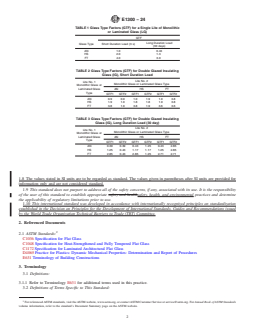
2.0 (picture) 1.80 (0.071)
(30 days)
2.5 ( ⁄32) 2.16 (0.085)
AN 1.0 0.43
2.7 (lami) 2.59 (0.102)
HS 2.0 1.3
3.0 ( ⁄8) 2.92 (0.115)
FT 4.0 3.0
4.0 ( ⁄32) 3.78 (0.149)
5.0 ( ⁄16) 4.57 (0.180)
6.0 ( ⁄4) 5.56 (0.219)
8.0 ( ⁄16) 7.42 (0.292)
TABLE 2 Glass Type Factors (GTF) for Double Glazed Insulating
10.0 ( ⁄8) 9.02 (0.355)
Glass (IG), Short Duration Load
12.0 ( ⁄2) 11.91 (0.469)
Lite No. 2 5
16.0 ( ⁄8) 15.09 (0.595)
Lite No. 1
Monolithic Glass or Laminated Glass Type 3
19.0 ( ⁄4) 18.26 (0.719)
Monolithic Glass or
22.0 ( ⁄8) 21.44 (0.844)
Laminated Glass AN HS FT
25.0 (1) 24.61 (0.969)
Type
GTF1 GTF2 GTF1 GTF2 GTF1 GTF2
AN 0.9 0.9 1.0 1.9 1.0 3.8
HS 1.9 1.0 1.8 1.8 1.9 3.8
FT 3.8 1.0 3.8 1.9 3.6 3.6
3.2.4.2 thickness designation for monolithic glass, n—a
term that defines a designated thickness for monolithic glass as
specified in Table 4 and Specification C1036.
TABLE 3 Glass Type Factors (GTF) for Double Glazed Insulating
Glass (IG), Long Duration Load (30 day)
3.2.5 Glass Types:
Lite No. 2 3.2.5.1 annealed (AN) glass, n—a flat, monolithic, glass lite
Lite No. 1
Monolithic Glass or Laminated Glass Type
of uniform thickness where the residual surface stresses are
Monolithic Glass or
Laminated Glass AN HS FT
nearly zero as defined in Specification C1036.
Type
GTF1 GTF2 GTF1 GTF2 GTF1 GTF2
3.2.5.2 fully tempered (FT) glass, n—a flat, monolithic,
AN 0.39 0.39 0.43 1.25 0.43 2.85
glass lite of uniform thickness that has been subjected to a
HS 1.25 0.43 1.17 1.17 1.25 2.85
special heat treatment process where the residual surface
FT 2.85 0.43 2.85 1.25 2.71 2.71
compression is not less than 69 MPa (10 000 psi) or the edge
compression not less than 67 MPa (9700 psi) as defined in
Specification C1048.
3.2.5.3 heat strengthened (HS) glass, n—a flat, monolithic,
glass lite of uniform thickness that has been subjected to a
3.2.2 aspect ratio (AR), n—for glass simply supported on
special heat treatment process where the residual surface
four sides, the ratio of the long dimension of the glass to the
compression is not less than 24 MPa (3500 psi) or greater than
short dimension of the glass is always equal to or greater than
52 MPa (7500 psi) as defined in Specification C1048.
1.0. For glass simply supported on three sides, the ratio of the
3.2.5.4 insulating glass (IG) unit, n—any combination of
length of one of the supported edges perpendicular to the free
two or three glass lites that enclose one or two sealed spaces
edge, to the length of the free edge, is equal to or greater than
respectively, filled with air or other gas.
0.5.
3.2.5.5 laminated glass (LG), n—a flat lite of uniform
3.2.3 glass breakage, n—the fracture of any lite or ply in
thickness consisting of two or more monolithic glass plies
monolithic, laminated, or insulating glass.
bonded together with an interlayer material as defined in
3.2.4 Glass Thickness: Specification C1172.
3.2.4.1 thickness designation for laminated glass (LG), n—a (1) Discussion—Many different interlayer materials are
used in LG. The information in this practice applies only to
term used to specify a LG construction based on the combined
thicknesses of component plies. polyvinyl butyral (PVB) interlayer or those interlayers that
demonstrate equivalency according to Appendix X8.
(1) Add the minimum thicknesses of the individual glass
plies and the nominal interlayer thickness. If the sum of all 3.2.6 glass type factor (GTF), n—a multiplying factor for
adjusting the LR of different glass types, that is, AN, HS, or FT
interlayer thicknesses is greater than 1.52 mm (0.060 in.) use
1.52 mm (0.060 in.) in the calculation. in monolithic glass, LG, or IG constructions.
(2) Select the nominal thickness or designation in Table 4
3.2.7 lateral, adj—perpendicular to the glass surface.
having the closest minimum thickness that is equal to or less
3.2.8 load, n—a uniformly distributed lateral pressure.
than the value obtained in 3.2.4.1 (1).
3.2.8.1 glass weight load, n—the dead load component of
(3) Exceptions—The construction of two 6 mm ( ⁄4 in.)
the glass weight.
glass plies plus 0.38 mm (0.015 in.) or 0.76 mm (0.030 in.)
interlayer shall be defined as 12 mm ( ⁄2 in.). The construction 3.2.8.2 load resistance (LR), n—the uniform lateral load that
of two 2.5 mm ( ⁄32 in.) glass plies plus 1.52 mm (0.060 in.) a glass construction can sustain based upon a given probability
interlayer shall be defined as 5 mm ( ⁄16 in.). The construction of breakage and load duration.
of two 4 mm ( ⁄32 in.) glass plies plus any thickness interlayer (1) Discussion—Multiplying the non-factored load (NFL)
shall be defined as 8 mm ( ⁄16 in.). from figures in Annex A1 by the relevant GTF and load share
E1300 − 24
(LS) factors gives the LR associated with a probability of 5. Summary of Practice
breakage less than or equal to 0.008.
5.1 The specifying authority shall provide the design load,
3.2.8.3 long duration load, n—any load lasting approxi-
the rectangular glass dimensions, the type of glass required,
mately 30 days.
and a statement, or details, showing that the glass edge support
(1) Discussion—For loads having durations other than 3 s
system meets the stiffness requirement in 6.2.4.
or 30 days, refer to Table X4.1.
5.2 The procedure specified in this practice shall be used to
3.2.8.4 non-factored load (NFL)—three-second duration
determine the uniform lateral LR of glass in buildings. If the
uniform load associated with a probability of breakage less
LR is less than the specified load, then other glass types and
than or equal to 0.008 for monolithic AN glass as determined
thicknesses may be evaluated to find a suitable assembly
from the figures in Annex A1.
having LR equal to or exceeding the specified design load.
3.2.8.5 short duration load, n—any load lasting 3 s or less.
5.3 The charts presented in this practice shall be used to
determine the approximate maximum lateral glass deflection.
3.2.8.6 specified design load, n—the magnitude in kPa (psf),
Appendix X1 presents additional procedures to determine the
type (for example, wind or snow) and duration of the load
approximate maximum lateral deflection for a specified load on
given by the specifying authority.
glass simply supported on four sides.
3.2.9 load share factor (LSF), n—the portion of applied load
going to a particular lite in consideration in a sealed IG unit,
6. Significance and Use
whether the lite be monolithic glass or LG (including the
6.1 This practice is used to determine the LR of specified
layered behavior of LG under long duration loads).
glass types and constructions exposed to uniform lateral loads.
3.2.9.1 Discussion—The LSF is used along with the GTF
and the NFL value from the NFL charts to give the LR of the
6.2 Use of this practice assumes:
IG unit, based on the resistance to breakage of one specific lite
6.2.1 The glass is free of edge damage and is properly
only.
glazed.
6.2.2 The glass has not been subjected to abuse.
3.2.10 patterned glass, n—rolled flat glass having a pattern
6.2.3 The surface condition of the glass is typical of glass
on one or both surfaces.
that has been in service for several years, and is weaker than
3.2.11 probability of breakage (P ), n—the statistical likeli-
b
freshly manufactured glass due to minor abrasions on exposed
hood that a given lite or ply would break at the first occurrence
surfaces.
of a specified load and duration, typically expressed in decimal
6.2.4 The glass edge support system is sufficiently stiff to
format when larger than 0.001 and scientific notation when less
limit the lateral deflections of the supported glass edges to no
than 0.001.
more than ⁄175 of their lengths. The specified design load shall
3.2.12 sandblasted glass, n—flat glass with a surface that
be used for this calculation.
has been sprayed by sand or other media at high velocities to
6.2.5 The deflection of glass or support system, or both,
produce a translucent effect.
shall not result in loss of glass edge support. The glass bite
3.2.13 specifying authority, n—the design professional re- reduction or pullout shall be considered using the method
sponsible for interpreting applicable regulations of authorities referenced in (1).
NOTE 2—Glass deflections are to be reviewed. This practice does not
having jurisdiction and considering appropriate site specific
address aesthetic issues caused by glass deflection.
factors to determine the appropriate values used to calculate the
NOTE 3—This practice does not consider the effects of deflection on
specified design load, and furnishing other information re-
insulating glass unit seal performance.
quired to perform this practice.
NOTE 4—The designer/engineer must determine what constitutes suf-
ficient glass edge support based on Annex A1, Non-Factored Load Charts.
3.2.14 wired glass, n—flat glass with a layer of wire strands
or mesh completely embedded in the glass. 6.3 Many other factors shall be considered in glass type and
thickness selection. These factors include but are not limited
4. Material Properties to: thermal stresses, spontaneous breakage of tempered glass,
the effects of windborne debris, excessive deflections, behavior
4.1 Glass (Soda-lime-silica):
of glass fragments after breakage, blast, seismic effects, build-
4.1.1 Modulus of Elasticity = 71.7 GPa (10.4 × 10 psi).
ing movement, heat flow, edge bite, noise abatement, and
4.1.2 Poisson’s Ratio = 0.22.
potential post-breakage consequences. In addition, consider-
3 3
4.1.3 Density = 2500 kg ⁄m (157 lb ⁄ft ).
ations set forth in building codes along with criteria presented
-53 -7 12
4.1.4 Surface Parameters m = 7; k = 2.86 × 10 N m
in safety-glazing standards and site-specific concerns may
-29 12 -7
(1.365 × 10 in. lb in.).
control the ultimate glass type and thickness selection.
4.1.4.1 These values are based on a load duration of 60 s.
6.4 For situations not specifically addressed in this standard,
4.1.5 Static Fatigue Constant n = 16 (for all glass types).
the design professional shall use engineering analysis and
4.2 Interlayers:
judgment to determine the LR of glass in buildings.
4.2.1 Refer to manufacturer for material properties for
relevant load duration and temperature. (Refer to Appendix X8
for material properties used to generate the charts Figs.
The boldface numbers in parentheses refer to a list of references at the end of
A1.29-A1.44.) this standard.
E1300 − 24
7. Procedure 7.2.5.1 Determine the NFL from the appropriate chart (the
upper charts of Figs. A1.29-A1.35) for the designated glass
7.1 Select the procedure to determine the load resistance.
thickness.
7.2 Basic Procedure:
7.2.5.2 Determine the GTF for the appropriate glass type,
7.2.1 For Monolithic Single Glazing Simply Supported Con-
load duration (short or long) from Table 1.
tinuously Along Four Sides:
7.2.5.3 Multiply NFL by GTF to get the LR of the laminated
7.2.1.1 Determine the NFL from the appropriate chart in
lite.
Annex A1 (the upper charts of Figs. A1.1-A1.14) for the glass
7.2.5.4 Determine the approximate maximum lateral (center
thickness and size.
of glass) deflection from the appropriate chart (the lower charts
7.2.1.2 Determine the GTF for the appropriate glass type
of Figs. A1.29-A1.35) for the designated glass thickness, size,
and load duration (short and long) from Table 1.
and design load. If the maximum lateral deflection falls outside
7.2.1.3 Multiply NFL by GTF to get the LR of the lite.
the charts in Annex A1, then use the procedures outlined in
7.2.1.4 Determine the appropriate maximum lateral (center
Appendix X1.
of glass) deflection from the approximate chart in Annex A1
7.2.6 For Laminated Single Glazing Simply Supported Con-
(the lower charts of Figs. A1.1-A1.14) for the designation glass
tinuously Along Three Sides Where In-Service Laminated
thickness, size, and design load. If the maximum lateral
Glass (LG) Temperatures At The Design Load Do Not Exceed
deflection falls outside the charges in Annex A1, then use the
50 °C (122 °F):
procedures outlined in Appendix X1.
7.2.6.1 Determine the NFL from the appropriate chart (the
7.2.2 For Monolithic Single Glazing Simply Supported Con-
upper charts of Figs. A1.36-A1.42) for the designated glass
tinuously Along Three Sides:
thickness and size equal to the LG thickness.
7.2.2.1 Determine the NFL from the appropriate chart in
7.2.6.2 Determine the GTF for the appropriate glass type
Annex A1 (the upper charts of Figs. A1.15-A1.26) for the
and load duration (short or long) from Table 1.
designated glass thickness and size.
7.2.6.3 Multiply NFL by GTF to get the LR of the laminated
7.2.2.2 Determine the GTF for the appropriate glass type
lite.
and load duration (short or long) from Table 1.
7.2.6.4 Determine the approximate maximum lateral (center
7.2.2.3 Multiply NFL by GTF to get the LR of the lite.
of unsupported edge) deflection from the appropriate chart (the
7.2.2.4 Determine the approximate maximum lateral (center
lower charts of Figs. A1.36-A1.42) for the designated glass
of unsupported edge) deflection from the appropriate chart in
thickness, size, and design load.
Annex A1 (the lower charts in Figs. A1.15-A1.26) for the
7.2.7 For Laminated Single Glazing Simply Supported Con-
designated glass thickness, size, and design load.
tinuously Along Two Opposite Sides Where In-Service Lami-
7.2.3 For Monolithic Single Glazing Simply Supported Con-
nated Glass (LG) Temperatures At The Design Load Do Not
tinuously Along Two Opposite Sides:
Exceed 50 °C (122 °F):
7.2.3.1 Determine the NFL from the upper chart of Fig. 7.2.7.1 Determine the NFL from the upper chart of Fig.
A1.27 for the designated glass thickness and length of unsup-
A1.43 for the designated glass thickness and length of unsup-
ported edges. ported edges.
7.2.3.2 Determine the GTF for the appropriate glass type
7.2.7.2 Determine the GTF for the appropriate glass type
and load duration (short or long) from Table 1.
and load duration (short or long) from Table 1.
7.2.3.3 Multiply NFL by GTF to get the LR of the lite.
7.2.7.3 Multiply NFL by GTF to get the LR of the laminated
7.2.3.4 Determine the approximate maximum lateral (center lite.
of an unsupported edge) deflection from the lower chart of Fig.
7.2.7.4 Determine the approximate maximum lateral (center
A1.27 for the designated glass thickness, length of unsupported
of an unsupported edge) deflection from the lower chart of Fig.
edge, and design load.
A1.43 for the designated glass thickness, length of unsupported
7.2.4 For Monolithic Single Glazing Continuously Sup- edge, and design load.
ported Along One Edge (Cantilever):
7.2.8 For Laminated Single Glazing Continuously Sup-
7.2.4.1 Determine the NFL from the upper chart of Fig. ported Along One Edge (Cantilever) Where In-Service Lami-
A1.28 for the designated glass thickness and length of unsup- nated Glass (LG) Temperatures At The Design Load Do Not
ported edges that are perpendicular to the supported edge.
Exceed 50 °C (122 °F):
7.2.4.2 Determine the GTF for the appropriate glass type 7.2.8.1 Determine the NFL from the upper chart of Fig.
and load duration (short or long) from Table 1. A1.44 for the designated glass thickness and length of unsup-
7.2.4.3 Multiply NFL by GTF to get the LR of the lite. ported edges that are perpendicular to the supported edge.
7.2.4.4 Determine the approximate maximum lateral (free 7.2.8.2 Determine the GTF for the appropriate glass type
and load duration (short or long) from Table 1.
edge opposite the supported edge) deflection from the lower
chart of Fig. A1.28 for the designated glass thickness, length of 7.2.8.3 Multiply NFL by GTF to get the LR of the laminated
unsupported edges, and design load. lite.
7.2.5 For Single-Glazed Laminated Glass (LG) Constructed 7.2.8.4 Determine the approximate maximum lateral (free
With a PVB Interlayer Simply Supported Continuously Along edge opposite the supported edge) deflection from the lower
Four Sides Where In-Service Laminated Glass (LG) Tempera- chart of Fig. A1.44 for the designated glass thickness, length of
tures At The Design Load Do Not Exceed 50 °C (122 °F): unsupported edges, and design load.
E1300 − 24
7.2.9 For Double Glazed Insulating Glass (IG) with Mono- 7.2.12.1 The LR of each lite must first be calculated for that
lithic Glass Lites of Equal (Symmetric) or Different (Asymmet- load acting for a short duration as in 7.2.10, and then for the
ric) Glass Type and Thickness Simply Supported Continuously same load acting for a long duration as given in 7.2.12.2 –
Along Four Sides: 7.2.12.5.
7.2.9.1 Determine the NFL1 for Lite No. 1 and NFL2 for
NOTE 6—There are some combinations of IG with LG where its
Lite No. 2 from the upper charts of Figs. A1.1-A1.14 (see
monolithic-like behavior under a short duration load gives the IG a lesser
Annex A3 for examples).
LR than under the layered behavior of long duration loads.
NOTE 5—Lites No. 1 or No. 2 can represent either the outward or 7.2.12.2 Determine the NFL for each lite from the upper
inward facing lite of the IG unit.
charts of Figs. A1.1-A1.14 and Figs. A1.29-A1.35 (see Annex
A3 for examples).
7.2.9.2 Determine the GTF1 for Lite No. 1 and GTF2 for
Lite No. 2 from Table 2 or Table 3, for the relevant glass type 7.2.12.3 Determine GTF1 for Lite No. 1 and GTF2 for Lite
No. 2 from Table 3 for the relevant glass type.
and load duration.
7.2.9.3 Determine the LSF1 for Lite No. 1 and LSF2 for 7.2.12.4 Determine LSF1 for Lite No. 1 and LSF2 for Lite
No. 2 from Table 6 for the relevant lite thickness.
Lite No. 2 from Table 5, for the relevant lite thickness.
7.2.9.4 Multiply NFL by GTF and divide by the LSF for 7.2.12.5 Multiply NFL by GTF and divide by the LSF for
each lite to determine LR1 for Lite No. 1 and LR2 for Lite No. each lite to determine LR1 for Lite No. 1 and LR2 for Lite No.
2 of the IG unit as follows: 2 of the IG unit, based on the long duration LR of each lite, as
follows:
LR1 5 NFL1 × GTF1÷LSF1 and LR2 5 NFL2 × GTF2÷LSF2 (1)
LR1 5 NFL1 × GTF1÷LSF1 and LR2 5 NFL2 × GTF2÷LSF2 (4)
7.2.9.5 The LR of the IG unit is the lower of the two values,
LR1 and LR2.
7.2.12.6 The LR of the IG unit is the lowest of the four
calculated LR values LR1 and LR2 for short duration loads
7.2.10 For Double Glazed Insulating Glass (IG) with One
from 7.2.10.4 and LR1 and LR2 for long duration loads from
Monolithic Lite and One Laminated Lite Under Short Duration
7.2.12.5.
Load Simply Supported Continuously Along Four Sides:
7.2.10.1 Determine the NFL for each lite from the upper 7.2.13 For Double Glazed Insulating Glass with Laminated
Glass (LG) over Laminated Glass (LG) Under Long Duration
charts of Figs. A1.1-A1.14 and Figs. A1.29-A1.35.
Load:
7.2.10.2 Determine the GTF1 for Lite No. 1 and GTF2 for
Lite No. 2 from Table 2. 7.2.13.1 The LR of each lite must first be calculated for that
load acting for a short duration as in 7.2.11, and then for the
7.2.10.3 Determine LSF1 for Lite No. 1 and LSF2 for Lite
same load acting for a long duration as given in 7.2.13.2 –
No. 2, from Table 5.
7.2.13.5.
7.2.10.4 Multiply NFL by GTF and divide by the LSF for
7.2.13.2 Determine NFL1 for Lite No. 1 and NFL2 for Lite
each lite to determine LR1 for Lite No. 1 and LR2 for Lite No.
No. 2 from the upper charts of Figs. A1.29-A1.35 (see Annex
2 of the IG unit as follows:
A3 for examples).
LR1 5 NFL1 × GTF1÷LSF1 and LR2 5 NFL2 × GTF2÷LSF2 (2)
7.2.13.3 Determine the GTF1 for Lite No. 1 and GTF2 for
7.2.10.5 The LR of the IG unit is the lower of the two
Lite No. 2 from Table 3.
calculated LR values.
7.2.13.4 Determine LSF1 for Lite No. 1 and LSF2 for Lite
7.2.11 For Double Glazed Insulating Glass with Laminated
No. 2 from Table 5.
Glass (LG) over Laminated Glass (LG) Under Short Duration
7.2.13.5 Multiply NFL by GTF and divide by the LSF for
Load Simply Supported Continuously Along Four Sides:
each lite to determine the LRs (LR1 and LR2 for Lites No. 1
7.2.11.1 Determine the NFL1 for Lite No. 1 and NFL2 for
and No. 2) of the IG unit, based on the long duration LR of
Lite No. 2 from the upper charts of Figs. A1.29-A1.35 (see
each lite, as follows:
Annex A3 for examples).
LR1 5 NFL1 × GTF1÷LSF1 and LR2 5 NFL2 × GTF2÷LSF2 (5)
7.2.11.2 For each lite, determine GTF1 for Lite No. 1 and
GTF2 for Lite No. 2 from Table 2. 7.2.13.6 The LR of the IG unit is the lowest of the four
calculated LR values LR1 and LR2 for short duration loads
7.2.11.3 For each lite, determine the LSF1 for Lite No. 1
from 6.12.4 and LR1 and LR2 for long duration loads from
and LSF2 for Lite No. 2 from Table 5.
7.2.13.5.
7.2.11.4 Multiply NFL by GTF and divide by the LSF for
each lite to determine LR1 for Lite No. 1 and LR2 for Lite No. 7.2.14 For Triple Glazed Insulating Glass (IG) with Three
Lites of Monolithic Glass of Equal (Symmetric) or Different
2 of the IG unit as follows:
(Asymmetric) Thickness with Two Separately Sealed Air
LR1 5 NFL1 × GTF1÷LSF1 and LR2 5 NFL2 × GTF2÷LSF2 (3)
Spaces and Equal Glass Type, Simply Supported Continuously
7.2.11.5 The LR of the IG unit is the lower of the two
Along Four Sides:
calculated LR values.
NOTE 7—The user is recommended to limit the combined width of both
7.2.12 For Double Glazed Insulating Glass (IG) with One
air spaces in the IG unit to less than or equal to 25 mm (1 in.). A larger
Monolithic Lite and One Laminated Lite, Under Long Dura-
combined dimension may result in excessive sealant stress and glass
tion Load Simply Supported Continuously Along Four Sides: stresses due to temperature and altitude conditions.
E1300 − 24
TABLE 5 Load Share Factors (LSF) for Double Glazed Insulating Glass (IG) Units
NOTE 1—Lite No. 1 Monolithic glass, Lite No. 2 Monolithic glass, short or long duration load, or Lite No. 1 Monolithic glass, Lite No. 2 Laminated glass, short duration load only, or Lite No.
1 Laminated Glass, Lite No. 2 Laminated Glass, short or long duration load.
NOTE 2—Values are approximated. Use Vallabhan and Chou (2) for alternate method. See Appendix X3 for basis of these values.
Lite No. 1 Lite No. 2
Monolithic Glass Monolithic Glass, Short or Long Duration Load or Laminated Glass, Short Duration Load Only
Nominal 2.0 2.5 2.7 3 4 5 6 8 10 12 16 19 22 25
3 1 5 3 1 5 3 1 5 3 7
Thickness (picture) ( ⁄32) (lami) ( ⁄8) ( ⁄32) ( ⁄16) ( ⁄4) ( ⁄16) ( ⁄8) ( ⁄2) ( ⁄8) ( ⁄4) ( ⁄8) (1)
mm ( in.) LSF1 LSF2 LSF1 LSF2 LSF1 LSF2 LSF1 LSF2 LSF1 LSF2 LSF1 LSF2 LSF1 LSF2 LSF1 LSF2 LSF1 LSF2 LSF1 LSF2 LSF1 LSF2 LSF1 LSF2 LSF1 LSF2 LSF1 LSF2
2.0 (picture) 0.500 0.500 0.367 0.633 0.251 0.749 0.190 0.810 0.097 0.903 0.058 0.942 0.033 0.967 0.014 0.986 0.008 0.992 0.003 0.997 0.002 0.998 0.001 0.999 0.0006 0.9994 0.0004 0.9996
2.5 ( ⁄32 ) 0.633 0.367 0.500 0.500 0.367 0.633 0.288 0.712 0.157 0.843 0.096 0.904 0.055 0.945 0.024 0.976 0.014 0.986 0.006 0.994 0.003 0.997 0.002 0.998 0.001 0.999 0.0007 0.9993
2.7 (lami) 0.749 0.251 0.633 0.367 0.500 0.500 0.411 0.589 0.243 0.757 0.154 0.846 0.092 0.908 0.041 0.959 0.023 0.977 0.010 0.990 0.005 0.995 0.003 0.997 0.002 0.998 0.001 0.999
3 ( ⁄8 ) 0.810 0.190 0.712 0.288 0.589 0.411 0.500 0.500 0.316 0.684 0.207 0.793 0.127 0.873 0.057 0.943 0.033 0.967 0.015 0.985 0.007 0.993 0.004 0.996 0.003 0.997 0.002 0.998
4 ( ⁄32 ) 0.903 0.097 0.843 0.157 0.757 0.243 0.684 0.316 0.500 0.500 0.361 0.639 0.239 0.761 0.117 0.883 0.069 0.931 0.031 0.969 0.015 0.985 0.009 0.991 0.005 0.995 0.004 0.996
5 ( ⁄16 ) 0.942 0.058 0.904 0.096 0.846 0.154 0.793 0.207 0.639 0.631 0.500 0.500 0.357 0.643 0.189 0.811 0.115 0.885 0.053 0.947 0.027 0.973 0.015 0.985 0.010 0.990 0.006 0.994
6 ( ⁄4 ) 0.967 0.033 0.945 0.055 0.908 0.092 0.873 0.127 0.761 0.239 0.643 0.357 0.500 0.500 0.296 0.704 0.190 0.810 0.092 0.908 0.048 0.952 0.027 0.973 0.017 0.983 0.011 0.989
8 ( ⁄16 ) 0.986 0.014 0.976 0.024 0.959 0.041 0.943 0.057 0.883 0.117 0.811 0.189 0.704 0.296 0.500 0.500 0.358 0.642 0.195 0.805 0.106 0.894 0.063 0.937 0.040 0.960 0.027 0.973
10 ( ⁄8 ) 0.992 0.008 0.986 0.014 0.977 0.023 0.967 0.033 0.931 0.069 0.885 0.115 0.810 0.190 0.642 0.358 0.500 0.500 0.303 0.697 0.176 0.824 0.108 0.892 0.069 0.931 0.047 0.953
12 ( ⁄2 ) 0.997 0.003 0.994 0.006 0.990 0.010 0.985 0.015 0.969 0.031 0.947 0.053 0.908 0.092 0.805 0.195 0.697 0.303 0.500 0.500 0.330 0.670 0.217 0.783 0.146 0.854 0.102 0.898
16 ( ⁄8 ) 0.998 0.002 0.997 0.003 0.995 0.005 0.993 0.007 0.985 0.015 0.973 0.027 0.952 0.048 0.894 0.106 0.824 0.176 0.670 0.330 0.500 0.500 0.361 0.639 0.259 0.741 0.187 0.813
19 ( ⁄4 ) 0.999 0.001 0.998 0.002 0.997 0.003 0.996 0.004 0.991 0.009 0.985 0.015 0.973 0.027 0.937 0.063 0.892 0.108 0.783 0.217 0.639 0.361 0.500 0.500 0.382 0.618 0.290 0.710
22 ( ⁄8 ) 0.9994 0.0006 0.999 0.001 0.998 0.002 0.997 0.003 0.995 0.005 0.990 0.010 0.983 0.017 0.960 0.040 0.931 0.069 0.854 0.146 0.741 0.259 0.618 0.382 0.500 0.500 0.398 0.602
25 (1) 0.9996 0.0004 0.999 0.0007 0.999 0.001 0.998 0.002 0.996 0.004 0.994 0.006 0.989 0.011 0.973 0.027 0.953 0.047 0.898 0.102 0.813 0.187 0.710 0.290 0.602 0.398 0.500 0.500
E1300 − 24
TABLE 6 Load Share Factors (LSF) for Double Glazed Insulating Glass (IG) Units
NOTE 1—Lite No. 1 Monolithic glass, Lite No. 2 Laminated glass, long duration load only.
NOTE 2—Values are approximated. Use Vallabhan and Chou (2) for alternate method.
Lite No. 1 Lite No. 2
Monolithic Glass Laminated Glass
Nominal 5 6 8 10 12 16 19
3 1 5 3 1 5 3
Thickness ( ⁄16) ( ⁄4) ( ⁄16) ( ⁄8) ( ⁄2) ( ⁄8) ( ⁄4)
mm ( in.) LSF1 LSF2 LSF1 LSF2 LSF1 LSF2 LSF1 LSF2 LSF1 LSF2 LSF1 LSF2 LSF1 LSF2
2.0 (picture) 0.224 0.776 0.144 0.856 0.051 0.949 0.030 0.970 0.017 0.983 0.007 0.993 0.004 0.996
2.5 ( ⁄32 ) 0.333 0.667 0.225 0.775 0.085 0.915 0.050 0.950 0.028 0.972 0.012 0.988 0.007 0.993
2.7 (lami) 0.463 0.537 0.333 0.667 0.139 0.861 0.083 0.917 0.048 0.952 0.021 0.979 0.012 0.988
3 ( ⁄8 ) 0.553 0.447 0.417 0.583 0.187 0.813 0.115 0.885 0.068 0.932 0.030 0.970 0.017 0.983
4 ( ⁄32 ) 0.728 0.272 0.609 0.391 0.333 0.667 0.221 0.779 0.136 0.864 0.062 0.938 0.035 0.965
5 ( ⁄16 ) 0.826 0.174 0.733 0.267 0.469 0.531 0.333 0.667 0.217 0.783 0.105 0.895 0.061 0.939
6 ( ⁄4 ) 0.895 0.105 0.832 0.168 0.614 0.386 0.474 0.526 0.333 0.667 0.174 0.826 0.105 0.895
8 ( ⁄16 ) 0.953 0.047 0.922 0.078 0.791 0.209 0.682 0.318 0.543 0.457 0.333 0.667 0.218 0.782
10 ( ⁄8 ) 0.973 0.027 0.955 0.045 0.872 0.128 0.794 0.206 0.681 0.319 0.473 0.527 0.333 0.667
12 ( ⁄2 ) 0.988 0.012 0.980 0.020 0.940 0.060 0.898 0.102 0.831 0.169 0.674 0.326 0.535 0.465
16 ( ⁄8 ) 0.994 0.006 0.990 0.010 0.970 0.030 0.947 0.053 0.909 0.091 0.808 0.192 0.701 0.299
19 ( ⁄4 ) 0.997 0.003 0.994 0.006 0.983 0.017 0.970 0.030 0.947 0.053 0.882 0.118 0.806 0.194
22 ( ⁄8 ) 0.998 0.002 0.996 0.004 0.989 0.011 0.981 0.019 0.966 0.034 0.923 0.077 0.870 0.130
25 (1) 0.999 0.001 0.998 0.002 0.993 0.007 0.987 0.013 0.977 0.023 0.948 0.052 0.910 0.090
7.2.14.1 Determine the NFL1 for Lite No. 1, NFL2 for Lite 7.2.15 If the LR thus determined is less than the specified
No. 2, and NFL3 for Lite No. 3 from the upper charts of Figs. design load and duration, the selected glass types and thick-
A1.1-A1.14 (see Annex A3 for examples). nesses are not acceptable. If the LR is greater than or equal to
the specified design load, then the glass types and thicknesses
NOTE 8—Lites No. 1 or No. 3 can represent either the outward or
are acceptable for a probability of breakage less than or equal
inward facing lite of the IG unit.
to 0.008.
7.2.14.2 Determine GTF1 for Lite No. 1, GTF2 for Lite
7.3 Analytical Procedure:
No. 2, and GTF3 for Lite No. 3 from Table 7 for the relevant
7.3.1 For Monolithic Single Glazing Simply Supported Con-
glass type and load duration.
tinuously Along Four Sides:
7.2.14.3 Determine LSF1 for Lite No. 1, LSF2 for Lite
7.3.1.1 Determine the in-plane surface tensile stresses ac-
No. 2, and LSF3 for Lite No. 3 by using the following
cording to A2.1 using the minimum thickness corresponding to
equations:
the desired nominal thickness listed in Table 4 for the specified
3 3 3 3
LSF1 5 t / t 1t 1t (6)
~ ! ~ !
1 1 2 3
design load applied to the lite.
3 3 3 3
LSF2 5 ~t !⁄~t 1t 1t ! (7)
2 1 2 3
7.3.1.2 Determine the probability of breakage according to
3 3 3 3
LSF3 5 ~t !⁄~t 1t 1t ! (8) A2.2.
3 1 2 3
7.3.1.3 If the probability of breakage is less than or equal to
where:
0.008, then the load resistance is greater than or equal to
t , t , and t = the respective minimum glass thicknesses for
1 2 3
specified design load.
each lite taken from Table 4.
7.3.1.4 Determine the maximum lateral (center of glass)
7.2.14.4 Multiply NFL by GTF and divide by the LSF for
deflection according to A2.1 using the minimum thickness
each lite to determine LR1 for Lite No. 1, LR2 for Lite No. 2 corresponding to the desired nominal thickness listed in Table
and LR3 for Lite No. 3 of the insulating glass unit as follows:
4 for the specified design load applied to the lite.
7.3.2 For Laminated Single Glazing Simply Supported Con-
LR1 5 NFL1× GTF1÷LSF1 (9)
tinuously Along Four Sides:
LR2 5 NFL2× GTF2÷LSF2 (10)
7.3.2.1 Determine the effective thickness for stress for each
LR3 5 NFL3× GTF3÷LSF3 (11)
glass ply, h1;ef;σ h2;ef;σ comprising the LG and the effective
thickness deflection, h for LG according to Appendix X9
ef;w
7.2.14.5 The load resistance of the triple glazed IG unit is
using published shear moduli for the LG interlayer material for
the lower of the three values: LR1, LR2, and LR3.
the temperature / load duration combination corresponding to
the design load duration designation as follows:
TABLE 7 Glass Type Factor (GTF) for Triple Glazed Insulating
(1) Long duration load, 20 °C at 30 days.
Glass (IG)
(2) Short duration load, 50 °C at 3 s.
GTF
Long Duration Load (30
NOTE 9—The effective thickness procedure provides one effective
Glass Type Short Duration Load (3 s)
days)
thickness to analyze the LG lite for deflection and an effective thickness
AN 0.81 0.34 for each ply to analyze each ply for stress.
HS 1.62 1.03
7.3.2.2 Determine the in-plane surface tensile stresses ac-
FT 3.24 2.58
cording to A2.1 using the effective thickness for stress for each
E1300 − 24
glass ply, h1;ef;σ h2;ef;σ comprising the LG for the specified 7.3.3.5 If the probability of breakage is less than or equal to
design load applied to the LG. 0.008 for each MO lite and each LG ply comprising the IG,
then the load resistance is greater than or equal to specified
7.3.2.3 Determine the probability of breakage according to
design load.
A2.2 for each glass ply comprising the LG.
7.3.3.6 Determine the maximum lateral (center of glass)
7.3.2.4 If each of the plies comprising the LG lite have a
deflection for each lite comprising the IG according to 7.3.1.4
probability of breakage of less than or equal to 0.008, then the
for MO lites and 7.3.2.5 for LG lites using the respective
load resistance is greater than or equal to specified design load.
apportioned specified design load according to 7.3.3.1.
7.3.2.5 Determine the maximum lateral (center of glass)
7.3.3.7 Repeat Steps 7.3.3.1 – 7.3.3.6 with the specified
deflection according to A2.1 using the effective thickness for
design load applied in the opposite direction (reverse the
deflection, h , for the specified design load applied to the LG
ef;w loading direction).
lite.
8. Report
7.3.3 For Double Glazed Insulating Glass Units Simply
8.1 Report the following information:
Supported Continuously Along Four Sides:
8.1.1 Date of calculation,
7.3.3.1 Determine the proportion of the specified design
8.1.2 The specified design load and duration, the short
load carried by each lite in the IG using a method that
dimension of the glass, the long dimension of the glass, the
maintains the ideal gas law equilibrium for the air space
glass type(s) and thickness(es), the GTF(s), the LSFs (for IG),
between IG assembly and loaded conditions. The method
the factored LR and the approximate lateral deflection, the
should accurately account for the displaced volumes of the lites
glass edge support conditions, and
comprising the IG when loaded.
8.1.3 A statement that the procedure followed was in
(1) Use the minimum thickness corresponding to the speci-
accordance with this practice or a full description of any
fied nominal thickness designation listed in Table 4 for MO
deviations.
glass.
9. Precision and Bias
(2) Use the effective thickness for deflection, h , for the
ef;w
LG according to Appendix X9 using published shear moduli 9.1 The NFL charts (the upper charts of Figs. A1.1-A1.44)
for the LG interlayer material for the temperature / load are based upon a theoretical glass breakage model that relates
duration combination corresponding to the design load dura- the strength of glass to the surface condition. Complete
tion designation as follows: discussions of the formulation of the model are presented
elsewhere (3, 4).
(a) Long duration load, 20 °C at 30 days.
9.1.1 A conservative estimate of the surface condition for
(b) Short duration load, 50 °C at 3 s.
glass design was used in generation of the charts. This surface
7.3.3.2 Determine the in-plane surface tensile stresses for
condition estimate is based upon the best available glass
each lite comprising the IG according to 7.3.1.1 for MO lites
strength data and engineering judgment. It is possible that the
and 7.3.2.1 for LG lites using the respective apportioned
information presented in the NFL charts may change as further
specified design load according to 7.3.3.1.
data becomes available.
7.3.3.3 Multiply the apportioned specified design load by
10. Keywords
1.11 (1/0.9) if atmospheric pressure and temperature changes
are neglected in 7.3.3.1.
10.1 annealed glass; deflection; flat glass; fully tempered
7.3.3.4 Determine the probability of breakage according to glass; glass; heat-strengthened glass; insulating glass; lami-
A2.2 for each MO lite and each LG glass ply comprising the nated glass; load resistance; monolithic glass; probability of
IG. breakage; snow load; soda lime silicate; strength; wind load
ANNEXES
(Mandatory Information)
A1. NON-FACTORED LOAD (NFL) CHARTS
A1.1 NFL charts are presented in the upper charts of Fig. A1.2 The values of the surface flaw parameters associated
A1.1 through Fig. A1.44 for both SI and inch-pound units. The with a particular glass sample vary with the treatment and
NFL charts were developed using a failure prediction model condition of the glass surface. In development of the NFL
for glass (5,6 ). The model allows the probability of breakage charts presented in upper charts of Fig. A1.1 through Fig.
of any lite or ply to be specified in terms of two surface flaw A1.44 it was assumed that m is equal to 7 and k is equal to 2.86
–53 –7 12 –29 12 –7
parameters, m and k. × 10 N m (1.365 × 10 in. lbf ). These flaw
E1300 − 24
FIG. A1.1 (upper chart) Non-Factored Load Chart for 2.0 mm (Picture) Glass with Four Sides Simply Supported
(lower chart) Deflection Chart for 2.0 mm (Picture) Glass with Four Sides Simply Supported
parameters represent the surface strength of weathered window freshly manufactured glass, the results may be conservative.
glass that has undergone in-service conditions for approxi- This method does not apply to glass that has been subjected to
mately 20 years. The selection of the surface flaw parameters
severe surface degradation or abuse such as weld splatter or
was based upon the best available data and engineering
sand blasting.
judgment. If the charts are used to predict the strength of
E1300 − 24
FIG. A1.2 (upper chart) Non-Factored Load Chart for 2.5 mm ( ⁄32 in.) Glass with Four Sides Simply Supported
(lower chart) Deflection Chart for 2.5 mm ⁄32 in.) Glass with Four Sides Simply Supported
A1.3 The data presented in the NFL charts are based on the recommendations are made in this practice regarding accept-
minimum glass thicknesses allowed by Specification C1036.
able lateral deflections. The lower charts of Fig. A1.1 through
These minimum glass thicknesses are presented in Table 4.
Fig. A1.44 indicate the maximum lateral deflection of the glass.
Glass may be manufactured thicker than those minimums. Not
A1.5 The following steps are used to determine the NFL for
accounting for this fact in the NFL charts makes the charts
a particular situation:
conservative from a design standpoint.
A1.5.1 Select the appropriate chart to be used based upon
A1.4 The maximum center of glass lateral deflection of a
the nominal glass thickness.
lite is often a major consideration in the selection of glass. No
E1300 − 24
FIG. A1.3 (upper chart) Non-Factored Load Chart for 2.7 mm (Lami) Glass with Four Sides Simply Supported
(lower chart) Deflection Chart for 2.7 mm (Lami) Glass with Four Sides Simply Supported
A1.5.2 Enter the horizontal axis of the chart at the point A1.5.4 Draw a line of constant AR from the point of zero
corresponding to the long dimension of the glass and project a
length and width through the intersection point in A1.5.3.
vertical line.
A1.5.5 Determine the NFL by interpolating between the
A1.5.3 Enter the vertical axis of the chart at the point
load contours along the diagonal line of constant AR drawn in
corresponding to the short dimension of the glass and project a
A1.5.4.
horizontal line until it intersects the vertical line of A1.5.2.
E1300 − 24
FIG. A1.4 (upper chart) Non-Factored Load Chart for 3.0 mm ( ⁄8 in.) Glass with Four Sides Simply Supported
(lower chart) Deflection Chart for 3.0 mm ( ⁄8 in.) Glass with Four Sides Simply Supported
E1300 − 24
FIG. A1.5 (upper chart) Non-Factored Load Chart for 4.0 mm ( ⁄32 in.) Glass with Four Sides Simply Supported
(lower chart) Deflection Chart for 4.0 mm ( ⁄32 in.) Glass with Four Sides Simply Supported
E1300 − 24
FIG. A1.6 (upper chart) Non-Factored Load Chart for 5.0 mm ( ⁄16 in.) Glass with Four Sides Simply Supported
(lower chart) Deflection Chart for 5.0 mm ( ⁄16 in.) Glass with Four Sides Simply Supported
E1300 − 24
FIG. A1.7 (upper chart) Non-Factored Load Chart for 6.0 mm ( ⁄4 in.) Glass with Four Sides Simply Supported
(lower chart) Deflection Chart for 6.0 mm ( ⁄4 in.) Glass with Four Sides Simply Supported
E1300 − 24
FIG. A1.8 (upper chart) Non-Factored Load Chart for 8.0 mm ( ⁄16 in.) Glass with Four Sides Simply Supported
(lower chart) Deflection Chart for 8.0 mm ( ⁄16 in.) Glass with Four Sides Simply Supported
E1300 − 24
FIG. A1.9 (upper chart) Non-Factored Load Chart for 10.0 mm ( ⁄8 in.) Glass with Four Sides Simply Supported
(lower chart) Deflection Chart for 10.0 mm ( ⁄8 in.) Glass with Four Sides Simply Supported
E1300 − 24
FIG. A1.10 (upper chart) Non-Factored Load Chart for 12.0 mm
...
This document is not an ASTM standard and is intended only to provide the user of an ASTM standard an indication of what changes have been made to the previous version. Because
it may not be technically possible to adequately depict all changes accurately, ASTM recommends that users consult prior editions as appropriate. In all cases only the current version
of the standard as published by ASTM is to be considered the official document.
Designation: E1300 − 16 E1300 − 24
Standard Practice for
Determining Load Resistance of Glass in Buildings
This standard is issued under the fixed designation E1300; the number immediately following the designation indicates the year of
original adoption or, in the case of revision, the year of last revision. A number in parentheses indicates the year of last reapproval. A
superscript epsilon (´) indicates an editorial change since the last revision or reapproval.
1. Scope
1.1 This practice describescovers procedures to determine the load resistance (LR) of specified glass types, including
combinations of glass types used in a sealed insulating glass (IG) unit, exposed to a uniform lateral load of short or long duration,
for a specified probability of breakage.
1.2 This practice applies to vertical and sloped glazing in buildings for which the specified design loads consist of wind load, snow
load and self-weight with a total combined magnitude less than or equal to 15 kPa (315 psf). This practice shall not apply to other
applications including, but not limited to, balustrades, glass floor panels, aquariums, structural glass members, and glass shelves.
1.3 This practice applies only to monolithic and laminated glass constructions of rectangular shape with continuous lateral support
along one, two, three, or four edges. This practice assumes that (1) the supported glass edges for two, three, and four-sided support
conditions are simply supported and free to slip in plane; (2) glass supported on two sides acts as a simply supported beam; and
(3) glass supported on one side acts as a cantilever. For insulating glass units, this practice only applies to insulating glass units
with four-sided edge support.
1.4 This practice does not apply to any form of wired, patterned, sandblasted, drilled, notched, or grooved glass. This practice does
not apply to glass with surface or edge treatments that reduce the glass strength.
NOTE 1—Ceramic enamel is known to affect glass load resistance. Consult the manufacturer for guidance.
1.5 This practice addresses only the determination of the resistance of glass to uniform lateral loads. The final thickness and type
of glass selected also depends upon a variety of other factors (see 5.36.3).
1.6 Charts in this practice provide a means to determine approximate maximum lateral glass deflection. Appendix X1 provides
additional procedures to determine maximum lateral deflection for glass simply supported on four sides.
1.7 The values stated in SI units are to be regarded as the standard. The values given in parentheses are for mathematical
conversions to inch-pound units that are provided for information only and are not considered standard.
1.7 Appendix X2 lists the key variables used in calculating the mandatory type factors in Tables 1-3 and comments on their
conservative values.
This practice is under the jurisdiction of ASTM Committee E06 on Performance of Buildings and is the direct responsibility of Subcommittee E06.52 on Glass Use in
Buildings.
Current edition approved June 1, 2016March 1, 2024. Published August 2016April 2024. Originally approved in 1989. Last previous edition approved in 20122016 as
ɛ1
E1300 – 12aE1300 – 16. . DOI: 10.1520/E1300-16.10.1520/E1300-24.
Copyright © ASTM International, 100 Barr Harbor Drive, PO Box C700, West Conshohocken, PA 19428-2959. United States
E1300 − 24
TABLE 1 Glass Type Factors (GTF) for a Single Lite of Monolithic
or Laminated Glass (LG)
GTF
Long Duration Load
Glass Type Short Duration Load (3 s)
(30 days)
AN 1.0 0.43
HS 2.0 1.3
FT 4.0 3.0
TABLE 2 Glass Type Factors (GTF) for Double Glazed Insulating
Glass (IG), Short Duration Load
Lite No. 2
Lite No. 1
Monolithic Glass or Laminated Glass Type
Monolithic Glass or
Laminated Glass AN HS FT
Type
GTF1 GTF2 GTF1 GTF2 GTF1 GTF2
AN 0.9 0.9 1.0 1.9 1.0 3.8
HS 1.9 1.0 1.8 1.8 1.9 3.8
FT 3.8 1.0 3.8 1.9 3.6 3.6
TABLE 3 Glass Type Factors (GTF) for Double Glazed Insulating
Glass (IG), Long Duration Load (30 day)
Lite No. 2
Lite No. 1
Monolithic Glass or Laminated Glass Type
Monolithic Glass or
Laminated Glass AN HS FT
Type
GTF1 GTF2 GTF1 GTF2 GTF1 GTF2
AN 0.39 0.39 0.43 1.25 0.43 2.85
HS 1.25 0.43 1.17 1.17 1.25 2.85
FT 2.85 0.43 2.85 1.25 2.71 2.71
1.8 The values stated in SI units are to be regarded as standard. The values given in parentheses after SI units are provided for
information only and are not considered standard.
1.9 This standard does not purport to address all of the safety concerns, if any, associated with its use. It is the responsibility
of the user of this standard to establish appropriate safety and healthsafety, health, and environmental practices and determine
the applicability of regulatory limitations prior to use.
1.10 This international standard was developed in accordance with internationally recognized principles on standardization
established in the Decision on Principles for the Development of International Standards, Guides and Recommendations issued
by the World Trade Organization Technical Barriers to Trade (TBT) Committee.
2. Referenced Documents
2.1 ASTM Standards:
C1036 Specification for Flat Glass
C1048 Specification for Heat-Strengthened and Fully Tempered Flat Glass
C1172 Specification for Laminated Architectural Flat Glass
D4065 Practice for Plastics: Dynamic Mechanical Properties: Determination and Report of Procedures
E631 Terminology of Building Constructions
3. Terminology
3.1 Definitions:
3.1.1 Refer to Terminology E631 for additional terms used in this practice.
3.2 Definitions of Terms Specific to This Standard:
For referenced ASTM standards, visit the ASTM website, www.astm.org, or contact ASTM Customer Service at service@astm.org. For Annual Book of ASTM Standards
volume information, refer to the standard’s Document Summary page on the ASTM website.
E1300 − 24
3.2.1 acid etched glass, n—glass surface that has been treated primarily with hydrofluoric acid and potentially in combination with
other agents. Acid etched glass strength shall be considered as equivalent to float glass in this practice provided the glass thickness
conforms to Specification C1036.
3.2.2 aspect ratio (AR), n—for glass simply supported on four sides, the ratio of the long dimension of the glass to the short
dimension of the glass is always equal to or greater than 1.0. For glass simply supported on three sides, the ratio of the length of
one of the supported edges perpendicular to the free edge, to the length of the free edge, is equal to or greater than 0.5.
3.2.3 glass breakage, n—the fracture of any lite or ply in monolithic, laminated, or insulating glass.
3.2.4 Glass Thickness:
3.2.4.1 thickness designation for laminated glass (LG), n—a term used to specify a LG construction based on the combined
thicknesses of component plies.
(1) Add the minimum thicknesses of the individual glass plies and the nominal interlayer thickness. If the sum of all interlayer
thicknesses is greater than 1.52 mm (0.060 in.) use 1.52 mm (0.060 in.) in the calculation.
(2) Select the nominal thickness or designation in Table 4 having the closest minimum thickness that is equal to or less than
the value obtained in 3.2.4.1 (1).
(3) Exceptions—The construction of two 6-mm6 mm ( ⁄4-in.) in.) glass plies plus 0.38-mm (0.015-in) or 0.76-mm (0.030-
in.)0.38 mm (0.015 in.) or 0.76 mm (0.030 in.) interlayer shall be defined as 12 mm ( ⁄2 in.). in.). The construction of two
3 3
2.5-mm2.5 mm ( ⁄32-in.) in.) glass plies plus 1.52-mm (0.060-in.)1.52 mm (0.060 in.) interlayer shall be defined as 5 mm ( ⁄16 in.).
5 5
in.). The construction of two 4-mm4 mm ( ⁄32-in.) in.) glass plies plus any thickness interlayer shall be defined as 8 mm ( ⁄16
in.). in.).
3.2.4.2 thickness designation for monolithic glass, n—a term that defines a designated thickness for monolithic glass as specified
in Table 4 and Specification C1036.
3.2.5 Glass Types:
3.2.5.1 annealed (AN) glass, n—a flat, monolithic, glass lite of uniform thickness where the residual surface stresses are nearly
zero as defined in Specification C1036.
3.2.5.2 fully tempered (FT) glass, n—a flat, monolithic, glass lite of uniform thickness that has been subjected to a special heat
treatment process where the residual surface compression is not less than 69 MPa (10 000 psi) or the edge compression not less
than 67 MPa (9700 psi) as defined in Specification C1048.
3.2.5.3 heat strengthened (HS) glass, n—a flat, monolithic, glass lite of uniform thickness that has been subjected to a special heat
treatment process where the residual surface compression is not less than 24 MPa (3500 psi) or greater than 52 MPa (7500 psi)
as defined in Specification C1048.
TABLE 4 Nominal and Minimum Glass Thicknesses
Nominal Thickness Minimum
or Designation, Thickness,
mm (in.) mm (in.)
2.0 (picture) 1.80 (0.071)
2.5 ( ⁄32) 2.16 (0.085)
2.7 (lami) 2.59 (0.102)
3.0 ( ⁄8) 2.92 ( 0.115)
3.0 ( ⁄8) 2.92 (0.115)
4.0 ( ⁄32) 3.78 ( 0.149)
4.0 ( ⁄32) 3.78 (0.149)
5.0 ( ⁄16) 4.57 (0.180)
6.0 ( ⁄4) 5.56 (0.219)
8.0 ( ⁄16) 7.42 (0.292)
10.0 ( ⁄8) 9.02 (0.355)
12.0 ( ⁄2) 11.91 (0.469)
16.0 ( ⁄8) 15.09 (0.595)
19.0 ( ⁄4) 18.26 (0.719)
22.0 ( ⁄8) 21.44 (0.844)
25.0 (1) 24.61 (0.969)
E1300 − 24
3.2.5.4 insulating glass (IG) unit, n—any combination of two or three glass lites that enclose one or two sealed spaces respectively,
filled with air or other gas.
3.2.5.5 laminated glass (LG), n—a flat lite of uniform thickness consisting of two or more monolithic glass plies bonded together
with an interlayer material as defined in Specification C1172.
(1) Discussion—Many different interlayer materials are used in LG. The information in this practice applies only to polyvinyl
butyral (PVB) interlayer or those interlayers that demonstrate equivalency according to Appendix X8.
3.2.6 glass type factor (GTF), n—a multiplying factor for adjusting the LR of different glass types, that is, AN, HS, or FT in
monolithic glass, LG, or IG constructions.
3.2.7 lateral, adj—perpendicular to the glass surface.
3.2.8 load, n—a uniformly distributed lateral pressure.
3.2.8.1 glass weight load, n—the dead load component of the glass weight.
3.2.8.2 load resistance (LR), n—the uniform lateral load that a glass construction can sustain based upon a given probability of
breakage and load duration.
(1) Discussion—Multiplying the non-factored load (NFL) from figures in Annex A1 by the relevant GTF and load share (LS)
factors gives the LR associated with a breakage probability of breakage less than or equal to 8 lites per 1000.0.008.
3.2.8.3 long duration load, n—any load lasting approximately 30 days.
(1) Discussion—For loads having durations other than 3 s or 30 days, refer to Table X4.1.
3.2.8.4 non-factored load (NFL)—three second three-second duration uniform load associated with a probability of breakage
less than or equal to 8 lites per 1000 0.008 for monolithic AN glass as determined from the figures in Annex A1.
3.2.8.5 short duration load, n—any load lasting 3 s or less.
3.2.8.6 specified design load, n—the magnitude in kPa (psf), type (for example, wind or snow) and duration of the load given
by the specifying authority.
3.2.9 load share factor (LSF), n—the portion of applied load going to a particular lite in consideration in a sealed IG unit, whether
the lite be monolithic glass or LG (including the layered behavior of LG under long duration loads).
3.2.9.1 Discussion—
The LSF is used along with the GTF and the NFL value from the NFL charts to give the LR of the IG unit, based on the resistance
to breakage of one specific lite only.
3.2.10 patterned glass, n—rolled flat glass having a pattern on one or both surfaces.
3.2.11 probability of breakage (P ), n—the fraction of glass lites or plies that statistical likelihood that a given lite or ply would
b
break at the first occurrence of a specified load and duration, typically expressed in lites per 1000.decimal format when larger than
0.001 and scientific notation when less than 0.001.
3.2.12 sandblasted glass, n—flat glass with a surface that has been sprayed by sand or other media at high velocities to produce
a translucent effect.
3.2.13 specifying authority, n—the design professional responsible for interpreting applicable regulations of authorities having
jurisdiction and considering appropriate site specific factors to determine the appropriate values used to calculate the specified
design load, and furnishing other information required to perform this practice.
3.2.14 wired glass, n—flat glass with a layer of wire strands or mesh completely embedded in the glass.
4. Material Properties
4.1 Glass (Soda-lime-silica):
4.1.1 Modulus of Elasticity = 71.7 GPa (10.4 × 10 psi).
E1300 − 24
4.1.2 Poisson’s Ratio = 0.22.
3 3
4.1.3 Density = 2500 kg ⁄m (157 lb ⁄ft ).
-53 -7 12 -29 12 -7
4.1.4 Surface Parameters m = 7; k = 2.86 × 10 N m (1.365 × 10 in. lb in.).
4.1.4.1 These values are based on a load duration of 60 s.
4.1.5 Static Fatigue Constant n = 16 (for all glass types).
4.2 Interlayers:
4.2.1 Refer to manufacturer for material properties for relevant load duration and temperature. (Refer to Appendix X8 for material
properties used to generate the charts Figs. A1.29-A1.44.)
5. Summary of Practice
5.1 The specifying authority shall provide the design load, the rectangular glass dimensions, the type of glass required, and a
statement, or details, showing that the glass edge support system meets the stiffness requirement in 5.2.46.2.4.
5.2 The procedure specified in this practice shall be used to determine the uniform lateral LR of glass in buildings. If the LR is
less than the specified load, then other glass types and thicknesses may be evaluated to find a suitable assembly having LR equal
to or exceeding the specified design load.
5.3 The charts presented in this practice shall be used to determine the approximate maximum lateral glass deflection. Appendix
X1 presents additional procedures to determine the approximate maximum lateral deflection for a specified load on glass simply
supported on four sides.
6. Significance and Use
6.1 This practice is used to determine the LR of specified glass types and constructions exposed to uniform lateral loads.
6.2 Use of this practice assumes:
6.2.1 The glass is free of edge damage and is properly glazed,glazed.
6.2.2 The glass has not been subjected to abuse,abuse.
6.2.3 The surface condition of the glass is typical of glass that has been in service for several years, and is weaker than freshly
manufactured glass due to minor abrasions on exposed surfaces,surfaces.
6.2.4 The glass edge support system is sufficiently stiff to limit the lateral deflections of the supported glass edges to no more than
⁄175 of their lengths. The specified design load shall be used for this calculation.
6.2.5 The deflection of glass or support system, or both, shall not result in loss of glass edge support. The glass bite reduction or
pullout shall be considered using the method referenced in (1).
NOTE 2—Glass deflections are to be reviewed. This practice does not address aesthetic issues caused by glass deflection.
NOTE 3—This practice does not consider the effects of deflection on insulating glass unit seal performance.
NOTE 4—The designer/engineer must determine what constitutes sufficient glass edge support based on Annex A1, Non-Factored Load Charts.
6.3 Many other factors shall be considered in glass type and thickness selection. These factors include but are not limited to:
The boldface numbers in parentheses refer to a list of references at the end of this standard.
E1300 − 24
thermal stresses, spontaneous breakage of tempered glass, the effects of windborne debris, excessive deflections, behavior of glass
fragments after breakage, blast, seismic effects, building movement, heat flow, edge bite, noise abatement, and potential
post-breakage consequences. In addition, considerations set forth in building codes along with criteria presented in safety-glazing
standards and site-specific concerns may control the ultimate glass type and thickness selection.
6.4 For situations not specifically addressed in this standard, the design professional shall use engineering analysis and judgment
to determine the LR of glass in buildings.
7. Procedure
7.1 Select the procedure to determine the load resistance.
7.2 Basic Procedure:
7.2.1 For Monolithic Single Glazing Simply Supported Continuously Along Four Sides:
7.2.1.1 Determine the NFL from the appropriate chart in Annex A1 (the upper charts of Figs. A1.1-A1.14) for the glass thickness
and size.
7.2.1.2 Determine the GTF for the appropriate glass type and load duration (short and long) from Table 1.
7.2.1.3 Multiply NFL by GTF to get the LR of the lite.
7.2.1.4 Determine the appropriate maximum lateral (center of glass) deflection from the approximate chart in Annex A1 (the lower
charts of Figs. A1.1-A1.14) for the designation glass thickness, size, and design load. If the maximum lateral deflection falls
outside the charges in Annex A1, then use the procedures outlined in Appendix X1.
7.2.2 For Monolithic Single Glazing Simply Supported Continuously Along Three Sides:
7.2.2.1 Determine the NFL from the appropriate chart in Annex A1 (the upper charts of Figs. A1.15-A1.26) for the designated
glass thickness and size.
7.2.2.2 Determine the GTF for the appropriate glass type and load duration (short or long) from Table 1.
7.2.2.3 Multiply NFL by GTF to get the LR of the lite.
7.2.2.4 Determine the approximate maximum lateral (center of unsupported edge) deflection from the appropriate chart in Annex
A1 (the lower charts in Figs. A1.15-A1.26) for the designated glass thickness, size, and design load.
7.2.3 For Monolithic Single Glazing Simply Supported Continuously Along Two Opposite Sides:
7.2.3.1 Determine the NFL from the upper chart of Fig. A1.27 for the designated glass thickness and length of unsupported edges.
7.2.3.2 Determine the GTF for the appropriate glass type and load duration (short or long) from Table 1.
7.2.3.3 Multiply NFL by GTF to get the LR of the lite.
7.2.3.4 Determine the approximate maximum lateral (center of an unsupported edge) deflection from the lower chart of Fig. A1.27
for the designated glass thickness, length of unsupported edge, and design load.
7.2.4 For Monolithic Single Glazing Continuously Supported Along One Edge (Cantilever):
7.2.4.1 Determine the NFL from the upper chart of Fig. A1.28 for the designated glass thickness and length of unsupported edges
that are perpendicular to the supported edge.
7.2.4.2 Determine the GTF for the appropriate glass type and load duration (short or long) from Table 1.
7.2.4.3 Multiply NFL by GTF to get the LR of the lite.
E1300 − 24
7.2.4.4 Determine the approximate maximum lateral (free edge opposite the supported edge) deflection from the lower chart of
Fig. A1.28 for the designated glass thickness, length of unsupported edges, and design load.
7.2.5 For Single-Glazed Laminated Glass (LG) Constructed With a PVB Interlayer Simply Supported Continuously Along Four
Sides Where In-Service Laminated Glass (LG) Temperatures At The Design Load Do Not Exceed 50°C (122°F):50 °C (122 °F):
7.2.5.1 Determine the NFL from the appropriate chart (the upper charts of Figs. A1.29-A1.35) for the designated glass thickness.
7.2.5.2 Determine the GTF for the appropriate glass type, load duration (short or long) from Table 1.
7.2.5.3 Multiply NFL by GTF to get the LR of the laminated lite.
7.2.5.4 Determine the approximate maximum lateral (center of glass) deflection from the appropriate chart (the lower charts of
Figs. A1.29-A1.35) for the designated glass thickness, size, and design load. If the maximum lateral deflection falls outside the
charts in Annex A1, then use the procedures outlined in Appendix X1.
7.2.6 For Laminated Single Glazing Simply Supported Continuously Along Three Sides Where In-Service Laminated Glass (LG)
Temperatures At The Design Load Do Not Exceed 50°C (122°F):50 °C (122 °F):
7.2.6.1 Determine the NFL from the appropriate chart (the upper charts of Figs. A1.36-A1.42) for the designated glass thickness
and size equal to the LG thickness.
7.2.6.2 Determine the GTF for the appropriate glass type and load duration (short or long) from Table 1.
7.2.6.3 Multiply NFL by GTF to get the LR of the laminated lite.
7.2.6.4 Determine the approximate maximum lateral (center of unsupported edge) deflection from the appropriate chart (the lower
charts of Figs. A1.36-A1.42) for the designated glass thickness, size, and design load.
7.2.7 For Laminated Single Glazing Simply Supported Continuously Along Two Opposite Sides Where In-Service Laminated Glass
(LG) Temperatures At The Design Load Do Not Exceed 50°C (122°F):50 °C (122 °F):
7.2.7.1 Determine the NFL from the upper chart of Fig. A1.43 for the designated glass thickness and length of unsupported edges.
7.2.7.2 Determine the GTF for the appropriate glass type and load duration (short or long) from Table 1.
7.2.7.3 Multiply NFL by GTF to get the LR of the laminated lite.
7.2.7.4 Determine the approximate maximum lateral (center of an unsupported edge) deflection from the lower chart of Fig. A1.43
for the designated glass thickness, length of unsupported edge, and design load.
7.2.8 For Laminated Single Glazing Continuously Supported Along One Edge (Cantilever) Where In-Service Laminated Glass
(LG) Temperatures At The Design Load Do Not Exceed 50°C (122°F):50 °C (122 °F):
7.2.8.1 Determine the NFL from the upper chart of Fig. A1.44 for the designated glass thickness and length of unsupported edges
that are perpendicular to the supported edge.
7.2.8.2 Determine the GTF for the appropriate glass type and load duration (short or long) from Table 1.
7.2.8.3 Multiply NFL by GTF to get the LR of the laminated lite.
7.2.8.4 Determine the approximate maximum lateral (free edge opposite the supported edge) deflection from the lower chart of
Fig. A1.44 for the designated glass thickness, length of unsupported edges, and design load.
7.2.9 For Double Glazed Insulating Glass (IG) with Monolithic Glass Lites of Equal (Symmetric) or Different (Asymmetric) Glass
Type and Thickness Simply Supported Continuously Along Four Sides:
E1300 − 24
7.2.9.1 Determine the NFL1 for Lite No. 1 and NFL2 for Lite No. 2 from the upper charts of Figs. A1.1-A1.14 (see Annex A3
for examples).
NOTE 5—Lites No. 1 or No. 2 can represent either the outward or inward facing lite of the IG unit.
7.2.9.2 Determine the GTF1 for Lite No. 1 and GTF2 for Lite No. 2 from Table 2 or Table 3, for the relevant glass type and load
duration.
7.2.9.3 Determine the LSF1 for Lite No. 1 and LSF2 for Lite No. 2 from Table 5, for the relevant lite thickness.
7.2.9.4 Multiply NFL by GTF and divide by the LSF for each lite to determine LR1 for Lite No. 1 and LR2 for Lite No. 2 of the
IG unit as follows:
LR15 NFL1×GTF1÷LSF1 and LR25 NFL2×GTF2÷LSF2 (1)
7.2.9.5 The LR of the IG unit is the lower of the two values, LR1 and LR2.
7.2.10 For Double Glazed Insulating Glass (IG) with One Monolithic Lite and One Laminated Lite Under Short Duration Load
Simply Supported Continuously Along Four Sides:
7.2.10.1 Determine the NFL for each lite from the upper charts of Figs. A1.1-A1.14 and Figs. A1.29-A1.35.
7.2.10.2 Determine the GTF1 for Lite No. 1 and GTF2 for Lite No. 2 from Table 2.
7.2.10.3 Determine LSF1 for Lite No. 1 and LSF2 for Lite No. 2, from Table 5.
7.2.10.4 Multiply NFL by GTF and divide by the LSF for each lite to determine LR1 for Lite No. 1 and LR2 for Lite No. 2 of
the IG unit as follows:
LR15 NFL1×GTF1÷LSF1 and LR25 NFL2×GTF2÷LSF2 (2)
7.2.10.5 The LR of the IG unit is the lower of the two calculated LR values.
7.2.11 For Double Glazed Insulating Glass with Laminated Glass (LG) over Laminated Glass (LG) Under Short Duration Load
Simply Supported Continuously Along Four Sides:
7.2.11.1 Determine the NFL1 for Lite No. 1 and NFL2 for Lite No. 2 from the upper charts of Figs. A1.29-A1.35 (see Annex A3
for examples).
7.2.11.2 For each lite, determine GTF1 for Lite No. 1 and GTF2 for Lite No. 2 from Table 2.
7.2.11.3 For each lite, determine the LSF1 for Lite No. 1 and LSF2 for Lite No. 2 from Table 5.
7.2.11.4 Multiply NFL by GTF and divide by the LSF for each lite to determine LR1 for Lite No. 1 and LR2 for Lite No. 2 of
the IG unit as follows:
LR15 NFL1×GTF1÷LSF1 and LR25 NFL2×GTF2÷LSF2 (3)
7.2.11.5 The LR of the IG unit is the lower of the two calculated LR values.
7.2.12 For Double Glazed Insulating Glass (IG) with One Monolithic Lite and One Laminated Lite, Under Long Duration Load
Simply Supported Continuously Along Four Sides:
7.2.12.1 The LR of each lite must first be calculated for that load acting for a short duration as in 6.2.107.2.10, and then for the
same load acting for a long duration as given in 6.2.12.27.2.12.2 – 6.2.12.57.2.12.5.
E1300 − 24
TABLE 5 Load Share Factors (LSF) for Double Glazed Insulating Glass (IG) Units
NOTE 1—Lite No. 1 Monolithic glass, Lite No. 2 Monolithic glass, short or long duration load, or Lite No. 1 Monolithic glass, Lite No. 2 Laminated glass, short duration load only, or Lite No.
1 Laminated Glass, Lite No. 2 Laminated Glass, short or long duration load.
NOTE 2—Values are approximated. Use Vallabhan and Chou (12) for alternate method. See Appendix X3 for basis of these values.
Lite No. 1 Lite No. 2
Monolithic Glass Monolithic Glass, Short or Long Duration Load or Laminated Glass, Short Duration Load Only
Nominal 2.0 2.5 2.7 3 4 5 6 8 10 12 16 19 22 25
3 1 5 3 1 5 3 1 5 3 7
Thickness (picture) ( ⁄32) (lami) ( ⁄8) ( ⁄32) ( ⁄16) ( ⁄4) ( ⁄16) ( ⁄8) ( ⁄2) ( ⁄8) ( ⁄4) ( ⁄8) (1)
mm ( in.) LSF1 LSF2 LSF1 LSF2 LSF1 LSF2 LSF1 LSF2 LSF1 LSF2 LSF1 LSF2 LSF1 LSF2 LSF1 LSF2 LSF1 LSF2 LSF1 LSF2 LSF1 LSF2 LSF1 LSF2 LSF1 LSF2 LSF1 LSF2
2.0 (picture) 0.500 0.500 0.367 0.633 0.251 0.749 0.190 0.810 0.097 0.903 0.058 0.942 0.033 0.967 0.014 0.986 0.008 0.992 0.003 0.997 0.002 0.998 0.001 0.999 0.0006 0.9994 0.0004 0.9996
2.5 ( ⁄32 ) 0.633 0.367 0.500 0.500 0.367 0.633 0.288 0.712 0.157 0.843 0.096 0.904 0.055 0.945 0.024 0.976 0.014 0.986 0.006 0.994 0.003 0.997 0.002 0.998 0.001 0.999 0.0007 0.9993
2.7 (lami) 0.749 0.251 0.633 0.367 0.500 0.500 0.411 0.589 0.243 0.757 0.154 0.846 0.092 0.908 0.041 0.959 0.023 0.977 0.010 0.990 0.005 0.995 0.003 0.997 0.002 0.998 0.001 0.999
3 ( ⁄8 ) 0.810 0.190 0.712 0.288 0.589 0.411 0.500 0.500 0.316 0.684 0.207 0.793 0.127 0.873 0.057 0.943 0.033 0.967 0.015 0.985 0.007 0.993 0.004 0.996 0.003 0.997 0.002 0.998
4 ( ⁄32 ) 0.903 0.097 0.843 0.157 0.757 0.243 0.684 0.316 0.500 0.500 0.361 0.639 0.239 0.761 0.117 0.883 0.069 0.931 0.031 0.969 0.015 0.985 0.009 0.991 0.005 0.995 0.004 0.996
5 ( ⁄16 ) 0.942 0.058 0.904 0.096 0.846 0.154 0.793 0.207 0.639 0.631 0.500 0.500 0.357 0.643 0.189 0.811 0.115 0.885 0.053 0.947 0.027 0.973 0.015 0.985 0.010 0.990 0.006 0.994
6 ( ⁄4 ) 0.967 0.033 0.945 0.055 0.908 0.092 0.873 0.127 0.761 0.239 0.643 0.357 0.500 0.500 0.296 0.704 0.190 0.810 0.092 0.908 0.048 0.952 0.027 0.973 0.017 0.983 0.011 0.989
8 ( ⁄16 ) 0.986 0.014 0.976 0.024 0.959 0.041 0.943 0.057 0.883 0.117 0.811 0.189 0.704 0.296 0.500 0.500 0.358 0.642 0.195 0.805 0.106 0.894 0.063 0.937 0.040 0.960 0.027 0.973
10 ( ⁄8 ) 0.992 0.008 0.986 0.014 0.977 0.023 0.967 0.033 0.931 0.069 0.885 0.115 0.810 0.190 0.642 0.358 0.500 0.500 0.303 0.697 0.176 0.824 0.108 0.892 0.069 0.931 0.047 0.953
12 ( ⁄2 ) 0.997 0.003 0.994 0.006 0.990 0.010 0.985 0.015 0.969 0.031 0.947 0.053 0.908 0.092 0.805 0.195 0.697 0.303 0.500 0.500 0.330 0.670 0.217 0.783 0.146 0.854 0.102 0.898
16 ( ⁄8 ) 0.998 0.002 0.997 0.003 0.995 0.005 0.993 0.007 0.985 0.015 0.973 0.027 0.952 0.048 0.894 0.106 0.824 0.176 0.670 0.330 0.500 0.500 0.361 0.639 0.259 0.741 0.187 0.813
19 ( ⁄4 ) 0.999 0.001 0.998 0.002 0.997 0.003 0.996 0.004 0.991 0.009 0.985 0.015 0.973 0.027 0.937 0.063 0.892 0.108 0.783 0.217 0.639 0.361 0.500 0.500 0.382 0.618 0.290 0.710
22 ( ⁄8 ) 0.9994 0.0006 0.999 0.001 0.998 0.002 0.997 0.003 0.995 0.005 0.990 0.010 0.983 0.017 0.960 0.040 0.931 0.069 0.854 0.146 0.741 0.259 0.618 0.382 0.500 0.500 0.398 0.602
25 (1) 0.9996 0.0004 0.999 0.0007 0.999 0.001 0.998 0.002 0.996 0.004 0.994 0.006 0.989 0.011 0.973 0.027 0.953 0.047 0.898 0.102 0.813 0.187 0.710 0.290 0.602 0.398 0.500 0.500
E1300 − 24
NOTE 6—There are some combinations of IG with LG where its monolithic-like behavior under a short duration load gives the IG a lesser LR than under
the layered behavior of long duration loads.
7.2.12.2 Determine the NFL for each lite from the upper charts of Figs. A1.1-A1.14 and Figs. A1.29-A1.35 (see Annex A3 for
examples).
7.2.12.3 Determine GTF1 for Lite No. 1 and GTF2 for Lite No. 2 from Table 3 for the relevant glass type.
7.2.12.4 Determine LSF1 for Lite No. 1 and LSF2 for Lite No. 2 from Table 6 for the relevant lite thickness.
7.2.12.5 Multiply NFL by GTF and divide by the LSF for each lite to determine LR1 for Lite No. 1 and LR2 for Lite No. 2 of
the IG unit, based on the long duration LR of each lite, as follows:
LR15 NFL1×GTF1÷LSF1 and LR25 NFL2×GTF2÷LSF2 (4)
7.2.12.6 The LR of the IG unit is the lowest of the four calculated LR values LR1 and LR2 for short duration loads from
6.2.10.47.2.10.4 and LR1 and LR2 for long duration loads from 6.2.12.57.2.12.5.
7.2.13 For Double Glazed Insulating Glass with Laminated Glass (LG) over Laminated Glass (LG) Under Long Duration Load:
7.2.13.1 The LR of each lite must first be calculated for that load acting for a short duration as in 6.2.117.2.11, and then for the
same load acting for a long duration as given in 6.2.13.27.2.13.2 – 6.2.13.57.2.13.5.
7.2.13.2 Determine NFL1 for Lite No. 1 and NFL2 for Lite No. 2 from the upper charts of Figs. A1.29-A1.35 (see Annex A3 for
examples).
7.2.13.3 Determine the GTF1 for Lite No. 1 and GTF2 for Lite No. 2 from Table 3.
7.2.13.4 Determine LSF1 for Lite No. 1 and LSF2 for Lite No. 2 from Table 5.
7.2.13.5 Multiply NFL by GTF and divide by the LSF for each lite to determine the LRs (LR1 and LR2 for Lites No. 1 and No. 2)
of the IG unit, based on the long duration LR of each lite, as follows:
LR15 NFL1×GTF1÷LSF1 and LR25 NFL2×GTF2÷LSF2 (5)
7.2.13.6 The LR of the IG unit is the lowest of the four calculated LR values LR1 and LR2 for short duration loads from 6.12.4
and LR1 and LR2 for long duration loads from 6.2.13.57.2.13.5.
TABLE 6 Load Share Factors (LSF) for Double Glazed Insulating Glass (IG) Units
NOTE 1—Lite No. 1 Monolithic glass, Lite No. 2 Laminated glass, long duration load only.
NOTE 2—Values are approximated. Use Vallabhan and Chou (12) for alternate method.
Lite No. 1 Lite No. 2
Monolithic Glass Laminated Glass
Nominal 5 6 8 10 12 16 19
3 1 5 3 1 5 3
Thickness ( ⁄16) ( ⁄4) ( ⁄16) ( ⁄8) ( ⁄2) ( ⁄8) ( ⁄4)
mm ( in.) LSF1 LSF2 LSF1 LSF2 LSF1 LSF2 LSF1 LSF2 LSF1 LSF2 LSF1 LSF2 LSF1 LSF2
2.0 (picture) 0.224 0.776 0.144 0.856 0.051 0.949 0.030 0.970 0.017 0.983 0.007 0.993 0.004 0.996
2.5 ( ⁄32 ) 0.333 0.667 0.225 0.775 0.085 0.915 0.050 0.950 0.028 0.972 0.012 0.988 0.007 0.993
2.7 (lami) 0.463 0.537 0.333 0.667 0.139 0.861 0.083 0.917 0.048 0.952 0.021 0.979 0.012 0.988
3 ( ⁄8 ) 0.553 0.447 0.417 0.583 0.187 0.813 0.115 0.885 0.068 0.932 0.030 0.970 0.017 0.983
4 ( ⁄32 ) 0.728 0.272 0.609 0.391 0.333 0.667 0.221 0.779 0.136 0.864 0.062 0.938 0.035 0.965
5 ( ⁄16 ) 0.826 0.174 0.733 0.267 0.469 0.531 0.333 0.667 0.217 0.783 0.105 0.895 0.061 0.939
6 ( ⁄4 ) 0.895 0.105 0.832 0.168 0.614 0.386 0.474 0.526 0.333 0.667 0.174 0.826 0.105 0.895
8 ( ⁄16 ) 0.953 0.047 0.922 0.078 0.791 0.209 0.682 0.318 0.543 0.457 0.333 0.667 0.218 0.782
10 ( ⁄8 ) 0.973 0.027 0.955 0.045 0.872 0.128 0.794 0.206 0.681 0.319 0.473 0.527 0.333 0.667
12 ( ⁄2 ) 0.988 0.012 0.980 0.020 0.940 0.060 0.898 0.102 0.831 0.169 0.674 0.326 0.535 0.465
16 ( ⁄8 ) 0.994 0.006 0.990 0.010 0.970 0.030 0.947 0.053 0.909 0.091 0.808 0.192 0.701 0.299
19 ( ⁄4 ) 0.997 0.003 0.994 0.006 0.983 0.017 0.970 0.030 0.947 0.053 0.882 0.118 0.806 0.194
22 ( ⁄8 ) 0.998 0.002 0.996 0.004 0.989 0.011 0.981 0.019 0.966 0.034 0.923 0.077 0.870 0.130
25 (1) 0.999 0.001 0.998 0.002 0.993 0.007 0.987 0.013 0.977 0.023 0.948 0.052 0.910 0.090
E1300 − 24
7.2.14 For Triple Glazed Insulating Glass (IG) with Three Lites of Monolithic Glass of Equal (Symmetric) or Different
(Asymmetric) Thickness with Two Separately Sealed Air Spaces and Equal Glass Type, Simply Supported Continuously Along Four
Sides:
NOTE 7—The user is recommended to limit the combined width of both air spaces in the IG unit to less than or equal to 25 mm (1 in.). A larger combined
dimension may result in excessive sealant stress and glass stresses due to temperature and altitude conditions.
7.2.14.1 Determine the NFL1 for Lite No. 1, NFL2 for Lite No. 2, and NFL3 for Lite No. 3 from the upper charts of Figs.
A1.1-A1.14 (see Annex A3 for examples).
NOTE 8—Lites No. 1 or No. 3 can represent either the outward or inward facing lite of the IG unit.
7.2.14.2 Determine GTF1 for Lite No. 1, GTF2 for Lite No. 2, and GTF3 for Lite No. 3 from Table 7 for the relevant glass type
and load duration.
7.2.14.3 Determine LSF1 for Lite No. 1, LSF2 for Lite No. 2, and LSF3 for Lite No. 3 by using the following equations:
3 3 3 3
LSF1 5 t / t 1t 1t (6)
~ ! ~ !
1 1 2 3
3 3 3 3
LSF2 5 t ⁄ t 1t 1t (7)
~ !~ !
2 1 2 3
3 3 3 3
LSF3 5 ~t !⁄~t 1t 1t ! (8)
3 1 2 3
where:
t , t , and t = the respective minimum glass thicknesses for each lite taken from Table 4.
1 2 3
7.2.14.4 Multiply NFL by GTF and divide by the LSF for each lite to determine LR1 for Lite No. 1, LR2 for Lite No. 2 and LR3
for Lite No. 3 of the insulating glass unit as follows:
LR1 5 NFL1×GTF1÷LSF1 (9)
LR2 5 NFL2×GTF2÷LSF2 (10)
LR3 5 NFL3×GTF3÷LSF3 (11)
7.2.14.5 The load resistance of the triple glazed IG unit is the lower of the three values: LR1, LR2, and LR3.
7.2.15 If the LR thus determined is less than the specified design load and duration, the selected glass types and thicknesses are
not acceptable. If the LR is greater than or equal to the specified design load, then the glass types and thicknesses are acceptable
for a breakage probability of breakage less than, or equal to, 8 in 1000.than or equal to 0.008.
TABLE 7 Glass Type Factor (GTF) for Triple Glazed Insulating
Glass (IG)
GTF
Long Duration Load (30
Glass Type Short Duration Load (3 s)
days)
AN 0.81 0.34
HS 1.62 1.03
FT 3.24 2.58
E1300 − 24
7.3 Analytical Procedure:
7.3.1 For Monolithic Single Glazing Simply Supported Continuously Along Four Sides:
7.3.1.1 Determine the in-plane surface tensile stresses according to A2.1 using the minimum thickness corresponding to the
desired nominal thickness listed in Table 4 for the specified design load applied to the lite.
7.3.1.2 Determine the probability of breakage according to A2.2.
7.3.1.3 If the probability of breakage, Pbreakage is ≤ less than or equal to 0.008, then the load resistance is greater than or equal
b
to specified design load.
7.3.1.4 Determine the maximum lateral (center of glass) deflection according to A2.1 using the minimum thickness corresponding
to the desired nominal thickness listed in Table 4 for the specified design load applied to the lite.
7.3.2 For Laminated Single Glazing Simply Supported Continuously Along Four Sides:
7.3.2.1 Determine the effective thickness for stress for each glass ply, h1;ef;σ h2;ef;σ comprising the LG and the effective
thickness deflection, hef;wh for LG according to Appendix X9 using published shear moduli for the LG interlayer material for
ef;w
the temperature / load duration combination corresponding to the design load duration designation as follows:
(1) Long duration load, 20°C20 °C at 30 days.
(2) Short duration load, 50°C at 3 s.50 °C at 3 s.
NOTE 9—The effective thickness procedure provides one effective thickness to analyze the LG lite for deflection and an effective thickness for each ply
to analyze each ply for stress.
7.3.2.2 Determine the in-plane surface tensile stresses according to A2.1 using the effective thickness for stress for each glass ply,
h1;ef;σ h2;ef;σ comprising the LG for the specified design load applied to the LG.
7.3.2.3 Determine the probability of breakage according to A2.2 for each glass ply comprising the LG.
7.3.2.4 If each of the plies comprising the LG lite have a probability of breakage, Pbreakage of ≤ less than or equal to 0.008, then
b
the load resistance is greater than or equal to specified design load.
7.3.2.5 Determine the maximum lateral (center of glass) deflection according to A2.1 using the effective thickness for deflection,
hef;w,h , for the specified design load applied to the LG lite.
ef;w
7.3.3 For Double Glazed Insulating Glass Units Simply Supported Continuously Along Four Sides:
7.3.3.1 Determine the proportion of the specified design load carried by each lite in the IG using a method that maintains the ideal
gas law equilibrium for the air space between IG assembly and loaded conditions. The method should accurately account for the
displaced volumes of the lites comprising the IG when loaded.
(1) Use the minimum thickness corresponding to the specified nominal thickness designation listed in Table 4 for MO glass.
(2) Use the effective thickness for deflection, hef;w,h , for the LG according to Appendix X9 using published shear moduli
ef;w
for the LG interlayer material for the temperature / load duration combination corresponding to the design load duration
designation as follows:
(a) Long duration load, 20°C20 °C at 30 days.
(b) Short duration load, 50°C50 °C at 3 s.
7.3.3.2 Determine the in-plane surface tensile stresses for each lite comprising the IG according to 6.3.1.17.3.1.1 for MO lites and
6.3.2.17.3.2.1 for LG lites using the respective apportioned specified design load according to 6.3.3.17.3.3.1.
7.3.3.3 Multiply the apportioned specified design load by 1.11 (1/0.9) if atmospheric pressure and temperature changes are
neglected in 6.3.3.17.3.3.1.
7.3.3.4 Determine the probability of breakage according to A2.2 for each MO lite and each LG glass ply comprising the IG.
E1300 − 24
7.3.3.5 If the probability of breakage, Pbreakage is ≤ less than or equal to 0.008 for each MO lite and each LG ply comprising
b
the IG, then the load resistance is greater than or equal to specified design load.
7.3.3.6 Determine the maximum lateral (center of glass) deflection for each lite comprising the IG according to 6.3.1.47.3.1.4 for
MO lites and 6.3.2.57.3.2.5 for LG lites using the respective apportioned specified design load according to 6.3.3.17.3.3.1.
7.3.3.7 Repeat Steps 6.3.3.17.3.3.1 – 6.3.3.67.3.3.6 with the specified design load applied in the opposite direction (reverse the
loading direction).
8. Report
8.1 Report the following information:
8.1.1 Date of calculation,
8.1.2 The specified design load and duration, the short dimension of the glass, the long dimension of the glass, the glass type(s)
and thickness(es), the GTF(s), the LSFs (for IG), the factored LR and the approximate lateral deflection, the glass edge support
conditions, and
8.1.3 A statement that the procedure followed was in accordance with this practice or a full description of any deviations.
9. Precision and Bias
9.1 The NFL charts (the upper charts of Figs. A1.1-A1.44) are based upon a theoretical glass breakage model that relates the
strength of glass to the surface condition. Complete discussions of the formulation of the model are presented elsewhere (23, 34).
9.1.1 A conservative estimate of the surface condition for glass design was used in generation of the charts. This surface condition
estimate is based upon the best available glass strength data and engineering judgment. It is possible that the information presented
in the NFL charts may change as further data becomes available.
10. Keywords
10.1 annealed glass; deflection; flat glass; fully tempered glass; glass; heat-strengthened glass; insulating glass; laminated glass;
load resistance; monolithic glass; probability of breakage; snow load; soda lime silicate; strength; wind load
ANNEXES
(Mandatory Information)
A1. NON-FACTORED LOAD (NFL) CHARTS
A1.1 NFL charts are presented in the upper charts of Fig. A1.1 through Fig. A1.44 for both SI and inch-pound units. The NFL
charts were developed using a failure prediction model for glass (45,6 5). The model allows the probability of breakage of any lite
or ply to be specified in terms of two surface flaw parameters, m and k.
A1.2 The values of the surface flaw parameters associated with a particular glass sample vary with the treatment and condition
of the glass surface. In development of the NFL charts presented in upper charts of Fig. A1.1 through Fig. A1.44 it was assumed
-53–53 -7–7 12 -29–29 12 -7–7
that m is equal to 7 and k is equal to 2.86 × 10 N m (1.365 × 10 in. lbf ). These flaw parameters represent the
surface strength of weathered window glass that has undergone in-service conditions for approximately 20 years. The selection of
the surface flaw parameters was based upon the best available data and engineering judgment. If the charts are used to predict the
strength of freshly manufactured glass, the results may be conservative. This method does not apply to glass that has been subjected
to severe surface degradation or abuse such as weld splatter or sand blasting.
E1300 − 24
FIG. A1.1 (upper chart) Non-Factored Load Chart for 2.0 mm (Picture) Glass with Four Sides Simply Supported
(lower chart) Deflection Chart for 2.0 mm (Picture) Glass with Four Sides Simply Supported
A1.3 The data presented in the NFL charts are based on the minimum glass thicknesses allowed by Specification C1036. These
minimum glass thicknesses are presented in Table 4. Glass may be manufactured thicker than those minimums. Not accounting
for this fact in the NFL charts makes the charts conservative from a design standpoint.
E1300 − 24
FIG. A1.2 (upper chart) Non-Factored Load Chart for 2.5 mm ( ⁄32 in.) Glass with Four Sides Simply Supported
(lower chart) Deflection Chart for 2.5 mm ⁄32 in.) Glass with Four Sides Simply Supported
A1.4 The maximum center of glass lateral deflection of a lite is often a major consideration in the selection of glass. No
recommendations are made in this practice regarding acceptable lateral deflections. The lower charts of Fig. A1.1 through Fig.
A1.44 indicate the maximum lateral deflection of the glass.
A1.5 The following steps are used to determine the NFL for a particular situation:
E1300 − 24
FIG. A1.3 (upper chart) Non-Factored Load Chart for 2.7 mm (Lami) Glass with Four Sides Simply Supported
(lower chart) Deflection Chart for 2.7 mm (Lami) Glass with Four Sides Simply Supported
A1.5.1 Select the appropriate chart to be used based upon the nominal glass thickness.
A1.5.2 Enter the horizontal axis of the chart at the point corresponding to the long dimension of the glass and project a vertical
line.
E1300 − 24
FIG. A1.4 (upper chart) Non-Factored Load Chart for 3.0 mm ( ⁄8 in.) Glass with Four Sides Simply Supported
(lower chart) Deflection Chart for 3.0 mm ( ⁄8 in.) Glass with Four Sides Simply Supported
A1.5.3 Enter the vertical axis of the chart at the point corresponding to the short dimension of the glass and project a horizontal
line until it intersects the vertical line of A1.5.2.
A1.5.4 Draw a line of constant AR from the point of zero length and width through the intersection point in A1.5.3.
E1300 − 24
FIG. A1.5 (upper chart) Non-Factored Load Chart for 4.0 mm ( ⁄32 in.) Glass with Four Sides Simply Supported
(lower chart) Deflection Chart for 4.0 mm ( ⁄32 in.) Glass with Four Sides Simply Supported
A1.5.5 Determine the NFL by interpolating betwee
...