

ASTM D4939-89(2020)
(Test Method)Standard Test Method for Subjecting Marine Antifouling Coating to Biofouling and Fluid Shear Forces in Natural Seawater
General Information
- Abstract
SIGNIFICANCE AND USE
5.1 Effective antifouling coatings are essential for the retention of speed and reduction of operating costs of ships. This test method is designed as a screening test to evaluate antifouling coating systems under conditions of hydrodynamic stress caused by water flow alternated with static exposure to a fouling environment. A dynamic test is necessary because of the increasing availability of AF coatings that are designed to ablate in service to expose a fresh antifouling surface. Because no ship is underway continually, a static exposure phase is included to give fouling microorganisms the opportunity to attach under static conditions. After an initial 30-day static exposure, alternated 30-day dynamic and static exposures are recommended as a standard cycle. The initial static exposure is selected to represent vessels coming out of drydock and sitting pierside while work is being completed. This gives the paint time to lose any remaining solvents, complete curing, absorb water, and, in general, stabilize to the in-water environment.
5.2 This test method is intended to provide a comparison with a control antifouling coating of known performance in protecting underwater portions of ships’ hulls. This test method gives an indication of the performance and anticipated service life of antifouling coatings for use on seagoing vessels. However, the degree of correlation between this test method and service performance has not been determined.
SCOPE
1.1 This test method covers the determination of antifouling performance and reduction of thickness of marine antifouling (AF) coatings by erosion or ablation (see Section 3) under specified conditions of hydrodynamic shear stress in seawater alternated with static exposure in seawater. An antifouling coating system of known performance is included to serve as a control in antifouling studies.
1.2 The values stated in SI units are to be regarded as the standard. The values given in parentheses are for information only.
1.3 This standard does not purport to address all of the safety concerns, if any, associated with its use. It is the responsibility of the user of this standard to establish appropriate safety, health, and environmental practices and determine the applicability of regulatory limitations prior to use. For a specific hazards statement, see Section 8.
1.4 This international standard was developed in accordance with internationally recognized principles on standardization established in the Decision on Principles for the Development of International Standards, Guides and Recommendations issued by the World Trade Organization Technical Barriers to Trade (TBT) Committee.
- Status
- Published
- Publication Date
- 31-Jul-2020
- Technical Committee
- D01 - Paint and Related Coatings, Materials, and Applications
- Drafting Committee
- D01.45 - Marine Coatings
Overview
ASTM D4939-89(2020) is an international standard test method published by ASTM International that outlines a procedure for subjecting marine antifouling coatings to biofouling and fluid shear forces in natural seawater. The purpose of the method is to simulate real-world marine conditions faced by ship hull coatings, specifically evaluating their resistance to underwater fouling and the erosive forces caused by water flow. Effective antifouling coatings play a crucial role in maintaining ship speed, reducing fuel consumption, and minimizing operating costs. This standard provides a comparative method to assess the performance and durability of antifouling coatings, considering both dynamic (fluid motion) and static (still water) exposure phases to closely replicate operational environments.
Key Topics
- Antifouling Performance Evaluation: The method addresses both the ability of coatings to prevent biofouling and their resistance to erosion or ablation under specified hydrodynamic forces.
- Test Procedure: Coatings are applied to steel panels, then alternately exposed to static seawater and hydrodynamic shear in a rotating drum apparatus. This alternation is designed to mimic service cycles of seagoing vessels, including periods docked and underway.
- Measurement and Inspection: Tests include periodic photographing, film thickness measurement, and fouling assessment following defined intervals and criteria.
- Control Systems: The test includes reference antifouling coatings of known performance, serving as a control for comparative analysis.
- Safety & Environmental Practices: Emphasizes the need for safe handling and disposal of antifouling paints and adherence to relevant safety practices.
- Standardized Reporting: The method defines comprehensive reporting requirements for fouling resistance, performance ratings, thickness loss, and environmental test conditions.
Applications
ASTM D4939-89(2020) is mainly used in marine coatings research, development, and quality control within the maritime and paint manufacturing industries. It is applicable for:
- Coating Manufacturers: To develop, screen, and validate new antifouling products under consistent and reproducible marine conditions.
- Shipbuilders and Fleet Operators: For selecting coating systems that ensure reduced biofouling, lower drag, and optimal operational efficiency.
- Regulatory Agencies and Third-Party Test Labs: To provide standardized performance data for certification, product approval, and comparative analysis.
- Marine Maintenance Planners: Assisting in predicting in-service coating longevity and maintenance schedules for vessels.
The standard offers practical value by enabling stakeholders to evaluate how different marine antifouling coatings withstand real-world hydrodynamic and fouling stresses, thereby informing decision-making for ship protection and cost management.
Related Standards
To ensure accurate and compatible results, ASTM D4939-89(2020) references several other standards and specifications related to marine coatings and testing methodologies, including:
- ASTM D1186 - Test Methods for Nondestructive Measurement of Dry Film Thickness of Nonmagnetic Coatings on a Ferrous Base
- ASTM D2200 - Practice for Use of Pictorial Surface Preparation Standards and Guides for Painting Steel Surfaces
- ASTM D3623 - Test Method for Testing Antifouling Panels in Shallow Submergence
- U.S. Military Specifications:
- MIL-P-24441 - Primer, Epoxy
- MIL-P-15931B - Paint, Antifouling, Vinyl
- MIL-S-22698A - Steel Plate, Carbon, Structural
These standards collectively support consistent application, surface preparation, and evaluation of marine antifouling coatings.
Keywords: ASTM D4939, marine antifouling coatings, biofouling, fluid shear, seawater, hydrodynamic stress, coating performance, ship hull protection, marine coatings standards, standard test method for antifouling.
Relations
- Effective Date
- 01-Aug-2020
- Refers
ASTM D3623-78a(2020) - Standard Test Method for Testing Antifouling Panels in Shallow Submergence - Effective Date
- 01-Aug-2020
- Effective Date
- 01-Jun-2013
- Refers
ASTM D3623-78a(2012) - Standard Test Method for Testing Antifouling Panels in Shallow Submergence - Effective Date
- 01-Jun-2012
- Effective Date
- 01-Jun-2008
- Refers
ASTM D3623-78a(2004) - Standard Test Method for Testing Antifouling Panels in Shallow Submergence - Effective Date
- 01-Jun-2004
- Refers
ASTM D2200-95(2001)e2 - Standard Pictorial Surface Preparation Standards for Painting Steel Surfaces - Effective Date
- 01-Jun-2001
- Effective Date
- 10-May-1998
- Refers
ASTM D2200-95(2001)e1 - Standard Pictorial Surface Preparation Standards for Painting Steel Surfaces - Effective Date
- 15-Apr-1995
- Effective Date
- 15-Apr-1995
- Effective Date
- 01-Aug-2020
- Effective Date
- 01-Aug-2020
Get Certified
Connect with accredited certification bodies for this standard

DNV
DNV is an independent assurance and risk management provider.

Lloyd's Register
Lloyd's Register is a global professional services organisation specialising in engineering and technology.

FSC International
Forest Stewardship Council certification.
Sponsored listings
Frequently Asked Questions
ASTM D4939-89(2020) is a standard published by ASTM International. Its full title is "Standard Test Method for Subjecting Marine Antifouling Coating to Biofouling and Fluid Shear Forces in Natural Seawater". This standard covers: SIGNIFICANCE AND USE 5.1 Effective antifouling coatings are essential for the retention of speed and reduction of operating costs of ships. This test method is designed as a screening test to evaluate antifouling coating systems under conditions of hydrodynamic stress caused by water flow alternated with static exposure to a fouling environment. A dynamic test is necessary because of the increasing availability of AF coatings that are designed to ablate in service to expose a fresh antifouling surface. Because no ship is underway continually, a static exposure phase is included to give fouling microorganisms the opportunity to attach under static conditions. After an initial 30-day static exposure, alternated 30-day dynamic and static exposures are recommended as a standard cycle. The initial static exposure is selected to represent vessels coming out of drydock and sitting pierside while work is being completed. This gives the paint time to lose any remaining solvents, complete curing, absorb water, and, in general, stabilize to the in-water environment. 5.2 This test method is intended to provide a comparison with a control antifouling coating of known performance in protecting underwater portions of ships’ hulls. This test method gives an indication of the performance and anticipated service life of antifouling coatings for use on seagoing vessels. However, the degree of correlation between this test method and service performance has not been determined. SCOPE 1.1 This test method covers the determination of antifouling performance and reduction of thickness of marine antifouling (AF) coatings by erosion or ablation (see Section 3) under specified conditions of hydrodynamic shear stress in seawater alternated with static exposure in seawater. An antifouling coating system of known performance is included to serve as a control in antifouling studies. 1.2 The values stated in SI units are to be regarded as the standard. The values given in parentheses are for information only. 1.3 This standard does not purport to address all of the safety concerns, if any, associated with its use. It is the responsibility of the user of this standard to establish appropriate safety, health, and environmental practices and determine the applicability of regulatory limitations prior to use. For a specific hazards statement, see Section 8. 1.4 This international standard was developed in accordance with internationally recognized principles on standardization established in the Decision on Principles for the Development of International Standards, Guides and Recommendations issued by the World Trade Organization Technical Barriers to Trade (TBT) Committee.
SIGNIFICANCE AND USE 5.1 Effective antifouling coatings are essential for the retention of speed and reduction of operating costs of ships. This test method is designed as a screening test to evaluate antifouling coating systems under conditions of hydrodynamic stress caused by water flow alternated with static exposure to a fouling environment. A dynamic test is necessary because of the increasing availability of AF coatings that are designed to ablate in service to expose a fresh antifouling surface. Because no ship is underway continually, a static exposure phase is included to give fouling microorganisms the opportunity to attach under static conditions. After an initial 30-day static exposure, alternated 30-day dynamic and static exposures are recommended as a standard cycle. The initial static exposure is selected to represent vessels coming out of drydock and sitting pierside while work is being completed. This gives the paint time to lose any remaining solvents, complete curing, absorb water, and, in general, stabilize to the in-water environment. 5.2 This test method is intended to provide a comparison with a control antifouling coating of known performance in protecting underwater portions of ships’ hulls. This test method gives an indication of the performance and anticipated service life of antifouling coatings for use on seagoing vessels. However, the degree of correlation between this test method and service performance has not been determined. SCOPE 1.1 This test method covers the determination of antifouling performance and reduction of thickness of marine antifouling (AF) coatings by erosion or ablation (see Section 3) under specified conditions of hydrodynamic shear stress in seawater alternated with static exposure in seawater. An antifouling coating system of known performance is included to serve as a control in antifouling studies. 1.2 The values stated in SI units are to be regarded as the standard. The values given in parentheses are for information only. 1.3 This standard does not purport to address all of the safety concerns, if any, associated with its use. It is the responsibility of the user of this standard to establish appropriate safety, health, and environmental practices and determine the applicability of regulatory limitations prior to use. For a specific hazards statement, see Section 8. 1.4 This international standard was developed in accordance with internationally recognized principles on standardization established in the Decision on Principles for the Development of International Standards, Guides and Recommendations issued by the World Trade Organization Technical Barriers to Trade (TBT) Committee.
ASTM D4939-89(2020) is classified under the following ICS (International Classification for Standards) categories: 47.020.05 - Materials and components for shipbuilding. The ICS classification helps identify the subject area and facilitates finding related standards.
ASTM D4939-89(2020) has the following relationships with other standards: It is inter standard links to ASTM D4939-89(2013), ASTM D3623-78a(2020), ASTM D2200-13, ASTM D3623-78a(2012), ASTM D2200-08, ASTM D3623-78a(2004), ASTM D2200-95(2001)e2, ASTM D3623-78a(1998), ASTM D2200-95(2001)e1, ASTM D2200-95, ASTM D5479-94(2020), ASTM D6990-20. Understanding these relationships helps ensure you are using the most current and applicable version of the standard.
ASTM D4939-89(2020) is available in PDF format for immediate download after purchase. The document can be added to your cart and obtained through the secure checkout process. Digital delivery ensures instant access to the complete standard document.
Standards Content (Sample)
This international standard was developed in accordance with internationally recognized principles on standardization established in the Decision on Principles for the
Development of International Standards, Guides and Recommendations issued by the World Trade Organization Technical Barriers to Trade (TBT) Committee.
Designation: D4939 − 89 (Reapproved 2020)
Standard Test Method for
Subjecting Marine Antifouling Coating to Biofouling and
Fluid Shear Forces in Natural Seawater
This standard is issued under the fixed designation D4939; the number immediately following the designation indicates the year of
original adoption or, in the case of revision, the year of last revision. A number in parentheses indicates the year of last reapproval. A
superscript epsilon (´) indicates an editorial change since the last revision or reapproval.
1. Scope Dry Film Thickness of Nonmagnetic Coatings Applied to
a Ferrous Base (Withdrawn 2006)
1.1 This test method covers the determination of antifouling
D2200 Practice for Use of Pictorial Surface Preparation
performance and reduction of thickness of marine antifouling
Standards and Guides for Painting Steel Surfaces
(AF) coatings by erosion or ablation (see Section 3) under
D3623 Test Method for Testing Antifouling Panels in Shal-
specified conditions of hydrodynamic shear stress in seawater
low Submergence
alternated with static exposure in seawater. An antifouling
2.2 U.S. Military Specifications:
coating system of known performance is included to serve as a
MIL-P-24441 Primer, Epoxy (Formula 150, Formula Sheet
control in antifouling studies.
24441/1)
1.2 The values stated in SI units are to be regarded as the
MIL-P-15931B Paint, Antifouling, Vinyl, Red (Formula
standard. The values given in parentheses are for information
121/63)
only.
MIL-S-22698A Steel Plate, Carbon, Structural
1.3 This standard does not purport to address all of the
3. Terminology
safety concerns, if any, associated with its use. It is the
responsibility of the user of this standard to establish appro-
3.1 Definitions of Terms Specific to This Standard:
priate safety, health, and environmental practices and deter-
3.1.1 ablation, n—in this test method, the removal or
mine the applicability of regulatory limitations prior to use.
wearing away of the outer layers of coating caused by the
For a specific hazards statement, see Section 8.
combined action of hydrolysis and hydrodynamic shear stress.
1.4 This international standard was developed in accor-
This action is often, but not necessarily, achieved by the
dance with internationally recognized principles on standard-
combined effects of hydrolysis and hydrodynamic shear stress.
ization established in the Decision on Principles for the
3.1.2 hydrolysis, n—softening or weakening of the outer
Development of International Standards, Guides and Recom-
layers, permitting the hydrodynamic shear stresses gradually to
mendations issued by the World Trade Organization Technical
remove them, continually exposing a fresh antifouling surface.
Barriers to Trade (TBT) Committee.
3.1.3 hydrodynamic shear stress, n—the force tangential to
the surface resulting from water in contact with and flowing
2. Referenced Documents
parallel to the surface.
2.1 ASTM Standards:
A569/A569M Specification for Steel, Carbon (0.15
4. Summary of Test Method
Maximum,Percent),Hot-RolledSheetandStripCommer-
3 4.1 The antifouling coatings to be tested and a control
cial (Withdrawn 2000)
coating are applied to steel panels and exposed in natural
D1186 Test Methods for Nondestructive Measurement of
seawater at a site where the fouling rate is high. The exposure
consists of alternate static and dynamic cycles of typically 30
days each for a total length of time to be specified (such as one
This test method is under the jurisdiction of ASTM Committee D01 on Paint
or two years) or until some selected degree of fouling is
and Related Coatings, Materials, andApplications and is the direct responsibility of
reached. The static exposure is conducted in accordance with
Subcommittee D01.45 on Marine Coatings.
Current edition approved Aug. 1, 2020. Published August 2020. Originally
Test Method D3623 except that the panels are smaller and are
approved in 1989. Last previous edition approved in 2013 as D4939 – 89 (2013).
preformed to fit a rotating drum. The dynamic exposure
DOI: 10.1520/D4939-89R20.
2 consists of subjecting the test panels to a shear stress by
For referenced ASTM standards, visit the ASTM website, www.astm.org, or
contact ASTM Customer Service at service@astm.org. For Annual Book of ASTM
Standards volume information, refer to the standard’s Document Summary page on
the ASTM website. Available from Standardization Documents Order Desk, DODSSP, Bldg. 4,
The last approved version of this historical standard is referenced on Section D, 700 Robbins Ave., Philadelphia, PA 19111-5098, http://
www.astm.org. www.dodssp.daps.mil.
Copyright © ASTM International, 100 Barr Harbor Drive, PO Box C700, West Conshohocken, PA 19428-2959. United States
D4939 − 89 (2020)
rotating the drum underwater at some specified revolution rate; 5.2 This test method is intended to provide a comparison
typically,thatratethatgivesaperipheralspeedof15knots(7.6 with a control antifouling coating of known performance in
m/s). See Note 1 for an example. Photographs and film protectingunderwaterportionsofships’hulls.Thistestmethod
thickness measurements (made in accordance with Test Meth- gives an indication of the performance and anticipated service
ods D1186) are taken before exposure to seawater and, along life of antifouling coatings for use on seagoing vessels.
with fouling ratings, at intervals during exposure. However, the degree of correlation between this test method
and service performance has not been determined.
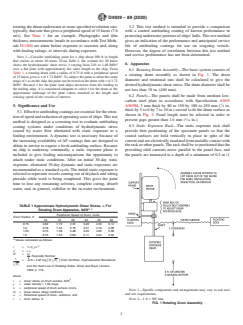
NOTE 1—Consider antifouling paint for a ship about 500 ft in length
that cruises at about 20 knots. From Table 2, the column for 20 knots
2 6. Apparatus
shows the hydrodynamic shear stress, τ varying from 2.01 to 1.40 lbf/ft
over a flat plate with approximately the same length as the ship. From
6.1 Rotating Drum Assembly—The basic system consists of
Table 1, a rotating drum with a radius of 0.75 ft with a peripheral speed
a rotating drum assembly as shown in Fig. 1. The drum
of 15 knots gives aτ of 1.72 lbf/ft . To subject the paint to about the same
diameter and rotational rate shall be calculated to give the
rangeofτasontheship,thepaintcanbetestedonthedrumwithτof1.72
desired hydrodynamic shear stress.The drum diameter shall be
lbf/ft . Because τ for the plate (and ships) decreases from the leading to
the trailing edge, it is considered adequate to select τ for the drum as the
not less than 18 in. (460 mm).
approximate midrange of the plate values matched to the length and
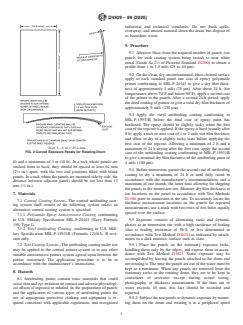
6.2 Panels—The panels shall be made from medium low-
cruising speed of the vessels of interest.
carbon steel plate in accordance with Specification A569/
A569M, 3 mm thick by 80 to 150 by 180 to 250 mm ( ⁄8 in.
5. Significance and Use
thick by 3 to 6 by 7 to 10 in.) curved to fit the drum surface as
5.1 Effective antifouling coatings are essential for the reten-
shown in Fig. 2. Panel length must be selected in order to
tionofspeedandreductionofoperatingcostsofships.Thistest
prevent gaps greater than 1.6 mm ( ⁄16 in.).
method is designed as a screening test to evaluate antifouling
coating systems under conditions of hydrodynamic stress 6.3 Static Exposure Rack—The static exposure rack shall
provide firm positioning of the specimen panels so that the
caused by water flow alternated with static exposure to a
fouling environment. A dynamic test is necessary because of coated surfaces are held vertically in place in spite of the
currentandareelectricallyinsulatedfrommetalliccontactwith
the increasing availability of AF coatings that are designed to
ablate in service to expose a fresh antifouling surface. Because therackorotherpanels.Therackshallbesopositionedthatthe
prevailing tidal currents move parallel to the panel face, and
no ship is underway continually, a static exposure phase is
included to give fouling microorganisms the opportunity to the panels are immersed to a depth of a minimum of 0.3 m (1
attach under static conditions. After an initial 30-day static
exposure, alternated 30-day dynamic and static exposures are
recommended as a standard cycle.The initial static exposure is
selected to represent vessels coming out of drydock and sitting
pierside while work is being completed. This gives the paint
time to lose any remaining solvents, complete curing, absorb
water, and, in general, stabilize to the in-water environment.
TABLE 1 Approximate Hydrodynamic Shear Stress, τ, For
2 A
Rotating Drum Apparatus, lbf/ft
Peripheral Speed of Drum, knots
Drum Radius, ft
10 15 20 22 25 30
0.75 0.82 1.72 2.91 3.48 4.39 6.14
1.0 0.78 1.64 2.78 3.31 4.19 5.86
1.25 0.75 1.58 2.68 3.20 4.05 5.68
1.5 0.73 1.53 2.60 3.11 3.94 5.52
A
Values calculated as follows:
τ = ⁄2 C ρv
f
v = r ω
vr
R =
, Reynolds Number
v
=
−0.6 + 4.07 log fR C g (from Dorfman, Hydrodynamic Resistance
œ f
C
œ f
and the Heat Loss of Rotating Solids, Oliver and Boyd, London,
1963, p. 176.
where
τ = shear stress on drum surface, lbf/ft ,
ρ = water density = 1.99 slugs,
v = peripheral speed of drum surface, knots,
NOTE 1—Specific components and arrangements may vary to suit user
C = shear stress (drag) coefficient,
f
and site requirements.
ω = Rotational speed of drum, radions/s, and
r = drum radius, ft. NOTE 2—1 ft = 305 mm.
FIG. 1 Rotating Drum Assembly
D4939 − 89 (2020)
industrial and technical standards. Do not flush spills,
overspray, and unused material down the drain, but dispose of
as hazardous waste.
9. Procedure
9.1 Abrasive blast clean the required number of panels (six
panels for each coating system being tested) to near white
metal (Grade Sa 2 ⁄2 of Pictorial Standard D2200) to obtain a
profile from 1 to 1.5 mils (25 to 40 µm).
9.2 Ontheclean,dry,uncontaminated,blast-cleanedsurface
apply to each standard panel one coat of epoxy polyamide
primer conforming to MIL-P-24441 to give a dry film thick-
ness of approximately 3 mils (75 µm). After about 24 h, (for
temperatures above 70°F and below 90°F), apply a second coat
of the primer to the panels. After a second 24-h period, apply
the third coating of primer to give a total dry film thickness of
approximately 9 mils (230 µm).
9.3 Apply the vinyl antifouling coating conforming to
MIL-P-15931B before the final coat of epoxy paint has
hardened. The epoxy should be slightly tacky when the first
coat of the topcoat is applied. If the epoxy is hard (usually after
8 h) apply a tack or mist coat of 1 to 2 mils wet film thickness
and allow to dry to a slightly tacky state before applying the
first coat of the topcoat. Allowing a minimum of 2 h and a
NOTE 1—1 in. = 25.4 mm.
maximum of 24 h drying after the first coat, apply the second
FIG. 2 Curved Ex
...