

ASTM A1120/A1120M-21
(Specification)Standard Specification for Electric-Resistance-Welded Carbon Steel Boiler, Superheater, Heat-Exchanger, and Condenser Tubes with Textured Surface
General Information
- Abstract
SCOPE
1.1 This specification covers average or minimum wall thickness electric resistance welded (ERW) tubing to be used for boilers, heat exchangers, condensers, and similar heat-transfer apparatus.
1.2 The tubing sizes and thicknesses usually furnished to the specification are 0.375 in. [9.5 mm] inside diameter (ID) to 1.5 in. [38 mm] outside diameter (OD) and 0.020 to 0.079 in. [0.5 to 2 mm], inclusive, in wall thickness. Tubing having other dimensions may be furnished provided such tubes comply with all other requirements of this specification.
1.3 The steel materials shall have the (1) external tube surface, (2) internal tube surface, or (3) both internal and external tube surfaces textured to improve heat transfer or fluid flow or both. Textured surface(s) are produced by cold forming a specified configuration on the surface(s) of base strip material before welding.
1.4 Optional supplementary requirements are provided and, when desired, shall be so stated on the purchase order.
1.5 Units—The values stated in either SI units or inch-pound units are to be regarded separately as standard. Within the text, the SI units are shown in brackets. The values stated in each system may not be exact equivalents; therefore, each system shall be used independently of the other. Combining values from the two systems may result in nonconformance with the standard. The inch-pound units shall apply unless the “M” designation (SI) of the product specification is specified in the order.
1.6 This standard does not purport to address all of the safety concerns, if any, associated with its use. It is the responsibility of the user of this standard to establish appropriate safety, health, and environmental practices and determine the applicability of regulatory limitations prior to use.
1.7 This international standard was developed in accordance with internationally recognized principles on standardization established in the Decision on Principles for the Development of International Standards, Guides and Recommendations issued by the World Trade Organization Technical Barriers to Trade (TBT) Committee.
- Status
- Published
- Publication Date
- 31-Oct-2021
- Technical Committee
- A01 - Steel, Stainless Steel and Related Alloys
- Drafting Committee
- A01.09 - Carbon Steel Tubular Products
Overview
ASTM A1120/A1120M-21 is the standard specification established by ASTM International for Electric-Resistance-Welded (ERW) carbon steel tubes with textured surfaces, specifically designed for use in boilers, superheaters, heat exchangers, condensers, and other heat-transfer equipment. This specification encompasses tubing with either average or minimum wall thickness, produced to improve both heat transfer and fluid flow through texturization of surfaces. Tubes covered under this standard may feature texture on exterior, interior, or both surfaces. The use of these tubes is common in industries that demand efficient and reliable thermal performance.
Key Topics
Scope and Material Dimensions:
- Covers ERW carbon steel tubes with inside diameters from 0.375 in. [9.5 mm] to 1.5 in. [38 mm], and wall thickness from 0.020 to 0.079 in. [0.5 to 2 mm].
- Other tube sizes may be acceptable if they meet all requirements of the standard.
Textured Surface Requirements:
- Tube surfaces may be textured externally, internally, or on both, using cold forming prior to the welding process.
- Texturing enhances heat transfer and fluid dynamics within heat-transfer apparatus.
Manufacturing and Chemical Composition:
- Tubes are manufactured by electric-resistance-welding without the addition of filler metal.
- The steel must be killed and meet specific chemical composition limits for carbon, manganese, phosphorus, and sulfur.
Mechanical and Physical Property Testing:
- Includes requirements for tensile strength, yield strength, elongation, and hardness.
- Mechanical tests such as flattening, flange, and hardness testing are required.
- Tube lots are tested to ensure consistent quality.
Ordering and Optional Requirements:
- Purchasers must specify relevant requirements in orders, including size, length, quantity, and any supplementary or optional tests (e.g., hydrostatic, nondestructive electric tests, certification needs).
Units and Marking:
- Both SI and inch-pound units are recognized; the system to be used must be specified in the order.
- Tubes are marked appropriately, including “ERW” and potentially bar codes as supplemental identification.
Applications
ASTM A1120/A1120M-21 ERW carbon steel textured tubes deliver practical value in a variety of critical applications, particularly where robust heat-transfer and fluid flow characteristics are essential. Typical uses include:
- Boilers:
Durable, heat-efficient tubing for commercial and industrial steam generation. - Superheaters:
Tubes capable of managing elevated temperatures for effective energy conversion. - Heat Exchangers:
Optimized fluid movement and heat transfer for process and comfort heating systems. - Condensers:
Consistent performance in cooling operations within power generation and industrial settings. - General Heat-Transfer Equipment:
Any setting where high-efficiency transfer of thermal energy is required.
The textured tube surfaces offer enhanced turbulence and boundary disruption, significantly promoting heat transfer rates and optimizing operational efficiency of heat-exchange processes.
Related Standards
When specifying, procuring, or working with ASTM A1120/A1120M-21 ERW carbon steel tubes, it is useful to be aware of related standards, including:
- ASTM A450/A450M: Specification for General Requirements for Carbon and Low Alloy Steel Tubes
- ASTM A941: Terminology Relating to Steel, Stainless Steel, Related Alloys, and Ferroalloys
- ASTM E140: Hardness Conversion Tables for Metals
- ASTM E213 & E273: Practices for Ultrasonic Testing of Metal Pipe and Weld Zones
- ASTM E384: Test Method for Microindentation Hardness of Materials
- ASME Section VIII Para UW-51: Relevant for pressure vessel construction and acceptance criteria
These related documents enable correct test methods, terminology, and cross-compliance in quality assurance for heat-transfer equipment manufacturing, inspection, and maintenance.
Keywords: ASTM A1120/A1120M-21, electric-resistance-welded steel tube, ERW carbon steel tube, textured surface tubes, heat exchanger tube, boiler tube, condenser tube, standard specification, heat transfer tubing, ASTM standards.
Relations
- Effective Date
- 01-Mar-2024
- Effective Date
- 01-Nov-2023
- Effective Date
- 01-Sep-2018
- Effective Date
- 01-Sep-2017
- Effective Date
- 01-Nov-2015
- Effective Date
- 01-May-2015
- Effective Date
- 01-Jun-2013
- Effective Date
- 01-May-2013
- Effective Date
- 01-Apr-2013
- Effective Date
- 01-Jun-2010
- Refers
ASTM E273-10 - Standard Practice for Ultrasonic Testing of the Weld Zone of Welded Pipe and Tubing - Effective Date
- 01-Jun-2010
- Effective Date
- 01-May-2010
- Effective Date
- 15-Apr-2010
- Effective Date
- 01-Feb-2010
- Effective Date
- 01-Feb-2010
Get Certified
Connect with accredited certification bodies for this standard

ECOCERT
Organic and sustainability certification.

Eurofins Food Testing Global
Global leader in food, environment, and pharmaceutical product testing.

Intertek Bangladesh
Intertek certification and testing services in Bangladesh.
Sponsored listings
Frequently Asked Questions
ASTM A1120/A1120M-21 is a technical specification published by ASTM International. Its full title is "Standard Specification for Electric-Resistance-Welded Carbon Steel Boiler, Superheater, Heat-Exchanger, and Condenser Tubes with Textured Surface". This standard covers: SCOPE 1.1 This specification covers average or minimum wall thickness electric resistance welded (ERW) tubing to be used for boilers, heat exchangers, condensers, and similar heat-transfer apparatus. 1.2 The tubing sizes and thicknesses usually furnished to the specification are 0.375 in. [9.5 mm] inside diameter (ID) to 1.5 in. [38 mm] outside diameter (OD) and 0.020 to 0.079 in. [0.5 to 2 mm], inclusive, in wall thickness. Tubing having other dimensions may be furnished provided such tubes comply with all other requirements of this specification. 1.3 The steel materials shall have the (1) external tube surface, (2) internal tube surface, or (3) both internal and external tube surfaces textured to improve heat transfer or fluid flow or both. Textured surface(s) are produced by cold forming a specified configuration on the surface(s) of base strip material before welding. 1.4 Optional supplementary requirements are provided and, when desired, shall be so stated on the purchase order. 1.5 Units—The values stated in either SI units or inch-pound units are to be regarded separately as standard. Within the text, the SI units are shown in brackets. The values stated in each system may not be exact equivalents; therefore, each system shall be used independently of the other. Combining values from the two systems may result in nonconformance with the standard. The inch-pound units shall apply unless the “M” designation (SI) of the product specification is specified in the order. 1.6 This standard does not purport to address all of the safety concerns, if any, associated with its use. It is the responsibility of the user of this standard to establish appropriate safety, health, and environmental practices and determine the applicability of regulatory limitations prior to use. 1.7 This international standard was developed in accordance with internationally recognized principles on standardization established in the Decision on Principles for the Development of International Standards, Guides and Recommendations issued by the World Trade Organization Technical Barriers to Trade (TBT) Committee.
SCOPE 1.1 This specification covers average or minimum wall thickness electric resistance welded (ERW) tubing to be used for boilers, heat exchangers, condensers, and similar heat-transfer apparatus. 1.2 The tubing sizes and thicknesses usually furnished to the specification are 0.375 in. [9.5 mm] inside diameter (ID) to 1.5 in. [38 mm] outside diameter (OD) and 0.020 to 0.079 in. [0.5 to 2 mm], inclusive, in wall thickness. Tubing having other dimensions may be furnished provided such tubes comply with all other requirements of this specification. 1.3 The steel materials shall have the (1) external tube surface, (2) internal tube surface, or (3) both internal and external tube surfaces textured to improve heat transfer or fluid flow or both. Textured surface(s) are produced by cold forming a specified configuration on the surface(s) of base strip material before welding. 1.4 Optional supplementary requirements are provided and, when desired, shall be so stated on the purchase order. 1.5 Units—The values stated in either SI units or inch-pound units are to be regarded separately as standard. Within the text, the SI units are shown in brackets. The values stated in each system may not be exact equivalents; therefore, each system shall be used independently of the other. Combining values from the two systems may result in nonconformance with the standard. The inch-pound units shall apply unless the “M” designation (SI) of the product specification is specified in the order. 1.6 This standard does not purport to address all of the safety concerns, if any, associated with its use. It is the responsibility of the user of this standard to establish appropriate safety, health, and environmental practices and determine the applicability of regulatory limitations prior to use. 1.7 This international standard was developed in accordance with internationally recognized principles on standardization established in the Decision on Principles for the Development of International Standards, Guides and Recommendations issued by the World Trade Organization Technical Barriers to Trade (TBT) Committee.
ASTM A1120/A1120M-21 is classified under the following ICS (International Classification for Standards) categories: 71.060.10 - Chemical elements. The ICS classification helps identify the subject area and facilitates finding related standards.
ASTM A1120/A1120M-21 has the following relationships with other standards: It is inter standard links to ASTM A941-24, ASTM A450/A450M-23, ASTM A450/A450M-18, ASTM A941-17, ASTM A941-15, ASTM A450/A450M-15, ASTM A941-13b, ASTM A941-13a, ASTM A941-13, ASTM A941-10a, ASTM E273-10, ASTM A450/A450M-10, ASTM A941-10, ASTM E384-10e1, ASTM E384-10. Understanding these relationships helps ensure you are using the most current and applicable version of the standard.
ASTM A1120/A1120M-21 is available in PDF format for immediate download after purchase. The document can be added to your cart and obtained through the secure checkout process. Digital delivery ensures instant access to the complete standard document.
Standards Content (Sample)
This international standard was developed in accordance with internationally recognized principles on standardization established in the Decision on Principles for the
Development of International Standards, Guides and Recommendations issued by the World Trade Organization Technical Barriers to Trade (TBT) Committee.
Designation:A1120/A1120M −21
Standard Specification for
Electric-Resistance-Welded Carbon Steel Boiler,
Superheater, Heat-Exchanger, and Condenser Tubes with
Textured Surface
This standard is issued under the fixed designation A1120/A1120M; the number immediately following the designation indicates the
year of original adoption or, in the case of revision, the year of last revision. A number in parentheses indicates the year of last
reapproval. A superscript epsilon (´) indicates an editorial change since the last revision or reapproval.
1. Scope 1.7 This international standard was developed in accor-
dance with internationally recognized principles on standard-
1.1 This specification covers average or minimum wall
ization established in the Decision on Principles for the
thickness electric resistance welded (ERW) tubing to be used
Development of International Standards, Guides and Recom-
for boilers, heat exchangers, condensers, and similar heat-
mendations issued by the World Trade Organization Technical
transfer apparatus.
Barriers to Trade (TBT) Committee.
1.2 Thetubingsizesandthicknessesusuallyfurnishedtothe
specification are 0.375 in. [9.5 mm] inside diameter (ID) to 1.5
2. Referenced Documents
in. [38 mm] outside diameter (OD) and 0.020 to 0.079 in. [0.5
2.1 ASTM Standards:
to 2 mm], inclusive, in wall thickness. Tubing having other
A450/A450M Specification for General Requirements for
dimensions may be furnished provided such tubes comply with
Carbon and Low Alloy Steel Tubes
all other requirements of this specification.
A941 TerminologyRelatingtoSteel,StainlessSteel,Related
1.3 The steel materials shall have the (1) external tube
Alloys, and Ferroalloys
surface, (2) internal tube surface, or (3) both internal and
E140 Hardness Conversion Tables for Metals Relationship
external tube surfaces textured to improve heat transfer or fluid
Among Brinell Hardness, Vickers Hardness, Rockwell
flow or both.Textured surface(s) are produced by cold forming
Hardness, Superficial Hardness, Knoop Hardness, Sclero-
aspecifiedconfigurationonthesurface(s)ofbasestripmaterial
scope Hardness, and Leeb Hardness
before welding.
E213 Practice for Ultrasonic Testing of Metal Pipe and
1.4 Optional supplementary requirements are provided and, Tubing
E273 Practice for Ultrasonic Testing of the Weld Zone of
when desired, shall be so stated on the purchase order.
Welded Pipe and Tubing
1.5 Units—The values stated in either SI units or inch-
E384 Test Method for Microindentation Hardness of Mate-
pound units are to be regarded separately as standard. Within
rials
the text, the SI units are shown in brackets. The values stated
2.2 ASME Standard:
in each system may not be exact equivalents; therefore, each
system shall be used independently of the other. Combining Section VIII Para UW-51
values from the two systems may result in nonconformance
with the standard. The inch-pound units shall apply unless the 3. Terminology
“M”designation(SI)oftheproductspecificationisspecifiedin
3.1 Definitions—Fordefinitionsofgeneraltermsusedinthis
the order.
specification, refer to Terminology A941.
1.6 This standard does not purport to address all of the
3.2 Definitions of Terms Specific to This Standard:
safety concerns, if any, associated with its use. It is the
3.2.1 plain cylindrical ring gauges, n—cylindrical metal
responsibility of the user of this standard to establish appro-
ring whose inside diameter is furnished to gauge tolerance.
priate safety, health, and environmental practices and deter-
mine the applicability of regulatory limitations prior to use.
For referenced ASTM standards, visit the ASTM website, www.astm.org, or
contact ASTM Customer Service at service@astm.org. For Annual Book of ASTM
This specification is under the jurisdiction of ASTM Committee A01 on Steel, Standards volume information, refer to the standard’s Document Summary page on
Stainless Steel and Related Alloys and is the direct responsibility of Subcommittee the ASTM website.
A01.09 on Carbon Steel Tubular Products. Available from American Society of Mechanical Engineers (ASME), ASME
Current edition approved Nov. 1, 2021. Published December 2021. DOI: International Headquarters, Two Park Ave., New York, NY 10016-5990, http://
10.1520/A1120_A1120M-21. www.asme.org.
Copyright © ASTM International, 100 Barr Harbor Drive, PO Box C700, West Conshohocken, PA 19428-2959. United States
A1120/A1120M−21
3.2.2 plain ending, n—portion of the tube that has no 3.3.15 S —Secondary character diameter.
d
surface texture.
3.3.16 S —Secondary character height (inside).
hi
3.2.3 primary character, n—largest texture impressed on
3.3.17 S —Secondary character height (outside).
ho
material.
3.3.18 W—Wall thickness (no pattern).
3.2.4 primary pattern, n—combination of primary charac-
3.3.19 W1—Wall thickness peak inside to valley outside
ters.
(secondary character).
3.2.5 secondary character, n—fine-cut texture impressed on
3.3.20 W2—Wall thickness valley inside to peak outside
material.
(secondary character)
3.2.6 secondary pattern, n—combination of secondary char-
3.3.21 W3—Wall thickness base of primary character.
acters.
3.3.22 W4—Wall thickness in wall of the primary character.
3.2.7 textured surface, n—impressing a series of characters
or textures into the material with the intent of improving heat
4. Ordering Information
transfer and fluid flow characteristics in the final welded tube.
4.1 It is the responsibility of the purchaser to specify all
3.3 Symbols:
requirements that are necessary for product ordered under this
3.3.1 D—Outside tube diameter-nominal.
specification. Such requirements may include, but are not
3.3.2 D1—Inside tube diameter.
limited to:
3.3.3 ID1—Topofprimarycharactertobottomofsecondary 4.1.1 Quantity (feet, metres, or number of lengths),
character; see Fig. 1 cross-section A-A for view of primary
4.1.2 Name of material (electric-resistance-welded tubes),
character and secondary character pattern.
4.1.3 Size (outside diameter and minimum or average wall
thickness),
3.3.4 ID2—Top of primary character to top of secondary
4.1.4 Length (specific or random),
character.
4.1.5 Optional requirements (product analysis, hydrostatic
3.3.5 ID3—Top of secondary character to top of secondary
or nondestructive electric test, crush test, and bar coding),
character.
4.1.6 Testreportrequired(seeCertificationsectionofSpeci-
3.3.6 ID4—Top of primary character to bottom of primary
fication A450/A450M),
character at intersection of the base (each on opposite sides of
4.1.7 Specification designation, and
the tube).
4.1.8 Special requirements and any supplementary require-
3.3.7 ID5—Top of primary character to top of primary ments selected.
character (each on opposite sides of the tube).
4.2 Additional requirements may include the various inside
3.3.8 ID6—Top of secondary character to bottom of second-
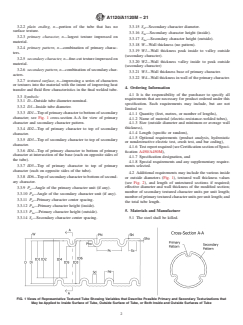
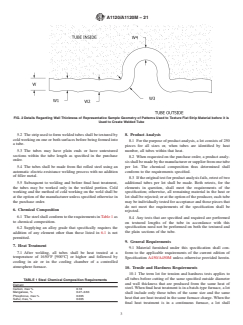
or outside diameters (Fig. 1), textured wall thickness values
ary character.
(see Fig. 2), and length of untextured sections if required;
effective diameter and wall thickness of the modified section;
3.3.9 P —Angle of the primary character unit (if any).
a
number of secondary textured character units per unit length;
3.3.10 P —Angle of the secondary character unit (if any).
b
number of primary textured character units per unit length; and
3.3.11 P —Primary character center spacing.
d
the total tube length.
3.3.12 P —Primary character height (inside).
hi
5. Materials and Manufacture
3.3.13 P —Primary character height (outside).
ho
3.3.14 S —Secondary character center spacing. 5.1 The steel shall be killed.
c
FIG. 1Views of Representative Textured Tube Showing Variables that Describe Possible Primary and Secondary Texturizations that
May be Applied to Inside Surface of Tube, Outside Surface of Tube, or Both Inside and Outside Surfaces of Tube
A1120/A1120M−21
FIG. 2Details Regarding Wall Thickness of Representative Sample Geometry of Patterns Used to Texture Flat Strip Material before it is
Used to Create Welded Tube
5.2 The strip used to form welded tubes shall be textured by 8. Product Analysis
cold working on one or both surfaces before being formed into
8.1 For the purpose of product analysis, a lot consists of 250
a tube.
pieces for all sizes or, when tubes are identified by heat
5.3 The tubes may have plain ends or have untextured number, all tubes within that heat.
sections within the tube length as specified in the purchase
8.2 When requested on the purchase order, a product analy-
order.
sisshallbemadebythemanufa
...