

ASTM D4638-16(2023)
(Guide)Standard Guide for Preparation of Biological Samples for Inorganic Chemical Analysis
General Information
- Abstract
SIGNIFICANCE AND USE
5.1 The chemical analysis of biological material, collected from such locations as streams, rivers, lakes, and oceans can provide information of environmental significance. The chemical analysis of biological material used in toxicity tests may be useful to better interpret the toxicological results.
5.2 Many aquatic biological samples, either as a result of their size, or their method of collection, are inherently heterogeneous in that they may contain occluded water in varying and unpredictable amounts and may contain foreign objects or material (for example, sediment) not ordinarily intended for analysis, the inclusion of which would result in inaccurate analysis.
5.3 Standard methods for separating foreign objects, to facilitate homogenization, will minimize errors due to poor mixing and inclusion of extraneous material.
5.4 Standardized procedures for drying provide a means for reporting analytical values to a common dry weight basis, if desired. Analyses may also be carried out or reported on a wet weight basis.
SCOPE
1.1 This guide describes procedures for the preparation of test samples collected from such locations as streams, rivers, ponds, lakes, estuaries, oceans, and toxicity tests and is applicable to such organisms as plankton, mollusks, fish, and plants.
1.2 The procedures are applicable to the determination of volatile, semivolatile, and nonvolatile inorganic constituents of biological materials. Analyses may be carried out or reported on either a dry or wet basis.
1.3 The values stated in SI units are to be regarded as standard. No other units of measurement are included in this standard.
1.4 This standard does not purport to address all of the safety concerns, if any, associated with its use. It is the responsibility of the user of this standard to establish appropriate safety, health, and environmental practices and determine the applicability of regulatory limitations prior to use. For a specific hazard statement, see 9.3.3.
1.5 This international standard was developed in accordance with internationally recognized principles on standardization established in the Decision on Principles for the Development of International Standards, Guides and Recommendations issued by the World Trade Organization Technical Barriers to Trade (TBT) Committee.
- Status
- Published
- Publication Date
- 31-Mar-2023
- Technical Committee
- D19 - Water
- Drafting Committee
- D19.05 - Inorganic Constituents in Water
Overview
ASTM D4638-16(2023), Standard Guide for Preparation of Biological Samples for Inorganic Chemical Analysis, provides comprehensive guidance for the preparation of biological samples-such as aquatic organisms-for subsequent inorganic chemical analysis. Developed and maintained by ASTM International, this standard helps laboratories ensure accuracy and consistency when analyzing samples collected from various aquatic environments, including streams, rivers, ponds, lakes, estuaries, and oceans. The guide outlines standardized procedures essential for reliable environmental monitoring, toxicity testing, and related scientific studies focused on inorganic constituents in biological materials.
Key Topics
- Sample Collection and Handling: Emphasizes the use of nonmetallic or fluorocarbon-coated sampling equipment to avoid contamination. Samples should be properly stored in plastic containers at low temperatures until ready for analysis.
- Removal of Foreign Matter: Recommends mechanical removal of foreign objects (e.g., sediment, leaves) using nonmetallic tools and, if needed, low-power microscopes, to minimize errors in inorganic analysis.
- Homogenization: Describes homogenization techniques for different sample types, ensuring representative test portions whether samples are analyzed on a wet or dry basis.
- Drying and Moisture Determination: Provides both oven and freeze-drying methods for moisture determination, a critical step for reporting data on a consistent dry weight or wet weight basis.
- Standardization of Analytical Values: Encourages reporting inorganic concentrations on a common basis (dry or wet weight) and provides calculation methods for moisture content and correction of analytical values.
- Digestion Procedures: Outlines the use of dry ashing and wet digestion techniques to prepare samples for the determination of volatile, semivolatile, and nonvolatile inorganic constituents often found in aquatic biological materials.
- Safety, Health, and Environmental Practices: Reminds users of the need to establish appropriate safety procedures and to be aware of regulatory requirements for laboratory practices.
Applications
The ASTM D4638-16(2023) standard is a critical reference for professionals engaged in:
- Environmental Monitoring: Enables the accurate assessment of inorganic pollutants (such as metals) in aquatic ecosystems by promoting uniform sample preparation.
- Ecotoxicology and Toxicity Testing: Facilitates better interpretation of toxicological outcomes by ensuring biological samples are prepared consistently, minimizing variability due to unrepresentative or contaminated samples.
- Regulatory Compliance: Supports laboratories in meeting international and national regulatory requirements for environmental sample analysis.
- Research and Academic Studies: Offers a reliable framework for research institutions conducting studies on water and biological quality by ensuring repeatability and accuracy of inorganic chemical analyses.
Related Standards
- ASTM D1129: Terminology Relating to Water
- ASTM D1193: Specification for Reagent Water
- ISO/IEC 17025 (related): General requirements for the competence of testing and calibration laboratories
- EPA Methods (related): Various sample preparation and digestion methods for environmental samples
Practical Value
Implementing the procedures outlined in ASTM D4638-16(2023) helps laboratories reduce analytical errors associated with the heterogeneity of biological samples. By standardizing the removal of extraneous materials, homogenization, and moisture content determination, users can ensure that reported data accurately reflect inorganic concentrations in aquatic organisms. Adhering to this guide contributes to credible environmental data, supports effective environmental management, and aligns with internationally recognized best practices in inorganic chemical analysis.
Keywords: biological sample preparation, inorganic analysis, environmental monitoring, aquatic organisms, sample homogenization, moisture determination, dry ashing, wet digestion, laboratory standards, ASTM D4638
Relations
- Effective Date
- 01-May-2020
- Effective Date
- 01-Mar-2010
- Effective Date
- 01-Sep-2006
- Effective Date
- 01-Sep-2006
- Effective Date
- 01-Mar-2006
- Effective Date
- 15-Feb-2006
- Effective Date
- 01-Mar-2004
- Effective Date
- 01-Mar-2004
- Effective Date
- 10-Aug-2003
- Effective Date
- 10-Mar-2003
- Effective Date
- 10-Jul-2002
- Effective Date
- 10-Jul-2002
- Effective Date
- 10-Feb-2002
- Effective Date
- 10-Feb-2002
- Effective Date
- 10-Feb-1999
Get Certified
Connect with accredited certification bodies for this standard

ECOCERT
Organic and sustainability certification.

Eurofins Food Testing Global
Global leader in food, environment, and pharmaceutical product testing.

Intertek Bangladesh
Intertek certification and testing services in Bangladesh.
Sponsored listings
Frequently Asked Questions
ASTM D4638-16(2023) is a guide published by ASTM International. Its full title is "Standard Guide for Preparation of Biological Samples for Inorganic Chemical Analysis". This standard covers: SIGNIFICANCE AND USE 5.1 The chemical analysis of biological material, collected from such locations as streams, rivers, lakes, and oceans can provide information of environmental significance. The chemical analysis of biological material used in toxicity tests may be useful to better interpret the toxicological results. 5.2 Many aquatic biological samples, either as a result of their size, or their method of collection, are inherently heterogeneous in that they may contain occluded water in varying and unpredictable amounts and may contain foreign objects or material (for example, sediment) not ordinarily intended for analysis, the inclusion of which would result in inaccurate analysis. 5.3 Standard methods for separating foreign objects, to facilitate homogenization, will minimize errors due to poor mixing and inclusion of extraneous material. 5.4 Standardized procedures for drying provide a means for reporting analytical values to a common dry weight basis, if desired. Analyses may also be carried out or reported on a wet weight basis. SCOPE 1.1 This guide describes procedures for the preparation of test samples collected from such locations as streams, rivers, ponds, lakes, estuaries, oceans, and toxicity tests and is applicable to such organisms as plankton, mollusks, fish, and plants. 1.2 The procedures are applicable to the determination of volatile, semivolatile, and nonvolatile inorganic constituents of biological materials. Analyses may be carried out or reported on either a dry or wet basis. 1.3 The values stated in SI units are to be regarded as standard. No other units of measurement are included in this standard. 1.4 This standard does not purport to address all of the safety concerns, if any, associated with its use. It is the responsibility of the user of this standard to establish appropriate safety, health, and environmental practices and determine the applicability of regulatory limitations prior to use. For a specific hazard statement, see 9.3.3. 1.5 This international standard was developed in accordance with internationally recognized principles on standardization established in the Decision on Principles for the Development of International Standards, Guides and Recommendations issued by the World Trade Organization Technical Barriers to Trade (TBT) Committee.
SIGNIFICANCE AND USE 5.1 The chemical analysis of biological material, collected from such locations as streams, rivers, lakes, and oceans can provide information of environmental significance. The chemical analysis of biological material used in toxicity tests may be useful to better interpret the toxicological results. 5.2 Many aquatic biological samples, either as a result of their size, or their method of collection, are inherently heterogeneous in that they may contain occluded water in varying and unpredictable amounts and may contain foreign objects or material (for example, sediment) not ordinarily intended for analysis, the inclusion of which would result in inaccurate analysis. 5.3 Standard methods for separating foreign objects, to facilitate homogenization, will minimize errors due to poor mixing and inclusion of extraneous material. 5.4 Standardized procedures for drying provide a means for reporting analytical values to a common dry weight basis, if desired. Analyses may also be carried out or reported on a wet weight basis. SCOPE 1.1 This guide describes procedures for the preparation of test samples collected from such locations as streams, rivers, ponds, lakes, estuaries, oceans, and toxicity tests and is applicable to such organisms as plankton, mollusks, fish, and plants. 1.2 The procedures are applicable to the determination of volatile, semivolatile, and nonvolatile inorganic constituents of biological materials. Analyses may be carried out or reported on either a dry or wet basis. 1.3 The values stated in SI units are to be regarded as standard. No other units of measurement are included in this standard. 1.4 This standard does not purport to address all of the safety concerns, if any, associated with its use. It is the responsibility of the user of this standard to establish appropriate safety, health, and environmental practices and determine the applicability of regulatory limitations prior to use. For a specific hazard statement, see 9.3.3. 1.5 This international standard was developed in accordance with internationally recognized principles on standardization established in the Decision on Principles for the Development of International Standards, Guides and Recommendations issued by the World Trade Organization Technical Barriers to Trade (TBT) Committee.
ASTM D4638-16(2023) is classified under the following ICS (International Classification for Standards) categories: 71.040.40 - Chemical analysis. The ICS classification helps identify the subject area and facilitates finding related standards.
ASTM D4638-16(2023) has the following relationships with other standards: It is inter standard links to ASTM D1129-13(2020)e2, ASTM D1129-10, ASTM D1129-06a, ASTM D1129-06ae1, ASTM D1193-06, ASTM D1129-06, ASTM D1129-04e1, ASTM D1129-04, ASTM D1129-03a, ASTM D1129-03, ASTM D1129-02a, ASTM D1129-01, ASTM D1129-02, ASTM D1129-99a, ASTM D1193-99. Understanding these relationships helps ensure you are using the most current and applicable version of the standard.
ASTM D4638-16(2023) is available in PDF format for immediate download after purchase. The document can be added to your cart and obtained through the secure checkout process. Digital delivery ensures instant access to the complete standard document.
Standards Content (Sample)
This international standard was developed in accordance with internationally recognized principles on standardization established in the Decision on Principles for the
Development of International Standards, Guides and Recommendations issued by the World Trade Organization Technical Barriers to Trade (TBT) Committee.
Designation: D4638 − 16 (Reapproved 2023)
Standard Guide for
Preparation of Biological Samples for Inorganic Chemical
Analysis
This standard is issued under the fixed designation D4638; the number immediately following the designation indicates the year of
original adoption or, in the case of revision, the year of last revision. A number in parentheses indicates the year of last reapproval. A
superscript epsilon (´) indicates an editorial change since the last revision or reapproval.
1. Scope 3. Terminology
3.1 Definitions:
1.1 This guide describes procedures for the preparation of
3.1.1 For definitions of terms used in this standard, refer to
test samples collected from such locations as streams, rivers,
Terminology D1129.
ponds, lakes, estuaries, oceans, and toxicity tests and is
applicable to such organisms as plankton, mollusks, fish, and
4. Summary of Guide
plants.
4.1 Samples are collected, where possible, with nonmetallic
1.2 The procedures are applicable to the determination of
or TFE-fluorocarbon-coated sampling equipment to prevent
volatile, semivolatile, and nonvolatile inorganic constituents of
contamination, stored in plastic containers, and kept either at
biological materials. Analyses may be carried out or reported
4 °C or frozen until returned to an adequate facility for
on either a dry or wet basis.
analysis.
1.3 The values stated in SI units are to be regarded as
4.2 Before analysis, samples are allowed to return to room
standard. No other units of measurement are included in this
temperature. Large foreign objects are mechanically removed
standard.
from the samples based upon visual examination; smaller
1.4 This standard does not purport to address all of the foreign objects are also removed mechanically, with the aid of
safety concerns, if any, associated with its use. It is the a low-power microscope.
responsibility of the user of this standard to establish appro-
4.3 Wet samples of small organisms such as plankton, are
priate safety, health, and environmental practices and deter-
mixed for preliminary homogenization, then allowed to settle,
mine the applicability of regulatory limitations prior to use.
to remove most of the occluded water. Larger organisms, such
For a specific hazard statement, see 9.3.3.
as fish, should be patted dry, using paper towels.
1.5 This international standard was developed in accor-
4.4 Where less than a whole organism is to be analyzed,
dance with internationally recognized principles on standard-
tissue excisions are made with nonmetallic tools such as plastic
ization established in the Decision on Principles for the
knives or TFE-fluorocarbon-coated scalpels.
Development of International Standards, Guides and Recom-
4.5 Moisture determinations are made on separate samples
mendations issued by the World Trade Organization Technical
from those analyzed for volatile or semivolatile constituents.
Barriers to Trade (TBT) Committee.
4.6 Analyses for volatile constituents are made using wet
2. Referenced Documents
samples from which supernatant liquid or occluded water has
been removed (see 4.3). The results may be calculated to the
2.1 ASTM Standards:
dry, original-sample basis, using the results of a moisture
D1129 Terminology Relating to Water
determination carried out on a separate sample.
D1193 Specification for Reagent Water
4.7 Analyses for semivolatile constituents are made on wet
samples or samples previously dried at a temperature (depen-
dent on constituents of interest), or using a procedure, found to
This guide is under the jurisdiction of ASTM Committee D19 on Water and is
be adequate for the purpose, and specified in the corresponding
the direct responsibility of Subcommittee D19.05 on Inorganic Constituents in
Water.
analytical procedure.
Current edition approved April 1, 2023. Published April 2023. Originally
ɛ1
4.8 Analyses for nonvolatile constituents are made on
approved in 1986. Last previous edition approved in 2021 as D4638 – 16 (2021) .
DOI: 10.1520/D4638-16R23.
samples previously dried at a temperature (dependent on
For referenced ASTM standards, visit the ASTM website, www.astm.org, or
constituents of interest), or using a procedure found to be
contact ASTM Customer Service at service@astm.org. For Annual Book of ASTM
adequate for the purpose, and specified in the corresponding
Standards volume information, refer to the standard’s Document Summary page on
the ASTM website. analytical procedure.
Copyright © ASTM International, 100 Barr Harbor Drive, PO Box C700, West Conshohocken, PA 19428-2959. United States
D4638 − 16 (2023)
4.9 Digest the samples according to the procedures outlined 6. Preliminary Treatment of Samples
in Section 9.
6.1 Treat small heterogeneous samples, such as plankton, as
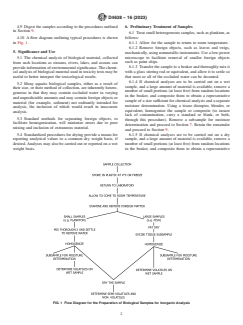
4.10 A flow diagram outlining typical procedures is shown
follows:
in Fig. 1.
6.1.1 Allow for the sample to return to room temperature.
6.1.2 Remove foreign objects, such as leaves and twigs,
5. Significance and Use
mechanically, using nonmetallic instruments. Use a low-power
microscope to facilitate removal of smaller foreign objects
5.1 The chemical analysis of biological material, collected
such as paint chips.
from such locations as streams, rivers, lakes, and oceans can
6.1.3 Transfer the sample to a beaker and thoroughly mix it
provide information of environmental significance. The chemi-
cal analysis of biological material used in toxicity tests may be with a glass stirring rod or equivalent, and allow it to settle so
that most or all of the occluded water can be decanted.
useful to better interpret the toxicological results.
6.1.4 If chemical analyses are to be carried out on a wet
5.2 Many aquatic biological samples, either as a result of
sample, and a large amount of material is available, remove a
their size, or their method of collection, are inherently hetero-
number of small portions (at least five) from random locations
geneous in that they may contain occluded water in varying
in the beaker, and composite them to obtain a representative
and unpredictable amounts and may contain foreign objects or
sample of a size sufficient for chemical analysis and a separate
material (for example, sediment) not ordinarily intended for
moisture determination. Using a tissue disrupter, blender, or
analysis, the inclusion of which would result in inaccurate
equivalent, homogenize the sample or composite (to ensure
analysis.
lack of contamination, carry a standard or blank, or both,
5.3 Standard methods for separating foreign objects, to
through this procedure). Remove a subsample for moisture
facilitate homogenization, will minimize errors due to poor
determination and proceed to Section 7. Retain the remainder
mixing and inclusion of extraneous material.
and proceed to Section 9.
5.4 Standardized procedures for drying provide a means for 6.1.5 If chemical analyses are to be carried out on a dry
reporting analytical values to a common dry weight basis, if sample, and a large amount of material is available, remove a
desired. Analyses may also be carried out or reported on a wet number of small portions (at least five) from random locations
weight basis. in the beaker, and composite them to obtain a representative
FIG. 1 Flow Diagram for the Preparation of Biological Samples for Inorganic Analysis
D4638 − 16 (2023)
weighing times to a minimum.
sample of a size sufficient for the analysis. Using a tissue
disrupter, blender, or equivalent, homogenize the sample, or
7.4.3 Repeat drying at hourly intervals, to attain a constant
composite (to ensure lack of contamination, carry a standard or
weight.
blank, or both, through this procedure), and proceed to Section
7.5 If a moisture determination (or sample drying) is to be
7.
made at room temperature, treat as follows:
6.2 Treat large samples such as fish as follows:
7.5.1 If drying is to be done in a desiccator, ensure that the
6.2.1 Allow the sample to return to room temperature.
desiccant in the bottom is fresh, and some means is available to
6.2.2 Pat the sample dry with paper toweling to remove as
indicate when the desiccant loses its drying capacity (for
much water as possible.
example, color change). A vacuum desiccator may also be
6.2.3 Transfer the sample to a nonmetallic surface, such as
used.
a flat glass plate, and excise a sufficient quantity of material, or
NOTE 2—If a vacuum desiccator is used, bear in mind that this may
specific organs, to obtain sufficient material for analysis. Make
cause the loss of volatile or semivolatile inorganics such as mercury, if the
excisions with plastic knives or TFE-fluorocarbon-coated scal-
dried sample is to be subjected to chemical analysis.
pels.
6.2.4 If chemical analyses are to be carried out on a wet 7.5.1.1 Transfer the containers holding the material to a
sample, use a tissue disrupter, blender, or equivalent, to desiccator.
homogenize the material (to ensure lack of contamination,
7.5.1.2 Leave the material in the desiccator for 48 h, then
carry a standard or blank, or both, through this procedure).
weigh the dried samples with the same accuracy as the wet
Remove a subsample for moisture determination and proceed
sample.
to Section 7. Retain the remainder and proceed to Section 9.
7.5.1.3 Repeat weighings at 4-h intervals, to attain a con-
6.2.5 If chemical analyses are to be carried out on a dry
stant weight (see Note 1).
sample, use a tissue disrupter, blender, or equivalent, to
7.5.2 Alternatively, sample drying or moisture determina-
homogenize the material (to ensure lack of contamination,
tions may be carried out in a laminar flow hood; treat as
carry a standard or blank, or both, through this procedure) and
follows:
proceed to Section 7.
7.5.2.1 Transfer the containers holding the material to an
appropriate hood and turn it on.
7. Drying Procedures
7.5.2.2 Leave the material in the hood for 48 h, then weigh
7.1 Use a sample or subsample prepared in accordance with
the dried samples with the same accuracy as the wet sample.
the directions given in Section 6.
7.5.2.3 Repeat weighings at 4-h intervals, to attain a con-
7.2 Treat subsamples from biological materials that are to
stant weight (see Note 1).
undergo chemical analysis without drying for moisture deter-
NOTE 3—Air-drying in the open is strongly discouraged unless it is
minations as follows:
carried out in a clean room, where possible contamination from airborne
7.2.1 Accurately weigh 5 g to 10 g 6 1 mg or 10 g to 25 g
particulates can be controlled.
6 10 mg of material into a nonmetallic container which has
7.6 If a moisture determination (or sample drying) is to be
been previously tared, and weighed with the same accuracy.
made using a freeze dryer, treat the determination as follows:
7.2.2 When a limited amount of material is available,
7.6.1 Transfer the containers holding the material to the
determine the moisture on a 1 g to 2 g sample, and weigh with
freeze dryer.
an accuracy of 60.1 mg. The use of samples smaller than 1 g
is not recommended for moisture determination. 7.6.2 Follow the manufacturer’s instructions for the particu-
lar unit in use. Make certain that a trap is placed between the
7.3 When an entire sample is to be dried prior to chemical
vacuum pump and the drying chamber to prevent pump oil
analysis, a moisture determination is also required. Transfer the
fumes from possibly contaminating the sample. Drying is
accurately weighed material (1 g to 2 g 6 0.1 mg, 5 g to 10 g
usually complete when the internal pressure in the drying
6 1 mg, >10 g 6 10 mg) into a dry nonmetallic container
chamber reaches 50 millitorrs or less.
which has been previously tared, and weigh with the same
7.6.3 Transfer the freeze-dried samples to a desiccator for
accuracy.
storage, and weigh them with the same accuracy as the wet
7.4 If a moisture determination (or sample drying) is to be
samples (see Note 1).
made using an oven, treat as follows:
NOTE 4—Because freeze drying occurs under vacuum, this may cause
7.4.1 Transfer the containers holding the material to an oven
the loss of volatile or semivolatile inorganics such as mercury, or both, if
and dry for 2 h at one of the following temperatures:
the dried sample is to be subjected to chemical analysis.
7.4.1.1 For the determination of semivolatile constituents,
use the temperature specified in the analytical procedure for the 7.7 The possibility of loss of volatile constituents dictates
the drying procedure to be used, prior to chemical analysis.
constituents(s).
7.4.1.2 For determination of nonvolatile constituents use Determine volatile constituents using undried samples. Deter-
mine semivolatile constituents using samples dried at a tem-
105 °C 6 2 °C.
7.4.2 Cool in a desiccator, then weigh the dried samples perature at which no significant losses occur.
with the same accuracy as the wet samples.
7.8 Analytical data reported on a dry weight basis should
NOTE 1—Biological materials tend to be very hygroscopic. Keep include percent moisture so that wet weight values can be
D4638 − 16 (2023)
obtained. Likewise, wet weight analytical data should include 8.3.6 Nitric Acid (1+9)—Mix one volume of nitric acid
percent moisture to permit recalculation to a dry weight basis. (HNO , sp gr 1.42) with nine volumes of water.
8.3.7 Nitric-Perchloric Acid Solution (3+1)—Mix three vol-
7.9 Use the following equations to calculate percent mois-
umes of ultra-pure concentrated nitric acid (HNO , sp gr 1.42)
ture and to correct analytical results from samples analyzed
with one volume of ultrapure concentrated perchloric acid
when wet.
(HClO , sp gr 1.67).
7.9.1 Calculate percent moisture as follows:
8.3.8 Sulfuric Acid (sp gr 1.84)—Concentrated ultra-pure
moisture, % 5 ~W /W !100 (1)
w d
sulfuric acid (H SO ).
2 4
8.3.9 Sulfuric Acid (1+9)—Mix one volume of sulfuric acid
where:
(H SO , sp gr 1.84) with nine volumes of water.
2 4
W = wet weight, g, and
w
W = dry weight, g
8.4 Filter Paper—Purchase suitable filter paper. Typically
d
the filter papers have a pore size of 0.45-μm membrane.
7.9.2 To calculate concentrations on a dry weight basis,
Material such as fine-textured, acid-washed, ashless paper, or
when determinations have been made on an undried sample,
glass fiber paper are acceptable. The user must first ascertain
use the following equation:
that the filter paper is of sufficient purity to use without
C 100
~ !
w
adversely affecting the bias and precision of the test method.
C 5 (2)
d
100 2 % moisture
9. Digestion Procedures
where:
C = concentration on a dry weight basis, and 9.1 Many procedures are available for the destruction of
d
C = concentration on a wet weight basis. biological material prior to inorganic analysis, but almost all
w
the methods fall into one of two main classes: dry ashing and
8. Reagents and Materials
wet digestion. Each of these classes has advantages and
disadvantages, as do the individual procedures that fall under
8.1 Purity of Reagents—Reagent grade chemicals shall be
them. Before choosing a particular method,
...