

ASTM A228/A228M-18
(Specification)Standard Specification for Steel Wire, Music Spring Quality
General Information
- Abstract
ABSTRACT
This specification covers high quality, round, cold-drawn steel music spring quality wire for the manufacture of springs subject to high stresses or requiring good fatigue properties. The steel shall either be ingot cast or strand cast. Heat and product analysis shall be performed wherein steel materials shall conform to required chemical compositions of carbon, manganese, phosphorus, sulfur, and silicon. Steel specimens shall also undergo tension test, wrap test, and torsion tests. Final products shall be marked by a tag.
SCOPE
1.1 This specification covers two types of round, cold-drawn steel music spring quality wire, uniform in mechanical properties, intended especially for the manufacture of springs subject to high stresses or requiring good fatigue properties.
1.2 The values stated in either SI units or inch-pound units are to be regarded separately as standard. The values stated in each system may not be exact equivalents; therefore, each system shall be used independently of the other. Combining values from the two systems may result in non-conformance with the standard.
1.3 This international standard was developed in accordance with internationally recognized principles on standardization established in the Decision on Principles for the Development of International Standards, Guides and Recommendations issued by the World Trade Organization Technical Barriers to Trade (TBT) Committee.
- Status
- Published
- Publication Date
- 31-Aug-2018
- Technical Committee
- A01 - Steel, Stainless Steel and Related Alloys
- Drafting Committee
- A01.03 - Steel Rod and Wire
Buy Documents
ASTM A228/A228M-18 - Standard Specification for Steel Wire, Music Spring Quality
REDLINE ASTM A228/A228M-18 - Standard Specification for Steel Wire, Music Spring Quality
Overview
ASTM A228/A228M-18 is the internationally recognized standard specification for steel wire of music spring quality, developed by ASTM International. This specification covers two types of high-quality, round, cold-drawn carbon steel wire intended primarily for the manufacture of springs, especially those required to endure high stresses and exhibit excellent fatigue properties. The standard addresses critical factors such as mechanical properties, chemical composition, surface quality, testing, packaging, and certification to ensure wire consistency and performance across a wide range of demanding industrial and commercial applications.
Key Topics
- Material and Manufacture
- Permits steel from various commercially accepted processes.
- Wire must be cold drawn to achieve the required mechanical properties.
- Defines two types of wire production and the appropriate substitution policy.
- Chemical Composition
- Mandates tight control of elements including carbon, manganese, phosphorus, sulfur, and silicon.
- Requires both heat and product analyses to verify compliance.
- Mechanical Properties and Testing
- Includes tensile, wrap, and torsion tests to ensure uniform mechanical performance.
- Details testing frequencies and test methods for each property.
- Dimensional Tolerances and Surface Quality
- Specifies permissible variations and allowable defects in wire diameter and roundness.
- Surface must be free from rust and detrimental imperfections.
- Packaging and Marking
- Outlines requirements for secure packaging, clear labeling, and traceability.
- Bar coding and special marking options are available to facilitate handling and identification.
Applications
Steel wire produced to ASTM A228/A228M-18 is essential for:
- High-Stress Springs:
Used extensively in music wire springs, valve springs, suspension springs, and other critical mechanical springs requiring superior fatigue resistance and stability. - Precision Mechanisms:
Suitable for precision instruments, control linkages, and devices demanding strict dimensional and quality control. - General Industrial Uses:
Applied in automotive, aerospace, manufacturing, and machinery components where high-performance steel wire is required. - Consumer Products:
Common in musical instruments (such as piano wire), fishing tackle, and sporting equipment due to its combination of strength and flexibility.
Manufacturers and engineers rely on this standard to guarantee that their products consistently meet performance expectations, regulatory compliance, and end-user safety requirements.
Related Standards
The following standards are referenced or relevant for achieving compliance with ASTM A228/A228M-18:
- ASTM A370: Test Methods and Definitions for Mechanical Testing of Steel Products
- ASTM A510/A510M: Specification for General Requirements for Wire Rods and Coarse Round Wire, Carbon Steel, and Alloy Steel
- ASTM A700: Guide for Packaging, Marking, and Loading Methods for Steel Products for Shipment
- ASTM A751: Test Methods, Practices, and Terminology for Chemical Analysis of Steel Products
- ASTM A938: Test Method for Torsion Testing of Wire
- ASTM A941: Terminology Relating to Steel, Stainless Steel, Related Alloys, and Ferroalloys
- ASTM E29: Practice for Using Significant Digits in Test Data to Determine Conformance with Specifications
- ASTM E1077: Test Methods for Estimating the Depth of Decarburization of Steel Specimens
- Fed. Std. No. 123: Marking for Shipment (Civil Agencies)
- ANSI B32.100: Preferred Metric Sizes for Flat, Round, Square, Rectangular, and Hexagonal Metal Products
- AIAG B-5 02.00: Primary Metals Identification Tag Application Standard
Adhering to ASTM A228/A228M-18 ensures reliability, interchangeability, and global acceptance for steel music spring wire products across numerous industries, supporting quality assurance, traceability, and robust performance.
Relations
- Effective Date
- 01-Sep-2018
- Effective Date
- 01-Mar-2024
- Effective Date
- 01-Mar-2024
- Effective Date
- 01-Nov-2019
- Effective Date
- 01-Jul-2019
- Effective Date
- 01-Sep-2018
- Refers
ASTM A370-17a - Standard Test Methods and Definitions for Mechanical Testing of Steel Products - Effective Date
- 15-Nov-2017
- Effective Date
- 01-Sep-2017
- Effective Date
- 01-Jan-2017
- Effective Date
- 01-Nov-2015
- Effective Date
- 01-Nov-2015
- Effective Date
- 01-Nov-2014
- Effective Date
- 15-May-2014
- Effective Date
- 01-Mar-2014
- Effective Date
- 15-Nov-2013
Buy Documents
ASTM A228/A228M-18 - Standard Specification for Steel Wire, Music Spring Quality
REDLINE ASTM A228/A228M-18 - Standard Specification for Steel Wire, Music Spring Quality
Get Certified
Connect with accredited certification bodies for this standard

Element Materials Technology
Materials testing and product certification.

Inštitut za kovinske materiale in tehnologije
Institute of Metals and Technology. Materials testing, metallurgical analysis, NDT.
Sponsored listings
Frequently Asked Questions
ASTM A228/A228M-18 is a technical specification published by ASTM International. Its full title is "Standard Specification for Steel Wire, Music Spring Quality". This standard covers: ABSTRACT This specification covers high quality, round, cold-drawn steel music spring quality wire for the manufacture of springs subject to high stresses or requiring good fatigue properties. The steel shall either be ingot cast or strand cast. Heat and product analysis shall be performed wherein steel materials shall conform to required chemical compositions of carbon, manganese, phosphorus, sulfur, and silicon. Steel specimens shall also undergo tension test, wrap test, and torsion tests. Final products shall be marked by a tag. SCOPE 1.1 This specification covers two types of round, cold-drawn steel music spring quality wire, uniform in mechanical properties, intended especially for the manufacture of springs subject to high stresses or requiring good fatigue properties. 1.2 The values stated in either SI units or inch-pound units are to be regarded separately as standard. The values stated in each system may not be exact equivalents; therefore, each system shall be used independently of the other. Combining values from the two systems may result in non-conformance with the standard. 1.3 This international standard was developed in accordance with internationally recognized principles on standardization established in the Decision on Principles for the Development of International Standards, Guides and Recommendations issued by the World Trade Organization Technical Barriers to Trade (TBT) Committee.
ABSTRACT This specification covers high quality, round, cold-drawn steel music spring quality wire for the manufacture of springs subject to high stresses or requiring good fatigue properties. The steel shall either be ingot cast or strand cast. Heat and product analysis shall be performed wherein steel materials shall conform to required chemical compositions of carbon, manganese, phosphorus, sulfur, and silicon. Steel specimens shall also undergo tension test, wrap test, and torsion tests. Final products shall be marked by a tag. SCOPE 1.1 This specification covers two types of round, cold-drawn steel music spring quality wire, uniform in mechanical properties, intended especially for the manufacture of springs subject to high stresses or requiring good fatigue properties. 1.2 The values stated in either SI units or inch-pound units are to be regarded separately as standard. The values stated in each system may not be exact equivalents; therefore, each system shall be used independently of the other. Combining values from the two systems may result in non-conformance with the standard. 1.3 This international standard was developed in accordance with internationally recognized principles on standardization established in the Decision on Principles for the Development of International Standards, Guides and Recommendations issued by the World Trade Organization Technical Barriers to Trade (TBT) Committee.
ASTM A228/A228M-18 is classified under the following ICS (International Classification for Standards) categories: 77.140.25 - Spring steels. The ICS classification helps identify the subject area and facilitates finding related standards.
ASTM A228/A228M-18 has the following relationships with other standards: It is inter standard links to ASTM A228/A228M-16, ASTM A370-24, ASTM A941-24, ASTM A700-14(2019), ASTM A370-19, ASTM A938-18, ASTM A370-17a, ASTM A941-17, ASTM A370-17, ASTM A370-15, ASTM A941-15, ASTM A700-14, ASTM A370-14, ASTM A751-14, ASTM A370-13. Understanding these relationships helps ensure you are using the most current and applicable version of the standard.
ASTM A228/A228M-18 is available in PDF format for immediate download after purchase. The document can be added to your cart and obtained through the secure checkout process. Digital delivery ensures instant access to the complete standard document.
Standards Content (Sample)
This international standard was developed in accordance with internationally recognized principles on standardization established in the Decision on Principles for the
Development of International Standards, Guides and Recommendations issued by the World Trade Organization Technical Barriers to Trade (TBT) Committee.
Designation:A228/A228M −18
Standard Specification for
Steel Wire, Music Spring Quality
This standard is issued under the fixed designationA228/A228M; the number immediately following the designation indicates the year
of original adoption or, in the case of revision, the year of last revision.Anumber in parentheses indicates the year of last reapproval.
A superscript epsilon (´) indicates an editorial change since the last revision or reapproval.
This standard has been approved for use by agencies of the U.S. Department of Defense.
1. Scope* E29Practice for Using Significant Digits in Test Data to
Determine Conformance with Specifications
1.1 This specification covers two types of round, cold-
E1077Test Methods for Estimating the Depth of Decarbur-
drawn steel music spring quality wire, uniform in mechanical
ization of Steel Specimens
properties, intended especially for the manufacture of springs
2.2 Federal Standard:
subject to high stresses or requiring good fatigue properties.
Fed. Std. No. 123,Marking for Shipment (Civil Agencies)
1.2 The values stated in either SI units or inch-pound units
are to be regarded separately as standard. The values stated in
3. Terminology
each system may not be exact equivalents; therefore, each
3.1 Definitions—For definitions of terms used in this
system shall be used independently of the other. Combining
specification, refer to Terminology A941.
values from the two systems may result in non-conformance
with the standard.
4. Ordering Information
1.3 This international standard was developed in accor-
4.1 Orders for steel wire under this specification shall
dance with internationally recognized principles on standard-
ization established in the Decision on Principles for the contain the following information:
4.1.1 Quantity (weight in lbs, or mass in kg),
Development of International Standards, Guides and Recom-
mendations issued by the World Trade Organization Technical 4.1.2 Name (music steel spring wire) and type (Type 1 or
Type 2) of material,
Barriers to Trade (TBT) Committee.
4.1.3 Diameter (Table 1 and Section 9),
2. Referenced Documents
4.1.4 Finish (see 10.2),
4.1.5 Packaging (Section 15), and
2.1 ASTM Standards:
4.1.6 ASTM designation and year of issue.
A370Test Methods and Definitions for Mechanical Testing
of Steel Products
4.2 Thepurchasershallhavetheoptiontospecifyadditional
A510/A510MSpecification for General Requirements for
requirements, including but not limited to:
Wire Rods and Coarse Round Wire, Carbon Steel, and
4.2.1 Requirements for certifications, heat, or test reports,
Alloy Steel
(see Section 14),
A700Guide for Packaging, Marking, and Loading Methods
4.2.2 Special packing, marking, and loading requirements
for Steel Products for Shipment
(see Section 15), and
A751Test Methods, Practices, and Terminology for Chemi-
4.2.3 Other special requirements, if any.
cal Analysis of Steel Products
NOTE 1—Atypical inch-pound units ordering description is as follows:
A938Test Method for Torsion Testing of Wire
10000 lb Music Steel SpringWire,Type 1, 0.055 in. diameter, phosphate
A941TerminologyRelatingtoSteel,StainlessSteel,Related
coated in 1000 lb coils to ASTM A288M_A228M dated _____, or for
Alloys, and Ferroalloys metricunits,5000kgMusicSteelSpringWire,Type1,1.40mmdiameter,
phosphate coated in 500 kg coils to ASTM A288 dated _____.
5. Materials and Manufacture
This specification is under the jurisdiction ofASTM Committee A01 on Steel,
Stainless Steel and RelatedAlloys and is the direct responsibility of Subcommittee
5.1 The steel may be made by any commercially accepted
A01.03 on Steel Rod and Wire.
steel-makingprocess.Therodtobeusedinthemanufactureof
Current edition approved Sept. 1, 2018. Published September 2018. Originally
approved in 1939. Last previous edition approved in 2016 as A228/A228M–16.
DOI: 10.1520/A0228_A0228M-18.
For referenced ASTM standards, visit the ASTM website, www.astm.org, or
contact ASTM Customer Service at service@astm.org. For Annual Book of ASTM Available from Standardization Documents Order Desk, DODSSP, Bldg. 4,
Standards volume information, refer to the standard’s Document Summary page on Section D, 700 Robbins Ave., Philadelphia, PA 19111–5098, http://
the ASTM website. www.dodssp.daps.mil.
*A Summary of Changes section appears at the end of this standard
Copyright © ASTM International, 100 Barr Harbor Drive, PO Box C700, West Conshohocken, PA 19428-2959. United States
A228/A228M−18
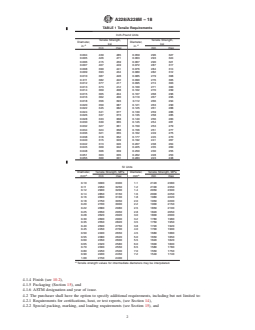
TABLE 1 Tensile Requirements
5.3.1 Type 1 wire shall be directly drawn from either
as-rolledrodsorfromairpatentedrodsorwiretothefinalwire
Inch-Pound Units
diameter.
Diameter, Tensile Strength, ksi Diameter, Tensile Strength, ksi
A A 5.3.2 Type2wireshallbedrawnfromeitherpatentedrodor
in. min max in. min max
patented wire to the final wire diameter. Air patenting is not
0.004 439 485 0.059 296 327
allowed.
0.005 426 471 0.063 293 324
5.3.3 Type 2 wire may be substituted for Type 1 wire.
0.006 415 459 0.067 290 321
0.007 407 449 0.072 287 317
Conversely, Type 1 wire may not be substituted for Type 2
0.008 399 441 0.076 284 314
wire.
0.009 393 434 0.080 282 312
0.010 387 428 0.085 279 308
NOTE2—Themethodofpatenting,andinparticularthemethodutilized
0.011 382 422 0.090 276 305
forcontrolledcooling,canbedesignedtooptimizethemicrostructureand
0.012 377 417 0.095 274 303
mechanicalpropertiesofeitherpatentedwirerodorpatentedwire,aswell
0.013 373 412 0.100 271 300
as of wires drawn from either of these. Because patenting is performed in
0.014 369 408 0.102 270 299
a linear manner rather than in a coiled or serpentine manner, the
0.015 365 404 0.107 268 296
uniformityofmicrostructureandmechanicalpropertiesalongthepatented
0.016 362 400 0.110 267 295
wire or patented wire rod length is improved compared to that existing in
0.018 356 393 0.112 266 294
0.020 350 387 0.121 263 290
either of these prior to patenting.
0.022 345 382 0.125 261 288
0.024 341 377 0.130 259 286
6. Chemical Composition
0.026 337 373 0.135 258 285
0.028 333 368 0.140 256 283
6.1 Thesteelshallconformtotherequirementsforchemical
0.030 330 365 0.145 254 281
composition prescribed in Table 2.
0.032 327 361 0.150 253 279
0.034 324 358 0.156 251 277
6.2 Heat Analysis—Each heat of steel shall be analyzed to
0.036 321 355 0.162 249 275
determine the percentage of elements prescribed in Table 2.
0.038 318 352 0.177 245 270
0.040 315 349 0.192 241 267 This analysis shall be made from a test specimen preferably
0.042 313 346 0.207 238 264
taken during the pouring of the heat. When requested in the
0.045 309 342 0.225 235 260
purchase order, the heat analysis shall be reported to the
0.048 306 339 0.250 230 255
0.051 303 335 0.262 228 253 purchaser.
0.055 300 331 0.283 223 248
6.3 Product Analysis—An analysis may be made by the
SI Units
purchaser from finished wire representing each heat of steel.
Diameter, Tensile Strength, MPa Diameter, Tensile Strength, MPa
The chemical composition thus determined, as to elements
A A
mm min max mm min max
required or restricted, shall conform to the product analysis
0.10 3000 3300 1.1 2120 2380
requirements specified in Table 3 of Specification A510/
0.11 2950 3250 1.2 2100 2350
A510M.
0.12 2900 3200 1.4 2050 2300
0.14 2850 3150 1.6 2000 2250
6.4 For referee purposes, Test Methods, Practices, and
0.16 2800 3100 1.8 1980 2220
Terminology A751 shall be used.
0.18 2750 3050 2.0 1950 2200
0.20 2700 3000 2.2 1900 2150
0.22 2680 2980 2.5 1850 2100
7. Mechanical Properties
0.25 2650 2950 2.8 1820 2050
7.1 Tension Test:
0.28 2620 2920 3.0 1800 2000
0.30 2600 2900 3.2 1780 1980
7.1.1 Requirements—Thematerialasrepresentedbytension
0.35 2550 2820 3.5 1750 1950
test specimens shall conform to the requirements prescribed in
0.40 2500 2750 3.8 1720 1920
Table 1.
0.45 2450 2700 4.0 1700 1900
0.50 2400 2650 4.5 1680 1880
7.1.2 Number of Tests—One test specimen shall be taken
0.55 2380 2620 5.0 1650 1850
from the top or outside end of each coil, reel, or spool, and
0.60 2350 2600 5.5 1620 1820
shall be tested for conformance.
0.65 2320 2580 6.0 1600 1800
0.70 2300 2550 6.5 1580 1780
7.1.3 Test Method—The tension test shall be made in
0.80 2250 2500 7.0 1550 1750
accordance with Test Methods and Definitions A370.
0.90 2200 2450 7.2 1540 1740
1.00 2150 2400 7.1.4 For wire diameters over 0.283 in. [7.2 mm], mechani-
A
cal properties shall be negotiated between purchaser and
Tensile strength values for intermediate diameters may be interpolated.
supplier and shall be included on the order information.
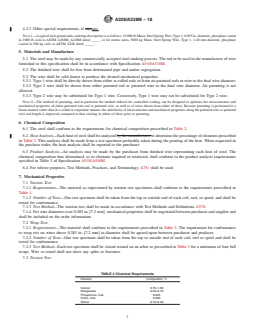
TABLE 2 Chemical Requirements
wire furnished to this specification shall be in accordance with
Element Composition, %
Specification A510/A510M.
Carbon 0.70–1.00
5.2 The finished wire shall be free from detrimental pipe
Manganese 0.20–0.70
and undue segregation.
Phosphorus, max 0.025
Sulfur, max 0.030
5.3 The wire shall be cold drawn to produce the desired
Silicon 0.10–0.30
mechanical properties.
A228/A228M−18
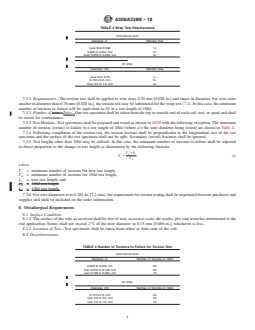
TABLE 4 Number of Torsions to Failure for Torsion Test
7.2 Wrap Test:
7.2.1 Requirements—The material shall conform to the
Inch-Pound Units
requirements prescribed in Table 3. The requirement for
Diameter, in. Number of Torsions in 100d
conformancetowraptestonwiresabove0.283in.[7.2mm]in
diametershallbeagreeduponbetweenpurchaserandproducer. 0.028 to 0.079, incl 25
over 0.079 to 0.138, incl 20
7.2.2 Number of Tests—One test specimen shall be taken
over 0.138 to 0.283, incl 15
fromthetoporoutsideendofeachcoil,reelorspoolandshall
SI Units
be tested for conformance.
Diameter, mm Number of Torsions in 100d
7.2.3 Test Method—Each test specimen shall be closed
wound on an arbor as prescribed in Table 3 for a minimum of
0.70 to 2.0, incl 25
four full wraps. Wire so tested shall not show any splits or over 2.0 to 3.5, incl 20
over 3.5 to 7.2, incl 15
fractures.
7.3 Torsion Test:
7.3.1 Requirements—The torsion test shall be applied to
7.3.6 For wire diameters over 0.283 in. [7.2 mm], the
wiresizes0.70mm[0.028in.]andlargerindiameter.Forwire
requirement for torsion testing shall be negotiated between
sizes smaller in diameter than 0.70 mm [0.028 in.], the torsion
purchaser and supplier and shall be included on the order
test may be substituted for the wrap test (7.2). In this case, the
information.
minimumnumberoftorsionstofailurewillbeequivalentto25
in a test length of 100d.
8. Metallurgical Requirements
7.3.2 Number of Tests—One test specimen shall be taken
fromthetoporoutsideendofeachcoil,reel,orspoolandshall 8
...
This document is not an ASTM standard and is intended only to provide the user of an ASTM standard an indication of what changes have been made to the previous version. Because
it may not be technically possible to adequately depict all changes accurately, ASTM recommends that users consult prior editions as appropriate. In all cases only the current version
of the standard as published by ASTM is to be considered the official document.
Designation: A228/A228M − 16 A228/A228M − 18
Standard Specification for
Steel Wire, Music Spring Quality
This standard is issued under the fixed designation A228/A228M; the number immediately following the designation indicates the year
of original adoption or, in the case of revision, the year of last revision. A number in parentheses indicates the year of last reapproval.
A superscript epsilon (´) indicates an editorial change since the last revision or reapproval.
This standard has been approved for use by agencies of the U.S. Department of Defense.
1. Scope*
1.1 This specification covers two types of round, cold-drawn steel music spring quality wire, uniform in mechanical properties,
intended especially for the manufacture of springs subject to high stresses or requiring good fatigue properties.
1.2 The values stated in either SI units or inch-pound units are to be regarded separately as standard. The values stated in each
system may not be exact equivalents; therefore, each system shall be used independently of the other. Combining values from the
two systems may result in non-conformance with the standard.
1.3 This international standard was developed in accordance with internationally recognized principles on standardization
established in the Decision on Principles for the Development of International Standards, Guides and Recommendations issued
by the World Trade Organization Technical Barriers to Trade (TBT) Committee.
2. Referenced Documents
2.1 ASTM Standards:
A370 Test Methods and Definitions for Mechanical Testing of Steel Products
A510/A510M Specification for General Requirements for Wire Rods and Coarse Round Wire, Carbon Steel, and Alloy Steel
A700 Guide for Packaging, Marking, and Loading Methods for Steel Products for Shipment
A751 Test Methods, Practices, and Terminology for Chemical Analysis of Steel Products
A938 Test Method for Torsion Testing of Wire
A941 Terminology Relating to Steel, Stainless Steel, Related Alloys, and Ferroalloys
E29 Practice for Using Significant Digits in Test Data to Determine Conformance with Specifications
E1077 Test Methods for Estimating the Depth of Decarburization of Steel Specimens
2.2 Federal Standard:
Fed. Std. No. 123, Marking for Shipment (Civil Agencies)
2.3 American National Standard:
B32.100 Preferred Metric Sizes for Flat, Round, Square, Rectangular, and Hexagonal Metal Products
2.4 AIAG Standard:
AIAG B-5 02.00 Primary Metals Identification Tag Application Standard
3. Terminology
3.1 Definitions—For definitions of terms used in this specification, refer to Terminology A941.
4. Ordering Information
4.1 Orders for steel wire under this specification shall contain the following information:
4.1.1 Quantity (weight in lbs, or mass in kg),
4.1.2 Name (music steel spring wire) and type (Type 1 or Type 2) of material,
4.1.3 Diameter (Table 1 and Section 9),
This specification is under the jurisdiction of ASTM Committee A01 on Steel, Stainless Steel and Related Alloys and is the direct responsibility of Subcommittee A01.03
on Steel Rod and Wire.
Current edition approved Dec. 1, 2016Sept. 1, 2018. Published January 2017September 2018. Originally approved in 1939. Last previous edition approved in 20142016
as A228/A228M – 14.A228/A228M – 16. DOI: 10.1520/A0228_A0228M-16.10.1520/A0228_A0228M-18.
For referenced ASTM standards, visit the ASTM website, www.astm.org, or contact ASTM Customer Service at service@astm.org. For Annual Book of ASTM Standards
volume information, refer to the standard’s Document Summary page on the ASTM website.
Available from Standardization Documents Order Desk, DODSSP, Bldg. 4, Section D, 700 Robbins Ave., Philadelphia, PA 19111–5098, http://www.dodssp.daps.mil.
*A Summary of Changes section appears at the end of this standard
Copyright © ASTM International, 100 Barr Harbor Drive, PO Box C700, West Conshohocken, PA 19428-2959. United States
A228/A228M − 18
TABLE 1 Tensile Requirements
Inch-Pound Units
Tensile Strength, Tensile Strength,
Diameter, Diameter,
ksi ksi
A A
in. in.
min max min max
0.004 439 485 0.059 296 327
0.005 426 471 0.063 293 324
0.006 415 459 0.067 290 321
0.007 407 449 0.072 287 317
0.008 399 441 0.076 284 314
0.009 393 434 0.080 282 312
0.010 387 428 0.085 279 308
0.011 382 422 0.090 276 305
0.012 377 417 0.095 274 303
0.013 373 412 0.100 271 300
0.014 369 408 0.102 270 299
0.015 365 404 0.107 268 296
0.016 362 400 0.110 267 295
0.018 356 393 0.112 266 294
0.020 350 387 0.121 263 290
0.022 345 382 0.125 261 288
0.024 341 377 0.130 259 286
0.026 337 373 0.135 258 285
0.028 333 368 0.140 256 283
0.030 330 365 0.145 254 281
0.032 327 361 0.150 253 279
0.034 324 358 0.156 251 277
0.036 321 355 0.162 249 275
0.038 318 352 0.177 245 270
0.040 315 349 0.192 241 267
0.042 313 346 0.207 238 264
0.045 309 342 0.225 235 260
0.048 306 339 0.250 230 255
0.051 303 335 0.262 228 253
0.055 300 331 0.283 223 248
SI Units
Diameter, Tensile Strength, MPa Diameter, Tensile Strength, MPa
A A
mm min max mm min max
0.10 3000 3300 1.1 2120 2380
0.11 2950 3250 1.2 2100 2350
0.12 2900 3200 1.4 2050 2300
0.14 2850 3150 1.6 2000 2250
0.16 2800 3100 1.8 1980 2220
0.18 2750 3050 2.0 1950 2200
0.20 2700 3000 2.2 1900 2150
0.22 2680 2980 2.5 1850 2100
0.25 2650 2950 2.8 1820 2050
0.28 2620 2920 3.0 1800 2000
0.30 2600 2900 3.2 1780 1980
0.35 2550 2820 3.5 1750 1950
0.40 2500 2750 3.8 1720 1920
0.45 2450 2700 4.0 1700 1900
0.50 2400 2650 4.5 1680 1880
0.55 2380 2620 5.0 1650 1850
0.60 2350 2600 5.5 1620 1820
0.65 2320 2580 6.0 1600 1800
0.70 2300 2550 6.5 1580 1780
0.80 2250 2500 7.0 1550 1750
0.90 2200 2450 7.2 1540 1740
1.00 2150 2400
A
Tensile strength values for intermediate diameters may be interpolated.
4.1.4 Finish (see 10.2),
4.1.5 Packaging (Section 15), and
4.1.6 ASTM designation and year of issue.
4.2 The purchaser shall have the option to specify additional requirements, including but not limited to:
4.2.1 Requirements for certifications, heat, or test reports, (see Section 14),
4.2.2 Special packing, marking, and loading requirements (see Section 15), and
A228/A228M − 18
4.2.3 Other special requirements, if any,any.
NOTE 1—A typical inch-pound units ordering description is as follows: 10 000 lb Music Steel Spring Wire, Type 1, 0.055 in. diameter, phosphate coated
in 1000 lb coils to ASTM A288M_A228M dated _____, or for metric units, 5000 kg Music Steel Spring Wire, Type 1, 1.40 mm diameter, phosphate
coated in 500 kg coils to ASTM A288 dated _____.
5. Materials and Manufacture
5.1 The steel may be made by any commercially accepted steel-making process. The rod to be used in the manufacture of wire
furnished to this specification shall be in accordance with Specification A510/A510M.
5.2 The finished wire shall be free from detrimental pipe and undue segregation.
5.3 The wire shall be cold drawn to produce the desired mechanical properties.
5.3.1 Type 1 wire shall be directly drawn from either as-rolled rods or from air patented rods or wire to the final wire diameter.
5.3.2 Type 2 wire shall be drawn from either patented rod or patented wire to the final wire diameter. Air patenting is not
allowed.
5.3.3 Type 2 wire may be substituted for Type 1 wire. Conversely, Type 1 wire may not be substituted for Type 2 wire.
NOTE 2—The method of patenting, and in particular the method utilized for controlled cooling, can be designed to optimize the microstructure and
mechanical properties of either patented wire rod or patented wire, as well as of wires drawn from either of these. Because patenting is performed in a
linear manner rather than in a coiled or serpentine manner, the uniformity of microstructure and mechanical properties along the patented wire or patented
wire rod length is improved compared to that existing in either of these prior to patenting.
6. Chemical Composition
6.1 The steel shall conform to the requirements for chemical composition prescribed in Table 2.
6.2 Heat Analysis—Each heat of steel shall be analyzed by the manufacturer to determine the percentage of elements prescribed
in Table 2. This analysis shall be made from a test specimen preferably taken during the pouring of the heat. When requested in
the purchase order, the heat analysis shall be reported to the purchaser.
6.3 Product Analysis—An analysis may be made by the purchaser from finished wire representing each heat of steel. The
chemical composition thus determined, as to elements required or restricted, shall conform to the product analysis requirements
specified in Table 3 of Specification A510/A510M.
6.4 For referee purposes, Test Methods, Practices, and Terminology A751 shall be used.
7. Mechanical Properties
7.1 Tension Test:
7.1.1 Requirements—The material as represented by tension test specimens shall conform to the requirements prescribed in
Table 1.
7.1.2 Number of Tests—One test specimen shall be taken from the top or outside end of each coil, reel, or spool, and shall be
tested for conformance.
7.1.3 Test Method—The tension test shall be made in accordance with Test Methods and Definitions A370.
7.1.4 For wire diameters over 0.283 in. [7.2 mm], mechanical properties shall be negotiated between purchaser and supplier and
shall be included on the order information.
7.2 Wrap Test:
7.2.1 Requirements—The material shall conform to the requirements prescribed in Table 3. The requirement for conformance
to wrap test on wires above 0.283 in. [7.2 mm] in diameter shall be agreed upon between purchaser and producer.
7.2.2 Number of Tests—One test specimen shall be taken from the top or outside end of each coil, reel or spool and shall be
tested for conformance.
7.2.3 Test Method—Each test specimen shall be closed wound on an arbor as prescribed in Table 3 for a minimum of four full
wraps. Wire so tested shall not show any splits or fractures.
7.3 Torsion Test:
TABLE 2 Chemical Requirements
Element Composition, %
Carbon 0.70–1.00
Manganese 0.20–0.70
Phosphorus, max 0.025
Sulfur, max 0.030
Silicon 0.10–0.30
A228/A228M − 18
TABLE 3 Wrap Test Requirements
Inch-Pound Units
Diameter, in. Mandrel Size
Less than 0.028 1×
0.028 to 0.256, incl 2×
Over 0.256 to 0.283, incl 3×
SI Units
Diameter, mm Mandrel Size
Less than 0.70 1×
0.70 to 6.5, incl 2×
Over 6.5 to 7.2, incl 3×
7.3.1 Requirements—The torsion test shall be applied to wire sizes 0.70 mm [0.028 in.] and larger in diameter. For wire sizes
smaller in diameter than 0.70 mm [0.028 in.], the torsion test may be substituted for the wrap test (7.2). In this case, the minimum
number of torsions to failure will be equivalent to 25 in a test length of 100d.
7.3.2 Number of tests—Tests—One test specimen shall be taken from the top or outside end of each coil, reel, or spool and shall
be tested for conformance.
7.3.3 Test Method—Test specimens shall be prepared and tested as shown in A938 with the following exception. The minimum
number of torsions (twists) to failure in a test length of 100d (where d = the wire diameter being tested) are shown in Table 4.
7.3.4 Following completion of the torsion test, the torsion fracture shall be perpendicular to the longitudinal axis of the test
specimen and the surface of the test specimen shall not be split. Secondary (recoil) fractures shall be ignored.
7.3.5 Test lengths other th
...