

ASTM D4945-17
(Test Method)Standard Test Method for High-Strain Dynamic Testing of Deep Foundations
General Information
- Abstract
SIGNIFICANCE AND USE
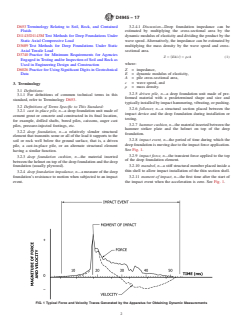
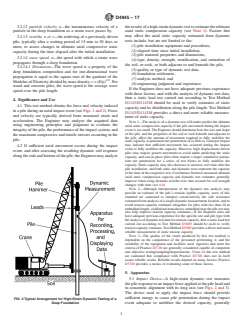
4.1 This test method obtains the force and velocity induced in a pile during an axial impact event (see Figs. 1 and 2). Force and velocity are typically derived from measured strain and acceleration. The Engineer may analyze the acquired data using engineering principles and judgment to evaluate the integrity of the pile, the performance of the impact system, and the maximum compressive and tensile stresses occurring in the pile.
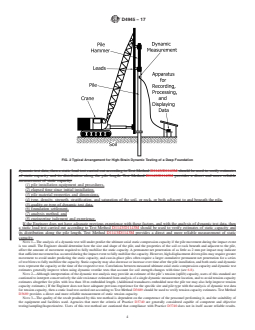
FIG. 2 Typical Arrangement for High-Strain Dynamic Testing of a Deep Foundation
4.2 If sufficient axial movement occurs during the impact event, and after assessing the resulting dynamic soil response along the side and bottom of the pile, the Engineer may analyze the results of a high-strain dynamic test to estimate the ultimate axial static compression capacity (see Note 1). Factors that may affect the axial static capacity estimated from dynamic tests include, but are not limited to the:
(1) pile installation equipment and procedures,
(2) elapsed time since initial installation,
(3) pile material properties and dimensions,
(4) type, density, strength, stratification, and saturation of the soil, or rock, or both adjacent to and beneath the pile,
(5) quality or type of dynamic test data,
(6) foundation settlement,
(7) analysis method, and
(8) engineering judgment and experience.
If the Engineer does not have adequate previous experience with these factors, and with the analysis of dynamic test data, then a static load test carried out according to Test Method D1143/D1143M should be used to verify estimates of static capacity and its distribution along the pile length. Test Method D1143/D1143M provides a direct and more reliable measurement of static capacity.
Note 1: The analysis of a dynamic test will under predict the ultimate axial static compression capacity if the pile movement during the impact event is too small. The Engineer should determine how the size and shape of the pile, and the properties of the s...
SCOPE
1.1 This dynamic test method covers the procedure for applying an axial impact force with a pile driving hammer or a large drop weight that will cause a relatively high strain at the top of an individual vertical or inclined deep foundation unit, and for measuring the subsequent force and velocity response of that deep foundation unit. While in this standard force and velocity are referenced as “measured,” they are typically derived from measured strain and acceleration values. High-strain dynamic testing applies to any deep foundation unit, also referred to herein as a “pile,” which functions in a manner similar to a driven pile or a cast-in-place pile regardless of the method of installation, and which conforms with the requirements of this test method.
1.2 This standard provides minimum requirements for dynamic testing of deep foundations. Plans, specifications, or provisions (or combinations thereof) prepared by a qualified engineer may provide additional requirements and procedures as needed to satisfy the objectives of a particular test program. The engineer in responsible charge of the foundation design, referred to herein as the “Engineer”, shall approve any deviations, deletions, or additions to the requirements of this standard.
1.3 The proper conduct and evaluation of high-strain dynamic tests requires special knowledge and experience. A qualified engineer should directly supervise the acquisition of field data and the interpretation of the test results so as to predict the actual performance and adequacy of deep foundations used in the constructed foundation. A qualified engineer shall approve the apparatus used for applying the impact force, driving appurtenances, test rigging, hoist equipment, support frames, templates, and test procedures.
1.4 The text of this standard references notes and footnotes which provide explanatory material. These notes and footnotes (excluding those in tables and figure...
- Status
- Published
- Publication Date
- 31-Oct-2017
- Technical Committee
- D18 - Soil and Rock
- Drafting Committee
- D18.11 - Deep Foundations
Overview
ASTM D4945-17: Standard Test Method for High-Strain Dynamic Testing of Deep Foundations sets the minimum requirements and procedures for high-strain dynamic testing of deep foundation units, such as driven piles and cast-in-place piles. Developed by ASTM, this dynamic test method assesses pile integrity, structural capacity, and overall pile performance under axial impact using force and velocity measurements derived from strain and acceleration transducers. The standard ensures reliable and consistent evaluation of deep foundations by outlining the proper conduct, supervision, and instrumentation for the testing process, contributing to safe and effective foundation engineering practices.
Key Topics
- High-Strain Dynamic Testing: Applies an axial impact force using a pile driving hammer or drop weight at the pile head, inducing significant strain for analysis.
- Measurement Parameters: Force and velocity are measured or derived from strain and acceleration data, enabling the evaluation of pile response during impact events.
- Test Scope: Covers both vertical and inclined deep foundation systems, including driven, cast-in-place, and other pile types conforming to the standard.
- Data Analysis: Collected force and velocity data are analyzed by a qualified engineer for assessing:
- Pile integrity
- Performance of the driving system
- Maximum stresses in the pile
- Estimation of ultimate axial static compression capacity (under specific conditions)
- Quality Assurance: Requires experienced engineers to directly supervise data acquisition and interpretation. Proper calibration and placement of transducers are essential for accurate results.
- Factors Affecting Testing: The estimated static capacity from dynamic tests can be influenced by several factors:
- Pile installation equipment and procedures
- Elapsed time since installation
- Pile material properties and geometry
- Soil or rock characteristics around the pile
- Data quality and analysis methods
- Foundation settlement
- Safety Considerations: Stresses the importance of safety, health, and environmental best practices during testing operations.
Applications
High-strain dynamic pile testing, as specified in ASTM D4945-17, is widely used in geotechnical engineering and construction industries for:
- Pile Integrity Assessment: Detecting potential flaws or damage along the pile length during and after installation.
- Design Verification: Estimating the ultimate static load-carrying capacity of deep foundations to ensure compliance with structural design requirements, particularly where static load testing may be challenging.
- Pile Driving Analysis: Monitoring hammer performance, transferred energy, and induced stresses during pile installation, which supports optimization of construction techniques and quality control.
- Foundation Performance Monitoring: Providing essential data for the verification of constructed foundation performance, especially for infrastructure projects such as bridges, high-rise buildings, and transportation systems.
- Settlement Analysis: Contributing to evaluations of foundation settlement over time, when integrated with other testing and monitoring data.
High-strain dynamic testing is especially valuable where site conditions or project constraints make traditional static load testing difficult, expensive, or time-consuming.
Related Standards
- ASTM D1143/D1143M: Standard test methods for deep foundations under static axial compressive load - Provides more direct and reliable measurement of static capacity when dynamic estimates are uncertain.
- ASTM D3689: Standard test methods for deep foundations under static axial tensile load.
- ASTM D3740: Minimum requirements for agencies engaged in testing of soil and rock in engineering design.
- ASTM D653: Terminology relating to soil, rock, and contained fluids.
- ASTM C469: Static modulus of elasticity and Poisson’s ratio of concrete in compression.
- ASTM D198: Static tests of lumber in structural sizes.
- ASTM D6026: Use of significant digits in geotechnical data.
Following ASTM D4945-17 helps ensure that deep foundation testing is performed with precision, reliability, and safety, supporting sound engineering judgment and optimal construction outcomes for deep foundation systems.
Relations
- Effective Date
- 01-Nov-2017
- Effective Date
- 01-Nov-2023
- Effective Date
- 01-Oct-2019
- Effective Date
- 01-Aug-2014
- Effective Date
- 01-Feb-2014
- Effective Date
- 01-Feb-2014
- Effective Date
- 01-Oct-2013
- Effective Date
- 15-Jun-2013
- Effective Date
- 01-May-2012
- Effective Date
- 01-Mar-2012
- Effective Date
- 01-Sep-2011
- Effective Date
- 01-Sep-2011
- Effective Date
- 01-Mar-2010
- Effective Date
- 01-Sep-2009
- Effective Date
- 01-Jan-2009
Get Certified
Connect with accredited certification bodies for this standard

Zavod za gradbeništvo Slovenije (ZAG) - Inšpekcija
ZAG inspection body for construction products, structures, and materials.
Sponsored listings
Frequently Asked Questions
ASTM D4945-17 is a standard published by ASTM International. Its full title is "Standard Test Method for High-Strain Dynamic Testing of Deep Foundations". This standard covers: SIGNIFICANCE AND USE 4.1 This test method obtains the force and velocity induced in a pile during an axial impact event (see Figs. 1 and 2). Force and velocity are typically derived from measured strain and acceleration. The Engineer may analyze the acquired data using engineering principles and judgment to evaluate the integrity of the pile, the performance of the impact system, and the maximum compressive and tensile stresses occurring in the pile. FIG. 2 Typical Arrangement for High-Strain Dynamic Testing of a Deep Foundation 4.2 If sufficient axial movement occurs during the impact event, and after assessing the resulting dynamic soil response along the side and bottom of the pile, the Engineer may analyze the results of a high-strain dynamic test to estimate the ultimate axial static compression capacity (see Note 1). Factors that may affect the axial static capacity estimated from dynamic tests include, but are not limited to the: (1) pile installation equipment and procedures, (2) elapsed time since initial installation, (3) pile material properties and dimensions, (4) type, density, strength, stratification, and saturation of the soil, or rock, or both adjacent to and beneath the pile, (5) quality or type of dynamic test data, (6) foundation settlement, (7) analysis method, and (8) engineering judgment and experience. If the Engineer does not have adequate previous experience with these factors, and with the analysis of dynamic test data, then a static load test carried out according to Test Method D1143/D1143M should be used to verify estimates of static capacity and its distribution along the pile length. Test Method D1143/D1143M provides a direct and more reliable measurement of static capacity. Note 1: The analysis of a dynamic test will under predict the ultimate axial static compression capacity if the pile movement during the impact event is too small. The Engineer should determine how the size and shape of the pile, and the properties of the s... SCOPE 1.1 This dynamic test method covers the procedure for applying an axial impact force with a pile driving hammer or a large drop weight that will cause a relatively high strain at the top of an individual vertical or inclined deep foundation unit, and for measuring the subsequent force and velocity response of that deep foundation unit. While in this standard force and velocity are referenced as “measured,” they are typically derived from measured strain and acceleration values. High-strain dynamic testing applies to any deep foundation unit, also referred to herein as a “pile,” which functions in a manner similar to a driven pile or a cast-in-place pile regardless of the method of installation, and which conforms with the requirements of this test method. 1.2 This standard provides minimum requirements for dynamic testing of deep foundations. Plans, specifications, or provisions (or combinations thereof) prepared by a qualified engineer may provide additional requirements and procedures as needed to satisfy the objectives of a particular test program. The engineer in responsible charge of the foundation design, referred to herein as the “Engineer”, shall approve any deviations, deletions, or additions to the requirements of this standard. 1.3 The proper conduct and evaluation of high-strain dynamic tests requires special knowledge and experience. A qualified engineer should directly supervise the acquisition of field data and the interpretation of the test results so as to predict the actual performance and adequacy of deep foundations used in the constructed foundation. A qualified engineer shall approve the apparatus used for applying the impact force, driving appurtenances, test rigging, hoist equipment, support frames, templates, and test procedures. 1.4 The text of this standard references notes and footnotes which provide explanatory material. These notes and footnotes (excluding those in tables and figure...
SIGNIFICANCE AND USE 4.1 This test method obtains the force and velocity induced in a pile during an axial impact event (see Figs. 1 and 2). Force and velocity are typically derived from measured strain and acceleration. The Engineer may analyze the acquired data using engineering principles and judgment to evaluate the integrity of the pile, the performance of the impact system, and the maximum compressive and tensile stresses occurring in the pile. FIG. 2 Typical Arrangement for High-Strain Dynamic Testing of a Deep Foundation 4.2 If sufficient axial movement occurs during the impact event, and after assessing the resulting dynamic soil response along the side and bottom of the pile, the Engineer may analyze the results of a high-strain dynamic test to estimate the ultimate axial static compression capacity (see Note 1). Factors that may affect the axial static capacity estimated from dynamic tests include, but are not limited to the: (1) pile installation equipment and procedures, (2) elapsed time since initial installation, (3) pile material properties and dimensions, (4) type, density, strength, stratification, and saturation of the soil, or rock, or both adjacent to and beneath the pile, (5) quality or type of dynamic test data, (6) foundation settlement, (7) analysis method, and (8) engineering judgment and experience. If the Engineer does not have adequate previous experience with these factors, and with the analysis of dynamic test data, then a static load test carried out according to Test Method D1143/D1143M should be used to verify estimates of static capacity and its distribution along the pile length. Test Method D1143/D1143M provides a direct and more reliable measurement of static capacity. Note 1: The analysis of a dynamic test will under predict the ultimate axial static compression capacity if the pile movement during the impact event is too small. The Engineer should determine how the size and shape of the pile, and the properties of the s... SCOPE 1.1 This dynamic test method covers the procedure for applying an axial impact force with a pile driving hammer or a large drop weight that will cause a relatively high strain at the top of an individual vertical or inclined deep foundation unit, and for measuring the subsequent force and velocity response of that deep foundation unit. While in this standard force and velocity are referenced as “measured,” they are typically derived from measured strain and acceleration values. High-strain dynamic testing applies to any deep foundation unit, also referred to herein as a “pile,” which functions in a manner similar to a driven pile or a cast-in-place pile regardless of the method of installation, and which conforms with the requirements of this test method. 1.2 This standard provides minimum requirements for dynamic testing of deep foundations. Plans, specifications, or provisions (or combinations thereof) prepared by a qualified engineer may provide additional requirements and procedures as needed to satisfy the objectives of a particular test program. The engineer in responsible charge of the foundation design, referred to herein as the “Engineer”, shall approve any deviations, deletions, or additions to the requirements of this standard. 1.3 The proper conduct and evaluation of high-strain dynamic tests requires special knowledge and experience. A qualified engineer should directly supervise the acquisition of field data and the interpretation of the test results so as to predict the actual performance and adequacy of deep foundations used in the constructed foundation. A qualified engineer shall approve the apparatus used for applying the impact force, driving appurtenances, test rigging, hoist equipment, support frames, templates, and test procedures. 1.4 The text of this standard references notes and footnotes which provide explanatory material. These notes and footnotes (excluding those in tables and figure...
ASTM D4945-17 is classified under the following ICS (International Classification for Standards) categories: 93.020 - Earthworks. Excavations. Foundation construction. Underground works. The ICS classification helps identify the subject area and facilitates finding related standards.
ASTM D4945-17 has the following relationships with other standards: It is inter standard links to ASTM D4945-12, ASTM D3740-23, ASTM D3740-19, ASTM D653-14, ASTM D198-14, ASTM D198-14e1, ASTM D198-13, ASTM D1143/D1143M-07(2013), ASTM D3740-12a, ASTM D3740-12, ASTM D3740-11, ASTM D653-11, ASTM D3740-10, ASTM D198-09, ASTM D653-09. Understanding these relationships helps ensure you are using the most current and applicable version of the standard.
ASTM D4945-17 is available in PDF format for immediate download after purchase. The document can be added to your cart and obtained through the secure checkout process. Digital delivery ensures instant access to the complete standard document.
Standards Content (Sample)
This international standard was developed in accordance with internationally recognized principles on standardization established in the Decision on Principles for the
Development of International Standards, Guides and Recommendations issued by the World Trade Organization Technical Barriers to Trade (TBT) Committee.
Designation: D4945 − 17
Standard Test Method for
High-Strain Dynamic Testing of Deep Foundations
This standard is issued under the fixed designation D4945; the number immediately following the designation indicates the year of
original adoption or, in the case of revision, the year of last revision.Anumber in parentheses indicates the year of last reapproval.A
superscript epsilon (´) indicates an editorial change since the last revision or reapproval.
1. Scope* recommended or advisory provision. Imperative sentences
indicate mandatory provisions.
1.1 This dynamic test method covers the procedure for
applying an axial impact force with a pile driving hammer or 1.5 Units—The values stated in SI units are to be regarded
alargedropweightthatwillcausearelativelyhighstrainatthe asstandard.Nootherunitsofmeasurementareincludedinthis
top of an individual vertical or inclined deep foundation unit, standard. Reporting of test results in units other than SI shall
and for measuring the subsequent force and velocity response not be regarded as nonconformance with this test method.
of that deep foundation unit. While in this standard force and
1.6 All observed and calculated values shall conform to the
velocity are referenced as “measured,” they are typically
guidelines for significant digits and rounding established in
derived from measured strain and acceleration values. High-
Practice D6026.
straindynamictestingappliestoanydeepfoundationunit,also
1.6.1 Theproceduresusedtospecifyhowdataarecollected/
referred to herein as a “pile,” which functions in a manner
recorded and calculated in this standard are regarded as the
similar to a driven pile or a cast-in-place pile regardless of the
industry standard. In addition, they are representative of the
method of installation, and which conforms with the require-
significant digits that should generally be retained. The proce-
ments of this test method.
dures used do not consider material variation, purpose for
1.2 This standard provides minimum requirements for dy- obtaining the data, special purpose studies, or any consider-
namic testing of deep foundations. Plans, specifications, or ations for the user’s objectives; and it is common practice to
provisions (or combinations thereof) prepared by a qualified increase or reduce significant digits of reported data to com-
engineer may provide additional requirements and procedures mensurate with these considerations. It is beyond the scope of
as needed to satisfy the objectives of a particular test program. this standard to consider significant digits used in analysis
The engineer in responsible charge of the foundation design, methods for engineering design.
referred to herein as the “Engineer”, shall approve any
1.7 This standard does not purport to address all of the
deviations, deletions, or additions to the requirements of this
safety concerns, if any, associated with its use. It is the
standard.
responsibility of the user of this standard to establish appro-
priate safety, health, and environmental practices and deter-
1.3 The proper conduct and evaluation of high-strain dy-
mine the applicability of regulatory limitations prior to use.
namic tests requires special knowledge and experience. A
For a specific precautionary statement, see Note 4.
qualified engineer should directly supervise the acquisition of
1.8 This international standard was developed in accor-
field data and the interpretation of the test results so as to
dance with internationally recognized principles on standard-
predict the actual performance and adequacy of deep founda-
ization established in the Decision on Principles for the
tions used in the constructed foundation. A qualified engineer
Development of International Standards, Guides and Recom-
shallapprovetheapparatususedforapplyingtheimpactforce,
mendations issued by the World Trade Organization Technical
driving appurtenances, test rigging, hoist equipment, support
Barriers to Trade (TBT) Committee.
frames, templates, and test procedures.
1.4 The text of this standard references notes and footnotes
2. Referenced Documents
whichprovideexplanatorymaterial.Thesenotesandfootnotes
2.1 ASTM Standards:
(excluding those in tables and figures) shall not be considered
C469Test Method for Static Modulus of Elasticity and
as requirements of the standard. The word “shall” indicates a
Poisson’s Ratio of Concrete in Compression
mandatory provision, and the word “should” indicates a
D198Test Methods of Static Tests of Lumber in Structural
Sizes
ThistestmethodisunderthejurisdictionofASTMCommitteeD18onSoiland
RockandisthedirectresponsibilityofSubcommitteeD18.11onDeepFoundations. For referenced ASTM standards, visit the ASTM website, www.astm.org, or
Current edition approved Nov. 1, 2017. Published December 2017. Originally contact ASTM Customer Service at service@astm.org. For Annual Book of ASTM
approved in 1989. Last previous edition approved in 2012 as D4945–12. DOI: Standards volume information, refer to the standard’s Document Summary page on
10.1520/D4945-17. the ASTM website.
*A Summary of Changes section appears at the end of this standard
Copyright © ASTM International, 100 Barr Harbor Drive, PO Box C700, West Conshohocken, PA 19428-2959. United States
D4945 − 17
D653Terminology Relating to Soil, Rock, and Contained 3.2.4.1 Discussion—Deep foundation impedance can be
Fluids estimated by multiplying the cross-sectional area by the
D1143/D1143MTest Methods for Deep Foundations Under dynamic modulus of elasticity and dividing the product by the
Static Axial Compressive Load wave speed.Alternatively, the impedance can be estimated by
D3689Test Methods for Deep Foundations Under Static multiplying the mass density by the wave speed and cross-
Axial Tensile Load sectional area.
D3740Practice for Minimum Requirements for Agencies
Z 5 ~EA/c! 5 ρcA (1)
Engaged in Testing and/or Inspection of Soil and Rock as
where:
Used in Engineering Design and Construction
Z = impedance,
D6026Practice for Using Significant Digits in Geotechnical
E = dynamic modulus of elasticity,
Data
A = pile cross-sectional area,
c = wave speed, and
3. Terminology
ρ = mass density.
3.1 Definitions:
3.2.5 driven pile, n—a deep foundation unit made of pre-
3.1.1 For definitions of common technical terms in this
formed material with a predetermined shape and size and
standard, refer to Terminology D653.
typicallyinstalledbyimpacthammering,vibrating,orpushing.
3.2 Definitions of Terms Specific to This Standard:
3.2.6 follower, n—a structural section placed between the
3.2.1 cast in-place pile, n—a deep foundation unit made of
impact device and the deep foundation during installation or
cement grout or concrete and constructed in its final location,
testing.
for example, drilled shafts, bored piles, caissons, auger cast
3.2.7 hammer cushion, n—thematerialinsertedbetweenthe
piles, pressure-injected footings, etc.
hammer striker plate and the helmet on top of the deep
3.2.2 deep foundation, n—a relatively slender structural
foundation.
element that transmits some or all of the load it supports to the
3.2.8 impact event, n—the period of time during which the
soil or rock well below the ground surface, that is, a driven
deepfoundationismovingduetotheimpactforceapplication.
pile, a cast-in-place pile, or an alternate structural element
See Fig. 1.
having a similar function.
3.2.9 impact force, n—the transient force applied to the top
3.2.3 deep foundation cushion, n—the material inserted
of the deep foundation element.
betweenthehelmetontopofthedeepfoundationandthedeep
foundation (usually plywood). 3.2.10 mandrel, n—a stiff structural member placed inside a
thin shell to allow impact installation of the thin section shell.
3.2.4 deep foundation impedance, n—a measure of the deep
foundation’s resistance to motion when subjected to an impact 3.2.11 moment of impact, n—the first time after the start of
event. the impact event when the acceleration is zero. See Fig. 1.
FIG. 1 Typical Force and Velocity Traces Generated by the Apparatus for Obtaining Dynamic Measurements
D4945 − 17
3.2.12 particle velocity, n—the instantaneous velocity of a theresultsofahigh-straindynamictesttoestimatetheultimate
particle in the deep foundation as a strain wave passes by. axial static compression capacity (see Note 1). Factors that
may affect the axial static capacity estimated from dynamic
3.2.13 restrike, n or v—the redriving of a previously driven
tests include, but are not limited to the:
pile, typically after a waiting period of 15 min to 30 days or
(1)pile installation equipment and procedures,
more, to assess changes in ultimate axial compressive static
(2)elapsed time since initial installation,
capacity during the time elapsed after the initial installation.
(3)pile material properties and dimensions,
3.2.14 wave speed, n—the speed with which a strain wave
(4)type, density, strength, stratification, and saturation of
propagates through a deep foundation.
the soil, or rock, or both adjacent to and beneath the pile,
3.2.14.1 Discussion—The wave speed is a property of the
(5)quality or type of dynamic test data,
deep foundation composition and for one-dimensional wave
(6)foundation settlement,
propagation is equal to the square root of the quotient of the
(7)analysis method, and
1/2
ModulusofElasticitydividedbymassdensity: c=(E/ρ) .For
(8)engineering judgment and experience.
wood and concrete piles, the wave speed is the average wave
If the Engineer does not have adequate previous experience
speed over the pile length.
with these factors, and with the analysis of dynamic test data,
then a static load test carried out according to Test Method
4. Significance and Use
D1143/D1143M should be used to verify estimates of static
4.1 This test method obtains the force and velocity induced
capacity and its distribution along the pile length.Test Method
inapileduringanaxialimpactevent(seeFigs.1and2).Force
D1143/D1143M provides a direct and more reliable measure-
and velocity are typically derived from measured strain and
ment of static capacity.
acceleration. The Engineer may analyze the acquired data
NOTE 1—The analysis of a dynamic test will under predict the ultimate
using engineering principles and judgment to evaluate the
axial static compression capacity if the pile movement during the impact
eventistoosmall.TheEngineershoulddeterminehowthesizeandshape
integrityofthepile,theperformanceoftheimpactsystem,and
of the pile, and the properties of the soil or rock beneath and adjacent to
themaximumcompressiveandtensilestressesoccurringinthe
the pile, affect the amount of movement required to fully mobilize the
pile.
staticcapacity.Apermanentnetpenetrationofaslittleas2mmperimpact
may indicate that sufficient movement has occurred during the impact
4.2 If sufficient axial movement occurs during the impact
event to fully mobilize the capacity. However, high displacement driven
event, and after assessing the resulting dynamic soil response
piles may require greater movement to avoid under predicting the static
alongthesideandbottomofthepile,theEngineermayanalyze
capacity, and cast-in-place piles often require a larger cumulative perma-
nent net penetration for a series of test blows to fully mobilize the
capacity. Static capacity may also decrease or increase over time after the
pile installation, and both static and dynamic tests represent the capacity
at the time of the respective test. Correlations between measured ultimate
axial static compression capacity and dynamic test estimates generally
improve when using dynamic restrike tests that account for soil strength
changes with time (see 6.8).
NOTE 2—Although interpretation of the dynamic test analysis may
provide an estimate of the pile’s tension (uplift) capacity, users of this
standard are cautioned to interpret conservatively the side resistance
estimatedfromanalysisofasingledynamicmeasurementlocation,andto
avoid tension capacity estimates altogether for piles with less than 10 m
embeddedlength.(Additionaltransducersembeddednearthepiletoemay
also help improve tension capacity estimates.) If the Engineer does not
have adequate previous experience for the specific site and pile type with
theanalysisofdynamictestdatafortensioncapacity,thenastaticloadtest
carried out according to Test Method D3689 should be used to verify
tensioncapacityestimates.TestMethodD3689providesadirectandmore
reliable measurement of static tension capacity.
NOTE 3—The quality of the result produced by this test method is
dependent on the competence of the personnel performing it, and the
suitability of the equipment and facilities used. Agencies that meet the
criteria of Practice D3740 are generally considered capable of competent
and objective testing/sampling/inspection/etc. Users of this test method
are cautioned that compliance with Practice D3740 does not in itself
assure reliable results. Reliable results depend on many factors; Practice
D3740 provides a means of evaluating some of those factors.
5. Apparatus
5.1 Impact Device—A high-strain dynamic test measures
thepileresponsetoanimpactforceappliedatthepileheadand
in concentric alignment with its long axis (see Figs. 2 and 3).
The device used to apply the impact force should provide
sufficient energy to cause pile penetration during the impact
FIG. 2 Typical Arrangement for High-Strain Dynamic Testing of a
Deep Foundation event adequate to mobilize the desired capacity, generally
D4945 − 17
type of transducer at a measurement location that will not
penetratethegroundusingbolts,screws,glue,solder,welds,or
similar attachment.
5.2.2 Embedded Transducers—Position the embedded
transducers at each measurement location prior to placing the
pile concrete, firmly supported by the pile reinforcement or
formwork to maintain the transducer location and orientation
during the concrete placement. When located near the pile
head, one of each type of embedded transducer located at the
centroid of the pile cross-section should provide adequate
measurement accuracy, which may be checked by proportion-
ality (see 6.9). Embedded transducers installed along the pile
length and near the pile toe help define the distribution of the
dynamic load within the pile, but usually require data quality
checks other than proportionality, such as redundant transduc-
ers (see 6.9). Embedded transducers shall provide firm anchor-
age to the pile concrete to obtain accurate measurements; the
anchorage and sensors should not significantly change the pile
impedance.
5.2.3 Transducer Accuracy—The transducers shall be cali-
brated prior to installation or mounting to an accuracy of 3%
throughout the applicable measurement range. If damaged or
functioning improperly, the transducers shall be replaced,
repaired and recalibrated, or rejected. The design of
transducers, whether mounted or embedded as single units or
asacombinedunit,shallmaintaintheaccuracyof,andprevent
interference between, the individual measurements. In general,
avoid mounting or embedding acceleration, velocity, or dis-
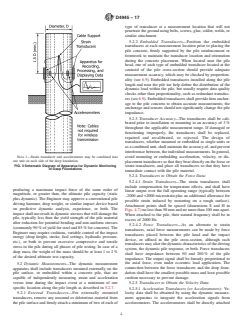
NOTE 1—Strain transducer and accelerometer may be combined into
one unit on each side of the deep foundation. placementtransducerssothattheybeardirectlyontheforceor
FIG. 3 Schematic Diagram of Apparatus for Dynamic Monitoring
strain transducers, and place all transducers so that they have
of Deep Foundations
immediate contact with the pile material.
5.2.4 Transducers to Obtain the Force Data:
5.2.4.1 Strain Transducers—The strain transducers shall
include compensation for temperature effects, and shall have
producing a maximum impact force of the same order of
linear output over the full operating range (typically between
magnitude, or greater than, the ultimate pile capacity (static
–2000 and +2000 microstrain plus an additional allowance for
plus dynamic). The Engineer may approve a conventional pile
possible strain induced by mounting on a rough surface).
driving hammer, drop weight, or similar impact device based
Attachment points shall be spaced (dimensions S and H in
on predictive dynamic analysis, experience, or both. The
Figs.4-7)nolessthan50mmandnomorethan100mmapart.
impactshallnotresultindynamicstressesthatwilldamagethe
When attached to the pile, their natural frequency shall be in
pile, typically less than the yield strength of the pile material
excess of 2000 Hz.
after reduction for potential bending and non-uniform stresses
5.2.4.2 Force Transducers—As an alternate to strain
(commonly90%ofyieldforsteeland85%forconcrete).The
transducers, axial force measurements can be made by force
Engineer may require cushions, variable control of the impact
transducers placed between the pile head and the impact
energy (drop height, stroke, fuel settings, hydraulic pressure,
device, or affixed in the pile cross-section, although such
etc.), or both to prevent excessive compressive and tensile
transducersmayalterthedynamiccharacteristicsofthedriving
stress in the pile during all phases of pile testing. In case of a
system, the dynamic pile response, or both. Force transducers
drop mass, the weight of the mass should be at least 1 to 2%
shall have impedance between 50 and 200% of the pile
of the desired ultimate test capacity.
impedance. The output signal shall be linearly proportional to
5.2 Dynamic Measurements—The dynamic measurement the axial force, even under eccentric load application. The
connection between the force transducers and the deep foun-
apparatus shall include transducers mounted externally on the
dation shall have the smallest possible mass and least possible
pile surface, or embedded within a concrete pile, that are
cushion necessary to prevent damage.
capable of independently measuring strain and acceleration
versus time during the impact event at a minimum of one
5.2.5 Transducers to Obtain the Velocity Data:
specific location along the pile length as described in 5.2.7.
5.2.5.1 Acceleration Transducers (or Accelerometers): Ve-
5.2.1 External Transducers—For externally mounted locity data shall be obtained by using the dynamic measure-
transducers, remove any unsound or deleterious material from ment apparatus to integrate the acceleration signals from
the pile surface and firmly attach a minimum of two of each of accelerometers. The accelerometers shall be directly attached
D4945 − 17
NOTE 1—Shown as separate transducers.
NOTE 1—Shown as separate transducers or alternative combined
FIG. 5 Typical Arrangement for Attaching Transducers to Con-
transducers.
crete Piles
FIG. 4 Typical Arrangement for Attaching Transducers to Pipe
Piles
typical, but not exclusionary.) Align transducers with their
sensitive direction parallel to the long axis of the pile.Arrange
to the pile surface, mounted to the pile with small rigid (solid,
strain transducers so that when averaged their measurements
nearly cubic shape) metal blocks, or embedded in the pile. Do
cancel axial bending stresses. Arrange accelerometers so that
not use overhanging brackets or plastic mounting blocks that
when averaged their measurements cancel movements due to
can deform during impact.Accelerometers shall be linear to at
bending.Unlesslocatedatthepilecentroid,placesimilartypes
least 1000 g and 1000 Hz for concrete piles. For steel piles, it
of transducer so that they are symmetrically opposed and
is advisable to use accelerometers that are linear to at least
equidistant from the pile centroid in a plane perpendicular to
2000gand2000Hz.Forpiezoelectricaccelerometersusingan
the pile axis. Verify the final position, firm connection, and
AC coupled signal path, the resonant frequency shall be above
alignment of all transducers, both external and embedded.
30 000 Hz when rigidly mounted, or above 10 000 Hz if the
Section 6.9 describes an important proportionality check re-
mountingisdamped,andthetimeconstantshallbeatleast1.0
quired for both external and embedded transducers that helps
stopreservethelowfrequencysignalcontent.Ifpiezoresistive
verify measurement accuracy.
accelerometers are used, then they should have a resonant
5.3 Signal Transmission—The signals from the transducers
frequency of at least 2500 Hz and a damped mounting.
shall be transmitted to the apparatus for recording, processing,
5.2.5.2 Velocity or Displacement Transducers—As an alter-
and displaying the data (see 5.4) by means of a cable or
native to acceleration transducers, velocity or displacement
wirelessequivalent.Anintermediateapparatusmaybeusedfor
transducers may be used to obtain velocity data, provided they
initialsignalprocessingpriortotransmissionofthesignaldata
are equivalent in performance to the specified acceleration
to the apparatus for recording, processing, and displaying the
transducers.
data if the processing functions it provides meet the require-
5.2.6 Combined Transducers—Force and velocity instru-
ments of 5.4. Cables shall be shielded to limit electronic and
mentationmayuseindividualtransducersconnectedseparately
other transmission interference. If wireless transmission is
to the pile, or transducers connected together and attached to
used, the signals arriving at the apparatus shall accurately
the pile as a combined unit.
represent the continuity and magnitude of the transducer
5.2.7 Placement of Transducers—To avoid irregular stress
measurements over the frequency range of the dynamic mea-
concentrations at the ends of the pile, locate transducers a
surement apparatus.
distance of at least 1.5 times the pile width from the top (or
bottom) of pile as illustrated in Figs. 4-7. (These figures are 5.4 Recording, Processing, and Displaying Data:
D4945 − 17
NOTE 1—Shown as combined transducers.
FIG. 6 Typical Arrangement for Attaching Transducers to Wood
Piles
NOTE 1—Shown as separate transducers.
FIG. 7 Typical Arrangement for Attaching Transducers to H-Piles
5.4.1 General—The signals from the transducers (see 5.2)
shallbetransmittedduringtheimpacteventtoanapparatusfor
recording, processing, and displaying the data. The apparatus
shallincludeavisualgraphicsdisplayoftheforceandvelocity entiation of displacement, use a minimum sample frequency
versus time, non-volatile memory for retaining data for future for each data channel of 10 000 Hz for concrete piles and 40
analysis, and a computational means to provide results consis- 000 Hz for timber or steel piles. Both analog and digital
tent with Engineer’s field testing objectives, for example, processing shall include signal conditioning that retains the
maximumstresses,maximumdisplacement,energytransferred frequency content appropriate to the sampling rate of the
to the pile, etc. The apparatus for recording, processing, and interpreted velocity signal. The minimum total time sampled
displaying data shall include compensation for temperature for each impact event shall be the greater of 100 milliseconds
effectsandprovideaself-calibrationcheckoftheapparatusfor or 3L/c (where L is the pile length and c is the pile material
recording, processing and displaying. No error shall exceed wave speed) with most of this time following the moment of
2% of the maximum signal expected. Fig. 3 shows a typical impact as shown in Fig. 1.
schematic arrangement for this apparatus. 5.4.3 Processing Data—As a minimum, the apparatus for
5.4.2 Recording Data—The raw data from the transducers processing signals from the transducers shall provide the
shall be recorded on site, electronically in digital form, with a following functions:
minimum of 12 bitADC resolution and including at most only 5.4.3.1 Force Data—The apparatus shall provide signal
the minimal processing required to obtain the force and conditioning for the force measurement system. If strain
velocity. Transducer data recor
...
This document is not an ASTM standard and is intended only to provide the user of an ASTM standard an indication of what changes have been made to the previous version. Because
it may not be technically possible to adequately depict all changes accurately, ASTM recommends that users consult prior editions as appropriate. In all cases only the current version
of the standard as published by ASTM is to be considered the official document.
Designation: D4945 − 12 D4945 − 17
Standard Test Method for
High-Strain Dynamic Testing of Deep Foundations
This standard is issued under the fixed designation D4945; the number immediately following the designation indicates the year of
original adoption or, in the case of revision, the year of last revision. A number in parentheses indicates the year of last reapproval. A
superscript epsilon (´) indicates an editorial change since the last revision or reapproval.
1. Scope Scope*
1.1 This dynamic test method covers the procedure for applying an axial impact force with a pile driving hammer or a large
drop weight that will cause a relatively high strain at the top of an individual vertical or inclined deep foundation unit, and for
measuring the subsequent force and velocity response of that deep foundation unit. While in this standard force and velocity are
referenced as “measured,” they are typically derived from measured strain and acceleration values. High-strain dynamic testing
applies to any deep foundation unit, also referred to herein as a “pile,” which functions in a manner similar to a driven pile or a
cast-in-place pile regardless of the method of installation, and which conforms with the requirements of this test method.
1.2 This standard provides minimum requirements for dynamic testing of deep foundations. Plans, specifications, or provisions
(or combinations thereof) prepared by a qualified engineer may provide additional requirements and procedures as needed to
satisfy the objectives of a particular test program. The engineer in responsible charge of the foundation design, referred to herein
as the “Engineer”, shall approve any deviations, deletions, or additions to the requirements of this standard.
1.3 The proper conduct and evaluation of high-strain dynamic tests requires special knowledge and experience. A qualified
engineer should directly supervise the acquisition of field data and the interpretation of the test results so as to predict the actual
performance and adequacy of deep foundations used in the constructed foundation. A qualified engineer shall approve the apparatus
used for applying the impact force, driving appurtenances, test rigging, hoist equipment, support frames, templates, and test
procedures.
1.4 The text of this standard references notes and footnotes which provide explanatory material. These notes and footnotes
(excluding those in tables and figures) shall not be considered as requirements of the standard. The word “shall” indicates a
mandatory provision, and the word “should” indicates a recommended or advisory provision. Imperative sentences indicate
mandatory provisions.
1.5 Units—The values stated in SI units are to be regarded as standard. No other units of measurement are included in this
standard. Reporting of test results in units other than SI shall not be regarded as nonconformance with this test method.
1.6 All observed and calculated values shall conform to the guidelines for significant digits and rounding established in Practice
D6026.
1.6.1 The procedures used to specify how data are collected/recorded and calculated in this standard are regarded as the industry
standard. In addition, they are representative of the significant digits that should generally be retained. The procedures used do not
consider material variation, purpose for obtaining the data, special purpose studies, or any considerations for the user’s objectives;
and it is common practice to increase or reduce significant digits of reported data to commensurate with these considerations. It
is beyond the scope of this standard to consider significant digits used in analysis methods for engineering design.
1.7 The method used to specify how data are collected, calculated, or recorded in this standard is not directly related to the
accuracy to which the data can be applied in design or other uses, or both. How one applies the results obtained using this standard
is beyond its scope.
1.7 This standard does not purport to address all of the safety concerns, if any, associated with its use. It is the responsibility
of the user of this standard to establish appropriate safety safety, health, and healthenvironmental practices and determine the
applicability of regulatory limitations prior to use. For a specific precautionary statement, see Note 4.
1.8 This international standard was developed in accordance with internationally recognized principles on standardization
established in the Decision on Principles for the Development of International Standards, Guides and Recommendations issued
by the World Trade Organization Technical Barriers to Trade (TBT) Committee.
This test method is under the jurisdiction of ASTM Committee D18 on Soil and Rock and is the direct responsibility of Subcommittee D18.11 on Deep Foundations.
Current edition approved May 1, 2012Nov. 1, 2017. Published June 2012December 2017. Originally approved in 1989. Last previous edition approved in 20082012 as
D4945 – 08.D4945 – 12. DOI: 10.1520/D4945-12.10.1520/D4945-17.
*A Summary of Changes section appears at the end of this standard
Copyright © ASTM International, 100 Barr Harbor Drive, PO Box C700, West Conshohocken, PA 19428-2959. United States
D4945 − 17
2. Referenced Documents
2.1 ASTM Standards:
C469 Test Method for Static Modulus of Elasticity and Poisson’s Ratio of Concrete in Compression
D198 Test Methods of Static Tests of Lumber in Structural Sizes
D653 Terminology Relating to Soil, Rock, and Contained Fluids
D1143/D1143M Test Methods for Deep Foundations Under Static Axial Compressive Load
D3689 Test Methods for Deep Foundations Under Static Axial Tensile Load
D3740 Practice for Minimum Requirements for Agencies Engaged in Testing and/or Inspection of Soil and Rock as Used in
Engineering Design and Construction
D6026 Practice for Using Significant Digits in Geotechnical Data
3. Terminology
3.1 Definitions—Definitions: For common definitions of terms used in this standard, see Terminology D653.
3.1.1 For definitions of common technical terms in this standard, refer to Terminology D653.
3.2 Definitions of Terms Specific to This Standard:
3.2.1 cast in-place pile, n—a deep foundation unit made of cement grout or concrete and constructed in its final location, for
example, drilled shafts, bored piles, caissons, auger cast piles, pressure-injected footings, etc.
3.2.2 deep foundation, n—a relatively slender structural element that transmits some or all of the load it supports to the soil or
rock well below the ground surface, that is, a driven pile, a cast-in-place pile, or an alternate structural element having a similar
function.
3.2.3 deep foundation cushion, n—the material inserted between the helmet on top of the deep foundation and the deep
foundation (usually plywood).
3.2.4 deep foundation impedance, n—a measure of the deep foundation’s resistance to motion when subjected to an impact
event. Deep foundation impedance can be calculated by multiplying the cross-sectional area by the dynamic modulus of elasticity
and dividing the product by the wave speed. Alternatively, the impedance can be calculated by multiplying the mass density by
the wave speed and cross-sectional area.
Z 5 EA/c 5 ρcA (1)
~ !
where:
Z = impedance,
E = dynamic modulus of elasticity,
A = cross-sectional area,
c = wave speed, and
ρ = mass density.
3.2.4.1 Discussion—
Deep foundation impedance can be estimated by multiplying the cross-sectional area by the dynamic modulus of elasticity and
dividing the product by the wave speed. Alternatively, the impedance can be estimated by multiplying the mass density by the wave
speed and cross-sectional area.
Z 5 ~EA/c! 5 ρcA (1)
where:
Z = impedance,
E = dynamic modulus of elasticity,
A = pile cross-sectional area,
c = wave speed, and
ρ = mass density.
3.2.5 driven pile, n—a deep foundation unit made of preformed material with a predetermined shape and size and typically
installed by impact hammering, vibrating, or pushing.
3.2.6 follower, n—a structural section placed between the impact device and the deep foundation during installation or testing.
3.2.7 hammer cushion, n—the material inserted between the hammer striker plate and the helmet on top of the deep foundation.
For referenced ASTM standards, visit the ASTM website, www.astm.org, or contact ASTM Customer Service at service@astm.org. For Annual Book of ASTM Standards
volume information, refer to the standard’s Document Summary page on the ASTM website.
D4945 − 17
3.2.8 impact event, n—the period of time during which the deep foundation is moving due to the impact force application. See
Fig. 1.
3.2.9 impact force, n—in the case of strain transducers,the transient the impact force is obtained by multiplying the measured
strain (ε) with the cross-sectional area (force applied to the top A) and the dynamic modulus of elasticity (of the deepE foundation).
element.
3.2.10 mandrel, n—a stiff structural member placed inside a thin shell to allow impact installation of the thin section shell.
3.2.11 moment of impact, n—the first time after the start of the impact event when the acceleration is zero. See Fig. 1.
3.2.12 particle velocity, n—the instantaneous velocity of a particle in the deep foundation as a strain wave passes by.
3.2.13 restrike, n or v—the redriving of a previously driven pile, typically after a waiting period of 15 min to 30 days or more,
to assess changes in ultimate axial compressive static capacity during the time elapsed after the initial installation.
3.2.14 wave speed, n—the speed with which a strain wave propagates through a deep foundation. It is a property of the deep
foundation composition and for one-dimensional wave propagation is equal to the square root of the quotient of the Modulus of
1/2
Elasticity divided by mass density: c = (E/ρ) .
3.2.14.1 Discussion—
The wave speed is a property of the deep foundation composition and for one-dimensional wave propagation is equal to the square
1/2
root of the quotient of the Modulus of Elasticity divided by mass density: c = (E/ρ) . For wood and concrete piles, the wave speed
is the average wave speed over the pile length.
4. Significance and Use
4.1 Based on the measurements from strain or force, and acceleration, velocity, or displacement transducers, this This test
method obtains the force and velocity induced in a pile during an axial impact event (see Figs. 1 and 2). Force and velocity are
typically derived from measured strain and acceleration. The Engineer may analyze the acquired data using engineering principles
and judgment to evaluate the integrity of the pile, the performance of the impact system, and the maximum compressive and tensile
stresses occurring in the pile.
4.2 If sufficient axial movement occurs during the impact event, and after assessing the resulting dynamic soil response along
the side and bottom of the pile, the Engineer may analyze the results of a high-strain dynamic test to estimate the ultimate axial
static compression capacity (see Note 1). Factors that may affect the axial static capacity estimated from dynamic tests include,
but are not limited to the: (1) pile installation equipment and procedures, (2) elapsed time since initial installation, (3) pile material
properties and dimensions, (4) type, density, strength, stratification, and saturation of the soil, or rock, or both adjacent to and
beneath the pile, (5) quality or type of dynamic test data, (6) foundation settlement, (7) analysis method, and (8) engineering
judgment and experience. If the Engineer does not have adequate previous experience with these factors, and with the analysis of
FIG. 1 Typical Force and Velocity Traces Generated by the Apparatus for Obtaining Dynamic Measurements
D4945 − 17
FIG. 2 Typical Arrangement for High-Strain Dynamic Testing of a Deep Foundation
dynamic test data, then a static load test carried out according to Test Method D1143/D1143M should be used to verify estimates
of static capacity and its distribution along the pile length. Test Method D1143/D1143M provides a direct and more reliable
measurement of static capacity.
(1) pile installation equipment and procedures,
(2) elapsed time since initial installation,
(3) pile material properties and dimensions,
(4) type, density, strength, stratification, and saturation of the soil, or rock, or both adjacent to and beneath the pile,
(5) quality or type of dynamic test data,
(6) foundation settlement,
(7) analysis method, and
(8) engineering judgment and experience.
If the Engineer does not have adequate previous experience with these factors, and with the analysis of dynamic test data, then
a static load test carried out according to Test Method D1143/D1143M should be used to verify estimates of static capacity and
its distribution along the pile length. Test Method D1143/D1143M provides a direct and more reliable measurement of static
capacity.
NOTE 1—The analysis of a dynamic test will under predict the ultimate axial static compression capacity if the pile movement during the impact event
is too small. The Engineer should determine how the size and shape of the pile, and the properties of the soil or rock beneath and adjacent to the pile,
affect the amount of movement required to fully mobilize the static capacity. A permanent net penetration of as little as 2 mm per impact may indicate
that sufficient movement has occurred during the impact event to fully mobilize the capacity. However, high displacement driven piles may require greater
movement to avoid under predicting the static capacity, and cast-in-place piles often require a larger cumulative permanent net penetration for a series
of test blows to fully mobilize the capacity. Static capacity may also decrease or increase over time after the pile installation, and both static and dynamic
tests represent the capacity at the time of the respective test. Correlations between measured ultimate axial static compression capacity and dynamic test
estimates generally improve when using dynamic restrike tests that account for soil strength changes with time (see 6.8).
NOTE 2—Although interpretation of the dynamic test analysis may provide an estimate of the pile’s tension (uplift) capacity, users of this standard are
cautioned to interpret conservatively the side resistance estimated from analysis of a single dynamic measurement location, and to avoid tension capacity
estimates altogether for piles with less than 10 m embedded length. (Additional transducers embedded near the pile toe may also help improve tension
capacity estimates.) If the Engineer does not have adequate previous experience for the specific site and pile type with the analysis of dynamic test data
for tension capacity, then a static load test carried out according to Test Method D3689 should be used to verify tension capacity estimates. Test Method
D3689 provides a direct and more reliable measurement of static tension capacity.
NOTE 3—The quality of the result produced by this test method is dependent on the competence of the personnel performing it, and the suitability of
the equipment and facilities used. Agencies that meet the criteria of Practice D3740 are generally considered capable of competent and objective
testing/sampling/inspection/etc. Users of this test method are cautioned that compliance with Practice D3740 does not in itself assure reliable results.
D4945 − 17
Reliable results depend on many factors; Practice D3740 provides a means of evaluating some of those factors.
5. Apparatus
5.1 Impact Device—A high-strain dynamic test measures the pile response to an impact force applied at the pile head and in
concentric alignment with its long axis (see Figs. 2 and 3). The device used to apply the impact force should provide sufficient
energy to cause pile penetration during the impact event adequate to mobilize the desired capacity, generally producing a maximum
impact force of the same order of magnitude, or greater than, the ultimate pile capacity (static plus dynamic). The Engineer may
approve a conventional pile driving hammer, drop weight, or similar impact device based on predictive dynamic analysis,
experience, or both. The impact shall not result in dynamic stresses that will damage the pile, typically less than the yield strength
of the pile material after reduction for potential bending and non-uniform stresses (commonly 90 % of yield for steel and 85 %
for concrete). The Engineer may require cushions, variable control of the impact energy (drop height, stroke, fuel settings,
hydraulic pressure, etc.), or both to prevent excessive compressive and tensile stress in the pile during all phases of pile testing.
In case of a drop mass, the weight of the mass should be at least 1 to 2 % of the desired ultimate test capacity.
5.2 Dynamic Measurements—The dynamic measurement apparatus shall include transducers mounted externally on the pile
surface, or embedded within a concrete pile, that are capable of independently measuring strain and acceleration versus time during
the impact event at a minimum of one specific location along the pile length as described in 5.2.7.
5.2.1 External Transducers—For externally mounted transducers, remove any unsound or deleterious material from the pile
surface and firmly attach a minimum of two of each of type of transducer at a measurement location that will not penetrate the
ground using bolts, screws, glue, solder, welds, or similar attachment.
5.2.2 Embedded Transducers—Position the embedded transducers at each measurement location prior to placing the pile
concrete, firmly supported by the pile reinforcement or formwork to maintain the transducer location and orientation during the
concrete placement. When located near the pile head, one of each type of embedded transducer located at the centroid of the pile
cross-section should provide adequate measurement accuracy, which may be checked by proportionality (see 6.9). Embedded
transducers installed along the pile length and near the pile toe help define the distribution of the dynamic load within the pile,
but usually require data quality checks other than proportionality, such as redundant transducers (see 6.9). Embedded transducers
shall provide firm anchorage to the pile concrete to obtain accurate measurements; the anchorage and sensors should not
significantly change the pile impedance.
NOTE 1—Strain transducer and accelerometer may be combined into one unit on each side of the deep foundation.
FIG. 3 Schematic Diagram of Apparatus for Dynamic Monitoring of Deep Foundations
D4945 − 17
5.2.3 Transducer Accuracy—The transducers shall be calibrated prior to installation or mounting to an accuracy of 3 %
throughout the applicable measurement range. If damaged or functioning improperly, the transducers shall be replaced, repaired
and recalibrated, or rejected. The design of transducers, whether mounted or embedded as single units or as a combined unit, shall
maintain the accuracy of, and prevent interference between, the individual measurements. In general, avoid mounting or
embedding acceleration, velocity, or displacement transducers so that they bear directly on the force or strain transducers, and place
all transducers so that they have immediate contact with the pile material.
5.2.4 Strain Transducers—Transducers to Obtain the Force Data: The strain transducers shall include compensation for
temperature effects, and shall have linear output over the full operating range (typically between –2000 and +2000 microstrain plus
an additional allowance for possible strain induced by mounting on a rough surface). Attachment points shall be spaced
(dimensions S and H in Figs. 4-7) no less than 50 mm and no more than 100 mm apart. When attached to the pile, their natural
frequency shall be in excess of 2000 Hz.
5.2.4.1 Strain Transducers—The strain transducers shall include compensation for temperature effects, and shall have linear
output over the full operating range (typically between –2000 and +2000 microstrain plus an additional allowance for possible
strain induced by mounting on a rough surface). Attachment points shall be spaced (dimensions S and H in Figs. 4-7) no less than
50 mm and no more than 100 mm apart. When attached to the pile, their natural frequency shall be in excess of 2000 Hz.
5.2.4.2 Force Transducers—As an alternate to strain transducers, axial force measurements can be made by force transducers
placed between the pile head and the impact device, or affixed in the pile cross-section, although such transducers may alter the
dynamic characteristics of the driving system, the dynamic pile response, or both. Force transducers shall have impedance between
50 and 200 % of the pile impedance. The output signal shall be linearly proportional to the axial force, even under eccentric load
application. The connection between the force transducers and the deep foundation shall have the smallest possible mass and least
possible cushion necessary to prevent damage.
5.2.5 Acceleration, Velocity, or Displacement Transducers—Transducers to Obtain the Velocity Data: Velocity data shall be
obtained by using the dynamic measurement apparatus to integrate the acceleration signals from accelerometers. The
accelerometers shall be directly attached to the pile surface, mounted to the pile with small rigid (solid, nearly cubic shape) metal
blocks, or embedded in the pile. Do not use overhanging brackets or plastic mounting blocks that can deform during impact.
Accelerometers shall be linear to at least 1000 g and 1000 Hz for concrete piles. For steel piles, it is advisable to use accelerometers
that are linear to at least 2000 g and 2000 Hz. For piezoelectric accelerometers using an AC coupled signal path, the resonant
NOTE 1—Shown as separate transducers or alternative combined transducers.
FIG. 4 Typical Arrangement for Attaching Transducers to
Pipe Piles
D4945 − 17
NOTE 1—Shown as separate transducers.
FIG. 5 Typical Arrangement for Attaching Transducers to Concrete Piles
frequency shall be above 30 000 Hz when rigidly mounted, or above 10 000 Hz if the mounting is damped, and the time constant
shall be at least 1.0 s to preserve the low frequency signal content. If piezoresistive accelerometers are used, then they should have
a resonant frequency of at least 2500 Hz and a damped mounting. Alternatively, velocity or displacement transducers may be used
to obtain velocity data, provided they are equivalent in performance to the specified accelerometers.
5.2.5.1 Acceleration Transducers (or Accelerometers): Velocity data shall be obtained by using the dynamic measurement
apparatus to integrate the acceleration signals from accelerometers. The accelerometers shall be directly attached to the pile
surface, mounted to the pile with small rigid (solid, nearly cubic shape) metal blocks, or embedded in the pile. Do not use
overhanging brackets or plastic mounting blocks that can deform during impact. Accelerometers shall be linear to at least 1000
g and 1000 Hz for concrete piles. For steel piles, it is advisable to use accelerometers that are linear to at least 2000 g and 2000
Hz. For piezoelectric accelerometers using an AC coupled signal path, the resonant frequency shall be above 30 000 Hz when
rigidly mounted, or above 10 000 Hz if the mounting is damped, and the time constant shall be at least 1.0 s to preserve the low
frequency signal content. If piezoresistive accelerometers are used, then they should have a resonant frequency of at least 2500
Hz and a damped mounting.
5.2.5.2 Velocity or Displacement Transducers—As an alternative to acceleration transducers, velocity or displacement
transducers may be used to obtain velocity data, provided they are equivalent in performance to the specified acceleration
transducers.
5.2.6 Combined Transducers—Force and velocity instrumentation may use individual transducers connected separately to the
pile, or transducers connected together and attached to the pile as a combined unit.
5.2.7 Placement of Transducers—To avoid irregular stress concentrations at the ends of the pile, locate transducers a distance
of at least 1.5 times the pile width from the top (or bottom) of pile as illustrated in Figs. 4-7. (These figures are typical, but not
exclusionary.) Align transducers with their sensitive direction parallel to the long axis of the pile. Arrange strain transducers so that
when averaged their measurements cancel axial bending stresses. Arrange accelerometers so that when averaged their
measurements cancel movements due to bending. Unless located at the pile centroid, place similar types of transducer so that they
are symmetrically opposed and equidistant from the pile centroid in a plane perpendicular to the pile axis. Verify the final position,
firm connection, and alignment of all transducers, both external and embedded. Section 6.9 describes an important proportionality
check required for both external and embedded transducers that helps verify measurement accuracy.
5.3 Signal Transmission—The signals from the transducers shall be transmitted to the apparatus for recording, processing, and
displaying the data (see 5.4) by means of a cable or wireless equivalent. An intermediate apparatus may be used for initial signal
D4945 − 17
NOTE 1—Shown as combined transducers.
FIG. 6 Typical Arrangement for Attaching Transducers to
Wood Piles
processing prior to transmission of the signal data to the apparatus for recording, processing, and displaying the data if the
processing functions it provides meet the requirements of 5.4. Cables shall be shielded to limit electronic and other transmission
interference. If wireless transmission is used, the signals arriving at the apparatus shall accurately represent the continuity and
magnitude of the transducer measurements over the frequency range of the dynamic measurement apparatus.
5.4 Recording, Processing, and Displaying Data:
5.4.1 General—The signals from the transducers (see 5.2) shall be transmitted during the impact event to an apparatus for
recording, processing, and displaying the data. The apparatus shall include a visual graphics display of the force and velocity versus
time, non-volatile memory for retaining data for future analysis, and a computational means to provide results consistent with
Engineer’s field testing objectives, for example, maximum stresses, maximum displacement, energy transferred to the pile, etc. The
apparatus for recording, processing, and displaying data shall include compensation for temperature effects and provide a
self-calibration check of the apparatus for recording, processing and displaying. No error shall exceed 2 % of the maximum signal
expected. Fig. 3 shows a typical schematic arrangement for this apparatus.
5.4.2 Recording Data—The raw data from the transducers shall be recorded on site, electronically in digital form, with a
minimum of 12 bit ADC resolution and including at most only the minimal processing required to obtain the force and velocity.
Transducer data recorded after minimal processing shall also record the information required to recover the raw data signals for
later reprocessing as needed, for example, calibrations, wave speed, mass density, pile area, etc. When determining velocity by
analog integration of acceleration, or analog differentiation of displacement, use a minimum sample frequency for each data
channel of 5000 Hz for concrete piles and 10 000 Hz for timber or steel piles. When determining velocity by digital integration
of acceleration, or digital differentiation of displacement, use a minimum sample frequency for each data channel of 10 000 Hz
for concrete piles and 40 000 Hz for timber or steel piles. Both analog and digital processing shall include signal conditioning that
retains the frequency content appropriate to the sampling rate of the interpreted velocity signal. The minimum total time sampled
for each impact event shal
...