

ASTM D5979-96(2019)e1
(Guide)Standard Guide for Conceptualization and Characterization of Groundwater Systems
General Information
- Abstract
SIGNIFICANCE AND USE
5.1 Conceptualization and characterization of a groundwater system is fundamental to any qualitative or quantitative analysis. This conceptualization begins with simple abstractions in the investigator's mind, emphasizing the major components of the studied system, that can be rendered in qualitative terms or simple illustrations. The extent of further development of the representation of the system depends on the character of the groundwater problem and the project objective. The abstract concept may suffice, or it may be further defined and quantified through use of analytical models of increasing complexity, and, in some cases, numerical models may be employed. If numerical models are used, the level of detail and sophistication of features represented in the model is likely to increase as the project develops. Evolution of conceptualization of a groundwater flow system should be terminated when the results of the related analyses are sufficient for the problem being addressed.
5.2 This guide may be used in the following:
5.2.1 Evaluating natural variations in groundwater flow systems.
5.2.2 Evaluating anthropogenic stresses on groundwater flow systems, such as pumping for water supply, irrigation, induced infiltration, or well injection.
5.2.3 Evaluating presence and velocity of groundwater contaminants.
5.2.4 Designing and selecting mathematical models to simulate groundwater systems; and completing model schematization and attribution based on the problem defined, characterized groundwater flow system, and model(s) selected.
5.2.5 Designing groundwater remediation systems.
5.3 This guide is a flexible description of specific techniques and investigation requirements; methods defined by other ASTM Standards or non-ASTM techniques may be appropriate in some circumstances and, after due consideration, some of the techniques herein may be omitted, altered, or enhanced.
5.3.1 A comprehensive list of items to be considered conceptualization a...
SCOPE
1.1 This guide covers an integrated, stepwise method for the qualitative conceptualization and quantitative characterization of groundwater flow systems, including the unsaturated zone, for natural or human-induced behavior or changes.
1.2 This guide may be used at any scale of investigation, including site-specific, subregional, and regional applications.
1.3 This guide describes an iterative process for developing multiple working hypotheses for characterizing groundwater flow systems. This process aims at reducing uncertainty with respect to conceptual models, observation, interpretation, and analysis in terms of hypothesis and refinement of the most likely conceptual model of the groundwater flow system. The process is also aimed at reducing the range of realistic values for parameters identified during the characterization process. This guide does not address the quantitative uncertainty associated with specific methods of hydrogeologic and groundwater system characterization and quantification, for example, the effects of well construction on water-level measurement.
1.4 This guide addresses the general procedure, types of data needed, and references that enable the investigator to complete the process of analysis and interpretation of each data type with respect to geohydrologic processes and hydrogeologic framework. This guide recommends the groups of data and analysis to be used during each step of the conceptualization process.
1.5 This guide does not address the specific methods for characterizing hydrogeologic and groundwater system properties.
1.6 This guide does not address model selection, design, or attribution for use in the process of groundwater flow system characterization and quantification. This guide does not address the process of model schematization, including the simplification of hydrologic systems and the representation of hydrogeologic parameters in models.
1.7 This guide d...
- Status
- Published
- Publication Date
- 31-Jul-2019
- Technical Committee
- D18 - Soil and Rock
- Drafting Committee
- D18.21 - Groundwater and Vadose Zone Investigations
Overview
ASTM D5979-96(2019)e1 is a standard guide developed by ASTM International for the conceptualization and characterization of groundwater systems. This guide provides an integrated, stepwise approach for qualitative and quantitative analysis of groundwater flow systems, inclusive of both the saturated and unsaturated zones. The process aids investigators in reducing uncertainty by developing multiple working hypotheses, iteratively refining conceptual models, and identifying relevant parameters for groundwater system evaluation.
This document is widely applicable to environmental professionals, hydrogeologists, water resource managers, and consultants engaged in groundwater studies at site-specific, subregional, or regional scales. While it does not specify methods for field characterization or model building, it outlines a flexible framework for data collection, system conceptualization, and characterization, aligning with internationally recognized standardization principles.
Key Topics
- Iterative Conceptualization: The standard emphasizes beginning with abstract, simple models and advancing in complexity as more data and understanding are gained.
- Data Integration: Comprehensive recommendations for collecting and organizing data from a variety of sources, such as geologic, hydrologic, geophysical, climate, and anthropogenic information.
- Qualitative and Quantitative Analysis: Facilitates both qualitative assessments and quantitative characterizations by incorporating data on system structure, recharge/discharge, flow paths, and chemical constituents.
- Flexible Process: Recognizes that methods from other ASTM or non-ASTM standards may be appropriate, supporting adaptation to specific project requirements and site conditions.
- Multiple Scales: Suitable for use at varying investigation scales, from single sites to regional groundwater systems.
Applications
ASTM D5979 serves multiple practical applications in groundwater resource management and environmental protection:
- Evaluating Groundwater Variability: Assessment of natural and human-induced changes in groundwater systems, including the response to extraction, injection, and land use changes.
- Contaminant Transport: Understanding the potential presence, migration, and velocities of contaminants within groundwater systems.
- Model Development: Guiding the selection and schematization of numerical and analytical models for simulating groundwater systems.
- Remediation Design: Supporting the conceptual and quantitative basis needed for designing effective groundwater remediation strategies.
- Project Planning: Assisting in the systematic planning and execution of groundwater investigations by recommending key data types and database development.
- Regulatory and Reporting Support: Creating standardized frameworks for reporting and interpretation that can be used in compliance and stakeholder engagement.
Related Standards
Several ASTM groundwater standards complement or extend the application of ASTM D5979:
- ASTM D653 – Terminology Relating to Soil, Rock, and Contained Fluids
- ASTM D5447 – Guide for Application of a Numerical Groundwater Flow Model to a Site-Specific Problem
- ASTM D5609 – Guide for Defining Boundary Conditions in Groundwater Flow Modeling
- ASTM D5610 – Guide for Defining Initial Conditions in Groundwater Flow Modeling
- ASTM D5717 – Guide for Design of Ground-Water Monitoring Systems in Karst and Fractured-Rock Aquifers
- ASTM D5730 – Guide for Site Characterization for Environmental Purposes
By referencing these and similar standards, groundwater professionals can ensure comprehensive and standardized approaches to conceptualization and characterization efforts.
Keywords: ASTM D5979, groundwater systems, conceptual model, groundwater characterization, hydrogeologic framework, groundwater flow, environmental site assessment, groundwater modeling, groundwater remediation, data integration, hydrogeology standards.
Relations
- Effective Date
- 01-Aug-2019
- Effective Date
- 15-Dec-2017
- Effective Date
- 01-Mar-2016
- Effective Date
- 01-Aug-2014
- Effective Date
- 01-Sep-2011
- Effective Date
- 01-Aug-2010
- Effective Date
- 01-Aug-2010
- Effective Date
- 01-Aug-2010
- Effective Date
- 01-Aug-2010
- Effective Date
- 01-Jan-2009
- Effective Date
- 01-Dec-2008
- Effective Date
- 01-Nov-2008
- Refers
ASTM D5609-94(2008) - Standard Guide for Defining Boundary Conditions in Groundwater Flow Modeling - Effective Date
- 15-Sep-2008
- Refers
ASTM D5609-94(2015)e1 - Standard Guide for Defining Boundary Conditions in Groundwater Flow Modeling - Effective Date
- 15-Sep-2008
- Refers
ASTM D5610-94(2008) - Standard Guide for Defining Initial Conditions in Groundwater Flow Modeling - Effective Date
- 15-Sep-2008
Get Certified
Connect with accredited certification bodies for this standard

CIS Institut d.o.o.
Personal Protective Equipment (PPE) certification body. Notified Body NB-2890 for EU Regulation 2016/425 PPE.

Kiwa BDA Testing
Building and construction product certification.
Kmetijski inštitut Slovenije
Agricultural Institute of Slovenia. Soil testing, plant health, agricultural product analysis.
Sponsored listings
Frequently Asked Questions
ASTM D5979-96(2019)e1 is a guide published by ASTM International. Its full title is "Standard Guide for Conceptualization and Characterization of Groundwater Systems". This standard covers: SIGNIFICANCE AND USE 5.1 Conceptualization and characterization of a groundwater system is fundamental to any qualitative or quantitative analysis. This conceptualization begins with simple abstractions in the investigator's mind, emphasizing the major components of the studied system, that can be rendered in qualitative terms or simple illustrations. The extent of further development of the representation of the system depends on the character of the groundwater problem and the project objective. The abstract concept may suffice, or it may be further defined and quantified through use of analytical models of increasing complexity, and, in some cases, numerical models may be employed. If numerical models are used, the level of detail and sophistication of features represented in the model is likely to increase as the project develops. Evolution of conceptualization of a groundwater flow system should be terminated when the results of the related analyses are sufficient for the problem being addressed. 5.2 This guide may be used in the following: 5.2.1 Evaluating natural variations in groundwater flow systems. 5.2.2 Evaluating anthropogenic stresses on groundwater flow systems, such as pumping for water supply, irrigation, induced infiltration, or well injection. 5.2.3 Evaluating presence and velocity of groundwater contaminants. 5.2.4 Designing and selecting mathematical models to simulate groundwater systems; and completing model schematization and attribution based on the problem defined, characterized groundwater flow system, and model(s) selected. 5.2.5 Designing groundwater remediation systems. 5.3 This guide is a flexible description of specific techniques and investigation requirements; methods defined by other ASTM Standards or non-ASTM techniques may be appropriate in some circumstances and, after due consideration, some of the techniques herein may be omitted, altered, or enhanced. 5.3.1 A comprehensive list of items to be considered conceptualization a... SCOPE 1.1 This guide covers an integrated, stepwise method for the qualitative conceptualization and quantitative characterization of groundwater flow systems, including the unsaturated zone, for natural or human-induced behavior or changes. 1.2 This guide may be used at any scale of investigation, including site-specific, subregional, and regional applications. 1.3 This guide describes an iterative process for developing multiple working hypotheses for characterizing groundwater flow systems. This process aims at reducing uncertainty with respect to conceptual models, observation, interpretation, and analysis in terms of hypothesis and refinement of the most likely conceptual model of the groundwater flow system. The process is also aimed at reducing the range of realistic values for parameters identified during the characterization process. This guide does not address the quantitative uncertainty associated with specific methods of hydrogeologic and groundwater system characterization and quantification, for example, the effects of well construction on water-level measurement. 1.4 This guide addresses the general procedure, types of data needed, and references that enable the investigator to complete the process of analysis and interpretation of each data type with respect to geohydrologic processes and hydrogeologic framework. This guide recommends the groups of data and analysis to be used during each step of the conceptualization process. 1.5 This guide does not address the specific methods for characterizing hydrogeologic and groundwater system properties. 1.6 This guide does not address model selection, design, or attribution for use in the process of groundwater flow system characterization and quantification. This guide does not address the process of model schematization, including the simplification of hydrologic systems and the representation of hydrogeologic parameters in models. 1.7 This guide d...
SIGNIFICANCE AND USE 5.1 Conceptualization and characterization of a groundwater system is fundamental to any qualitative or quantitative analysis. This conceptualization begins with simple abstractions in the investigator's mind, emphasizing the major components of the studied system, that can be rendered in qualitative terms or simple illustrations. The extent of further development of the representation of the system depends on the character of the groundwater problem and the project objective. The abstract concept may suffice, or it may be further defined and quantified through use of analytical models of increasing complexity, and, in some cases, numerical models may be employed. If numerical models are used, the level of detail and sophistication of features represented in the model is likely to increase as the project develops. Evolution of conceptualization of a groundwater flow system should be terminated when the results of the related analyses are sufficient for the problem being addressed. 5.2 This guide may be used in the following: 5.2.1 Evaluating natural variations in groundwater flow systems. 5.2.2 Evaluating anthropogenic stresses on groundwater flow systems, such as pumping for water supply, irrigation, induced infiltration, or well injection. 5.2.3 Evaluating presence and velocity of groundwater contaminants. 5.2.4 Designing and selecting mathematical models to simulate groundwater systems; and completing model schematization and attribution based on the problem defined, characterized groundwater flow system, and model(s) selected. 5.2.5 Designing groundwater remediation systems. 5.3 This guide is a flexible description of specific techniques and investigation requirements; methods defined by other ASTM Standards or non-ASTM techniques may be appropriate in some circumstances and, after due consideration, some of the techniques herein may be omitted, altered, or enhanced. 5.3.1 A comprehensive list of items to be considered conceptualization a... SCOPE 1.1 This guide covers an integrated, stepwise method for the qualitative conceptualization and quantitative characterization of groundwater flow systems, including the unsaturated zone, for natural or human-induced behavior or changes. 1.2 This guide may be used at any scale of investigation, including site-specific, subregional, and regional applications. 1.3 This guide describes an iterative process for developing multiple working hypotheses for characterizing groundwater flow systems. This process aims at reducing uncertainty with respect to conceptual models, observation, interpretation, and analysis in terms of hypothesis and refinement of the most likely conceptual model of the groundwater flow system. The process is also aimed at reducing the range of realistic values for parameters identified during the characterization process. This guide does not address the quantitative uncertainty associated with specific methods of hydrogeologic and groundwater system characterization and quantification, for example, the effects of well construction on water-level measurement. 1.4 This guide addresses the general procedure, types of data needed, and references that enable the investigator to complete the process of analysis and interpretation of each data type with respect to geohydrologic processes and hydrogeologic framework. This guide recommends the groups of data and analysis to be used during each step of the conceptualization process. 1.5 This guide does not address the specific methods for characterizing hydrogeologic and groundwater system properties. 1.6 This guide does not address model selection, design, or attribution for use in the process of groundwater flow system characterization and quantification. This guide does not address the process of model schematization, including the simplification of hydrologic systems and the representation of hydrogeologic parameters in models. 1.7 This guide d...
ASTM D5979-96(2019)e1 is classified under the following ICS (International Classification for Standards) categories: 13.060.10 - Water of natural resources. The ICS classification helps identify the subject area and facilitates finding related standards.
ASTM D5979-96(2019)e1 has the following relationships with other standards: It is inter standard links to ASTM D5979-96(2014), ASTM D5447-17, ASTM D5609-16, ASTM D653-14, ASTM D653-11, ASTM D5408-93(2010)e1, ASTM D5409/D5409M-93(2010)e1, ASTM D5447-04(2010), ASTM D5254/D5254M-92(2010)e1, ASTM D653-09, ASTM D653-08a, ASTM D653-08, ASTM D5609-94(2008), ASTM D5609-94(2015)e1, ASTM D5610-94(2008). Understanding these relationships helps ensure you are using the most current and applicable version of the standard.
ASTM D5979-96(2019)e1 is available in PDF format for immediate download after purchase. The document can be added to your cart and obtained through the secure checkout process. Digital delivery ensures instant access to the complete standard document.
Standards Content (Sample)
This international standard was developed in accordance with internationally recognized principles on standardization established in the Decision on Principles for the
Development of International Standards, Guides and Recommendations issued by the World Trade Organization Technical Barriers to Trade (TBT) Committee.
´1
Designation: D5979 − 96 (Reapproved 2019)
Standard Guide for
Conceptualization and Characterization of Groundwater
Systems
This standard is issued under the fixed designation D5979; the number immediately following the designation indicates the year of
original adoption or, in the case of revision, the year of last revision. A number in parentheses indicates the year of last reapproval. A
superscript epsilon (´) indicates an editorial change since the last revision or reapproval.
ε NOTE—Reapproved with editorial changes in May 2019.
1. Scope 1.6 This guide does not address model selection, design, or
attribution for use in the process of groundwater flow system
1.1 Thisguidecoversanintegrated,stepwisemethodforthe
characterization and quantification. This guide does not ad-
qualitative conceptualization and quantitative characterization
dress the process of model schematization, including the
of groundwater flow systems, including the unsaturated zone,
simplification of hydrologic systems and the representation of
for natural or human-induced behavior or changes.
hydrogeologic parameters in models.
1.2 This guide may be used at any scale of investigation,
1.7 This guide does not address special considerations
including site-specific, subregional, and regional applications.
requiredforcharacterizationofkarstandfracturedrockterrain.
Insuchhydrogeologicsettings,refertoQuinlan (1) andGuide
1.3 This guide describes an iterative process for developing
D5717 for additional guidance.
multiple working hypotheses for characterizing groundwater
flow systems. This process aims at reducing uncertainty with
1.8 This guide does not address special considerations
respect to conceptual models, observation, interpretation, and
regarding the source, fate, and movement of chemicals in the
analysis in terms of hypothesis and refinement of the most
subsurface.
likely conceptual model of the groundwater flow system. The
1.9 This standard does not purport to address all of the
process is also aimed at reducing the range of realistic values
safety concerns, if any, associated with its use. It is the
for parameters identified during the characterization process.
responsibility of the user of this standard to establish appro-
This guide does not address the quantitative uncertainty
priate safety, health, and environmental practices and deter-
associatedwithspecificmethodsofhydrogeologicandground-
mine the applicability of regulatory limitations prior to use.
water system characterization and quantification, for example,
1.10 This guide offers an organized collection of informa-
the effects of well construction on water-level measurement.
tion or a series of options and does not recommend a specific
1.4 This guide addresses the general procedure, types of
course of action. This document cannot replace education or
data needed, and references that enable the investigator to
experienceandshouldbeusedinconjunctionwithprofessional
completetheprocessofanalysisandinterpretationofeachdata
judgment. Not all aspects of this guide may be applicable in all
type with respect to geohydrologic processes and hydrogeo-
circumstances. This ASTM standard is not intended to repre-
logic framework. This guide recommends the groups of data
sent or replace the standard of care by which the adequacy of
and analysis to be used during each step of the conceptualiza-
a given professional service must be judged, nor should this
tion process.
document be applied without consideration of a project’s many
unique aspects. The word “Standard” in the title of this
1.5 This guide does not address the specific methods for
document means only that the document has been approved
characterizing hydrogeologic and groundwater system proper-
through the ASTM consensus process.
ties.
1.11 This international standard was developed in accor-
dance with internationally recognized principles on standard-
ization established in the Decision on Principles for the
ThisguideisunderthejurisdictionofASTMCommitteeD18onSoilandRock
and is the direct responsibility of Subcommittee D18.21 on Groundwater and
Vadose Zone Investigations.
Current edition approved Aug. 1, 2019. Published August 2019. Originally
approved in 1996. Last previous edition approved in 2008 as D5979–96(2014). The boldface numbers in parentheses refer to a list of references at the end of
DOI: 10.1520/D5979-96R19E01. this standard.
Copyright © ASTM International, 100 Barr Harbor Drive, PO Box C700, West Conshohocken, PA 19428-2959. United States
´1
D5979 − 96 (2019)
Development of International Standards, Guides and Recom- tualization and characterization process includes: Problem
mendations issued by the World Trade Organization Technical Definition and Database Development (Section 6); Preliminary
Barriers to Trade (TBT) Committee. Conceptualization (Section 7); Surface Characterization (Sec-
tion 8); Subsurface Characterization (Section 9); Hydrogeo-
2. Referenced Documents
logic Characterization (Section 10); Groundwater System
Characterization (Section 11); and Groundwater System Quan-
2.1 ASTM Standards:
tification (Section 12) (see Fig. 1). Conceptualization and
D653 Terminology Relating to Soil, Rock, and Contained
characterization is an iterative process beginning with a theo-
Fluids
retical understanding of the groundwater system followed by
D5254/D5254M Practice for Minimum Set of Data Ele-
datacollectionandrefinementoftheunderstanding.Additional
ments to Identify a Groundwater Site (Withdrawn 2019)
data collection and analysis, and the refinement of the ground-
D5408 Guide for Set of Data Elements to Describe a
water system conceptual model occurs during the entire
Groundwater Site; Part One—Additional Identification
process of conceptualization and characterization, and during
Descriptors (Withdrawn 2019)
groundwater model development and use (see Fig. 1).
D5409/D5409M Guide for Set of Data Elements to Describe
a Groundwater Site;Part Two—Physical Descriptors
4.2 This guide presents an approach that can be used at any
(Withdrawn 2019)
scale.Thenatureoftheproblemtobesolvedwilldeterminethe
D5410 Guide for Set of Data Elements to Describe a
type and scale of data collected.
Groundwater Site;Part Three—Usage Descriptors (With-
drawn 2016)
5. Significance and Use
D5447 Guide for Application of a Numerical Groundwater
5.1 Conceptualization and characterization of a groundwa-
Flow Model to a Site-Specific Problem
ter system is fundamental to any qualitative or quantitative
D5474 Guide for Selection of Data Elements for Groundwa-
analysis. This conceptualization begins with simple abstrac-
ter Investigations
tions in the investigator’s mind, emphasizing the major com-
D5609 Guide for Defining Boundary Conditions in Ground-
ponents of the studied system, that can be rendered in quali-
water Flow Modeling
tative terms or simple illustrations. The extent of further
D5610 GuideforDefiningInitialConditionsinGroundwater
developmentoftherepresentationofthesystemdependsonthe
Flow Modeling
character of the groundwater problem and the project objec-
D5717 Guide for Design of Ground-Water Monitoring Sys-
tive. The abstract concept may suffice, or it may be further
tems in Karst and Fractured-Rock Aquifers (Withdrawn
defined and quantified through use of analytical models of
2005)
increasing complexity, and, in some cases, numerical models
D5730 Guide for Site Characterization for Environmental
may be employed. If numerical models are used, the level of
Purposes With Emphasis on Soil, Rock, the Vadose Zone
detail and sophistication of features represented in the model is
and Groundwater (Withdrawn 2013)
likely to increase as the project develops. Evolution of con-
3. Terminology
ceptualization of a groundwater flow system should be termi-
nated when the results of the related analyses are sufficient for
3.1 Definitions:
the problem being addressed.
3.1.1 conceptual model, n—an interpretation or working
description of the characteristics and dynamics of the physical
5.2 This guide may be used in the following:
system.
5.2.1 Evaluating natural variations in groundwater flow
3.1.2 groundwater flow model, n—application of a math-
systems.
ematical model to represent a regional or site-specific ground-
5.2.2 Evaluating anthropogenic stresses on groundwater
water flow system.
flow systems, such as pumping for water supply, irrigation,
3.1.3 hydrologic system, n—the general concepts of the induced infiltration, or well injection.
hydrologic elements, active hydrologic processes, and the
5.2.3 Evaluating presence and velocity of groundwater con-
interlinkages and hierarchy of elements and processes.
taminants.
5.2.4 Designing and selecting mathematical models to
3.1.4 For definitions of other terms used in this guide, see
simulate groundwater systems; and completing model schema-
Terminology D653 and Guide D5447.
tization and attribution based on the problem defined, charac-
4. Summary of Guide
terized groundwater flow system, and model(s) selected.
5.2.5 Designing groundwater remediation systems.
4.1 This guide presents an integrated approach for concep-
tualizingandcharacterizinggroundwatersystems.Theconcep-
5.3 Thisguideisaflexibledescriptionofspecifictechniques
and investigation requirements; methods defined by other
3 ASTMStandardsornon-ASTMtechniquesmaybeappropriate
For referenced ASTM standards, visit the ASTM website, www.astm.org, or
contact ASTM Customer Service at service@astm.org. For Annual Book of ASTM in some circumstances and, after due consideration, some of
Standards volume information, refer to the standard’s Document Summary page on
the techniques herein may be omitted, altered, or enhanced.
the ASTM website.
5.3.1 A comprehensive list of items to be considered con-
The last approved version of this historical standard is referenced on
www.astm.org. ceptualization and characterization are included in the main
´1
D5979 − 96 (2019)
5.3.2 Inkarstandfracturedrockhydrogeologicsettings,this
guide should be used in conjunction with Guide D5717.
5.4 The methods and amount of effort required for
conceptualization, characterization, and quantification of
groundwater systems for modeling or other applications will
vary with site conditions, objectives of investigation, and
investigator experience. This guide does not replace proper
academic training and experience in hydrogeologic principles,
or in groundwater system analysis and quantification. This
guide does not set mandatory guidelines and does not consti-
tute a list of necessary steps or procedures for all investiga-
tions.
5.5 This guide may be used for project planning and data
collection, but does not provide specific aspects for field
characterization techniques. Refer to Table X1.1 in Guide
D5730, Practice D5254/D5254M, and Refs (3, 4, 5, and 6) for
further guidance regarding field characterization techniques.
5.6 This guide may be used to generate the necessary
information as part of the process for model selection, design,
and as input to model schematization, including the simplifi-
cation of hydrologic systems and the representation of hydro-
geologic parameters in models. Refer to Ref (7) for further
guidance.
6. Problem Definition and Database Development
6.1 Define the Objectives of the Project—Once the objec-
tives are defined, identify the appropriate facets and scale of
the groundwater system for characterization.
6.2 Define the Site—The boundaries of a site are defined
using one or more of the following considerations: natural site
characteristics (topography, soils, geology, hydrology, biota),
current and past land use and ownership, or known or sus-
pected extent of current or anticipated project-related stresses,
which may include cones of depression or contaminant migra-
tion. If site boundaries are initially defined by ownership,
natural site characteristics of a broader scale should be evalu-
ated to determine whether the scope of at least parts of the
investigation should include areas that are off-site. For
example, investigations of groundwater contamination should
include areas of potential sources upgradient and potential
migration paths down-gradient from a site.
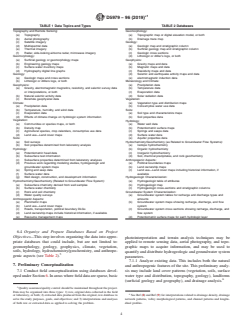
6.3 Gather Data from Existing Sources—This step involves
locating, collecting, and organizing the data needed (see Table
1) to solve the problem into a manageable database. See
Practice D5254/D5254M and Guides D5408, D5409/D5409M,
D5410, D5474, and D5730 for data elements to identify a
groundwater site.
NOTE 1—Conceptualization and characterization is an iterative process
6.3.1 Collect data, such as maps, tables, and reports, from
beginning with a theoretical understanding of the groundwater system
available published and unpublished sources, and field and
followed by data collection and refinement of the understanding. Addi-
tional data collection and analysis, and the refinement of the groundwater laboratory studies. Note the methods used to collect and
system conceptual model occurs during the process of conceptualization
analyze the data. Note levels of quality assurance and quality
andcharacterization,andduringgroundwatermodeldevelopmentanduse.
control as required by the project.
FIG. 1 Procedure for Conceptualization and Characterization of
6.3.2 Collect data from interviews of local and regionally
Groundwater Flow Systems (2)
knowledgeable people. This may include, but is not limited to,
worker histories, former practices, and engineering activities
headings (Sections 6 through 13) and first subheadings (for that either changed the site or provide historical data (location
example, 7.1 and 8.1). of old wells, contaminant history, and so forth).
´1
D5979 − 96 (2019)
TABLE 1 Data Topics and Types TABLE 2 Databases
Topography and Remote Sensing: Geomorphology:
(a) Topography (a) Topographic map or digital elevation model, or both
(b) Aerial photography (b) Drainage trace map
(c) Satellite imagery Geology:
(d) Multispectral data (a) Geologic map and stratigraphic column
(e) Thermal imagery (b) Surficial geology map and stratigraphic column
(f) Radar, side-looking airborne radar, microwave imagery (c) Geologic cross sections
Geomorphology: (d) Lithologic or driller’s logs, or both
(a) Surficial geology or geomorphology maps Geophysics:
(b) Engineering geology maps (a) Gravity maps and data
(c) Surface water inventory maps (b) Magnetic maps and data
(d) Hydrography digital line graphs (c) Resistivity maps and data
Geology: (d) Seismic and earthquake activity maps and data
(a) Geologic maps and cross sections (e) electromagnetic induction data
(b) Lithologic or drillers logs, or both Meteorology and Climate:
Geophysics: (a) Precipitation data
(a) Gravity, electromagnetic magnetics, resistivity, and seismic survey data (b) Temperature data
or interpretations, or both (c) Evaporation data
(b) Natural seismic activity data (d) Solar radiation data
(c) Borehole geophysical data Vegetation:
Climate: (a) Vegetation type and distribution maps
(a) Precipitation data (b) Consumptive water use data
(b) Temperature, humidity, and wind data Soils:
(c) Evaporation data (a) Soil type and characteristics maps
(d) Effects of climate change on hydrologic system information (b) Soil properties data
Vegetation: Hydrology:
(a) Communities or species maps, or both (a) Water well data
(b) Density map (b) Potentiometric surface maps
(c) Agricultural species, crop calendars, consumptive use data
(c) Springs and seeps data
(d) Land use—Land cover maps (d) Surface water data
Soils: (e) Aquifer properties data
(a) Soil surveys Hydrochemistry/Geochemistry (as Related to Groundwater Flow Systems):
(b) Soil properties determined from laboratory analysis (a) Isotope hydrochemistry
Hydrology: (b) Organic hydrochemistry
(a) Potentiometric head data (c) Inorganic hydrochemistry
(b) Subsurface test information (d) Soil, chemical precipitates, and rock geochemistry
(c) Subsurface properties determined from laboratory analyses Anthropogenic Aspects:
(d) Previous work regarding modeling studies, hydrogeologic and
(a) Political boundaries maps
groundwater system maps (b) Land ownership maps
(e) Spring and seep data (c) Land use—Land cover maps including historical information, if
(f) Surface water data available
(g) Well design, construction, and development information Hydrogeologic Characterization:
Hydrochemistry/Geochemistry (Related to Groundwater Flow System): (a) Hydrogeologic table of attributes
(a) Subsurface chemistry derived from well samples (b) Hydrogeologic map
(b) Surface water chemistry (c) Hydrogeologic cross-sections and stratigraphic columns
(c) Rock and soil chemistry Groundwater System Characterization:
(d) Water quality surveys
(a) Groundwater system tables for recharge and discharge types and
Anthropogenic Aspects: amounts
(a) Planimetric maps (b) Groundwater system maps showing recharge, discharge, and flow
(b) Land use—Land cover maps system
(c) Roads, transportation, political boundary DLGs (c) Groundwater system cross sections showing recharge, discharge, and
(d) Land ownership maps include historical information, if available flow system
(e) Resource management maps (d) Potentiometric surface maps for each hydrologic layer
6.4 Organize and Prepare Databases Based on Project
Objectives—This step involves organizing the data into appro-
photointerpretation and terrain analysis techniques may be
priate databases that could include, but are not limited to:
applied to remote sensing data, aerial photography, and topo-
geomorphology, geology, geophysics, climate, vegetation,
graphic maps to acquire information, and may be used to
soils, hydrology, hydrochemistry/geochemistry, and anthropo-
quantify and distribute hydrogeologic and groundwater system
genic aspects (see Table 2).
parameters.
7.1.1 Analyze existing data. This includes both the natural
7. Preliminary Conceptualization
and anthropogenic features of the site. This preliminary analy-
7.1 Conduct field conceptualization using databases devel- sis may include land cover patterns (vegetation, soils, surface
opedunderSection6.Inareaswherefielddataaresparse,basic water type and distribution, topography, geology), landforms
(surficial geology and geography), and drainage analysis.
Quality assurance/quality control should be maintained throughout the project.
Data may be organized into three types: 1) raw, original data collected in the field
or laboratory, or both; 2) extracted data produced from the original, raw database to See Ref (8) and Ref (9) for interpretations related to drainage density, drainage
solve the study purposes, goals, and objectives; and 3) interpretations and analyses network patterns, valley morphological patterns, and channel patterns and longitu-
of both raw or extracted data as applied to solving the problem. dinal profiles.
´1
D5979 − 96 (2019)
7.1.2 Conduct field reconnaissance to relate the preliminary 8.1.7 Conduct a geomorphologic process and deposits
analysis of the information collected to study site conditions. analysis, including maps depicting the type, properties, and
distribution of geomorphic materials; geologic outcrops; land-
7.2 Conduct qualitative groundwater system conceptualiza-
forms and slope; or other geomorphic characteristics needed to
tion. This results in the development of one or more initial
understand and solve the problem.
conceptual models that will be used for characterization and
quantification. This qualitative analysis uses the same logic
9. Subsurface Characterization
presented in Sections 8 through 12 for quantitative analysis.
9.1 Determine stratigraphic and lithologic units (soil and
7.2.1 Qualitatively characterize the study area surface using
rock) using the soils, geology, and geophysics databases and
procedures stated in Section 8.
analysis, and surface characterization results. The stratigraphy
7.2.2 Qualitatively characterize the study area subsurface
or lithology of the subsurface framework, or both, is deter-
geologic framework using procedures stated in Section 9.
mined for the
...