ASTM F2052-06e1
(Test Method)Standard Test Method for Measurement of Magnetically Induced Displacement Force on Medical Devices in the Magnetic Resonance Environment
Standard Test Method for Measurement of Magnetically Induced Displacement Force on Medical Devices in the Magnetic Resonance Environment
SIGNIFICANCE AND USE
This test method is one of those required to determine if the presence of a medical device may cause injury to individuals during an MR examination and in the MR environment. Other safety issues which should be addressed include but may not be limited to magnetically induced torque (see Test Method F 2213) and RF heating (see Test Method F 2182). The terms and icons in Practice F 2503 should be used to mark the device for safety in the magnetic resonance environment.
If the device deflects less than 45°, then the magnetically induced deflection force is less than the force on the device due to gravity (its weight). For this condition, it is assumed that any risk imposed by the application of the magnetically induced force is no greater than any risk imposed by normal daily activity in the Earth’gravitational field.
A deflection of less than 45° at the location of the maximum static magnetic field gradient in one MR system does not preclude a deflection exceeding 45° in a system with a higher field strength or larger static field gradients.
This test method alone is not sufficient for determining if a device is safe in the MR environment.
SCOPE
1.1 This test method covers the measurement of the magnetically induced displacement force produced by static magnetic field gradients on medical devices and the comparison of that force to the weight of the medical device.
1.2 This test method does not address other possible safety issues which include but are not limited to issues of magnetically induced torque, RF heating, induced heating, acoustic noise, interaction among devices, and the functionality of the device and the MR system.
1.3 This test method is intended for devices that can be suspended from a string. Devices which cannot be suspended from a string are not covered by this test method. The weight of the string from which the device is suspended during the test must be less than 1 % of the weight of the tested device.
1.4 This test method shall be carried out in a system in which the direction of the magnetically induced deflection force is horizontal.
1.5 The values stated in SI units are to be regarded as standard. Values in parentheses are for information only.
This standard does not purport to address all of the safety concerns, if any, associated with its use. It is the responsibility of the user of this standard to establish appropriate safety and health practices and determine the applicability of regulatory requirements prior to use.
General Information
- Status
- Historical
- Publication Date
- 28-Feb-2006
- Technical Committee
- F04 - Medical and Surgical Materials and Devices
- Drafting Committee
- F04.15 - Material Test Methods
- Current Stage
Relations
- Effective Date
- 01-Mar-2006
- Effective Date
- 15-May-2014
- Effective Date
- 01-Mar-2006
- Effective Date
- 01-Mar-2006
- Effective Date
- 01-Mar-2006
- Effective Date
- 01-Mar-2006
- Effective Date
- 01-Mar-2006
- Effective Date
- 01-Mar-2006
ASTM F2052-06e1 - Standard Test Method for Measurement of Magnetically Induced Displacement Force on Medical Devices in the Magnetic Resonance Environment
Frequently Asked Questions
ASTM F2052-06e1 is a standard published by ASTM International. Its full title is "Standard Test Method for Measurement of Magnetically Induced Displacement Force on Medical Devices in the Magnetic Resonance Environment". This standard covers: SIGNIFICANCE AND USE This test method is one of those required to determine if the presence of a medical device may cause injury to individuals during an MR examination and in the MR environment. Other safety issues which should be addressed include but may not be limited to magnetically induced torque (see Test Method F 2213) and RF heating (see Test Method F 2182). The terms and icons in Practice F 2503 should be used to mark the device for safety in the magnetic resonance environment. If the device deflects less than 45°, then the magnetically induced deflection force is less than the force on the device due to gravity (its weight). For this condition, it is assumed that any risk imposed by the application of the magnetically induced force is no greater than any risk imposed by normal daily activity in the Earth’gravitational field. A deflection of less than 45° at the location of the maximum static magnetic field gradient in one MR system does not preclude a deflection exceeding 45° in a system with a higher field strength or larger static field gradients. This test method alone is not sufficient for determining if a device is safe in the MR environment. SCOPE 1.1 This test method covers the measurement of the magnetically induced displacement force produced by static magnetic field gradients on medical devices and the comparison of that force to the weight of the medical device. 1.2 This test method does not address other possible safety issues which include but are not limited to issues of magnetically induced torque, RF heating, induced heating, acoustic noise, interaction among devices, and the functionality of the device and the MR system. 1.3 This test method is intended for devices that can be suspended from a string. Devices which cannot be suspended from a string are not covered by this test method. The weight of the string from which the device is suspended during the test must be less than 1 % of the weight of the tested device. 1.4 This test method shall be carried out in a system in which the direction of the magnetically induced deflection force is horizontal. 1.5 The values stated in SI units are to be regarded as standard. Values in parentheses are for information only. This standard does not purport to address all of the safety concerns, if any, associated with its use. It is the responsibility of the user of this standard to establish appropriate safety and health practices and determine the applicability of regulatory requirements prior to use.
SIGNIFICANCE AND USE This test method is one of those required to determine if the presence of a medical device may cause injury to individuals during an MR examination and in the MR environment. Other safety issues which should be addressed include but may not be limited to magnetically induced torque (see Test Method F 2213) and RF heating (see Test Method F 2182). The terms and icons in Practice F 2503 should be used to mark the device for safety in the magnetic resonance environment. If the device deflects less than 45°, then the magnetically induced deflection force is less than the force on the device due to gravity (its weight). For this condition, it is assumed that any risk imposed by the application of the magnetically induced force is no greater than any risk imposed by normal daily activity in the Earth’gravitational field. A deflection of less than 45° at the location of the maximum static magnetic field gradient in one MR system does not preclude a deflection exceeding 45° in a system with a higher field strength or larger static field gradients. This test method alone is not sufficient for determining if a device is safe in the MR environment. SCOPE 1.1 This test method covers the measurement of the magnetically induced displacement force produced by static magnetic field gradients on medical devices and the comparison of that force to the weight of the medical device. 1.2 This test method does not address other possible safety issues which include but are not limited to issues of magnetically induced torque, RF heating, induced heating, acoustic noise, interaction among devices, and the functionality of the device and the MR system. 1.3 This test method is intended for devices that can be suspended from a string. Devices which cannot be suspended from a string are not covered by this test method. The weight of the string from which the device is suspended during the test must be less than 1 % of the weight of the tested device. 1.4 This test method shall be carried out in a system in which the direction of the magnetically induced deflection force is horizontal. 1.5 The values stated in SI units are to be regarded as standard. Values in parentheses are for information only. This standard does not purport to address all of the safety concerns, if any, associated with its use. It is the responsibility of the user of this standard to establish appropriate safety and health practices and determine the applicability of regulatory requirements prior to use.
ASTM F2052-06e1 is classified under the following ICS (International Classification for Standards) categories: 11.040.40 - Implants for surgery, prosthetics and orthotics. The ICS classification helps identify the subject area and facilitates finding related standards.
ASTM F2052-06e1 has the following relationships with other standards: It is inter standard links to ASTM F2052-06, ASTM F2052-14, ASTM F3395/F3395M-19, ASTM F3160-21, ASTM F2213-17, ASTM F1831-17, ASTM F2182-19e2, ASTM F2503-23. Understanding these relationships helps ensure you are using the most current and applicable version of the standard.
You can purchase ASTM F2052-06e1 directly from iTeh Standards. The document is available in PDF format and is delivered instantly after payment. Add the standard to your cart and complete the secure checkout process. iTeh Standards is an authorized distributor of ASTM standards.
Standards Content (Sample)
NOTICE: This standard has either been superseded and replaced by a new version or withdrawn.
Contact ASTM International (www.astm.org) for the latest information
´1
Designation: F2052 − 06
StandardTest Method for
Measurement of Magnetically Induced Displacement Force
on Medical Devices in the Magnetic Resonance
Environment
This standard is issued under the fixed designation F2052; the number immediately following the designation indicates the year of
original adoption or, in the case of revision, the year of last revision. A number in parentheses indicates the year of last reapproval. A
superscript epsilon (´) indicates an editorial change since the last revision or reapproval.
´ NOTE—Paragraph X1.3 was added editorially in May 2006.
1. Scope F2119 Test Method for Evaluation of MR Image Artifacts
from Passive Implants
1.1 This test method covers the measurement of the mag-
F2182 Test Method for Measurement of Radio Frequency
netically induced displacement force produced by static mag-
Induced Heating On or Near Passive Implants During
netic field gradients on medical devices and the comparison of
Magnetic Resonance Imaging
that force to the weight of the medical device.
F2213 Test Method for Measurement of Magnetically In-
1.2 This test method does not address other possible safety
duced Torque on Medical Devices in the Magnetic Reso-
issues which include but are not limited to issues of magneti-
nance Environment
cally induced torque, RF heating, induced heating, acoustic
F2503 Practice for Marking Medical Devices and Other
noise, interaction among devices, and the functionality of the
Items for Safety in the Magnetic Resonance Environment
device and the MR system.
2.2 Other Standards:
1.3 This test method is intended for devices that can be
IEC 60601–2–33 Ed. 2.0 Medical Electronic Equipment—
suspended from a string. Devices which cannot be suspended
Part2:ParticularRequirementsfortheSafetyofMagnetic
from a string are not covered by this test method. The weight
Resonance Equipment for Medical Diagnosis
ofthestringfromwhichthedeviceissuspendedduringthetest
ISO 13485:2003(E) Medical Devices—Quality Manage-
must be less than 1 % of the weight of the tested device.
ment Systems—Requirements for Regulatory Purposes,
definition 3.7
1.4 This test method shall be carried out in a system in
which the direction of the magnetically induced deflection
force is horizontal. 3. Terminology
1.5 The values stated in SI units are to be regarded as 3.1 Definitions:
standard. Values in parentheses are for information only. 3.1.1 diamagnetic material—a material whose relative per-
meability is less than unity.
1.6 This standard does not purport to address all of the
safety concerns, if any, associated with its use. It is the 3.1.2 ferromagnetic material—a material whose magnetic
responsibility of the user of this standard to establish appro-
moments are ordered and parallel producing magnetization in
priate safety and health practices and determine the applica- one direction.
bility of regulatory requirements prior to use.
3.1.3 magnetic field strength (H in A/m)—strength of the
applied magnetic field.
2. Referenced Documents
3.1.4 magnetic induction or magnetic flux density (B in
2.1 ASTM Standards:
T)—that magnetic vector quantity which at any point in a
magnetic field is measured either by the mechanical force
experiencedbyanelementofelectriccurrentatthepoint,orby
This test method is under the jurisdiction ofASTM Committee F04 on Medical
and Surgical Materials and Devices and is the direct responsibility of Subcommittee
the electromotive force induced in an elementary loop during
F04.15 on Material Test Methods.
any change in flux linkages with the loop at the point. The
Current edition approved April 28, 2006. Published March 2006. Originally
magnetic induction is frequently referred to as the magnetic
approved in 2000. Last previous edition approved in 2002 as F2052 – 02. DOI:
10.1520/F2052-06E01.
For referenced ASTM standards, visit the ASTM website, www.astm.org, or
contact ASTM Customer Service at service@astm.org. For Annual Book of ASTM
Standards volume information, refer to the standard’s Document Summary page on Available fromAmerican National Standards Institute (ANSI), 25 W. 43rd St.,
the ASTM website. 4th Floor, New York, NY 10036.
Copyright © ASTM International, 100 Barr Harbor Drive, PO Box C700, West Conshohocken, PA 19428-2959. United States
´1
F2052 − 06
field. B isthestaticfieldinanMRsystem.Plaintypeindicates 3.1.13 paramagnetic material—a material having a relative
o
a scalar (for example, B) and bold type indicates a vector (for permeability which is slightly greater than unity, and which is
practically independent of the magnetizing force.
example,B).
3.1.14 tesla, (T)—the SI unit of magnetic induction equal to
3.1.5 magnetic resonance diagnostic device—a device in-
10 gauss (G).
tended for general diagnostic use to present images which
reflectthespatialdistributionormagneticresonancespectra,or
4. Summary of Test Method
both, which reflect frequency and distribution of nuclei exhib-
4.1 Amedical device is suspended by a string at the point in
iting nuclear magnetic resonance. Other physical parameters
a magnetic field that will produce the greatest magnetically
derived from the images or spectra, or both, may also be
induced deflection. The angular deflection of the string from
produced.
the vertical is measured. If the device deflects less than 45°,
3.1.6 magnetic resonance (MR) environment—volume
then the magnetically induced deflection force is less than the
within the 0.50 mT (5 gauss (G)) line of an MR system, which
force on the device due to gravity (its weight).
includes the entire three dimensional volume of space sur-
rounding the MR scanner. For cases where the 0.50 mT line is 5. Significance and Use
contained within the Faraday shielded volume, the entire room
5.1 This test method is one of those required to determine if
shall be considered the MR environment.
the presence of a medical device may cause injury to individu-
als during an MR examination and in the MR environment.
3.1.7 magnetic resonance equipment (MR equipment)—
Other safety issues which should be addressed include but may
medical electrical equipment which is intended for in-vivo
notbelimitedtomagneticallyinducedtorque(seeTestMethod
magnetic resonance examination of a patient. The MR equip-
F2213) and RF heating (see Test Method F2182). The terms
ment comprises all parts in hardware and software from the
and icons in Practice F2503 should be used to mark the device
supply mains to the display monitor. The MR equipment is a
for safety in the magnetic resonance environment.
Programmable Electrical Medical System (PEMS).
5.2 If the device deflects less than 45°, then the magneti-
3.1.8 magnetic resonance system (MR system)— ensemble
cally induced deflection force is less than the force on the
of MR equipment, accessories, including means for display,
device due to gravity (its weight). For this condition, it is
control, energy supplies, and the MR environment.
assumed that any risk imposed by the application of the
IEC 60601–2–33
magnetically induced force is no greater than any risk imposed
3.1.9 magnetic resonance examination (MR examination)—
by normal daily activity in the Earth’s gravitational field.
process of acquiring data by magnetic resonance from a
5.3 A deflection of less than 45° at the location of the
patient.
maximum static magnetic field gradient in one MR system
does not preclude a deflection exceeding 45° in a system with
3.1.10 magnetic resonance (MR)—resonant absorption of
a higher field strength or larger static field gradients.
electromagnetic energy by an ensemble of atomic particles
situated in a magnetic field.
5.4 This test method alone is not sufficient for determining
if a device is safe in the MR environment.
3.1.11 medical device—any instrument, apparatus,
implement, machine, appliance, implant, in vitro reagent or
6. Apparatus
calibrator, software, material, or other similar or related article,
6.1 The test fixture consists of a sturdy nonmagnetic struc-
intended by the manufacturer to be used, alone or in
ture capable of holding the test device in the proper position
combination, for human beings for one or more of the specific
withoutdeflectionofthetestfixtureandcontainingaprotractor
purpose(s) of:
with 1° graduated markings, rigidly mounted to the structure.
(1) diagnosis, prevention, monitoring, treatment, or allevia-
The 0° indicator on the protractor is oriented vertically. The
tion of disease,
(2) diagnosis, monitoring, treatment, alleviation of, or com-
testdeviceissuspendedfromathinstringthatisattachedtothe
pensation for an injury,
0° indicator on the protractor. In order for the weight of the
(3) investigation, replacement, modification, or support of the
stringtobeconsiderednegligiblewhencomparedtotheweight
anatomy or of a physiological process,
(4) supporting or sustaining life,
of the device, the weight of the string shall be less than 1 % of
(5) control of conception,
the weight of the device. The string shall be long enough so
(6) disinfection of medical devices, and
thatthedevicemaybesuspendedfromthetestfixtureandhang
(7) providing information for medical purposes by means of
in vitro examination of specimens derived from the hu-
freelyinspace.Motionofthestringshallnotbeconstrainedby
man body, and which does not achieve its primary in-
the support structure or the protractor. The string may be
tended action in or on the human body by
pharmacological, immunological, or metabolic means, attached to the device at any convenient location.
but which may be assisted in its function by such means.
ISO 13485
7. Test Specimens
3.1.12 magnetically induced displacement force— force
7.1 For purposes of device qualification, the device evalu-
produced when a magnetic object is exposed to the spatial ated according to this test method should be representative of
gradient of a magnetic field. This force will tend to cause the
manufactured medical devices that have been processed to a
object to translate in the gradient field. finished condition (for example, sterilized).
´1
F2052 − 06
7.2 For purposes of device qualification, the devices should
not be altered in any manner prior to testing.
8. Procedure
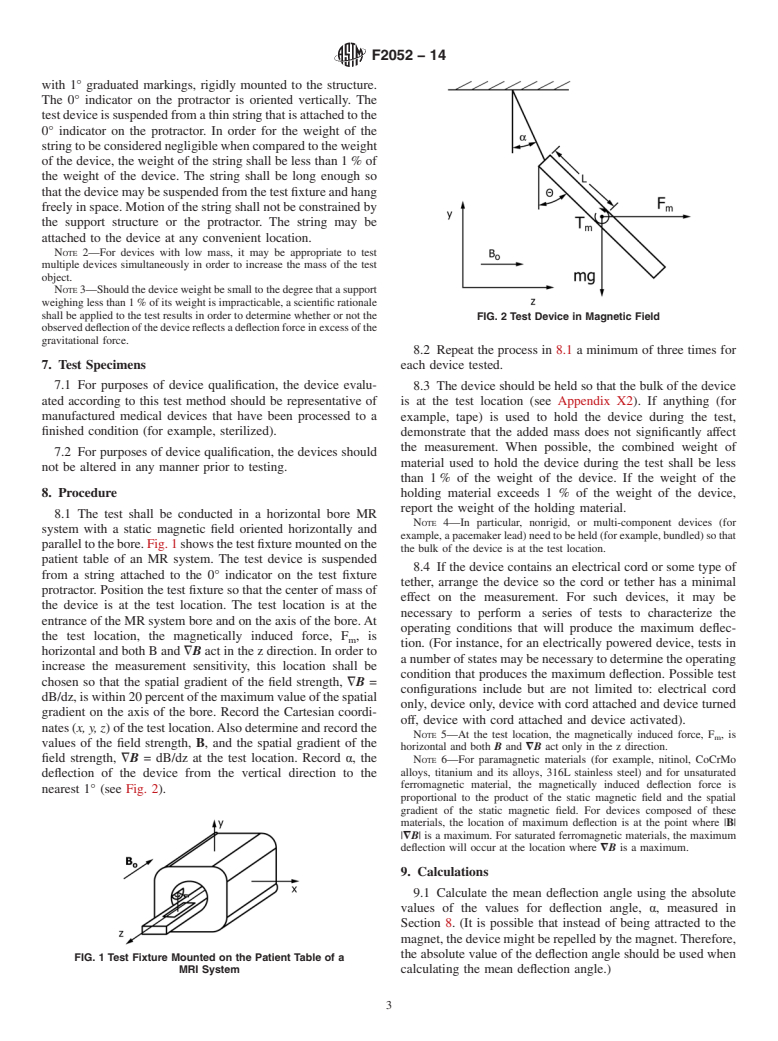
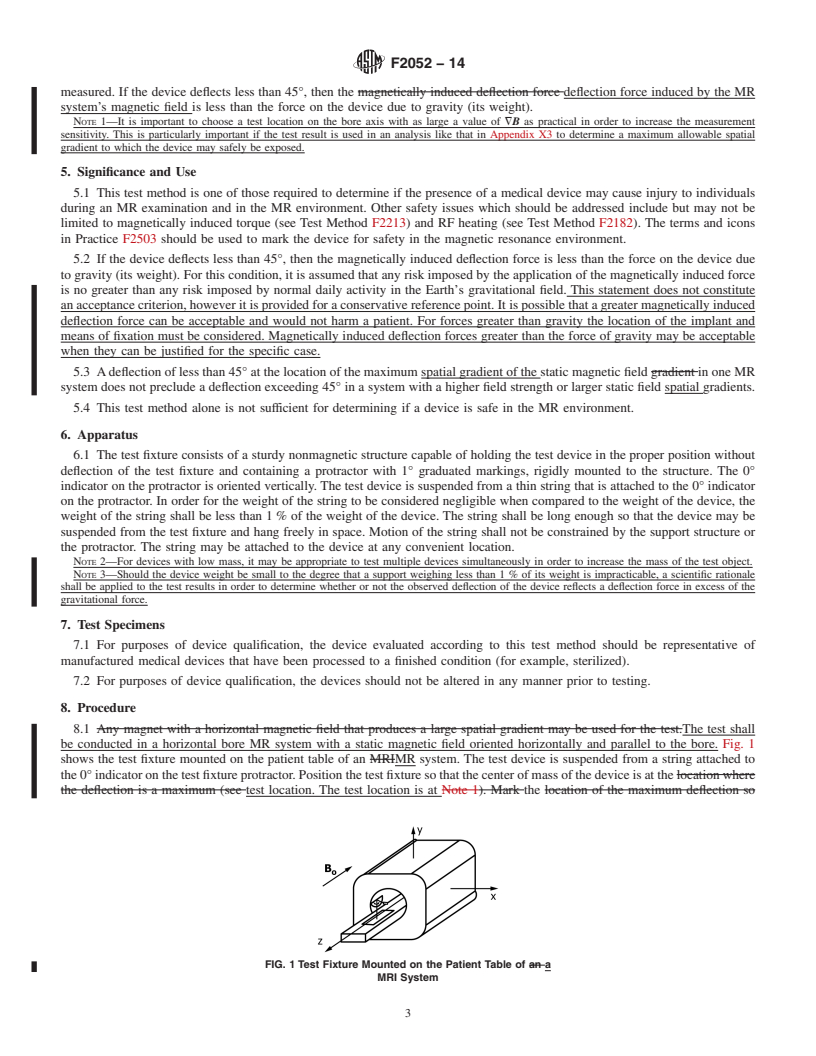
8.1 Any magnet with a horizontal magnetic field that
produces a large spatial gradient may be used for the test. Fig.
1 shows the test fixture mounted on the patient table of an MRI
system. The test device is suspended from a string attached to
the 0° indicator on the test fixture protractor. Position the test
fixture so that the center of mass of the device is at the location
where the deflection is a maximum (see Note 1). Mark the
location of the maximum deflection so all test repetitions will
be conducted at the same location. Hold the device so that the
string is vertical and then release it. Recordα, the deflection of
the device from the vertical direction to the nearest 1° (see Fig.
FIG. 2 Test Device in Magnetic Field
2).
8.2 Repeat the process in 8.1 a minimum of three times for
each device tested.
9. Calculations
8.3 The device should be constrained so that the bulk of the
9.1 Calculate the mean deflection angle using the absolute
device is at the point of maximum deflection (see Appendix
values of the values for deflection angle, α, measured in
X2). If anything (for example, tape) is used to constrain the
Section 8. (It is possible that instead of being attracted to the
device during the test, demonstrate that the added mass does
magnet,thedevicemightberepelledbythemagnet.Therefore,
not significantly affect the measurement.The combined weight
the absolute value of the deflection angle should be used when
of material used to constrain the device during the test shall be
calculating the mean deflection angle.)
less than 1 % of the weight of the device.
9.2 Calculate the mean magnetically induced deflection
8.4 If the device contains an electrical cord or some type of
force for the device using the mean value for the deflection
tether, arrange the device so th
...
La norme ASTM F2052-06e1 est un document essentiel qui établit une méthode de test standardisée destinée à mesurer la force de déplacement induite magnétiquement sur les dispositifs médicaux dans l'environnement de résonance magnétique (RM). Son importance réside dans sa capacité à évaluer si la présence d'un dispositif médical peut entraîner des blessures chez les patients lors d'une examination RM. L'étendue de cette norme se concentre sur la mesure de la force de déplacement induite par les gradients de champ magnétique statique sur les dispositifs médicaux et la comparaison de cette force avec le poids du dispositif. À cet égard, la norme souligne un critère crucial : si la déviation d'un dispositif est inférieure à 45°, cela signifie que la force de déviation induite magnétiquement demeure inférieure à celle exercée par la gravité. Cette évaluation permet d'arguer que les risques potentiels liés à l'application de cette force magnétiquement induite ne dépassent pas ceux associés aux activités quotidiennes normales dans le champ gravitationnel terrestre. Un aspect remarquable de la norme est qu'elle est bien précise sur les types de dispositifs couverts ; elle ne s'applique qu'à ceux pouvant être suspendus par une ficelle, garantissant ainsi la pertinence et l'applicabilité des tests dans des conditions de mesures standardisées. La norme stipule également que pour assurer des résultats fiables, le poids de la ficelle ne doit pas dépasser 1% du poids du dispositif testé et que les tests doivent être effectués dans un système où la force de déviation induite magnétiquement est horizontale. Cependant, il est essentiel de noter que cette méthode de test ne couvre pas tous les enjeux de sécurité potentiels dans l'environnement de RM. Des préoccupations telles que le couple induit magnétiquement, le chauffage par radiofréquence, le bruit acoustique et les interactions entre dispositifs ne sont pas abordées par cette norme. Par conséquent, il incombe à l'utilisateur de cette norme de mettre en place les pratiques de sécurité et de santé appropriées et d'établir la conformité avec les exigences réglementaires pertinentes avant son utilisation. Dans l'ensemble, la norme ASTM F2052-06e1 se distingue par sa rigueur dans l'évaluation de la sécurité des dispositifs médicaux dans des environnements de résonance magnétique. Son approche systématique et sa spécificité en font un outil précieux pour les professionnels de la santé et les fabricants de dispositifs médicaux cherchant à garantir la sécurité des patients et l'efficacité des examens RM.
ASTM F2052-06e1 표준은 자기 공명(MR) 환경에서 의료 기기에 의한 자석 유도 변위력을 측정하는 시험 방법을 제시합니다. 이 표준의 범위는 의료 기기 사용 시 개인에게 부상을 초래할 수 있는 위험을 평가하도록 설계되었습니다. 전반적으로, 이 표준은 MR 환경에서의 안전성을 결정하는 데 필수적인 요소로, 특히 자석 유도 토크와 RF 가열과 같은 다른 안전 문제를 다루기 위한 기초가 됩니다. 이 표준의 주요 강점 중 하나는 의료 기기의 자석 유도 변위력을 중량과 비교하여 면밀히 분석할 수 있도록 하는 것입니다. 자석 유도력으로 인한 변위가 45° 미만일 경우, 이 표준은 해당 기기가 지구 중력에서의 일상 활동과 유사한 수준의 위험을 수반한다고 가정합니다. 이는 의료 기기에 대한 사용자의 신뢰를 높이고, MR 환경에서의 안전성을 개선하는 데 크게 기여합니다. 또한, ASTM F2052-06e1은 특정 조건 하에서의 시험 방법을 명확히 정의하여, 고정된 방향으로 발생하는 자석 유도 변위력을 측정하는 과정을 규정합니다. 이 표준은 특히 1% 이하의 중량을 가진 줄에 매달 수 있는 기기에 적용되며, 이를 통해 중량이 미세하게 다른 다양한 기기들을 비교할 수 있는 기회를 제공합니다. 하지만, 이 표준은 의료 기기의 전체 안전성을 평가하는 데는 제한적일 수 있으며, RF 가열, 유도 가열, 기기 간 상호작용, 그리고 MR 시스템과의 기능적 관련성 등의 추가적인 안전 문제는 별도로 고려해야 합니다. 그러므로 사용자는 본 표준을 적용하기 전, 관련 규제 요구사항을 파악하고 적절한 안전 및 건강 관행을 수립하는 책임이 있습니다. 결론적으로, ASTM F2052-06e1 표준은 자기 공명 환경에서의 의료 기기와 관련된 자석 유도 변위력을 평가하기 위한 중요한 지침을 제공하며, 생명 안전과 직결된 분야에서 매우 중요한 역할을 합니다. 이 표준은 의료 기기의 개발 및 활용 과정에서 필수적으로 고려되어야 할 문서로, 의료 분야의 안전성을 높이는 데 기여할 것입니다.
The ASTM F2052-06e1 standard provides a vital methodology for evaluating the magnetically induced displacement force on medical devices when placed within the magnetic resonance (MR) environment. Its scope, primarily established to ensure patient safety during MR examinations, addresses the significant risk that certain medical devices may pose due to their interaction with powerful magnetic fields. A key strength of this standard lies in its comprehensive approach to measuring the magnetically induced displacement force, comparing this force directly with the weight of the medical device. This comparison serves as a crucial indicator of potential risk, allowing manufacturers and healthcare providers to assess whether the device is safe for use in an MR setting. The stipulation that devices capable of deflecting less than 45° are assumed to pose a low risk is straightforward and provides clarity for testing protocols. However, the standard explicitly acknowledges that it does not encompass all safety concerns associated with medical devices in the MR environment. For instance, critical issues such as magnetically induced torque, RF heating, and acoustic noise are notably absent from its purview. This delineation emphasizes the importance of supplementary test methods, such as Test Method F 2213 for torque and Test Method F 2182 for RF heating, to ensure a comprehensive safety assessment. The specific requirement that the test must be conducted in a system where the magnetically induced deflection force acts horizontally adds another layer of precision to the standard, ensuring reliable and consistent results across various testing scenarios. Furthermore, the standard's insistence on using SI units aligns it with global practices, thereby enhancing its relevance in international contexts. In summary, ASTM F2052-06e1 stands as a robust guideline for the assessment of magnetically induced displacement forces in medical devices, yet it effectively highlights the necessity for a multi-faceted approach to ensure comprehensive safety in the MR environment.
Die Norm ASTM F2052-06e1 bietet ein umfassendes Prüfverfahren zur Messung der magnetisch induzierten Ablenkungskraft auf medizinische Geräte im Umfeld der Magnetresonanztomographie (MRT). Die Bedeutung dieser Norm liegt vor allem in ihrer Fähigkeit, das potenzielle Risiko von Verletzungen während einer MRT-Untersuchung zu bestimmen, welches durch die Wechselwirkung zwischen medizinischen Geräten und dem statischen Magnetfeld entstehen kann. Ein wesentlicher Stärke dieser Norm ist die klare Definition des Anwendungsbereichs, welcher die Messung der Ablenkungskraft unter dem Einfluss von statischen Magnetfeldgradienten umfasst. Die Norm hebt hervor, dass eine Ablenkung von weniger als 45° als unbedenklich angesehen wird, vorausgesetzt, dass die induzierte Kraft die Schwerkraft des Geräts nicht übersteigt. Dies schafft eine klare Grundlage für die Bewertung der Sicherheit von Geräten in der magnetischen Resonanzumgebung. Die Norm ist besonders relevant für Hersteller und Anwender von medizinischen Geräten, da sie spezifische Richtlinien für die Durchführung der Tests bereitstellt. Es wird betont, dass die Geräte, die geprüft werden, von einem Faden abgehängt werden müssen, was eine exakte und standardisierte Testumgebung gewährleistet. Darüber hinaus hebt die Norm hervor, dass die Verwendung von SI-Einheiten als Standard betrachtet werden sollte, um Konsistenz und Vergleichbarkeit in den Testergebnissen zu gewährleisten. Trotz ihrer Stärken ist es wichtig zu beachten, dass die ASTM F2052-06e1 nicht alle sicherheitsrelevanten Aspekte abdeckt. Die Norm weist darauf hin, dass zusätzliche Sicherheitsprobleme, wie magnetisch induzierte Drehmomente, RF-Heizung und Geräuschinterferenzen, gesondert betrachtet werden müssen. Dies unterstreicht die Notwendigkeit für eine umfassendere Sicherheitsbewertung, die über das hinausgeht, was in dieser Norm behandelt wird. Insgesamt stellt die ASTM F2052-06e1 eine entscheidende Ressource für die Sicherstellung der Patienten- und Gerätelicherheit in der MRT-Diagnostik dar, indem sie eine strukturierte Herangehensweise an die Messung der magnetisch induzierten Ablenkungskraft bietet und damit zur Innovationsförderung im Bereich der medizinischen Geräte beiträgt.
ASTM F2052-06e1は、医療機器の磁気共鳴環境における磁気誘導変位力の測定方法に関する標準規格です。この標準の主な目的は、MR検査中に医療機器の存在が個人に対して傷害を引き起こす可能性があるかどうかを評価することにあります。これにより、治療や診断を行う際の安全性を確保するための重要な手段となっています。 この標準の強みは、静的磁場勾配によって生じる磁気誘導変位力を測定し、その力を医療機器の重さと比較することにあります。これにより、医療機器がMR環境でどのように振る舞うかや、日常的な重力に対するリスクの相対的な位置づけを行うことが可能です。特に、変位が45°未満であれば、通常の地球の重力場でのリスクと同程度であると見なされます。この基準に従うことで、MR環境における安全性の評価を体系的に行うことができます。 ただし、ASTM F2052-06e1には注意すべき点もあります。この標準は、磁気誘導トルクやRF加熱、音響ノイズなど、他の安全問題については言及していないため、総合的な安全評価には他のテスト方法(例えば、F 2213やF 2182)を併用する必要があります。また、試験対象は糸から吊るすことができる医療機器に限られており、吊るすことができないデバイスは対象外とされています。この制約により、特定の医療機器が適用範囲外となる場合があるため、ユーザーは使用する機器の適合性に注意が必要です。 全体として、ASTM F2052-06e1は医療機器がMR環境で安全に使用できるかを評価するための重要なツールであり、その計測手法は業界内での広範な利用が期待されます。この標準に従うことで、医療機器の安全性を高め、患者に対するリスクを最小限に抑えるための基盤を提供しています。


Questions, Comments and Discussion
Ask us and Technical Secretary will try to provide an answer. You can facilitate discussion about the standard in here.
Loading comments...