

ASTM A686-92(2024)
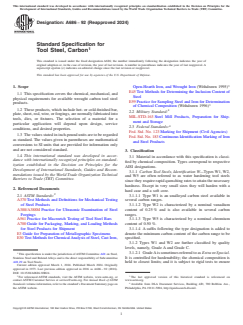
(Specification)Standard Specification for Tool Steel, Carbon
General Information
- Abstract
ABSTRACT
This specification covers chemical, mechanical, and physical requirements for available wrought carbon tool steel products. These products, which include hot- or cold-finished bar, plate, sheet, rod, wire, or forgings, are normally fabricated into tools, dies, or fixtures. The selection of a material for a particular application will depend upon design, service conditions, and desired properties. An analysis of each heat of steel shall be made by the manufacturer to determine the percentage of the elements specified and these values shall conform to the chemical composition specified by the reference material. The hardness of the specimen after the specified heat treatment shall meet the minimum hardness value for the particular type of steel prescribed by the reference material. Rockwell C tests should be used where possible but light load tests may be necessary on thin specimens. The macrostructure of a specimen representing the entire cross-sectional area in the annealed condition shall be prepared in accordance with the reference material. It shall exhibit a structure free of excessive porosity, segregation, slag, dirt or other nonmetallic inclusions, pipes, checks, cracks, and other injurious defects.
SCOPE
1.1 This specification covers the chemical, mechanical, and physical requirements for available wrought carbon tool steel products.
1.2 These products, which include hot- or cold-finished bar, plate, sheet, rod, wire, or forgings, are normally fabricated into tools, dies, or fixtures. The selection of a material for a particular application will depend upon design, service conditions, and desired properties.
1.3 The values stated in inch-pound units are to be regarded as standard. The values given in parentheses are mathematical conversions to SI units that are provided for information only and are not considered standard.
1.4 This international standard was developed in accordance with internationally recognized principles on standardization established in the Decision on Principles for the Development of International Standards, Guides and Recommendations issued by the World Trade Organization Technical Barriers to Trade (TBT) Committee.
- Status
- Published
- Publication Date
- 29-Feb-2024
- Technical Committee
- A01 - Steel, Stainless Steel and Related Alloys
- Drafting Committee
- A01.29 - Tool Steels
Overview
ASTM A686-92(2024), Standard Specification for Tool Steel, Carbon, is a widely recognized ASTM International standard that establishes the chemical, mechanical, and physical requirements for wrought carbon tool steel products. This specification applies to a range of tool steel forms including hot- or cold-finished bars, plates, sheets, rods, wires, and forgings. Carbon tool steels defined by this standard are commonly used in the manufacturing of tools, dies, and fixtures due to their specific performance characteristics, which are ensured by detailed requirements for chemical composition, hardness, macrostructure, and workmanship.
Key Topics
- Scope: This standard covers all wrought carbon tool steel products intended for fabrication into tools and tool-related components. It details requirements for both product specifications and testing procedures.
- Product Types: Includes hot-rolled, cold-drawn, machined, ground, and forged shapes such as bars, plates, sheets, rods, and wires.
- Classification: Materials are primarily identified by chemical composition with types corresponding to AISI designations W1, W2, and W5. These are known as water-hardening tool steels, each available in several carbon content ranges and classified by quality grades (A and C) according to hardenability and uniformity.
- Chemical Analysis: Every heat of steel must be analyzed to ensure conformity with prescribed element percentages. Quality control may involve both manufacturer and purchaser sampling per referenced ASTM test methods.
- Mechanical Properties: Minimum annealed and heat-treated hardness requirements must be met, typically verified using Brinell or Rockwell hardness tests.
- Macrostructure: Tool steel must display freedom from porosity, segregation, slag, and other nonmetallic inclusions or defects that could compromise performance.
- Workmanship and Tolerances: Products must be free of detrimental surface flaws and manufactured to strict dimensional tolerances for optimal functionality and machinability.
- Packaging and Marking: Requirements ensure traceability and preservation during storage and shipment, supporting supply chain integrity.
Applications
ASTM A686-92(2024) carbon tool steels are vital in numerous industrial and manufacturing contexts, including:
- Tool & Die Making: Material properties defined in this standard make these steels suitable for cutting tools, punches, chisels, and shear blades that demand precise hardness and toughness.
- Fixtures & Jigs Production: Used for components that endure repetitive mechanical stresses and require reliable dimensional stability.
- Industrial Forgings: The standard supports the production of durable forged components, including custom dies and high-stress machine parts.
- Repair & Maintenance: Provides a go-to specification for replacement parts and repair stock, ensuring compatibility with original tooling.
- Strict regulatory environments: Compliance with ASTM A686 assists manufacturers in meeting procurement specifications for Department of Defense and other government contracts, thanks to referenced federal and military standards.
Related Standards
For comprehensive quality assurance and compatibility in steel tool manufacturing, ASTM A686-92(2024) often interfaces with the following standards:
- ASTM A370: Test Methods and Definitions for Mechanical Testing of Steel Products.
- ASTM E45: Test Methods for Determining the Inclusion Content of Steel.
- ASTM A561: Practice for Macroetch Testing of Tool Steel Bars.
- ASTM A700: Guide for Packaging, Marking, and Loading Methods for Steel Products for Shipment.
- MIL-STD-163: Steel Mill Products, Preparation for Shipment and Storage (U.S. military standard).
- Fed. Std. No. 123 & 183: Marking for Shipment and Continuous Identification of Iron and Steel Products.
Practical Value
By adhering to ASTM A686-92(2024), manufacturers and purchasers ensure consistent quality, performance, and traceability of carbon tool steels. The standard supports reliable toolmaking, efficient fabrication, and quality assurance in both commercial and defense industry supply chains, reducing the risk of failure due to material inconsistencies and non-conformance. Usage of ASTM A686 fosters interoperability and streamlines procurement in global and regulated markets, making it essential for any operation relying on high-performance tool steel products.
Relations
- Effective Date
- 01-Mar-2024
- Effective Date
- 01-Mar-2024
- Effective Date
- 15-Sep-2023
Get Certified
Connect with accredited certification bodies for this standard

Element Materials Technology
Materials testing and product certification.

Inštitut za kovinske materiale in tehnologije
Institute of Metals and Technology. Materials testing, metallurgical analysis, NDT.
Sponsored listings
Frequently Asked Questions
ASTM A686-92(2024) is a technical specification published by ASTM International. Its full title is "Standard Specification for Tool Steel, Carbon". This standard covers: ABSTRACT This specification covers chemical, mechanical, and physical requirements for available wrought carbon tool steel products. These products, which include hot- or cold-finished bar, plate, sheet, rod, wire, or forgings, are normally fabricated into tools, dies, or fixtures. The selection of a material for a particular application will depend upon design, service conditions, and desired properties. An analysis of each heat of steel shall be made by the manufacturer to determine the percentage of the elements specified and these values shall conform to the chemical composition specified by the reference material. The hardness of the specimen after the specified heat treatment shall meet the minimum hardness value for the particular type of steel prescribed by the reference material. Rockwell C tests should be used where possible but light load tests may be necessary on thin specimens. The macrostructure of a specimen representing the entire cross-sectional area in the annealed condition shall be prepared in accordance with the reference material. It shall exhibit a structure free of excessive porosity, segregation, slag, dirt or other nonmetallic inclusions, pipes, checks, cracks, and other injurious defects. SCOPE 1.1 This specification covers the chemical, mechanical, and physical requirements for available wrought carbon tool steel products. 1.2 These products, which include hot- or cold-finished bar, plate, sheet, rod, wire, or forgings, are normally fabricated into tools, dies, or fixtures. The selection of a material for a particular application will depend upon design, service conditions, and desired properties. 1.3 The values stated in inch-pound units are to be regarded as standard. The values given in parentheses are mathematical conversions to SI units that are provided for information only and are not considered standard. 1.4 This international standard was developed in accordance with internationally recognized principles on standardization established in the Decision on Principles for the Development of International Standards, Guides and Recommendations issued by the World Trade Organization Technical Barriers to Trade (TBT) Committee.
ABSTRACT This specification covers chemical, mechanical, and physical requirements for available wrought carbon tool steel products. These products, which include hot- or cold-finished bar, plate, sheet, rod, wire, or forgings, are normally fabricated into tools, dies, or fixtures. The selection of a material for a particular application will depend upon design, service conditions, and desired properties. An analysis of each heat of steel shall be made by the manufacturer to determine the percentage of the elements specified and these values shall conform to the chemical composition specified by the reference material. The hardness of the specimen after the specified heat treatment shall meet the minimum hardness value for the particular type of steel prescribed by the reference material. Rockwell C tests should be used where possible but light load tests may be necessary on thin specimens. The macrostructure of a specimen representing the entire cross-sectional area in the annealed condition shall be prepared in accordance with the reference material. It shall exhibit a structure free of excessive porosity, segregation, slag, dirt or other nonmetallic inclusions, pipes, checks, cracks, and other injurious defects. SCOPE 1.1 This specification covers the chemical, mechanical, and physical requirements for available wrought carbon tool steel products. 1.2 These products, which include hot- or cold-finished bar, plate, sheet, rod, wire, or forgings, are normally fabricated into tools, dies, or fixtures. The selection of a material for a particular application will depend upon design, service conditions, and desired properties. 1.3 The values stated in inch-pound units are to be regarded as standard. The values given in parentheses are mathematical conversions to SI units that are provided for information only and are not considered standard. 1.4 This international standard was developed in accordance with internationally recognized principles on standardization established in the Decision on Principles for the Development of International Standards, Guides and Recommendations issued by the World Trade Organization Technical Barriers to Trade (TBT) Committee.
ASTM A686-92(2024) is classified under the following ICS (International Classification for Standards) categories: 77.140.10 - Heat-treatable steels. The ICS classification helps identify the subject area and facilitates finding related standards.
ASTM A686-92(2024) has the following relationships with other standards: It is inter standard links to ASTM A686-92(2016), ASTM A370-24, ASTM A370-23. Understanding these relationships helps ensure you are using the most current and applicable version of the standard.
ASTM A686-92(2024) is available in PDF format for immediate download after purchase. The document can be added to your cart and obtained through the secure checkout process. Digital delivery ensures instant access to the complete standard document.
Standards Content (Sample)
This international standard was developed in accordance with internationally recognized principles on standardization established in the Decision on Principles for the
Development of International Standards, Guides and Recommendations issued by the World Trade Organization Technical Barriers to Trade (TBT) Committee.
Designation: A686 − 92 (Reapproved 2024)
Standard Specification for
Tool Steel, Carbon
This standard is issued under the fixed designation A686; the number immediately following the designation indicates the year of
original adoption or, in the case of revision, the year of last revision. A number in parentheses indicates the year of last reapproval. A
superscript epsilon (´) indicates an editorial change since the last revision or reapproval.
This standard has been approved for use by agencies of the U.S. Department of Defense.
1. Scope Open-Hearth Iron, and Wrought Iron (Withdrawn 1995)
E45 Test Methods for Determining the Inclusion Content of
1.1 This specification covers the chemical, mechanical, and
Steel
physical requirements for available wrought carbon tool steel
E59 Practice for Sampling Steel and Iron for Determination
products.
of Chemical Composition (Withdrawn 1996)
1.2 These products, which include hot- or cold-finished bar,
2.2 Military Standard:
plate, sheet, rod, wire, or forgings, are normally fabricated into
MIL-STD-163 Steel Mill Products, Preparation for Ship-
tools, dies, or fixtures. The selection of a material for a
ment and Storage
particular application will depend upon design, service
2.3 Federal Standards:
conditions, and desired properties.
Fed. Std. No. 123 Marking for Shipment (Civil Agencies)
1.3 The values stated in inch-pound units are to be regarded
Fed. Std. No. 183 Continuous Identification Marking of Iron
as standard. The values given in parentheses are mathematical
and Steel Products
conversions to SI units that are provided for information only
and are not considered standard.
3. Classification
1.4 This international standard was developed in accor-
3.1 Material in accordance with this specification is classi-
dance with internationally recognized principles on standard-
fied by chemical composition. Types correspond to respective
ization established in the Decision on Principles for the
AISI designations.
Development of International Standards, Guides and Recom-
3.1.1 Carbon Tool Steels, Identification W—Types W1, W2,
mendations issued by the World Trade Organization Technical
and W5 are often referred to as water hardening tool steels
Barriers to Trade (TBT) Committee.
since they require rapid quenching rates to attain the necessary
hardness. Except in very small sizes they will harden with a
2. Referenced Documents
hard case and a soft core.
2.1 ASTM Standards: 3.1.1.1 Type W1 is an unalloyed carbon steel available in
A370 Test Methods and Definitions for Mechanical Testing several carbon ranges.
of Steel Products 3.1.1.2 Type W2 is characterized by a nominal vanadium
A388/A388M Practice for Ultrasonic Examination of Steel content of 0.25 % and is also available in several carbon
Forgings ranges.
A561 Practice for Macroetch Testing of Tool Steel Bars
3.1.1.3 Type W5 is characterized by a nominal chromium
A700 Guide for Packaging, Marking, and Loading Methods content of 0.50 %.
for Steel Products for Shipment
3.1.1.4 A suffix following the type designation is added to
E3 Guide for Preparation of Metallographic Specimens denote the minimum carbon content of the carbon range to be
E30 Test Methods for Chemical Analysis of Steel, Cast Iron, specified.
3.1.2 Types W1 and W2 are further classified by quality
levels, namely, Grade A and Grade C.
3.1.2.1 Grade A is sometimes referred to as Extra or Special.
This specification is under the jurisdiction of ASTM Committee A01 on Steel,
It is controlled for hardenability; the chemical composition is
Stainless Steel and Related Alloys and is the direct responsibility of Subcommittee
A01.29 on Tool Steels.
held to closest limits; and it is subject to rigid tests to ensure
Current edition approved March 1, 2024. Published March 2024. Originally
approved in 1973. Last previous edition approved in 2016 as A686 – 92 (2016).
DOI: 10.1520/A0686-92R24.
2 3
For referenced ASTM standards, visit the ASTM website, www.astm.org, or The last approved version of this historical standard is referenced on
contact ASTM Customer Service at service@astm.org. For Annual Book of ASTM www.astm.org.
Standards volume information, refer to the standard’s Document Summary page on Available from DLA Document Services, Building 4/D, 700 Robbins Ave.,
the ASTM website. Philadelphia, PA 19111-5094, http://quicksearch.dla.mil.
Copyright © ASTM International, 100 Barr Harbor Drive, PO Box C700, West Conshohocken, PA 19428-2959. United States
A686 − 92 (2024)
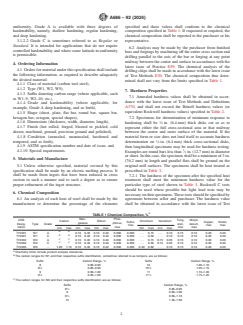
uniformity. Grade A is available with three degrees of specified and these values shall conform to the chemical
hardenability, namely, shallow hardening, regular hardening, composition specified in Table 1. If requested or required, the
and deep hardening. chemical composition shall be reported to the purchaser or his
3.1.2.2 Grade C is sometimes referred to as Regular or representative.
Standard. It is intended for applications that do not require
6.2 Analysis may be made by the purchaser from finished
controlled hardenability and where some latitude in uniformity
bars and forgings by machining off the entire cross section and
is permissible.
drilling parallel to the axis of the bar or forging at any point
midway between the center and surface in accordance with the
4. Ordering Information
latest issue of Practice E59. The chemical analysis of the
4.1 Orders for material under this specification shall include
drilling chips shall be made in accordance with the latest issue
the following information, as required to describe adequately
of Test Methods E30. The chemical composition thus deter-
the desired material:
mined shall not vary from the limits specified in Table 1.
4.1.1 Class of material (carbon tool steel),
4.1.2 Type (W1, W2, W5),
7. Hardness Properties
4.1.3 Suffix denoting carbon range (where applicable, such
7.1 Annealed hardness values shall be obtained in accor-
as W1–9, W2–10, etc.),
dance with the latest issue of Test Methods and Definitions
4.1.4 Grade and hardenability (where applicable, for
A370, and shall not exceed the Brinell hardness values (or
example, Grade A deep hardening, and so forth),
equivalent Rockwell hardness values) specified in Table 2.
4.1.5 Shape (sheet, plate, flat bar, round bar, square bar,
hexagon bar, octagon, special shapes),
7.2 Specimens for determination of minimum response to
4.1.6 Dimensions (thickness, width, diameter, length),
hardening shall be ⁄4 in. (6.4 mm) thick disks cut so as to
4.1.7 Finish (hot rolled, forged, blasted or pickled, cold
represent either the full cross-sectional area or that midway
drawn, machined, ground, precision ground and polished),
between the center and outer surface of the material. If the
4.1.8 Condition (annealed, unannealed, hardened and
material form or size does not lend itself to accurate hardness
tempered, and so forth),
determination on ⁄4 in. (6.4 mm) thick cross-sectional disks,
4.1.9 ASTM specification number and date of issue, and
then longitudinal specimens may be used for hardness testing.
4.1.10 Special requirements.
Examples are round bars less than ⁄2 in. (12.7 mm) in diameter
or sheet. In this case, the specimen shall be a minimum of 3 in.
5. Materials and Manufacture
(76.2 mm) in length and parallel flats shall be ground on the
5.1 Unless otherwise specified, material covered by this original mill surfaces. The specimens shall be heat treated as
specification shall be made by an electric melting process. It prescribed in Table 3.
shall be made from ingots that have been reduced in cross 7.2.1 The hardness of the specimen after the specified heat
section in such a manner and to such a degree as to ensure
treatment shall meet the minimum hardness value for the
proper refinement of the ingot structure.
particular type of steel shown in Table 3. Rockwell C tests
should be used where possible but light load tests may be
6. Chemical Composition
necessary on thin specimens. These tests should be specified by
6.1 An analysis of each heat of steel shall be made by the agreement between seller and purchaser. The hardness value
manufacturer to determine the percentage of the elements shall be obtained in accordance with the latest issue of Test
A
TABLE 1 Chemical Composition, %
Man- Phos-
UNS Tung- Molyb-
Carbon Silicon Chromium Vanadium
Sulfur, Copper, Nickel,
ganese phorus,
Desig- Type Grade sten, denum,
max max max
max
nation max max
min max min max min max min max min max
B B
T72301 W1 A 0.10 0.40 0.10 0.40 0.030 0.030 . . . 0.15 . . . 0.10 0.15 0.10 0.20 0.20
B B
T72301 W1 C 0.10 0.40 0.10 0.40 0.030 0.030 . . . 0.30 . . . 0.10 0.15 0.10 0.20 0.20
C C
T72302 W2 A 0.10 0.40 0.10 0.40 0.030 0.030 . . . 0.15 0.15 0.35 0.15 0.10 0.20 0.20
C C
T72302 W2 C 0.10 0.40 0.10 0.40 0.030 0.030 . . . 0.30 0.15 0.35 0.15 0.10 0.20 0.20
T72305 W5 . 1.05 1.15 0.10 0.40 0.10 0.40 0.030 0.030 0.40 0.60 . . . 0.10 0.15 0.10 0.20 0.20
A
Chemistry limits include product analysis tolerances.
B
The carbon ranges for W1 and their respective suffix identification, sometimes referred to as tempers, are as follows:
Suffix Carbon Range, % Suffix Carbon Range, %
8 0.80–0.90 10 1.00–1.10
1 1
8 ⁄2 0.85–0.95 10 ⁄2 1.05–1.15
9 0.90–1.00 11 1.10–1.20
1 1
9 ⁄2 0.95–1.05 11 ⁄2 1.15–1.25
C
The carbon ranges for W2 and their respective suffix identification are as follows:
Suffix Carbon Range, %
8 ⁄2 0.85–0.95
9 0.90–1.00
9 ⁄2 0.95–1.10
13 1.30–1.50
A686 − 92 (2024)
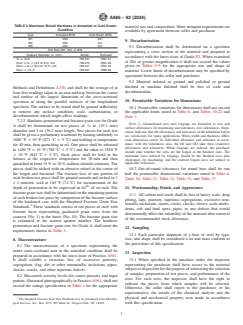
TABLE 2 Maximum Brinell Hardness in Annealed or Cold Drawn
material size and composition. More stringent requirements are
Condition
available by agreement between seller and purchaser.
Type Annealed BHN Cold Drawn BHN
W1 202 241
9. Decarburization
W2 202 241
W5 202 241
9.1 Decarburization shall be determined on a specimen
Drill Rod (W1, W2, or W5)
representing a cross section of the material and prepared in
Ordered Diameter, in. (mm) Brinell Rockwell
accordance with the latest issue of Guide E3. When examined
To ⁄8 (3.2) HB 341 HRC 37
at 20× or greater magnification it shall not exceed the values
1 1
Over ⁄8 to ⁄4 (3.2 to 6.4), incl HB 275 HRC 28
1 1
Over ⁄4 to ⁄2 (6.4 to 12.7), incl HB 241 HRC 23 given in Tables 5-9 for the appropriate size and shape of
Over ⁄2 (12.7) HB 207 HRB 96
material. Lower limits of decarburization may be specified by
agreement between the seller and purchaser.
9.2 Material ordered as ground and polished or ground
finished or machine finished shall be free of scale and
Methods and Definitions A370, and shall be the average of at
decarburization.
least five readings taken in an area midway between the center
and surface of the largest dimension of the cross-sectional
10. Permissible Variations for Dimensions
specimen or along the parallel surfaces of the longitudinal
specimen. The surface to be tested shall be ground sufficiently
10.1 Permissible variations for dimensions shall not exceed
to remove any surface condition, scale, carburization, or
the applicable limits stated in Table 6, and Tables 10-22 and
decarburization which might affect readings.
Note 1.
7.2.2 Hardness penetration and fracture grain size for Grade
NOTE 1—Unmachined tool steel forgings are furnished to size and
A shall be determined on test pieces of ⁄4 in. (19.1 mm)
surface allowances for machining and tolerances over allowances. Expe-
diameter and 3 in. (76.2 mm) length. Two pieces for each test
rience indicates that the allowances and tolerances in the tabulation below
shall be given a preliminary treatment by heating uniformly to
are satisfactory for many applications. When width and thickness differ,
each dimension carries its individual allowance and tolerance in accor-
1600 °F 6 10 °F (871 °C 6 5 °C) and holding at temperature
dance with the tabulation: also, the ID and OD take their respective
for 40 min, then quenching in oil. One piece shall be reheated
allowances and tolerances. When forgings are ordered, the purchaser
to 1450 °F 6 10 °F (788 °C 6 5 °C) and the other to 1550 °F
should state whether the sizes are the forged or the finished sizes. The
6 10 °F (843 °C 6 5 °C). Each piece shall be held in the
minimum sizes ordered for forgings should be the finished sizes plus
furnace at the respective temperature for 30 min and then
allowances for machining; and the ordered forged sizes are subject to
applicable tolerances
quenched in brine (5 % to 10 % sodium chloride solution). The
pieces shall be nicked with an abrasive wheel in the center of
10.2 Out-of-round tolerances for round bars shall be one
the length and fractured. The fracture face of one portion of
half the permissible dimensional variations stated in Table 6,
each broken test piece shall be ground smooth and etched in 1
Table 10, Table 12, Table 14, Table 15, and Table 17.
+ 1 muriatic acid at 165 °F (74 °C) for measurement of the
ths
depth of penetration to be expressed in 64 of an inch. The
11. Workmanship, Finish, and Appearance
fracture grain size shall be determined on the remaining portion
11.1 All carbon tool steels shall be free of heavy scale, deep
of each broken test piece by comparison of the fracture surface
pitting, laps, porosity, injurious segregations, excessive non-
of the hardened case with the Shepherd Fracture Grain Size
metallic inclusions, seams, cracks, checks, slivers, scale marks,
Standards. These standards consist of ten pieces of steel with
dents, soft and hard spots, pipes, or any defects that would
fracture faces representing graduated grain sizes from the
detrimentally affect the suitability of the material after removal
coarsest (No. 1) to the finest (No. 10). The fracture grain size
of the recommended stock allowance.
is estimated to the nearest quarter number. The hardness
penetration and fracture grain size for Grade A shall meet the
12. Sampling
requirements shown in Table 3.
12.1 Each particular shipment of a heat of steel by type,
size, and shape shall be considered a lot and must conform to
8. Macrostructure
the provisions of this specification.
8.1 The macrostructure of a specimen representing the
entire cross-sectional area in the annealed condition shall be
13. Inspection
prepared in accordance with the latest issue of Practice A561.
13.1 When specified in the purchase order, the inspector
It shall exhibit a structure free of excessive porosity,
representing the purchaser shall have access to the material
segregation, slag, dirt or other nonmetallic inclusions, pipes,
subject to inspection for the purpose of witnessing the selection
checks, cracks, and other injurious defects.
of samples, preparation of test pieces, and performance of the
8.2 Macroetch severity levels for center porosity and ingot
tests. For such tests, the inspector shall have the right to
pattern, illustrated photographically in Practice A561, shall not
indicate the pieces from which samples will be selected.
exceed the ratings specification in Table 4 for the appropriate
Otherwise, the seller shall report to the purchaser, or his
representative, the results of the chemical analysis and the
physical and mechanical property tests made in accordance
The Shepherd Fracture Gain Size Standards may be purchased from Metallur-
gical Services, Inc., Box 1075, 925 Main St., Niagara Falls, NY 14302. with this specification.
A686 − 92 (2024)
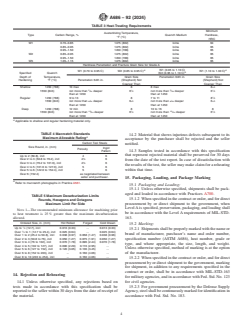
TABLE 3 Heat-Treating Requirements
Minimum
Austenitizing Temperature,
Type Carbon Range, % Quench Medium Hardness,
°F (°C)
HRC
W1 0.70–0.85 1475 (802) brine 64
0.85–0.95 1475 (802) brine 65
0.95–1.50 1450 (788) brine 65
W2 0.85–0.95 1475 (802) brine 65
0.95–1.50 1450 (788) brine 65
W5 1.05–1.15 1475 (802) brine 65
Hardness Penetration and Fracture Grain Size for Grade A
W1 (0.95 to 1.10 C)
A A
W1 (0.70 to 0.95 C) W2 (0.85 to 0.95 C) W1 (1.10 to 1.30 C)
A
Specified Quench W2 (0.95 to 1.10 C)
Depth of Temperature, Grain Size Penetration 64th in. Grain Size
Hardening °F (°C) Penetration 64th in. (Shepherd) Not (Shepherd) Not
Coarser Than Coarser Than
Shallow 1450 (788) 10 max 8 8 max 8 ⁄2
5 1 5 1
1550 (843) not more than ⁄64 deeper 6 ⁄2 not more than ⁄64 deeper 6 ⁄2
than at 1450 than at 1450
Regular 1450 (788) 9 to 13 8 7 to 11 8 ⁄2
8 1 8 1
1550 (843) not more than ⁄64 deeper 6 ⁄2 not more than ⁄64 deeper 6 ⁄2
than at 1450 than at 1450
Deep 1450 (788) 12 min 8 10 to 16 8
10 1 10 1
1550 (843) not more than ⁄64 deeper 6 ⁄2 not more than ⁄64 deeper 6 ⁄2
than at 1450 than at 1450
A
Applicable to shallow and regular hardening material only.
TABLE 4 Macroetch Standards
14.2 Material that shows injurious defects subsequent to its
A
Maximum Allowable Rating
acceptance by the purchaser shall be rejected and the seller
Carbon Tool Steels
notified.
Size Round, in. (mm)
Ingot
Porosity
14.3 Samples tested in accordance with this specification
Pattern
that represent rejected material shall be preserved for 30 days
Up to 2 (50.8), incl 4 6
Over 2 to 3 (50.8 to 76.2), incl 4½ 6
from the date of the test report. In case of dissatisfaction with
Over 3 to 4 (76.2 to 101.6), incl 4½ 6
the results of the test, the seller may make claim for a rehearing
Over 4 to 5 (101.6 to 127.0), incl 5 6
within that time.
Over 5 to 6 (122.0 to 152.4), incl 5 6
Over 6 (152.4) as negotiated between
seller and purchaser.
15. Packaging, Loading, and Package Marking
A
Refer to macroetch photographs in Practice A561.
15.1 Packaging and Loading:
15.1.1 Unless otherwise specified, shipments shall be pack-
aged and loaded in accordance with Practices A700.
TABLE 5 Maximum Decarburization Limits
15.1.2 When specified in the contract or order, and for direct
Rounds, Hexagons and Octagons
Maximum Limit Per Side procurement by or direct shipment to the government, when
Level A is specified, preservation, packaging, and loading shall
NOTE 1—The recommended minimum allowance for machining prior
be in accordance with the Level A requirements of MIL-STD-
to heat treatment is 25 % greater than the maximum decarburization
163.
allowed.
Ordered Size, in. (mm) Hot Rolled Forged Cold Drawn
15.2 Marking:
Up to ⁄2 (12.7), incl 0.013 (0.33) . 0.013 (0.33)
15.2.1 Shipments shall be properly marked with the name or
Over ⁄2 to 1 (12.7 to 25.4), incl 0.025 (0.64) . 0.025 (0.64)
brand of manufacturer, purchaser’s name and order number,
Over 1 to 2 (25.4 to 50.8), incl 0.038 (0.97) 0.058 (1.47) 0.038 (0.96)
Over 2 to 3 (50.8 to 76), incl 0.050 (1.27) 0.075 (1.91) 0.050 (1.27) specification number (ASTM A686), heat number, grade or
Over 3 to 4 (76 to 102), incl 0.070 (1.78) 0.096 (2.44) 0.070 (1.78)
type, and where appropriate, the size, length, and weight.
Over 4 to 5 (102 to 127), incl 0.090 (2.29) 0.116 (2.95) .
Unless otherwise specified, method of marking is at the option
Over 5 to 6 (127 to 152), incl 0.120 (3.05) 0.136 (3.45) .
Over 6 to 8 (152 to 203), incl . 0.160 (4.06) .
of the manufacturer.
Over 8 to 10 (203 to 254), incl . 0.160 (4.06) .
15.2.2 When specified in the contract or order, and for direct
procurement by or direct shipment to the government, marking
for shipment, in addition to any requirements specified in the
contract or order, shall be in accordance with MIL-STD-163
14. Rejection and Rehearing
for military agencies, and in accordance with Fed. Std. No. 123
14.1 Unless otherwise specified, any rejections based on for civil agencies.
tests made in accordance with this specification shall be 15.2.3 For government procurement by the Defense Supply
reported to the seller within 30 days from the date of receipt of Agency, steel shall be continuously marked for identification in
the material. accordance with Fed. Std. No. 183.
A686 − 92 (2024)
TABLE 6 Rough-Turned Round Bars
A
Size Tolerance
B
Size Tolerance, in. (mm)
Specified Sizes,
in. (mm)
Under Over
3 1
Over ⁄4 to 1 ⁄2 (19.0 to 38.1), incl 0.00 010 (0.254)
1 1
Over 1 ⁄2 to 3 ⁄16 (38.1 to 77.8), incl 0.00 015 (0.38)
1 1
Over 3 ⁄16 to 4 ⁄16 (77.8 to 103.2), incl 0.00 031 (0.79)
1 1
Over 4 ⁄16 to 6 ⁄16 (103.2 to 154), incl 0.00 062 (1.6)
1 1
Over 6 ⁄16 to 10 ⁄16 (154 to 255.6), incl 0.00 094 (2.4)
Over 10 ⁄16 Please consult producer
A
Out-of-round tolerances to be ⁄2 of the total tolerance.
B
Consult producer for oversize allowance and decarburization limits for all sizes.
TABLE 7 Maximum Decarburization Limits
Hot Rolled Square and Flat Bars
Maximum Limit Per Side
NOTE 1—The recommended minimum allowance for machining prior to heat treatment is 25 % greater than the maximum decarburization allowed.
Specified Widths, in. (mm)
Specified
1 1
0 to ⁄2 (0 Over ⁄2 to Over 1 to Over 2 to Over 3 to Over 4 to Over 5 to Over 6 to Over 7 to Over 8 to Over 9 to
Thickness,
to 12.7) 1 (12.7 to 2 (25.4 to 3 (50.8 to 4 (76 to 5 (102 to 6 (127 to 7 (152 to 8 (178 to 9 (203 to 12 (229 to
in. (mm)
incl. 25.4), incl 50.8), incl 76), incl 102), incl 127), incl 152), incl 178), incl 203), incl 229), incl 304), incl
0 to ⁄2 (0 to 12.7), A 0.020 0.020 0.024 0.028 0.032 0.036 0.040 0.044 0.048 0.04
...