


ASTM G37-98(2011)
(Practice)Standard Practice for Use of Mattsson's Solution of pH 7.2 to Evaluate the Stress- Corrosion Cracking Susceptibility of Copper-Zinc Alloys
Standard Practice for Use of Mattsson's Solution of pH 7.2 to Evaluate the Stress- Corrosion Cracking Susceptibility of Copper-Zinc Alloys
SIGNIFICANCE AND USE
This test environment is believed to give an accelerated ranking of the relative or absolute degree of stress-corrosion cracking susceptibility for different brasses. It has been found to correlate well with the corresponding service ranking in environments that cause stress-corrosion cracking which is thought to be due to the combined presence of traces of moisture and ammonia vapor. The extent to which the accelerated ranking correlates with the ranking obtained after long-term exposure to environments containing corrodents other than ammonia is not at present known. Examples of such environments may be severe marine atmospheres (Cl−), severe industrial atmospheres (predominantly SO2), and super-heated ammonia-free steam.
It is not possible at present to specify any particular time to failure (defined on the basis of any particular failure criteria) in pH 7.2 Mattsson's solution that corresponds to a distinction between acceptable and unacceptable stress-corrosion behavior in brass alloys. Such particular correlations must be determined individually.
Mattsson's solution of pH 7.2 may also cause stress independent general and intergranular corrosion of brasses to some extent. This leads to the possibility of confusing stress-corrosion failures with mechanical failures induced by corrosion-reduced net cross sections. This danger is particularly great with small cross section specimens, high applied stress levels, long exposure periods and stress-corrosion resistant alloys. Careful metallographic examination is recommended for correct diagnosis of the cause of failure. Alternatively, unstressed control specimens may be exposed to evaluate the extent to which stress independent corrosion degrades mechanical properties.
SCOPE
1.1 This practice covers the preparation and use of Mattsson's solution of pH 7.2 as an accelerated stress-corrosion cracking test environment for brasses (copper-zinc base alloys). The variables (to the extent that these are known at present) that require control are described together with possible means for controlling and standardizing these variables.
1.2 This practice is recommended only for brasses (copper-zinc base alloys). The use of this test environment is not recommended for other copper alloys since the results may be erroneous, providing completely misleading rankings. This is particularly true of alloys containing aluminum or nickel as deliberate alloying additions.
1.3 This practice is intended primarily where the test objective is to determine the relative stress-corrosion cracking susceptibility of different brasses under the same or different stress conditions or to determine the absolute degree of stress corrosion cracking susceptibility, if any, of a particular brass or brass component under one or more specific stress conditions. Other legitimate test objectives for which this test solution may be used do, of course, exist. The tensile stresses present may be known or unknown, applied or residual. The practice may be applied to wrought brass products or components, brass castings, brass weldments, and so forth, and to all brasses. Strict environmental test conditions are stipulated for maximum assurance that apparent variations in stress-corrosion susceptibility are attributable to real variations in the material being tested or in the tensile stress level and not to environmental variations.
1.4 This practice relates solely to the preparation and control of the test environment. No attempt is made to recommend surface preparation or finish, or both, as this may vary with the test objectives. Similarly, no attempt is made to recommend particular stress-corrosion test specimen configurations or methods of applying the stress. Test specimen configurations that may be used are referenced in Practice G30 and STP 425.
1.5 The values stated in SI units are to be regarded as standard. No other units of measurement are included in this standard. ...
General Information
Relations
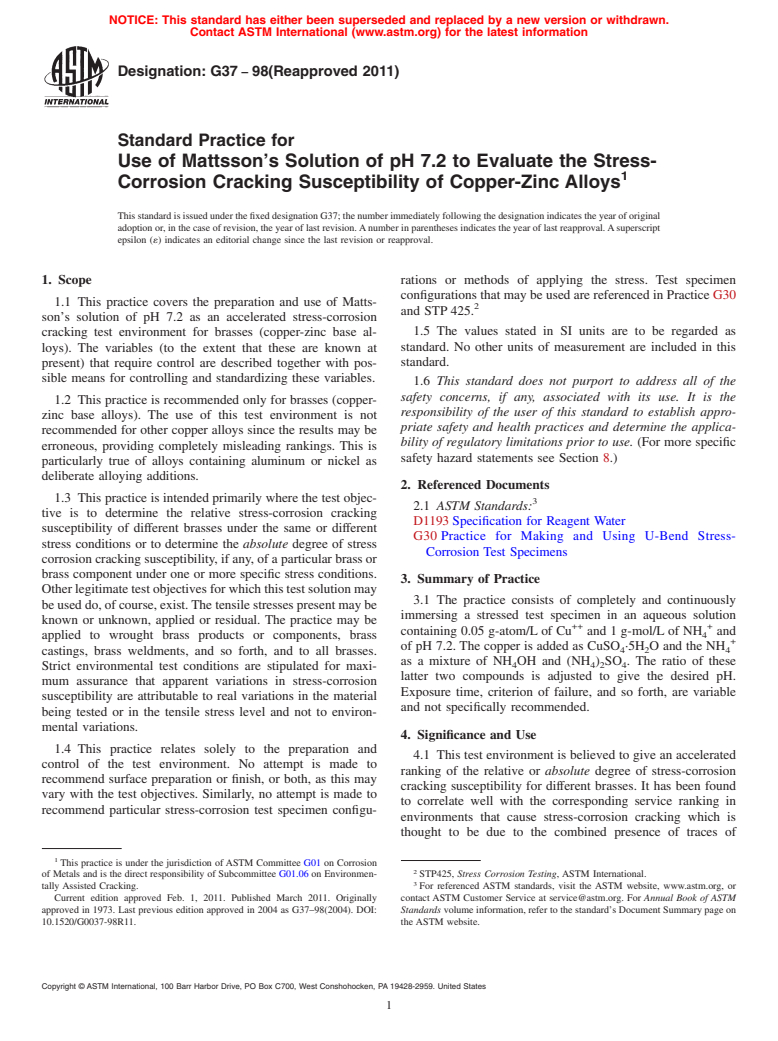
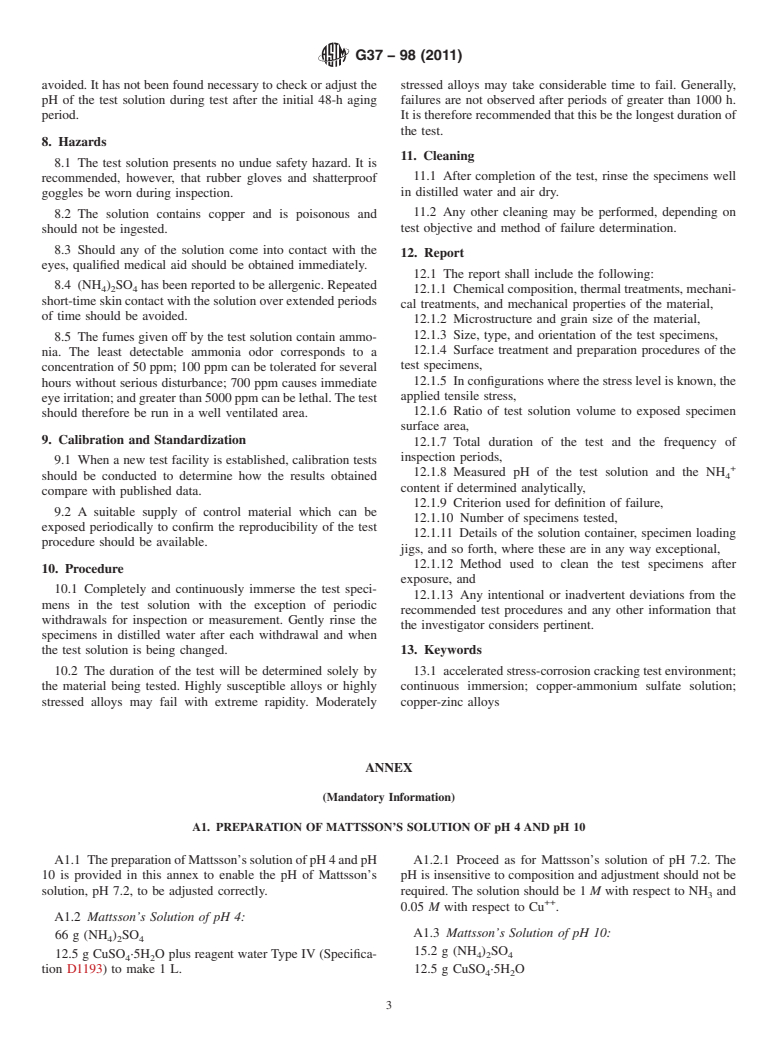
Standards Content (Sample)
NOTICE: This standard has either been superseded and replaced by a new version or withdrawn.
Contact ASTM International (www.astm.org) for the latest information
Designation: G37 − 98(Reapproved 2011)
Standard Practice for
Use of Mattsson’s Solution of pH 7.2 to Evaluate the Stress-
Corrosion Cracking Susceptibility of Copper-Zinc Alloys
ThisstandardisissuedunderthefixeddesignationG37;thenumberimmediatelyfollowingthedesignationindicatestheyearoforiginal
adoptionor,inthecaseofrevision,theyearoflastrevision.Anumberinparenthesesindicatestheyearoflastreapproval.Asuperscript
epsilon (´) indicates an editorial change since the last revision or reapproval.
1. Scope rations or methods of applying the stress. Test specimen
configurations that may be used are referenced in PracticeG30
1.1 This practice covers the preparation and use of Matts-
and STP425.
son’s solution of pH 7.2 as an accelerated stress-corrosion
1.5 The values stated in SI units are to be regarded as
cracking test environment for brasses (copper-zinc base al-
standard. No other units of measurement are included in this
loys). The variables (to the extent that these are known at
standard.
present) that require control are described together with pos-
sible means for controlling and standardizing these variables.
1.6 This standard does not purport to address all of the
safety concerns, if any, associated with its use. It is the
1.2 This practice is recommended only for brasses (copper-
responsibility of the user of this standard to establish appro-
zinc base alloys). The use of this test environment is not
priate safety and health practices and determine the applica-
recommended for other copper alloys since the results may be
bility of regulatory limitations prior to use. (For more specific
erroneous, providing completely misleading rankings. This is
safety hazard statements see Section 8.)
particularly true of alloys containing aluminum or nickel as
deliberate alloying additions.
2. Referenced Documents
1.3 This practice is intended primarily where the test objec-
2.1 ASTM Standards:
tive is to determine the relative stress-corrosion cracking
D1193Specification for Reagent Water
susceptibility of different brasses under the same or different
G30 Practice for Making and Using U-Bend Stress-
stress conditions or to determine the absolute degree of stress
Corrosion Test Specimens
corrosioncrackingsusceptibility,ifany,ofaparticularbrassor
brass component under one or more specific stress conditions.
3. Summary of Practice
Otherlegitimatetestobjectivesforwhichthistestsolutionmay
3.1 The practice consists of completely and continuously
beuseddo,ofcourse,exist.Thetensilestressespresentmaybe
immersing a stressed test specimen in an aqueous solution
known or unknown, applied or residual. The practice may be
++ +
containing 0.05 g-atom/L of Cu and 1 g-mol/L of NH and
applied to wrought brass products or components, brass
+
of pH 7.2. The copper is added as CuSO ·5H O and the NH
4 2 4
castings, brass weldments, and so forth, and to all brasses.
as a mixture of NH OH and (NH ) SO . The ratio of these
4 4 2 4
Strict environmental test conditions are stipulated for maxi-
latter two compounds is adjusted to give the desired pH.
mum assurance that apparent variations in stress-corrosion
Exposure time, criterion of failure, and so forth, are variable
susceptibility are attributable to real variations in the material
and not specifically recommended.
being tested or in the tensile stress level and not to environ-
mental variations.
4. Significance and Use
1.4 This practice relates solely to the preparation and
4.1 This test environment is believed to give an accelerated
control of the test environment. No attempt is made to
ranking of the relative or absolute degree of stress-corrosion
recommend surface preparation or finish, or both, as this may
cracking susceptibility for different brasses. It has been found
vary with the test objectives. Similarly, no attempt is made to
to correlate well with the corresponding service ranking in
recommend particular stress-corrosion test specimen configu-
environments that cause stress-corrosion cracking which is
thought to be due to the combined presence of traces of
This practice is under the jurisdiction ofASTM Committee G01 on Corrosion
of Metals and is the direct responsibility of Subcommittee G01.06 on Environmen- STP425, Stress Corrosion Testing, ASTM International.
tally Assisted Cracking. For referenced ASTM standards, visit the ASTM website, www.astm.org, or
Current edition approved Feb. 1, 2011. Published March 2011. Originally contact ASTM Customer Service at service@astm.org. For Annual Book of ASTM
approved in 1973. Last previous edition approved in 2004 as G37–98(2004). DOI: Standards volume information, refer to the standard’s Document Summary page on
10.1520/G0037-98R11. the ASTM website.
Copyright © ASTM International, 100 Barr Harbor Drive, PO Box C700, West Conshohocken, PA 19428-2959. United States
G37 − 98 (2011)
moisture and ammonia vapor. The extent to which the accel- Committee on Analytical Reagents of the American Chemical
erated ranking correlates with the ranking obtained after Society shall be used.
long-term exposure to environments containing corrodents
6.2 Purity of Water—Reagent water Type IV (Specification
otherthanammoniaisnotatpresentknown.Examplesofsuch
D1193) shall be used to prepare the test solution.
−
environmentsmaybeseveremarineatmospheres(Cl ),severe
industrial atmospheres (predominantly SO ), and super-heated 7. Test Solution
ammonia-free steam.
7.1 The concentration of the test solution shall be 0.05
++
g-atom/Lwith respect to Cu and 1.0 g-mol/Lwith respect to
4.2 Itisnotpossibleatpresenttospecifyanyparticulartime
+
tofailure(definedonthebasisofanyparticularfailurecriteria) NH . The pH of the test solution shall be 7.2+0.3,−0.1 pH.
in pH 7.2 Mattsson’s solution that corresponds to a distinction
7.2 The test solution shall be prepared by completely
betweenacceptableandunacceptablestress-corrosionbehavior
dissolving 590.0 6 1.0 g of (NH ) SO in 4 Lof water and by
4 2 4
inbrassalloys.Suchparticularcorrelationsmustbedetermined
completely dissolving 125.0 6 0.5 g of CuSO ·5HOin1Lof
4 2
individually.
water. These two solutions should then be thoroughly mixed
and 71.0 6 0.2 mLof NH OH solution added, preferably with
4.3 Mattsson’s solution of pH 7.2 may also cause stress 4
a buret. Finally, the whole should be diluted to 10.0 6 0.1 L
independent general and intergranular corrosion of brasses to
and allowed to age for 48 to 96 h in the test container prior to
some extent. This leads to the possibility of confusing stress-
use. It is not recommended that the solution be stored for
corrosion failures with mechanical failures induced by
extended periods or used without the specified aging. Smaller
corrosion-reduced net cross sections. This danger is particu-
or larger volumes of solution can be prepared using lesser
larly great with small cross section specimens, high applied
amounts of reagents in the same proportions.
stress levels, long exposure periods and stress-corrosion resis-
tant alloys. Careful metallographic examination is recom-
7.3 After aging, the pH of the test solution should be
mended for correct diagnosis of the cause of failure. Alterna-
measured. If outside the range specified above, the pH may be
tively, unstressed control specimens may be exposed to
adjusted to within the range 7.1 to 7.5 by the addition of fresh
evaluate the extent to which stress independent corrosion
pH 4 or pH 10 Mattsson’s solution. Addition of NH OH or
degrades mechanical properties.
H SO to adjust pH is not recommended since the concentra-
2 4
tion of the various soluble ions can be considerably altered.
5. Apparatus
7.4 Temperature control of the test solution is not recom-
5.1 Anysuitableinertcontainermaybeusedtoholdthetest
mended.Instead,theroomairtemperatureshouldbecontrolled
solutionandtestspecimensduringexposure.Glassorplasticis at 21 6 3°C and the test solution allowed to reach its
highly recommended. The container should be fitted with a
equilibrium temperature with the air. No room air relative
removable top to reduce evaporation during test, thus prevent- humiditycontrolisrecommendedandtemperaturerecordingis
ing dust and other particulate matter fro
...
Questions, Comments and Discussion
Ask us and Technical Secretary will try to provide an answer. You can facilitate discussion about the standard in here.