

ASTM E323-11(2021)
(Specification)Standard Specification for Perforated-Plate Sieves for Testing Purposes
General Information
- Abstract
ABSTRACT
This specification covers perforated-plate sieves with either round or square apertures, normally mounted in a frame for use in precision testing in the classification of materials according to designated nominal particle size. The materials used in the manufacture of these sieves shall be steel, stainless steel, brass, bronze, or other rigid material. Each plate of specified sieve designation and aperture size shall conform to individually allocated dimensional requirements.
SCOPE
1.1 This specification covers perforated plate with either round or square apertures, normally mounted in a frame for use as sieves in precision testing in the classification of materials according to designated nominal particle size. A method for checking the accuracy of perforated sieve plates is included as information in Appendix X1.
Note 1: The perforated-plate sieves covered by this specification are intended for general precision testing. Some industries may require more restricted specifications for sieves for special testing purposes.
Note 2: For other types of sieves see Specifications E11 and E161.
Note 3: Complete instructions and procedures on the use of test sieves are contained in ASTM STP 447, Manual on Test Sieving Methods. This manual also contains a list of all ASTM published standards on sieve analysis procedures for specific materials or industries.
1.2 The values stated in inch-pound units are to be regarded as standard. The values given in parentheses are mathematical conversions to SI units that are provided for information only and are not considered standard.
1.3 This standard does not purport to address all of the safety concerns, if any, associated with its use. It is the responsibility of the user of this standard to establish appropriate safety, health, and environmental practices and determine the applicability of regulatory limitations prior to use.
1.4 This international standard was developed in accordance with internationally recognized principles on standardization established in the Decision on Principles for the Development of International Standards, Guides and Recommendations issued by the World Trade Organization Technical Barriers to Trade (TBT) Committee.
- Status
- Published
- Publication Date
- 31-Aug-2021
- Technical Committee
- E29 - Particle and Spray Characterization
- Drafting Committee
- E29.01 - Sieves, Sieving Methods, and Screening Media

Overview
ASTM E323-11(2021), Standard Specification for Perforated-Plate Sieves for Testing Purposes, provides requirements for the manufacture and use of perforated-plate sieves, which are essential tools for classifying materials based on particle size. These sieves, equipped with round or square apertures, are primarily constructed from robust materials such as steel, stainless steel, brass, bronze, or other rigid substances. This specification ensures that sieves meet precise standards necessary for reliable and repeatable particle size testing, which is vital in quality control, production, and research environments across many industries.
Key Topics
Design and Construction
- Covers sieves with round or square apertures, precisely arranged for accuracy in particle size classification.
- The sieve plates must conform to stringent dimensional requirements, including permissible variations for aperture sizes and plate thickness.
- Materials such as steel, stainless steel, brass, and bronze are specified for construction, prohibiting any paint, plating, or coating.
- Sieve plates are normally mounted in frames, which may be square, rectangular, or circular, with defined borders and appropriate frame heights.
Aperture Arrangement and Marking
- Round apertures are arranged in an equilateral triangular pattern; square apertures can be arranged either staggered or in line.
- All sieves are to be clearly marked with aperture sizes in both millimeters and inches, directly on the plate or frame, aiding traceability and compliance.
Inspection and Accuracy
- The standard outlines methods for checking the accuracy of aperture sizes, including recommended measurement and visual inspection techniques to ensure quality.
- Specific guidance is provided for verifying dimensions and plate thickness using calibrated gauges or accurate measuring tools.
Labeling and Packaging
- Requirements for labeling each perforated sieve for clear identification.
- Stipulations for packaging and shipment are included to ensure products arrive undamaged and appropriately marked for shipping authorities.
Applications
Perforated-plate sieves standard ASTM E323-11(2021) are widely used in:
- Minerals and Aggregates Testing
Ensuring correct grading and particle size distribution in construction materials. - Agricultural Products Classifying grains, seeds, and fertilizers for processing and quality control.
- Chemical and Pharmaceutical Industries Standardizing powders and granules for manufacturing consistency.
- Environmental Testing Analyzing soil or sediment samples for ecological research or regulatory compliance.
- Quality Assurance Laboratories Providing repeatable and verifiable particle size analysis to meet product specifications.
The standard is referenced and applied globally wherever precision particle size separation is critical for product safety, performance, or regulatory requirements.
Related Standards
For comprehensive sieving and particle size analysis protocols, ASTM E323-11(2021) should be used in conjunction with:
- ASTM E11: Specification for Woven Wire Test Sieve Cloth and Test Sieves.
- ASTM E161: Specification for Electroformed Material and Test Sieves.
- ASTM E1638: Terminology Relating to Sieves, Sieving Methods, and Screening Media.
- ASTM STP 447: Manual on Test Sieving Methods - detailed guidance on sieving procedures and data interpretation.
These related standards ensure compatibility and provide additional technical and terminology support for implementing precise and effective sieving operations in laboratory or industrial environments.
Keywords: Perforated-plate sieves, ASTM E323, particle size analysis, test sieve, sieve analysis, precision testing, sieve construction, aperture size, material classification, quality control.
Relations
- Effective Date
- 01-Oct-2013
- Effective Date
- 01-Jun-2013
- Effective Date
- 15-May-2012
- Effective Date
- 01-Apr-2012
- Refers
ASTM E1638-11a - Standard Terminology Relating to Sieves, Sieving Methods, and Screening Media - Effective Date
- 15-Nov-2011
- Effective Date
- 01-May-2011
- Effective Date
- 01-Dec-2010
- Effective Date
- 01-May-2010
- Effective Date
- 01-May-2009
- Effective Date
- 01-Mar-2009
- Effective Date
- 01-Oct-2007
- Effective Date
- 01-Oct-2004
- Effective Date
- 01-Oct-2004
- Effective Date
- 01-May-2004
- Effective Date
- 10-May-2001
Get Certified
Connect with accredited certification bodies for this standard

IMP NDT d.o.o.
Non-destructive testing services. Radiography, ultrasonic, magnetic particle, penetrant, visual inspection.
Inštitut za kovinske materiale in tehnologije
Institute of Metals and Technology. Materials testing, metallurgical analysis, NDT.
Q Techna d.o.o.
NDT and quality assurance specialist. 30+ years experience. NDT personnel certification per ISO 9712, nuclear and thermal power plant inspections, QA/
Sponsored listings
Frequently Asked Questions
ASTM E323-11(2021) is a technical specification published by ASTM International. Its full title is "Standard Specification for Perforated-Plate Sieves for Testing Purposes". This standard covers: ABSTRACT This specification covers perforated-plate sieves with either round or square apertures, normally mounted in a frame for use in precision testing in the classification of materials according to designated nominal particle size. The materials used in the manufacture of these sieves shall be steel, stainless steel, brass, bronze, or other rigid material. Each plate of specified sieve designation and aperture size shall conform to individually allocated dimensional requirements. SCOPE 1.1 This specification covers perforated plate with either round or square apertures, normally mounted in a frame for use as sieves in precision testing in the classification of materials according to designated nominal particle size. A method for checking the accuracy of perforated sieve plates is included as information in Appendix X1. Note 1: The perforated-plate sieves covered by this specification are intended for general precision testing. Some industries may require more restricted specifications for sieves for special testing purposes. Note 2: For other types of sieves see Specifications E11 and E161. Note 3: Complete instructions and procedures on the use of test sieves are contained in ASTM STP 447, Manual on Test Sieving Methods. This manual also contains a list of all ASTM published standards on sieve analysis procedures for specific materials or industries. 1.2 The values stated in inch-pound units are to be regarded as standard. The values given in parentheses are mathematical conversions to SI units that are provided for information only and are not considered standard. 1.3 This standard does not purport to address all of the safety concerns, if any, associated with its use. It is the responsibility of the user of this standard to establish appropriate safety, health, and environmental practices and determine the applicability of regulatory limitations prior to use. 1.4 This international standard was developed in accordance with internationally recognized principles on standardization established in the Decision on Principles for the Development of International Standards, Guides and Recommendations issued by the World Trade Organization Technical Barriers to Trade (TBT) Committee.
ABSTRACT This specification covers perforated-plate sieves with either round or square apertures, normally mounted in a frame for use in precision testing in the classification of materials according to designated nominal particle size. The materials used in the manufacture of these sieves shall be steel, stainless steel, brass, bronze, or other rigid material. Each plate of specified sieve designation and aperture size shall conform to individually allocated dimensional requirements. SCOPE 1.1 This specification covers perforated plate with either round or square apertures, normally mounted in a frame for use as sieves in precision testing in the classification of materials according to designated nominal particle size. A method for checking the accuracy of perforated sieve plates is included as information in Appendix X1. Note 1: The perforated-plate sieves covered by this specification are intended for general precision testing. Some industries may require more restricted specifications for sieves for special testing purposes. Note 2: For other types of sieves see Specifications E11 and E161. Note 3: Complete instructions and procedures on the use of test sieves are contained in ASTM STP 447, Manual on Test Sieving Methods. This manual also contains a list of all ASTM published standards on sieve analysis procedures for specific materials or industries. 1.2 The values stated in inch-pound units are to be regarded as standard. The values given in parentheses are mathematical conversions to SI units that are provided for information only and are not considered standard. 1.3 This standard does not purport to address all of the safety concerns, if any, associated with its use. It is the responsibility of the user of this standard to establish appropriate safety, health, and environmental practices and determine the applicability of regulatory limitations prior to use. 1.4 This international standard was developed in accordance with internationally recognized principles on standardization established in the Decision on Principles for the Development of International Standards, Guides and Recommendations issued by the World Trade Organization Technical Barriers to Trade (TBT) Committee.
ASTM E323-11(2021) is classified under the following ICS (International Classification for Standards) categories: 19.120 - Particle size analysis. Sieving. The ICS classification helps identify the subject area and facilitates finding related standards.
ASTM E323-11(2021) has the following relationships with other standards: It is inter standard links to ASTM E11-13, ASTM E1638-13, ASTM E1638-12, ASTM E161-12, ASTM E1638-11a, ASTM E1638-11, ASTM E1638-10, ASTM E161-00(2010), ASTM E11-09e1, ASTM E1638-09, ASTM E1638-07a, ASTM E161-00(2004), ASTM E1638-94(2004), ASTM E11-04, ASTM E11-01. Understanding these relationships helps ensure you are using the most current and applicable version of the standard.
ASTM E323-11(2021) is available in PDF format for immediate download after purchase. The document can be added to your cart and obtained through the secure checkout process. Digital delivery ensures instant access to the complete standard document.
Standards Content (Sample)
This international standard was developed in accordance with internationally recognized principles on standardization established in the Decision on Principles for the
Development of International Standards, Guides and Recommendations issued by the World Trade Organization Technical Barriers to Trade (TBT) Committee.
Designation: E323 −11 (Reapproved 2021)
Standard Specification for
Perforated-Plate Sieves for Testing Purposes
This standard is issued under the fixed designation E323; the number immediately following the designation indicates the year of
original adoption or, in the case of revision, the year of last revision. A number in parentheses indicates the year of last reapproval. A
superscript epsilon (´) indicates an editorial change since the last revision or reapproval.
This standard has been approved for use by agencies of the U.S. Department of Defense.
1. Scope E11 Specification for Woven Wire Test Sieve Cloth and Test
Sieves
1.1 This specification covers perforated plate with either
E161 Specification for Electroformed Material and Test
round or square apertures, normally mounted in a frame for use
Sieves
as sieves in precision testing in the classification of materials
E1638 Terminology Relating to Sieves, Sieving Methods,
according to designated nominal particle size. A method for
and Screening Media
checking the accuracy of perforated sieve plates is included as
2.2 Other Documents:
information in Appendix X1.
Fed. Std. No. 123 Marking for Shipment (Civil Agencies)
NOTE 1—The perforated-plate sieves covered by this specification are
MIL-STD-129 Marking for Shipment and Storage
intended for general precision testing. Some industries may require more
restricted specifications for sieves for special testing purposes.
3. Terminology
NOTE 2—For other types of sieves see Specifications E11 and E161.
NOTE 3—Complete instructions and procedures on the use of test sieves 3.1 Definitions—For definitions of related terms, refer to
are contained in ASTM STP 447, Manual on Test Sieving Methods. This
Terminology E1638.
manual also contains a list of all ASTM published standards on sieve
analysis procedures for specific materials or industries.
4. Perforated Sieve Plates
1.2 The values stated in inch-pound units are to be regarded
4.1 Materials used in the manufacture of perforated sieve
as standard. The values given in parentheses are mathematical
plates shall be steel, stainless steel, brass, bronze, or other rigid
conversions to SI units that are provided for information only
material and shall not be painted, plated, or otherwise coated.
and are not considered standard.
The thickness of materials used for perforated sieves plates
1.3 This standard does not purport to address all of the
shall conform to the requirements of column (7) in Table 1, but
safety concerns, if any, associated with its use. It is the may vary within the limits shown in column (10).
responsibility of the user of this standard to establish appro-
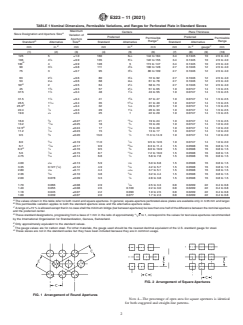
4.2 Round apertures shall be arranged with their centers
priate safety, health, and environmental practices and deter-
nominally at the vertices of equilateral triangles as shown in
mine the applicability of regulatory limitations prior to use.
Fig. 1. The diameter of any aperture shall not vary from the
1.4 This international standard was developed in accor-
nominal diameter given in columns (1) and (2) of Table 1 by
dance with internationally recognized principles on standard-
more than the maximum variation given in column (3). The
ization established in the Decision on Principles for the
preferred centers for round apertures shall be as given in
Development of International Standards, Guides and Recom-
column (4) of Table 1 but may vary within the range given in
mendations issued by the World Trade Organization Technical
column (6).
Barriers to Trade (TBT) Committee.
4.3 Square apertures shall be arranged in a staggered pattern
with their midpoints nominally at the vertices of isosceles
2. Referenced Documents
triangles whose bases shall equal their heights or shall be
2.1 ASTM Standards:
arranged in line with their midpoints nominally at the vertices
of squares as shown in Fig. 2. The midsection of any aperture
shall not vary from the nominal midsection dimension given in
ThisspecificationisunderthejurisdictionofASTMCommitteeE29onParticle
and Spray Characterization and is the direct responsibility of Subcommittee E29.01
columns (1) and (2) of Table 1 by more than the maximum
on Sieves, Sieving Methods, and Screening Media.
variation given in column (3). The preferred centers for square
Current edition approved Sept. 1, 2021. Published October 2021. Originally
apertures shall be as given in column (4) of Table 1, but may
approved in 1967. Last previous edition approved in 2016 as E323 – 11 (2016).
DOI: 10.1520/E0323-11R21. vary within the range given in column (6).
For referenced ASTM standards, visit the ASTM website, www.astm.org, or
contact ASTM Customer Service at service@astm.org. For Annual Book of ASTM
Standards volume information, refer to the standard’s Document Summary page on Available from DLA Document Services, Building 4/D, 700 Robbins Ave.,
the ASTM website. Philadelphia, PA 19111-5094, http://quicksearch.dla.mil.
Copyright © ASTM International, 100 Barr Harbor Drive, PO Box C700, West Conshohocken, PA 19428-2959. United States
E323 − 11 (2021)
TABLE 1 Nominal Dimensions, Permissible Variations, and Ranges for Perforated Plate in Standard Sieves
Maximum Centers Plate Thickness
A
Sieve Designation and Aperture Size
Variation of
Preferred Preferred
Permissible Permissible
Aperture
C
D
B Range Range
Standard Alternative Size Standard Alternative Standard Alternative
E E E F
mm in. mm mm in. mm mm in. gauge mm
(1) (2) (3) (4) (5) (6) (7) (8) (9) (10)
125 5 ±1.0 160 6 ⁄4 144 to 184 3.4 0.1345 10 2.5 to 4.0
1 1
106 4 ⁄4 ±0.9 135 5 ⁄4 122 to 155 3.4 0.1345 10 2.5 to 4.0
G
100 4 ±0.9 128 5 115 to 147 3.4 0.1345 10 2.5 to 4.0
1 3
90 3 ⁄2 ±0.8 111 4 ⁄8 100 to 128 2.7 0.1046 12 2.5 to 4.0
75 3 ±0.7 95 3 ⁄4 86 to 109 2.7 0.1046 12 2.5 to 4.0
1 1
63 2 ⁄2 ±0.6 80 3 ⁄8 72 to 92 2.7 0.1046 12 2.5 to 4.0
1 5
53 2 ⁄8 ±0.6 68 2 ⁄8 61 to 78 2.7 0.1046 12 2.5 to 4.0
G
50 2 ±0.5 64 2 ⁄2 58 to 73 2.7 0.1046 12 2.5 to 4.0
3 1
45 1 ⁄4 ±0.5 57 2 ⁄4 51 to 65 1.9 0.0747 14 1.5 to 2.5
1 7
37.5 1 ⁄2 ±0.4 48 1 ⁄8 43 to 55 1.9 0.0747 14 1.5 to 2.5
1 5
31.5 1 ⁄4 ±0.4 41 1 ⁄8 37 to 47 1.9 0.0747 14 1.5 to 2.5
1 5
26.5 1 ⁄16 ±0.4 35 1 ⁄16 31 to 40 1.9 0.0747 14 1.5 to 2.5
G
25.0 1 ±0.4 32 1 ⁄4 29 to 37 1.9 0.0747 14 1.5 to 2.5
7 1
22.4 ⁄8 ±0.3 29 1 ⁄8 26 to 33 1.9 0.0747 14 1.5 to 2.5
19.0 ⁄4 ±0.3 25 1 22 to 29 1.9 0.0747 14 1.5 to 2.5
5 13
16.0 ⁄8 ±0.27 21 ⁄16 19 to 24 1.9 0.0747 14 1.5 to 2.5
17 3
13.2 ⁄32 ±0.25 18 ⁄4 16 to 20 1.9 0.0747 14 1.0 to 2.0
G
1 11
12.5 ⁄2 ±0.24 17 ⁄16 15 to 20 1.9 0.0747 14 1.0 to 2.0
7 5
11.2 ⁄16 ±0.23 15 ⁄8 13 to 17 1.9 0.0747 14 1.0 to 2.0
3 1
9.5 ⁄8 ±0.20 13.0 ⁄2 11.3 to 14.9 1.9 0.0747 14 1.0 to 2.0
5 7
8.0 ⁄16 ±0.19 11.0 ⁄16 9.5 to 12.6 1.9 0.0747 14 1.0 to 2.0
17 25
6.7 ⁄64 ±0.17 9.9 ⁄64 8.3 to 11.4 1.5 0.0598 16 0.8 to 1.5
G
1 3
6.3 ⁄4 ±0.16 9.5 ⁄8 8.0 to 10.9 1.5 0.0598 16 0.8 to 1.5
7 11
5.6 ⁄32 ±0.15 8.7 ⁄32 7.2 to 10.0 1.5 0.0598 16 0.8 to 1.5
3 1
4.75 ⁄16 ±0.14 6.8 ⁄4 5.8 to 7.8 1.5 0.0598 16 0.8 to 1.5
5 7
4.00 ⁄32 ±0.13 5.9 ⁄32 5.0 to 6.8 1.5 0.0598 16 0.8 to 1.5
1 3
3.35 0.127 ( ⁄8) ±0.12 4.9 ⁄16 4.2 to 5.7 1.5 0.0598 16 0.8 to 1.5
7 11
2.80 ⁄64 ±0.11 4.4 ⁄64 3.7 to 5.1 1.5 0.0598 16 0.8 to 1.5
3 5
2.36 ⁄62 ±0.10 3.8 ⁄32 3.2 to 4.4 1.5 0.0598 16 0.8 to 1.5
2.00 0.078 ±0.09 3.3 ⁄8 2.8 to 3.8 1.5 0.0598 16 0.8 to 1.5
1.70 0.066 ±0.08 2.9 ⁄64 2.5 to 3.3 0.8 0.0299 22 0.4 to 0.8
1.40 0.055 ±0.08 2.6 0.100 2.2 to 3.0 0.8 0.0299 22 0.4 to 0.8
1.18 0.045 ±0.07 2.2 0.090 1.9 to 2.5 0.8 0.0299 22 0.4 to 0.8
1.00 0.039 ±0.07 2.0 0.077 1.7 to 2.3 0.8 0.0299 22 0.4 to 0.8
A
The values shown in this table refer to both round and square apertures. In general, square-aperture perforated-sieve plates are available only in 3.35 mm and larger.
B
This permissible variation applies to both the standard aperture sizes and the alternative aperture sizes.
C
Arangeof±15 %isallowedexceptthatinnocaseshalltheminimumbridge(barbetwe
...