

ASTM F1657/F1657M-96(2024)
(Practice)Standard Practice for Emergency Joining of Booms with Incompatible Connectors
General Information
- Abstract
SIGNIFICANCE AND USE
3.1 The use of this practice for the emergency joining of booms will not guarantee the effective performance of the joined boom sections, since each boom design and the environmental conditions of each incident govern the overall performance.
3.2 Historically, different types of end connectors have been produced. This practice addresses the operational need to connect different types, during spill incidents. (Warning—Use of this practice with similar or different sizes of boom may cause the transmission of unwanted loading such as, tension loading and bending moments on certain boom parts resulting in possible premature failure of the containment system.)
3.3 There are a wide range of boom connector configurations presently in use. These connectors were based upon some or all of the following design criteria:
3.3.1 Connect and transfer tensile loads between boom sections,
3.3.2 Minimize oil leakage between boom sections,
3.3.3 Be easily connectable in the presence of dirt, oil or ice, or a combination thereof,
3.3.4 Be quickly and easily connected and disconnected, in and out of the water,
3.3.5 Maintain boom performance (freeboard, heave response, conformance, stability, and so forth),
3.3.6 Be unaffected by temperature extremes,
3.3.7 Have no protruding parts that could snag, injure, or puncture,
3.3.8 Be light weight and buoyant,
3.3.9 Be operatively symmetrical,
3.3.10 Require no special tools for installation or removal,
3.3.11 Require no loose parts for connection,
3.3.12 Extend to the full height and draft of the boom,
3.3.13 Resist distortion (that is, winding boom on a reel), and
3.3.14 Be inherently safe to personnel.
SCOPE
1.1 This practice provides a standard practice for the joining of oil spill containment boom connectors in emergencies.
1.2 The use of this connection method may adversely affect the total tensile strength of the connected booms.
1.3 These criteria are intended to define mating requirements that will allow the emergency or occasional connection of unlike connectors.
1.4 This practice is not intended to replace Specification F962.
1.5 This practice does not address the compatibility of spill control equipment with spill products. It is the user's responsibility to ensure that any equipment selected is compatible with the anticipated spilled material.
1.6 There is no guarantee that all of the connectors in use today can accept the holes spaced as required without interfering with existing bolt holes or other connector features.
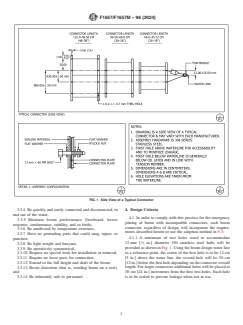
1.7 The values stated in either SI units or inch-pound units are to be regarded separately as standard. The values stated in each system may not be exact equivalents; therefore, each system shall be used independently of the other. Combining values from the two systems may result in non-conformance with the standard. See Note 5 in Fig. 1—dimensions A and B are critical.
FIG. 1 Side View of a Typical Connector
1.8 This standard does not purport to address all of the safety concerns, if any, associated with its use. It is the responsibility of the user of this standard to establish appropriate safety, health, and environmental practices and determine the applicability of regulatory limitations prior to use. For a specific precautionary statement, see 3.2.
1.9 This international standard was developed in accordance with internationally recognized principles on standardization established in the Decision on Principles for the Development of International Standards, Guides and Recommendations issued by the World Trade Organization Technical Barriers to Trade (TBT) Committee.
- Status
- Published
- Publication Date
- 29-Feb-2024
- Technical Committee
- F20 - Hazardous Substances and Oil Spill Response
- Drafting Committee
- F20.11 - Control


Overview
ASTM F1657/F1657M-96(2024), Standard Practice for Emergency Joining of Booms with Incompatible Connectors, defines procedures for connecting oil spill containment booms during emergency response situations when booms have incompatible connector types. By outlining standardized emergency practices, this document promotes interoperability between various boom designs on the market, enhancing rapid oil spill containment during critical incidents. Developed in accordance with internationally recognized standards principles, this ASTM practice responds to real-world operational needs and environmental challenges faced during spill response.
Key Topics
Scope and Limitations
- This standard provides procedures for emergency joining only; it is not a replacement for permanent connectors or comprehensive compatibility checks.
- Use of this practice may impact the total tensile strength and overall performance of assembled boom sections.
- Users are cautioned that improper application may lead to suboptimal containment or premature failure due to loading on incompatible connectors.
Operational Considerations
- Designed for use when swift containment is critical and standard connection methods are not possible due to differing connector types.
- Addresses requirements for joining connectors of different sizes or designs, acknowledging the risk of unwanted loads or stress on boom parts.
- Suggests using non-metallic gaskets to minimize leakage at connection points, with materials chosen for chemical compatibility with spill products.
Design Criteria
- Connectors should allow for the transfer of tensile loads, minimize oil leakage, and maintain boom functional performance (stability, buoyancy, conformance).
- Connection points are specified for alignment based on waterline, ensuring adaptability to various connector designs.
- Ensures ease of use in challenging conditions (oil, dirt, ice) and specifies no requirement for special tools or loose parts for installation and removal.
User Responsibilities
- Users are responsible for ensuring any adapted connections maintain safety, health, and environmental protection standards.
- Verification of the mechanical strength and chemical compatibility of combined booms remains essential.
- The standard does not guarantee compatibility or performance across all existing boom/connectors-proper assessment is required for each incident.
Applications
Oil Spill Emergency Response
- Used primarily by environmental agencies, marine spill responders, and oil recovery operators during oil spill emergencies when rapid deployment of booms is needed, regardless of connector compatibility.
- Facilitates the joining of booms from different manufacturers, reducing delays and improving spill containment efficiency.
Temporary Spill Containment
- Supports temporary or occasional connections when permanent solutions are unavailable or impractical.
- Useful during natural disasters, vessel accidents, or pipeline ruptures where mismatched boom connectors are present on site.
Interoperability in Multi-Agency Operations
- Enables cooperation between organizations with different yet functionally similar containment systems, supporting mutual aid and international spill response.
Related Standards
- ASTM F818 – Terminology relating to spill response booms and barriers: Provides essential definitions for consistent communication.
- ASTM F962 – Specification for Oil Spill Response Boom Connection: Z-Connector: Sets requirements for permanent boom connectors.
- ASTM F1093 – Test Methods for Tensile Strength Characteristics of Oil Spill Response Boom: Supplies test methods relevant to this practice.
- ASTM F1523 – Guide for Selection of Booms in Accordance With Water Body Classifications: Assists with selecting suitable booms based on application environment.
Keywords: Oil spill containment, boom connector, emergency joining, incompatible connectors, spill response, ASTM F1657, boom interoperability, oil spill emergency response.
Relations
- Effective Date
- 01-Mar-2024
Get Certified
Connect with accredited certification bodies for this standard

Institut za varilstvo d.o.o. (Welding Institute)
Slovenia's leading welding institute since 1952. ISO 3834, EN 1090, pressure equipment certification, NDT personnel, welder qualification. Only IIW Au
Sponsored listings
Frequently Asked Questions
ASTM F1657/F1657M-96(2024) is a standard published by ASTM International. Its full title is "Standard Practice for Emergency Joining of Booms with Incompatible Connectors". This standard covers: SIGNIFICANCE AND USE 3.1 The use of this practice for the emergency joining of booms will not guarantee the effective performance of the joined boom sections, since each boom design and the environmental conditions of each incident govern the overall performance. 3.2 Historically, different types of end connectors have been produced. This practice addresses the operational need to connect different types, during spill incidents. (Warning—Use of this practice with similar or different sizes of boom may cause the transmission of unwanted loading such as, tension loading and bending moments on certain boom parts resulting in possible premature failure of the containment system.) 3.3 There are a wide range of boom connector configurations presently in use. These connectors were based upon some or all of the following design criteria: 3.3.1 Connect and transfer tensile loads between boom sections, 3.3.2 Minimize oil leakage between boom sections, 3.3.3 Be easily connectable in the presence of dirt, oil or ice, or a combination thereof, 3.3.4 Be quickly and easily connected and disconnected, in and out of the water, 3.3.5 Maintain boom performance (freeboard, heave response, conformance, stability, and so forth), 3.3.6 Be unaffected by temperature extremes, 3.3.7 Have no protruding parts that could snag, injure, or puncture, 3.3.8 Be light weight and buoyant, 3.3.9 Be operatively symmetrical, 3.3.10 Require no special tools for installation or removal, 3.3.11 Require no loose parts for connection, 3.3.12 Extend to the full height and draft of the boom, 3.3.13 Resist distortion (that is, winding boom on a reel), and 3.3.14 Be inherently safe to personnel. SCOPE 1.1 This practice provides a standard practice for the joining of oil spill containment boom connectors in emergencies. 1.2 The use of this connection method may adversely affect the total tensile strength of the connected booms. 1.3 These criteria are intended to define mating requirements that will allow the emergency or occasional connection of unlike connectors. 1.4 This practice is not intended to replace Specification F962. 1.5 This practice does not address the compatibility of spill control equipment with spill products. It is the user's responsibility to ensure that any equipment selected is compatible with the anticipated spilled material. 1.6 There is no guarantee that all of the connectors in use today can accept the holes spaced as required without interfering with existing bolt holes or other connector features. 1.7 The values stated in either SI units or inch-pound units are to be regarded separately as standard. The values stated in each system may not be exact equivalents; therefore, each system shall be used independently of the other. Combining values from the two systems may result in non-conformance with the standard. See Note 5 in Fig. 1—dimensions A and B are critical. FIG. 1 Side View of a Typical Connector 1.8 This standard does not purport to address all of the safety concerns, if any, associated with its use. It is the responsibility of the user of this standard to establish appropriate safety, health, and environmental practices and determine the applicability of regulatory limitations prior to use. For a specific precautionary statement, see 3.2. 1.9 This international standard was developed in accordance with internationally recognized principles on standardization established in the Decision on Principles for the Development of International Standards, Guides and Recommendations issued by the World Trade Organization Technical Barriers to Trade (TBT) Committee.
SIGNIFICANCE AND USE 3.1 The use of this practice for the emergency joining of booms will not guarantee the effective performance of the joined boom sections, since each boom design and the environmental conditions of each incident govern the overall performance. 3.2 Historically, different types of end connectors have been produced. This practice addresses the operational need to connect different types, during spill incidents. (Warning—Use of this practice with similar or different sizes of boom may cause the transmission of unwanted loading such as, tension loading and bending moments on certain boom parts resulting in possible premature failure of the containment system.) 3.3 There are a wide range of boom connector configurations presently in use. These connectors were based upon some or all of the following design criteria: 3.3.1 Connect and transfer tensile loads between boom sections, 3.3.2 Minimize oil leakage between boom sections, 3.3.3 Be easily connectable in the presence of dirt, oil or ice, or a combination thereof, 3.3.4 Be quickly and easily connected and disconnected, in and out of the water, 3.3.5 Maintain boom performance (freeboard, heave response, conformance, stability, and so forth), 3.3.6 Be unaffected by temperature extremes, 3.3.7 Have no protruding parts that could snag, injure, or puncture, 3.3.8 Be light weight and buoyant, 3.3.9 Be operatively symmetrical, 3.3.10 Require no special tools for installation or removal, 3.3.11 Require no loose parts for connection, 3.3.12 Extend to the full height and draft of the boom, 3.3.13 Resist distortion (that is, winding boom on a reel), and 3.3.14 Be inherently safe to personnel. SCOPE 1.1 This practice provides a standard practice for the joining of oil spill containment boom connectors in emergencies. 1.2 The use of this connection method may adversely affect the total tensile strength of the connected booms. 1.3 These criteria are intended to define mating requirements that will allow the emergency or occasional connection of unlike connectors. 1.4 This practice is not intended to replace Specification F962. 1.5 This practice does not address the compatibility of spill control equipment with spill products. It is the user's responsibility to ensure that any equipment selected is compatible with the anticipated spilled material. 1.6 There is no guarantee that all of the connectors in use today can accept the holes spaced as required without interfering with existing bolt holes or other connector features. 1.7 The values stated in either SI units or inch-pound units are to be regarded separately as standard. The values stated in each system may not be exact equivalents; therefore, each system shall be used independently of the other. Combining values from the two systems may result in non-conformance with the standard. See Note 5 in Fig. 1—dimensions A and B are critical. FIG. 1 Side View of a Typical Connector 1.8 This standard does not purport to address all of the safety concerns, if any, associated with its use. It is the responsibility of the user of this standard to establish appropriate safety, health, and environmental practices and determine the applicability of regulatory limitations prior to use. For a specific precautionary statement, see 3.2. 1.9 This international standard was developed in accordance with internationally recognized principles on standardization established in the Decision on Principles for the Development of International Standards, Guides and Recommendations issued by the World Trade Organization Technical Barriers to Trade (TBT) Committee.
ASTM F1657/F1657M-96(2024) is classified under the following ICS (International Classification for Standards) categories: 23.020.10 - Stationary containers and tanks. The ICS classification helps identify the subject area and facilitates finding related standards.
ASTM F1657/F1657M-96(2024) has the following relationships with other standards: It is inter standard links to ASTM F1657/F1657M-96(2018). Understanding these relationships helps ensure you are using the most current and applicable version of the standard.
ASTM F1657/F1657M-96(2024) is available in PDF format for immediate download after purchase. The document can be added to your cart and obtained through the secure checkout process. Digital delivery ensures instant access to the complete standard document.
Standards Content (Sample)
This international standard was developed in accordance with internationally recognized principles on standardization established in the Decision on Principles for the
Development of International Standards, Guides and Recommendations issued by the World Trade Organization Technical Barriers to Trade (TBT) Committee.
Designation: F1657/F1657M − 96 (Reapproved 2024)
Standard Practice for
Emergency Joining of Booms with Incompatible
Connectors
This standard is issued under the fixed designation F1657/F1657M; the number immediately following the designation indicates the year
of original adoption or, in the case of revision, the year of last revision. A number in parentheses indicates the year of last reapproval.
A superscript epsilon (´) indicates an editorial change since the last revision or reapproval.
1. Scope Development of International Standards, Guides and Recom-
mendations issued by the World Trade Organization Technical
1.1 This practice provides a standard practice for the joining
Barriers to Trade (TBT) Committee.
of oil spill containment boom connectors in emergencies.
1.2 The use of this connection method may adversely affect
2. Referenced Documents
the total tensile strength of the connected booms.
2.1 ASTM Standards:
1.3 These criteria are intended to define mating require-
F818 Terminology Relating to Spill Response Booms and
ments that will allow the emergency or occasional connection
Barriers
of unlike connectors.
F962 Specification for Oil Spill Response Boom Connec-
tion: Z-Connector
1.4 This practice is not intended to replace Specification
F962. F1093 Test Methods for Tensile Strength Characteristics of
Oil Spill Response Boom
1.5 This practice does not address the compatibility of spill
F1523 Guide for Selection of Booms in Accordance With
control equipment with spill products. It is the user’s respon-
Water Body Classifications
sibility to ensure that any equipment selected is compatible
with the anticipated spilled material.
3. Significance and Use
1.6 There is no guarantee that all of the connectors in use
3.1 The use of this practice for the emergency joining of
today can accept the holes spaced as required without interfer-
booms will not guarantee the effective performance of the
ing with existing bolt holes or other connector features.
joined boom sections, since each boom design and the envi-
1.7 The values stated in either SI units or inch-pound units
ronmental conditions of each incident govern the overall
are to be regarded separately as standard. The values stated in
performance.
each system may not be exact equivalents; therefore, each
3.2 Historically, different types of end connectors have been
system shall be used independently of the other. Combining
produced. This practice addresses the operational need to
values from the two systems may result in non-conformance
connect different types, during spill incidents. (Warning—Use
with the standard. See Note 5 in Fig. 1—dimensions A and B
of this practice with similar or different sizes of boom may
are critical.
cause the transmission of unwanted loading such as, tension
1.8 This standard does not purport to address all of the
loading and bending moments on certain boom parts resulting
safety concerns, if any, associated with its use. It is the
in possible premature failure of the containment system.)
responsibility of the user of this standard to establish appro-
3.3 There are a wide range of boom connector configura-
priate safety, health, and environmental practices and deter-
tions presently in use. These connectors were based upon some
mine the applicability of regulatory limitations prior to use.
or all of the following design criteria:
For a specific precautionary statement, see 3.2.
3.3.1 Connect and transfer tensile loads between boom
1.9 This international standard was developed in accor-
sections,
dance with internationally recognized principles on standard-
3.3.2 Minimize oil leakage between boom sections,
ization established in the Decision on Principles for the
3.3.3 Be easily connectable in the presence of dirt, oil or ice,
or a combination thereof,
This practice is under the jurisdiction of ASTM Committee F20 on Hazardous
Substances and Oil Spill Response and is the direct responsibility of Subcommittee
F20.11 on Control. For referenced ASTM standards, visit the ASTM website, www.astm.org, or
Current edition approved March 1, 2024. Published March 2024. Originally contact ASTM Customer Service at service@astm.org. For Annual Book of ASTM
approved in 1996. Last previous edition approved in 2018 as F1657 – 96 (2018). Standards volume information, refer to the standard’s Document Summary page on
DOI: 10.1520/F
...