


ASTM D4283-98(2022)
(Test Method)Standard Test Method for Viscosity of Silicone Fluids
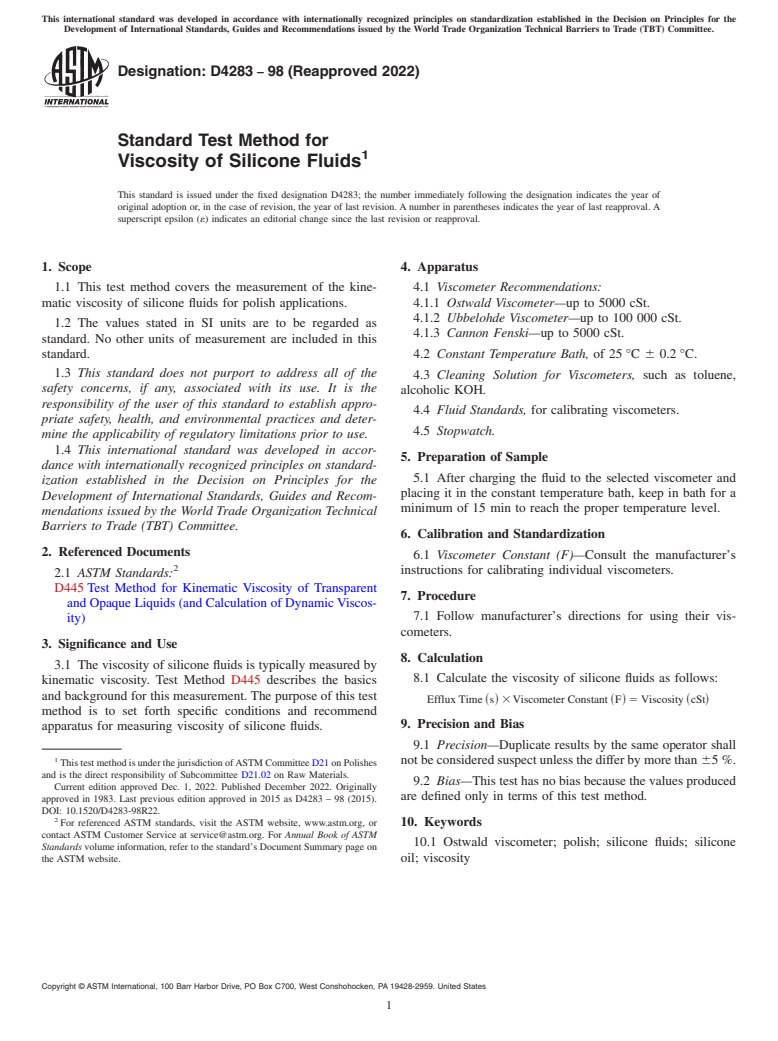
Standard Test Method for Viscosity of Silicone Fluids
SIGNIFICANCE AND USE
3.1 The viscosity of silicone fluids is typically measured by kinematic viscosity. Test Method D445 describes the basics and background for this measurement. The purpose of this test method is to set forth specific conditions and recommend apparatus for measuring viscosity of silicone fluids.
SCOPE
1.1 This test method covers the measurement of the kinematic viscosity of silicone fluids for polish applications.
1.2 The values stated in SI units are to be regarded as standard. No other units of measurement are included in this standard.
1.3 This standard does not purport to address all of the safety concerns, if any, associated with its use. It is the responsibility of the user of this standard to establish appropriate safety, health, and environmental practices and determine the applicability of regulatory limitations prior to use.
1.4 This international standard was developed in accordance with internationally recognized principles on standardization established in the Decision on Principles for the Development of International Standards, Guides and Recommendations issued by the World Trade Organization Technical Barriers to Trade (TBT) Committee.
General Information
Standards Content (Sample)
This international standard was developed in accordance with internationally recognized principles on standardization established in the Decision on Principles for the
Development of International Standards, Guides and Recommendations issued by the World Trade Organization Technical Barriers to Trade (TBT) Committee.
Designation: D4283 − 98 (Reapproved 2022)
Standard Test Method for
1
Viscosity of Silicone Fluids
This standard is issued under the fixed designation D4283; the number immediately following the designation indicates the year of
original adoption or, in the case of revision, the year of last revision. A number in parentheses indicates the year of last reapproval. A
superscript epsilon (´) indicates an editorial change since the last revision or reapproval.
1. Scope 4. Apparatus
1.1 This test method covers the measurement of the kine- 4.1 Viscometer Recommendations:
matic viscosity of silicone fluids for polish applications. 4.1.1 Ostwald Viscometer—up to 5000 cSt.
4.1.2 Ubbelohde Viscometer—up to 100 000 cSt.
1.2 The values stated in SI units are to be regarded as
4.1.3 Cannon Fenski—up to 5000 cSt.
standard. No other units of measurement are included in this
standard. 4.2 Constant Temperature Bath, of 25 °C 6 0.2 °C.
1.3 This standard does not purport to address all of the
4.3 Cleaning Solution for Viscometers, such as toluene,
safety concerns, if any, associated with its use. It is the
alcoholic KOH.
responsibility of the user of this standard to establish appro-
4.4 Fluid Standards, for calibrating viscometers.
priate safety, health, and environmental practices and deter-
4.5 Stopwatch.
mine the applicability of regulatory limitations prior to use.
1.4 This international standard was developed in accor-
5. Preparation of Sample
dance with internationally recognized principles on standard-
5.1 After charging the fluid to the selected viscometer and
ization established in the Decision on Principles for the
placing it in the constant temperature bath, keep in bath for a
Development of International Standards, Guides and Recom-
minimum of 15 min to reach the proper temperature level.
mendations issued by the World Trade Organization Technical
Barriers to Trade (TBT) Committee.
6. Calibration and Standardization
2. Referenced Documents
6.1 Viscometer Constant (F)—Consult the manufacturer’s
2
instructions for calibrating individual viscometers.
2.1 ASTM Standards:
D445 Test Method for Kinematic Viscosity of Transparent
7. Procedure
and Opaque Liquids (and Calculation of Dynamic Viscos-
7.1 Follow manufacturer’s directions for using their vis-
ity)
cometers.
3. Significance and Use
8. Calculation
3.1 The viscosity of silicone fluids is typically measured by
8.1 Calculate the viscosity of silicone fluids as follows:
kinematic viscosity. Test Method D445 describes the basics
and background for this measurement
...
This May Also Interest You
SIGNIFICANCE AND USE
5.1 This test method is used to evaluate an automotive engine oil's control of engine deposits under operating conditions deliberately selected to accelerate deposit formation. This VH test method was correlated with the previous VG test method, which was correlated with field service data, determined from side-by-side comparisons of two or more oils in police, taxi fleets, and delivery van services.
5.2 This test method, along with other test methods are used to define an engine oils minimum performance level necessary to meet certification requirements for API Category Specifications as outlined in Specification D4485. This test method may also be incorporated in automobile manufacturers’ factory–fill specifications.
5.3 The basic engine used in this test method is representative of many that are in modern automobiles. This factor, along with the accelerated operating conditions, should be considered when interpreting test results.
SCOPE
1.1 This test method is commonly referred to as the Sequence VH test, and it has been correlated with the Sequence VG test. The Sequence VG test was previously correlated with vehicles used in stop-and-go service prior to 1996, particularly with regard to sludge and varnish formation.3 It is one of the test methods required to evaluate oils intended to satisfy the API SN, SN Plus performance category.
1.2 The values stated in SI units are to be regarded as the standard. No other units of measurement are included in this standard.
1.2.1 Exception—Where there is no direct SI equivalent such as screw threads, national pipe threads/diameters, tubing size, or specified single source equipment.
1.3 A table of contents follows:
Section
Scope
1
Referenced Documents
2
Terminology
3
Summary of Test Method
4
Significance and Use
5
Apparatus (General Description)
6
Apparatus (The Test Engine)
7
Sequence VH Test Engine
7.1
Required New Engine Parts
7.2
Reusable Engine Parts
7.3
Specially Fabricated Engine Parts
7.4
Special Engine Measurement and Assembly Equipment
7.5
Miscellaneous Engine Components—Preparation
7.6
Solvents and Cleaners Required
7.7
Assembling the Test Engine—Preparations
7.8
Assembling the Test Engine—Installations
7.9
Engine Installation on the Test Stand
7.10
Engine Fluids (Supply/Discharge Systems)
8
Intake Air
8.1
Fuel and Fuel System
8.2
Engine Oil and Engine Oil System
8.3
Coolants
8.4
Measurement Instrumentation
9
Temperatures
9.1
Pressures
9.2
Flow Rates
9.3
Fuel Consumption
9.4
Speed and Torque
9.5
Exhaust Gas
9.6
Humidity
9.7
Miscellaneous Laboratory Equipment
10
Test Stand Calibration
11
Test Procedure
12
Pre-Test Procedure
12.1
Engine Operating Procedure
12.2
Periodic Measurements and Functions
12.3
Special Maintenance Procedures
12.4
Diagnostic Data Review
12.5
End of Test Procedure
12.6
Interpretation of Test Results
13
Parts Rating Area—Environment
13.1
Sludge Ratings
13.2
Varnish Ratings
13.3
Clogging
13.4
Sticking
13.5
Used Oil Analyses
13.6
Assessment of Test Validity
14
General
14.1
Used Oil Analyses—Interpretation
14.2
Blowby Flow Rate
14.3
Manifold Absolute Pressure (MAP)
14.4
Fuel Consumption Rate
14.5
Oil Consumption
14.6
Engine Parts Replacement
14.7
Quality Index
14.8
Final Test Report
15
Report Forms
15.1
Precision and Bias
16
Keywords
17
ANNEXES
ASTM TMC: Organization
Annex A1
ASTM TMC: Calibration Procedures
Annex A2
ASTM TMC: Maintenance Activities
Annex A3
ASTM TMC: Related Information
Annex A4
Safety Precautions
Annex A5
Control and Data Acquis...
- Standard91 pagesEnglish languagesale 15% off
- Standard91 pagesEnglish languagesale 15% off
SIGNIFICANCE AND USE
5.1 Lubricating greases are used in almost all bearings used in any machinery. Lubricating grease is composed of ~90 % additized oil and soap or other thickening agent. There are over a dozen metallic elements present in greases, either blended as additives for performance enhancements or as thickeners, or in used greases present as contaminants and wear metals. Determining their concentrations can be an important aspect of grease manufacture. The metal content can also indicate the amount of thickeners in the grease. Additionally, a reliable analysis technique can also assist in the process of trouble shooting problems with new and used grease in the field.
5.2 Although widely used in other sectors of the oil industry for metal analysis, ICP-AES based Test Methods D4951 or D5185 cannot be used for analyzing greases because of their insolubility in organic solvents used in these test methods. Hence, grease samples need to be brought into aqueous solution by acid decomposition before ICP-AES measurements.
5.3 Test Method D3340 has been used to determine lithium and sodium content of lubricating greases using flame photometry. This technique is no longer widely used. This new test method provides a test method for multi-element analysis of grease samples. This is the first D02 standard available for simultaneous multi-element analysis of lubricating greases.
SCOPE
1.1 This test method covers the determination of a number of metals such as aluminum, antimony, barium, calcium, iron, lithium, magnesium, molybdenum, phosphorus, silicon, sodium, sulfur, and zinc in unused lubricating greases by inductively coupled plasma atomic emission spectrometry (ICP-AES) technique.
1.1.1 The range of applicability for this test method, based on the interlaboratory study conducted in 2005,2 is aluminum (10 to 600), antimony (10 to 2300), barium (50 to 800), calcium (20 to 50 000), iron (10 to 360), lithium (300 to 3200), magnesium (30 to 10 000), molybdenum (50 to 22 000), phosphorus (50 to 2000), silicon (10 to 15 000), sodium (30 to 1500), sulfur (1600 to 28 000), and zinc (300 to 2200), all in mg/kg. Lower levels of elements may be determined by using larger sample weights, and higher levels of elements may be determined by using smaller amounts of sample or by using a larger dilution factor after sample dissolution. However, the test precision in such cases has not been determined, and may be different than the ones given in Table 3.
1.1.2 It may also be possible to determine additional metals such as bismuth, boron, cadmium, chromium, copper, lead, manganese, potassium, titanium, etc. by this technique. However, not enough data is available to specify the precision for these latter determinations. These metals may originate into greases through contamination or as additive elements.
1.1.3 During sample preparation, the grease samples are decomposed with a variety of acid mixture(s). It is beyond the scope of this test method to specify appropriate acid mixtures for all possible combination of metals present in the sample. But if the ash dissolution results in any visible insoluble material, the test method may not be applicable for the type of grease being analyzed, assuming the insoluble material contains some of the analytes of interest.
1.2 Elements present at concentrations above the upper limit of the calibration curves can be determined with additional appropriate dilutions of dissolved samples and with no degradation of precision.
1.3 The development of the technique behind this test method is documented by Fox.3
1.4 The values stated in SI units are to be regarded as the standard. The values given in parentheses are for information only.
1.5 This standard does not purport to address all of the safety concerns, if any, associated with its use. It is the responsibility of the user of this standard to establish appropriate safety, health, and environmental practices and dete...
- Standard7 pagesEnglish languagesale 15% off
- Standard7 pagesEnglish languagesale 15% off
SIGNIFICANCE AND USE
5.1 The tendency of oils to foam at high temperature can be a serious problem in systems such as high-speed gearing, high volume pumping, and splash lubrication. Foaming can cause inadequate lubrication, cavitation, and loss of lubricant due to overflow, and these events can lead to mechanical failure.
5.2 Correlation between the amount of foam created or the time for foam to collapse, or both, and actual lubrication failure has not been established. Such relations should be empirically determined for foam sensitive applications.
SCOPE
1.1 This test method covers the procedure for determining the foaming characteristics of lubricating oils (specifically transmission fluid and motor oil) at 150 °C.
1.2 Foaming characteristics of lubricating oils at temperatures up to 93.5 °C are determined by Test Method D892 or IP 146.
1.3 The values stated in SI units are to be regarded as standard.
1.3.1 Exception—The values given in parentheses are provided for information only.
1.4 WARNING—Mercury has been designated by many regulatory agencies as a hazardous substance that can cause serious medical issues. Mercury, or its vapor, has been demonstrated to be hazardous to health and corrosive to materials. Use caution when handling mercury and mercury-containing products. See the applicable product Safety Data Sheet (SDS) for additional information. The potential exists that selling mercury or mercury-containing products, or both, is prohibited by local or national law. Users must determine legality of sales in their location.
1.5 This standard does not purport to address all of the safety concerns, if any, associated with its use. It is the responsibility of the user of this standard to establish appropriate safety, health, and environmental practices and determine the applicability of regulatory limitations prior to use.
1.6 This international standard was developed in accordance with internationally recognized principles on standardization established in the Decision on Principles for the Development of International Standards, Guides and Recommendations issued by the World Trade Organization Technical Barriers to Trade (TBT) Committee.
- Standard9 pagesEnglish languagesale 15% off
- Standard9 pagesEnglish languagesale 15% off
SIGNIFICANCE AND USE
5.1 These are accelerated engine oil tests (known as the 1K and 1N test procedures), performed in a standardized, calibrated, stationary single-cylinder diesel engine using either mass fraction 0.4 % sulfur fuel (1K test) or mass fraction 0.04 % sulfur fuel (1N test), that give a measure of (1) piston and ring groove deposit forming tendency, (2) piston, ring and liner scuffing and (3) oil consumption.
5.2 The 1K test was correlated with vehicles equipped with certain multi-cylinder direct injection engines used in heavy duty and high speed service prior to 1989, particularly with respect to aluminum piston deposits, and oil consumption, when fuel sulfur was nominally mass fraction 0.4 %. These data are given in Research Report RR:D02-1273.9
5.3 The 1N test has been used to predict piston deposit formation in four-stroke cycle, direct injection, diesel engines that have been calibrated to meet 1994 U.S. federal exhaust emission requirements for heavy-duty engines operated on fuel containing less than mass fraction 0.05 % sulfur. See Research Report RR:D02-1321.9
5.4 These test methods are used in the establishment of diesel engine oil specification requirements as cited in Specification D4485 for appropriate API Performance Category oils (API 1509).
5.5 These test methods are also used in diesel engine oil development.
SCOPE
1.1 These test methods cover the performance of engine oils intended for use in certain diesel engines. They are performed in a standardized high-speed, single-cylinder diesel engine by either the 1K (0.4 % mass fuel sulfur) or 1N (0.04 % mass fuel sulfur) procedure.3 The only difference in the two test methods is the fuel used. Piston and ring groove deposit-forming tendency and oil consumption are measured. Also, the piston, the rings, and the liner are examined for distress and the rings for mobility. These test methods are required to evaluate oils intended to satisfy API service categories CF-4 and CH-4 for 1K, and CG-4 for 1N of Specification D4485.
1.2 These test methods, although based on the original Caterpillar 1K/1N procedures,3 also embody TMC information letters issued before these test methods were first published. These test methods are subject to frequent change. Until the next revision of these test methods, TMC will update changes in these test methods by the issuance of information letters which shall be obtained from TMC (see Annex A1 – Annex A4).
1.3 The values stated in SI units are to be regarded as standard. No other units of measurement are included in this standard.
1.3.1 Exception—Where there is no direct SI equivalent such as screw threads, national pipe threads/diameters, tubing size, or single source equipment specified. Also Brake Specific Fuel Consumption is measured in kilograms per kilowatthour.
1.4 The following is the Table of Contents:
Section
Introduction
Scope
1
Referenced documents
2
Terminology
3
Summary of Test Methods
4
Significance and Use
5
Apparatus
6
General Laboratory Requirements
6.1
Test Engine
6.2
Test Engine Accessories and Parts
6.3
Reagents and Materials
7
Test Oil Sample Requirements
8
Preparation of Apparatus
9
Engine Inspection
9.1
Engine Pre-Test Lubrication System Flush
9.2
Engine Pre-Test Measurements and Inspections
9.3
Engine Assembly
9.4
Pressure Testing of Fuel System Assembly
9.5
Calibration of Engine Test Stand
10
General Requirements and Frequency of Calibration
10.1
Runs
10.2
Specified Test Parameters
10.3
Calibration Test Acceptance Criteria
10.4
Action on Rejection of Calibration Test
10.5
Test Numbering
10.6
Reference Oils
10.7
Severity Adjustments
10.8
Engine Operating Procedure
11
...
- Standard70 pagesEnglish languagesale 15% off
- Standard70 pagesEnglish languagesale 15% off
SIGNIFICANCE AND USE
5.1 This is an accelerated engine oil test, performed in a standardized, calibrated, stationary single-cylinder diesel engine that gives a measure of (1) piston and ring groove deposit forming tendency, (2) piston, ring and liner scuffing and (3) oil consumption. The test is used in the establishment of diesel engine oil specification requirements as cited in Specification D4485 for appropriate API Performance Category C oils (API 1509). The test method can also be used in diesel engine oil development.
SCOPE
1.1 This test method covers and is required to evaluate the performance of engine oils intended to satisfy certain American Petroleum Institute (API) C service categories (included in Specification D4485). It is performed in a laboratory using a standardized high-speed, single-cylinder diesel engine.4 Piston and ring groove deposit-forming tendency and oil consumption is measured. The piston, the rings, and the liner are also examined for distress and the rings for mobility.
1.2 The values stated in SI units are to be regarded as standard. No other units of measurement are included in this standard.
1.2.1 Exceptions—Where there is no direct SI equivalent such as screw threads, National Pipe Threads/diameters, tubing size, or where there is a sole source supply equipment specification.
1.3 This standard does not purport to address all of the safety concerns, if any, associated with its use. It is the responsibility of the user of this standard to establish appropriate safety, health, and environmental practices and determine the applicability of regulatory limitations prior to use. Being an engine test method, this standard does have definite hazards that require safe practices (see Appendix X2 on Safety).
1.4 The following is the Table of Contents:
Section
Scope
1
Referenced Documents
2
Terminology
3
Summary of Test Method
4
Significance and Use
5
Apparatus and Installation
6
Intake Air System
6.2.1
Exhaust System
6.2.2
Fuel System
6.2.3
Oil Consumption System
6.2.4
Engine Oil System
6.2.5
Oil Heating System
6.2.5.1
Oil Sample Valve
6.2.5.2
Engine Coolant System
6.2.6
Engine Instrumentation
6.2.7
Reagents and Materials
7
Oil Samples
8
Preparation of Apparatus
9
General Engine Assembly Practices
9.1
Complete Engine Inspection
9.2
Copper Components
9.3
Engine Lubricant System Flush
9.4
Engine Piston Cooling Jets
9.5
Engine Measurements and Inspections
9.6
Cylinder Head
9.7
Valve Guide Bushings
9.8
Fuel Injector
9.9
Piston and Rings
9.10
Cylinder Liner
9.11
Compression Ratio
9.12
Engine Timing
9.13
Engine Coolant System Cleaning Procedure
9.14
Calibration and Standardization
10
Test Cell Instrumentation
10.1
Instrumentation Standards
10.2
Coolant Flow
10.3
Re-calibration Requirements
10.4
Fuel Injectors
10.5
Air Flow
10.6
Intake Air Barrel
10.7
Fuel Filter
10.8
Oil Scale Flow Rates
10.9
Calibration of Test Stands
10.10
Extending Test Stand Calibration Period
10.11
Test Run Numbering
10.13
Humidity Calibration Requirements
10.14
Calibration of Piston Deposit Raters
10.15
Procedure
11
Engine Break-in Procedure
11.1
Cool-down Procedure
11.2
Warm-up Procedure
11.3
Shutdowns and Lost Time
11.4
Periodic Measurements
11.5
Engine Control Systems
11.6
Engine Coolant
11.6.1
Engine Fuel System
11.6.2
Engine Oil Temperature
11.6.3
Exhaust Pressure
11.6.4
Intake Air
11.6.5
Post-Test Procedures
11.7
Piston Ring Side Clearances
11.7.1
Piston Ratings
11.7.2
Referee Ratings
11.7.3
Ring End Gap...
- Standard57 pagesEnglish languagesale 15% off
- Standard57 pagesEnglish languagesale 15% off
SIGNIFICANCE AND USE
5.1 Test Method—The data obtained from the use of this test method provide a comparative index of the fuel-saving capabilities of automotive engine oils under repeatable laboratory conditions. A BL has been established for this test to provide a standard against which all other oils can be compared. The BL oil is an SAE 20W-30 grade fully formulated lubricant. The test procedure was not designed to give a precise estimate of the difference between two test oils without adequate replication. The test method was developed to compare the test oil to the BL oil. Companion test methods used to evaluate engine oil performance for specification requirements are discussed in the latest revision of Specification D4485.
5.2 Use—The Sequence VIE test method is useful for engine oil fuel economy specification acceptance. It is used in specifications and classifications of engine lubricating oils, such as the following:
5.2.1 Specification D4485.
5.2.2 API 1509.
5.2.3 SAE Classification J304.
5.2.4 SAE Classification J1423.
SCOPE
1.1 This test method covers an engine test procedure for the measurement of the effects of automotive engine oils on the fuel economy of passenger cars and light-duty trucks with gross vehicle weight 3856 kg or less. The tests are conducted using a specified spark-ignition engine with a displacement of 3.6 L (General Motors)4 on a dynamometer test stand. It applies to multi-viscosity oils used in these applications.
1.2 The values stated in SI units are to be regarded as standard. No other units of measurement are included in this standard.
1.2.1 Exceptions—Where there is no direct equivalent such as the units for screw threads, National Pipe threads/diameters, tubing size, and single source supply equipment specifications. Additionally, Brake Specific Fuel Consumption (BSFC) is measured in kilogram per kilowatt hour.
1.3 This test method is arranged as follows:
Subject
Section
Introduction
Scope
1
Referenced Documents
2
Terminology
3
Summary of Test Method
4
Significance and Use
5
Apparatus
6
General
6.1
Test Engine Configuration
6.2
Laboratory Ambient Conditions
6.3
Engine Speed and Torque Control
6.4
Dynamometer
6.4.1
Dynamometer Torque
6.4.2
Engine Cooling System
6.5
External Oil System
6.6
Fuel System
6.7
Fuel Flow Measurement
6.7.2
Fuel Temperature and Pressure Control to the Fuel Flow Meter
6.7.3
Fuel Temperature and Pressure Control to Engine Fuel Rail
6.7.4
Fuel Supply Pumps
6.7.5
Fuel Filtering
6.7.6
Engine Intake Air Supply
6.8
Intake Air Humidity
6.8.1
Intake Air Filtration
6.8.2
Intake Air Pressure Relief
6.8.3
Temperature Measurement
6.9
Thermocouple Location
6.9.5
AFR Determination
6.10
Exhaust and Exhaust Back Pressure Systems
6.11
Exhaust Manifolds
6.11.1
Laboratory Exhaust System
6.11.2
Exhaust Back Pressure
6.11.3
Pressure Measurement and Pressure Sensor Locations
6.12
Engine Oil
6.12.2
Fuel to Fuel Flow Meter
6.12.3
Fuel to Engine Fuel Rail
6.12.4
Exhaust Back Pressure
6.12.5
Intake Air
6.12.6
Intake Manifold Vacuum/Absolute Pressure
6.12.7
Coolant Flow Differential Pressure
6.12.8
Crankcase Pressure
6.12.9
Engine Hardware and Related Apparatus
6.13
Test Engine Configuration
6.13.1
ECU (Power Control Module)
6.13.2
Thermostat Block-Off Adapter Plate
6.13.3
Wiring Harness
6.13.4
Thermostat Block-Off Plate
6.13.5
Oil Filter Adapter Plate
6.13.6
Modified Throttle Body Assembly
6.13.7
Fuel Rail
6.13.8
Miscellaneous Apparatus Related to Engine Operation
6.14
Reagents and Materials
7
Engine Oil
7.1
Test Fuel
7.2
Engine Coolant
7.3
Cleaning Materials...
- Standard80 pagesEnglish languagesale 15% off
- Standard80 pagesEnglish languagesale 15% off
SIGNIFICANCE AND USE
5.1 This test method provides a semiquantitative estimate of the acid number of lubricating oils obtained from laboratory oxidation tests using smaller amounts of sample than Test Methods D974, D664, or D3339. It has specific application in Test Method D943 and in Test Method D4871. This test method, therefore, provides a means of monitoring the relative oxidation of lubricating oils by measuring changes in acid number, at different time intervals and under various oxidizing test conditions.
5.2 Since this test method is semiquantitative, each laboratory shall develop its own criteria for each oxidation test method for determining when to switch from this semiquantitative test method to a more precise test method for acid number.
SCOPE
1.1 This test method is a semiquantitative micro method intended for monitoring the changes in acidic constituents occurring in lubricating oils during oxidation testing, when the acid number of such oils falls within the range from 0.02 mg to 1.0 mg of potassium hydroxide per gram of sample. It is applicable to such oils as turbine oils, hydraulic oils, and other circulating oils.
Note 1: This test method is a micro version of Test Method D974 and it produces results similar to that method.
1.2 This test method is designed for use where sample size is limited. It shall not be used as a replacement for higher precision methods such as Test Methods D974 or D664. It shall not be used to monitor oils in-service.
1.3 The values stated in SI units are to be regarded as the standard.
1.3.1 Exception—The values given in parentheses are for information only.
1.4 This standard does not purport to address all of the safety concerns, if any, associated with its use. It is the responsibility of the user of this standard to establish appropriate safety, health, and environmental practices and determine the applicability of regulatory limitations prior to use.
1.5 This international standard was developed in accordance with internationally recognized principles on standardization established in the Decision on Principles for the Development of International Standards, Guides and Recommendations issued by the World Trade Organization Technical Barriers to Trade (TBT) Committee.
- Standard3 pagesEnglish languagesale 15% off
- Standard3 pagesEnglish languagesale 15% off
SCOPE
1.1 This terminology standard covers the compilation of terminology developed by Committee D02 on Petroleum Products, Liquid Fuels, and Lubricants, except that it does not include terms/definitions specific only to the standards in which they appear.
1.1.1 The terminology, mostly definitions, is unique to petroleum, petroleum products, lubricants, and certain products from biomass and chemical synthesis. Meanings of the same terms outside of applications to petroleum, petroleum products, and lubricants can be found in other compilations and in dictionaries of general usage.
1.1.2 The terms/definitions exist in two places: (1) in the standards in which they appear and (2) in this compilation.
1.2 This international standard was developed in accordance with internationally recognized principles on standardization established in the Decision on Principles for the Development of International Standards, Guides and Recommendations issued by the World Trade Organization Technical Barriers to Trade (TBT) Committee.
- Standard82 pagesEnglish languagesale 15% off
- Standard82 pagesEnglish languagesale 15% off
SIGNIFICANCE AND USE
5.1 This test method assesses the performance of an engine oil with respect to control of piston deposits and maintenance of oil consumption under heavy-duty operating conditions selected to accelerate deposit formation in a turbocharged, intercooled four-stroke-cycle diesel engine equipped with a combustion system that minimizes federally controlled exhaust gas emissions.
5.2 The results from this test method may be compared against specification requirements to ascertain acceptance.
5.3 The design of the test engine used in this test method is representative of many, but not all, diesel engines. This factor, along with the accelerated operating conditions, needs to be considered when comparing test results against specification requirements.
SCOPE
1.1 The test method covers a heavy-duty engine test procedure under high output conditions to evaluate engine oil performance with regard to piston deposit formation, piston ring sticking and oil consumption control in a combustion environment designed to minimize exhaust emissions. This test method is commonly referred to as the Caterpillar C13 Heavy-Duty Engine Oil Test.3
1.2 The values stated in SI units are to be regarded as standard. No other units of measurement are included in this standard.
1.2.1 Exceptions—Where there are no SI equivalent such as screw threads, National Pipe Treads (NPT), and tubing sizes.
1.3 This standard does not purport to address all of the safety concerns, if any, associated with its use. It is the responsibility of the user of this standard to establish appropriate safety, health, and environmental practices and determine the applicability of regulatory limitations prior to use. See Annex A1 for general safety precautions.
1.4 This international standard was developed in accordance with internationally recognized principles on standardization established in the Decision on Principles for the Development of International Standards, Guides and Recommendations issued by the World Trade Organization Technical Barriers to Trade (TBT) Committee.
- Standard37 pagesEnglish languagesale 15% off
- Standard37 pagesEnglish languagesale 15% off
SIGNIFICANCE AND USE
5.1 This test method was developed to evaluate automotive engine oils for protection against oil thickening and piston deposits during moderately high-speed, hightemperature service.
5.1.1 The increase in kinematic viscosity of the oil indicates the tendency of an oil to thicken because of oxidation. In automotive service, such thickening can cause oil pump starvation and resultant catastrophic engine failures.
5.1.2 The deposit ratings for an oil indicate the tendency for the formation of deposits throughout the engine, including those that can cause sticking of the piston rings in their grooves. In automotive service, such ring sticking can cause a loss of compression pressures in the engine.
5.2 The test method was developed to correlate with oils of known good and poor protection against oil thickening and piston deposits. Specially formulated oils that produce less than desirable results with unleaded fuels were also used during the development of this test.
5.3 The Sequence IIIH engine oil test has been recommended as a replacement for the Sequence IIIG test and is expected to be used in specifications and classifications of engine lubricating oils, such as the following:
5.3.1 Specification D4485.
5.3.2 Military Specification MIL-PRF-2104.
5.3.3 SAE Classification J183.
SCOPE
1.1 This test method covers an engine test procedure for evaluating automotive engine oils for certain high-temperature performance characteristics, including oil thickening (as measured by kinematic viscosity increase), piston deposits, ring sticking, oil consumption, and phosphorus retention. Such oils include both single-viscosity and multiviscosity grade oils that are used in both spark-ignition, gasoline-fueled engines, as well as in diesel engines.
1.1.1 Additionally, with nonmandatory supplemental requirements, a Sequence IIIHA Test (Mini Rotary Viscometer and Cold Cranking Simulator measurements), or a Sequence IIIHB Test (phosphorus retention measurement) can be conducted. These supplemental test procedures are contained in Appendix X1 and Appendix X2, respectively.
Note 1: Companion test methods used to evaluate engine oil performance for specification requirements are discussed in SAE J304.
1.2 The values stated in SI units are to be regarded as standard. No other units of measurement are included in this standard.
1.2.1 Exceptions:
1.2.1.1 Where there is no direct SI equivalent such as screw threads, national pipe threads/diameters, tubing sizes, and valve sizes and springs.
1.2.1.2 The ring end gaps in Table A8.7, the dimensions for the blowby ventilation support bracket in Fig. A3.2, and the torque wrenches in Table A8.1 are in inch-pound units.
1.3 This standard does not purport to address all of the safety concerns, if any, associated with its use. It is the responsibility of the user of this standard to establish appropriate safety, health, and environmental practices and determine the applicability of regulatory limitations prior to use. Specific warning statements are provided in 6.11.6, 7.1, 7.2.1, and 7.3.
1.4 This international standard was developed in accordance with internationally recognized principles on standardization established in the Decision on Principles for the Development of International Standards, Guides and Recommendations issued by the World Trade Organization Technical Barriers to Trade (TBT) Committee.
- Standard40 pagesEnglish languagesale 15% off
- Standard40 pagesEnglish languagesale 15% off
Questions, Comments and Discussion
Ask us and Technical Secretary will try to provide an answer. You can facilitate discussion about the standard in here.