

ASTM C181-11(2018)
(Test Method)Standard Test Method for Workability Index of Fireclay and High-Alumina Refractory Plastics
General Information
- Abstract
SIGNIFICANCE AND USE
3.1 Workability index serves as a measure of the facility with which refractory plastic materials can be rammed, gunned, or vibrated into place.
3.2 Workability index is commonly used to control consistency of plastics during manufacture. It has also been found useful for specification acceptance by the consumer.
3.3 The workability index determination can provide information for developing a plastic body. When a sample splits under impact at various water contents, it is an indication that the material is “short” or lacking in plasticity.
3.4 Determinations on samples that split during impact will be difficult to reproduce. If the sample splits, the measurement is not a true indication of deformation. This should be noted in the report.
SCOPE
1.1 This test method covers the determination of the workability index of fireclay and high-alumina refractory plastics by measuring the plastic deformation of a molded test specimen when subjected to impacts.
1.2 The values stated in inch-pound units are to be regarded as standard. The values given in parentheses are mathematical conversions to SI units that are provided for information only and are not considered standard.
1.3 This standard does not purport to address all of the safety concerns, if any, associated with its use. It is the responsibility of the user of this standard to establish appropriate safety, health, and environmental practices and determine the applicability of regulatory limitations prior to use.
1.4 This international standard was developed in accordance with internationally recognized principles on standardization established in the Decision on Principles for the Development of International Standards, Guides and Recommendations issued by the World Trade Organization Technical Barriers to Trade (TBT) Committee.
- Status
- Published
- Publication Date
- 30-Sep-2018
- Technical Committee
- C08 - Refractories
- Drafting Committee
- C08.09 - Monolithics


Overview
ASTM C181-11(2018) is the internationally recognized standard test method for determining the workability index of fireclay and high-alumina refractory plastics. Developed by ASTM International, this standard provides a consistent approach for measuring the plastic deformation of molded refractory plastic specimens when subjected to impact. The workability index serves as an important parameter for assessing handling and placement characteristics, ensuring that refractory plastics can be effectively rammed, gunned, or vibrated into place during installation.
This method is invaluable for manufacturers, quality control laboratories, and end-users involved in the production, acceptance, or development of refractory plastics. It assists in maintaining uniform materials and supports specification compliance within the refractories industry.
Key Topics
- Workability Index Definition: The workability index quantitatively expresses how easily a refractory plastic can be formed or compacted, directly impacting its suitability for high-temperature applications.
- Test Method Scope: The procedure covers fireclay and high-alumina formulations, employing a standardized apparatus (sand rammer with plunger and weight) to simulate installation conditions and measure deformation.
- Significance for Manufacturing: The index is vital for controlling plastic consistency during production to meet customer specifications and application requirements.
- Sample Preparation Variables: Proper temperature control and consistent specimen preparation are critical, as variations may affect test reproducibility and accuracy.
- Acceptance and Reporting: Results help in specification acceptance, with special reporting required if samples split under impact, indicating insufficient plasticity or "shortness" of the material.
Applications
The ASTM C181 workability index test method is widely applied in several practical areas:
- Production Quality Control: Used by refractory manufacturers to ensure product batches maintain consistent workability, promoting optimal installation and service performance.
- Specification Compliance: Facilities and end-users apply the test when accepting deliveries to verify that materials meet project or industry requirements.
- Research and Development: Material developers utilize the method to assess the impact of composition changes and to formulate new fireclay or high-alumina plastics with specific placement properties.
- Installation Suitability: The results guide installers on material handling, informing whether a refractory plastic is appropriate for ramming, gunning, or vibrating based on its workability profile.
Effective implementation of the ASTM C181 test supports reduced installation issues, improved material performance, and extends the lifespan of industrial furnaces, kilns, and other high-temperature structures.
Related Standards
Several ASTM and international standards are associated with the testing and characterization of refractories:
- ASTM D2906: Practice for Statements on Precision and Bias for Textiles (referenced in test precision discussions).
- Standards governing physical and chemical properties of monolithic refractories.
- International standardization principles: This test method was developed in accordance with World Trade Organization (WTO) Technical Barriers to Trade (TBT) principles for harmonized testing.
Organizations involved in refractory material production, installation, and quality assurance frequently use ASTM C181 in tandem with other testing methods to obtain a comprehensive evaluation of material performance.
Keywords: ASTM C181, workability index, fireclay refractory plastics, high-alumina refractory plastics, plastic deformation, refractories testing, quality control, installation suitability, standard test method.
Relations
- Effective Date
- 01-Oct-2018
- Effective Date
- 10-Nov-1997
- Effective Date
- 10-Nov-1997
- Effective Date
- 01-Oct-2018
- Effective Date
- 01-Oct-2018
- Effective Date
- 01-Oct-2018
- Effective Date
- 01-Oct-2018
Frequently Asked Questions
ASTM C181-11(2018) is a standard published by ASTM International. Its full title is "Standard Test Method for Workability Index of Fireclay and High-Alumina Refractory Plastics". This standard covers: SIGNIFICANCE AND USE 3.1 Workability index serves as a measure of the facility with which refractory plastic materials can be rammed, gunned, or vibrated into place. 3.2 Workability index is commonly used to control consistency of plastics during manufacture. It has also been found useful for specification acceptance by the consumer. 3.3 The workability index determination can provide information for developing a plastic body. When a sample splits under impact at various water contents, it is an indication that the material is “short” or lacking in plasticity. 3.4 Determinations on samples that split during impact will be difficult to reproduce. If the sample splits, the measurement is not a true indication of deformation. This should be noted in the report. SCOPE 1.1 This test method covers the determination of the workability index of fireclay and high-alumina refractory plastics by measuring the plastic deformation of a molded test specimen when subjected to impacts. 1.2 The values stated in inch-pound units are to be regarded as standard. The values given in parentheses are mathematical conversions to SI units that are provided for information only and are not considered standard. 1.3 This standard does not purport to address all of the safety concerns, if any, associated with its use. It is the responsibility of the user of this standard to establish appropriate safety, health, and environmental practices and determine the applicability of regulatory limitations prior to use. 1.4 This international standard was developed in accordance with internationally recognized principles on standardization established in the Decision on Principles for the Development of International Standards, Guides and Recommendations issued by the World Trade Organization Technical Barriers to Trade (TBT) Committee.
SIGNIFICANCE AND USE 3.1 Workability index serves as a measure of the facility with which refractory plastic materials can be rammed, gunned, or vibrated into place. 3.2 Workability index is commonly used to control consistency of plastics during manufacture. It has also been found useful for specification acceptance by the consumer. 3.3 The workability index determination can provide information for developing a plastic body. When a sample splits under impact at various water contents, it is an indication that the material is “short” or lacking in plasticity. 3.4 Determinations on samples that split during impact will be difficult to reproduce. If the sample splits, the measurement is not a true indication of deformation. This should be noted in the report. SCOPE 1.1 This test method covers the determination of the workability index of fireclay and high-alumina refractory plastics by measuring the plastic deformation of a molded test specimen when subjected to impacts. 1.2 The values stated in inch-pound units are to be regarded as standard. The values given in parentheses are mathematical conversions to SI units that are provided for information only and are not considered standard. 1.3 This standard does not purport to address all of the safety concerns, if any, associated with its use. It is the responsibility of the user of this standard to establish appropriate safety, health, and environmental practices and determine the applicability of regulatory limitations prior to use. 1.4 This international standard was developed in accordance with internationally recognized principles on standardization established in the Decision on Principles for the Development of International Standards, Guides and Recommendations issued by the World Trade Organization Technical Barriers to Trade (TBT) Committee.
ASTM C181-11(2018) is classified under the following ICS (International Classification for Standards) categories: 81.080 - Refractories. The ICS classification helps identify the subject area and facilitates finding related standards.
ASTM C181-11(2018) has the following relationships with other standards: It is inter standard links to ASTM C181-11, ASTM D2906-97(2002), ASTM D2906-97, ASTM C179-14(2019), ASTM C1054-18, ASTM C673-97(2022), ASTM C71-12(2018). Understanding these relationships helps ensure you are using the most current and applicable version of the standard.
ASTM C181-11(2018) is available in PDF format for immediate download after purchase. The document can be added to your cart and obtained through the secure checkout process. Digital delivery ensures instant access to the complete standard document.
Standards Content (Sample)
This international standard was developed in accordance with internationally recognized principles on standardization established in the Decision on Principles for the
Development of International Standards, Guides and Recommendations issued by the World Trade Organization Technical Barriers to Trade (TBT) Committee.
Designation: C181 − 11 (Reapproved 2018)
Standard Test Method for
Workability Index of Fireclay and High-Alumina Refractory
Plastics
This standard is issued under the fixed designation C181; the number immediately following the designation indicates the year of
original adoption or, in the case of revision, the year of last revision. A number in parentheses indicates the year of last reapproval. A
superscript epsilon (´) indicates an editorial change since the last revision or reapproval.
1. Scope 3.2 Workability index is commonly used to control consis-
tency of plastics during manufacture. It has also been found
1.1 This test method covers the determination of the work-
useful for specification acceptance by the consumer.
ability index of fireclay and high-alumina refractory plastics by
measuring the plastic deformation of a molded test specimen
3.3 The workability index determination can provide infor-
when subjected to impacts.
mation for developing a plastic body. When a sample splits
under impact at various water contents, it is an indication that
1.2 The values stated in inch-pound units are to be regarded
the material is “short” or lacking in plasticity.
as standard. The values given in parentheses are mathematical
conversions to SI units that are provided for information only
3.4 Determinations on samples that split during impact will
and are not considered standard.
be difficult to reproduce. If the sample splits, the measurement
is not a true indication of deformation. This should be noted in
1.3 This standard does not purport to address all of the
the report.
safety concerns, if any, associated with its use. It is the
responsibility of the user of this standard to establish appro-
4. Apparatus
priate safety, health, and environmental practices and deter-
mine the applicability of regulatory limitations prior to use.
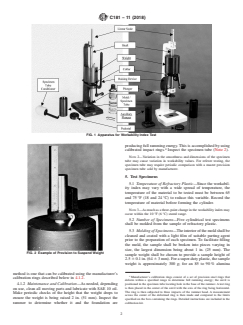
4.1 Rammer—The apparatus shall consist of the device
1.4 This international standard was developed in accor-
known as the sand rammer for refractories (see Fig. 1). It shall
dance with internationally recognized principles on standard-
consist essentially of a steel cylindrical mold (specimen tube)
ization established in the Decision on Principles for the
2.00 in. (50.8 mm) in inside diameter and 4.75 in. (120.6 mm)
Development of International Standards, Guides and Recom-
in length, supported in a vertical position on the same axis as
mendations issued by the World Trade Organization Technical
a shaft to which shall be fastened a plunger that fits inside the
Barriers to Trade (TBT) Committee.
mold. A 14-lb (6.4-kg) cylindrical weight slides on the same
shaft and is arranged to fall a distance of 2 in. (51 mm) before
2. Referenced Documents
engaging a collar fastened to the shaft.As shown in Fig. 1, the
2.1 ASTM Standards:
weight may be raised by a manually rotated cam. Provision
D2906 Practice for Statements on Precision and Bias for
shall be made by the equipment manufacturer to support the
Textiles (Withdrawn 2008)
weight, thereby removing the load from the vertical shaft
(example shown in Fig. 2). The sand rammer will include a
3. Significance and Use
linear scale capable of measuring sample height to 0.02 in.
3.1 Workability index serves as a measure of the facility (0.5 mm) with a typical range of 1.7 to 2.5 in. (Note 1). The
with which refractory plastic materials can be rammed, portion of the scale to be used shall be adjusted so that when
gunned, or vibrated into place. the vertical shaft is measuring a 3.00-in. standard, 3.00 in. is
read on the scale.
NOTE 1—The apparatus as described in this section is capable of
This test method is under the jurisdiction of ASTM Committee C08 on
measuring workabilities up to about 32 %. For products of higher
Refractories and is the direct responsibility of Subcommittee C08.09 on Monolith-
workability, a suitable spacer block may be installed under the specimen.
ics.
Current edition approved Oct. 1, 2018. Published October 2018. Originally
4.1.1 Mounting for Rammer—It is recommended the ram-
approved in 1943. Last previous edition approved in 2011 as C181 – 11. DOI:
merbemountedonsandrammerbasesoldbythemanufacturer
10.1520/C0181-11R18.
or a concrete column to isolate the rammer from vibration
For referenced ASTM standards, visit the ASTM website, www.astm.org, or
contact ASTM Customer Service at service@astm.org. For Annual Book of ASTM
variations. The rammer is to be secured onto the base or
Standards volume information, refer to the standard’s Document Summary page on
column using steel bolts.Variable results are obtained from the
the ASTM website.
test unless the described mounting or an acceptable alternative
The last approved version of this historical standard is referenced on
www.astm.org. mounting is used for the rammer. An acceptable mounting
Copyright © ASTM International, 100 Barr Harbor Drive, PO Box C700, West Conshohocken, PA 19428-2959. United States
C181 − 11 (2018)
FIG. 1 Apparatus for Workability Index Test
producing full ramming energy. This is accomplished by using
calibrated impact rings. Inspect the specimen tube (Note 2).
NOTE 2—Variation in the smoothness and dimensions of the specimen
tube may cause variation in workability values. For referee testing, the
specimen tube may require periodic comparison with a master precision
specimen tube sold by manufacturer.
5. Test Specimens
5.1 Temperature of Refractory Plastic—Since the workabil-
ity index may vary with a wide spread of temperature, the
temperature of the material to be tested must be between 65
and 75 °F (18 and 24 °C) to reduce this variable. Record the
temperature of material before forming the cylinder.
NOTE 3—As much as a three-point change in the workability index may
occur within the 10 °F (6 °C) stated range.
5.2 Number of Specimens—Five cylindrical test specimens
shall be molded from the sample of refractory plastic.
5.3 MoldingofSpecimens—Theinteriorofthemoldshallbe
cleaned and coated with a li
...