

ASTM F434-93(2017)
(Test Method)Standard Test Method for Blow-Out Testing of Preformed Gaskets
General Information
- Abstract
SIGNIFICANCE AND USE
3.1 This test method is designed to compare all types of preformed gaskets under controlled conditions with respect to blow-out resistance. This test method may be used as a routine test when agreed upon between the purchaser and the seller.
SCOPE
1.1 This test method covers the determination of the resistance against blow-out of preformed gaskets. The test is conducted under ambient conditions and should be used for comparison purposes only to select suitable designs and constructions for specific applications.
1.2 The values stated in SI units are to be regarded as the standard. The values given in parentheses are for information only.
1.3 This standard does not purport to address all of the safety concerns, if any, associated with its use. It is the responsibility of the user of this standard to establish appropriate safety and health practices and determine the applicability of regulatory limitations prior to use.
1.4 This international standard was developed in accordance with internationally recognized principles on standardization established in the Decision on Principles for the Development of International Standards, Guides and Recommendations issued by the World Trade Organization Technical Barriers to Trade (TBT) Committee.
- Status
- Published
- Publication Date
- 30-Apr-2017
- Technical Committee
- F03 - Gaskets
- Drafting Committee
- F03.20 - Mechanical Test Methods


Overview
ASTM F434-93(2017), Standard Test Method for Blow-Out Testing of Preformed Gaskets, is published by ASTM International. This standard provides a method for determining the blow-out resistance of preformed gaskets under controlled ambient conditions. Designed mainly for comparative purposes, it aids manufacturers, quality control personnel, and buyers in evaluating and selecting suitable gasket designs and materials for specific applications.
Blow-out resistance is vital in many industries where gaskets are used to maintain seals under pressure. This test method helps ensure reliability, performance, and safety in sealing applications, making it a valuable tool for product selection and quality assurance.
Key Topics
- Blow-Out Resistance Measurement: The core of this standard is a comparative test to assess how preformed gaskets withstand internal pressure before experiencing a blow-out.
- Test Conditions: The procedure is conducted under ambient conditions with a controlled pressure supply, typically up to 7 MPa (1000 psi).
- Specimen Specifications: The standard outlines the nominal specimen size and provides guidance on reporting the thickness, as gasket performance can vary depending on this parameter.
- Testing Apparatus: Components required include a pressure supply, a test unit capable of withstanding high pressure, booster pump, and temperature indicating devices.
- Procedure Steps: Gaskets are assembled in the test unit, bolts are tightened following a specified pattern, and internal pressure is gradually increased while monitoring for failure. Detailed safety measures are stipulated for operators during testing.
- Reporting Requirements: Key results such as identification of the gasket, specimen thickness, pressure at blow-out or confirmation that the gasket withstood maximum pressure, and a log of pressure and temperature readings are to be documented.
- Safety Considerations: It is the user's responsibility to implement suitable health and safety practices and ensure compliance with applicable regulations.
Applications
ASTM F434-93(2017) is widely applied across industries that utilize preformed gaskets in pressurized equipment, piping systems, and vessel flanges. Key application areas include:
- Manufacturing: Assists manufacturers in competitive benchmarking and quality control by providing a standardized basis for comparing gasket performance.
- Procurement and Supplier Agreements: Enables clear, agreed-upon methods for routine testing between purchasers and suppliers to ensure product consistency and reliability.
- Design Selection: Supports engineers in selecting the best-suited gasket designs for specific pressure environments, reducing the risk of seal failures and downtime.
- Product Development: Guides research and development activities in creating or improving gasket materials and designs for enhanced blow-out resistance.
- Compliance and Certification: Serves as a reference method in supplier and customer specifications, quality assurance documents, and regulatory compliance.
Related Standards
For comprehensive gasket testing and selection, consider referencing the following related ASTM standards:
- ASTM F36 - Test Method for Compressibility and Recovery of Gasket Materials
- ASTM F37 - Test Methods for Sealability of Gasket Materials
- ASTM F104 - Classification System for Nonmetallic Gasket Materials
- ASTM F595 - Specification for Austenitic Stainless Steel Bolts, Hex Cap Screws, and Studs (for hardware compatibility)
- ISO Standards on Gaskets - For international compatibility and broader application scope
Utilizing ASTM F434-93(2017) in conjunction with these related standards ensures a comprehensive approach to evaluating gasket performance for use in critical sealing applications.
Keywords: gasket blow-out testing, preformed gasket, hydrostatic pressure, ASTM F434, blow-out resistance, gasket testing standard, sealing reliability, industrial gaskets, comparative test method.
Relations
- Effective Date
- 01-May-2017
Get Certified
Connect with accredited certification bodies for this standard

DIBt (Deutsches Institut für Bautechnik)
German Institute for Building Technology.
DIN CERTCO
DIN Group product certification.

Aboma Certification B.V.
Specialized in construction, metal, and transport sectors.
Sponsored listings
Frequently Asked Questions
ASTM F434-93(2017) is a standard published by ASTM International. Its full title is "Standard Test Method for Blow-Out Testing of Preformed Gaskets". This standard covers: SIGNIFICANCE AND USE 3.1 This test method is designed to compare all types of preformed gaskets under controlled conditions with respect to blow-out resistance. This test method may be used as a routine test when agreed upon between the purchaser and the seller. SCOPE 1.1 This test method covers the determination of the resistance against blow-out of preformed gaskets. The test is conducted under ambient conditions and should be used for comparison purposes only to select suitable designs and constructions for specific applications. 1.2 The values stated in SI units are to be regarded as the standard. The values given in parentheses are for information only. 1.3 This standard does not purport to address all of the safety concerns, if any, associated with its use. It is the responsibility of the user of this standard to establish appropriate safety and health practices and determine the applicability of regulatory limitations prior to use. 1.4 This international standard was developed in accordance with internationally recognized principles on standardization established in the Decision on Principles for the Development of International Standards, Guides and Recommendations issued by the World Trade Organization Technical Barriers to Trade (TBT) Committee.
SIGNIFICANCE AND USE 3.1 This test method is designed to compare all types of preformed gaskets under controlled conditions with respect to blow-out resistance. This test method may be used as a routine test when agreed upon between the purchaser and the seller. SCOPE 1.1 This test method covers the determination of the resistance against blow-out of preformed gaskets. The test is conducted under ambient conditions and should be used for comparison purposes only to select suitable designs and constructions for specific applications. 1.2 The values stated in SI units are to be regarded as the standard. The values given in parentheses are for information only. 1.3 This standard does not purport to address all of the safety concerns, if any, associated with its use. It is the responsibility of the user of this standard to establish appropriate safety and health practices and determine the applicability of regulatory limitations prior to use. 1.4 This international standard was developed in accordance with internationally recognized principles on standardization established in the Decision on Principles for the Development of International Standards, Guides and Recommendations issued by the World Trade Organization Technical Barriers to Trade (TBT) Committee.
ASTM F434-93(2017) is classified under the following ICS (International Classification for Standards) categories: 91.100.50 - Binders. Sealing materials. The ICS classification helps identify the subject area and facilitates finding related standards.
ASTM F434-93(2017) has the following relationships with other standards: It is inter standard links to ASTM F434-93(2009). Understanding these relationships helps ensure you are using the most current and applicable version of the standard.
ASTM F434-93(2017) is available in PDF format for immediate download after purchase. The document can be added to your cart and obtained through the secure checkout process. Digital delivery ensures instant access to the complete standard document.
Standards Content (Sample)
This international standard was developed in accordance with internationally recognized principles on standardization established in the Decision on Principles for the
Development of International Standards, Guides and Recommendations issued by the World Trade Organization Technical Barriers to Trade (TBT) Committee.
Designation: F434 − 93 (Reapproved 2017)
Standard Test Method for
Blow-Out Testing of Preformed Gaskets
ThisstandardisissuedunderthefixeddesignationF434;thenumberimmediatelyfollowingthedesignationindicatestheyearoforiginal
adoptionor,inthecaseofrevision,theyearoflastrevision.Anumberinparenthesesindicatestheyearoflastreapproval.Asuperscript
epsilon (´) indicates an editorial change since the last revision or reapproval.
1. Scope 4.2 Test Unit, capable of withstanding 7 MPa (1000 psi)
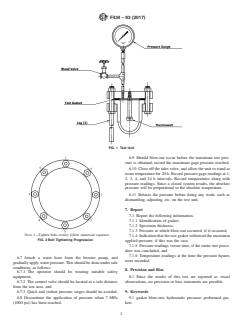
internal pressure under ambient conditions. Provisions should
1.1 This test method covers the determination of the resis-
be made for valve and pressure gage mountings, as shown in
tance against blow-out of preformed gaskets. The test is
Fig.1.Thegageshallreadfrom0to7MPa(0to1000psi)and
conducted under ambient conditions and should be used for
be mounted so as to be visible at some distance.
comparison purposes only to select suitable designs and
constructions for specific applications. 4.3 Booster Pump—An air-operated hydraulic (water) pres-
−5 3 3
sure pump, capable of delivering 1.1×10 m /s (40 in. /min)
1.2 The values stated in SI units are to be regarded as the
against a back pressure of 35 MPa (5000 psi).
standard. The values given in parentheses are for information
only. 4.4 Temperature Indicating Device—A thermometer ca-
pable of reading 1°C (2°F) in the ambient temperature range.
1.3 This standard does not purport to address all of the
safety concerns, if any, associated with its use. It is the
5. Test Specimen
responsibility of the user of this standard to establish appro-
priate safety and health practices and determine the applica- 5.1 The specimen shall be a 102 mm (4-in.) nominal-size
bility of regulatory limitations prior to use.
gasket114mm(4.5in.)ininsidediameterby165mm(6.5in.)
1.4 This international standard was developed in accor- in outside diameter. The thickness of the test gasket will
dance with internationally recognized principles on standard-
depend upon its expected usage and must be specified in the
ization established in the Decision on Principles for the report, as results will vary accordingly.
Development of International Standards, Guides and Recom-
mendations issued by the World Trade Organization Technical 6. Procedure
Barriers to Trade (TBT) Committee.
6.1 Assemble the specimen in the test unit.
6.2 The bolt threads should be well lubricated using moly-
2. Referenced Documents
disulfide dry film or grease. Sanding the bottom of the bolt
2.1 ASTM Adjuncts:
heads and the washers will reduce torque variable and ensure
Detailed Drawings of Test Unit
duplication of results.
3. Significance and Use
6.3 Tighten the bolts, using the sequence shown in Fig. 2,
increasing the torque loading in 25% increments to the
3.1 This test method is designed to compare all types of
targeted torque, but do not exceed the rating on the bolts.
preformed gaskets under controlled conditions with respect to
blow-out resistance.This test method may be used as a routine
6.4 Fill the test unit with water, and bleed out all excess air
test when agreed upon between the purchaser and the seller.
by tilting until no further air bubbles are forthcoming.
6.5 Fill the oil reservoir (thermowell) three-quarters full of
4. Apparatus
light oil. Allow 15 min for the temperature to stabilize, and
4.1 Pressure Supply, capable of 7 MPa (1000 psi), prefer-
insert the temperature sensor.
ablyhydraulic,andwithpropersafetyprecautions,intheevent
6.6 Before applying hydrostatic pressure, cover the entire
of a rapid-gasket failure.
test receptacle with a metal shield, leaving the gage exposed
for the recording of data.
This test method is under the jurisdiction ofASTM Committee F03 on Gaskets
and is the direct responsibility of Subcommittee F03.20 on Mechanical Test
Methods
...