

ASTM E2910-12(2018)
(Guide)Standard Guide for Preferred Methods for Acceptance of Product
General Information
- Abstract
ABSTRACT
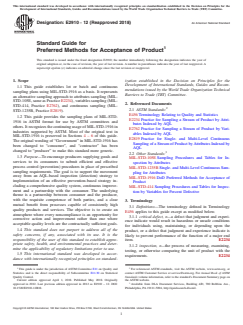
This guide establishes lot or batch and continuous sampling plans using MIL-STD-1916 as a basis. It represents an alternative sampling approach to attributes sampling (MILSTD-105E, same as Practice E2234), variables sampling (MILSTD-414, Practice E2762), and continuous sampling (MILSTD-1235B, Practice E2819). This standard provides a set of sampling plans and procedures for planning and conducting inspections to assess quality and conformance to contract requirements. This standard eliminates acceptable quality levels (AQL’s) and associated practices within specifications.
SIGNIFICANCE AND USE
5.1 Procurement practices encourage industry innovation and provide flexibility to achieve the benefits of continuous improvement.
5.2 There is an evolving industrial product quality philosophy that recognizes the need for quality policy changes that will provide producers with opportunities and incentives toward improvement of product quality and cooperative relationships between the producer and the consumer.
5.3 Process controls and statistical control methods are the preferable means of preventing nonconformances, controlling quality, and generating information for improvement. An effective process control system may also be used to provide information to assess the quality of deliverables submitted for acceptance. Producers are encouraged to use process control and statistical control procedures for their internal control and to submit effective process control procedures in lieu of prescribed sampling requirements to the consumer for approval.
5.4 Sampling inspection by itself is an inefficient industrial practice for demonstrating conformance to the requirements of a contract and its technical data package. The application of sampling plans for acceptance involves both consumer and producer risks; and increased sampling is one way of reducing these risks, but it also increases costs. Producers can reduce risks by employing efficient processes with appropriate process controls. To the extent that such practices are employed and are effective, risk is controlled and, consequently, inspection and testing can be reduced.
5.5 The following points provide the basis for this standard:
5.5.1 Producers are required to submit deliverables that conform to requirements and to generate and maintain sufficient evidence of conformance.
5.5.2 Producers are responsible for establishing their own manufacturing and process controls to produce results in accordance with requirements.
5.5.3 Producers are expected to use recognized prevention practices such as...
SCOPE
1.1 This guide establishes lot or batch and continuous sampling plans using MIL-STD-1916 as a basis. It represents an alternative sampling approach to attributes sampling (MIL-STD-105E, same as Practice E2234), variables sampling (MIL-STD-414, Practice E2762), and continuous sampling (MIL-STD-1235B, Practice E2819).
1.2 This guide provides the sampling plans of MIL-STD-1916 in ASTM format for use by ASTM committees and others. It recognizes the continuing usage of MIL-STD-1916 in industries supported by ASTM. Most of the original text in MIL-STD-1916 is preserved in Sections 4 – 6 of this guide. The original wording of “Government” in MIL-STD-1916 has been changed to “consumer”, and “contractor” has been changed to “producer” to make this standard more generic.
1.3 Purpose—To encourage producers supplying goods and services to its consumers to submit efficient and effective process control (prevention) procedures in place of prescribed sampling requirements. The goal is to support the movement away from an AQL-based inspection (detection) strategy to implementation of an effective prevention-based strategy including a comprehensive quality system, continuous improvement and a partnership with the consumer. The underlying theme is a partnership between consumer and the producer, with the requisite competence of both parties, and a cle...
- Status
- Published
- Publication Date
- 31-Mar-2018
- Technical Committee
- E11 - Quality and Statistics
- Drafting Committee
- E11.30 - Statistical Quality Control
Overview
ASTM E2910-12(2018), Standard Guide for Preferred Methods for Acceptance of Product, provides comprehensive guidance on acceptance sampling and inspection methods for industrial products. Developed by ASTM International, this standard references the MIL-STD-1916 framework and offers alternatives to traditional acceptance sampling techniques such as MIL-STD-105E (attributes), MIL-STD-414 (variables), and MIL-STD-1235B (continuous sampling). ASTM E2910-12(2018) emphasizes a shift away from Acceptable Quality Levels (AQLs) and towards prevention and process-based quality assurance. The standard supports both lot/batch and continuous sampling plans, promoting innovation and continuous improvement through effective quality systems and close producer-consumer partnerships.
Key Topics
- Sampling Plan Alternatives: The standard provides matched sampling plans for lot or batch acceptance, as well as continuous sampling, based on MIL-STD-1916, but reformulated for broader industrial applicability.
- Process Control Focus: Strong emphasis on prevention-based quality strategies, recommending the use of process controls and statistical quality methods over sole reliance on inspection.
- Producer and Consumer Responsibilities: Producers are mandated to ensure conformance to contractual requirements and to maintain adequate evidence supporting quality. Consumers are encouraged to support alternative acceptance procedures if robust process controls are in place.
- Elimination of AQLs: The guide moves away from Acceptable Quality Levels and associated detection-based practices, promoting continuous process improvement instead.
- Flexibility and Innovation: The standard enables both producers and consumers to negotiate alternative sampling and quality verification schemes tailored to effective internal controls and demonstrated process stability.
Applications
ASTM E2910-12(2018) is applicable across various industries and contract environments where the acceptance of product deliverables is required. Typical uses include:
- Manufacturing and Supply Chain: Ensuring that end items, components, or raw materials meet technical and quality requirements before acceptance.
- Quality Inspections: Planning and conducting inspections for operations, services, or administrative processes based on recognized sampling plans.
- Procurement Processes: Designing quality plans and sampling strategies for supplier evaluation, acceptance of products, and ongoing quality assurance.
- Continuous Improvement Programs: Supporting organizations focused on reducing the need for end-product inspection by fostering robust, statistically controlled processes.
This standard is especially valuable for:
- Organizations transitioning from AQL-based acceptance inspection to prevention-focused quality management.
- Contracts where reducing cost and risk associated with extensive product inspection is desired.
- Producers with advanced quality systems seeking recognition of alternative, efficient acceptance methods.
Related Standards
To effectively implement ASTM E2910-12(2018), organizations should also be familiar with these related standards:
- MIL-STD-1916: Department of Defense Preferred Methods for Acceptance of Product, foundational to the sampling approaches in E2910.
- MIL-STD-105E / ASTM E2234: Sampling procedures and tables for inspection by attributes.
- MIL-STD-414 / ASTM E2762: Sampling procedures and tables for inspection by variables for percent defective.
- MIL-STD-1235B / ASTM E2819: Single- and multi-level continuous sampling plans for attributes indexed by AQL.
- ASTM E456: Terminology relating to quality and statistics.
- ISO 9000 Series: International standards for quality management systems, referenced for establishing acceptable quality systems under E2910.
Practical Value
Implementing ASTM E2910-12(2018) provides significant practical benefits:
- Promotes a partnership-driven approach to quality between producers and consumers.
- Reduces reliance on end-point inspection and associated costs.
- Encourages adoption of advanced process control and statistical quality management methods.
- Supports continuous improvement, higher confidence in conformance, and lower risk in product acceptance.
Organizations adopting this guide position themselves for improved efficiency, compliance with international quality philosophies, and meet modern contract requirements for evidence-based product acceptance.
Relations
- Effective Date
- 01-Apr-2018
- Effective Date
- 01-Apr-2022
- Refers
ASTM E2762-10(2020) - Standard Practice for Sampling a Stream of Product by Variables Indexed by AQL - Effective Date
- 01-Jan-2020
- Effective Date
- 01-Oct-2017
- Effective Date
- 01-Oct-2017
- Refers
ASTM E2762-10(2014) - Standard Practice for Sampling a Stream of Product by Variables Indexed by AQL - Effective Date
- 01-Apr-2014
- Effective Date
- 15-Nov-2013
- Effective Date
- 15-Nov-2013
- Effective Date
- 15-Nov-2013
- Effective Date
- 15-Nov-2013
- Effective Date
- 15-Aug-2013
- Effective Date
- 01-Apr-2013
- Effective Date
- 01-May-2012
- Effective Date
- 01-May-2012
- Effective Date
- 01-May-2011
Get Certified
Connect with accredited certification bodies for this standard

BSI Group
BSI (British Standards Institution) is the business standards company that helps organizations make excellence a habit.

Bureau Veritas
Bureau Veritas is a world leader in laboratory testing, inspection and certification services.

DNV
DNV is an independent assurance and risk management provider.
Sponsored listings
Frequently Asked Questions
ASTM E2910-12(2018) is a guide published by ASTM International. Its full title is "Standard Guide for Preferred Methods for Acceptance of Product". This standard covers: ABSTRACT This guide establishes lot or batch and continuous sampling plans using MIL-STD-1916 as a basis. It represents an alternative sampling approach to attributes sampling (MILSTD-105E, same as Practice E2234), variables sampling (MILSTD-414, Practice E2762), and continuous sampling (MILSTD-1235B, Practice E2819). This standard provides a set of sampling plans and procedures for planning and conducting inspections to assess quality and conformance to contract requirements. This standard eliminates acceptable quality levels (AQL’s) and associated practices within specifications. SIGNIFICANCE AND USE 5.1 Procurement practices encourage industry innovation and provide flexibility to achieve the benefits of continuous improvement. 5.2 There is an evolving industrial product quality philosophy that recognizes the need for quality policy changes that will provide producers with opportunities and incentives toward improvement of product quality and cooperative relationships between the producer and the consumer. 5.3 Process controls and statistical control methods are the preferable means of preventing nonconformances, controlling quality, and generating information for improvement. An effective process control system may also be used to provide information to assess the quality of deliverables submitted for acceptance. Producers are encouraged to use process control and statistical control procedures for their internal control and to submit effective process control procedures in lieu of prescribed sampling requirements to the consumer for approval. 5.4 Sampling inspection by itself is an inefficient industrial practice for demonstrating conformance to the requirements of a contract and its technical data package. The application of sampling plans for acceptance involves both consumer and producer risks; and increased sampling is one way of reducing these risks, but it also increases costs. Producers can reduce risks by employing efficient processes with appropriate process controls. To the extent that such practices are employed and are effective, risk is controlled and, consequently, inspection and testing can be reduced. 5.5 The following points provide the basis for this standard: 5.5.1 Producers are required to submit deliverables that conform to requirements and to generate and maintain sufficient evidence of conformance. 5.5.2 Producers are responsible for establishing their own manufacturing and process controls to produce results in accordance with requirements. 5.5.3 Producers are expected to use recognized prevention practices such as... SCOPE 1.1 This guide establishes lot or batch and continuous sampling plans using MIL-STD-1916 as a basis. It represents an alternative sampling approach to attributes sampling (MIL-STD-105E, same as Practice E2234), variables sampling (MIL-STD-414, Practice E2762), and continuous sampling (MIL-STD-1235B, Practice E2819). 1.2 This guide provides the sampling plans of MIL-STD-1916 in ASTM format for use by ASTM committees and others. It recognizes the continuing usage of MIL-STD-1916 in industries supported by ASTM. Most of the original text in MIL-STD-1916 is preserved in Sections 4 – 6 of this guide. The original wording of “Government” in MIL-STD-1916 has been changed to “consumer”, and “contractor” has been changed to “producer” to make this standard more generic. 1.3 Purpose—To encourage producers supplying goods and services to its consumers to submit efficient and effective process control (prevention) procedures in place of prescribed sampling requirements. The goal is to support the movement away from an AQL-based inspection (detection) strategy to implementation of an effective prevention-based strategy including a comprehensive quality system, continuous improvement and a partnership with the consumer. The underlying theme is a partnership between consumer and the producer, with the requisite competence of both parties, and a cle...
ABSTRACT This guide establishes lot or batch and continuous sampling plans using MIL-STD-1916 as a basis. It represents an alternative sampling approach to attributes sampling (MILSTD-105E, same as Practice E2234), variables sampling (MILSTD-414, Practice E2762), and continuous sampling (MILSTD-1235B, Practice E2819). This standard provides a set of sampling plans and procedures for planning and conducting inspections to assess quality and conformance to contract requirements. This standard eliminates acceptable quality levels (AQL’s) and associated practices within specifications. SIGNIFICANCE AND USE 5.1 Procurement practices encourage industry innovation and provide flexibility to achieve the benefits of continuous improvement. 5.2 There is an evolving industrial product quality philosophy that recognizes the need for quality policy changes that will provide producers with opportunities and incentives toward improvement of product quality and cooperative relationships between the producer and the consumer. 5.3 Process controls and statistical control methods are the preferable means of preventing nonconformances, controlling quality, and generating information for improvement. An effective process control system may also be used to provide information to assess the quality of deliverables submitted for acceptance. Producers are encouraged to use process control and statistical control procedures for their internal control and to submit effective process control procedures in lieu of prescribed sampling requirements to the consumer for approval. 5.4 Sampling inspection by itself is an inefficient industrial practice for demonstrating conformance to the requirements of a contract and its technical data package. The application of sampling plans for acceptance involves both consumer and producer risks; and increased sampling is one way of reducing these risks, but it also increases costs. Producers can reduce risks by employing efficient processes with appropriate process controls. To the extent that such practices are employed and are effective, risk is controlled and, consequently, inspection and testing can be reduced. 5.5 The following points provide the basis for this standard: 5.5.1 Producers are required to submit deliverables that conform to requirements and to generate and maintain sufficient evidence of conformance. 5.5.2 Producers are responsible for establishing their own manufacturing and process controls to produce results in accordance with requirements. 5.5.3 Producers are expected to use recognized prevention practices such as... SCOPE 1.1 This guide establishes lot or batch and continuous sampling plans using MIL-STD-1916 as a basis. It represents an alternative sampling approach to attributes sampling (MIL-STD-105E, same as Practice E2234), variables sampling (MIL-STD-414, Practice E2762), and continuous sampling (MIL-STD-1235B, Practice E2819). 1.2 This guide provides the sampling plans of MIL-STD-1916 in ASTM format for use by ASTM committees and others. It recognizes the continuing usage of MIL-STD-1916 in industries supported by ASTM. Most of the original text in MIL-STD-1916 is preserved in Sections 4 – 6 of this guide. The original wording of “Government” in MIL-STD-1916 has been changed to “consumer”, and “contractor” has been changed to “producer” to make this standard more generic. 1.3 Purpose—To encourage producers supplying goods and services to its consumers to submit efficient and effective process control (prevention) procedures in place of prescribed sampling requirements. The goal is to support the movement away from an AQL-based inspection (detection) strategy to implementation of an effective prevention-based strategy including a comprehensive quality system, continuous improvement and a partnership with the consumer. The underlying theme is a partnership between consumer and the producer, with the requisite competence of both parties, and a cle...
ASTM E2910-12(2018) is classified under the following ICS (International Classification for Standards) categories: 03.120.01 - Quality in general. The ICS classification helps identify the subject area and facilitates finding related standards.
ASTM E2910-12(2018) has the following relationships with other standards: It is inter standard links to ASTM E2910-12, ASTM E456-13a(2022)e1, ASTM E2762-10(2020), ASTM E456-13A(2017)e1, ASTM E456-13A(2017)e3, ASTM E2762-10(2014), ASTM E456-13ae2, ASTM E456-13ae1, ASTM E456-13a, ASTM E456-13ae3, ASTM E456-13, ASTM E2234-09(2013), ASTM E456-12, ASTM E456-12e1, ASTM E2819-11. Understanding these relationships helps ensure you are using the most current and applicable version of the standard.
ASTM E2910-12(2018) is available in PDF format for immediate download after purchase. The document can be added to your cart and obtained through the secure checkout process. Digital delivery ensures instant access to the complete standard document.
Standards Content (Sample)
This international standard was developed in accordance with internationally recognized principles on standardization established in the Decision on Principles for the
Development of International Standards, Guides and Recommendations issued by the World Trade Organization Technical Barriers to Trade (TBT) Committee.
Designation: E2910 − 12 (Reapproved 2018) An American National Standard
Standard Guide for
Preferred Methods for Acceptance of Product
This standard is issued under the fixed designation E2910; the number immediately following the designation indicates the year of
original adoption or, in the case of revision, the year of last revision. A number in parentheses indicates the year of last reapproval. A
superscript epsilon (´) indicates an editorial change since the last revision or reapproval.
1. Scope ization established in the Decision on Principles for the
Development of International Standards, Guides and Recom-
1.1 This guide establishes lot or batch and continuous
mendations issued by the World Trade Organization Technical
sampling plans using MIL-STD-1916 as a basis. It represents
Barriers to Trade (TBT) Committee.
an alternative sampling approach to attributes sampling (MIL-
STD-105E,sameasPracticeE2234),variablessampling(MIL-
2. Referenced Documents
STD-414, Practice E2762), and continuous sampling (MIL-
2.1 ASTM Standards:
STD-1235B, Practice E2819).
E456 Terminology Relating to Quality and Statistics
1.2 This guide provides the sampling plans of MIL-STD-
E2234 Practice for Sampling a Stream of Product by Attri-
1916 in ASTM format for use by ASTM committees and
butes Indexed by AQL
others.ItrecognizesthecontinuingusageofMIL-STD-1916in
E2762 Practice for Sampling a Stream of Product by Vari-
industries supported by ASTM. Most of the original text in
ables Indexed by AQL
MIL-STD-1916 is preserved in Sections4–6 of this guide.
E2819 Practice for Single- and Multi-Level Continuous
The original wording of “Government” in MIL-STD-1916 has
Sampling of a Stream of Product byAttributes Indexed by
been changed to “consumer”, and “contractor” has been
AQL
changed to “producer” to make this standard more generic.
2.2 Other Standards:
1.3 Purpose—To encourage producers supplying goods and
MIL-STD-105E Sampling Procedures and Tables for In-
services to its consumers to submit efficient and effective
spection by Attributes
process control (prevention) procedures in place of prescribed
MIL-STD-1235B Single- and Multi-Level Continuous Sam-
sampling requirements. The goal is to support the movement
pling for Attributes
away from an AQL-based inspection (detection) strategy to
MIL-STD-1916 DoD Preferred Methods for Acceptance of
implementation of an effective prevention-based strategy in-
Product
cluding a comprehensive quality system, continuous improve-
MIL-STD-414 Sampling Procedures and Tables for Inspec-
ment and a partnership with the consumer. The underlying
tion by Variables for Percent Defective
theme is a partnership between consumer and the producer,
with the requisite competence of both parties, and a clear
3. Terminology
mutual benefit from processes capable of consistently high
3.1 Definitions—The terminology defined in Terminology
quality products and services. The objective is to create an
E456 applies to this guide except as modified below.
atmosphere where every noncompliance is an opportunity for
3.1.1 critical defect, n—a defect that judgment and experi-
corrective action and improvement rather than one where
ence indicate would result in hazardous or unsafe conditions
acceptable quality levels are the contractually sufficient goals.
for individuals using, maintaining, or depending upon the
1.4 This standard does not purport to address all of the
product, or a defect that judgment and experience indicate is
safety concerns, if any, associated with its use. It is the
likely to prevent performance of the function of a major end
responsibility of the user of this standard to establish appro-
item. E2234
priate safety, health, and environmental practices and deter-
3.1.2 inspection, n—the process of measuring, examining,
mine the applicability of regulatory limitations prior to use.
testing, or otherwise comparing the unit of product with the
1.5 This international standard was developed in accor-
requirements. E2234
dance with internationally recognized principles on standard-
1 2
This guide is under the jurisdiction of ASTM Committee E11 on Quality and For referenced ASTM standards, visit the ASTM website, www.astm.org, or
Statistics and is the direct responsibility of Subcommittee E11.30 on Statistical contact ASTM Customer Service at service@astm.org. For Annual Book of ASTM
Quality Control. Standards volume information, refer to the standard’s Document Summary page on
Current edition approved April 1, 2018. Published May 2018. Originally the ASTM website.
approved in 2012. Last previous edition approved in 2012 as E2910 – 12. DOI: Available from DLA Document Services, Building 4/D, 700 Robbins Ave.,
10.1520/E2910-12R18. Philadelphia, PA 19111-5094, http://quicksearch.dla.mil.
Copyright © ASTM International, 100 Barr Harbor Drive, PO Box C700, West Conshohocken, PA 19428-2959. United States
E2910 − 12 (2018)
3.1.3 major defect, n—a defect, other than critical, that is 3.2.11 nonconforming unit, n—see non-conforming item.
likely to result in failure, or to reduce materially the usability
3.2.12 quality, n—the composite of material attributes in-
of the unit of product for its intended purpose. E2234
cluding performance features and characteristics of a product
or service to satisfy a given need.
3.1.4 minor defect, n—a defect that is not likely to reduce
materially the usability of the unit of product for its intended
3.2.13 quality assurance, n—a planned and systematic pat-
purpose, or is a departure from established standards having
tern of all actions necessary to provide adequate confidence
little bearing on the effective use or operation of the unit.
that adequate technical requirements are established; products
E2234
and services conform to established technical requirements;
and satisfactory performance is achieved.
3.1.5 non-conforming item, n—an item containing at least
one non-conformity. E2234
3.2.14 quality audit, n—asystematicexaminationoftheacts
and decisions with respect to quality in order to independently
3.1.6 production interval, n—a finite period of production,
verify or evaluate the operational requirements of the quality
N items in length. E2819
program or the specification or contract requirements of the
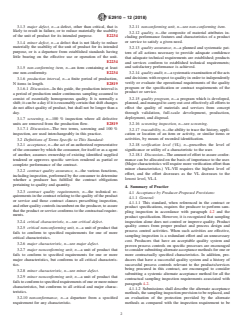
3.1.6.1 Discussion—In this guide, the production interval is
product or service.
a period of production under continuous sampling assumed to
consist of essentially homogeneous quality. It is normally a 3.2.15 quality program, n—a program which is developed,
planned, and managed to carry out cost effectively all efforts to
shift;itcanbeadayifitisreasonablycertainthatshiftchanges
do not affect quality of product, but shall not be longer than a effect the quality of materials and services from concept
through validation, full-scale development, production,
day.
deployment, and disposal.
3.1.7 screening, n—100 % inspection where all defective
3.2.16 screening inspection, n—see screening.
units are removed from the production flow. E2819
3.1.7.1 Discussion—The two terms, screening and 100 %
3.2.17 traceability, n—the ability to trace the history, appli-
inspection, are used interchangeably in this practice.
cation or location of an item or activity, or similar items or
activities, by means of recorded identification.
3.2 Definitions of Terms Specific to This Standard:
3.2.18 verification level (VL), n—prescribes the level of
3.2.1 acceptance, n—the act of an authorized representative
of the consumer by which the consumer, for itself or as a agent significance or utility of a characteristic to the user.
3.2.18.1 Discussion—The amount of effort to assure confor-
of another, assumes ownership of existing identified supplied
tendered or approves specific services rendered as partial or mance can be allocated on the basis of importance to the user.
(Major characteristics will require more verification effort than
complete performance of the contract.
minor characteristics.) VL-VII requires the highest level of
3.2.2 contract quality assurance, n—the various functions,
effort, and the effort decreases as the VL decreases to the
including inspection, performed by the consumer to determine
lowest level, VL-I.
whether a producer has fulfilled the contract obligations
pertaining to quality and quantity.
4. Summary of Practice
3.2.3 contract quality requirements, n—the technical re-
4.1 Acceptance by Producer-Proposed Provisions:
quirements in the contract relating to the quality of the product
4.1.1 General:
or service and those contract clauses prescribing inspection,
4.1.1.1 This standard, when referenced in the contract or
and other quality controls incumbent on the producer, to assure
product specifications, requires the producer to perform sam-
that the product or service conforms to the contractual require-
pling inspection in accordance with paragraph 4.2 and the
ments.
product specification. However, it is recognized that sampling
3.2.4 critical characteristic, n—see critical defect. inspection alone does not control or improve quality. Product
quality comes from proper product and process design and
3.2.5 critical nonconforming unit, n—a unit of product that
process control activities. When such activities are effective,
fails to conform to specified requirements for one of more
sampling inspection is a redundant effort and an unnecessary
critical characteristics.
cost. Producers that have an acceptable quality system and
3.2.6 major characteristic, n—see major defect.
proven process controls on specific processes are encouraged
3.2.7 major nonconforming unit, n—a unit of product that to consider submitting alternate acceptance methods for one or
fails to conform to specified requirements for one or more more contractually specified characteristics. In addition, pro-
major characteristics, but conforms to all critical characteris- ducers that have a successful quality system and a history of
tics. successful process controls relevant to the products/services
being procured in this contract, are encouraged to consider
3.2.8 minor characteristic, n—see minor defect.
submitting a systemic alternate acceptance method for all the
3.2.9 minor nonconforming unit, n—a unit of product that
contractual sampling inspection requirements associated with
failstoconformtospecifiedrequirementsofoneormoreminor
paragraph 4.2.
characteristics, but conforms to all critical and major charac-
4.1.1.2 Submissions shall describe the alternate acceptance
teristics.
methods, the sampling inspection provision to be replaced, and
3.2.10 nonconformance, n—a departure from a specified an evaluation of the protection provided by the alternate
requirement for any characteristic. methods as compared with the inspection requirement to be
E2910 − 12 (2018)
replaced. The alternate acceptance method shall include evi- 4.1.4 Withdrawal of Approval of Alternates—The consumer
dence of process control and capability during production reserves the right to withdraw approval of alternate acceptance
together with adequate criteria, measurement, and evaluation methods that are determined to provide less assurance of
procedures to maintain control of the process. The acceptabil- quality than the inspection requirements originally specified or
ity of the alternate acceptance methods is dependent upon the when the inability to maintain process stability and capability
existence of a quality system, the demonstration of its process over time becomes apparent.
focus, and the availability of objective evidence of effective-
4.2 Acceptance by Tables:
ness.
4.2.1 Preferred Sampling Plans—This standard establishes
4.1.2 Requirements and Procedures:
three sets of matched sampling plans for the sampling inspec-
4.1.2.1 Producers currently operating quality systems in
tion of product submitted to the consumer for acceptance.
accordance with such models as ISO 9000, ANSI/ASQC
These sampling plans provide for inspecting the samples from
Q9004, or others that are deemed satisfactory to the consumer
lots or batches by attributes or variables measurement and for
representative are qualified to apply for alternate acceptance
continuous sampling by attributes measurement. The three sets
methods if demonstration of process focus and objective
of matched sampling plans are indexed by seven specified
evidence of effectiveness exists.
verification levels (VL) and five code letters (CL), which are
4.1.2.2 The producer shall include in his request for ap-
determined by the lot or production interval size.The sampling
proval of an alternate acceptance method an assessment plan to
plans are matched between corresponding VL and CL combi-
periodically verify process stability, capability, and other con-
nations to result in essentially similar protection. The producer
ditions under which the alternate acceptance method was
has the option to utilize the type of plan, at the same
developed. The current minimum values of process capability
verification level, that best complements the production pro-
are equivalent to a Cpk of 2.00 for critical characteristics, 1.33
cess.
for major characteristics, and 1.00 for minor characteristics.
4.2.2 Formation and Identification of Lots or Batches—The
Upon approval of the assessment plan, the producer may
product shall be assembled into identifiable lots, sublots, or
reduce or eliminate inspection sampling when the plan criteria
batches,orinsuchothermannerasmaybeprescribed.Eachlot
are met or exceeded.
or batch shall, as far as practicable, consist of units of product
4.1.3 Submission and Incorporation:
of a single type, grade, class, size, and composition, manufac-
4.1.3.1 Submission—There are two ways of submitting al-
tured under essentially the same conditions, and at essentially
ternate acceptance methods:
the same time. The lots or batches shall be identified by the
(1) Submission of individual alternate acceptance methods
producer and shall be kept intact in adequate and suitable
for one or more contractually specified sampling inspection
storage space.Although lot or batch size is not used to select a
requirementsthroughtheconsumerqualityassurancerepresen-
continuous sampling plan, the formation of lots or batches may
tative (QAR) to the procuring contracting officer (PCO) for
remain desirable for reasons of homogeneity, shipping
approvalatanytimeduringthecontractperiodofperformance.
convenience, and facilitation of payment.
(2) Submission of a systemic alternate acceptance method
4.2.3 Determination of Sampling Plan—A sampling plan is
to the PCO prior to contract being awarded. This pre-approval
determined by:
allows the producer to adopt alternate acceptance methods
4.2.3.1 Verification level (VL) as specified,
throughout the length of the contract. After contract award,
4.2.3.2 Type of sampling (attributes, variables, or
submissions of a systemic alternate acceptance method should
continuous),
be made through the administrative contracting officer (ACO)
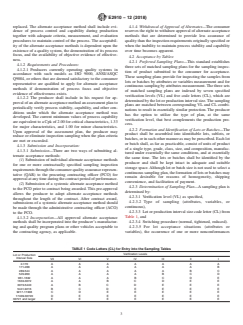
4.2.3.3 Lot or production interval size code letter (CL) from
to the PCO.
Table 1, and
4.1.3.2 Incorporation—All approved alternate acceptance
4.2.3.4 Switching procedure (normal, tightened, reduced).
methods shall be incorporated into the producer’s manufactur-
ing and quality program plans or other vehicles acceptable to 4.2.3.5 For lot acceptance situations (attributes or
the contracting agency, as applicable. variables), the occurrence of one or more nonconformances
TABLE 1 Code Letters (CL) for Entry into the Sampling Tables
Verification Levels
Lot or Production
Interval Size
VII VI V IV III II I
2-170 AAAAAAA
171-288 AAAAAAB
289-544 AAAAAB C
545-960 AAAAB C D
961-1632 AAAB C D E
1633-3072 A A B C D E E
3073-5440 A B C D E E E
5441-9216 B C D EEEE
9217-17408 C D EEEEE
17409-30720 D EEEEEE
30721 and larger EEEEEEE
E2910 − 12 (2018)
shall result in withholding acceptance of the product submitted screening operation. The occurrence of one or more critical
and initiation of corrective action. When continuous sampling nonconformances requires corrective action as specified in
paragraph 4.5.
is in effect, the occurrence of a nonconforming unit while in a
sampling phase results in withholding acceptance of that unit,
4.5 Special Reservations for Critical Nonconformance—
a return to screening, and initiation of corrective action. If a
When a critical nonconformance is discovered at any phase of
nonconforming unit is found while in a screening phase,
production or during any inspection, the following immediate
acceptance is withheld for that unit and screening is continued
actions are required:
until the requirements of paragraph 6.2.3.3(2) are satisfied.
4.5.1 Prevent delivery of critical nonconforming units to the
4.2.4 Sampling of Lots or Batches:
consumer,
4.5.2 Notify the consumer representative,
4.2.4.1 Selection of Units—Units of product drawn from a
4.5.3 Identify the cause,
lot for a sample shall be selected at random from the lot
4.5.4 Take corrective action, and
without regard to their quality. Random sampling requires that
4.5.5 Screen all available units.
each unit in the lot, batch, or production interval has the same
4.5.6 Records of corrective actions shall be maintained and
probability of being selected for the sample.
made available to the consumer representative.
4.2.4.2 Representative (Stratified) Sampling—When
appropriate, the number of units in the sample shall be selected
5. Significance and Use
inproportiontothesizeofsublotsorsubbatches,orpartsofthe
lot or batch, identified by some rational criterion. When
5.1 Procurement practices encourage industry innovation
representative sampling is used, the units from each sublot,
and provide flexibility to achieve the benefits of continuous
subbatch, or part shall be selected at random.
improvement.
4.2.4.3 Process of Sampling—Asample may be drawn after
5.2 There is an evolving industrial product quality philoso-
all units comprising the lot or batch have been assembled, or
phy that recognizes the need for quality policy changes that
sampleunitsmaybedrawnduringassemblyofthelotorbatch,
will provide producers with opportunities and incentives to-
in which case the size of the lot or batch shall be determined
ward improvement of product quality and cooperative relation-
before samples are drawn. When the lot or batch passes the
ships between the producer and the consumer.
sampling plan, such lots or batches are acceptable and may be
5.3 Process controls and statistical control methods are the
submitted to the consumer.
preferable means of preventing nonconformances, controlling
4.2.4.4 Non-Conforming Product—When sample units are
quality, and generating information for improvement. An
drawn during lot or batch assembly and nonconforming units
effective process control system may also be used to provide
are found, the producer shall withhold from acceptance that
information to assess the quality of deliverables submitted for
portion of the lot completed and all additional production
acceptance. Producers are encouraged to use process control
occurring prior to the initiation and verification of corrective
and statistical control procedures for their internal control and
action. For lots or batches withheld from acceptance, the
to submit effective process control procedures in lieu of
producer shall take the following actions:
prescribed sampling requirements to the consumer for ap-
(1) Screen the lots or batches and dispose of all noncon-
proval.
forming units in accordance with paragraph 4.3.
5.4 Sampling inspection by itself is an inefficient industrial
(2) Determine the cause of the nonconformances and
practice for demonstrating conformance to the requirements of
implement appropriate process changes.
a contract and its technical data package. The application of
(3) Initiate the switching requirements of paragraph
sampling plans for acceptance involves both consumer and
6.2.1.3.
producer risks; and increased sampling is one way of reducing
(4) Advise the consumer representative of actions taken
these risks, but it also increases costs. Producers can reduce
and resubmit the screened lot or batches to the consumer for
risks by employing efficient processes with appropriate process
evaluation/consideration.
controls.Totheextentthatsuchpracticesareemployedandare
effective, risk is controlled and, consequently, inspection and
4.3 Disposition of Nonconforming Product—All units of
testing can be reduced.
product found to be nonconforming by the producer shall be
removed and kept apart from the flow of production or
5.5 The following points provide the basis for this standard:
otherwise identified or segregated to preclude submission to
5.5.1 Producers are required to submit deliverables that
the consumer. The producer may rework or repair these units
conform to requirements and to generate and maintain suffi-
unless the contract excludes such activities. Corrected product
cient evidence of conformance.
shall be screened by the producer and resubmitted to the
5.5.2 Producers are responsible for establishing their own
consumer apart from the regular flow of the product.
manufacturing and process controls to produce results in
accordance with requirements.
4.4 Critical Characteristics—Unless otherwise specified in
5.5.3 Producers are expected to use recognized prevention
the contract or product specifications, the producer is required
practices such as process controls and statistical techniques.
for each critical characteristic to implement an automated
screening or a fail-safe manufacturing operation and apply
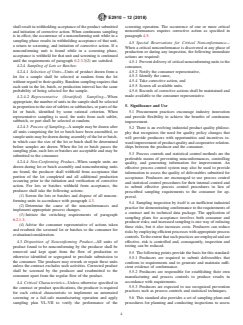
5.6 This standard also provides a set of sampling plans and
sampling plan VL-VII to verify the performance of the procedures for planning and conducting inspections to assess
E2910 − 12 (2018)
quality and conformance to contract requirements. This stan- procedures, processes, and resources. Such documentation is
dard eliminates acceptable quality levels (AQL’s) and associ- hereinafter called the quality system plan. The producer shall
ated practices within specifications. maintain, disseminate, update, and improve the quality system
plan in order to ensure its continued use and accuracy. The
5.7 Applicability—This standard, when referenced in the
design and documentation of the quality system plan shall
contract, specification, or purchase order, is applicable to the
allow for ease of use, review, and audit by internal as well as
prime producer, and should be extended to subcontractors or
consumer personnel.
vendor facilities. The quality plans are to be applied as
6.1.2 Prevention-Based Quality System—The quality sys-
specified in the contract documents, and deliverables may be
temshallbeprevention-based.Commonqualitysystemmodels
submitted for acceptance if the requirements of this standard
that reflect this philosophy include the ISO 9000 series and
have been met.
many industry specific total quality standards and programs.
5.8 Applications—Quality plans and procedures in this stan-
The quality system shall also reflect additional needs in
dard may be used when appropriate to assess conformance to
accordance with the requirements of this standard. Regardless
requirements of the following:
of the model chosen, the quality system shall demonstrate its
5.8.1 End items,
prevention-based outlook by meeting the following objectives
5.8.2 Components or basic materials,
throughout all areas of contract performance:
5.8.3 Operations or services,
6.1.2.1 Thequalitysystemisunderstoodandexecutedbyall
5.8.4 Materials in process,
personnel having any influence on product or process quality.
5.8.5 Supplies in storage,
6.1.2.2 Products and services meet or exceed consumer
5.8.6 Maintenance operations,
requirements.
5.8.7 Data or records, and
6.1.2.3 Quality is deliberately and economically controlled.
5.8.8 Administrative procedures.
6.1.2.4 Emphasis is on the prevention of process discrepan-
NOTE1—Useoftheword“product”throughoutthisstandardalsorefers
cies and product nonconformances.
to services and other deliverables.
6.1.2.5 Discrepancies and nonconformances that do occur
5.9 Product Requirements—The producer is required to
arereadilydetected,androotcausecorrectiveactionsaretaken
submit product that meets all contract and specification re-
and verified.
quirements. The application of the quality plans or procedures
6.1.2.6 Sound problem solving and statistical methods are
of this standard does not relieve the producer of responsibility
employed to continuously reduce process variability and, in
for meeting all contract product requirements. The producer’s
turn, improve process capability and product quality.
quality system, including manufacturing processes and quality
6.1.2.7 Recordsaremaintainedandindicateimplementation
control measures, will be established and operated to consis-
of the quality plan and effectiveness of the control procedures.
tently produce products that meet all requirements.Absence of
6.1.3 Process Focus of Quality System—To demonstrate a
any inspection or process control requirement in the contract
process focus, the producer shall demonstrate that the manu-
does not relieve the producer of responsibility for assuring that
facturing process and its related processes have been studied
all products or supplies submitted to the consumer for accep-
and are understood, controlled, and documented to show that
tance conform to all requirements of the contract.
they are:
5.10 Limitations—The sampling plans and procedures of
6.1.3.1 Consistently producing conforming product.
this standard are not intended for use with destructive tests or
6.1.3.2 Controlled as far upstream as possible.
where product screening is not feasible or desirable. In such
6.1.3.3 Robust to variation in equipment, raw materials, and
cases, the sampling plans to be used will be specified in the
other process inputs, and designed to yield a quality product.
contract or product specifications.
6.1.3.4 Operated with the intent to constantly strive to
reduce process/product variability.
6. Procedure
6.1.3.5 Designed to utilize manufacturing equipment with
6.1 Acceptance by Producer-Proposed Provisions—In order
objectives of minimum variability around targeted values.
for an alternate acceptance method to be considered, the
6.1.3.6 Managed for continuous improvement.
producer shall establish and implement an internal prevention-
6.1.3.7 Designed and controlled using a combination of
based quality system as a means of ensuring that all products
manufacturing practices and statistical methods in order to
conform to requirements specified by the contract and associ-
ensure defect prevention and process improvement.
ated specifications and standards. The acceptability of the
6.1.4 Objective Evidence of Quality System Implementation
quality system as part of the request for alternate acceptance
and Effectiveness:
method(s) is depend
...