

ASTM F1911-05(2023)
(Practice)Standard Practice for Installation of Barbed Tape
General Information
- Abstract
SIGNIFICANCE AND USE
4.1 This practice is intended to provide standard requirements utilizing specialized equipment and hand tools.
4.2 Ensure that the barbed tape is fabricated from acceptable material and well constructed. Field verification of the barbed tape's acceptability shall be in accordance with the project's specifications and this specification.
SCOPE
1.1 This practice covers the installation procedure for barbed tape.
1.2 The primary purpose of this practice is to guide those responsible for or concerned with the installation of barbed tape on chain link fences, masonry walls, roofs or used as ground barriers. This standard is not intended to cover aspects of perimeter security for establishing levels of product performance or give analysis relating to various design comparisons.
1.3 This standard involves the use of material, that may cause injury, including exposure to hazardous materials, and operation of specialized equipment.
1.4 The values stated in inch-pound units are to be regarded as standard. No other units of measurement are included in this standard.
1.5 This standard does not purport to address all of the safety concerns, if any, associated with its use. It is the responsibility of the user of this standard to establish appropriate safety, health, and environmental practices and determine the applicability of regulatory limitations prior to use.
1.6 This international standard was developed in accordance with internationally recognized principles on standardization established in the Decision on Principles for the Development of International Standards, Guides and Recommendations issued by the World Trade Organization Technical Barriers to Trade (TBT) Committee.
- Status
- Published
- Publication Date
- 31-Aug-2023
- Technical Committee
- F14 - Fences
- Drafting Committee
- F14.40 - Chain Link Fence and Wire Accessories
Overview
ASTM F1911-05(2023), published by ASTM International, is the standard practice document for the installation of barbed tape. This guidance is essential for professionals responsible for installing barbed tape on various structures, including chain link fences, masonry walls, roofs, and as ground barriers. The standard focuses on proper installation techniques, materials verification, and adherence to safety and performance requirements. Its goal is to ensure barbed tape obstacles are constructed and installed consistently, safely, and in accordance with project and industry specifications.
Key Topics
- Scope of Application
- Outlines the installation procedure for barbed tape, addressing a wide range of security, commercial, and industrial applications.
- Details accepted use scenarios, including fence tops, sides, walls, roofs, and ground deployments.
- Material Requirements
- Stresses the requirement for barbed tape to be fabricated from acceptable, verified materials.
- Field verification according to project specifications and this standard ensures material compliance.
- Installation Methods
- Covers various installation techniques such as concertina (coiled), helical, and double-coil arrangements.
- Recommends using specialized equipment and hand tools for safety and efficiency.
- Provides direction for splicing rolls, securing barbed tape to different surfaces, and using proper tie materials.
- Safety and Precautions
- Highlights potential hazards, including injury and exposure to hazardous materials.
- Reminds installers to follow appropriate safety, health, and environmental practices and consider legal or regulatory limitations.
- Unit Standards
- Specifies use of inch-pound units throughout the standard.
- Compliance
- Developed in line with international standards principles as outlined by the World Trade Organization Technical Barriers to Trade (TBT).
Applications
ASTM F1911-05(2023) is widely applicable in the following domains:
- Perimeter Security: Provides a consistent approach for installing physical deterrents to unauthorized access in detention facilities, utilities, military installations, and private properties.
- Commercial and Industrial Sites: Guides installers on securing property boundaries, storage yards, warehouses, and critical infrastructure with barbed tape barriers.
- Public and Private Sector Projects: Assures that government and corporate facilities meet standard requirements for barbed tape installation, supporting safety and asset protection.
- Temporary and Permanent Barriers: Outlines processes for both temporary and permanent barbed tape solutions, including recoverability for temporary setups.
- Ground and Elevated Installations: Details specialized approaches for different configurations, such as stacking coils at ground level or installing on fence tops and walls.
Following ASTM F1911 ensures reliable, repeatable installation results that support security, operational efficiency, and regulatory compliance.
Related Standards
For a holistic approach to barbed tape installation and related fencing systems, consider the following ASTM standards:
- ASTM F1379: Terminology Relating to Barbed Tape
- ASTM F1910: Specification for Long Barbed Tape Obstacles
- ASTM F1916: Specifications for Selecting Chain Link Barrier Systems With Coated Chain Link Fence Fabric and Round Posts
These documents provide essential supplemental information on materials, terminology, product selection, and specific barrier configurations.
Keywords: ASTM F1911, barbed tape installation, security fences, perimeter protection, concertina wire, standard practice, barbed obstacle, safety standards, industrial fencing.
Relations
- Effective Date
- 01-Mar-2013
- Effective Date
- 01-Mar-2013
- Effective Date
- 01-Sep-2008
- Effective Date
- 01-Jun-2008
- Effective Date
- 01-Jun-2008
- Effective Date
- 10-Jul-2003
- Effective Date
- 10-Jan-2003
- Effective Date
- 15-Jul-1999
- Effective Date
- 01-Jan-1995
Get Certified
Connect with accredited certification bodies for this standard

Element Materials Technology
Materials testing and product certification.

Inštitut za kovinske materiale in tehnologije
Institute of Metals and Technology. Materials testing, metallurgical analysis, NDT.
Sponsored listings
Frequently Asked Questions
ASTM F1911-05(2023) is a standard published by ASTM International. Its full title is "Standard Practice for Installation of Barbed Tape". This standard covers: SIGNIFICANCE AND USE 4.1 This practice is intended to provide standard requirements utilizing specialized equipment and hand tools. 4.2 Ensure that the barbed tape is fabricated from acceptable material and well constructed. Field verification of the barbed tape's acceptability shall be in accordance with the project's specifications and this specification. SCOPE 1.1 This practice covers the installation procedure for barbed tape. 1.2 The primary purpose of this practice is to guide those responsible for or concerned with the installation of barbed tape on chain link fences, masonry walls, roofs or used as ground barriers. This standard is not intended to cover aspects of perimeter security for establishing levels of product performance or give analysis relating to various design comparisons. 1.3 This standard involves the use of material, that may cause injury, including exposure to hazardous materials, and operation of specialized equipment. 1.4 The values stated in inch-pound units are to be regarded as standard. No other units of measurement are included in this standard. 1.5 This standard does not purport to address all of the safety concerns, if any, associated with its use. It is the responsibility of the user of this standard to establish appropriate safety, health, and environmental practices and determine the applicability of regulatory limitations prior to use. 1.6 This international standard was developed in accordance with internationally recognized principles on standardization established in the Decision on Principles for the Development of International Standards, Guides and Recommendations issued by the World Trade Organization Technical Barriers to Trade (TBT) Committee.
SIGNIFICANCE AND USE 4.1 This practice is intended to provide standard requirements utilizing specialized equipment and hand tools. 4.2 Ensure that the barbed tape is fabricated from acceptable material and well constructed. Field verification of the barbed tape's acceptability shall be in accordance with the project's specifications and this specification. SCOPE 1.1 This practice covers the installation procedure for barbed tape. 1.2 The primary purpose of this practice is to guide those responsible for or concerned with the installation of barbed tape on chain link fences, masonry walls, roofs or used as ground barriers. This standard is not intended to cover aspects of perimeter security for establishing levels of product performance or give analysis relating to various design comparisons. 1.3 This standard involves the use of material, that may cause injury, including exposure to hazardous materials, and operation of specialized equipment. 1.4 The values stated in inch-pound units are to be regarded as standard. No other units of measurement are included in this standard. 1.5 This standard does not purport to address all of the safety concerns, if any, associated with its use. It is the responsibility of the user of this standard to establish appropriate safety, health, and environmental practices and determine the applicability of regulatory limitations prior to use. 1.6 This international standard was developed in accordance with internationally recognized principles on standardization established in the Decision on Principles for the Development of International Standards, Guides and Recommendations issued by the World Trade Organization Technical Barriers to Trade (TBT) Committee.
ASTM F1911-05(2023) is classified under the following ICS (International Classification for Standards) categories: 77.140.65 - Steel wire, wire ropes and link chains; 95.020 - Military in general. The ICS classification helps identify the subject area and facilitates finding related standards.
ASTM F1911-05(2023) has the following relationships with other standards: It is inter standard links to ASTM F1379-95(2013), ASTM F1910-98(2013), ASTM F1916-98, ASTM F1910-98(2008), ASTM F1379-95(2008), ASTM F1910-98(2003), ASTM F1379-95(2003), ASTM F1910-98e1, ASTM F1379-95. Understanding these relationships helps ensure you are using the most current and applicable version of the standard.
ASTM F1911-05(2023) is available in PDF format for immediate download after purchase. The document can be added to your cart and obtained through the secure checkout process. Digital delivery ensures instant access to the complete standard document.
Standards Content (Sample)
This international standard was developed in accordance with internationally recognized principles on standardization established in the Decision on Principles for the
Development of International Standards, Guides and Recommendations issued by the World Trade Organization Technical Barriers to Trade (TBT) Committee.
Designation: F1911 − 05 (Reapproved 2023)
Standard Practice for
Installation of Barbed Tape
This standard is issued under the fixed designation F1911; the number immediately following the designation indicates the year of
original adoption or, in the case of revision, the year of last revision. A number in parentheses indicates the year of last reapproval. A
superscript epsilon (´) indicates an editorial change since the last revision or reapproval.
1. Scope Posts for Detention Applications (Withdrawn 2008)
1.1 This practice covers the installation procedure for
3. Terminology
barbed tape.
3.1 Refers to Terminology F1379.
1.2 The primary purpose of this practice is to guide those
responsible for or concerned with the installation of barbed
4. Significance and Use
tape on chain link fences, masonry walls, roofs or used as
4.1 This practice is intended to provide standard require-
ground barriers. This standard is not intended to cover aspects
ments utilizing specialized equipment and hand tools.
of perimeter security for establishing levels of product perfor-
mance or give analysis relating to various design comparisons.
4.2 Ensure that the barbed tape is fabricated from acceptable
material and well constructed. Field verification of the barbed
1.3 This standard involves the use of material, that may
tape’s acceptability shall be in accordance with the project’s
cause injury, including exposure to hazardous materials, and
specifications and this specification.
operation of specialized equipment.
1.4 The values stated in inch-pound units are to be regarded
5. Site Preparation
as standard. No other units of measurement are included in this
5.1 The owner shall specify the location in which the barbed
standard.
tape shall be installed by furnishing drawings or personal
1.5 This standard does not purport to address all of the
instruction.
safety concerns, if any, associated with its use. It is the
5.2 Barbed tape obstacles shall be in accordance with
responsibility of the user of this standard to establish appro-
Specification F1910 barbed tape specifications.
priate safety, health, and environmental practices and deter-
mine the applicability of regulatory limitations prior to use.
NOTE 1—Refer to Terminology F1379 for barb configuration and cross
1.6 This international standard was developed in accor-
sections.
dance with internationally recognized principles on standard-
ization established in the Decision on Principles for the
6. Installation
Development of International Standards, Guides and Recom-
6.1 When the specifications are unclear, refer to these
mendations issued by the World Trade Organization Technical
instructions or contact the owner for information covering
Barriers to Trade (TBT) Committee.
placement, coil attachment, splicing, etc.
2. Referenced Documents 6.2 Non-Reinforced (Concertina):
6.2.1 Description—Barbed obstacle capable of being per-
2.1 ASTM Standards:
manently or temporarily installed. Barbed tape used for some
F1379 Terminology Relating to Barbed Tape
temporary installations shall have the ability of being recov-
F1910 Specification for Long Barbed Tape Obstacles
ered and used repeatedly.
F1916 Specifications for Selecting Chain Link Barrier Sys-
6.2.2 Top of the Fence Installation—Barb Arms are recom-
tems With Coated Chain Link Fence Fabric and Round
mended for top of the fence installations. Single 45° barb arms
with a single strand of barbed wire or tension wire located in
This practice is under the jurisdiction of ASTM Committee F14 on Fences and
the outer position of the arm will support coils deployed at the
is the direct responsibility of Subcommittee F14.40 on Chain Link Fence and Wire
top of the fence. Barb arms are positioned so that arms are out
Accessories.
of reach from the approach side. “V” arms are not recom-
Current edition approved Sept. 1, 2023. Published September 2023. Originally
approved 1998. Last previous edition approved in 2019 as F1911 – 05 (2019). DOI: mended for security applications where climbing is a threat or
10.1520/F1911-05R23.
For referenced ASTM standards, visit the ASTM website, www.astm.org, or
contact ASTM Customer Service at service@astm.org. For Annual Book of ASTM
Standards volume information, refer to the standard’s Document Summary page on The last approved version of this historical standard is referenced on
the ASTM website. www.astm.org.
Copyright © ASTM International, 100 Barr Harbor Drive, PO Box C700, West Conshohocken, PA 19428-2959. United States
F1911 − 05 (2023)
where only one row of barbed tape is specified. Two rows of
barbed tape are recommended where “V” arms are specified.
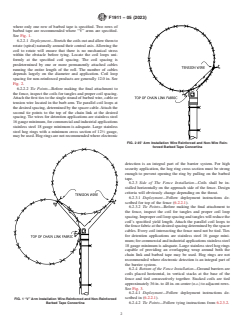
See Fig. 1.
6.2.2.1 Deployment—Stretch the coils out and allow them to
rotate (spiral) naturally around their central axis. Allowing the
coil to rotate will ensure that there is no mechanical stress
within the obstacle before tying. Locate the coil loops uni-
formly at the specified coil spacing. The coil spacing is
predetermined by one or more permanently attached cables
running the entire length of the roll. The number of cables
depends largely on the diameter and application. Coil loop
spacing for non-reinforced products are generally 12.0 in. See
Fig. 2.
6.2.2.2 Tie Points—Before making the final attachment to
the fence, inspect the coils for tangles and proper coil spacing.
Attach the first ties to the single strand of barbed wire, cable or
tension wire located in the barb arm. Tie parallel coil loops at
the desired spacing, determined by the spacer cable. Attach the
second tie points to the top of the chain link at the desired
spacing. Tie wires for detention applications are stainless steel
16 gauge minimum, for commercial and industrial applications
stainless steel 18 gauge minimum is adequate. Large stainless
steel hog rings with a minimum cross section of 12 ⁄2 gauge,
may be used. Hog rings are not recommended where electronic
FIG. 2 45° Arm Installation Wire Reinforced and Non-Wire Rein-
forced Barbed Tape Concertina
detection is an integral part of the barrier system. For high
security application, the hog ring cross section must be strong
enough to prevent opening the ring by pulling on the barbed
tape.
6.2.3 Side of The Fence Installation—Coils shall be in-
stalled horizontally on the approach side of the fence. Design
criteria will obviously change depending on the threat.
6.2.3.1 Deployment—Follow deployment instructions de-
scribed for top of the fence (6.2.2.1).
6.2.3.2 Tie Points—Before making the final attachment to
the fence, inspect the coil for tangles and proper coil loop
spacing. Improper coil loop spacing and tangles will reduce the
coil’s specified yield length. Attach the parallel coil loops to
the fence fabric at the desired spacing determined by the spacer
cables. Every coil intersecting the fence need not be tied. Ties
for detention applications are stainless steel 16 gauge mini-
mum; for commercial and industrial applications stainless steel
18 gauge minimum is adequate. Large stainless steel hog rings
capable of providing an overlapping wrap around both the
chain link and barbed tape may be used. Hog rings are not
recommended where electronic detection is an integral part of
the barrier system.
6.2.4 Bottom of the Fence Installation—Ground barriers are
coils placed horizontal, in vertical stacks at the base of the
fence and tied consecutively together. Stacked coils are tied
approximately 36 in. to 48 in. on center (o.c.) to adjacent rows.
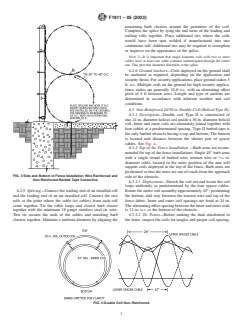
See Fig. 3.
6.2.4.1 Deployment—Follow deployment instructions de-
scribed in (6.2.2.1).
FIG. 1 “V” Arm Installation Wire-Reinforced and Non-Reinforced
Barbed Tape Concertina 6.2.4.2 Tie Points—Follow tying instructions from 6.2.3.2.
F1911 − 05 (2023)
remaining barb clusters around the perimeter of the coil.
Complete the splice by tying the end turns of the leading and
trailing rolls together. Place additional ties where the coils
would have been spot welded if manufactured into one
continuous roll. Additional ties may be required to strengthen
or improve on the appearance of the splice.
NOTE 2—It is important that larger diameter coils with two or more
cables have at least one cable continue uninterrupted through the entire
run. This prevents diameter distortion at the splice.
6.2.6 Ground Anchors—Coils deployed on the ground shall
be anchored as required, depending on the application and
security threat. For security applications, place ground stakes 5
ft. o.c. Multiple coils on the ground for high security applica-
tions; stakes are generally 10 ft o.c. with an alternating offset
pitch of 5 ft between rows. Length and type of anchors are
determined in accordance with inherent weather and soil
conditions.
6.3 Non-Reinforced 24/30 in. Double Coil (Helical Type II):
6.3.1 Description—Double coil Type II is constructed of
one 24 in. diameter helical coil inside a 30 in. diameter helical
coil. Inner and outer coils are alternately joined together with
four cables at a predetermined spacing. Type II barbed tape is
the only barbed obstacle having a top and bottom. The bottom
is located mid distance between the shorter pair of spacer
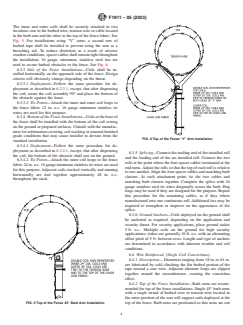
cables. See Fig. 4.
6.3.2 Top of the Fence Installation —Barb arms are recom-
mended for top of the fence installations. Single 45° barb arms
with a single strand of barbed wire, tension wire or ⁄16 in.
diameter cable, located in the outer position of the arm will
support coils deployed at the top of the fence. Barb arms are
positioned so that the arms are out of reach from the approach
FIG. 3 Side and Bottom of Fence Installation Wire Reinforced and
side of the obstacle.
Non-Reinforced Barbed Tape Concertina
6.3.2.1 Deployment—Stretch the coil out and locate the coil
loops uniformly as predetermined by the four spacer cables.
6.2.5 Splicing—Connect the trailing end of an installed roll Rotate the entire coil assembly approximately 45°; positioning
and the leading end of an un–installed roll. Connect the two the bottom, mid way between the tension wire and top of the
rolls at the point where the cable (or cables) from each roll fence fabric. Inner and outer coil spacings are fixed at 24 in.
come together. Tie the cable loops and closest barb cluster The alternating offset spacing between the inner and outer coils
together with the minimum 18 gauge stainless steel tie wire. is 12 in. o.c. at the bottom of the obstacle.
This tie secures the ends of the cables and matching barb 6.3.2.2 Tie Points—Before making the final attachment to
clusters together. Maintain a uniform diameter by aligning the the fence, inspect the coils for tangles and proper coil spacing.
FIG. 4 Double Coil Non–Reinforced
F1911 − 05 (2023)
The inner and outer coils shall be securely attached in two
locations: one to the barbed wire, tension wire or cable located
in the barb arm and the other to the top of the fence fabric. See
Fig. 5. For installations using “V” arms; a second row of
barbed tape shall be installed to prevent using the arm as a
breaching aid. To reduce distortion as a result of adverse
weather conditions, spacer cables shall remain tight throughout
the installation. 16 gauge, minimum, stainless steel ties are
used to secure barbed obstacles to the fence. See Fig. 6.
6.3.3 Side of the Fence Installations—Coils shall be in-
stalled horizontally on the approach side of the fence. Design
criteria will obviously change depending on the threat.
6.3.3.1 Deployment—Follow the same procedure for de-
ployment as described in 6.2.3.1, except, that after dispensing
the coil, rotate the coil assembly 90° and place the bottom of
the obstacle against the fence.
6.3.3.2 Tie Points—Attach the inner and outer coil loops to
the fence fabric 12 in. o.c. 16 gauge minimum stainless tie
wires are used for this purpose.
6.3.4 Bottom of the Fence Installations—Coils at the base of
the fence shall be installed with the bottom of the coil resting
on the ground or prepared surfaces. Consult with the manufac-
turer for information covering coil stacking or unusual finished
grade conditions that may cause installer to deviate from the
FIG. 6 Top of the Fence “V” Arm Installation
standard installation.
6.3.4.1 Deployment—Follow the same procedure for de-
ployment as described in 6.3.2.1, except, that after dispensing
6.3.5 Splicing—Connect the trailing end of the installed roll
the coil, the bottom of the obstacle shall rest on the ground.
and the leading end of the un–installed roll. Connect the two
6.3.4.2 Tie Points—Attach the outer coil loops to the fence
rolls at the point where the four spacer cables terminated at the
fabric 24 in. o.c. 16 gauge minimum stainless tie wires are used
end turns. Adjust the rolls so that the top of each roll is relative
for this purpose. Adjacent coils stacked vertically and running
to one another. Align the four spacer cables and matching barb
horizontally are tied together approximately 48 in. o.c.
clusters. At each attachment point, tie the two cables and
throughout the stack.
matching barb clusters together. Complete the splice with 16
gauge stainless steel tie wires diagonally across the barb. Hog
rings may be used if they are designed for the purpose. Repeat
this procedure for the remaining cables, as if they where
manufactured into one continuous roll. Additional ties may be
required to strengthen or improve on the appearance of the
splice.
6.3.6 Ground Anchors—Coils deployed on the ground shall
be anchored as required, depending on the application and
security threat. For security applications, place ground stakes
5 ft. o.c. Multiple coils on the ground for high security
applications: stakes are generally 10 ft. o.c. with an alternating
offset pitch of 5 ft. between rows. Length and type of anchors
are determined in accordance with inherent weather and soil
conditions.
6.4 Wire Reinforced, (Single Coil Concertinas),
6.4.1 Description— Diameters ranging from 18 in. to 61 in.
are fabricated by cold clinching the flat barbed portion of the
tape around a core wire. Adjacent alternate loops are clipped
together around the circumference, creating the concertina
effect.
6.4.2 Top of the Fence Installation—Barb arms are recom-
mended for top of the fence installations. Single 45° barb arms
with a single strand of barbed wire or tension wire located in
the outer position of the arm will support coils deployed at the
FIG. 5 Top of the Fence 45° Barb Arm Installation top of the fence. Barb arms are positioned so that arms are out
F1911 − 05 (2023)
application, the hog ring cross section must be strong enough
to prevent opening the ring by pulling on the barbed tape.
6.4.3 Side of the Fence Installation—Coils shall be installed
horizontally on the approach side of the fence. Design criteria
will obviously change depending on the threat.
6.4.3.1 Deployment—Stretch the coils out and allow them to
rotate (spiral) naturally around their central axis. Allowing the
coil to rotate will ensure that there is no mechanical stress
within the obstacle before tying. Locate the coil loops uni-
formly at the specified coil spacing. Coil loop spacing for
concertina products will vary depending on the coil configu-
ration and number of clips. Coil loop spacings for wire
reinforced products are generally 12.0 in. See Fig. 2.
6.4.3.2 Tie Points—Before making the attachment to the
fence, inspect the coils for tangles and proper coil spacing.
Attach the parallel coil loops to the side of the fence using
twistable tie wires. Ties for detention applications are stainless
steel 16 gauge minimum. For commercial and industrial
applications stainless steel 18 gauge minimum ties are ad-
equate. Large stainless steel hog rings used for this purpose
should be of sufficient size to wrap completely around the tape
and fabric with an overlap.
6.4.4 Bottom of the Fence Installation—Coils installed at
the base of the fence are placed horizontal in vertical stacks and
tied consecutively together. Stacked coils are tied app
...