


ASTM G2/G2M-19
(Test Method)Standard Test Method for Corrosion Testing of Products of Zirconium, Hafnium, and Their Alloys in Water at 680°F (360°C) or in Steam at 750°F (400°C)
Standard Test Method for Corrosion Testing of Products of Zirconium, Hafnium, and Their Alloys in Water at 680°F (360°C) or in Steam at 750°F (400°C)
SIGNIFICANCE AND USE
5.1 This test method is primarily used as an acceptance test for products of zirconium, hafnium, and their alloys. This standard has been widely used in the development of new alloys, heat treating practices, and for evaluation of welding techniques.
5.2 Specimens are normally tested after careful etching and rinsing. Specimens with as-manufactured surfaces may also be tested without further surface removal.
5.3 When tubing with a second material clad on the inner surface is to be tested, the inner cladding shall be removed prior to the test.
SCOPE
1.1 This test method covers (1) the determination of mass gain, and (2) the surface inspection of products of zirconium, hafnium, and their alloys when corrosion tested in water at 680°F [360°C] or in steam at 750°F [400°C].
1.2 This test method is to be utilized in its entirety to the extent specified herein as a product acceptance test.
1.3 This test method may be used on wrought products, castings, powder metallurgy products, and weld metals.
1.4 Unless a single unit is used, for example corrosion mass gain in mg/dm2, the values stated in either inch-pound or SI units are to be regarded separately as standard. The values stated in each system are not exact equivalents; therefore each system must be used independently of the other. SI values cannot be mixed with inch-pound values.
1.5 This standard does not purport to address all of the safety concerns, if any, associated with its use. It is the responsibility of the user of this standard to establish appropriate safety, health, and environmental practices and determine the applicability of regulatory limitations prior to use. For specific precautionary statements, see Section 9.
1.6 This international standard was developed in accordance with internationally recognized principles on standardization established in the Decision on Principles for the Development of International Standards, Guides and Recommendations issued by the World Trade Organization Technical Barriers to Trade (TBT) Committee.
General Information
- Status
- Published
- Publication Date
- 31-Dec-2018
- Technical Committee
- B10 - Reactive and Refractory Metals and Alloys
- Drafting Committee
- B10.02 - Zirconium and Hafnium
Relations
- Effective Date
- 01-Jan-2019
- Effective Date
- 01-Mar-2012
- Effective Date
- 01-Mar-2012
- Effective Date
- 01-Oct-2008
- Effective Date
- 15-Nov-2006
- Effective Date
- 15-Sep-2006
- Effective Date
- 01-May-2006
- Effective Date
- 15-Aug-2005
- Effective Date
- 01-Dec-2004
- Effective Date
- 10-Jun-2003
- Effective Date
- 10-May-2002
- Effective Date
- 10-May-1999
- Effective Date
- 01-Jan-2019
- Effective Date
- 01-Jan-2019
- Effective Date
- 01-Jan-2019
Overview
ASTM G2/G2M-19 is an international standard test method developed by ASTM International for corrosion testing of products made from zirconium, hafnium, and their alloys. This standard specifically addresses methods for determining corrosion resistance by measuring mass gain and performing surface inspections after exposing the materials to highly challenging environments-namely water at 680°F (360°C) or steam at 750°F (400°C). ASTM G2/G2M-19 is widely adopted for product acceptance, alloy development, and evaluation of heat treatment and welding techniques, ensuring that materials meet performance expectations in demanding service conditions.
Key Topics
- Corrosion Resistance Evaluation: The core of this standard is to assess how products of zirconium, hafnium, and their alloys withstand corrosion under high temperature and pressure conditions, measuring both mass gain and surface appearance changes.
- Acceptance Testing: Used extensively as an acceptance criterion for finished products, ensuring that materials meet industry and customer specifications.
- Applicability: Suitable for wrought products, castings, powder metallurgy components, and weld metals.
- Testing Procedures:
- Specimens may be tested after specialized etching and rinsing, or as-manufactured.
- For clad tubing, inner cladding must be removed before testing to avoid interference.
- Measurement Units: Results can be reported in either SI or inch-pound units, but systems must not be interchanged or combined in calculations.
- Control Coupons: Utilizes zirconium alloy specimens of known performance for monitoring test validity and ensuring consistency across test runs.
- Safety and Compliance: Highlights the importance of adhering to safety, health, and environmental practices in line with regulatory requirements.
Applications
- Nuclear and Chemical Industries: Essential in qualifying zirconium and hafnium alloy components used in reactors, heat exchangers, and chemical processing equipment, where corrosion resistance is critical.
- Material Development: Supports the research and development of new alloy compositions and heat treatment processes by providing reliable, repeatable assessment of corrosion performance.
- Process and Quality Control: Used for routine acceptance testing in production environments to verify material integrity before deployment in service.
- Welding Technique Validation: Assists in evaluating and qualifying welding processes by analyzing the corrosion resistance of welded joints and heat-affected zones.
Related Standards
- ASTM D888: Test Methods for Dissolved Oxygen in Water, referenced for measuring oxygen content in test water.
- ASTM E29: Practice for Using Significant Digits in Test Data to Determine Conformance with Specifications, guiding data reporting.
- ASME Pressure Vessel Codes: For design and construction of autoclaves used during corrosion testing.
- Other ASTM Metals Corrosion Standards: Such as those for titanium, nickel, or stainless steels, providing parallel approaches for different materials.
Practical Value
Adhering to ASTM G2/G2M-19 ensures consistent and internationally recognized evaluation of corrosion performance for critical zirconium and hafnium alloy products. This standard helps manufacturers, suppliers, and end-users reduce risk by verifying that materials can withstand aggressive environments typical in nuclear energy and chemical processing sectors. Reliable corrosion testing minimizes failures in service, improves safety, and supports regulatory compliance, making it an indispensable part of quality assurance for reactive and refractory metal components.
Keywords
ASTM G2/G2M-19, zirconium corrosion testing, hafnium corrosion resistance, high temperature steam corrosion, mass gain measurement, surface inspection, nuclear materials testing, acceptance test for alloys, ASTM corrosion standards, quality control in metallurgy.
Buy Documents
ASTM G2/G2M-19 - Standard Test Method for Corrosion Testing of Products of Zirconium, Hafnium, and Their Alloys in Water at 680°F (360°C) or in Steam at 750°F (400°C)
REDLINE ASTM G2/G2M-19 - Standard Test Method for Corrosion Testing of Products of Zirconium, Hafnium, and Their Alloys in Water at 680°F (360°C) or in Steam at 750°F (400°C)
Get Certified
Connect with accredited certification bodies for this standard

Element Materials Technology
Materials testing and product certification.

Inštitut za kovinske materiale in tehnologije
Institute of Metals and Technology. Materials testing, metallurgical analysis, NDT.
Sponsored listings
Frequently Asked Questions
ASTM G2/G2M-19 is a standard published by ASTM International. Its full title is "Standard Test Method for Corrosion Testing of Products of Zirconium, Hafnium, and Their Alloys in Water at 680°F (360°C) or in Steam at 750°F (400°C)". This standard covers: SIGNIFICANCE AND USE 5.1 This test method is primarily used as an acceptance test for products of zirconium, hafnium, and their alloys. This standard has been widely used in the development of new alloys, heat treating practices, and for evaluation of welding techniques. 5.2 Specimens are normally tested after careful etching and rinsing. Specimens with as-manufactured surfaces may also be tested without further surface removal. 5.3 When tubing with a second material clad on the inner surface is to be tested, the inner cladding shall be removed prior to the test. SCOPE 1.1 This test method covers (1) the determination of mass gain, and (2) the surface inspection of products of zirconium, hafnium, and their alloys when corrosion tested in water at 680°F [360°C] or in steam at 750°F [400°C]. 1.2 This test method is to be utilized in its entirety to the extent specified herein as a product acceptance test. 1.3 This test method may be used on wrought products, castings, powder metallurgy products, and weld metals. 1.4 Unless a single unit is used, for example corrosion mass gain in mg/dm2, the values stated in either inch-pound or SI units are to be regarded separately as standard. The values stated in each system are not exact equivalents; therefore each system must be used independently of the other. SI values cannot be mixed with inch-pound values. 1.5 This standard does not purport to address all of the safety concerns, if any, associated with its use. It is the responsibility of the user of this standard to establish appropriate safety, health, and environmental practices and determine the applicability of regulatory limitations prior to use. For specific precautionary statements, see Section 9. 1.6 This international standard was developed in accordance with internationally recognized principles on standardization established in the Decision on Principles for the Development of International Standards, Guides and Recommendations issued by the World Trade Organization Technical Barriers to Trade (TBT) Committee.
SIGNIFICANCE AND USE 5.1 This test method is primarily used as an acceptance test for products of zirconium, hafnium, and their alloys. This standard has been widely used in the development of new alloys, heat treating practices, and for evaluation of welding techniques. 5.2 Specimens are normally tested after careful etching and rinsing. Specimens with as-manufactured surfaces may also be tested without further surface removal. 5.3 When tubing with a second material clad on the inner surface is to be tested, the inner cladding shall be removed prior to the test. SCOPE 1.1 This test method covers (1) the determination of mass gain, and (2) the surface inspection of products of zirconium, hafnium, and their alloys when corrosion tested in water at 680°F [360°C] or in steam at 750°F [400°C]. 1.2 This test method is to be utilized in its entirety to the extent specified herein as a product acceptance test. 1.3 This test method may be used on wrought products, castings, powder metallurgy products, and weld metals. 1.4 Unless a single unit is used, for example corrosion mass gain in mg/dm2, the values stated in either inch-pound or SI units are to be regarded separately as standard. The values stated in each system are not exact equivalents; therefore each system must be used independently of the other. SI values cannot be mixed with inch-pound values. 1.5 This standard does not purport to address all of the safety concerns, if any, associated with its use. It is the responsibility of the user of this standard to establish appropriate safety, health, and environmental practices and determine the applicability of regulatory limitations prior to use. For specific precautionary statements, see Section 9. 1.6 This international standard was developed in accordance with internationally recognized principles on standardization established in the Decision on Principles for the Development of International Standards, Guides and Recommendations issued by the World Trade Organization Technical Barriers to Trade (TBT) Committee.
ASTM G2/G2M-19 is classified under the following ICS (International Classification for Standards) categories: 77.060 - Corrosion of metals; 77.120.99 - Other non-ferrous metals and their alloys. The ICS classification helps identify the subject area and facilitates finding related standards.
ASTM G2/G2M-19 has the following relationships with other standards: It is inter standard links to ASTM G2/G2M-06(2011)e1, ASTM D888-12, ASTM D888-12e1, ASTM E29-08, ASTM E29-06b, ASTM E29-06a, ASTM E29-06, ASTM D888-05, ASTM E29-04, ASTM D888-03, ASTM E29-02e1, ASTM E29-93a(1999), ASTM B352/B352M-17(2021), ASTM B353-12(2022)e1, ASTM B811-13(2022)e1. Understanding these relationships helps ensure you are using the most current and applicable version of the standard.
ASTM G2/G2M-19 is available in PDF format for immediate download after purchase. The document can be added to your cart and obtained through the secure checkout process. Digital delivery ensures instant access to the complete standard document.
Standards Content (Sample)
This international standard was developed in accordance with internationally recognized principles on standardization established in the Decision on Principles for the
Development of International Standards, Guides and Recommendations issued by the World Trade Organization Technical Barriers to Trade (TBT) Committee.
Designation: G2/G2M − 19
Standard Test Method for
Corrosion Testing of Products of Zirconium, Hafnium, and
Their Alloys in Water at 680°F (360°C) or in Steam at 750°F
(400°C)
This standard is issued under the fixed designation G2/G2M; the number immediately following the designation indicates the year of
original adoption or, in the case of revision, the year of last revision.Anumber in parentheses indicates the year of last reapproval.A
superscript epsilon (´) indicates an editorial change since the last revision or reapproval.
1. Scope E29Practice for Using Significant Digits in Test Data to
Determine Conformance with Specifications
1.1 This test method covers (1) the determination of mass
gain, and (2) the surface inspection of products of zirconium,
3. Terminology
hafnium, and their alloys when corrosion tested in water at
680°F [360°C] or in steam at 750°F [400°C]. 3.1 Definitions of Terms Specific to This Standard:
3.1.1 control coupons, n—zirconium alloy specimens of
1.2 This test method is to be utilized in its entirety to the
known performance used to monitor the validity of the test.
extent specified herein as a product acceptance test.
3.1.2 etching, n—a process for removal of surface metal by
1.3 This test method may be used on wrought products,
action of acids in water.
castings, powder metallurgy products, and weld metals.
3.1.3 GradeAwater,n—purifiedwaterhavingapHof5.0to
1.4 Unlessasingleunitisused,forexamplecorrosionmass
8.0 and an electrical resistivity of not less than 1.0 MΩ·cm.
gain in mg/dm , the values stated in either inch-pound or SI
3.1.4 Grade B water, n—water prepared with deionized or
units are to be regarded separately as standard. The values
demineralized water having a minimum electrical resistivity of
stated in each system are not exact equivalents; therefore each
0.5 MΩ·cm.
system must be used independently of the other. SI values
cannot be mixed with inch-pound values.
3.1.5 ThestatedvaluesofpHandelectricalresistivityareto
be met after the measured values are corrected to 77°F [25°C].
1.5 This standard does not purport to address all of the
3.1.6 high mass gain coupons, n—zirconium alloy speci-
safety concerns, if any, associated with its use. It is the
mens that have been specially heat-treated to produce a mass
responsibility of the user of this standard to establish appro-
gain higher than the maximum specified as acceptable value
priate safety, health, and environmental practices and deter-
used for verifying the severity of the test.
mine the applicability of regulatory limitations prior to use.
For specific precautionary statements, see Section 9.
NOTE 1—For the purpose of standardization the term “mass gain” is
1.6 This international standard was developed in accor-
used, however within industry the terms “mass gain” and “weight gain”
dance with internationally recognized principles on standard- are used interchangeably.
ization established in the Decision on Principles for the
3.1.7 reagent grade, n—the grade of chemicals normally
Development of International Standards, Guides and Recom-
used for analytical purposes.
mendations issued by the World Trade Organization Technical
Barriers to Trade (TBT) Committee.
4. Summary of Test Method
4.1 Specimens of zirconium, hafnium, or their alloys are
2. Referenced Documents
2 exposed to high-pressure water or steam at elevated tempera-
2.1 ASTM Standards:
tures for 72 or 336 h. The corrosion is normally measured by
D888Test Methods for Dissolved Oxygen in Water
thegaininmassofthespecimensandbytheappearanceofthe
oxidefilmonthespecimensurfaces.Insomeinstances,suchas
ThistestmethodisunderthejurisdictionofASTMCommitteeB10onReactive
weld evaluation, mass gain measurements are either impracti-
and Refractory Metals andAlloys and is the direct responsibility of Subcommittee
B10.02 on Zirconium and Hafnium.
cal to make or not required. When so specified, appearance of
Current edition approved Jan. 1, 2019. Published February 2019. Originally
the specimen shall be the sole criterion for acceptance.
ɛ1
approvedin1967.Lastpreviouseditionapprovedin2011asG2/G2M–06(2011) .
DOI: 10.1520/G0002_G0002M-19.
For referenced ASTM standards, visit the ASTM website, www.astm.org, or 5. Significance and Use
contact ASTM Customer Service at service@astm.org. For Annual Book of ASTM
5.1 This test method is primarily used as an acceptance test
Standards volume information, refer to the standard’s Document Summary page on
the ASTM website. for products of zirconium, hafnium, and their alloys. This
Copyright © ASTM International, 100 Barr Harbor Drive, PO Box C700, West Conshohocken, PA 19428-2959. United States
G2/G2M − 19
standard has been widely used in the development of new 8.7 Sulfuric Acid (H SO ), reagent grade.
2 4
alloys, heat treating practices, and for evaluation of welding
8.8 Nitrogen Gas, for purging or controlling oxygen con-
techniques.
tent.
5.2 Specimens are normally tested after careful etching and
8.9 Argon-Hydrogen Mixed Gas, for purging or controlling
rinsing. Specimens with as-manufactured surfaces may also be
oxygen content.
tested without further surface removal.
5.3 When tubing with a second material clad on the inner
9. Hazards
surface is to be tested, the inner cladding shall be removed
9.1 The chemicals used in preparing specimens for this test
prior to the test.
are hazardous. Detailed information on safe handling of
organiccompounds,acidsandproductsofzirconium,hafnium,
6. Interferences
and their alloys should be obtained from competent sources.
6.1 Autoclave loads that have one or more specimens
9.2 High-temperature, high-pressure autoclave operation
showing gross oxidation may affect results on other specimens
must be in accordance with government regulations and
in the autoclave by contamination of the environment.
manufacturer’s instructions.
9.3 Hydrogen gas used for addition to the autoclave steam
7. Apparatus
supply must be handled in accordance with guidelines for
7.1 The apparatus consists of equipment for (1) etching the
explosives and flammables.
specimens when required, (2) measuring the specimen surface
9.4 Donotaddcoldwaterdirectlytotheautoclavevesselin
area and mass, the water resistivity and pH, test temperature
order to accelerate cooling upon completion of testing.
and pressure, etch and rinse temperature, and (3) performing
the water or steam corrosion test at elevated temperature and
pressure. 10. Sampling, Test Specimens, and Test Units
7.1.1 Etching—An acid bath, a flowing rinse, and a deion-
10.1 The size and the quantity of the test specimens, the
ized water rinse are needed for proper metal removal and
method of selection, surface preparation, and test acceptance
stain-free rinsing. Polyethylene or polypropylene tanks are
criteria shall be specified in the product specification or by
commonly used with a bottom feed for flowing water rinses.
agreement between the purchaser and the seller as stated in the
Specimen hangers are generally made of Type 300 series
purchase contract.
stainless steel. When many specimens are processed, a me-
10.2 Each specimen and control coupons shall be individu-
chanical dipper for the etching process is useful.
ally identified.
7.1.2 Autoclaves, constructed of Type 300 series stainless
steel or nickel base alloys such as UNS grade N06600 or
11. Preparation of Apparatus
N06690andaremanufacturedtoconformtoASME(American
SocietyforMechanicalEngineers)andgovernmentregulations
11.1 General requirements for new or reworked autoclaves
governingunfiredpressurevessels.Theautoclaveisfittedwith
and parts of autoclaves previously used for testing materials
devices for measurement and control of pressure and
other than to this standard are as follows:
temperature, safety devices, and venting valves. Control sys-
11.1.1 Before specimens are tested in a new or reworked
tems for pressure and temperature adequate to meet the
autoclave, or in one having new valves, tubing, gaskets, etc.,
requirements of this standard are needed. Sample holders and
which contact the test specimen, clean the apparatus
other internal accessories are also constructed of Type 300 or
thoroughly, wipe with reagent grade ethanol or acetone, and
400 series stainless steel, or nickel-base alloys such as UNS
rinse twice with Grade B water. Dry the autoclave or auxiliary
grade N06600 or N06690.
equipmentbyvacuumcleaningordrainandwipewithaclean,
lint-free cloth, and inspect carefully to ensure freedom from
NOTE2—Ifautoclaveheatingisperformedinanoven,theovenandnot
contamination.Thereshallbenovisiblecontamination,suchas
the autoclave will have the automatic temperature-control equipment.
lubricant, residues, dust or dirt, loose oxides or rust, and oil or
7.1.3 Measuring Equipment, capable of measuring speci-
–5 grease film on the water surface, internal surface, gasket, or
men dimensions to 0.002 in. [5 × 10 m] and a balance
–4 head surfaces.
capable of weighing specimens to1×10 g are needed.
11.1.2 Clean all new and reworked fixtures and jigs to be
usedintheautoclave,rinseinhotGradeBwater.Autoclavethe
8. Reagents and Materials
fixturesandjigsforatleast1dayat750°F[400°C]in1500psi
8.1 Argon Gas, welding grade.
[10.3 MPa] steam or at 680°F [360°C] in water. Inspect the
8.2 Grade A Water. parts for corrosion product. If corrosion product is found or
electricalresistivityoftheresidualwaterafterthetestmeasures
8.3 Grade B Water.
less than 0.1 MΩ·cm, the parts should be cleaned and auto-
8.4 Detergents and Solvents, for specimen cleaning includ-
claved again.
ing reagent grade ethanol and reagent grade acetone.
11.2 General requirements for autoclaves and parts in con-
8.5 Hydrofluoric Acid (HF), reagent grade.
tinuous use for corrosion testing under this standard are as
8.6 Nitric Acid (HNO ), reagent grade. follows:
G2/G2M − 19
11.2.1 With Grade B water rinse all autoclaves, fixtures,
parts, and jigs that have been in continuous use and have
shown satisfactory behavior in prior tests. Inspect the fixtures
and jigs for corrosion products after each test and rework and
re-prepare items showing loose corrosion product.
12. Calibration and Standardization
12.1 High Mass Gain Coupon Preparation—Thesecoupons
shall be selected from a previously tested lot. The selected
material shall be heat treated to produce the desired mass gain.
Heatingfor8hat1652 65°F[(900 63°C]andcoolingto572
6 5°F [300 6 3°C] at a rate not exceeding 6°F/min [3.3°C/
min] will normally produce the desired mass gain.
12.2 Autoclaves:
12.2.1 Prior to use for product acceptance testing, an auto-
clave shall be profiled thermally as in 12.4.2 and shall
demonstrate acceptability by testing at least three control
coupons, one each at the top, middle, and bottom of useful
volume. The test results shall be incorporated in the certifica-
tiondocumentfortheautoclaveacceptancetest.Whendesired,
high mass gain coupons may also be used.
12.2.2 Establishing Mass Gain Mean and Standard Devia-
tion of Control Coupons—The control coupon lot and, when
desired, the high mass gain coupon lot mass gain mean and
standard deviation shall be established by a minimum of one
autoclave test as follows:
FIG. 1 Control Coupon and High Mass Gain Coupon Positioning
12.2.2.1 Randomly select 12 specimens from the control
for Establishing Mass Gain Mean and Standard Deviation
coupon lot or the high mass gain coupon lot respectively.
12.2.2.2 Prepare all specimens per the pretest requirements
of this test method.
12.2.4 The new or used autoclave is considered acceptable
12.2.2.3 Locatethe12or24specimensinafixtureorjig,in
if each control coupon mass gain is reproducible within the
accordance with Fig. 1, and place the fixture or jig inside the
previously established control coupon mean mass gain 63
useful volume of the autoclave.
standard deviations.
12.2.2.4 Complete the steam or water corrosion test in
12.3 Use of Control Coupons:
accordance with any one of the four methods in 14.3.
12.3.1 Each autoclave run used for acceptance of product
12.2.2.5 Remove specimens and weigh in accordance with
shall contain at least three control coupons with one at the top,
the requirement of this test method.
one at the middle, and one at the bottom of the specimen load.
12.2.2.6 Calculate and establish the mass gain mean and
12.3.2 The control coupons may be as manufactured or
standard deviation (n–1 method) of each set of coupons for the
etched before testing, but if etched, the surfaces should exhibit
test method used.
no stains, pits, or areas of abnormal etching attack.
12.2.2.7 For product acceptance tests the mean value and
12.3.3 An autoclave test is considered acceptable only if
standard deviation for the control coupons may be the value
each post-test control coupon mass gain is not less than the
established in 12.2.2.6 or may be calculated periodically using
established mean value minus 3 standard deviations and the
all accepted values determined over at least the preceding
visual appearance of each control coupon is equal to or better
3-month period but not less than 21 values.
than the product acceptance standard. If a control coupon
12.2.3 An alternative method for establishing the mass gain
post-test mass gain exceeds the mean value plus 3 standard
meanandstandarddeviationforthecontrolcouponswhichare
deviations, or the specified mass gain value, and one or more
used repeatedly is:
test specimens from the corresponding location in the auto-
12.2.3.1 Expose the control coupons to be used in three clave failed to meet the mass gain acceptance criterion, the
failed specimen(s) may be discarded and a new test made to
different tests, once each in the top, middle, and bottom of an
autoclave, and determine mass gain. determine conformance.
12.3.4 Control coupons may be reused after removal of
12.2.3.2 Themeanvalueofeachcontrolcouponisthemean
oxide film.
for the three tests.
12.2.3.3 Thestandarddeviationforthecontrolcouponlotis 12.4 Calibration:
calculated by the (n–1) method using the data from all of the 12.4.1 Thetemperaturemeasurementandrecordingsystems
control coupons taken from the same material lot. used to determine conformance shall be calibrated at least
G2/G2M − 19
every 6 months and shall not deviate more than 65°F [63°C] often specified by agreement between contracting parties. The
from calibration standards traceable to NBS or other known cleaning section of Appendix X1 is an example of a suitable
national standards. cleaning procedure.
12.4.2 Vertical thermal profiles of the autoclaves at the test
14. Procedure
temperatures shall be made at least once in each 6-month
period, or whenever the heaters or the control thermocouples 14.1 Inspection of Specimens—Examine the specimens for
folds,cracks,blisters,foreignmaterial,luster,brownacidstain,
areadjustedorreplaced.Theaxialextentoftheautoclaveused
for performing the product acceptance testing shall be re- and the like. Discard or re-prepare any etched specimen
exhibiting the acid stain or dull surfaces.
stricted to the volume shown to be within 65°F [63°C] of the
recorded autoclave temperature, after temperature compensa-
14.2 Dimensions, Mass, and Inspection—Measure each test
tion for calibration of the thermocouples. This volume is
specimen, either before or after testing, to 60.002 in. [65×
considered the useful volume. The profile thermocouples may –5
10 m] and calculate the surface area rounded to the nearest 1
be located at the center or near the radial extremity of the –6 2
×10 m in accordance with Practice E29. Weigh the
autoclave volume. –4
specimens to the nearest1×10 g with an analytical balance
12.4.3 Pressure-measuring devices shall be calibrated annu-
checked daily with a calibrated mass before use and zeroed
ally and the recorded reading shall be within 650 psi
before each fifth weighing. Do not weigh specimens until they
[60.35MPa]ofthecalibrationstandardovertherangeusedfor
are thoroughly dry and at the same temperature as the balance.
testing.
14.3 Autoclaving:
14.3.1 Place the clean and weighed test specimens on the
13. Conditioning
clean fixtures in a manner precluding specimen-to-specimen
13.1 Test Water Quality—The water used to conduct the
contact.Corrosion-filmedType300or400seriesstainlesssteel
corrosion test shall be Grade A water and have an oxygen
washers or wire mesh grids may be used as separators.
content not exceeding 45 ppb. The oxygen content specifica-
Immediately before immersing in the autoclave, the fixtures
tion may be met either by direct measurement using the
containing the specimens may be rinsed in Grade B water.
appropriate method in Test Methods D888 or by the use of
Immediately before operation, rinse the autoclave twice with
Venting Method A or B of 14.3.
Grade B water. Place the specimens and fixtures in the useful
volume of the cleaned and rinsed autoclave.
13.2 Autoclave Load Restrictions—The surface area of
14.3.2 Venting Method A:
specimens loaded in a static autoclave shall not exceed 0.1
14.3.2.1 Water Tests—Fill the clean, thoroughly rinsed au-
m /L of autoclave volume.
toclave with enough Grade A water to cover the parts being
13.3 Test Conditions:
tested during the entire test period. Calculate the amount of
13.3.1 Temperature—The recorded temperature within the
water to be added so that the specimens are completely
volume used for testing shall be the specified value 65°F
immersedintheliquidphaseatthetesttemperatureasfollows:
[63°C] for steam tests and 610°F [66°C] for water tests.
Volumeofwaterrequired, L 5 k V 2 V (1)
~ !
0 1
13.3.2 Pressure—The recorded pressure shall be as speci-
fied 6100 psig [60.7 MPa] for steam tests and 6200 psig
where:
[61.4 MPa] for water tests.
V = autoclave volume, L,
13.3.3 Time—The exposure time tolerance at the specified
V = total volume in L of specimens and fixture, and is
temperature and pressure shall be+8 h,−0 h. The time at
calculated by dividing the total mass in grams of
specified conditions need not be continuous.
specimens and fixture by 7000.
13.3.4 Tests where temperature or pressure limits or both
k = 0.8348 at 295°F [146°C],
are exceeded for not more than 10% of the nominal test time,
0.6329 at 500°F [260°C],
but where control coupons indicate satisfactory behavior, may,
0.5954 at 550°F [288°C],
at the option of the test laboratory, be deemed acceptable.
0.5550 at 600°F [316°C],
0.4980 at 650°F [343°C], and
13.4 Specimen Preparation:
0.4489 at 680°F [360°C].
13.4.1 Etched Specimen—Specimens should be thoroughly
cleanedpriortoacidetchingandcarefullyrinsedtopreparethe Add a 10% excess of water.Activate the autoclave heating
surfaces for testing in a manner that eliminates the effects of units after the autoclave has been attached and sealed. When
machining, grinding, or other techniques used to obtain a
theinternaltemperaturereachesabout300°F[147°C],openthe
specimen of the desired size.Any technique that produces the vent valve to the atmosphere or the venting manifold as
desired smooth and shiny finish free of stains may be used.
necessary for sufficient time for degassing to be complete, but
Zirconium-niobium alloys etch to a matte finish
...
This document is not an ASTM standard and is intended only to provide the user of an ASTM standard an indication of what changes have been made to the previous version. Because
it may not be technically possible to adequately depict all changes accurately, ASTM recommends that users consult prior editions as appropriate. In all cases only the current version
of the standard as published by ASTM is to be considered the official document.
´1
Designation: G2/G2M − 06 (Reapproved 2011) G2/G2M − 19
Standard Test Method for
Corrosion Testing of Products of Zirconium, Hafnium, and
Their Alloys in Water at 680°F (360°C) or in Steam at 750°F
(400°C)
This standard is issued under the fixed designation G2/G2M; the number immediately following the designation indicates the year of
original adoption or, in the case of revision, the year of last revision. A number in parentheses indicates the year of last reapproval. A
superscript epsilon (´) indicates an editorial change since the last revision or reapproval.
ε NOTE—Editorial corrections were made in Section 14.3.4.1 in October 2013.
1. Scope
1.1 This test method covers (1) the determination of mass gain, and (2) the surface inspection of products of zirconium,
hafnium, and their alloys when corrosion tested in water at 680°F [360°C] or in steam at 750°F [400°C].
1.2 This test method is to be utilized in its entirety to the extent specified herein as a product acceptance test.
1.3 This test method may be used on wrought products, castings, powder metallurgy products, and weld metals.
1.4 Unless a single unit is used, for example corrosion mass gain in mg/dm , the values stated in either inch-pound or SI units
are to be regarded separately as standard. The values stated in each system are not exact equivalents; therefore each system must
be used independently of the other. SI values cannot be mixed with inch-pound values.
1.5 This standard does not purport to address all of the safety concerns, if any, associated with its use. It is the responsibility
of the user of this standard to establish appropriate safety safety, health, and healthenvironmental practices and determine the
applicability of regulatory limitations prior to use. For specific precautionary statements, see Section 9.
1.6 This international standard was developed in accordance with internationally recognized principles on standardization
established in the Decision on Principles for the Development of International Standards, Guides and Recommendations issued
by the World Trade Organization Technical Barriers to Trade (TBT) Committee.
2. Referenced Documents
2.1 ASTM Standards:
D888 Test Methods for Dissolved Oxygen in Water
E29 Practice for Using Significant Digits in Test Data to Determine Conformance with Specifications
3. Terminology
3.1 Definitions of Terms Specific to This Standard:
3.1.1 control coupons, n—zirconium alloy specimens of known performance used to monitor the validity of the test.
3.1.2 etching, n—a process for removal of surface metal by action of acids in water.
3.1.3 Grade A water, n—purified water having a pH of 5.0 to 8.0 and an electrical resistivity of not less than 1.0 MΩ·cm.
3.1.4 Grade B water, n—water prepared with deionized or demineralized water having a minimum electrical resistivity of 0.5
MΩ·cm.
3.1.5 The stated values of pH and electrical resistivity are to be met after the measured values are corrected to 77°F [25°C].
3.1.6 high mass gain coupons, n—zirconium alloy specimens that have been specially heat-treated to produce a mass gain higher
than the maximum specified as acceptable value used for verifying the severity of the test.
This test method is under the jurisdiction of ASTM Committee B10 on Reactive and Refractory Metals and Alloys and is the direct responsibility of Subcommittee B10.02
on Zirconium and Hafnium.
Current edition approved Sept. 1, 2011Jan. 1, 2019. Published September 2011February 2019. Originally approved in 1967. Last previous edition approved in 20062011
ɛ1
as G2/G2M – 06.G2/G2M – 06 (2011) . DOI: 10.1520/G0002_G0002M-06R11E01.10.1520/G0002_G0002M-19.
For referenced ASTM standards, visit the ASTM website, www.astm.org, or contact ASTM Customer Service at service@astm.org. For Annual Book of ASTM Standards
volume information, refer to the standard’s Document Summary page on the ASTM website.
Copyright © ASTM International, 100 Barr Harbor Drive, PO Box C700, West Conshohocken, PA 19428-2959. United States
G2/G2M − 19
NOTE 1—For the purpose of standardization the term “mass gain” is used, however within industry the terms “mass gain” and “weight gain” are used
interchangeably.
3.1.7 reagent grade, n—the grade of chemicals normally used for analytical purposes.
4. Summary of Test Method
4.1 Specimens of zirconium, hafnium, or their alloys are exposed to high-pressure water or steam at elevated temperatures for
72 or 336 h. The corrosion is normally measured by the gain in mass of the specimens and by the appearance of the oxide film
on the specimen surfaces. In some instances, such as weld evaluation, mass gain measurements are either impractical to make or
not required. When so specified, appearance of the specimen shall be the sole criterion for acceptance.
5. Significance and Use
5.1 This test method is primarily used as an acceptance test for products of zirconium, hafnium, and their alloys. This standard
has been widely used in the development of new alloys, heat treating practices, and for evaluation of welding techniques.
5.2 Specimens are normally tested after careful etching and rinsing. Specimens with as-manufactured surfaces may also be
tested without further surface removal.
5.3 When tubing with a second material clad on the inner surface is to be tested, the inner cladding shall be removed prior to
the test.
6. Interferences
6.1 Autoclave loads that have one or more specimens showing gross oxidation may affect results on other specimens in the
autoclave by contamination of the environment.
7. Apparatus
7.1 The apparatus consists of equipment for (1) etching the specimens when required, (2) measuring the specimen surface area
and mass, the water resistivity and pH, test temperature and pressure, etch and rinse temperature, and (3) performing the water or
steam corrosion test at elevated temperature and pressure.
7.1.1 Etching—An acid bath, a flowing rinse, and a deionized water rinse are needed for proper metal removal and stain-free
rinsing. Polyethylene or polypropylene tanks are commonly used with a bottom feed for flowing water rinses. Specimen hangers
are generally made of Type 300 series stainless steel. When many specimens are processed, a mechanical dipper for the etching
process is useful.
7.1.2 Autoclaves, constructed of Type 300 series stainless steel or nickel base alloys such as UNS grade N06600 or N06690 and
are manufactured to conform to ASME (American Society for Mechanical Engineers) and government regulations governing
unfired pressure vessels. The autoclave is fitted with devices for measurement and control of pressure and temperature, safety
devices, and venting valves. Control systems for pressure and temperature adequate to meet the requirements of this standard are
needed. Sample holders and other internal accessories are also constructed of Type 300 or 400 series stainless steel, or nickel-base
alloys such as UNS grade N06600 or N06690.
NOTE 2—If autoclave heating is performed in an oven, the oven and not the autoclave will have the automatic temperature-control equipment.
–5
7.1.3 Measuring Equipment, capable of measuring specimen dimensions to 0.002 in. [5 by× 10 m] and a balance capable of
–4
weighing specimens to 1 by× 10 g are needed.
8. Reagents and Materials
8.1 Argon Gas, welding grade.
8.2 Grade A Water.
8.3 Grade B Water.
8.4 Detergents and Solvents, for specimen cleaning including reagent grade ethanol and reagent grade acetone.
8.5 Hydrofluoric Acid (HF), reagent grade.
8.6 Nitric Acid (HNO ), reagent grade.
8.7 Sulfuric Acid (H SO ), reagent grade.
2 4
8.8 Nitrogen Gas, for purging or controlling oxygen content.
8.9 Argon-Hydrogen Mixed Gas, for purging or controlling oxygen content.
9. Hazards
9.1 The chemicals used in preparing specimens for this test are hazardous. Detailed information on safe handling of organic
compounds, acids and products of zirconium, hafnium, and their alloys should be obtained from competent sources.
G2/G2M − 19
9.2 High-temperature, high-pressure autoclave operation must be in accordance with government regulations and manufactur-
er’s instructions.
9.3 Hydrogen gas used for addition to the autoclave steam supply must be handled in accordance with guidelines for explosives
and flammables.
9.4 Do not add cold water directly to the autoclave vessel in order to accelerate cooling upon completion of testing.
10. Sampling, Test Specimens, and Test Units
10.1 The size and the quantity of the test specimens, the method of selection, surface preparation, and test acceptance criteria
shall be specified in the product specification or by agreement between the purchaser and the seller as stated in the purchase
contract.
10.2 Each specimen and control coupons shall be individually identified.
11. Preparation of Apparatus
11.1 General requirements for new or reworked autoclaves and parts of autoclaves previously used for testing materials other
than to this standard are as follows:
11.1.1 Before specimens are tested in a new or reworked autoclave, or in one having new valves, tubing, gaskets, etc., which
contact the test specimen, clean the apparatus thoroughly, wipe with reagent grade ethanol or acetone, and rinse twice with Grade
B water. Dry the autoclave or auxiliary equipment by vacuum cleaning or drain and wipe with a clean, lint-free cloth, and inspect
carefully to ensure freedom from contamination. There shall be no visible contamination, such as lubricant, residues, dust or dirt,
loose oxides or rust, and oil or grease film on the water surface, internal surface, gasket, or head surfaces.
11.1.2 Clean all new and reworked fixtures and jigs to be used in the autoclave, rinse in hot Grade B water. Autoclave the
fixtures and jigs for at least 1 day at 750°F [400°C] in 1500 psi [10.3 MPa] steam or at 680°F [360°C] in water. Inspect the parts
for corrosion product. If corrosion product is found or electrical resistivity of the residual water after the test measures less than
0.1 MΩ·cm, the parts should be cleaned and autoclaved again.
11.2 General requirements for autoclaves and parts in continuous use for corrosion testing under this standard are as follows:
11.2.1 With Grade B water rinse all autoclaves, fixtures, parts, and jigs that have been in continuous use and have shown
satisfactory behavior in prior tests. Inspect the fixtures and jigs for corrosion products after each test and rework and re-prepare
items showing loose corrosion product.
12. Calibration and Standardization
12.1 High Mass Gain Coupon Preparation—These coupons shall be selected from a previously tested lot. The selected material
shall be heat treated to produce the desired mass gain. Heating for 8 h at 1652 6 5°F [(900 6 3°C] and cooling to 572 6 5°F
[300 6 3°C] at a rate not exceeding 6°F/min [3.3°C/min] will normally produce the desired mass gain.
12.2 Autoclaves:
12.2.1 Prior to use for product acceptance testing, an autoclave shall be profiled thermally as in 12.4.2 and shall demonstrate
acceptability by testing at least three control coupons, one each at the top, middle, and bottom of useful volume. The test results
shall be incorporated in the certification document for the autoclave acceptance test. When desired, high mass gain coupons may
also be used.
12.2.2 Establishing Mass Gain Mean and Standard Deviation of Control Coupons—The control coupon lot and, when desired,
the high mass gain coupon lot mass gain mean and standard deviation shall be established by a minimum of one autoclave test
as follows:
12.2.2.1 Randomly select 12 specimens from the control coupon lot or the high mass gain coupon lot respectively.
12.2.2.2 Prepare all specimens per the pretest requirements of this test method.
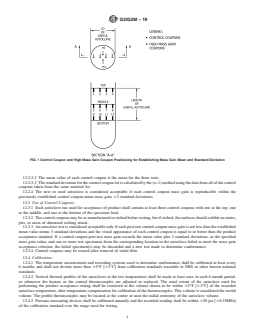
12.2.2.3 Locate the 12 or 24 specimens in a fixture or jig, in accordance with Fig. 1, and place the fixture or jig inside the useful
volume of the autoclave.
12.2.2.4 Complete the steam or water corrosion test in accordance with any one of the four methods in 14.3.
12.2.2.5 Remove specimens and weigh in accordance with the requirement of this test method.
12.2.2.6 Calculate and establish the mass gain mean and standard deviation (n–1 method) of each set of coupons for the test
method used.
12.2.2.7 For product acceptance tests the mean value and standard deviation for the control coupons may be the value
established in 12.2.2.6 or may be calculated periodically using all accepted values determined over at least the preceding 3-month
period but not less than 21 values.
12.2.3 An alternative method for establishing the mass gain mean and standard deviation for the control coupons which are used
repeatedly is:
12.2.3.1 Expose the control coupons to be used in three different tests, once each in the top, middle, and bottom of an autoclave,
and determine mass gain.
G2/G2M − 19
FIG. 1 Control Coupon and High Mass Gain Coupon Positioning for Establishing Mass Gain Mean and Standard Deviation
12.2.3.2 The mean value of each control coupon is the mean for the three tests.
12.2.3.3 The standard deviation for the control coupon lot is calculated by the (n–1) method using the data from all of the control
coupons taken from the same material lot.
12.2.4 The new or used autoclave is considered acceptable if each control coupon mass gain is reproducible within the
previously established control coupon mean mass gain 63 standard deviations.
12.3 Use of Control Coupons:
12.3.1 Each autoclave run used for acceptance of product shall contain at least three control coupons with one at the top, one
at the middle, and one at the bottom of the specimen load.
12.3.2 The control coupons may be as manufactured or etched before testing, but if etched, the surfaces should exhibit no stains,
pits, or areas of abnormal etching attack.
12.3.3 An autoclave test is considered acceptable only if each post-test control coupon mass gain is not less than the established
mean value minus 3 standard deviations and the visual appearance of each control coupon is equal to or better than the product
acceptance standard. If a control coupon post-test mass gain exceeds the mean value plus 3 standard deviations, or the specified
mass gain value, and one or more test specimens from the corresponding location in the autoclave failed to meet the mass gain
acceptance criterion, the failed specimen(s) may be discarded and a new test made to determine conformance.
12.3.4 Control coupons may be reused after removal of oxide film.
12.4 Calibration:
12.4.1 The temperature measurement and recording systems used to determine conformance shall be calibrated at least every
6 months and shall not deviate more than 65°F [63°C] from calibration standards traceable to NBS or other known national
standards.
12.4.2 Vertical thermal profiles of the autoclaves at the test temperatures shall be made at least once in each 6-month period,
or whenever the heaters or the control thermocouples are adjusted or replaced. The axial extent of the autoclave used for
performing the product acceptance testing shall be restricted to the volume shown to be within 65°F [63°C] of the recorded
autoclave temperature, after temperature compensation for calibration of the thermocouples. This volume is considered the useful
volume. The profile thermocouples may be located at the center or near the radial extremity of the autoclave volume.
12.4.3 Pressure-measuring devices shall be calibrated annually and the recorded reading shall be within 650 psi [60.35MPa]
of the calibration standard over the range used for testing.
G2/G2M − 19
13. Conditioning
13.1 Test Water Quality—The water used to conduct the corrosion test shall be Grade A water and have an oxygen content not
exceeding 45 ppb. The oxygen content specification may be met either by direct measurement using the appropriate method in Test
Methods D888 or by the use of Venting Method A or B of 14.3.
13.2 Autoclave Load Restrictions—The surface area of specimens loaded in a static autoclave shall not exceed 0.1 m /L of
autoclave volume.
13.3 Test Conditions:
13.3.1 Temperature—The recorded temperature within the volume used for testing shall be the specified value 65°F [63°C]
for steam tests and 610°F [66°C] for water tests.
13.3.2 Pressure—The recorded pressure shall be as specified 6100 psig [60.7 MPa] for steam tests and 6200 psig [61.4 MPa]
for water tests.
13.3.3 Time—The exposure time tolerance at the specified temperature and pressure shall be + 8 h, − 0 h. The time at specified
conditions need not be continuous.
13.3.4 Tests where temperature or pressure limits or both are exceeded for not more than 10 % of the nominal test time, but
where control coupons indicate satisfactory behavior, may, at the option of the test laboratory, be deemed acceptable.
13.4 Specimen Preparation:
13.4.1 Etched Specimen—Specimens should be thoroughly cleaned prior to acid etching and carefully rinsed to prepare the
surfaces for testing in a manner that eliminates the effects of machining, grinding, or other techniques used to obtain a specimen
of the desired size. Any technique that produces the desired smooth and shiny finish free of stains may be used. Zirconium-niobium
alloys etch to a matte finish. An example of a suitable procedure for etching and rinsing is given in Appendix X1.
13.4.2 As-Manufactured Specimens—These specimens should be thoroughly cleaned prior to testing to avoid contamination of
the autoclave which could aversely affect other specimens in the test. The extent of the specimen cleaning is often specified by
agreement between contracting parties. The cleaning section of Appendix X1 is an example of a suitable cleaning procedure.
14. Procedure
14.1 Inspection of Specimens—Examine the specimens for folds, cracks, blisters, foreign material, luster, brown acid stain, and
the like. Discard or re-prepare any etched specimen exhibiting the acid stain or dull surfaces.
14.2 Dimensions, Weight,Mass, and Inspection—Measure each test specimen, either before or after testing, to 60.002 in. [65
–5 –6 2
by× 10 m] and calculate the surface area rounded to the nearest 1 by× 10 m in accordance with Practice E29. Weigh the
–4
specimens to the nearest 1 by× 10 g with an analytical balance checked daily with a calibrated mass before use and zeroed before
each fifth weighing. Do not weigh specimens until they are thoroughly dry and at the same temperature as the balance.
14.3 Autoclaving:
14.3.1 Place the clean and weighed test specimens on the clean fixtures in a manner precluding specimen-to-specimen contact.
Corrosion-filmed Type 300 or 400 series stainless steel washers or wire mesh grids may be used as separators. Immediately before
immersing in the autoclave, the fixtures containing the specimens may be rinsed in Grade B water. Immediately before operation,
rinse the autoclave twice with Grade B water. Place the specimens and fixtures in the useful volume of the cleaned and rinsed
autoclave.
14.3.2 Venting Method A:
14.3.2.1 Water Tests—Fill the clean, thoroughly rinsed autoclave with enough Grade A water to cover the parts being tested
during the entire test period. Calculate the amount of water to be added so that the specimens are completely immersed in the liquid
phase at the test temperature as follows:
Volume of water required, L 5 k V 2 V (1)
~ !
0 1
where:
V = autoclave volume, L,
V = total volume in L of specimens and fixture, and is calculated by dividing the total weight in grams of specimens and fixture
by 7000.
V = total volume in L of specimens and fixture, and is calculated by dividing the total mass in grams of specimens and fixtur
...
Questions, Comments and Discussion
Ask us and Technical Secretary will try to provide an answer. You can facilitate discussion about the standard in here.
Loading comments...