

ASTM A516/A516M-17
(Specification)Standard Specification for Pressure Vessel Plates, Carbon Steel, for Moderate- and Lower-Temperature Service
General Information
- Abstract
ABSTRACT
This specification covers carbon steel plates intended primarily for service in welded pressure vessels where improved notch toughness is important. According to different strength levels, the plates are available in four grades: Grades 55, 60, 65, and 70. The maximum thickness of plates is limited only by the capacity of the composition to meet the specified mechanical property requirements. The steel shall be killed and shall conform to fine austenitic grain size requirements. The mechanical properties such as tensile strength, yield strength, and elongation shall be determined by a tension test for the plates.
SCOPE
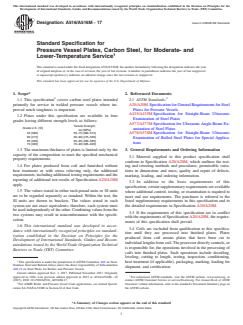
1.1 This specification2 covers carbon steel plates intended primarily for service in welded pressure vessels where improved notch toughness is important.
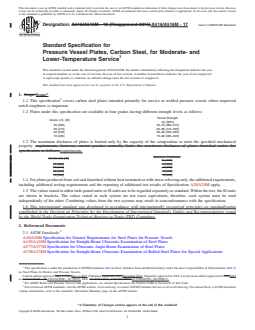
1.2 Plates under this specification are available in four grades having different strength levels as follows:
Grade U.S. [SI]
Tensile Strength,
ksi [MPa]
55 [380]
55–75 [380–515]
60 [415]
60–80 [415–550]
65 [450]
65–85 [450–585]
70 [485]
70–90 [485–620]
1.3 The maximum thickness of plates is limited only by the capacity of the composition to meet the specified mechanical property requirements.
1.4 For plates produced from coil and furnished without heat treatment or with stress relieving only, the additional requirements, including additional testing requirements and the reporting of additional test results of Specification A20/A20M apply.
1.5 The values stated in either inch-pound units or SI units are to be regarded separately as standard. Within the text, the SI units are shown in brackets. The values stated in each system are not exact equivalents; therefore, each system must be used independently of the other. Combining values from the two systems may result in nonconformance with the specification.
1.6 This international standard was developed in accordance with internationally recognized principles on standardization established in the Decision on Principles for the Development of International Standards, Guides and Recommendations issued by the World Trade Organization Technical Barriers to Trade (TBT) Committee.
- Status
- Published
- Publication Date
- 31-Oct-2017
- Technical Committee
- A01 - Steel, Stainless Steel and Related Alloys
- Drafting Committee
- A01.11 - Steel Plates for Boilers and Pressure Vessels
Buy Documents

ASTM A516/A516M-17 - Standard Specification for Pressure Vessel Plates, Carbon Steel, for Moderate- and Lower-Temperature Service

REDLINE ASTM A516/A516M-17 - Standard Specification for Pressure Vessel Plates, Carbon Steel, for Moderate- and Lower-Temperature Service
Overview
ASTM A516/A516M-17 - Standard Specification for Pressure Vessel Plates, Carbon Steel, for Moderate- and Lower-Temperature Service is an internationally recognized standard issued by ASTM International. This specification addresses the requirements for carbon steel plates used primarily in welded pressure vessels, especially when improved notch toughness is required. The standard outlines the characteristics, grades, and mechanical properties of these plates, making it essential for engineering, manufacturing, and safety applications in industries where pressure vessel integrity under varying temperatures is critical.
Key Topics
- Scope and Application: ASTM A516/A516M-17 specifies requirements for carbon steel plates for use in pressure vessels subjected to moderate and lower temperatures. It covers four strength grades: 55, 60, 65, and 70, allowing users to select materials based on needed performance levels.
- Mechanical Properties: The plates must meet specific tensile strength, yield strength, and elongation requirements. Notch toughness is a highlighted property for this application, ensuring reliability under impact or sudden temperature changes.
- Material Production: Plates are produced using killed steel practices and must conform to fine austenitic grain size requirements for enhanced toughness and structural integrity.
- Testing and Compliance: Tension tests are mandatory, and additional tests may be required for plates produced from coil or for special applications. Both inch-pound and SI units are included, but values from different systems are not to be combined.
- Supplementary Requirements: Additional controls, such as vacuum treatment, Charpy V-notch impact tests, and ultrasonic inspection, are available to address unique application needs or purchaser requirements.
- Standardization Principles: The development and updates of ASTM A516/A516M-17 adhere to internationally recognized standardization principles, ensuring compatibility with global markets and regulatory requirements.
Applications
ASTM A516/A516M-17 carbon steel plates are widely used in the fabrication of pressure vessels and boilers operated at moderate and lower temperatures. Typical applications include:
- Petrochemical and Chemical Processing: Storage tanks, reactors, and vessels where resistance to pressure and variable temperatures is essential.
- Power Generation: Steam boilers and components for thermal and nuclear power plants.
- Oil & Gas Industry: Transport and storage equipment subjected to different atmospheric and process temperatures.
- Refineries: Pressure vessels in hydrocarbon processing, including supplementary requirements for hydrofluoric acid alkylation service.
- General Tank and Vessel Manufacturing: Where structural integrity, safety, and toughness under pressure are key concerns.
These applications demand reliable materials that maintain their properties under stress, impact, and varying temperatures, making ASTM A516/A516M-17 a critical specification for engineers and manufacturers.
Related Standards
ASTM A516/A516M-17 is often used in conjunction with the following standards to ensure comprehensive coverage of materials and testing for steel pressure vessel plates:
- ASTM A20/A20M: General Requirements for Steel Plates for Pressure Vessels.
- ASTM A435/A435M: Straight-Beam Ultrasonic Examination of Steel Plates.
- ASTM A577/A577M: Ultrasonic Angle-Beam Examination of Steel Plates.
- ASTM A578/A578M: Straight-Beam Ultrasonic Examination of Rolled Steel Plates for Special Applications.
- ASME SA-516/SA-516M: For applications governed by the ASME Boiler and Pressure Vessel Code.
For more detailed information or specific technical requirements, users and manufacturers should review these related standards along with ASTM A516/A516M-17.
Keywords: ASTM A516, pressure vessel plate, carbon steel, moderate temperature, low temperature, steel plate standard, notch toughness, tensile strength, pressure vessel specification, ASTM International.
Relations
- Effective Date
- 01-Nov-2023
- Effective Date
- 01-Nov-2023
- Effective Date
- 01-Nov-2023
- Effective Date
- 01-Mar-2018
- Effective Date
- 15-Nov-2017
- Effective Date
- 01-Nov-2017
- Effective Date
- 01-Nov-2015
- Effective Date
- 01-Oct-2014
- Effective Date
- 01-Oct-2013
- Effective Date
- 01-Mar-2012
- Effective Date
- 01-Mar-2012
- Effective Date
- 01-Mar-2012
- Effective Date
- 01-Nov-2011
- Effective Date
- 01-Oct-2010
- Effective Date
- 01-Oct-2009
Buy Documents
ASTM A516/A516M-17 - Standard Specification for Pressure Vessel Plates, Carbon Steel, for Moderate- and Lower-Temperature Service
REDLINE ASTM A516/A516M-17 - Standard Specification for Pressure Vessel Plates, Carbon Steel, for Moderate- and Lower-Temperature Service
Get Certified
Connect with accredited certification bodies for this standard

Element Materials Technology
Materials testing and product certification.

Inštitut za kovinske materiale in tehnologije
Institute of Metals and Technology. Materials testing, metallurgical analysis, NDT.
Sponsored listings
Frequently Asked Questions
ASTM A516/A516M-17 is a technical specification published by ASTM International. Its full title is "Standard Specification for Pressure Vessel Plates, Carbon Steel, for Moderate- and Lower-Temperature Service". This standard covers: ABSTRACT This specification covers carbon steel plates intended primarily for service in welded pressure vessels where improved notch toughness is important. According to different strength levels, the plates are available in four grades: Grades 55, 60, 65, and 70. The maximum thickness of plates is limited only by the capacity of the composition to meet the specified mechanical property requirements. The steel shall be killed and shall conform to fine austenitic grain size requirements. The mechanical properties such as tensile strength, yield strength, and elongation shall be determined by a tension test for the plates. SCOPE 1.1 This specification2 covers carbon steel plates intended primarily for service in welded pressure vessels where improved notch toughness is important. 1.2 Plates under this specification are available in four grades having different strength levels as follows: Grade U.S. [SI] Tensile Strength, ksi [MPa] 55 [380] 55–75 [380–515] 60 [415] 60–80 [415–550] 65 [450] 65–85 [450–585] 70 [485] 70–90 [485–620] 1.3 The maximum thickness of plates is limited only by the capacity of the composition to meet the specified mechanical property requirements. 1.4 For plates produced from coil and furnished without heat treatment or with stress relieving only, the additional requirements, including additional testing requirements and the reporting of additional test results of Specification A20/A20M apply. 1.5 The values stated in either inch-pound units or SI units are to be regarded separately as standard. Within the text, the SI units are shown in brackets. The values stated in each system are not exact equivalents; therefore, each system must be used independently of the other. Combining values from the two systems may result in nonconformance with the specification. 1.6 This international standard was developed in accordance with internationally recognized principles on standardization established in the Decision on Principles for the Development of International Standards, Guides and Recommendations issued by the World Trade Organization Technical Barriers to Trade (TBT) Committee.
ABSTRACT This specification covers carbon steel plates intended primarily for service in welded pressure vessels where improved notch toughness is important. According to different strength levels, the plates are available in four grades: Grades 55, 60, 65, and 70. The maximum thickness of plates is limited only by the capacity of the composition to meet the specified mechanical property requirements. The steel shall be killed and shall conform to fine austenitic grain size requirements. The mechanical properties such as tensile strength, yield strength, and elongation shall be determined by a tension test for the plates. SCOPE 1.1 This specification2 covers carbon steel plates intended primarily for service in welded pressure vessels where improved notch toughness is important. 1.2 Plates under this specification are available in four grades having different strength levels as follows: Grade U.S. [SI] Tensile Strength, ksi [MPa] 55 [380] 55–75 [380–515] 60 [415] 60–80 [415–550] 65 [450] 65–85 [450–585] 70 [485] 70–90 [485–620] 1.3 The maximum thickness of plates is limited only by the capacity of the composition to meet the specified mechanical property requirements. 1.4 For plates produced from coil and furnished without heat treatment or with stress relieving only, the additional requirements, including additional testing requirements and the reporting of additional test results of Specification A20/A20M apply. 1.5 The values stated in either inch-pound units or SI units are to be regarded separately as standard. Within the text, the SI units are shown in brackets. The values stated in each system are not exact equivalents; therefore, each system must be used independently of the other. Combining values from the two systems may result in nonconformance with the specification. 1.6 This international standard was developed in accordance with internationally recognized principles on standardization established in the Decision on Principles for the Development of International Standards, Guides and Recommendations issued by the World Trade Organization Technical Barriers to Trade (TBT) Committee.
ASTM A516/A516M-17 is classified under the following ICS (International Classification for Standards) categories: 77.140.30 - Steels for pressure purposes. The ICS classification helps identify the subject area and facilitates finding related standards.
ASTM A516/A516M-17 has the following relationships with other standards: It is inter standard links to ASTM A578/A578M-17(2023), ASTM A435/A435M-17(2023), ASTM A577/A577M-17(2023), ASTM A20/A20M-18, ASTM A20/A20M-17, ASTM A578/A578M-17, ASTM A20/A20M-15, ASTM A20/A20M-14, ASTM A20/A20M-13, ASTM A577/A577M-90(2012), ASTM A435/A435M-90(2012), ASTM A578/A578M-07(2012), ASTM A20/A20M-11, ASTM A20/A20M-10, ASTM A20/A20M-09. Understanding these relationships helps ensure you are using the most current and applicable version of the standard.
ASTM A516/A516M-17 is available in PDF format for immediate download after purchase. The document can be added to your cart and obtained through the secure checkout process. Digital delivery ensures instant access to the complete standard document.
Standards Content (Sample)
This international standard was developed in accordance with internationally recognized principles on standardization established in the Decision on Principles for the
Development of International Standards, Guides and Recommendations issued by the World Trade Organization Technical Barriers to Trade (TBT) Committee.
Designation:A516/A516M −17 Used in USDOE-NE Standards
Standard Specification for
Pressure Vessel Plates, Carbon Steel, for Moderate- and
Lower-Temperature Service
This standard is issued under the fixed designationA516/A516M; the number immediately following the designation indicates the year
of original adoption or, in the case of revision, the year of last revision. A number in parentheses indicates the year of last reapproval.
A superscript epsilon (´) indicates an editorial change since the last revision or reapproval.
This standard has been approved for use by agencies of the U.S. Department of Defense.
1. Scope* 2. Referenced Documents
2 3
1.1 This specification covers carbon steel plates intended 2.1 ASTM Standards:
primarily for service in welded pressure vessels where im- A20/A20M SpecificationforGeneralRequirementsforSteel
proved notch toughness is important. Plates for Pressure Vessels
A435/A435M Specification for Straight-Beam Ultrasonic
1.2 Plates under this specification are available in four
Examination of Steel Plates
grades having different strength levels as follows:
A577/A577M Specification for Ultrasonic Angle-Beam Ex-
Tensile Strength,
Grade U.S. [SI]
amination of Steel Plates
ksi [MPa]
55 [380] 55–75 [380–515] A578/A578M Specification for Straight-Beam Ultrasonic
60 [415] 60–80 [415–550]
Examination of Rolled Steel Plates for Special Applica-
65 [450] 65–85 [450–585]
tions
70 [485] 70–90 [485–620]
1.3 The maximum thickness of plates is limited only by the
3. General Requirements and Ordering Information
capacity of the composition to meet the specified mechanical
3.1 Material supplied to this product specification shall
property requirements.
conform to Specification A20/A20M, which outlines the test-
1.4 For plates produced from coil and furnished without
ing and retesting methods and procedures, permissible varia-
heat treatment or with stress relieving only, the additional
tions in dimensions and mass, quality and repair of defects,
requirements,includingadditionaltestingrequirementsandthe
marking, loading, and ordering information.
reporting of additional test results of Specification A20/A20M
3.2 In addition to the basic requirements of this
apply.
specification, certain supplementary requirements are available
1.5 The values stated in either inch-pound units or SI units
where additional control, testing, or examination is required to
are to be regarded separately as standard. Within the text, the
meet end use requirements. The purchaser is referred to the
SI units are shown in brackets. The values stated in each
listed supplementary requirements in this specification and to
system are not exact equivalents; therefore, each system must
the detailed requirements in Specification A20/A20M.
be used independently of the other. Combining values from the
3.3 If the requirements of this specification are in conflict
two systems may result in nonconformance with the specifi-
with the requirements of Specification A20/A20M, the require-
cation.
ments of this specification shall prevail.
1.6 This international standard was developed in accor-
3.4 Coils are excluded from qualification to this specifica-
dance with internationally recognized principles on standard-
tion until they are processed into finished plates. Plates
ization established in the Decision on Principles for the
produced from coil means plates that have been cut to
Development of International Standards, Guides and Recom-
individuallengthsfromcoil.Theprocessordirectlycontrols,or
mendations issued by the World Trade Organization Technical
is responsible for, the operations involved in the processing of
Barriers to Trade (TBT) Committee.
coils into finished plates. Such operations include decoiling,
leveling, cutting to length, testing, inspection, conditioning,
This specification is under the jurisdiction of ASTM Committee A01 on Steel,
heat treatment (if applicable), packaging, marking, loading for
Stainless Steel and Related Alloys and is the direct responsibility of Subcommittee
shipment, and certification.
A01.11 on Steel Plates for Boilers and Pressure Vessels.
Current edition approved Nov. 1, 2017. Published November 2017. Originally
approved in 1964. Last previous edition approved in 2015 as A516/A516M – 10 For referenced ASTM standards, visit the ASTM website, www.astm.org, or
(2015). DOI: 10.1520/A0516_A0516M-17. contact ASTM Customer Service at service@astm.org. For Annual Book of ASTM
For ASME Boiler and Pressure Vessel Code applications, see related Specifi- Standards volume information, refer to the standard’s Document Summary page on
cation SA-516/SA-516M in Section II of that Code. the ASTM website.
*A Summary of Changes section appears at the end of this standard
Copyright © ASTM International, 100 Barr Harbor Drive, PO Box C700, West Conshohocken, PA 19428-2959. United States
A516/A516M−17
TABLE 1 Chemical Requirements
Composition, %
Elements
Grade 55 Grade 60 Grade 65 Grade 70
[Grade 380] [Grade 415] [Grade 450] [Grade 485]
A,B
Carbon, max:
⁄2 in. [12.5 mm] and under 0.18 0.21 0.24 0.27
Over ⁄2 in. to 2 in. [12.5 to 50 mm], incl 0.20 0.23 0.26 0.28
Over 2 in. to 4 in. [50 to 100 mm], incl 0.22 0.25 0.28 0.30
Over 4 to 8 in. [100 to 200 mm], incl 0.24 0.27 0.29 0.31
Over 8 in. [200 mm] 0.26 0.27 0.29 0.31
B
Manganese:
⁄2 in. [12.5 mm] and under:
C
Heat analysis 0.60–0.90 0.60–0.90 0.85–1.20 0.85–1.20
C
Product analysis 0.55–0.98 0.55–0.98 0.79–1.30 0.79–1.30
Over ⁄2 in. [12.5 mm]:
Heat analysis 0.60–1.20 0.85–1.20 0.85–1.20 0.85–1.20
Product analysis 0.55–1.30 0.79–1.30 0.79–1.30 0.79–1.30
A
Phosphorus, max 0.025 0.025 0.025 0.025
A
Sulfur, max 0.025 0.025 0.025 0.025
Silicon:
Heat analysis 0.15–0.40 0.15–0.40 0.15–0.40 0.15–0.40
Product analysis 0.13–0.45 0.13–0.45 0.13–0.45 0.13–0.45
A
Applies to both heat and product analyses.
B
For each reduction of 0.01 percentage point below the specified maximum for carbon, an increase of 0.06 percentage point above the specified maximum for manganese
is permitted, up to a maximum of 1.50 % by heat analysis and 1.60 % by product analysis.
C
Grade 60 plates ⁄2 in. [12.5 mm] and under in thickness may have 0.85–1.20 % manganese on heat analysis, and 0.79–
...
This document is not an ASTM standard and is intended only to provide the user of an ASTM standard an indication of what changes have been made to the previous version. Because
it may not be technically possible to adequately depict all changes accurately, ASTM recommends that users consult prior editions as appropriate. In all cases only the current version
of the standard as published by ASTM is to be considered the official document.
Designation: A516/A516M − 10 (Reapproved 2015) A516/A516M − 17 Used in USDOE-NE Standards
Standard Specification for
Pressure Vessel Plates, Carbon Steel, for Moderate- and
Lower-Temperature Service
This standard is issued under the fixed designation A516/A516M; the number immediately following the designation indicates the year
of original adoption or, in the case of revision, the year of last revision. A number in parentheses indicates the year of last reapproval.
A superscript epsilon (´) indicates an editorial change since the last revision or reapproval.
This standard has been approved for use by agencies of the U.S. Department of Defense.
1. Scope Scope*
1.1 This specification covers carbon steel plates intended primarily for service in welded pressure vessels where improved
notch toughness is important.
1.2 Plates under this specification are available in four grades having different strength levels as follows:
Tensile Strength,
Grade U.S. [SI]
ksi [MPa]
55 [380] 55–75 [380–515]
60 [415] 60–80 [415–550]
65 [450] 65–85 [450–585]
70 [485] 70–90 [485–620]
1.3 The maximum thickness of plates is limited only by the capacity of the composition to meet the specified mechanical
property requirements; however, current practice normally limits the maximum thickness of plates furnished under this
specification as follows:requirements.
Maximum Thickness,
Grade U.S. [SI]
in. [mm]
55 [380] 12 [305]
60 [415] 8 [205]
65 [450] 8 [205]
70 [485] 8 [205]
1.4 For plates produced from coil and furnished without heat treatment or with stress relieving only, the additional requirements,
including additional testing requirements and the reporting of additional test results of Specification A20/A20M apply.
1.5 The values stated in either inch-pound units or SI units are to be regarded separately as standard. Within the text, the SI units
are shown in brackets. The values stated in each system are not exact equivalents; therefore, each system must be used
independently of the other. Combining values from the two systems may result in nonconformance with the specification.
1.6 This international standard was developed in accordance with internationally recognized principles on standardization
established in the Decision on Principles for the Development of International Standards, Guides and Recommendations issued
by the World Trade Organization Technical Barriers to Trade (TBT) Committee.
2. Referenced Documents
2.1 ASTM Standards:
A20/A20M Specification for General Requirements for Steel Plates for Pressure Vessels
A435/A435M Specification for Straight-Beam Ultrasonic Examination of Steel Plates
A577/A577M Specification for Ultrasonic Angle-Beam Examination of Steel Plates
A578/A578M Specification for Straight-Beam Ultrasonic Examination of Rolled Steel Plates for Special Applications
This specification is under the jurisdiction of ASTM Committee A01 on Steel, Stainless Steel and Related Alloys and is the direct responsibility of Subcommittee A01.11
on Steel Plates for Boilers and Pressure Vessels.
Current edition approved Sept. 1, 2015Nov. 1, 2017. Published September 2015November 2017. Originally approved in 1964. Last previous edition approved in 20102015
as A516/A516M – 10.A516/A516M – 10 (2015). DOI: 10.1520/A0516_A0516M-10R15.10.1520/A0516_A0516M-17.
For ASME Boiler and Pressure Vessel Code applications, see related Specification SA-516/SA-516M in Section II of that Code.
For referenced ASTM standards, visit the ASTM website, www.astm.org, or contact ASTM Customer Service at service@astm.org. For Annual Book of ASTM Standards
volume information, refer to the standard’s Document Summary page on the ASTM website.
*A Summary of Changes section appears at the end of this standard
Copyright © ASTM International, 100 Barr Harbor Drive, PO Box C700, West Conshohocken, PA 19428-2959. United States
A516/A516M − 17
3. General Requirements and Ordering Information
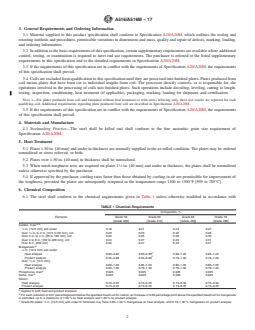
3.1 Material supplied to this product specification shall conform to Specification A20/A20M, which outlines the testing and
retesting methods and procedures, permissible variations in dimensions and mass, quality and repair of defects, marking, loading,
and ordering information.
3.2 In addition to the basic requirements of this specification, certain supplementary requirements are available where additional
control, testing, or examination is required to meet end use requirements. The purchaser is referred to the listed supplementary
requirements in this specification and to the detailed requirements in Specification A20/A20M.
3.3 If the requirements of this specification are in conflict with the requirements of Specification A20/A20M, the requirements
of this specification shall prevail.
3.4 Coils are excluded from qualification to this specification until they are processed into finished plates. Plates produced from
coil means plates that have been cut to individual lengths from coil. The processor directly controls, or is responsible for, the
operations involved in the processing of coils into finished plates. Such operations include decoiling, leveling, cutting to length,
testing, inspection, conditioning, heat treatment (if applicable), packaging, marking, loading for shipment, and certification.
NOTE 1—For plates produced from coil and furnished without heat treatment or with stress relieving only, three test results are reported for each
qualifying coil. Additional requirements regarding plate produced from coil are described in Specification A20/A20M.
3.5 If the requirements of this specification are in conflict with the requirements of Specification A20/A20M, the requirements
of this specification shall prevail.
4. Materials and Manufacture
4.1 Steelmaking Practice—The steel shall be killed and shall conform to the fine austenitic grain size requirement of
Specification A20/A20M.
5. Heat Treatment
5.1 Plates 1.50 in. [40 mm] and under in thickness are normally supplied in the as-rolled condition. The plates may be ordered
normalized or stress relieved, or both.
5.2 Plates over 1.50 in. [40 mm] in thickness shall be normalized.
5.3 When notch-toughness tests are required on plates 1 ⁄2 in. [40 mm] and under in thickness, the plates shall be normalized
unless otherwise specified by the purchaser.
5.4 If approved by the purchaser, cooling rates faster than those obtained by cooling in air are permissible for improvement of
the toughness, provided the plates are subsequent
...