

ASTM B134/B134M-15(2021)
(Specification)Standard Specification for Brass Wire
General Information
- Abstract
ABSTRACT
This specification establishes the requirements for round, hexagonal, octagonal, rectangular and square brass wire of UNS Alloy Nos. C21000, C22000, C22600, C23000, C23400, C24000, C26000, C27000, and C27400. The chemical composition, temper, annealed wire grain size, Rockwell hardness, and tensile strength requirements are detailed.
SCOPE
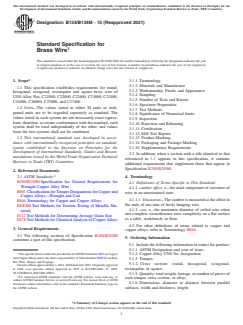
1.1 This specification establishes requirements for round, hexagonal, octagonal, rectangular and square brass wire of UNS Alloy Nos. C21000, C22000, C22600, C23000, C23400, C24000, C26000, C27000, and C27400.
1.2 Units—The values stated in either SI units or inch-pound units are to be regarded separately as standard. The values stated in each system are not necessarily exact equivalents; therefore, to ensure conformance with the standard, each system shall be used independently of the other, and values from the two systems shall not be combined.
1.3 This international standard was developed in accordance with internationally recognized principles on standardization established in the Decision on Principles for the Development of International Standards, Guides and Recommendations issued by the World Trade Organization Technical Barriers to Trade (TBT) Committee.
- Status
- Published
- Publication Date
- 30-Jun-2021
- Technical Committee
- B05 - Copper and Copper Alloys
- Drafting Committee
- B05.02 - Rod, Bar, Wire, Shapes and Forgings
Overview
ASTM B134/B134M-15(2021): Standard Specification for Brass Wire is a comprehensive standard developed by ASTM International. This specification outlines the requirements for round, hexagonal, octagonal, rectangular, and square brass wire produced from several copper-zinc alloys (UNS Alloy Nos. C21000, C22000, C22600, C23000, C23400, C24000, C26000, C27000, and C27400). The standard details methodologies for testing, as well as defining requirements for chemical composition, temper, annealed grain size, Rockwell hardness, tensile strength, and dimensions.
This standard aligns with globally recognized principles on standardization, supporting trade and quality assurance across industries that use brass wire.
Key Topics
- Alloy Range: Covers multiple UNS copper-zinc alloy numbers, each with specific compositional requirements for copper, lead, and iron, with the balance being zinc.
- Wire Forms: Specifies brass wire in various cross-sectional shapes, including round, hexagonal, octagonal, rectangular, and square.
- Mechanical Properties: Defines temper conditions, annealed wire grain size, Rockwell hardness, and tensile strength for different alloys and tempers.
- Dimensional Standards: Details requirements for dimensions, permissible variations, mass, straightness, and edge contour, referencing accompanying general specifications.
- Test Methods: Prescribes recognized test procedures for tension, chemical analysis, and grain size. Acceptance or rejection of products is based on results from standardized tests.
- Ordering Information: Guides purchasers on specifying alloy, temper, size, quantity, edge type, and form (coil, spool, reel). Options for certifications and mill test reports are included.
- Packaging and Marking: Addresses how wire should be packaged and marked for identification and traceability.
Applications
ASTM B134/B134M-15(2021) brass wire is widely used in industries requiring reliable, versatile, and high-quality copper-alloy wire. Practical applications include:
- Manufacturing: Brass wire's formability and corrosion resistance suits it for components in automotive, electronics, and appliance manufacturing.
- Ornamental and Architectural: Used for decorative elements, mesh, and wirework in architectural and artistic settings.
- General Engineering: Serves as fastening, binding, or spring wire where non-electrical, high-strength, or general-purpose copper-zinc wire is needed.
- Industrial Supply: Frequently specified in procurement for maintenance, repair, and operational stock in diverse industries.
By adhering to ASTM B134/B134M, manufacturers and purchasers can ensure consistency in performance, material quality, and fit-for-purpose supply chains.
Related Standards
- ASTM B250/B250M: Provides the general requirements for wrought copper alloy wire, referenced for details on tolerances, finish, and testing in B134/B134M.
- ASTM B601: Classification for temper designations in copper and copper alloys.
- ASTM B846: Terminology standard for copper and copper alloys, ensuring clear communication about properties and processes.
- ASTM E8/E8M: Test methods for tension testing of metallic materials, as applied to tensile strength determinations.
- ASTM E112: Procedures for determining average grain size, critical for verifying annealed wire quality.
- ASTM E478: Chemical analysis methods for copper alloys, providing the basis for compositional conformity.
Keywords: ASTM B134, brass wire, copper-alloy wire, copper-zinc alloy, round wire, hexagonal wire, octagonal wire, square wire, rectangular wire, wire temper, tensile strength, grain size, chemical composition, Rockwell hardness, industrial standards.
Relations
- Effective Date
- 01-Jan-2024
- Refers
ASTM B250/B250M-19 - Standard Specification for General Requirements for Wrought Copper Alloy Wire - Effective Date
- 01-Oct-2019
- Effective Date
- 01-Aug-2019
- Effective Date
- 01-Jan-2019
- Effective Date
- 01-Oct-2018
- Effective Date
- 01-Mar-2018
- Effective Date
- 01-Oct-2016
- Refers
ASTM B250/B250M-16 - Standard Specification for General Requirements for Wrought Copper Alloy Wire - Effective Date
- 01-Oct-2016
- Effective Date
- 15-Jul-2016
- Effective Date
- 01-Feb-2015
- Effective Date
- 01-Jun-2013
- Refers
ASTM B250/B250M-13 - Standard Specification for General Requirements for Wrought Copper Alloy Wire - Effective Date
- 01-Apr-2013
- Effective Date
- 15-Nov-2012
- Refers
ASTM B250/B250M-12 - Standard Specification for General Requirements for Wrought Copper Alloy Wire - Effective Date
- 01-Oct-2012
- Effective Date
- 01-Oct-2012
Get Certified
Connect with accredited certification bodies for this standard

Element Materials Technology
Materials testing and product certification.

Inštitut za kovinske materiale in tehnologije
Institute of Metals and Technology. Materials testing, metallurgical analysis, NDT.
Sponsored listings
Frequently Asked Questions
ASTM B134/B134M-15(2021) is a technical specification published by ASTM International. Its full title is "Standard Specification for Brass Wire". This standard covers: ABSTRACT This specification establishes the requirements for round, hexagonal, octagonal, rectangular and square brass wire of UNS Alloy Nos. C21000, C22000, C22600, C23000, C23400, C24000, C26000, C27000, and C27400. The chemical composition, temper, annealed wire grain size, Rockwell hardness, and tensile strength requirements are detailed. SCOPE 1.1 This specification establishes requirements for round, hexagonal, octagonal, rectangular and square brass wire of UNS Alloy Nos. C21000, C22000, C22600, C23000, C23400, C24000, C26000, C27000, and C27400. 1.2 Units—The values stated in either SI units or inch-pound units are to be regarded separately as standard. The values stated in each system are not necessarily exact equivalents; therefore, to ensure conformance with the standard, each system shall be used independently of the other, and values from the two systems shall not be combined. 1.3 This international standard was developed in accordance with internationally recognized principles on standardization established in the Decision on Principles for the Development of International Standards, Guides and Recommendations issued by the World Trade Organization Technical Barriers to Trade (TBT) Committee.
ABSTRACT This specification establishes the requirements for round, hexagonal, octagonal, rectangular and square brass wire of UNS Alloy Nos. C21000, C22000, C22600, C23000, C23400, C24000, C26000, C27000, and C27400. The chemical composition, temper, annealed wire grain size, Rockwell hardness, and tensile strength requirements are detailed. SCOPE 1.1 This specification establishes requirements for round, hexagonal, octagonal, rectangular and square brass wire of UNS Alloy Nos. C21000, C22000, C22600, C23000, C23400, C24000, C26000, C27000, and C27400. 1.2 Units—The values stated in either SI units or inch-pound units are to be regarded separately as standard. The values stated in each system are not necessarily exact equivalents; therefore, to ensure conformance with the standard, each system shall be used independently of the other, and values from the two systems shall not be combined. 1.3 This international standard was developed in accordance with internationally recognized principles on standardization established in the Decision on Principles for the Development of International Standards, Guides and Recommendations issued by the World Trade Organization Technical Barriers to Trade (TBT) Committee.
ASTM B134/B134M-15(2021) is classified under the following ICS (International Classification for Standards) categories: 77.150.30 - Copper products. The ICS classification helps identify the subject area and facilitates finding related standards.
ASTM B134/B134M-15(2021) has the following relationships with other standards: It is inter standard links to ASTM E8/E8M-24, ASTM B250/B250M-19, ASTM B846-19a, ASTM B846-19, ASTM B601-18a, ASTM B601-18, ASTM B601-16, ASTM B250/B250M-16, ASTM E8/E8M-16, ASTM E8/E8M-15, ASTM E8/E8M-13, ASTM B250/B250M-13, ASTM E112-12, ASTM B250/B250M-12, ASTM B601-12. Understanding these relationships helps ensure you are using the most current and applicable version of the standard.
ASTM B134/B134M-15(2021) is available in PDF format for immediate download after purchase. The document can be added to your cart and obtained through the secure checkout process. Digital delivery ensures instant access to the complete standard document.
Standards Content (Sample)
This international standard was developed in accordance with internationally recognized principles on standardization established in the Decision on Principles for the
Development of International Standards, Guides and Recommendations issued by the World Trade Organization Technical Barriers to Trade (TBT) Committee.
Designation:B134/B134M −15 (Reapproved 2021)
Standard Specification for
Brass Wire
This standard is issued under the fixed designation B134/B134M; the number immediately following the designation indicates the year
of original adoption or, in the case of revision, the year of last revision. A number in parentheses indicates the year of last reapproval.
A superscript epsilon (´) indicates an editorial change since the last revision or reapproval.
1. Scope* 3.1.1 Terminology
3.1.2 Materials and Manufacture
1.1 This specification establishes requirements for round,
3.1.3 Workmanship, Finish, and Appearance
hexagonal, octagonal, rectangular and square brass wire of
3.1.4 Sampling
UNSAlloy Nos. C21000, C22000, C22600, C23000, C23400,
3.1.5 Number of Tests and Retests
C24000, C26000, C27000, and C27400.
3.1.6 Specimen Preparation
1.2 Units—The values stated in either SI units or inch-
3.1.7 Test Methods
pound units are to be regarded separately as standard. The
3.1.8 Significance of Numerical limits
values stated in each system are not necessarily exact equiva-
3.1.9 Inspection
lents; therefore, to ensure conformance with the standard, each
3.1.10 Rejection and Rehearing
system shall be used independently of the other, and values
3.1.11 Certification
from the two systems shall not be combined.
3.1.12 Mill Test Reports
1.3 This international standard was developed in accor-
3.1.13 Product Marking;
dance with internationally recognized principles on standard- 3.1.14 Packaging and Package Marking
ization established in the Decision on Principles for the
3.1.15 Supplementary Requirements
Development of International Standards, Guides and Recom-
3.2 In addition, when a section with a title identical to that
mendations issued by the World Trade Organization Technical
referenced in 3.1 appears in this specification, it contains
Barriers to Trade (TBT) Committee.
additional requirements that supplement those that appear in
Specification B250/B250M.
2. Referenced Documents
4. Terminology
2.1 ASTM Standards:
B250/B250M Specification for General Requirements for
4.1 Definitions of Terms Specific to This Standard:
Wrought Copper Alloy Wire
4.1.1 camber offset, n—the axial component of curvature of
B601 Classification forTemper Designations for Copper and
wire in an unrestrained state.
Copper Alloys—Wrought and Cast
4.1.1.1 Discussion—The camber is measured as the offset in
B846 Terminology for Copper and Copper Alloys
the ends of one turn of freely hanging wire.
E8/E8M Test Methods for Tension Testing of Metallic Ma-
4.1.2 cast, n—the maximum diameter of coiled wire when
terials
one complete circumference rests completely on a flat surface
E112 Test Methods for Determining Average Grain Size
as a table, workbench, or floor.
E478 Test Methods for ChemicalAnalysis of CopperAlloys
4.2 For other definitions of terms related to copper and
3. General Requirements
copper alloys, refer to Terminology B846.
3.1 The following sections of Specification B250/B250M
5. Ordering Information
constitute a part of this specification.
5.1 Include the following information in orders for product:
5.1.1 ASTM Designation and year of issue;
ThisspecificationisunderthejurisdictionofASTMCommitteeB05onCopper
5.1.2 Copper Alloy UNS No. designation;
and CopperAlloys and is the direct responsibility of Subcommittee B05.02 on Rod,
5.1.3 Temper;
Bar, Wire, Shapes and Forgings.
5.1.4 Cross section: round, hexagonal, octagonal,
Current edition approved July 1, 2021. Published July 2021. Originally approved
rectangular, or square;
in 1940. Last previous edition approved in 2015 as B134/B134M – 15. DOI:
10.1520/B0134_B0134M-15R21.
5.1.5 Quantity: total weight, footage, or number of pieces of
For referenced ASTM standards, visit the ASTM website, www.astm.org, or
each temper, cross section, or alloy;
contact ASTM Customer Service at service@astm.org. For Annual Book of ASTM
5.1.6 Dimensions: diameter or distance between parallel
Standards volume information, refer to the standard’s Document Summary page on
the ASTM website. surfaces, width and thickness, length;
*A Summary of Changes section appears at the end of this standard
Copyright © ASTM International, 100 Barr Harbor Drive, PO Box C700, West Conshohocken, PA 19428-2959. United States
B134/B134M−15 (2021)
5.1.7 Type of edge: square corners, rounded edge, full- C26000, C27000, and C27400 shall be available in H00, H01,
rounded edge; H02, H03, H04, H06, H08, and H10 tempers as defined in
5.1.8 How furnished: coil, spool, or reel, specific lengths Classification B601.
with or without ends; and 8.1.1 Product made in H04 temper is not generally available
5.1.9 When material is purchased for agencies of the U.S.
in sizes over ⁄2 in. [13 mm] in diameter.
government (Specification B250/B250M).
8.1.2 Product made in H06 temper is not generally available
in sizes over ⁄8 in. [10 mm] in diameter.
5.2 The following options are available to this specification
8.1.3 Product made in H08 temper is not generally available
and should be specified in the contract or purchase order when
in sizes over ⁄4 in. [6 mm] in diameter.
required:
8.1.4 Square product is not generally available in H06 or
5.2.1 Certification (Specification B250/B250M, and
H08 tempers.
5.2.2 Mill test report (Specification B250/B250M.
8.1.5 The tension test shall be the standard temper test for
5.2.3 Cast and camber requirements, if specified.
all H temper wire.
6. Materials and Manufacture
8.1.6 The product in annealed form of UNS Alloys Nos.
C21000 and C22000 shall be available in OS050, OS035,
6.1 Material—The material shall be made from cast billets,
OS025, and OS015 tempers as defined in Classification B601.
logs, or rods of Copper Alloy UNS Nos. C21000, C22000,
8.1.7 The product in annealed form of UNS Alloy Nos.
C22600, C23000, C23400, C24000, C26000, C27000, or
C22600, C23000, C23400, and C24000 shall be available in
C27400, of such purity, soundness, and structure to be suitable
OS070,OS050,OS035,OS025,OS015,andOS010tempersas
for processing into the desired product.
defined in Classification B601.
6.2 Manufacture—The products shall be manufactured by
8.1.8 The product in annealed form of UNS Alloy Nos.
suchhotworking,coldworking,andannealingprocessingasto
C26000, C27000, and C27400 shall be available in OS120,
produce a uniform wrought structure in the finished product.
OS070, OS050, OS035, OS025, and OS015 tempers as defined
in Classification B601.
7. Chemical Composition
7.1 The material shall conform to the chemical composi-
9. Grain Size for Annealed Wire
tional requirements specified in Table 1 for the copper alloy
9.1 Grain size shall be the standard requirement for all
specified in the ordering information.
product in the annealed tempers.
7.1.1 When all elements specified for a given alloy in Table
1 are determined, their sum of results shall be as follows:
9.2 Acceptanceorrejectionbasedongrainsizeshalldepend
Sum of Results, only on the average grain size of test specimens taken from
Alloy UNS Nos.
Percent, Minimum
each of two sample portions and each specimen shall be within
thelimitsprescribedinTable2whendeterminedinaccordance
C21000, C22000, C22600, C23000, 99.8
C23400, C24000 with Test Methods E112.
C26000, C27000, C27400 99.7
7.2 These composition limits do not preclude the presence 10. Mechanical Property Requirements
of other elements. Limits may be established and analysis
10.1 Tensile Strength Requirements:
required for unnamed elements by agreement between the
10.1.1 Drawnorrolledproductshallconformtotherequire-
manufacturer or supplier and the purchaser.
ments specified in Tables 3-6, by alloy and temper, for wire
7.3 Zinc,listedasthe“remainder,”isthedifferencebetween
0.020 in. [0.5 mm] and over in diameter or distance between
the sum of results for all elements determined and 100 %.
parallel surfaces.
10.1.1.1 The temper of wire under 0.020 in. [0.5 mm] in
8. Temper
diameter or distance between parallel surfaces shall be subject
8.1 The product in drawn or rolled wire of UNSAlloy Nos. to agreement between the manufacturer, or supplier, and the
C21000, C22000, C22600, C23000, C23400, C24000,
purchaser.
TABLE 1 Chemical Requirements
Copper Alloy Composition, %
UNS No.
Copper Lead, max Iron, max Zinc
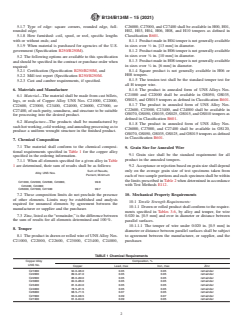
C21000 94.0–96.0 0.05 0.05 remainder
C22000 89.0–91.0 0.05 0.05 remainder
C22600 86.0–89.0 0.05 0.05 remainder
C23000 84.0–86.0 0.05 0.05 remainder
C23400 81.0–84.0 0.05 0.05 remainder
C24000 78.5–81.5 0.05 0.05 remainder
C26000 68.5–71.5 0.07 0.05 remainder
C27000 63.0–68.5 0.09 0.07 remainder
C27400 61.0–64.0 0.09 0.05 remainder
B134/B134M−15 (2021)
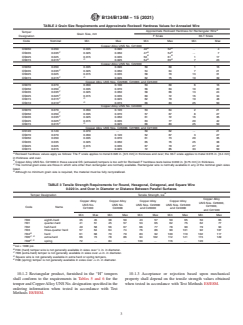
TABLE 2 Grain Size Requirements and Approximate Rockwell Hardness Values for Annealed Wire
A
Approximate Rockwell Hardness for Rectangular Wire
Temper
Grain Size, mm
Designation
F Scale 30-T Scale
Code Nominal Min Max Min Max Min Max
Copper Alloy UNS No. C21000
B B
OS050 0.050 0.035 0.090 40 52 . 4
C B B
OS035 0.035 0.025 0.050 47 54 . 7
B B
OS025 0.025 0.015 0.035 50 61 117
CD B B
OS015 0.015 0.025 54 65 723
Copper Alloy UNS No. C22000
OS050 0.050 0.035 0.090 50 60 1 16
C
OS035 0.035 0.025 0.050 54 64 7 21
OS025 0.025 0.015 0.035 58 70 13 31
CD
OS015 0.015 0.025 62 75 19 39
Copper Alloy UNS Nos. C22600, C23000, and C23400
OS070 0.070 0.050 0.100 53 60 6 16
C
OS050 0.050 0.035 0.070 56 63 10 20
C
OS035 0.035 0.025 0.050 58 66 13 24
C
OS025 0.025 0.015 0.035 60 72 16 34
CD
OS015 0.015 0.025 62 79 19 48
CD
OS010 0.010 0.015 66 83 25 50
Copper Alloy UNS No. C24000
OS070 0.070 0.050 0.120 53 64 2 21
C
OS050 0.050 0.035 0.070 57 67 8 27
C
OS035 0.035 0.025 0.050 61 72 16 35
C
OS025 0.025 0.015 0.035 63 77 20 42
CD
OS015 0.015 0.025 66 83 25 50
Copper Alloy UNS Nos. C26000, C27000, and C27400
OS120 0.120 0.070 . 50 62 . 21
OS070 0.070 0.050 0.120 52 67 3 27
OS050 0.050 0.035 0.070 61 73 20 35
OS035 0.035 0.025 0.050 65 76 25 38
OS025 0.025 0.015 0.035 67 79 27 42
D
OS015 0.015 0.025 72 85 33 50
A
Rockwell hardness values apply as follows: The F scale applies to metal 0.020 in. [0.5 mm] in thickness and over; the 30-T scale applies to metal 0.015 in. [0.4 mm]
in thickness and over.
B
Copper Alloy UNS No. C21000 in these several OS (annealed) tempers is too soft for Rockwell F hardness tests below 0.030 in. [0.75 mm] in thickness.
C
The nominal grain sizes are those in which wire other than rectangular are normally available. Rectangular wire is normally available in any of the nominal grain sizes
listed.
D
Although no minimum grain size is required, the material must be fully recrystallized.
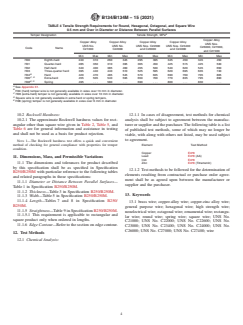
TABLE 3 Tensile Strength Requirements for Round, Hexagonal, Octagonal, and Square Wire
0.020 in. and Over in Diameter or Distance Between Parallel Surfaces
A
Temper Designation Tensile Strength, ksi
Copper Alloy
Copper Alloy Copper Alloy Copper Alloy Copper Alloy
UNS Nos. C26000,
UNS No. UNS No. UNS Nos. C22600 UNS Nos. C23400
C27000,
Code Name
C21000 C22000 and C23000 and C24000
and C27400
Min Max Min Max Min Max Min Max Min Max
H00 eighth-hard 35 45 38 50 43 57 50 65 50 65
H01 quarter-hard 41 51 45 57 53 65 62 75 62 77
H02 half-hard 49 58 56 67 66 77 78 90 79 94
H03 three-quarter hard 57 64 64 74 76 86 90 101 92 107
B
H04 hard 61 68 70 79 83 92 100 110 102 117
C, D
H06 extra-hard 66 73 78 86 94 102 112 121 115 129
E, D
H08 spring 72 . 84 . 100 . 116 . 120 .
A
ksi = 1000 psi.
B
H04 (hard) temper wire is not generally available in sizes over ⁄2 in. in diameter.
C
H06 (extra-hard) temper is not generally available in sizes over ⁄8 in. in diameter.
D
Square wire is not generally available in extra hard or spring tempers.
E
H08 (spring) temper is not generally available in sizes over ⁄4 in. in diameter.
10.1.2 Rectangular
...